
Key Takeaways
- 7-hydroxymitragynine binds the same mu-opioid receptor as morphine, 5 to 22 times more strongly than mitragynine, so quitting produces classical opioid withdrawal rather than a mild supplement taper 1, 2.
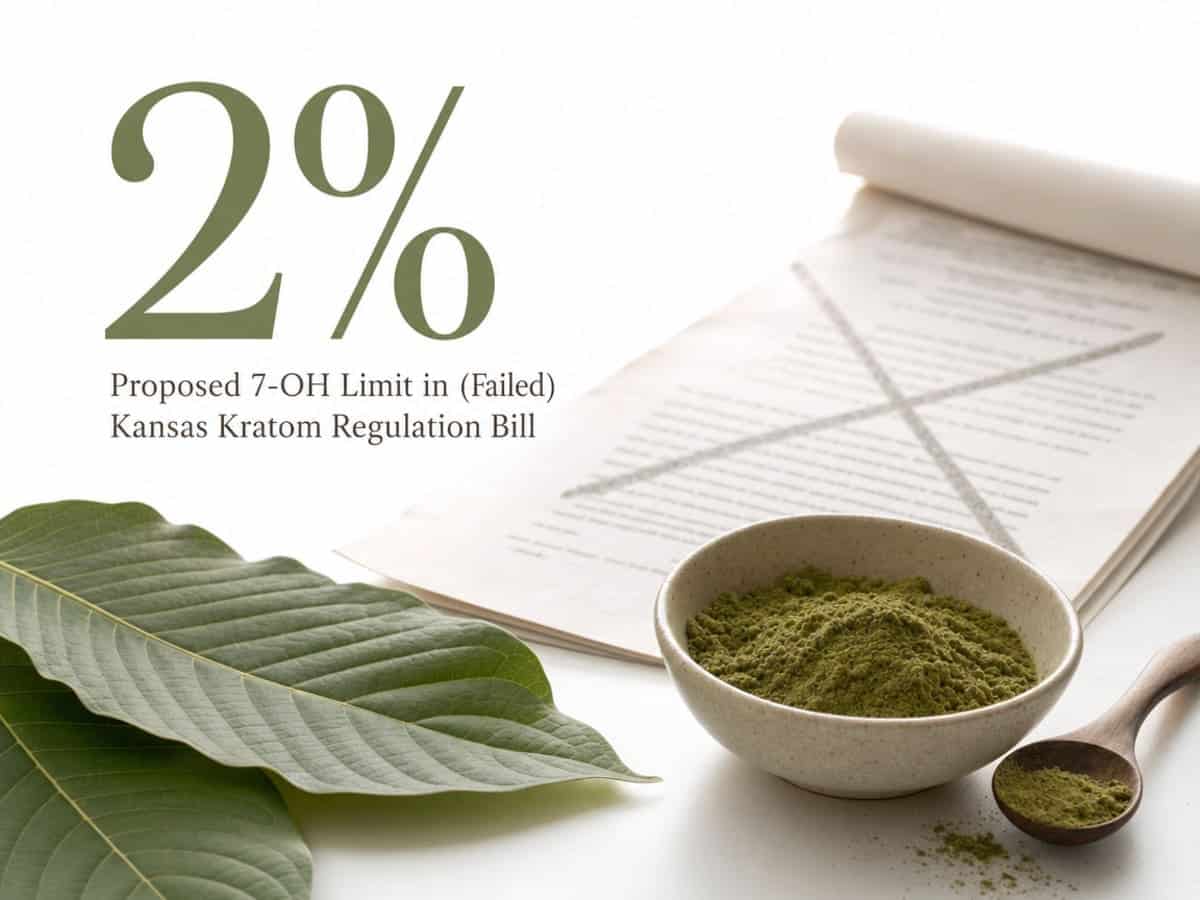
- Kansas moved past HB 2188’s proposed 2% cap and placed mitragynine and 7-OH on its controlled substances schedule, making possession and sale illegal statewide 5.
- Buprenorphine-naloxone has documented effectiveness for kratom and 7-OH withdrawal, and licensed Kansas clinicians follow federal confidentiality rules, so honest dose disclosure at intake shapes safer care 6, 7, 12.
- When calling a Kansas provider, ask whether they treat 7-OH as opioid use disorder, offer buprenorphine when appropriate, and integrate care for underlying anxiety, pain, or trauma 10, 12.
Why quitting 7-OH keeps failing—and what that actually means
You’ve probably tried to stop three or four times already. Maybe more. You cut back for a day, made it to hour thirty-six, and then the sweats and the crawling skin and the sense that something was terribly wrong drove you back to the tablets. And somewhere in that loop, you started to wonder if the problem was you—if you just lacked willpower, or discipline, or whatever the internet says people like you are supposed to have.
The problem is not you. The problem is pharmacology.
7-hydroxymitragynine—the compound doing most of the work in concentrated 7-OH tablets, shots, and extracts—binds the same mu-opioid receptor in your brain that morphine binds 1. The FDA’s own review concluded that repeated use produces tolerance, physical dependence, and withdrawal that looks like classical opioid withdrawal 2. NIDA says the same thing in plainer language: kratom can cause dependence and withdrawal symptoms similar to those of opioids 11. This is not “a rough couple of days off caffeine.” Your body has adapted to a substance acting on the same receptors as prescription painkillers, and it is now protesting the way it would protest any opioid taper done wrong.
That reframe matters. If you’ve been quietly grading yourself against a supplement withdrawal, you’ve been using the wrong rubric. What you’re up against has a name, a mechanism, and—this is the part most people miss—a medical playbook. The fact that you’re reading this page instead of ordering another shipment is already a step most people don’t take. Keep going.
7-OH is not a supplement. It’s a mu-opioid agonist.
How 7-hydroxymitragynine binds the same receptor as morphine
Here is the sentence the packaging never puts on the label: 7-hydroxymitragynine is an opioid. Not opioid-adjacent. Not opioid-like in some hand-wavy way. It sits down on the mu-opioid receptor—the same lock that morphine, oxycodone, and heroin turn—and it turns the key.
The University of Virginia’s toxicology group put a number on how firmly it turns that key. 7-OH binds the mu-opioid receptor 5 to 22 times more strongly than mitragynine, the primary alkaloid people usually think of when they hear “kratom,” with the exact multiple depending on which binding study you read 1. That range is doing a lot of quiet work. It means a concentrated 7-OH tablet is not a stronger cup of tea. It is a different pharmacological class of product operating at a different intensity on the same brain circuitry that gets people into trouble with prescription opioids.
The FDA’s own review reached the same conclusion by a different route. Working from the preclinical data, the agency wrote that repeated or prolonged use of 7-OH would produce tolerance, physical dependence, and potentially opioid addiction—the pattern typical of mu-opioid agonist drugs of abuse 2. That is regulator language for: your body treats this like an opioid, so your brain will, too.
If you have been comparing your experience to a supplement withdrawal and coming up short on self-compassion, this is the correction. You are not weak at quitting caffeine. You are dependent on an opioid.
Leaf kratom tea vs. concentrated 7-OH tablets and shots
There is a real distinction hidden inside the word “kratom,” and the industry has spent years blurring it. On one end sits the traditional preparation: dried leaves from Mitragyna speciosa, brewed as a bitter tea, chewed fresh by farm workers in Southeast Asia for centuries. In that form the dominant alkaloid is mitragynine, and 7-OH is a trace metabolite the liver produces from it 3.
On the other end sits what is actually stocked behind the counter at the vape shop: tablets, shots, and extracts engineered to deliver concentrated 7-OH directly. Not a trace. Not a metabolite of something else. The active ingredient itself, isolated or synthesized, at doses the leaf could never produce.
A 2025 pharmacology review put the framing bluntly. Concentrated 7-OH should be understood as a semi-synthetic opioid derivative, not a botanical preparation, carrying unacceptable hazards of dependence, withdrawal, respiratory depression, and death 4. That is not the same product as a cup of tea, and pretending otherwise is how a lot of people ended up dependent without ever thinking they were using an opioid.
This matters for you practically. If your use started with capsules or loose powder and drifted toward the branded tablets, the shots, the “extract” bottles with a percentage on the label—your exposure profile changed underneath you. The dose went up. The receptor activity went up. And the withdrawal you’re now hitting reflects that shift, not some personal failure to handle a mild herb.
The ‘gas station heroin’ label, briefly
You have probably seen the phrase “gas station heroin” in a news headline or a Reddit thread, usually attached to a photo of a small bottle with a lightning bolt on it. It is a blunt label, and it does what blunt labels do: it flattens nuance for shock value.
But strip the drama and it is describing something real. Concentrated 7-OH shots are sold at convenience stores, cost a few dollars, and act on the same receptor as heroin with clinically significant potency 4. The label is not fair to every kratom product on the shelf, and it is not the identity of the person using them. It is, however, an accurate shorthand for the specific category of high-7-OH extracts that has driven most of the recent dependence cases clinicians are now seeing.
What Kansas law now says about kratom and 7-OH
From HB 2188’s 2% cap to Schedule I under HB 2365
If you walked into a Kansas smoke shop last spring and noticed the 7-OH shelf had thinned out—or disappeared entirely—here is why.
For a while, Kansas looked like it was going to go the regulation route. House Bill 2188, introduced as a version of the Kansas Kratom Consumer Protection Act, would have required labeling of mitragynine and 7-OH content on every product and would have flagged any kratom item as adulterated if 7-OH exceeded 2% of the total alkaloid fraction. The bill also would have banned synthetic mitragynine and synthetic 7-OH outright 5. The idea was a common one in kratom policy: let the leaf products stay, but choke off the concentrated tablets, shots, and lab-made analogs driving the dependence cases.
HB 2188 did not pass. Kansas moved in a harder direction instead. Through subsequent legislation, kratom’s active alkaloids—mitragynine and 7-hydroxymitragynine—were placed on the state’s controlled substances schedule, making possession, sale, and distribution of these compounds illegal statewide.
The gap between those two outcomes is where a lot of confusion lives. A proposed 2% ceiling on 7-OH content is a consumer protection framework. A Schedule I designation is prohibition. One assumes the product can be made safer; the other decides it cannot. The practical effect on your smoke-shop shelf is the same either way—the tablets are gone—but the legal meaning if you still have some in your glove compartment is dramatically different. That distinction matters for what happens next, especially if you are trying to get to treatment without adding a legal problem to a medical one.
What Schedule I means for possession, treatment, and honesty with clinicians
Here is the part that scares people into staying quiet, so let’s take it straight.
Yes, the legal status changed. Yes, that theoretically raises the stakes if you are still holding product. But Kansas treatment providers—the licensed clinical kind, not the courts—operate under federal confidentiality rules that protect what you disclose during an assessment or in treatment. A clinician taking a substance use history is not a mandated reporter for personal possession. They need to know what you have been taking, how much, and how recently, because that information determines whether your withdrawal is managed with buprenorphine, comfort medications, or something else entirely.
Clinical guidance for these cases is explicit: kratom and 7-OH dependence should be managed with the same structured assessment and individualized care applied to opioid use disorder, which requires an accurate history 7, 12. Tell your intake nurse what you actually used. The Schedule I label is a policy decision. Your care is a separate conversation, and it works better when it’s honest.
What withdrawal actually feels like on day one, day three, and week three
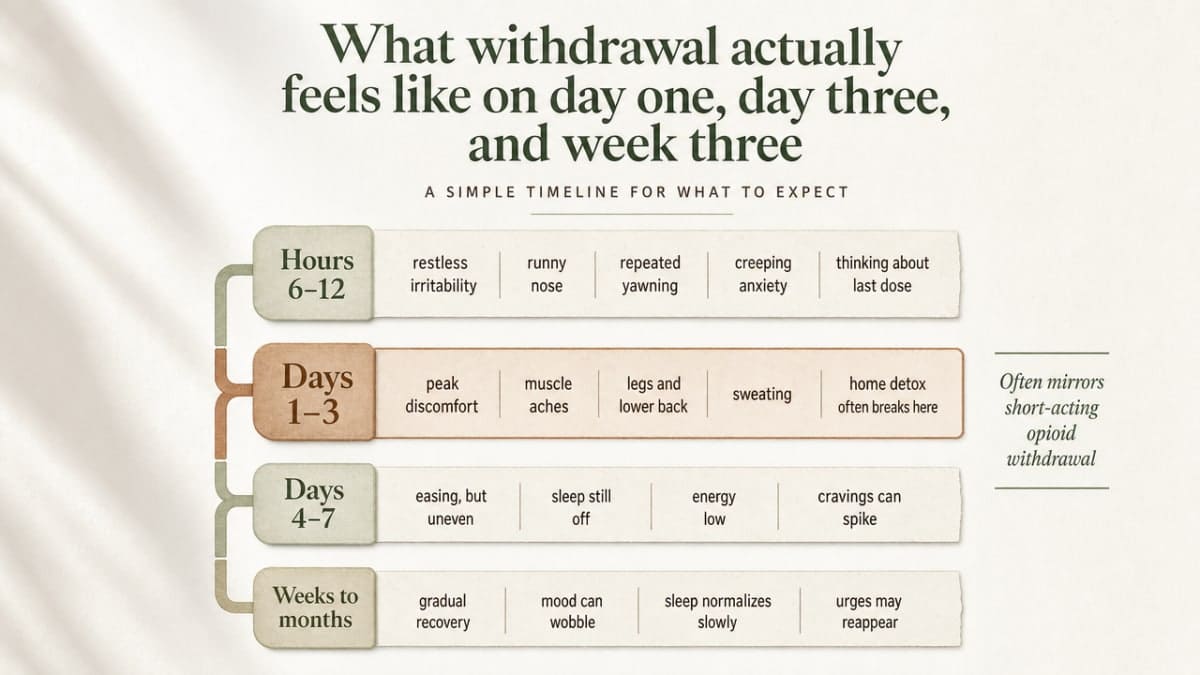
If you know what’s coming, you can plan for it. If you don’t, day two ambushes you and you go looking for the tablets. So here is the honest timeline, drawn from the clinical literature on kratom and 7-OH withdrawal, which reads almost identically to short-acting opioid withdrawal 6, 7.
Hours 6 to 12. The first signals are quiet and easy to dismiss. A restless irritability. A runny nose. Yawning that won’t stop. Some anxiety creeping in around the edges. You start doing the math on when your last dose was, and you notice you’re doing that math a lot. This is the window where most people talk themselves into “just one more” to smooth out the day.
Days 1 to 3. This is the peak, and it is the reason home detox usually collapses here. Muscle aches settle into your legs and lower back. You sweat through your shirt and then shiver. Stomach cramps, nausea, diarrhea. Sleep is broken or gone entirely. Restless legs at 3 a.m. that make you want to crawl out of your skin. Cravings arrive in waves, not as a thought but as a full-body pull. If you have been using concentrated 7-OH tablets or shots, this window tends to be sharper and more physically intense than what the leaf-tea users describe, because your receptors have adapted to a stronger agonist 2, 4.
Days 4 to 7. The acute physical symptoms start loosening their grip. The GI storm settles. You can eat again. You might sleep four hours in a row. You will not feel good, but you will feel human enough to notice you feel bad, which is progress.
Weeks to months. This is the part almost nobody warns you about. Post-acute withdrawal—flat mood, poor sleep, low energy, cravings that show up when you’re tired or stressed—can stretch on for weeks or a few months as your brain rebuilds its own opioid signaling 7. It is not a sign the detox failed. It is the second half of the same process, and it is the reason medication support and dual-diagnosis care matter beyond week one.
Knowing the shape of the curve doesn’t make it painless. It does make it survivable, especially with medical support timed to the peak.
Why self-detox keeps collapsing at day two or three
Look at the pattern. You picked a Sunday because you had two days off. You threw out the tablets, told yourself this time was different, drank water, tried to sleep. Somewhere around hour forty you were in the car. Not because you wanted to be. Because the choice had stopped feeling like a choice.
Self-detox from 7-OH usually collapses at the same place opioid self-detox collapses: the peak of the physical curve, when your body is loudest and your judgment is quietest 6. You are not losing a willpower contest. You are trying to out-argue a mu-opioid receptor that has been rewired to expect the drug, and the receptor has better negotiating leverage at 3 a.m. than you do.
There is a second reason home attempts stall, and it is the one nobody names. Most people using 7-OH started using it to manage something—chronic pain that outlasted the prescription, anxiety that made mornings unworkable, sleep that never came, or trauma that hummed under everything else 10. Strip the drug out and the original problem walks right back into the room, uncushioned. Without a plan for that underlying driver, day three is not just withdrawal. It is withdrawal plus the return of everything you were medicating.
This is why medically supervised care exists. Not because you can’t handle discomfort. Because the math changes when someone else is holding the medication, the monitoring, and the treatment for what sent you here in the first place 12.
What real treatment for 7-OH dependence looks like
Medically supervised withdrawal, not a wellness retreat
Real treatment for 7-OH dependence starts with the same premise clinicians use for any opioid withdrawal: the peak is predictable, the symptoms are manageable with medication, and you should not be alone for the hard part. That is the entire idea. Not candles. Not a juice cleanse. A clinical setting where someone is checking your vitals, adjusting your comfort medications, and watching for the complications that make home attempts dangerous—dehydration from vomiting and diarrhea, blood pressure spikes, the psychiatric wave that hits when the anxiety you were medicating comes back all at once 7.
The clinical literature is direct about this. Kratom and 7-OH dependence should be treated with the structured, individualized approach used for any opioid use disorder, which means a formal assessment, a medically supervised withdrawal plan, and pharmacologic support timed to the peak of the curve 7, 12. Whether that happens in a residential setting or a partial hospitalization program depends on your dose history, your medical picture, and what has failed before. Someone taking multiple 7-OH shots a day for months needs more support than a college student who took capsules for a semester. The intake should sort that out on day one.
If a program is selling you serenity without also explaining the medication protocol, you are looking at the wrong kind of place.
Buprenorphine-naloxone: the medication most patients don’t know is on the table
Here is the piece of information that changes the arithmetic of quitting.
Buprenorphine-naloxone—the medication most people know by the brand name Suboxone—works for 7-OH dependence. Not theoretically. Not in principle. In documented cases. A published case series described patients with kratom dependence in whom buprenorphine-naloxone effectively suppressed withdrawal symptoms and cravings, allowing them to stabilize and taper off comfortably 6. The same medication used for heroin and prescription opioid dependence works here because you are, at the receptor level, dealing with the same category of drug 1, 2.
What that means practically: you do not have to grind through the peak of withdrawal with willpower and Gatorade. A buprenorphine induction, done correctly and timed to your last dose, can turn day two from a crisis into a manageable afternoon. From there, the plan is individualized. Some people stay on maintenance buprenorphine for months or longer while the rest of the treatment—therapy, dual-diagnosis work, sleep, structure—does its job. Others taper off buprenorphine on a schedule the clinician builds with them. Both paths are legitimate. Neither is “replacing one drug with another” in any meaningful clinical sense, no matter what the recovery-culture chatter online says.
You will not know which path is right for you until a clinician who understands 7-OH sits down with your actual history. What matters right now is knowing the option exists, because most people using 7-OH have no idea their withdrawal has a specific medication answer with published evidence behind it 6, 12. Ask about it at intake by name. If the program cannot answer clearly, keep calling.
Treating the anxiety, pain, or trauma underneath the powder
Detox handles the receptor. It does not handle the reason you sat down with 7-OH in the first place.
Almost nobody starts a concentrated opioid habit for fun. The stories cluster: a back injury that outlasted the prescription. Anxiety that made mornings feel like drowning. A trauma history the nervous system never finished processing. Depression that made the flat, warm blanket of an opioid feel like the first real relief in years. Case reports on kratom users describe exactly this pattern—dependence tangled up with underlying psychiatric conditions, each one making the other harder to manage 10.
If treatment stops at the medication and never touches that layer, you will be back. Not because you failed, but because the equation did not change. The pain still hurts. The anxiety still wakes you up. The trauma still shapes what you reach for at 9 p.m.
Trauma-informed dual-diagnosis care is the term for the alternative. In practice, it means the clinical team treats the substance use and the mental health condition as one problem with two faces, not two problems taking turns. Therapy for the trauma or anxiety runs alongside the medication plan. Pain gets a non-opioid strategy. Sleep gets addressed as its own target. The point is that when the acute withdrawal ends, you have something to walk into that is not the same empty room the drug used to fill. This is the layer most self-detox attempts never reach, and it is why the third attempt fails the same way the first two did 12.
Finding help in Kansas without the rehab-marketing runaround
You do not need a five-step buyer’s guide right now. You need to know what to ask and who is qualified to answer.
When you call a Kansas treatment provider, three questions sort the serious ones from the sales scripts.
- First: do you treat kratom and 7-OH dependence specifically, and do your clinicians understand it as an opioid use disorder? If the person on the phone hesitates or reframes it as “herbal detox,” keep dialing.
- Second: is buprenorphine-naloxone on the table if a clinician determines it’s clinically appropriate for me? A program that cannot discuss medication options for opioid-type withdrawal is not equipped for what you are dealing with 6, 12.
- Third: do you treat co-occurring conditions—the anxiety, depression, pain, or trauma—alongside the substance use, or do those get referred out? Integrated care is not a luxury feature here. It is the mechanism that keeps day thirty from looking like day one 10.
Sunflower Recovery Center in Osawatomie offers this continuum—residential, partial hospitalization, and intensive outpatient care with trauma-informed dual-diagnosis programming and medication options for opioid-type withdrawal. Commercial insurance is accepted; Medicare and Medicaid are not. That’s the honest version. Whether you call Sunflower or another Kansas provider, the questions above are the ones that matter. Reading this far is not a small thing. Make the call while the tab is still open.
Talk to Someone Who Understands 7-OH Struggles
Connect immediately for guidance on building a safer, more stable path out of 7-OH dependence.
Frequently Asked Questions
Is 7-OH actually addictive, or is that just anti-kratom hype?
It’s addictive. 7-hydroxymitragynine is a mu-opioid receptor agonist, and the FDA’s own review concluded that repeated use produces tolerance, physical dependence, and withdrawal typical of opioid drugs of abuse 2. NIDA says the same thing in plainer terms: kratom can cause dependence and withdrawal similar to opioids 11. Your experience is not hype.
Is kratom or 7-OH legal in Kansas right now?
No. Kansas placed kratom’s active alkaloids—mitragynine and 7-hydroxymitragynine—on the state’s controlled substances schedule, making possession and sale illegal. An earlier bill, HB 2188, would have regulated products by capping 7-OH at 2% of the alkaloid fraction, but that proposal did not pass 5. The state chose prohibition instead of consumer protection labeling.
How long does 7-OH withdrawal last?
Acute symptoms follow an opioid-type curve: early signs at 6 to 12 hours, peak intensity through days one to three, and the worst of it easing by days four to seven 6, 7. Post-acute symptoms—flat mood, poor sleep, cravings when you’re tired or stressed—can linger for weeks or a few months as your receptors recalibrate.
Can I just taper off 7-OH at home instead of going to treatment?
Some people do. Most don’t, because the peak of withdrawal lands at day two or three, and that’s when home attempts collapse 6. If you’ve already failed a taper more than once, the pattern is telling you something. Clinical guidance treats 7-OH dependence with the same medically supervised approach used for other opioids 7, 12.
Will buprenorphine work for kratom or 7-OH dependence, or is it only for heroin and pills?
It works. A published case series documented buprenorphine-naloxone effectively suppressing kratom withdrawal symptoms and cravings, allowing patients to stabilize and taper 6. Because 7-OH acts on the same mu-opioid receptor as prescription opioids 1, the medication that stabilizes classical opioid withdrawal stabilizes this one too. Ask about it by name at intake.
Do I have to tell a Kansas treatment provider I was using a Schedule I substance?
Yes, and you should. Licensed clinicians follow federal confidentiality rules and are not mandated reporters for personal possession. They need your actual dose history to plan withdrawal management and choose the right medication 7, 12. If you leave out the 7-OH shots because the label sounds worse than “kratom,” the taper will be wrong.
References
- 7-Hydroxymitragynine. https://med.virginia.edu/toxicology/wp-content/uploads/sites/268/2025/08/Aug25-7-hydroxymitragynine.pdf
- 7-Hydroxymitragynin (7-OH): An Assessment of the Scientific Data and Toxicological Concerns Around an Emerging Opioid Threat. https://www.fda.gov/files/drugs/published/7-hydroxymitragynin_7-oh_an_assessment_of_the_scientific_data_and_toxicological_concerns_around_an_emerging_opioid_threat.pdf
- 7-Hydroxymitragynine Is an Active Metabolite of Mitragynine and a Key Mediator of Its Analgesic Effects. https://pmc.ncbi.nlm.nih.gov/articles/PMC6598159/
- From Kratom to 7-Hydroxymitragynine: Evolution of a Natural Product into an Emerging Opioid Threat. https://pmc.ncbi.nlm.nih.gov/articles/PMC12671409/
- HOUSE BILL No. 2188 (Kansas Kratom Consumer Protection Act proposal). https://www.kslegislature.gov/li_2024/b2023_24/measures/documents/hb2188_00_0000.pdf
- Treatment of Kratom Dependence With Buprenorphine-Naloxone. https://pmc.ncbi.nlm.nih.gov/articles/PMC6077846/
- Clinical Implications of Kratom (Mitragyna speciosa) Use: A Literature Review. https://pmc.ncbi.nlm.nih.gov/articles/PMC9934140/
- The Pharmacology and Toxicology of Kratom: From Traditional Herb to Drug of Abuse. https://pmc.ncbi.nlm.nih.gov/articles/PMC5566535/
- Kratom: A Dangerous New Drug of Abuse. https://pmc.ncbi.nlm.nih.gov/articles/PMC7281605/
- Kratom Use and Mental Health: A Case Report and Review. https://pmc.ncbi.nlm.nih.gov/articles/PMC4479117/
- Kratom DrugFacts. https://www.drugabuse.gov/publications/drugfacts/kratom
- Management of Novel Psychoactive Substance Use Disorders. https://pmc.ncbi.nlm.nih.gov/articles/PMC10444743/