
Finding Generalized Anxiety Disorder Treatment That Works
Key Takeaways
- Generalized anxiety disorder is diagnosed by a pattern of uncontrollable worry lasting six months or more across multiple life areas, not by intensity on a single bad day 2.
- Stepped care moves from structured self-help and CBT to medication when needed, with cognitive behavioral therapy showing durable benefits that persist after treatment ends 3.
- SSRIs and SNRIs are the default medications because they lack the dependence risk of benzodiazepines, which current guidance restricts to short-term severe situations only 5, 6.
- For co-occurring anxiety and substance use, integrated care under one team — with trauma screening and measurement-based check-ins — outperforms parallel treatment plans handled in separate silos 9, 11.
When Worry Becomes a Disorder — and Why That Matters for Recovery
It’s 3 a.m. and your brain is rehearsing tomorrow’s conversation for the fourth time. Your shoulders are tight. You’ve already considered every worst-case version of next week, next month, and the email you sent on Tuesday. If you’ve been here for months — or years — you already know this isn’t ordinary worry. It’s a mind that won’t stop scanning, and it’s genuinely exhausting.
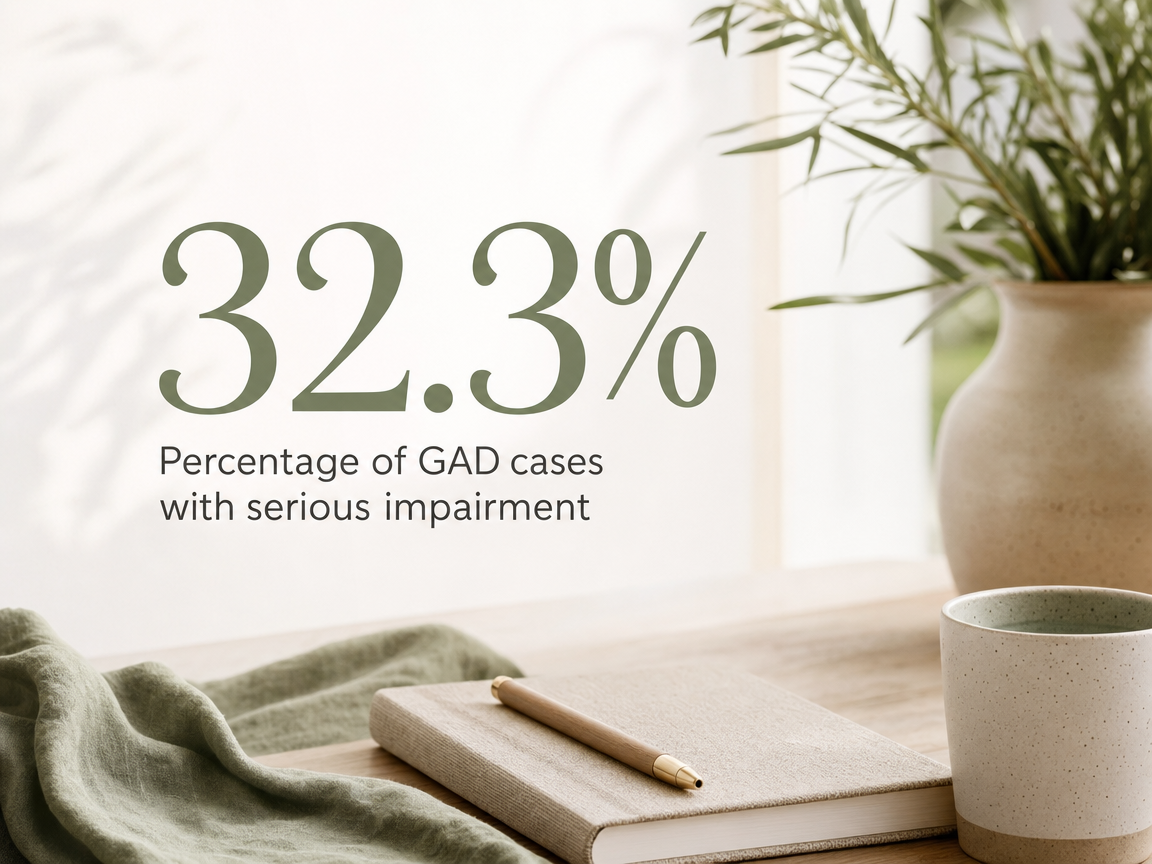
Generalized anxiety disorder is the clinical name for that pattern: persistent, hard-to-control worry that spreads across situations and often gets worse without treatment 2. It’s not rare, and it’s not a character flaw. NIMH estimates that 2.7% of U.S. adults had GAD in the past year, and 32.3% of those adults experienced serious impairment — meaning the anxiety significantly disrupted work, relationships, or daily function 1.
Here’s what makes this article different from most of what you’ll read: if you’re living with GAD alongside a substance use disorder, your treatment plan can’t be two separate plans stapled together. Alcohol, kratom, benzodiazepines, cannabis, stimulants — they all interact with anxiety in ways that change what works and what backfires. SAMHSA defines co-occurring disorders as the coexistence of at least one mental health condition and one substance use disorder, and the agency is clear that integrated care produces better outcomes than treating each condition in a separate silo 9.
So this guide walks you through what actually works for GAD — therapy, medication, movement, measurement — and what shifts when addiction and trauma are part of the picture. You’ve probably tried things already. That counts. Let’s build on it.

What a Real Diagnosis Looks Like
The Signals Clinicians Actually Look For
A real GAD diagnosis isn’t based on how anxious you feel on your worst day. It’s based on a pattern. Clinicians look for excessive, hard-to-control worry that shows up more days than not for at least six months, across multiple areas of your life — work, health, family, money, the future 2. The worry isn’t tied to one specific situation. It moves.
Alongside that, they’ll ask about the physical and cognitive companions of GAD:
- restlessness or feeling on edge
- fatigue that sleep doesn’t fix
- trouble concentrating
- irritability that surprises you
- muscle tension that lives in your jaw and shoulders
- sleep that either won’t start or won’t stay 7
You don’t need every symptom. You need a cluster that’s been there long enough to disrupt how you function.
A good evaluation also asks what the anxiety is costing you — missed work, avoided phone calls, canceled plans, a relationship that’s worn thin. That functional impact is what separates ordinary worry from a disorder that warrants treatment 2. If you’ve been quietly rearranging your life around the anxiety, that counts as evidence.
Why Substance Use Often Hides — or Mimics — GAD
Here’s where diagnosis gets complicated, and where a lot of people in recovery get misread. Alcohol, kratom, benzodiazepines, cannabis, and stimulants all change how your nervous system handles stress. They can mask GAD for years — a few drinks at night, a daily kratom dose, a benzo prescription from a decade ago — and then withdrawal can mimic GAD so closely that even experienced clinicians struggle to tell them apart.
Withdrawal from alcohol or benzodiazepines can produce racing thoughts, muscle tension, insomnia, and a sense of dread that looks identical to a generalized anxiety disorder. Stimulant use can crank baseline anxiety to a constant hum. And the rebound anxiety after a substance leaves your system is often worse than what was there before you started using.
Stepped Care: How Treatment Actually Escalates
The Sequence From Self-Help to Specialist Care
Good GAD treatment isn’t a single intervention — it’s a sequence. Clinicians don’t throw every tool at you on day one. They start with the least invasive option that has real evidence behind it, then escalate based on how you actually respond. This is called stepped care, and it’s the backbone of how international guidelines structure anxiety treatment.
The general progression looks like this:
- structured self-help or group interventions come first for milder symptoms
- individual CBT becomes the next step
- applied relaxation or medication enters the picture when symptoms remain severe or unresponsive 4
The 2024 Royal Australian and New Zealand College of Psychiatrists guidance reinforces the same shape — brief structured CBT-based psychological interventions, stress management, mindfulness or relaxation, and structured physical exercise as core building blocks, with medication added when those aren’t enough on their own 5.
Here’s the part that matters for you: stepped care isn’t a punishment system where you have to fail at the easy stuff before you’re allowed real help. If your symptoms are already severe, or if you’re managing GAD alongside active substance use or withdrawal, your clinician should start higher up the ladder. The sequence describes a default — not a rigid script. You’re allowed to move faster when the picture warrants it, and any decent program will adjust the entry point to match where you actually are.
CBT as the First-Line Therapy
If one thing in GAD treatment has the deepest evidence behind it, it’s cognitive behavioral therapy. A 2024 network meta-analysis of psychotherapies for adults with GAD concluded that CBT may represent the first-line therapy because its benefits remained effective even after treatment ended — something most other interventions can’t claim 3. That durability matters. You’re not looking for a treatment that works only while you’re sitting in the room.
CBT for GAD isn’t about positive thinking. It’s a structured, skill-building process: you learn to identify the worry patterns your brain runs on autopilot, test the predictions those worries make against what actually happens, and gradually build tolerance for uncertainty instead of trying to think your way out of it 7. Sessions usually involve homework — worry logs, exposure exercises, behavioral experiments — because the skills only stick when you practice them between visits.
For people in recovery, CBT has a second advantage worth naming. The same cognitive skills that quiet anxious rumination also help with the thought patterns that drive cravings and relapse. A clinician who’s trained in both can weave them together rather than asking you to learn two separate frameworks. That overlap is one of the practical reasons integrated dual-diagnosis programs lean on CBT so heavily.
Movement, Relaxation, and the Habits That Hold the Plan Together
Therapy and medication get most of the attention, but the daily habits underneath them are what keep the plan from collapsing between appointments. Current 2024 guidance explicitly recommends structured physical exercise, stress management, and mindfulness or relaxation training as part of the core treatment package for GAD — not as extras 5. They’re listed alongside CBT for a reason.
Structured movement doesn’t mean training for a marathon. It means consistent, scheduled activity — walking, strength work, yoga, swimming — that gives your nervous system a predictable outlet several times a week. Applied relaxation, progressive muscle relaxation, and brief mindfulness practices teach your body that the wound-up state isn’t the only setting available 4.
If you’re early in recovery, these habits do double duty. They steady sleep, blunt cravings, and give the long evenings something to push against. Start with one. Build from there. Every small piece you keep is part of the treatment, not separate from it.

Medication Without the Hype or the Hedging
Why SSRIs and SNRIs Are the Default
When medication enters the picture for GAD, it usually starts with one of two classes: SSRIs (selective serotonin reuptake inhibitors) or SNRIs (serotonin-norepinephrine reuptake inhibitors). These aren’t sedatives. They don’t blunt you on day one. They gradually shift the underlying chemistry that keeps your nervous system stuck in scanning mode, and they take two to six weeks to start showing meaningful effect 6.
Common SSRIs used for GAD include sertraline, escitalopram, and paroxetine. Common SNRIs include venlafaxine and duloxetine. Pharmacotherapy reviews place these first because they have the strongest combination of evidence, tolerability, and safety for long-term use — and because they don’t carry the dependence risk that older anti-anxiety drugs do 6. Guideline reviews also note that combining CBT with anxiolytic medication can improve outcomes compared with either alone, particularly when symptoms are moderate to severe 8.
Side effects are real and worth naming:
- nausea in the first week or two
- sleep changes
- sometimes a temporary uptick in anxiety before things settle
- sexual side effects that can persist
None of this means the medication is failing — it means your body is adjusting. A good prescriber will check in within the first few weeks and adjust the dose or switch the agent if something isn’t working. You don’t have to white-knuckle through a side effect that’s making your life worse.
The Benzodiazepine Question, Answered Directly
If you’re in recovery, you’ve almost certainly thought about this one. Xanax, Ativan, Klonopin, Valium — benzodiazepines work fast, and for decades they were handed out for anxiety like aspirin. You deserve the current, honest answer about whether they belong in your plan.
Here’s the practical translation: a responsible prescriber treating your GAD shouldn’t be reaching for a daily benzodiazepine, especially if you’ve had a problem with alcohol, opioids, kratom, or other sedating substances. If a clinician offers one as a routine option without asking detailed questions about your substance use history, that’s a signal to ask more questions or get a second opinion. Short-term use in a true crisis can occasionally be appropriate, but it’s not the path for ongoing GAD management — and for you specifically, the risk math is different than it is for someone without a recovery history. SSRIs, SNRIs, CBT, and the daily habits underneath them are doing the long-term work 6.
How Long You’ll Likely Stay on Medication
One of the most common questions — and one most prescribers don’t answer clearly upfront — is how long this lasts. Current clinical practice guidelines suggest treating GAD for at least 6 to 8 months after you’ve reached a good response, and often longer, to reduce the risk of relapse 8. That timeline catches people off guard. You’re not on medication for two weeks until you feel better and then done.
For dual-diagnosis recovery, the longer arc usually makes sense rather than less. The first year is when anxiety is most likely to surge back, and a stable medication floor can protect the recovery work you’re doing in therapy. When it’s time to taper, it should be slow, planned, and coordinated with your therapist — not a unilateral decision made on a hard week. Stopping abruptly is where people lose ground. Stopping thoughtfully, with a plan, is just another step in the same treatment.
When Anxiety and Addiction Travel Together
Why Parallel Care Underperforms Integrated Care
Picture two treatment plans on two clipboards. One belongs to a therapist treating your anxiety. The other belongs to a counselor treating your substance use. They’ve never met. They use different language, different forms, different goals, and they schedule on different days. You’re the one trying to translate between them — which is exhausting on a good day and impossible on a bad one. That’s parallel care, and it’s still how a lot of people end up getting treated.
SAMHSA is explicit that co-occurring mental health and substance use disorders should be addressed together rather than in separate silos, and that integrated treatment produces better outcomes than parallel or sequential approaches 9. The agency’s consumer-facing guidance reinforces the same point: integrated care improves results, and people managing both conditions do better when one coordinated team is responsible for the whole picture 10.
What integrated care actually looks like in practice: one assessment that covers both conditions, one treatment team that talks to each other weekly, one plan that accounts for how your anxiety medication, your therapy goals, your withdrawal timeline, and your relapse-prevention work all interact. When your CBT therapist knows your sobriety date and your prescriber knows what kratom withdrawal looked like for you, decisions get made with the full chart in front of them — not half of it.
Screening for Trauma as Part of Anxiety Care
If you’ve lived with GAD long enough to be reading this, there’s a good chance something in your history is feeding it. Trauma is common among people in behavioral health treatment, and SAMHSA’s guidance is that trauma histories should be systematically screened for and addressed within mental health and substance use services — not treated as a separate problem you have to disclose on your own 11.
This matters for anxiety care specifically because untreated trauma keeps the nervous system primed. You can do excellent CBT work on your present-day worries and still feel like the volume dial is stuck high if an older injury is running in the background. A program that screens for trauma at intake — and has clinicians trained to respond to what comes up — gives you somewhere to put that piece instead of leaving it to bleed into every other part of treatment.
You don’t have to walk in ready to tell the whole story. A trauma-informed approach means the people treating your GAD know that asking, listening, and pacing matter — and that whatever you bring will be handled with care, not as an extra item on a checklist.
What the First 60 to 90 Days Can Actually Look Like
A lot of the fear around starting treatment is just not knowing what the first few months will feel like. Here’s a realistic shape, drawn from how stepped, integrated care tends to unfold for someone managing GAD alongside a substance use history.
- Weeks 1–2: Stabilization and assessment.
- The first stretch is mostly about getting steady. If withdrawal is part of the picture, that gets medically managed first — you can’t accurately diagnose or treat anxiety while a nervous system is still detoxing. A full assessment covers both conditions together, including a trauma screen, because trauma histories are common and should be addressed within treatment rather than left on the side 11. SSRIs or SNRIs may start here, with the understanding that meaningful effect takes two to six weeks 6.
- Weeks 3–6: Structured therapy takes hold.
- This is usually where CBT becomes the spine of the week — individual sessions, skills groups, worry logs you actually fill out. Structured movement, relaxation training, and sleep work get scheduled in alongside therapy, not treated as optional 5. If you’re in a residential or PHP setting, the structure does some of the heavy lifting for you.
- Weeks 7–12: Stepping down with the plan intact.
- As stability builds, intensity drops — from residential to PHP to IOP to weekly outpatient — but the core treatment doesn’t stop. Medication continues, CBT continues, and one coordinated team keeps adjusting the plan based on how you’re actually doing 10. You’re not graduating from treatment at week 12. You’re moving into the longer phase where the work holds.
Measurement-Based Care: Turning a Plan Into Progress
One of the hardest parts of GAD treatment is that progress can feel invisible. You’re doing the work — therapy, medication, walks, sleep — and the noise in your head is still there some days. Measurement-based care is how good programs turn that fog into something you can actually see.
In practice, it means short, repeated check-ins on the things that matter:
- anxiety symptom scores
- sleep quality
- substance-use urges
- mood
- how you’re functioning at work and home
Filled out weekly, those scores become a line on a chart instead of a guess. Your clinician can see when a medication is starting to work, when a stressor is pushing numbers back up, and when it’s time to adjust the plan rather than wait another month 8. Some programs add biometric tracking — sleep, heart rate variability, stress signals — to round out what self-report alone can miss.
For dual-diagnosis recovery, this kind of feedback loop is doing real work. When one coordinated team can see both your anxiety scores and your recovery markers in the same chart, decisions get made earlier and with more nerve 10. You stop being the translator between two sets of providers, and your plan stops drifting. Progress becomes something you can point to on the weeks it doesn’t quite feel like progress yet.
Choosing a Program Without Getting Sold To
Treatment marketing can feel slick in a way that’s hard to trust, especially when you’re tired and just want help. A few concrete questions cut through most of it.
- Ask whether the program treats anxiety and substance use under one team, with one assessment and one plan — not two clinicians who happen to share a parking lot 9.
- Ask how they handle the benzodiazepine question for someone with your history; the answer should match current guidance, not a habit from twenty years ago 5.
- Ask whether CBT is part of the weekly structure or just listed on the website, and how they measure whether it’s working 3.
- Ask about trauma screening at intake 11.
- Ask what the step-down looks like at week 8, week 12, and month 6 — because real treatment doesn’t end at discharge 8.
If the answers are specific, you’re in a different kind of conversation than if they’re polished. You’ve already done the harder work of getting this far. The program you choose should meet that effort with the same seriousness.
Start Your Journey Toward Lasting Anxiety Relief
Connect with a compassionate team to begin your personalized anxiety and dual diagnosis treatment path today.
Frequently Asked Questions
What is the most effective treatment for generalized anxiety disorder?
Cognitive behavioral therapy has the strongest evidence, and a 2024 network meta-analysis found CBT’s benefits held up even after treatment ended — which most other therapies can’t claim 3. For moderate to severe symptoms, combining CBT with an SSRI or SNRI often works better than either alone 8. The best plan for you depends on severity, history, and what you’ve already tried.
Can I take anxiety medication if I’m in recovery from a substance use disorder?
Yes — SSRIs and SNRIs don’t carry the dependence risk that older anti-anxiety drugs do, and they’re considered first-line medication for GAD 6. They’re not sedatives, and they work gradually over weeks. The medications to be cautious about are benzodiazepines, which current guidance restricts to short-term severe situations only 5. A prescriber who knows your full history can build a plan that respects your recovery.
Are benzodiazepines still prescribed for GAD?
Rarely, and not as a routine first-line option. The 2024 Royal Australian and New Zealand College of Psychiatrists guidance recommends against benzodiazepines for GAD except for very short-term use in severe acute situations 5. Concerns about tolerance, rebound anxiety, and dependence have shifted prescribing away from daily benzodiazepine use, especially for people with a substance use history. SSRIs, SNRIs, and CBT carry the long-term work instead.
How long does GAD treatment usually last?
Longer than most people expect. Clinical practice guidelines suggest treating GAD for at least 6 to 8 months after you’ve reached a good response, and often longer, to reduce relapse risk 8. That covers medication duration specifically; therapy skills you build during CBT stay with you. For dual-diagnosis recovery, the longer arc is usually protective — the first year is when anxiety is most likely to surge back.
Why does anxiety and addiction need to be treated together instead of separately?
SAMHSA is direct that integrated treatment for co-occurring mental health and substance use disorders produces better outcomes than parallel or sequential care 9. When one team handles both conditions, decisions about medication, therapy, and relapse prevention get made with the full picture in view rather than half of it 10. Anxiety and substance use also interact constantly — withdrawal can mimic GAD, and untreated anxiety drives relapse.
What should I look for when choosing a GAD treatment program?
Ask whether anxiety and substance use are handled by one team with one assessment and one plan 9. Ask whether CBT is built into the weekly structure and how progress is measured 3. Ask how they screen for trauma at intake 11. Ask how they handle benzodiazepine requests for someone with your history 5. Specific answers signal a program doing real clinical work, not marketing.
References
- Generalized Anxiety Disorder – National Institute of Mental Health. https://www.nimh.nih.gov/health/statistics/generalized-anxiety-disorder
- Anxiety Disorders – National Institute of Mental Health. https://www.nimh.nih.gov/health/topics/anxiety-disorders
- Psychotherapies for Generalized Anxiety Disorder in Adults. https://pubmed.ncbi.nlm.nih.gov/37851421/
- Generalised anxiety disorder and panic disorder in adults – NCBI Bookshelf. https://www.ncbi.nlm.nih.gov/books/NBK552847/
- Management of generalized anxiety disorder and panic disorder in adults: recommendations from the Royal Australian and New Zealand College of Psychiatrists. https://pmc.ncbi.nlm.nih.gov/articles/PMC10785994/
- Pharmacotherapy of Anxiety Disorders: Current and Emerging Treatment Options. https://pmc.ncbi.nlm.nih.gov/articles/PMC7786299/
- A Comprehensive Review of the Generalized Anxiety Disorder. https://pmc.ncbi.nlm.nih.gov/articles/PMC10612137/
- Clinical Practice Guidelines for the Management of Generalised Anxiety Disorder. https://www.ncbi.nlm.nih.gov/pmc/articles/PMC5310105/
- Co‑Occurring Disorders and Other Health Conditions. https://www.samhsa.gov/substance-use/treatment/co-occurring-disorders
- Managing Life with Co‑Occurring Disorders. https://www.samhsa.gov/mental-health/serious-mental-illness/co-occurring-disorders
- Trauma‑Informed Care in Behavioral Health Services. https://www.ncbi.nlm.nih.gov/books/NBK207195/