
A Practical Guide to Finding Family Therapy Near Me
Key Takeaways
- Searching for family therapy while addiction is active means you need a program built for substance use, not general couples counseling that treats communication as the core problem.
- Family involvement embedded inside addiction treatment improves engagement, retention, and substance use outcomes more reliably than parallel tracks where the family sits in the waiting room 1.
- Match the level of care to what’s happening at home: standalone outpatient works for stable situations, while active use or co-occurring conditions call for residential, PHP, or IOP with family programming built in.
- Verify any Kansas clinician through the BSRB license lookup, confirming LMFT or LCMFT status, active license, and expiration date before you book an intake 11.
- Expect a written consent process to govern what the treatment team can share with you; a program that handles this clearly has thought through the confidentiality frame that makes family work possible 9.
- Bring a short list of questions to every intake call covering evidence-based models, treatment length, family programming structure, dual-diagnosis integration, and the consent process, then compare answers across programs.
- This week, narrow your search to two or three programs within driving distance, verify each named clinician through BSRB, and start your own support through Al-Anon or individual therapy regardless of your partner’s readiness.
When “family therapy near me” really means “help us survive his addiction”
You typed those four words into Google at some point this week. Maybe at 2 a.m. after another argument. Maybe in the parking lot before work, sitting in the car with the engine off. And you already know that what you’re really searching for isn’t a therapist within a ten-mile radius. You’re searching for someone who understands that the fights, the missing money, the empty bottles in the garage, the kratom pouches in the console, the way he looks at you when he thinks you’re not watching — all of it is one problem, not five.
That changes the search. A lot.
General couples counseling assumes two people who want to communicate better. Family therapy for addiction assumes a household organized around a substance, whether anyone in it will say that out loud yet. Those are different rooms with different rules. If you’ve already tried the first kind and it fell apart within a few months, that’s not a personal failure. It’s a category mismatch.
Here’s what this guide will actually do for you. It will help you tell the difference between a therapist who lists “addiction” on a directory profile and a program built for it. It will show you how to check a Kansas license in under five minutes so you’re not guessing about credentials. It will walk you through when standalone outpatient family therapy is enough, and when you need family work embedded inside a higher level of care. And it will name the confidentiality questions that will come up before you’re ready for them, so you can walk in already knowing the answers.
You are not starting from zero. You are choosing more carefully this time.
Why family therapy belongs inside addiction care, not next to it
The instinct to book a separate family therapist while your partner goes to detox or an outpatient program feels logical. Divide the labor. He works on the addiction; the two of you work on the marriage. It sounds tidy, and it’s the setup a lot of families end up in by accident. But the research doesn’t actually support treating the two things as parallel tracks that occasionally wave at each other.
SAMHSA’s clinical advisory on family therapy in substance use treatment puts it plainly: bringing family members into the treatment itself changes the outcomes of that treatment. Clients engage more. They stay in care longer. Their substance use outcomes improve compared to individual-only approaches 1. The family isn’t the audience for recovery. The family is part of how recovery happens.
A 2026 systematic review looked at every randomized controlled trial of family-based interventions for substance use disorders published between 2012 and 2024. Fifteen trials met the inclusion criteria. Eleven of them showed significant positive effects on both substance use and family functioning 2. That is a narrow, well-defined finding — not a promise that family therapy fixes every household, and not a claim about long-term marriage outcomes. It is a claim that family-involved addiction care outperforms addiction care that leaves the family in the waiting room, more often than not, in controlled studies.
The other reason to keep family work inside the same program: when co-occurring depression, anxiety, PTSD, or an eating disorder is in the picture, integrated treatment guidance recommends family education, family support groups, and family therapy as a bundled component of dual-diagnosis care — not as a referral you chase down on your own 3. Splitting the pieces across three or four providers usually means no one owns the whole picture. That is the exhaustion you are already feeling. You do not need more of it.

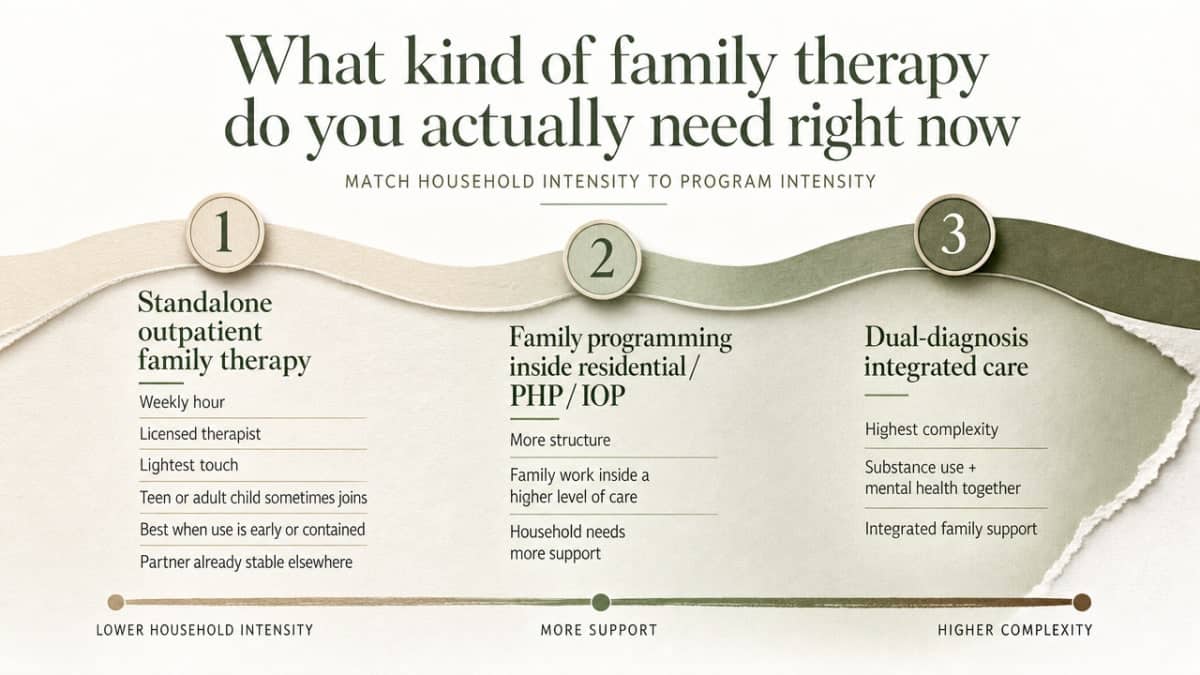
What kind of family therapy do you actually need right now
There is no single answer here, and anyone who gives you one without asking about your household is guessing. The honest question is which level of care fits what is actually happening at your kitchen table this month. Below are the three patterns you are most likely to be choosing between.
Standalone outpatient family therapy
This is what most people picture when they type your search: a licensed therapist, an office somewhere in Overland Park or Lawrence or Topeka, a weekly hour with you and your partner in the room together. Sometimes a teenager or an adult child too. It is the lightest touch, and for some families it is enough.
Standalone outpatient family therapy tends to work when the substance use is early or contained, when your partner is already stable in individual addiction treatment somewhere else, or when the immediate problem is the aftermath — broken trust, communication that has collapsed, kids who saw things they should not have seen. NIDA specifically names family therapy as an evidence-based approach for people with substance use problems and their families, particularly around family-system issues 4. It is a real modality, not a consolation prize.
Where it falls short is when the addiction itself is still active and unaddressed. If your partner is drinking daily, using opioids, or cycling through kratom or 7-OH without any other treatment, an hour a week of family therapy is being asked to hold weight it was not designed to carry. You will feel the sessions getting hijacked by the most recent crisis. The therapist will keep trying to do family work, and the substance use will keep interrupting it.
Family programming inside residential, PHP, or IOP care
The other pattern is family work built inside a treatment program — residential, partial hospitalization (PHP), or intensive outpatient (IOP). Instead of hiring a family therapist and hoping the individual addiction provider talks to them, you choose a program that already has family sessions, family education, and multi-family support groups on its calendar. The clinicians share notes. One team owns the whole case.
SAMHSA’s implementation guidance for integrated treatment is direct about this: family interventions in dual-diagnosis programs should include education about the illness, family support groups, and structured family therapy sessions as a bundled component of care, not as separate errands the family runs on its own 3. When you are looking at a program’s brochure or website, those three ingredients are what you are looking for. If only one is on offer — a monthly “family day” and nothing else — that is family involvement in name, not in structure.
Here is the practical difference. In standalone outpatient, you are the coordinator. You are the one telling the family therapist what happened at detox, telling the psychiatrist what came up in family session, telling everyone what the kids saw last weekend. Inside a program with real family programming, that coordination is the clinicians’ job. Your job shifts to showing up, learning, and doing the work in the sessions themselves. If you are already exhausted — and you almost certainly are — that difference is not small.
Residential is the most intensive: your partner lives on site, often for weeks, and family sessions are scheduled into the treatment plan. PHP runs most of the day, most days of the week, with family components layered in. IOP is a few evenings a week and works well as a step-down or when residential is not possible. The family programming inside each of these is designed to match the intensity of the care around it, which is the piece a standalone therapist simply cannot replicate.
When co-occurring mental health changes the answer
If your partner is also dealing with depression, anxiety, PTSD, unresolved trauma, or an eating disorder alongside the substance use, the calculation shifts. This is not an edge case. It is the majority of what walks into Kansas treatment centers.
Integrated treatment guidance for co-occurring disorders is clear that family involvement is not optional in these cases — family education, support groups, and family therapy are considered core components of the treatment, not add-ons for motivated households 3. The reason is mechanical. Trauma and mood disorders live in the relationships around a person as much as inside them. Treating the addiction while ignoring how depression is showing up between you, or how a trauma history is driving the substance use, leaves the actual driver untouched.
What this means practically: if there is a dual-diagnosis picture in your home, standalone outpatient family therapy is almost never the right first move on its own. You are looking for a program that treats both conditions in the same building, with the same team, and that includes structured family work in the treatment plan. “Trauma-informed” should not be a marketing phrase on the homepage — it should show up in how the intake staff talks to you on the phone, in what questions they ask, and in whether they can name their model when you ask.
How to verify a Kansas family therapist before you book
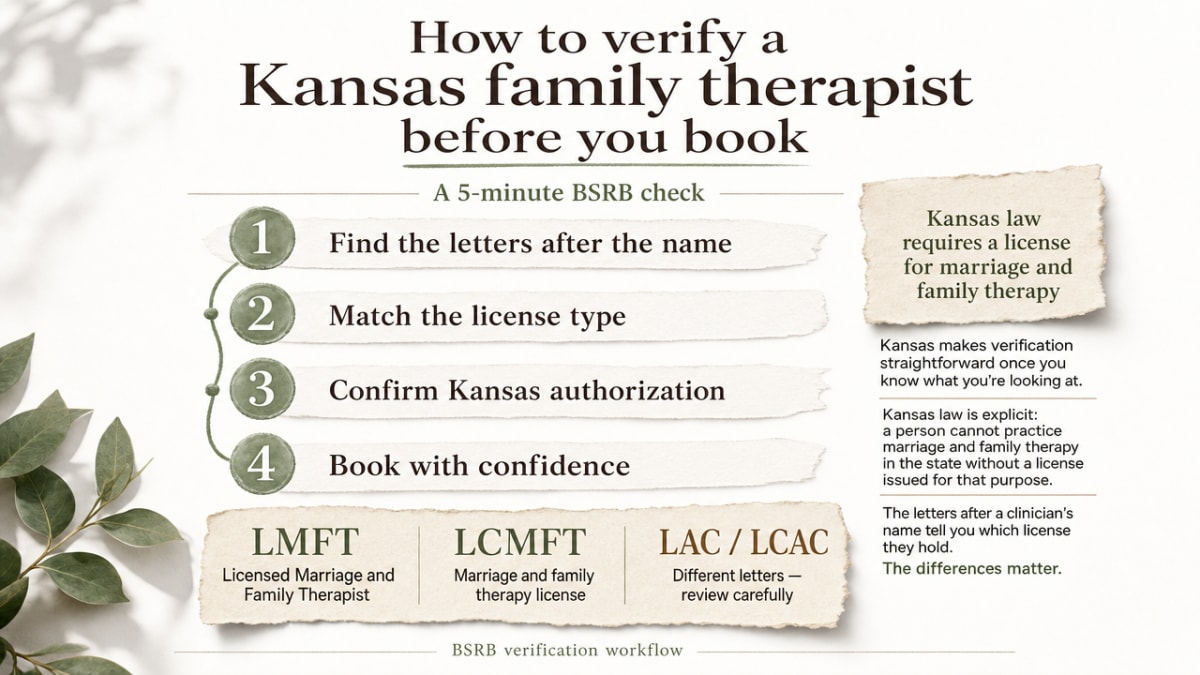
Before you sit through an intake call or hand over insurance information, spend five minutes confirming that the person on the other end is legally allowed to do this work in Kansas. It sounds paranoid until you realize how many people list themselves as “family counselors” without holding the license that actually authorizes marriage-and-family therapy in this state. The good news: Kansas makes verification straightforward once you know what you’re looking at.
LMFT, LCMFT, and what the letters after the name mean in Kansas
Kansas law is explicit that a person cannot practice marriage and family therapy in the state without a license issued for that purpose 8. The letters that show up after a clinician’s name tell you which one they hold, and the differences matter more than they look.
- LMFT
- A Licensed Marriage and Family Therapist. That is the entry-level clinical license after graduate training.
- LCMFT
- A Licensed Clinical Marriage and Family Therapist, which carries broader authority, including the ability to independently diagnose and treat mental disorders. If your partner has a co-occurring depression, PTSD, or anxiety diagnosis in the picture, that clinical-level license is the one you want in the room.
Kansas Statute 65-6404 spells out what stands behind those letters. Applicants must complete a master’s or doctoral degree with specified coursework, finish an academically supervised practicum with at least 300 hours of direct client contact, and obtain attestation of competency to diagnose and treat mental disorders before the clinical license is granted 10. That is not a weekend certificate. It is a multi-year training track with real supervision hours attached.
You will also see LAC (Licensed Addiction Counselor) and LCAC (Licensed Clinical Addiction Counselor) attached to some clinicians who work in substance use settings. Those are separate license types under the same board. A strong family program often has both credentials on the team — MFT-licensed clinicians running the family sessions, addiction-licensed clinicians running the individual substance use work, and clear communication between them. If the person you’re calling holds only a general counseling license and no MFT credential, that is worth asking about directly.
Using the BSRB license lookup in five minutes
The Kansas Behavioral Sciences Regulatory Board (BSRB) runs a public verification site that is considered a primary source for licensure data on psychologists, social workers, professional counselors, marriage and family therapists, addiction counselors, and behavior analysts practicing in Kansas 11. You do not need an account. You do not need to call anyone. You just need the clinician’s name.
Go to the BSRB license verification page and search by last name. When the result comes up, check three things:
- the license type (does it actually say Marriage and Family Therapist, or the clinical version?)
- the status (active, not expired or under discipline)
- the expiration date
If any of those look off, or if the person’s name doesn’t come up at all, that is your answer.
If the family therapy is going to happen inside a treatment program rather than a solo private practice, ask the intake coordinator for the names of the specific clinicians who will run your family sessions and run each one through the same lookup. Programs are usually happy to give you those names. If a program gets cagey when you ask, that itself is information.
The consent and confidentiality conversation nobody warned you about
Here is the part that catches almost every spouse off guard. You call a program, you agree to family sessions, you show up on the appointed day — and the clinician tells you there are things your partner has said that they cannot repeat to you. Not “will not.” Cannot. Federal privacy law and clinical ethics draw a hard line around what a treatment provider is allowed to share about the person in the primary treatment role, even with a spouse who is actively participating in family sessions.
This lands as a betrayal if no one warns you first. It is not a betrayal. It is the frame that makes the work possible.
SAMHSA’s guidance on co-occurring disorders is direct: providers“must understand how to involve family members, when appropriate, without jeopardizing client privacy and confidentiality,”and they should bring family into planning and treatment once written consent is obtained 9. Written consent is the operative phrase. A program with a real family component will hand your partner a release-of-information form early, walk through what he wants to authorize the team to share with you, and put the answer in writing. That document sets the rules for every conversation that follows.
The good news is that consent is not all-or-nothing. Your partner can authorize the team to discuss treatment progress and family dynamics with you while keeping individual-session content private. He can name specific topics that are on the table and specific topics that are not. Trauma disclosures, for instance, often stay in individual work until he is ready to bring them into family sessions himself. That timing is clinical, not evasive.
What to ask on the intake call: does the program use a written family consent process, when in the admission timeline is it completed, and what happens if your partner declines to sign one at all. A program that has a clear answer to all three questions has thought about this before you arrived. A program that fumbles the question is telling you something important.
Questions to ask before you commit to a program
By the time you’re on an intake call, you’re probably tired enough that you’ll accept whatever the person on the other end says. That is exactly the moment to have a short list already written down. You don’t need to interrogate anyone. You need answers to a small number of questions that separate real family-involved addiction care from marketing copy.
Is the treatment evidence-based, and what does that mean here? NIDA’s guidance for evaluating addiction treatment starts with this exact question — whether the care being offered has research behind it and matches the specific problem 5. A good program can name its models. Cognitive behavioral therapy, motivational interviewing, structural or behavioral family therapy, EMDR for trauma. If the answer is a vague “we use a holistic approach,” keep asking.
How long is treatment, and what happens after? NIDA notes that research supports treatment lasting three months or longer, with step-down levels of care built in 5. Ask what a 60-day residential stay looks like, whether PHP or IOP follows, and how family sessions carry across those transitions. Recovery isn’t a discharge date.
What does family programming actually include? The bundle you’re looking for, per SAMHSA’s integrated treatment guidance, is family education about the illness, structured family therapy sessions, and family support groups 3. Ask how often family sessions happen, who runs them, and whether siblings or adult children can attend. A single “family weekend” is not a program.
How is co-occurring mental health treated in the same building? If trauma, depression, anxiety, or an eating disorder is part of the picture, ask directly whether psychiatric care and substance use care share a treatment plan, or whether they’re two separate silos with a hallway between them. SAMHSA’s advisory frames integrated family involvement as core to outcomes when both conditions are present 1.
What is the written consent process for including me? You already know from the last section why this matters. Ask when the release-of-information form is completed, what it covers by default, and how you’ll be told if your partner limits it.
Write the answers down during the call. If a program can’t or won’t answer these clearly, you have your answer.
What to do this week if you’re in eastern Kansas
You do not have to solve this by Friday. You do have a few small moves that will save you weeks later.
Pick two or three programs to actually call. Not ten. Ten will paralyze you. Focus on programs within driving distance of the Kansas City metro or eastern Kansas that offer residential, PHP, or IOP with a real family component — not just a monthly visitors’ day. If your partner’s picture includes trauma, depression, or anxiety alongside the substance use, prioritize places that treat both under one roof 3.
Open the BSRB verification page in a tab and keep it there. When each intake coordinator names the clinician who will run your family sessions, look them up before the next call. Two minutes each. This is the step almost no one takes, and it is the one that separates a real MFT credential from a well-designed website 11.
Write down the five questions from the previous section and use the same list on every call. You will hear the difference in the answers within the first program or two.
Take care of yourself in the meantime. Al-Anon, a therapist of your own, one honest conversation with a friend who will not try to fix it — any of these are legitimate first moves while your partner is still deciding. Family recovery does not wait for his readiness to begin.
If a Kansas program that fits these criteria is useful to know about, Sunflower Recovery Center in Osawatomie offers residential, PHP, and IOP care with family programming built into the treatment plan, trauma-informed dual-diagnosis treatment under one team, and clinicians credentialed through the same BSRB process this article walked you through. Call them or call someone else — the criteria matter more than the name on the door.
You have been carrying this alone for a long time. The next call is the one that stops that.
Start Your Family’s Healing Conversation Today
Connect with a caring admissions specialist to discuss your family’s next steps toward recovery and support.
Frequently Asked Questions
Is family therapy the same as couples counseling when addiction is involved?
No, and this is the mismatch that trips up most spouses. Couples counseling assumes two people working on communication and connection. Family therapy for addiction assumes a household organized around a substance and treats that pattern directly, often as part of a broader substance use treatment plan. SAMHSA’s advisory frames family therapy as a distinct clinical modality that improves engagement and outcomes when embedded in addiction care 1. If addiction is active, you need the second kind.
How do I check if a family therapist is actually licensed in Kansas?
Use the Kansas Behavioral Sciences Regulatory Board verification site, which is considered a primary source for licensure data on marriage and family therapists, addiction counselors, and other behavioral health professionals in the state 11. Search by the clinician’s last name, then confirm the license type (LMFT or LCMFT), active status, and expiration date. Kansas law requires a license before anyone can practice marriage and family therapy, so if the name doesn’t appear, keep looking 8.
Does my husband have to agree to family therapy for me to get help?
No. His readiness is not a prerequisite for yours. You can start individual therapy with a licensed clinician, join Al-Anon, or call a treatment program to ask about family education sessions that don’t require the identified patient to be enrolled yet. SAMHSA’s guidance on integrated treatment describes family support and education as components that can begin independently of the person with the substance use disorder 3. Your recovery does not wait on his decision to start his.
Do I need outpatient family therapy or a residential program with family sessions?
Match the intensity of the family work to the intensity of the substance use. If your partner is stable in individual treatment and the wound between you is what remains, standalone outpatient family therapy can hold that work 4. If the substance use is still active or a co-occurring condition like trauma or depression is present, look for a program where family education, support groups, and structured family therapy are bundled inside residential, PHP, or IOP care 3.
Will the therapist share what my partner says in individual sessions with me?
Not automatically, and not without his written consent. SAMHSA guidance for co-occurring disorders states that providers must involve family members without jeopardizing client privacy, and that involvement follows written consent 9. He can authorize the team to discuss treatment progress and family dynamics with you while keeping individual-session content private, or he can name specific topics that are shareable. Ask on the intake call when the release form is completed and what it covers by default.
Does family therapy actually work when there’s also depression, anxiety, or trauma?
Yes, and in dual-diagnosis situations it’s considered a core component of care rather than an add-on. SAMHSA’s integrated treatment guidance recommends that programs serving people with co-occurring mental health and substance use disorders offer family education, support groups, and structured family therapy as a bundle 3. The reason is practical: trauma and mood disorders live inside relationships as much as inside individuals. Treating the addiction while ignoring the family system leaves too much of the driver untouched.
References
- Advisory: The Importance of Family Therapy in Substance Use Disorder Treatment. https://library.samhsa.gov/sites/default/files/pep20-02-02-016.pdf
- A Systematic Review on Randomized Controlled Trials – PMC. https://pmc.ncbi.nlm.nih.gov/articles/PMC13068785/
- Integrated Treatment for Co-Occurring Disorders. https://library.samhsa.gov/sites/default/files/ebp-kit-building-your-program-10112019.pdf
- Treatment and Recovery | National Institute on Drug Abuse – NIH. https://nida.nih.gov/publications/drugs-brains-behavior-science-addiction/treatment-recovery
- Treatment Options – National Institute on Drug Abuse. https://nida.nih.gov/sites/default/files/pdf/treatment_options_download_nidamed.pdf
- Efficacy of Family-based Interventions in Addressing Substance Use Disorders: A Systematic Review on Randomized Controlled Trials. https://pubmed.ncbi.nlm.nih.gov/41970367/
- Family-based interventions for substance misuse: a systematic review of systematic reviews. https://pmc.ncbi.nlm.nih.gov/articles/PMC4150116/
- Statute. https://www.kslegislature.gov/li/b2025_26/statute/065_000_0000_chapter/065_064_0000_article/065_064_0004_section/065_064_0004_k/
- Chapter 5—Strategies for Working With People Who Have Co‑Occurring Disorders. https://www.ncbi.nlm.nih.gov/books/NBK571013/
- Kansas Statute 65-6404: Licensure as a Marriage and Family Therapist. https://www.ksrevisor.gov/statutes/chapters/ch65/065_064_0004.html
- Kansas BSRB License Verification Site. https://licensing.ks.gov/Verification_BSRB/Search.aspx