
Key Takeaways
- Osawatomie sits about 50 minutes south of Kansas City, offering enough distance from daily triggers while keeping family close for Saturday sessions and eventual step-down care.
- Residential care shows a 65% completion rate versus 52% for outpatient, and 1.71 times greater six-month retention for buprenorphine patients 1, 3.
- Trauma-informed dual diagnosis work needs a safe container — treating depression, anxiety, or PTSD alongside substance use is how relapse three months out gets prevented.
- Compare programs on continuing care structure, not just length; holding abstinence above 65% typically requires 12 months of care after the initial stay 4.
If you’re reading this at a hard hour
If it’s late, or early, and you’re scrolling on your phone with the sound off so no one wakes up, you’re already doing something. That counts. Looking up a residential treatment center in Osawatomie, KS, when everything in you wants to close the tab and try again tomorrow — that’s not nothing. That’s the first quiet move away from the pattern.
You don’t have to have the words yet. You don’t have to know if you want detox, or 30 days, or 60, or what your insurance will say. You just have to keep reading for a few more minutes.
This guide walks you through what a residential stay at Sunflower Recovery Center actually looks like — the drive down from Kansas City, the shape of a real day, why leaving your daily environment matters when trauma sits underneath the drinking or the pills, and how the step-down works when you’re ready to go home. No pitch. No pressure. Just a clear picture, so the next decision feels a little less impossible.
Why the place matters: Osawatomie and the Kansas City metro
Osawatomie sits in Miami County, about 50 minutes south of downtown Kansas City. It’s a small town — the kind with a main street, a river bend, wide sky, and quiet that actually sounds like quiet. When you drive in from the metro, you feel the shift. Fewer stoplights. Fewer bars you know the inside of. Fewer routes past the house where things went sideways.
That distance isn’t a marketing detail. In early recovery, the environment you wake up in either helps you or works against you. Being about an hour from Kansas City means you’re far enough that your daily triggers don’t have easy access to you, and close enough that your people can still show up. A partner can drive down for a family session on a Saturday. A sister in Overland Park can be there in under an hour. When you step down into a Partial Hospitalization or Intensive Outpatient program later, you’re not moving across the state to keep your care team.
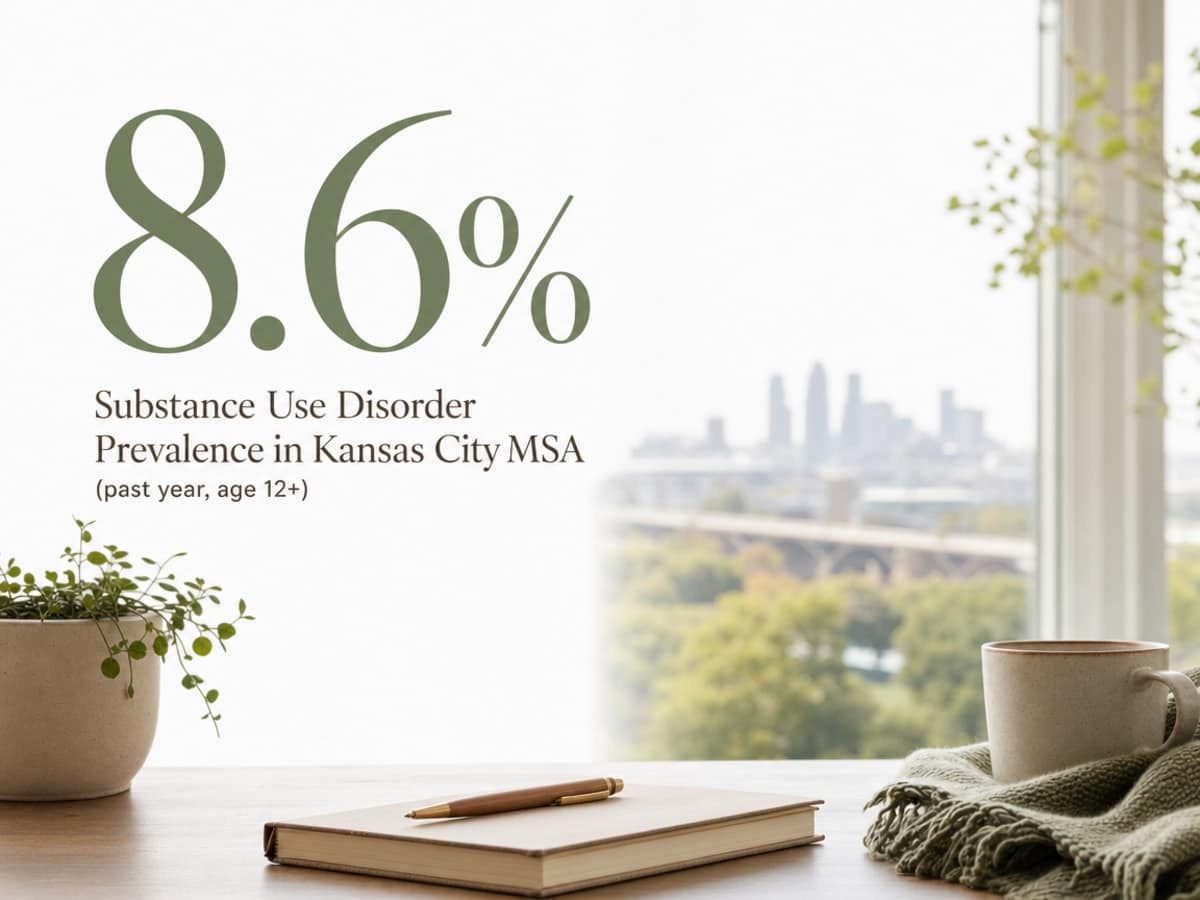
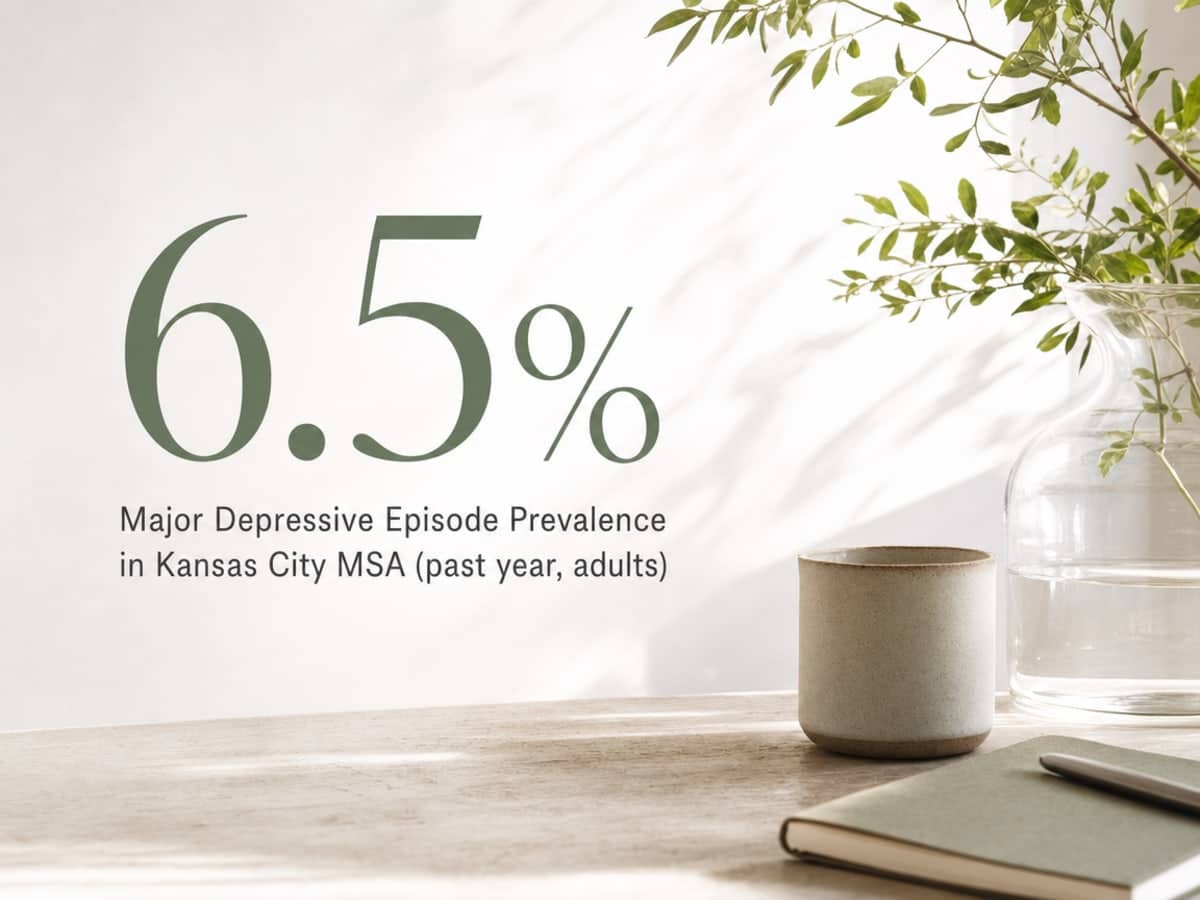
The need in this catchment is real, and it’s not small. In the Kansas City metro, about 157,000 people age 12 and older — roughly 8.6% — had a past-year substance use disorder, and 106,000 adults (6.5%) had a past-year major depressive episode.2Those two numbers overlap more often than most people realize. If you’re using and also carrying depression, anxiety, or old trauma, you’re not an edge case around here. You’re the majority of who walks through the door.
What Osawatomie offers you is a container: a place that’s geographically separate from the life that’s been hurting you, but still tied to Kansas City by a short stretch of highway. That combination — quiet town, reachable family — is why the setting itself does some of the work before therapy even starts.
A day inside a Sunflower residential stay
The first thing you’ll notice is that the day has a shape. Not a rigid one, but a real one — and after months or years of your day being shaped by cravings, avoidance, or whatever it took to get through, that shape is a relief. You don’t have to decide what happens next. Someone has already thought about it, and it’s good for you.
Mornings start gently. You wake up in a bedroom that looks like a bedroom, not a hospital room. A staff member checks in. You strap on your Huml Health wearable if you took it off overnight, and your sleep, heart rate variability, and stress numbers from the night before sync up. That data doesn’t sit on a server somewhere — it goes to your clinical team and helps shape what your day actually needs. If your HRV crashed and you barely slept, your therapist knows before you sit down. Breakfast follows, with the other residents. Coffee. Real food. Small conversation, or none, depending on where you are.
Mid-morning is process group. This is where you start hearing other people say the things you thought only you had thought. Then individual therapy, often the trauma work — this is the room where the harder pieces get unpacked, at a pace your clinician sets with you, not on top of you. Lunch breaks the intensity on purpose.
Afternoons move your body and your skills. Fitness or experiential therapy comes first — a walk, strength work, something that reminds your nervous system it still belongs to you. Then a skills group: distress tolerance, relapse prevention, communication, whatever your care plan is pointing at that week. If you have co-occurring depression, anxiety, or an eating disorder in the mix, those threads run through both the individual and group work, not off to the side.
Evenings soften. Dinner together. A community meeting or a specialty group some nights. Peer time — cards, a movie, a phone call home if that’s part of your plan. Journaling. A last biometric check-in that quietly tells your team how the day landed in your body. Lights out earlier than you’re probably used to, because sleep is treatment here, not an afterthought.
Multiply that rhythm by 60 days, and something changes. Not because any single hour is magic, but because your body finally gets a stretch of predictable, safe, sober days in a row. Most people haven’t had that in a long time. You get to.
Why residential is a different tool than outpatient
The completion and retention edge, honestly stated
If you’ve tried outpatient before and it didn’t hold, you’re not weak. You were probably being asked to do the hardest work of your life in the same rooms, on the same commute, with the same phone contacts that helped you get sick. Residential is a different tool because it changes what surrounds you while you change.
The best national comparison we have on this comes from a 2011 SAMHSA Treatment Episode Data Set study, which looked at completion rates across the U.S. public treatment system. Residential programs reported a 65% completion rate compared to 52% for outpatient settings, and clients in residential care were nearly three times as likely to complete treatment overall.1That’s a study of the public system, not private centers like Sunflower, and completion isn’t the same as long-term sobriety — but it tells you something real. Staying in the room long enough for the work to actually happen is easier when the room is designed for it.
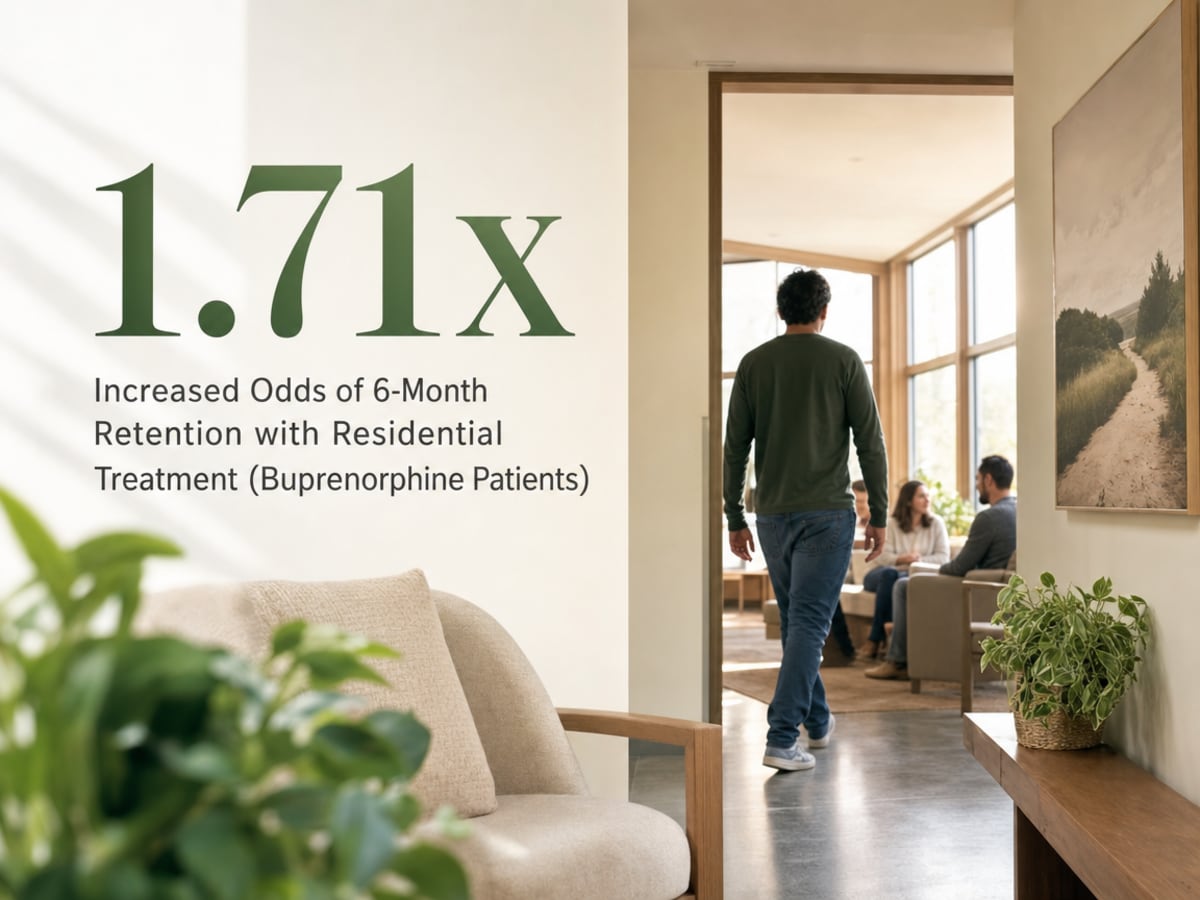
There’s a second piece worth knowing, especially if opioids are part of your story. A more recent cohort study of patients on buprenorphine found that residential care was associated with 1.71 times greater odds of still being in treatment at six months compared to outpatient care.3Six months is where a lot of people fall off, and where relapse risk spikes. Staying engaged for that long isn’t a small win — it’s often the difference between one more attempt and the attempt that changes things.
None of this means residential is magic. It means residential is a stronger container for the first stretch, when your body is settling, your sleep is coming back, and you’re figuring out what your life is actually made of when substances aren’t in the middle of it.
The honest caveat: continuing care is what carries you
Here’s the part a lot of treatment websites skip. Residential gets you started strong, but it isn’t the whole answer. The same buprenorphine study that found the six-month retention edge also found that residential care, on its own, didn’t reduce overdose risk compared to outpatient — what reduced overdose risk was staying on medication for opioid use disorder, regardless of setting.3The container matters. What you do inside it, and after it, matters more.
This is why the residential stay is built to hand off, not to stand alone. When your 60 days wrap, you don’t just walk out with a folder and good luck. You step down into the Partial Hospitalization Program, then Intensive Outpatient, then whatever aftercare structure your care plan has built with you — often back in the Kansas City area, so the transition is a short drive, not a life uprooting. Family programming runs alongside so the people you’re going home to have language for what you’ve been through.
If someone is selling you 30 days as a cure, be careful. If someone is offering you 60 days plus a plan for the year that follows, that’s what the evidence actually asks for.
Trauma-informed dual diagnosis: why the container matters
Here’s something worth saying plainly: if you’re drinking or using, there’s usually a reason underneath. Not an excuse — a reason. Something your body learned to survive. Maybe a childhood that wasn’t safe. Maybe a loss you never got to grieve. Maybe an assault you’ve never said out loud. Maybe combat, or a hospital room, or a marriage that slowly took pieces of you. Whatever it is, the substance became the tool that kept it quiet enough to function.
Trauma-informed care means the people treating you already know that. They don’t start with “why can’t you stop?” They start with “what happened to you?” That shift changes everything about how the work feels. You’re not being managed. You’re being met.
Dual diagnosis just means the addiction and the mental health piece — depression, anxiety, PTSD, an eating disorder, whatever’s riding alongside — get treated as one thing, not two. Because they are one thing. In the Kansas City area, roughly 6.5% of adults had a past-year major depressive episode, and the overlap with substance use is significant.2Treating only the drinking while ignoring the depression underneath is how people relapse three months out.
Now here’s why the residential container specifically matters for this work. Trauma therapy asks you to open things you’ve spent years keeping closed. That’s hard, and it’s supposed to be. If you try to do that opening while still sleeping in the house where it happened, or while still driving past the bar, or while still carrying your phone full of the wrong numbers, your nervous system can’t settle enough to actually process anything. You just re-wound and re-numb, re-wound and re-numb.
A residential stay creates something your body may not have had in years: a safe room. Not just physically safe — emotionally safe. Predictable meals. Predictable people. No one to hide from. No shift that ends with you alone at 11 p.m. with a bottle. Inside that container, your clinician can do the deeper work at a pace you can actually tolerate, because the rest of your day isn’t a threat.
You don’t have to be ready to talk about the hard stuff on day one. You just have to be somewhere it’s finally safe to.
The wearable on your wrist: how biometrics shape your care plan
Most treatment programs run on what you can put into words during a 50-minute session. The problem is, in early recovery, your words are often the last thing to catch up to what’s actually happening inside you. You might say you’re fine at 10 a.m. and mean it, while your body has been in a low-grade panic since 3 a.m.
The Huml Health wearable you’ll wear at Sunflower helps close that gap. It’s a small device on your wrist that quietly tracks the things you can’t easily report on: how long you actually slept versus how long you were in bed, how your heart rate variability moved through the night, where your stress ran high during the day. That information syncs to your clinical team, so what they’re seeing isn’t just your self-report — it’s your nervous system’s report.
Practically, this changes what your care plan does. If your sleep collapses the night before a trauma session, your therapist can slow the pace. If your stress numbers spike every afternoon around the same time, that pattern becomes something to look at together, not a mystery you’re carrying alone. Recovery gets more responsive, because the plan can change with your body instead of waiting for the next scheduled check-in.
What Kansas requires behind the scenes
You don’t need to memorize any of this to walk in the door. But if a small piece of you feels safer knowing there’s real structure holding the program up, here’s what that structure looks like.
Kansas regulates residential addiction treatment as a licensed, 24-hour live-in program, with rules that cover who can staff it, how quickly your care has to be planned, and how you’re placed at the right level of intensity. Your individualized treatment plan has to be completed within seven days of admission, updated at least every 30 days, and built with your input — not handed to you.11Discharge planning isn’t a last-day scramble; it’s required from the start.11Placement follows ASAM criteria, the same national framework Kansas uses under its KanCare Medicaid waiver, which is how the state decides who genuinely needs residential care versus a lower level.6
So the shape of your day isn’t arbitrary. It’s clinical, and it’s accountable.
Leaving home for 30 to 60 days: the fears worth naming
Let’s say the quiet parts out loud, because they’re the reason a lot of people close this tab.
Your kids. Who picks them up, who tucks them in, who explains where you went. Your job. Whether you’ll have one when you come back, whether FMLA covers this, whether your boss will guess. Your pet. Your rent. The pile of mail. The person you love who’s going to be alone in the house for two months. The withdrawal you’re scared of. The idea that if you stop, you’ll have to actually feel everything you’ve been outrunning.
None of these fears are silly. Every one of them has kept someone in the driveway with the engine off. Naming them is not weakness — it’s the first honest conversation you’ve had about this in a long time.
Here’s what usually happens once you make the call. The intake team walks through logistics with you before you ever pack a bag. FMLA paperwork, a plan for your kids or your pets, what to tell your employer and what you don’t have to. If detox needs to happen first, that gets sorted — you don’t have to arrive already through the worst of it. Family programming means the people at home aren’t left to figure this out alone; they get their own support, their own language.
And the fear underneath the fears — that stopping means facing what’s been there — is real. But you won’t face it alone, and you won’t face it in the same room where it started. That’s the whole point of leaving for a stretch. Sixty days is not forever. It’s a season. And the life you’re afraid of losing is often the life that’s been slowly losing you.
After residential: the step-down that protects your progress
Sixty days changes a lot. It doesn’t finish the work. The stretch right after you leave residential is where recovery gets tested — the drive home, the first grocery store run, the first night in your own bed. That’s why the plan starts before you walk out.
Your step-down at Sunflower moves in stages. First, the Partial Hospitalization Program: full clinical days, but you sleep somewhere else — often at home or in sober living, back in the Kansas City area. Then Intensive Outpatient, where you’re building a real life around a lighter clinical schedule — a few sessions a week, evenings if you’re working. Family programming keeps running through both, so the people at home aren’t guessing what you need.
This isn’t extra. It’s what the evidence asks for. A review of continuing care in substance use treatment found that to hold abstinence rates above roughly 65%, most people need continuing care for at least 12 months after the initial episode, regardless of whether they started in residential or outpatient.4Sixty days built the foundation. The year that follows is what the house gets built on. You don’t have to do it alone — that’s the whole design.
One call, one next step
You don’t have to know what to say. You don’t have to have your insurance card, your work schedule, or your bag packed. You just have to pick up the phone.
The person who answers at Sunflower has heard the version of your story before. Not the exact one — yours is yours — but the shape of it. They can walk you through what happens next: what your insurance likely covers, whether detox comes first, how soon a bed is open, what to tell the people at home.
One call. That’s the whole ask tonight. If you’re the family member reading this instead of the person using, the same call works — you can start the conversation on their behalf.
Osawatomie is closer than you think, and so is a day that doesn’t start the way today did.
Start Your Osawatomie Residential Recovery Journey Today
Connect directly with admissions to secure your place in a safe, structured residential treatment environment.
Frequently Asked Questions
How long is a residential stay at Sunflower?
The residential program runs 60 days. That length isn’t arbitrary — evidence shows that stays of three months or more, paired with continuing care, produce the strongest 12-month outcomes.4Sixty days builds the foundation, and the PHP and IOP step-downs carry the work forward from there.
How far is Osawatomie from Kansas City, and can my family visit?
Osawatomie sits about 50 minutes south of downtown Kansas City, in Miami County. That’s close enough for a Saturday drive from Overland Park, Lee’s Summit, or the Northland. Family programming is built into your care plan, so the people at home aren’t guessing what you need — they’re part of the work.
Do I need to detox before I come, or can that happen here?
You don’t need to arrive already through withdrawal. When you call, the intake team walks through what your body is dealing with and helps sort detox first if it’s needed. You won’t be left to white-knuckle it alone at home, and you won’t be turned away because you’re still using today.
What happens after I finish the 60 days?
You step down, you don’t drop off. Most people move into the Partial Hospitalization Program first — full clinical days, sleeping at home or in sober living — then into Intensive Outpatient a few sessions a week. Discharge planning starts early in your stay, not on the last day, so the handoff feels like continuation, not an ending.
Will my insurance cover residential treatment?
Sunflower accepts most commercial insurance plans. The center does not participate in Medicare or Medicaid. When you call, the intake team can run your benefits and tell you what your specific plan covers before you commit to anything. You don’t need to have your card in hand to start that conversation.
How is Sunflower different from Osawatomie State Hospital?
They’re separate places doing different work. Osawatomie State Hospital is a state-run acute psychiatric facility serving adults from more than 45 Kansas counties.9Sunflower Recovery Center is a private residential addiction treatment program focused on trauma-informed dual diagnosis care — substance use plus the depression, anxiety, or trauma underneath it.
References
- Residential and outpatient treatment completion for substance use disorders in the U.S. public treatment system. https://pubmed.ncbi.nlm.nih.gov/26925821/
- Substance Use and Mental Disorders in the Kansas City MSA. https://www.samhsa.gov/data/sites/default/files/NSDUHMetroBriefReports/NSDUHMetroBriefReports/NSDUH-Metro-Kansas-City.pdf
- Association between treatment setting and outcomes among opioid use disorder patients receiving buprenorphine. https://pmc.ncbi.nlm.nih.gov/articles/PMC9389731/
- The Continuing Care Model of Substance Use Treatment. https://pmc.ncbi.nlm.nih.gov/articles/PMC4007701/
- Is residential treatment effective for opioid use disorders? A comparison of treatment outcomes. https://pmc.ncbi.nlm.nih.gov/articles/PMC4253677/
- Kansas KanCare SUD 1115 Demonstration Implementation Plan. https://www.medicaid.gov/Medicaid-CHIP-Program-Information/By-Topics/Waivers/1115/downloads/ks/KanCare/ks-kancare-cms-appvl-sud-implementation-plan-20190807.pdf
- Effectiveness and Cost-effectiveness of Four Treatment Modalities for Substance Disorders. https://pmc.ncbi.nlm.nih.gov/articles/PMC1360883/
- Kansas Drug Overdose Mortality Report 2023. https://www.kdhe.ks.gov/DocumentCenter/View/9222/Kansas-Drug-Overdose-Mortality-Report-2023-PDF
- DA 400 Agency Name: Osawatomie State Hospital Division of the Budget, FY 2025. https://budget.kansas.gov/wp-content/uploads/494-OSH-FY-2025-1.pdf
- Residential Treatment Compared With Outpatient Treatment for Tobacco Use and Dependence. https://pmc.ncbi.nlm.nih.gov/articles/PMC3046940/
- State Residential Treatment for Behavioral Health Conditions: Regulation and Policy – Kansas Summary. https://aspe.hhs.gov/sites/default/files/2021-08/StateBHCond-Kansas.pdf
- Overdose Data Dashboard | KDHE, KS. https://www.kdhe.ks.gov/1309/Data-Dashboard