
Key Takeaways
- A written relapse prevention plan should function as a 12 to 24 month operating document, naming triggers, warning signs, contacts, and cadence rather than serving as a discharge worksheet.
- Kansas City’s fentanyl-saturated drug supply raises the stakes of any slip, with 80% of Kansas opioid deaths involving fentanyl 1, making medication and naloxone essential backstops.
- Continuing care lasting nine months or longer produced a 71.7% abstinence rate at twelve months versus 37.4% at three months, so aftercare cadence matters more than initial intensity 10.
- Before choosing providers, compare active outreach versus passive scheduling, proximity across the Kansas-Missouri line, dual-diagnosis monitoring, and whether alumni support extends through month twenty-four 9, 11.
Why Discharge Day in Kansas City Needs a Written Plan, Not a Pep Talk
Discharge day feels like a graduation and a cliff at the same time. You have done the hard work of getting sober. Now you have to walk back into the same city, sometimes the same block, and stay that way. That is a different kind of work, and it deserves a different kind of preparation than a folder of handouts and a hug at the door.
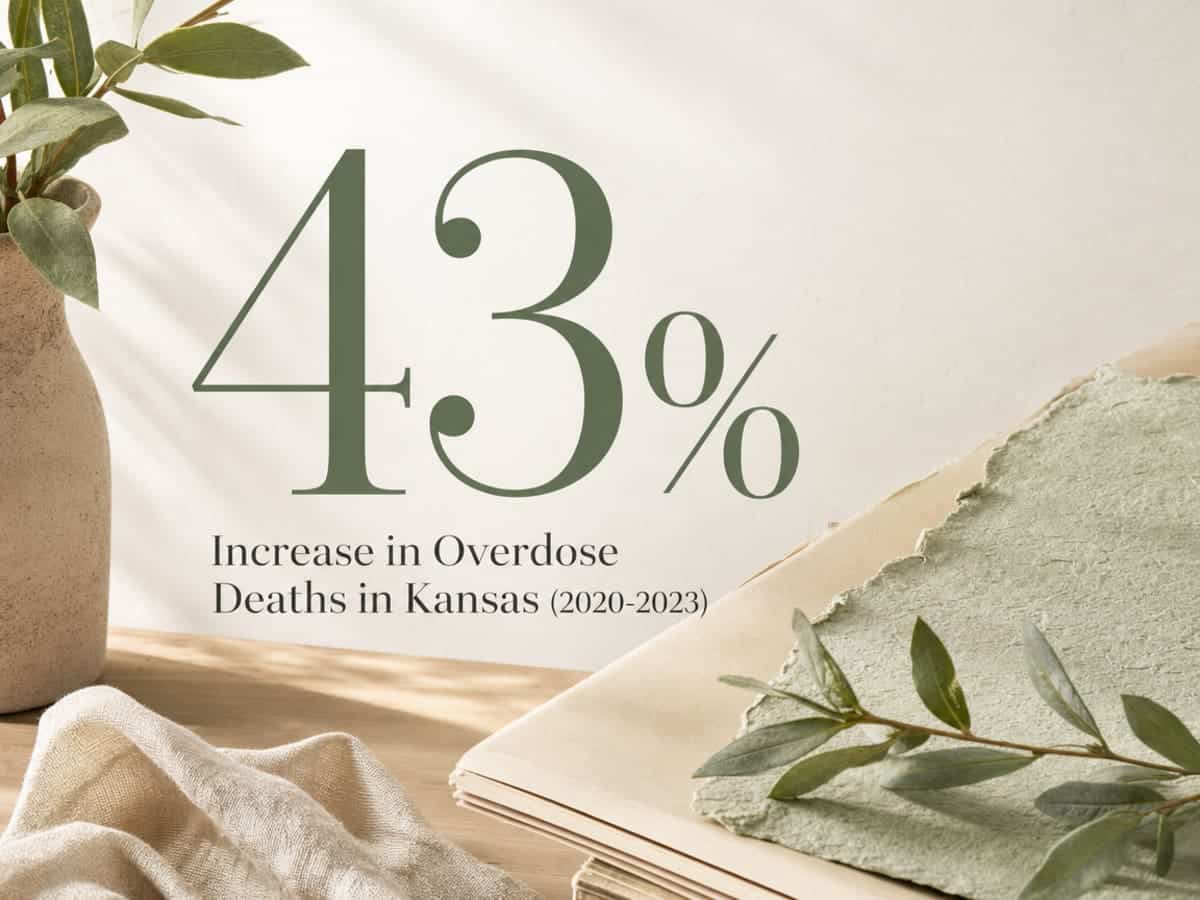
The local numbers explain why. Overdose deaths in Kansas rose 43% from 2020 to 2023, and the Kansas City Metro region recorded 724 deaths at a rate of 17.4 per 100,000 per year, with 68% of those deaths involving an opioid and roughly 80% of the opioid deaths involving fentanyl 1. That is not a scare stat to memorize. It is the risk environment your plan has to survive in. A slip that used to mean a bad week now sits inside a drug supply where a single counterfeit pill can be fatal.
So a written relapse prevention plan is not a worksheet you sign and file. It is your operating document for the next 12 to 24 months, structured the way SAMHSA case managers structure it with the client and their support people, not for them 4. It names your triggers, your early warning signs, the humans you will call before the craving wins, and the cadence of continuing care that will keep the plan alive after the adrenaline of leaving treatment wears off. The rest of this guide walks you through building that document, section by section, with the specifics Kansas City actually asks of you.
The Six Components of a Plan You Will Actually Use
Internal Triggers: Mood, Sleep, and Trauma Signals
Internal triggers are the ones you cannot outrun by driving a different route home. They live in your body and your head, and they were there before the substance and will be there after. Naming them is the first real page of your plan.
Write down the mood states that historically preceded your use. Loneliness at 9 p.m. Resentment after a call with a specific family member. The flat, gray feeling on a Sunday afternoon. If trauma is part of your story, add the somatic signals too: the tight chest, the racing heart, the dissociation that used to make a drink or a pill feel like relief. SAMHSA’s integrated treatment guide is explicit that people with co-occurring disorders should keep a daily inventory of psychiatric symptoms and symptom changes, because a shift in mental health almost always precedes a shift in substance use 3.
Sleep belongs in this column. Two nights of poor sleep is not just tiredness — for many people in recovery, it is the earliest measurable signal that something is off. If Sunflower’s Huml Health wearable flagged your sleep or heart rate variability during treatment, that same data pattern is what you are watching for at home.
External Triggers: Places, People, and KC-Specific Cues
External triggers are the ones the city hands you. Marlatt’s cognitive-behavioral model treats identifying specific high-risk situations as the anchor of the whole plan — you cannot build coping skills for a situation you have not named yet 6. So get specific. Not “bars.” The bar on Southwest Boulevard where you used to close out Fridays. Not “friends.” The person who still texts you at 11 p.m. on paydays.
Map your week honestly. The Power & Light District on a Saturday night. The Country Club Plaza during holiday shopping when the crowds feel overwhelming. Exit 233 off I-35 that used to be your dealer’s neighborhood. The gas station near your job that sold the pills. Commutes are their own category — if I-70 or I-35 puts you within a mile of an old use spot every day, that is a trigger you drive through twice a shift.
Then add the softer cues: paydays, court dates, holidays, the anniversary of a loss. Write each one down with the day it lands. A trigger you have circled on a calendar is a trigger you can plan around, not one that ambushes you.
Early Warning Signs and the Daily Check-In
Warning signs are what shows up between a normal day and a craving. They are not the craving itself — they are the twenty-four to seventy-two hours before it. TIP 47 puts understanding the relapse process and common warning signs at the top of the intensive outpatient relapse-prevention task list, and for good reason 12. If you can catch yourself at the warning-sign stage, you have time. At the craving stage, you have minutes.
Yours will be personal. Common ones:
- skipping meals
- isolating from your sponsor
- romanticizing old use stories
- picking fights
- driving past old spots “just to see”
- letting hygiene slide
Write down five to seven that you actually recognize in yourself.
Then commit to a daily check-in. Two minutes, same time each day. Rate your mood, sleep, cravings, and connection on a 1-to-10 scale. If two categories drop by two points in a day, that is your signal to call someone before the day ends. The check-in only works if you do it on good days too — otherwise it becomes a crisis form instead of a monitoring tool.
Coping Skills, Support Contacts, and the Intervention Script
Coping skills should be matched to the trigger, not chosen from a generic list. If loneliness is your trigger, “take a walk” is not a coping skill — calling a specific person is. If anger is your trigger, a fifteen-minute cardio block or a grounding exercise beats journaling. Marlatt’s model calls for enhancing the coping skills that match each identified high-risk situation, one to one 6. Write the trigger on the left, the response on the right.
Now the support contacts. The VA’s relapse prevention template asks for names and phone numbers of the people in your recovery support system, in writing, on the plan itself 13. Not “my sponsor” — the number. Include your sponsor, one alumni peer, one family member who knows the plan, your therapist, your prescriber if you are on medication, and the local crisis line. Six names, six numbers.
Finally, an intervention script. What you will do, in order, when a warning sign hits. It might read: text sponsor, leave the location, drive to a specific safe place, call the second name on the list if the first does not answer, attend the 7 p.m. meeting. Write it down while you are calm so you do not have to think when you are not.
The Continuing Care Dose: Why Three Months Is Not Enough
Here is the number that should shape your calendar for the next year: patients who stayed in outpatient care for nine months or longer had a 71.7% abstinence rate at twelve months post-discharge, compared with 37.4% for those who stopped at three months. And patients who paired weekly AA attendance with a formal aftercare program for the full twelve months after residential treatment reported 90% past-year abstinence 10. Same people, same starting point. The variable that moved the outcome was time in structured support, not the intensity of the initial stay.
That gap matters because most people leaving treatment in Kansas City default to a three-month IOP and then quietly taper themselves off. The plan becomes a memory by month four. The research on continuing care is consistent that interventions work better when they run longer and when the program reaches out to the patient rather than waiting for the patient to show up 9. Passive aftercare — “call us if you need us” — is not aftercare. Active outreach is.
If your current discharge plan ends at ninety days, that is not a finished plan. That is the first quarter of it. The next section maps what months four through twenty-four should actually look like on your calendar.

A Week-by-Week Aftercare Cadence for the First Year
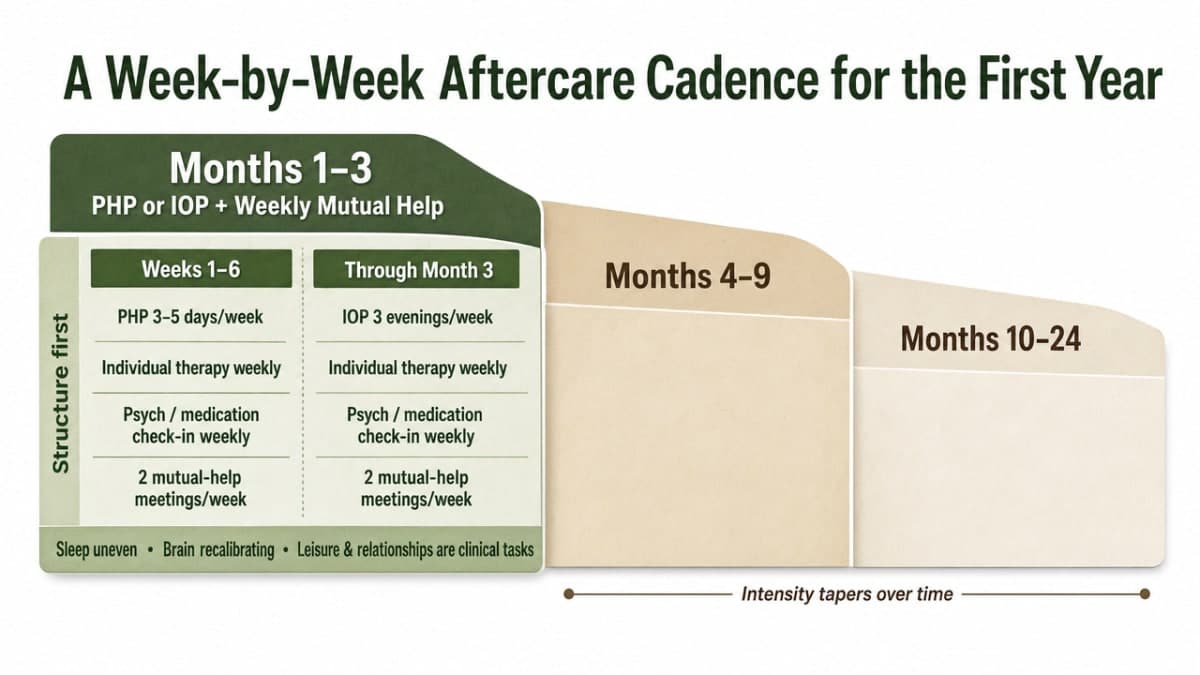
Months 1–3: PHP or IOP Plus Weekly Mutual Help
The first ninety days are when your calendar has to do the heavy lifting your discipline cannot yet do alone. Your brain is still recalibrating, your sleep is still uneven, and the novelty of freedom outside a residential setting cuts both ways. So you fill the week with structure that someone else built.
A typical Kansas City cadence at this stage looks like PHP three to five days a week for the first four to six weeks, stepping down to IOP three evenings a week through month three. Add one individual therapy session and one psychiatric or medication check-in weekly. Then two mutual-help meetings — AA, NA, SMART Recovery, Refuge Recovery, whichever fits. TIP 47’s intensive outpatient framework treats structuring leisure time and rebuilding relationships as clinical tasks at this stage, not extras 12. So block a Saturday morning coffee with a sober peer the same way you block therapy.
Keep the daily check-in going. Two minutes, same time. If your PHP or IOP program uses active outreach — a case manager who calls when you miss a session instead of waiting for you to reschedule — that is the design the continuing-care research consistently favors 9. Do not decline the call.
Months 4–9: Tapering to Alumni Groups and MAT Check-Ins
This is the stretch where most plans quietly die. IOP graduation feels like a milestone, and it is, but it is also the moment your week suddenly has nine free evening hours it did not have before. Empty calendar space is a trigger of its own.
Replace the IOP slot before you lose it. A weekly alumni group is the anchor — same night, same room or same video link, same faces. Add a second mutual-help meeting if you were only doing one. Keep individual therapy at least twice a month through month six, then monthly through month nine if you and your therapist agree. If you are on buprenorphine, naltrexone, or another medication, keep the prescriber check-ins on the calendar as non-negotiable, not as-needed.
This is also where Missouri’s continuum-of-care model becomes practical: extended outpatient services close to home are the whole point of the phase, so pick providers you can reach in fifteen minutes on a bad day, not thirty on a good one 2. And ask your alumni coordinator to check in if you miss two consecutive groups. Active outreach outperforms passive attendance policies in the continuing-care literature, and this is the phase where drift starts 9.
Months 10–24: Monthly Alumni Contact and Recovery Capital
By month ten, the plan shifts from intensive support to what researchers call recovery capital — the accumulated relationships, routines, and roles that make sobriety the default instead of the effort. The Wisconsin synthesis of the aftercare literature is direct on the horizon: continuing care should remain available for at least twenty-four months, initiated early and sustained through structured, proactive contact 11.
What that looks like week to week:
- one alumni group meeting a month, ideally in person
- weekly mutual-help attendance, still
- a quarterly check-in with your original treatment team or a step-down clinician
- medication management on whatever cadence your prescriber sets
- a sponsee, a service commitment, or a volunteer role — something where someone is counting on you to show up
Update the written plan itself every six months. Your triggers shift. The person who was your safest call in month three may not be in month eighteen. New warning signs surface. A plan you have not touched in a year is a plan you have already stopped using. Pull it out, mark it up, and keep going.
Opioid-Specific Backstops: Medication, Naloxone, and the Fentanyl Reality
If your drug of choice was an opioid, your plan needs a layer that non-opioid plans do not. The Kansas supply is saturated with fentanyl, and a single lapse that used to mean a bad night now carries a real chance of not waking up. That is not a reason to panic. It is a reason to build redundancy into the plan.
StatPearls organizes relapse prevention into five broad strategies: therapy, medications, monitoring, peer support, and emerging interventions 8. For opioid use disorder in a fentanyl-saturated market, treat those five as layers of defense that all run at once, not options you pick from.
Medication is the layer most people underuse. Buprenorphine or naltrexone, prescribed by a KC-area provider and taken on schedule, blunts craving and blocks the reward of a slip. Stopping the medication without a clinical conversation is one of the most common early setbacks — treat every dose change as a plan revision.
Monitoring — daily check-ins, wearable data, prescriber urine screens if you have agreed to them — catches drift before it becomes a decision. Peer support and therapy, the other two layers, keep the human infrastructure intact so the medication and monitoring have somewhere to land 8.
Add fentanyl test strips to the plan if you have people in your life who still use. It does not compromise your recovery to help keep someone else alive.
Dual-Diagnosis Signals: Watching Depression, PTSD, and Sleep Alongside Cravings
If you came into treatment with depression, anxiety, PTSD, an eating disorder, or another co-occurring condition, your relapse risk does not just track cravings. It tracks mood. SAMHSA’s integrated treatment guide is direct on this point: people with co-occurring disorders benefit from relapse prevention education about both conditions and their interrelations, plus a daily inventory to monitor psychiatric symptoms and symptom changes — because a psychiatric flare almost always shows up before the substance craving does 3.
So your daily check-in gets a second column. Alongside mood, sleep, cravings, and connection, track the symptoms specific to your diagnosis. For depression, that might be anhedonia, hopelessness, or how long it took to get out of bed. For PTSD, hypervigilance, nightmare frequency, dissociative episodes, or the number of times you were pulled back into a trauma memory. For anxiety, panic episodes and the physical symptoms that come with them. Two-point drops in two consecutive days are your trigger to call your prescriber or therapist, not to wait for the next scheduled appointment.
Sleep gets its own line for a reason. Fragmented sleep destabilizes mood, mood destabilizes coping, and destabilized coping is where the craving finally has room to land. If you used Sunflower’s Huml Health wearable during treatment to track sleep quality and heart rate variability, keep watching the same signals at home — you already know what your baseline looks like when things are steady, and what the numbers do when they are not.
Dual recovery groups belong on your calendar too. A room where people are working both sides of the diagnosis at once is different from a substance-only meeting, and SAMHSA specifically recommends attendance at dual recovery groups as part of integrated relapse prevention 3. Ask your discharge planner which ones meet in the KC metro. Put one on the weekly schedule.
Kansas City Logistics: Missouri-Side, Kansas-Side, and Wellness Court
The state line is a paperwork problem, not a geographic one. You cross it on the way to the grocery store. Your treatment team probably does not. If you got residential care in Osawatomie and live in Independence, or your PHP was in Overland Park and your job is downtown on the Missouri side, your aftercare plan has to name which providers hold which pieces — and who talks to whom when something shifts.
Missouri’s Division of Behavioral Health builds its model around a continuum of recovery services with extended outpatient care close to home, which is exactly the phase you are entering 2. Ask your discharge planner to line up an IOP or alumni group on your side of the line before you leave treatment, not after. Fifteen minutes on a bad day beats a forty-minute drive you will skip.
If you are entering aftercare through Jackson County’s Wellness Court or another problem-solving court, your plan has an extra layer: peer support, self-help groups, and community treatment all have to coordinate with the justice system, and your case manager should be conducting continuing care and relapse prevention planning with you and your significant others, not handing you a checklist 4, 5. Bring the written plan to every court date. Update it when conditions change.
How Sunflower Structures Discharge Planning and Alumni Support
The gap between a plan on paper and a plan that survives month six is almost always about who is holding the other end of the rope. Sunflower’s discharge planning starts weeks before you leave residential care, not on the last day. The clinical team builds the written plan with you and, when appropriate, the family members and referring clinicians who will actually be in the room after discharge — the case management framework SAMHSA describes, where continuing care and relapse prevention are conducted with the client and involved significant others rather than handed over as a packet 4.
That plan includes your triggers, your warning signs, your six-name contact list, your intervention script, and the specific IOP or alumni cadence you will step into next. If you used the Huml Health wearable during treatment, your baseline sleep and heart rate variability numbers travel with you — so the signals you learned to read inside are the same ones you are watching at home.
The alumni program is the active-outreach layer the continuing-care research keeps pointing to 9. Regular check-ins, alumni groups, and someone whose job it is to notice when you go quiet. If you are close to discharge or already out and rebuilding the plan, call Sunflower and ask specifically about aftercare and alumni support.
Start building your Kansas City relapse plan today
Connect with professionals who understand your journey and will guide your next steps for lasting recovery.
Frequently Asked Questions
How long should a relapse prevention plan cover after I leave treatment in Kansas City?
Plan for 12 to 24 months of active continuing care, not 90 days. The research on aftercare consistently shows that interventions lasting 12 months or longer, with active outreach rather than passive scheduling, produce the strongest outcomes 9, 11. Your plan should be a living document you revise every six months, not a form you file at discharge.
What should actually be written down in my relapse prevention plan?
Six things, on paper: internal triggers (mood, sleep, trauma signals), external triggers (specific places, people, dates), early warning signs, matched coping skills, a support contact list with names and phone numbers, and a step-by-step intervention script for when a warning sign hits 13. Add a daily two-minute check-in tracking mood, sleep, cravings, and connection on a 1-to-10 scale.
Do I need medication-assisted treatment if my drug of choice was an opioid?
Talk to a prescriber about it seriously. Medication is one of the five core relapse-prevention strategies for opioid use disorder, alongside therapy, monitoring, peer support, and emerging interventions 8. In a fentanyl-saturated supply where 80% of Kansas opioid deaths involve fentanyl 1, buprenorphine or naltrexone plus naloxone at home is a redundancy layer that has saved lives. Not a moral question — a clinical one.
How do I coordinate aftercare if I live on the Missouri side but got treatment on the Kansas side (or vice versa)?
Ask your discharge planner to line up a specific IOP or alumni group on your home side before you leave. Missouri’s Division of Behavioral Health builds its model around extended outpatient care close to home, which is exactly what you need 2. Bring both providers into one written plan so your therapist, prescriber, and alumni coordinator know each other’s contact info 4.
What warning signs should I watch for beyond cravings if I have a co-occurring mental health condition?
Track the symptoms of your other diagnosis daily. For depression: anhedonia, hopelessness, how long it took to get out of bed. For PTSD: nightmares, hypervigilance, dissociation. For anxiety: panic episodes and their physical signs. SAMHSA recommends a daily inventory of psychiatric symptoms because mental health flares almost always precede substance cravings 3. Two-point drops on two consecutive days is your signal to call your prescriber.
Is weekly AA or NA enough, or do I need formal aftercare too?
Both, if you can. Patients who paired weekly AA with a formal aftercare program for the full 12 months after residential treatment reported 90% past-year abstinence — significantly higher than mutual help alone 10. Mutual-help meetings give you a room full of people who understand. Formal aftercare gives you a clinician tracking your progress and a case manager who calls when you go quiet 9.
References
- Drug Overdose Deaths in Kansas 2020–2023 Quick Facts (KDHE SUDORS). https://www.kdhe.ks.gov/DocumentCenter/View/43963/SUDORS-Data-By-PHEP-Regions
- Treatment Services (Missouri Department of Mental Health, Division of Behavioral Health). https://dmh.mo.gov/behavioral-health/treatment-services
- Integrated Treatment for Co‑Occurring Disorders: A Guide to Implementation (SAMHSA PEP20-02-01-004). https://library.samhsa.gov/sites/default/files/SAMHSA_Digital_Download/PEP20-02-01_004.pdf
- TIP 27: Comprehensive Case Management for Substance Abuse Treatment (SAMHSA). https://library.samhsa.gov/sites/default/files/sma15-4215.pdf
- Quick Guide for Clinicians Based on TIP 30: Continuity of Offender Treatment for Substance Use Disorders from Institution to Community (SAMHSA). https://library.samhsa.gov/sites/default/files/sma15-3594.pdf
- Relapse Prevention: An Overview of Marlatt’s Cognitive–Behavioral Model (PMC article). https://pmc.ncbi.nlm.nih.gov/articles/PMC6760427/
- Relapse prevention (PMC review). https://pmc.ncbi.nlm.nih.gov/articles/PMC5844157/
- Addiction Relapse Prevention (StatPearls, NCBI Bookshelf). https://www.ncbi.nlm.nih.gov/books/NBK551500/
- Continuing Care Research: What We’ve Learned and Where We’re Going (PMC article). https://pmc.ncbi.nlm.nih.gov/articles/PMC2670779/
- The Continuing Care Model of Substance Use Treatment (PMC article). https://pmc.ncbi.nlm.nih.gov/articles/PMC4007701/
- Aftercare, Relapse Prevention and Continuing Care (Wisconsin court system training PDF). https://www.wicourts.gov/courts/programs/problemsolving/docs/aftercarerelapseprevention.pdf
- KAP Keys for Clinicians Based on TIP 47—Substance Abuse: Clinical Issues in Intensive Outpatient Treatment (SAMHSA KAP Keys). https://radarcart.boisestate.edu/library/files/2017/07/KAP-Key-47_SMA07-4251.pdf
- Reducing Relapse Risk (VA Whole Health Library). https://www.va.gov/WHOLEHEALTHLIBRARY/docs/Reducing-Relapse-Risk.pdf