
Key Takeaways
- Kansas behavioral health provider ratios drop sharply outside urban areas, with frontier counties at 0.38 per 100 people needing care and no addiction-trained specialists in rural regions 10, 6.
- Distance and small-town visibility function as a privacy tax, and only about 10% of rural adults with a substance use disorder receive any treatment 13.
- For residential care, traveling 60 to 90 miles outside the county can be a clinical advantage, breaking daily triggers and shielding identity in ways local outpatient cannot 1.
- A ten-minute benefits check with a program like Sunflower in Osawatomie clarifies whether commercial coverage fits, or points toward CCBHCs, telemedicine buprenorphine, or crisis centers instead 11, 9.
When Everyone in Town Knows Your Truck
You already know something has to change. That’s not the hard part. The hard part is that the county mental health center sits two blocks from the grain elevator, your neighbor works the front desk, and your truck is not exactly anonymous in the parking lot.
If you’re reading this, you’ve probably done the math already. The nearest specialty provider might be 60 miles away. The one closer to home is staffed by people who went to school with your sister. And the idea of sitting in that waiting room, or explaining to your boss why you need every Tuesday afternoon off, feels heavier than the drinking or the pills themselves.
None of that is paranoia. Rural Kansas has real workforce shortages, real distance-to-care problems, and a real privacy tax that people in Wichita or Kansas City don’t pay 1. The barriers you’re feeling are documented. They’re also solvable, though not always in the way the closest brochure suggests.
What follows is an honest map of what’s available, why local sometimes isn’t the answer, and how a residential stay outside your county might be the most private, structured option on the table.
The Access Gap Isn’t in Your Head
How Thin the Provider Bench Really Is
When it feels like there’s nobody nearby who can actually help, that’s not a feeling. That’s a measurable shortage, and Kansas has the numbers to prove it.
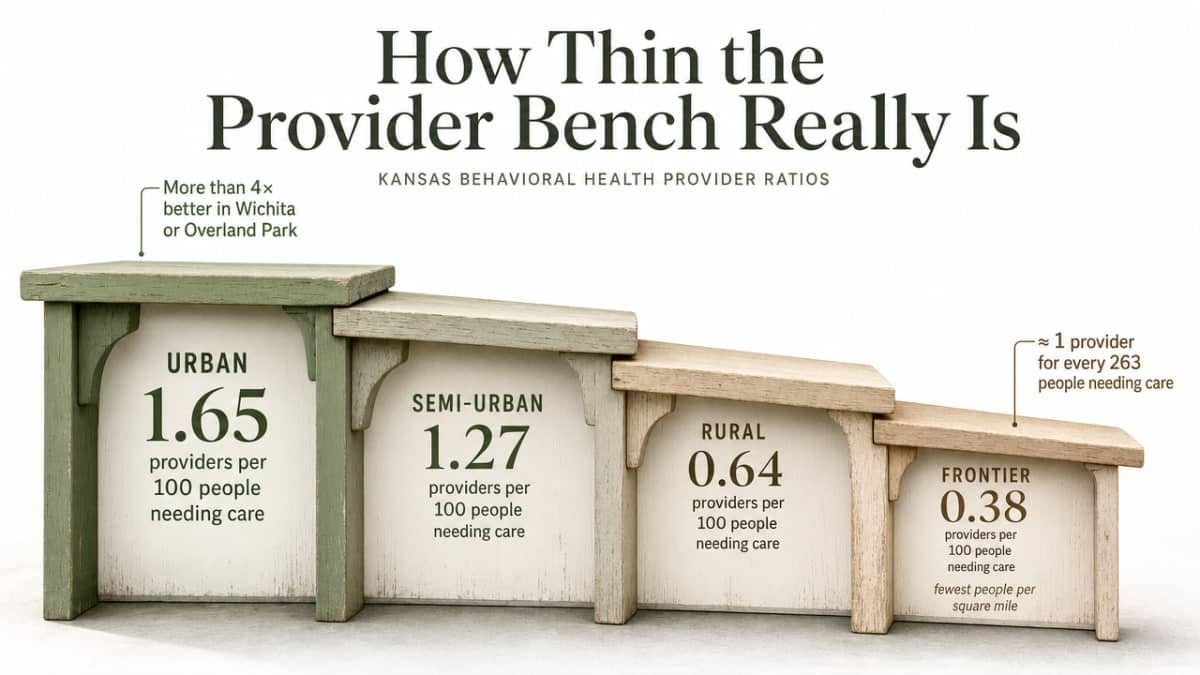
The 2025 gap analysis from the Kansas Children’s Cabinet looked at behavioral health provider ratios across the state and found a four-tier drop-off that tracks exactly with where you live:
- Urban counties have 1.65 behavioral health providers per 100 people needing care.
- Semi-urban counties sit at 1.27.
- Rural counties fall to 0.64.
- Frontier counties — the ones with the fewest people per square mile, and the ones many Kansans call home — come in at 0.38 10.
Read that again. In a frontier county, there is roughly one behavioral health provider for every 263 people who need one. In Wichita or Overland Park, that ratio is more than four times better. Same state. Same insurance cards. Same crisis. Wildly different odds of getting a call back.
And “behavioral health provider” is a broad bucket. It includes licensed counselors, social workers, and psychologists — not just people with specific addiction training. The subset who actually specialize in substance use disorder is much smaller than those ratios suggest, and it thins out further the farther west or south you go 10.
So if you’ve called three numbers this month and gotten voicemail, a six-week wait, or a polite “we don’t take new patients right now,” you are not doing this wrong. The bench is that thin. What you’re running into isn’t a personal failure to find the right door — it’s a workforce shortage that the state itself has documented and is still working to fix 10. Naming that out loud matters, because a lot of people quietly conclude they must be the problem. You aren’t.
The Drive Nobody Tells You About
Everyone knows rural means farther. What nobody quantifies is how much farther, or what that actually costs you when you’re trying to hold a job, hide a treatment schedule from a curious coworker, and keep gas in the tank.
A 2025 peer-reviewed study of spatial access to substance use treatment looked at census tracts nationwide and stratified them by rurality. Small rural tracts had to travel about 34 miles farther than urban tracts to reach the nearest specialty SUD program serving their population 7. Thirty-four extra miles, one way. For a program that meets weekly or more often, that’s an extra hour or more in the truck each visit, plus fuel, plus the time you can’t be at work.
The Kansas-specific picture is starker in the corners of the state. Legislative testimony to the Special Committee on Mental Health Modernization noted that Kansans in the northwest, southwest, and southeast don’t have proximity to Certified Community Behavioral Health Clinics — and that residents in the northwesternmost areas may need to drive close to 200 miles to reach one 11. Two hundred miles is not a commute. That’s a day. That’s a hotel. That’s asking your brother to cover chores.
The distance isn’t just a hassle. It’s a filter. Every extra mile between you and the nearest program is another reason to postpone the call, skip the follow-up, or drop out after a rough week. When people say access is the problem in rural Kansas, this is what they mean — not that help doesn’t exist somewhere, but that somewhere is a long way from your driveway 1.
One Addiction Specialist per 29,000 Kansans
Here’s the number that sits behind the other numbers. In 2025 Senate testimony supporting a proposed Kansas Behavioral Health Center of Excellence, experts reported that the state has roughly one addiction-trained provider per 29,000 people with substance use disorder — and none available in the rural areas of the state 6.
None. Not few. Not stretched. None with the specific addiction training that complex cases often need.
That doesn’t mean rural Kansas has zero help. Community mental health centers, primary care doctors prescribing buprenorphine, and telehealth clinicians all fill in as they can, and many do good work. What it means is that if you have a serious substance use disorder — especially one tangled up with trauma, depression, or another mental health condition — the person with the deepest expertise to treat it is almost certainly not in your county 6.
This isn’t a knock on your local providers. They know what they’re missing. It’s why so many of them refer out. And it’s part of why traveling for care — even far enough that the license plates in the parking lot don’t match yours — isn’t a compromise or a last resort. For a lot of rural Kansans, it’s how you finally get in front of someone whose whole practice is addiction, not one of ten things they cover on a Tuesday.
Why Staying Local Feels Impossible
The Privacy Math of a Small County
Here’s the piece nobody puts on a flyer. In a town of 3,000 people, everybody’s truck has a personality. The receptionist at the county mental health center is somebody’s aunt. The parking lot is visible from the co-op. And the intake paperwork you fill out passes through hands that already know your last name, your ex-wife, and where you sit at church.
That isn’t a small annoyance. It’s the reason a lot of people in rural Kansas don’t walk through the door at all. Research on rural communities has found that highly stigmatized perceptions of substance use — and the fear of being identified as someone who uses drugs — actively push people away from local treatment, even when a program exists within driving distance 13. HRSA’s rural SUD brief flags the same dynamic: stigma and privacy concerns are core reasons rural residents avoid seeking care close to home 1.
You can do everything right — get honest with yourself, pick up the phone, sign the forms — and still find yourself calculating who might see your car. That’s not a character flaw. It’s the geometry of a place where relationships are dense and news travels fast.
What this means practically: privacy in a small county isn’t just about HIPAA. It’s about the walk from the parking lot to the door. And when that walk feels impossible, the answer isn’t to try harder. It’s to notice that the map might need to be bigger.
What Only 10% Getting Treatment Actually Means
A 2024 peer-reviewed study looked at rural adults nationwide who met the clinical criteria for a substance use disorder — 2.8 million people in 2020 alone. Of those, only about 10% received any substance use treatment from an inpatient or outpatient program. For opioid use disorder specifically, just 1 in 500 received medication for it 13.
Sit with that for a second. Nine out of ten rural adults who needed treatment didn’t get it. Not because they didn’t want it, in most cases. Because the door was too far, the wait was too long, the number went to voicemail, the coverage didn’t work, or walking in felt more dangerous than staying sick.
That gap is what the numbers in the section above actually feel like from the inside. Provider ratios of 0.38 in frontier counties 10and drives approaching 200 miles for northwest Kansans 11aren’t abstract policy problems. They’re the mechanism by which most of the people who need help never receive it.
If you’ve been circling this for months — or years — you are not an outlier. You are part of a very large group of rural adults for whom the standard pathway has quietly failed. Knowing that doesn’t fix anything on its own. But it does clear away one of the heavier weights: the sense that everyone else figured this out and you didn’t. They didn’t. The system did not make it easy to.
What’s Actually Available Without Leaving the County
Community Mental Health Centers and CCBHCs
Most rural Kansas counties do have a community mental health center. That’s the backbone of the public system, and for many people it’s the first — sometimes only — door within a reasonable drive. Federally funded health departments and community health centers also show up on the map in places like Douglas and Finney Counties, and they sometimes coordinate substance use services alongside primary care 3.
The newer layer is Certified Community Behavioral Health Clinics, sometimes called CCBHCs or CSCs. These are supposed to offer integrated mental health and substance use care under one roof, with expanded hours and mobile crisis response. When one is nearby, it can be a real step up from the older model.
The problem is the map. Legislative testimony has flagged that CCBHCs currently serve only parts of Kansas — the southwest, southeast, and northwest corners are largely without proximity to one 11. If you live in those regions, the “integrated” option on paper is still a long drive in practice.
Community centers do valuable work with what they have. But their counselors are stretched, and specific addiction training among staff is uneven, which is part of why the state is still building out its specialty network 10.
Telehealth, Buprenorphine, and Their Real Limits
Telehealth has done real good in rural Kansas. A video visit from your kitchen removes the parking-lot problem, saves the drive, and connects you to a clinician you’d never reach otherwise. For medication-assisted treatment — especially buprenorphine for opioid use disorder — telehealth has made prescribers more reachable, and the state has been pushed to help rural providers set up telemedicine buprenorphine services specifically 11. The KU statewide report echoes this: expanding access to medication for opioid use disorder is a top priority, especially in rural and frontier areas 2.
Here’s the honest part. Telehealth works well for some things and not for others.
- It works for medication management, ongoing therapy sessions, and check-ins once you’re stable.
- It works less well when you need medically supervised detox, when your home is where the drinking or using happens, or when the people around you are part of what’s keeping you sick.
HRSA’s own rural SUD brief acknowledges the debate: telehealth and office-based treatment alone often can’t overcome the deeper structural barriers rural residents face 1.
A weekly video call is a lifeline. It is not the same as being somewhere else, sleeping somewhere else, and having the substance physically out of reach for a stretch of weeks. If you’ve tried outpatient and telehealth and kept relapsing between visits, that’s information about intensity, not about your worth.
Crisis Centers and What State Rules Require
When things get acute — you can’t stop, you can’t sleep, withdrawal is scaring you or the people around you — crisis intervention centers are the piece of the system built for that moment. Kansas administrative rules spell out what these centers are supposed to do: stabilize the patient, treat acute withdrawal, run assessments, and connect people to the next appropriate setting, whether that’s back home or into longer-term care 9. That includes 24-hour observation and, where appropriate, medication for withdrawal.
A crisis center is not a treatment program. It’s a bridge — usually a few days, sometimes a little longer. You come out stabilized, not recovered.
In rural Kansas, the nearest crisis center may still be a drive, and beds fill up. But knowing this door exists matters, especially if things escalate at 2 a.m. and the choice feels binary. It isn’t. And what happens after the crisis stabilization — the residential stay, the PHP, the therapy that actually addresses why this keeps happening — is where the real work lives.
Why Distance Can Be a Clinical Feature, Not a Bug
Most of this article has treated distance as the problem. For a lot of the practical stuff — the drive, the fuel, the missed shifts — it is. But when the question shifts from outpatient visits to residential treatment, distance flips. It stops being the obstacle. It starts being part of what makes the treatment work.
Think about what actually keeps a substance use disorder going. It’s not just the substance. It’s the gas station on the way home that sells single beers. It’s the coworker who always has something. It’s the drive past the house where things got bad. It’s the phone that lights up at 9 p.m. with the same three names. When you try to get sober inside that geography, you’re doing the work with one hand tied behind your back.
None of this means residential care is right for everyone or that leaving town is a magic reset. It means the miles between your driveway and the door can be doing quiet clinical work — protecting sleep, breaking routines, and giving the therapy room to actually land.
What Residential Care in Osawatomie Looks Like
The Continuum: Residential, PHP, and IOP
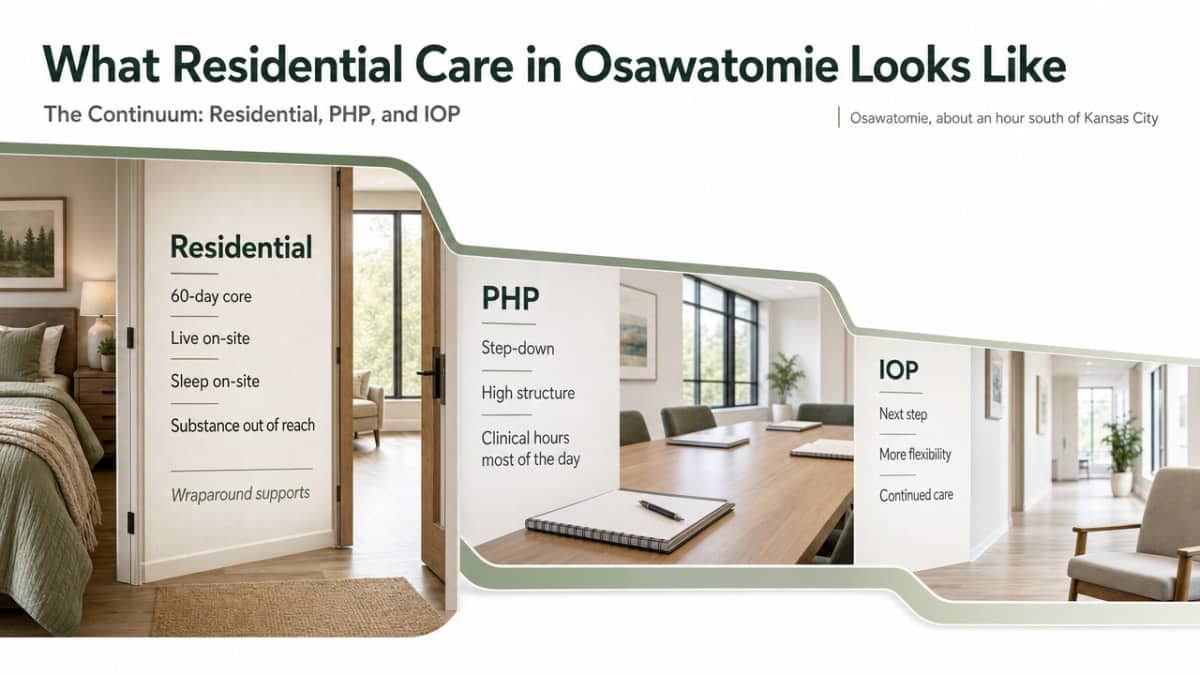
Sunflower Recovery Center sits in Osawatomie, about an hour south of Kansas City and far enough from most of rural Kansas that the parking lot isn’t full of familiar plates. What it offers isn’t a single program. It’s a continuum, which matters because addiction rarely responds to one dose of anything.
The core is a 60-day residential program. You live on-site, sleep on-site, and the substance is physically out of reach for a stretch of weeks. That’s the part telehealth and a weekly counseling appointment cannot replicate — and it’s the piece the KU statewide report flags as exceptionally limited in Kansas, especially when paired with wraparound supports 2.
From there, the Partial Hospitalization Program (PHP) steps the intensity down while keeping structure high — clinical hours most of the day, evenings freer. Intensive Outpatient (IOP) drops it further, with sessions that fit around work or family. The point of a continuum is that you don’t graduate from residential straight back into the life that got you here. You step down through it.
Trauma-Informed Dual Diagnosis Care
If your drinking or using is tangled up with something older — a childhood you don’t talk about, a deployment, a loss, a depression that’s been there since long before the substance — then treatment that only addresses the substance is going to keep failing you. Not because you’re weak. Because half the problem is still in the room.
Roughly 60% of the adults Sunflower treats come in with dual diagnosis needs — substance use plus a co-occurring mental health condition like depression, anxiety, trauma, or an eating disorder. The clinical approach is built around that reality rather than treating it as a complication. Care plans are developed by multidisciplinary teams and adapted as things change, and the program integrates biometric wearable data — sleep, stress, heart rate variability — to see what’s actually happening between sessions rather than guessing.
That kind of specialty depth is exactly what Kansas doesn’t have distributed across its rural counties, where an addiction-trained provider often isn’t available at all 6.
Honest Fit: Insurance, Eligibility, and Who This Isn’t For
Here’s the straight version. Sunflower accepts most commercial insurance. It does not participate in Medicare or Medicaid. If your coverage is through KanCare or Medicare, this specific program is not going to be your path, and the honest thing is to say that up front rather than waste your intake call.
If you have commercial coverage — through an employer, a spouse’s plan, or a private policy — a benefits check is a phone call, not a commitment. The intake team can tell you what your plan actually covers before you decide anything.
The program is built for adults with substance use disorder, often with co-occurring mental health conditions. It is not a detox-only facility, not a court-mandated bed farm, and not a fit if you need a Medicaid-funded pathway. Knowing what something isn’t is part of trusting what it is.
Making the Call: A Practical Next Step
You don’t have to decide anything today. You just have to find out what’s actually on the table for you.
A benefits check takes about ten minutes on the phone. You give the intake team your insurance card, they tell you what your plan covers, and you hang up knowing something you didn’t know before. That’s it. No commitment. No paperwork mailed to your house with a return address that raises eyebrows.
If it turns out Sunflower is a fit — commercial coverage, adult, substance use with or without co-occurring conditions — the next step is an assessment. If it isn’t a fit, the team can point you toward what might be, whether that’s a CCBHC-adjacent provider, a telemedicine buprenorphine option 11, or a crisis center closer to home 9.
You already carried the hardest weight — the part where you decided something has to change. Making the call is smaller than that. Just one number, one conversation, one honest answer about what comes next.
Reach Out Privately—Start Your Recovery Journey Today
Connect with a caring team ready to guide you, away from small-town eyes and distractions.
Frequently Asked Questions
Is it worth driving out of my county for addiction treatment when there’s a clinic closer to home?
Often, yes — especially for residential care. A closer clinic may offer counseling or medication management, but it may not have addiction-trained specialists on staff, and rural Kansas has none of those in many counties 6. Distance from familiar triggers and social surveillance can also help the treatment actually work.
How do I get addiction treatment in rural Kansas without everyone in town finding out?
The most reliable way is to get care outside your county. Rural stigma and fear of being identified are documented barriers that push people away from local programs 1. A residential stay 60 to 90 miles away means the parking lot, staff, and other patients aren’t people from your church, co-op, or workplace.
Can telehealth and buprenorphine replace residential treatment for someone in a rural Kansas county?
Sometimes, but not always. Telehealth and buprenorphine work well for ongoing medication management and therapy once you’re stable 2. They work less well when you need medically supervised detox, when home is where the using happens, or when weekly video calls haven’t stopped the cycle. Residential fills a different clinical gap.
What’s the difference between a crisis center, a community mental health center, and a residential program?
A crisis center stabilizes acute withdrawal over a few days and refers you onward 9. A community mental health center offers outpatient counseling and, sometimes, medication management on an ongoing basis. A residential program is where you live on-site for weeks, with structured clinical hours daily. Each covers different intensity levels.
Does Sunflower in Osawatomie accept Medicare or Medicaid?
No. Sunflower Recovery Center accepts most commercial insurance — employer plans, spousal coverage, private policies — but does not participate in Medicare or Medicaid, including KanCare. If your coverage is through one of those programs, this specific facility isn’t going to be your path, and the intake team will tell you that honestly.
What if I have trauma or depression alongside the substance use?
That’s the norm, not the exception. About 60% of the adults Sunflower treats come in with a co-occurring mental health condition — trauma, depression, anxiety, or an eating disorder alongside the substance use. Treating only the substance while ignoring what’s underneath is part of why so many attempts don’t stick. Dual diagnosis care addresses both.
References
- Addressing Substance Use Disorder in Rural Communities. https://www.hrsa.gov/sites/default/files/hrsa/rural-health/rhd-2023-addressing-sud-in-rural-communities.pdf
- New report clears a path for Kansas’ response to substance use. https://aai.ku.edu/news/article/new-report-clears-a-path-for-kansas-response-to-substance-use
- HRSA Data Explorer – Kansas Provider Sites (Behavioral/Substance Use Related). https://data.hrsa.gov/data/data-explorer?paramServiceId=HAB_RDR¶mTyp=state¶mCd=20
- Educating Social Workers in Rural and Frontier Areas to Address Substance Use. https://digitalcommons.murraystate.edu/cgi/viewcontent.cgi?article=1214&context=crsw
- Kansas – Drug Overdose Deaths. https://www.cdc.gov/drugoverdose/factsheets/state_fact_sheets/kansas.html
- Kansas Behavioral Health Center of Excellence (Senate testimony). https://www.kslegislature.gov/b2025_26/committees/testimony/pdf/?apn=b2025_26/year1/senate/committees/ctte_s_wam_1/testimony/published/ctte_s_wam_1_20250304_07_testimony.html
- Variation in Spatial Access to Substance Use Treatment for Older Adults by Rurality. https://pmc.ncbi.nlm.nih.gov/articles/PMC12760776/
- 2021 Mental Health Modernization and Reform Working Groups Recommendations. https://www.kslegislature.gov/li_2022/b2021_22/committees/ctte_spc_2021_ks_mental_health_modern_1/documents/testimony/20210928_02.pdf
- Kan. Admin. Regs. § 26-52-17 – Alcohol and substance abuse services. https://www.law.cornell.edu/regulations/kansas/K-A-R-26-52-17
- Children and Families in Rural Kansas. https://kschildrenscabinet.gov/wp-content/uploads/2025/12/2025_Gap_Analysis_Rural.pdf
- Testimony to Special Committee on Kansas Mental Health Modernization and Reform. https://www.kslegislature.gov/li_2022/b2021_22/committees/ctte_spc_2021_ks_mental_health_modern_1/documents/testimony/20210928_08.pdf
- Kansas Behavioral Health Center of Excellence (Senate testimony). https://kslegislature.gov/b2025_26/committees/testimony/pdf/?apn=b2025_26/year1/senate/committees/ctte_s_wam_1/testimony/published/ctte_s_wam_1_20250304_07_testimony.html
- Barriers to opioid use disorder treatment among people who use drugs in rural communities in the U.S.. https://pmc.ncbi.nlm.nih.gov/articles/PMC10997882/