
Key Takeaways
- Kansas law layers four protections around teacher treatment: K.S.A. § 65-5602 privilege, § 65-5603 exceptions, § 59-29b79 records rules, and federal preemption over open-records requests 2, 8.
- Voluntary summer treatment without a workplace incident does not automatically trigger a licensure filing, since 2025 session laws keep impairment records confidential inside board proceedings 7.
- Small-district visibility is a real variable statutes cannot fix, so choosing a facility outside your community and controlling family messaging matters as much as legal protections 5.
- Plan the call by working backward from your first in-service date, using FMLA medical-necessity language rather than a diagnosis, and admit before any HR conversation about accommodations 6, 8.
Summer Is a Clinical Window, Not a Marketing Hook
You already know why you’re reading this. You made it to the last week of May, you closed the classroom door behind you, and the thing you’ve been managing all year is louder now that the bell schedule isn’t drowning it out. You don’t need a definition of addiction. You need to know whether the next ten weeks are enough time to get real treatment, and whether anyone at your district will ever have to know.
Here’s the honest answer to the first part: yes, in most cases, summer is a genuine clinical window. Not a discount season. Not a marketing angle. A real stretch of time long enough to complete medical stabilization, a residential stay, and step-down care before August in-service — if you plan the calendar backward from that first staff meeting instead of forward from a crisis.
You are not an outlier for being here. RAND’s work on U.S. educators found that teachers report higher job-related stress and depressive symptoms than the general adult working population, and that stigma and fear of job repercussions rank among the top reasons educators don’t seek mental health or substance use care 1. Every quiet part of that finding — the fear, the calculating, the waiting for June — is what brought you to this page.
What follows is written for you as a colleague, not a prospect. Kansas law gives you more protection than most teachers realize, and less than some rehab websites suggest. The next sections walk through exactly what your district can learn, what your neighbors can guess, and how a 60-day residential program plus PHP and IOP actually fits between the last bell and the first in-service day.
What Kansas Law Actually Protects — and What It Doesn’t
The Privilege at the Base: K.S.A. § 65-5602
Start here, because everything else in this article sits on top of it. Kansas law gives you, the patient, a privilege — not a favor from your treatment center, not a policy that can be revised, but a statutory right. Under K.S.A. § 65-5602, treatment personnel are barred from disclosing that you are receiving or have received treatment for a mental, alcohol, drug dependency, or emotional condition, and they cannot share communications made for diagnosis or treatment 2. The privilege belongs to you. Not to the clinic. Not to your district.
Read that again in practical terms. If your superintendent calls a treatment facility in July and asks whether a teacher by your name is a patient there, the lawful answer is that the facility cannot confirm or deny anything without your written authorization. The same is true if a school board member’s spouse works in admissions billing at a hospital and gets curious. The privilege runs against the world, not just against nosy neighbors.
This is stronger protection than most educators assume they have when they first start Googling in June. It is also narrower than a blanket promise, which is where the next section comes in.
The Carve-Outs Every Teacher Should Read: § 65-5603 and § 59-29b79
The privilege has edges, and you should know exactly where they are before you admit. K.S.A. § 65-5603 spells out when the privilege does not apply: involuntary commitment proceedings, court-ordered examinations, information a clinician is required by law to report to public officials, and certain emergency treatment disclosures 9. If you walk into voluntary residential treatment during summer break and you are not a danger to yourself or others, none of those triggers apply to you. If a judge later orders your records in a custody case, that is a different conversation — and one worth having with a Kansas attorney before you file anything.
The companion statute, K.S.A. § 59-29b79, governs the treatment and medical records themselves. It declares those records privileged and lists the narrow conditions for release: your written consent, accreditation or scholarship review, or a court order 8. “District HR sent a form asking for verification” is not on that list. Neither is “the principal wants to know.” A release requires your signature, and you can limit exactly what it authorizes and to whom.
This layered structure — a broad protective rule followed by tightly enumerated exceptions — matches the pattern that national reviewers describe across state confidentiality frameworks, where disclosure without patient consent is generally prohibited except for emergencies and specific reporting duties 3. Kansas is not an outlier. If anything, the state’s carve-outs are unusually specific, which works in your favor when you are trying to plan around them.
Impairment Records, Licensure, and the 2025 Session Laws
Licensure is the piece that keeps most teachers up at night, and it deserves a clear-eyed look. Kansas’s 2025 session laws address the confidentiality of impairment-related information directly: records and reports relating to impairment are confidential and not subject to discovery or release outside of a board proceeding, and drug screening results tied to certain programs are not to be disclosed publicly 7. That framing matters. Impairment records live inside a professional review context, not on a public docket.
What that means for you: voluntarily entering treatment on your own time, without a triggering event at work, does not automatically generate a licensure filing. There is no clinician in Kansas who is required to call your state licensing agency because you checked into a residential program in June. Reporting duties are event-driven — a positive test tied to a workplace incident, a court order, a mandated safety report — not diagnosis-driven.
Talk to a licensed Kansas attorney or your union representative about your specific situation before you assume anything about your certificate. This paragraph is not legal advice. It is the piece of the picture teachers almost never see explained honestly on treatment center websites.
Why Your Treatment Address Isn’t a Public Record
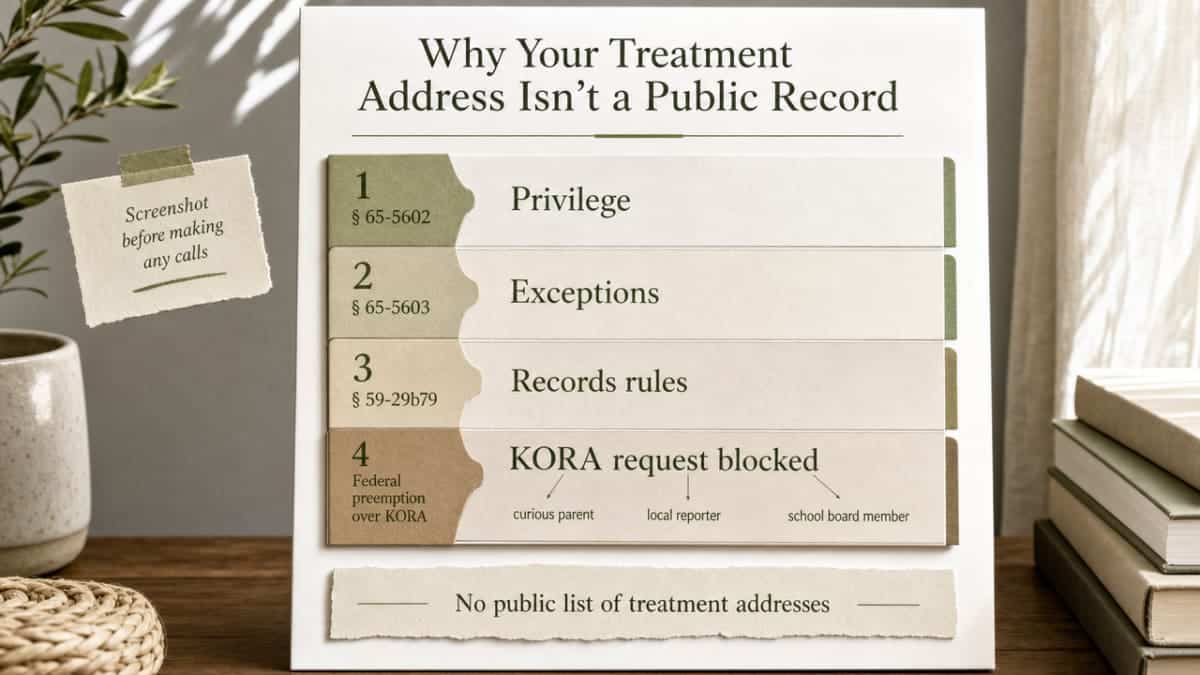
One more layer, and it is the one that reassures teachers from small districts the most. In Kansas Attorney General Opinion 2011-005, the state analyzed whether the addresses of people residing at facilities for alcohol or substance abuse evaluation or treatment could be released under the Kansas Open Records Act. The conclusion: those addresses may not be distributed under KORA because federal privacy protections preempt the state open-records requirement for individually identifiable health records and patient identity 11.
Translated: a curious parent, a local reporter, or a school board member cannot file an open-records request and get a list of who is at a treatment facility this summer. The paper trail you are worried about does not exist in a form anyone can pull.
Stack it up — § 65-5602 privilege, § 65-5603 exceptions, § 59-29b79 records rules, and federal preemption over KORA — and you have a four-layer confidentiality structure most teachers never see mapped out. Screenshot the next graphic before you make any calls.
Two Confidentiality Problems, Two Different Fixes
What Your District and HR Can Legally Learn
Your district has a narrow lane. Without your signed authorization, HR cannot pull your treatment records, cannot verify whether you are a patient anywhere, and cannot ask a clinician to describe what you’re being treated for. K.S.A. § 59-29b79 makes those records privileged and lists only a few unlocks: your written consent, accreditation or scholarship review, or a court order 8. A form emailed by a benefits coordinator does not qualify. A phone call from your building principal does not qualify.
What HR can legally learn is what you tell them. If you request leave, you decide the level of detail. “A serious health condition requiring inpatient care” is a full and lawful answer. You are not obligated to say “residential addiction treatment” on any leave form, and clinicians completing FMLA paperwork can describe medical necessity without naming a diagnosis on documents that route through your district. National reviewers describe this pattern across states — disclosure without patient consent is generally prohibited outside emergencies and specific reporting duties 3.
What Your Neighbor at the Pharmacy Can Gossip About
This is the fear the statutes don’t fix. The parent who fills prescriptions at the pharmacy on Main Street. The board member who sits two pews back at church. The paraprofessional whose sister works front desk at the clinic in the next county over. Kansas law binds treatment personnel to silence 2. It does not bind the person who saw your car in a parking lot.
You cannot legislate away small-town observation, but you can reduce the surface area. Choose a facility outside your immediate community — the drive from a rural district to Osawatomie or Kansas City is a feature, not a burden. Ask admissions how they route calls, whether staff use first names only in common areas, and how visitors are logged. Tell your family what you’re comfortable with them saying if someone asks where you are; “a medical program” is accurate and closes the conversation.
The systematic review of teacher well-being flags this exact barrier: educators frequently cite stigma and fear of being identified as reasons they delay seeking help 5. You are not being paranoid. You are being strategic about a real social variable that the law cannot reach.
Who Sees the Chart: Counselor Recordkeeping in Kansas
A quick word on what actually gets written down. Kan. Admin. Regs. § 102-7-11a requires licensed addiction counselors in Kansas to maintain accurate client records — assessments, treatment plans, progress notes — and to take reasonable steps to protect confidentiality, accessibility, and durability of those records 10. That means the chart exists, and it is thorough. It also means it is stored under professional rules designed to keep it out of unauthorized hands.
Ask your intake coordinator two questions before you admit: who inside the facility has routine access to your file, and what release form language they use if you later want a specific piece of information shared with, say, your primary care physician for continuity of care. A good clinical team will answer both without hesitation.
ADA, FMLA, and the Line You Can’t Cross Before You Admit
The Recovering-vs-Currently-Using Distinction
“limited protection from discrimination for recovering drug abusers and for alcoholics”while allowing employers to enforce rules against current illegal drug use 4. The National Academies review is blunter: individuals currently engaging in the illegal use of drugs have no ADA protection in employment, even if they are otherwise qualified and pose no direct threat 6.
Read that carefully. The protection turns on the word “currently.” Entering treatment is the act that moves you from unprotected to protected under this framework. That is one of several reasons the sequence matters — admit first, then have any conversation about accommodations or leave, not the other way around. Walking into HR before you have started care to “get ahead of it” can put you on the wrong side of that line. This is educational, not legal advice; loop in a Kansas attorney or your union rep about your specific facts before you say anything on the record.
FMLA Leave Without a Diagnosis on the Timesheet
FMLA is the tool most Kansas teachers underuse. If you qualify, you can take job-protected leave for a serious health condition that requires inpatient care or continuing treatment — and residential addiction treatment fits that definition. What surprises most educators is how little detail your district is entitled to.
Your certifying clinician completes the medical portion of the paperwork. Your name, dates, and a medical-necessity statement are required; a specific diagnosis is not. “Inpatient treatment for a serious health condition, followed by continuing care” is a lawful and complete certification. The Kansas confidentiality statutes reinforce this: your treatment records themselves are privileged and cannot be pulled by HR to fill in the blanks 8.
Ask your clinician to complete FMLA forms using medical-necessity language rather than diagnostic labels. Ask your union rep to review the form before it goes back. And send it directly to the leave administrator, not to your principal — the fewer hands it passes through in a small district, the better.
Fitness-for-Duty and Licensure Board Referrals
Two things can pull your treatment out of the confidential lane and into a formal review: a fitness-for-duty evaluation and a licensure board referral. Both are event-driven, not diagnosis-driven. A district can require a fitness-for-duty exam when there is a documented, job-related reason — a workplace incident, an observed impairment, a pattern that has been recorded. Voluntarily attending treatment in July, on your own, without any workplace event, does not by itself trigger one.
Kansas’s 2025 session laws keep impairment-related records inside board proceedings rather than in the public record; those files are confidential and not subject to release outside a board matter 7. And under § 65-5603, the privilege yields in specific situations — court-ordered examinations, mandatory reporting, involuntary commitment — none of which apply to a voluntary summer admission 9.
If a fitness-for-duty request does arrive, respond through your union or an attorney. Do not sign a blanket release. Narrow the scope in writing to the specific question the district is entitled to ask.
Mapping Care Onto the School Calendar
From May Bell to August In-Service: A Realistic Timeline
Count the weeks. Most Kansas districts release students the last week of May and bring staff back for in-service in early to mid-August. That gives you roughly ten to eleven weeks — enough time, if you sequence it correctly, to complete a full continuum of care that federal treatment guidance describes as clinically appropriate for substance use disorders: stabilization, residential, step-down, and continuing outpatient support 6.
Here is what fitting that continuum into summer actually looks like. Medical detox, when needed, runs roughly five to ten days. A 60-day residential stay carries you from early June into early August. Partial hospitalization follows for two to three weeks, and intensive outpatient begins as soon as PHP wraps, continuing into the school year on an evening schedule. Aftercare — sponsor meetings, therapy, medication management — runs indefinitely alongside your teaching.
You do not have to fit every stage into summer. A shorter residential stay is a valid clinical decision when the assessment supports it. But when you call to plan, ask admissions to work backward from your first in-service date, not forward from your admit date. That single change in framing is the difference between a plan that fits your career and a plan that fights it.

If Summer Isn’t Long Enough: Overlap Options and Leave
Sometimes the math doesn’t work. A late-June admission, a longer detox, a clinical team that recommends 90 days residential instead of 60 — any of these can push discharge past your first in-service day. That is not a reason to shorten treatment. It is a reason to use the leave protections you already have.
FMLA-eligible teachers can extend beyond the last day of summer into the first weeks of the school year without giving up job protection, using medical-necessity language rather than a diagnosis on the certification. Your treatment records themselves remain privileged and cannot be pulled to fill in what the form leaves out 8. Some districts also offer sick leave banks, short-term disability, or unpaid personal leave that can bridge a two- or three-week overlap.
A quiet return in mid-August with a substitute covering your first week is a better outcome than a rushed discharge on August 1. Ask your clinical team to write a discharge date driven by readiness, not by your class roster. Then let the leave paperwork catch up.
Re-Entry: IOP, Aftercare, and Your Evaluation Cycle
Coming back to the classroom is a clinical event, not just a scheduling one. Intensive outpatient typically meets three evenings a week for nine to twelve hours total — after school lets out, before your grading catches up with you. When you plan your treatment call, ask which IOP tracks meet on evenings compatible with parent conferences, IEP meetings, and the November-December stretch when your evaluation cycle heats up.
Build the aftercare scaffolding before you need it. A sponsor whose phone you will actually answer during a hard fifth period. A therapist within driving distance who takes your insurance. A primary care physician who has continuity-of-care notes from your treatment team, released through a narrow authorization you control 10. If your certificate ever comes under review for an unrelated event, a documented, active recovery plan is the record you want on file.
Do not tell your building principal your evening schedule. Tell them you have a standing medical appointment. That is accurate, sufficient, and the last confidentiality decision the summer required of you.
Planning the Call Before You Ever Admit
Before you dial anyone, write down three things on a piece of paper you can shred later: your last contract day, your first in-service date, and the name of one person outside your district who already knows. That is your working document. Everything else — insurance card, medication list, questions about visitors — can wait until the second call.
When you reach out to Sunflower Recovery Center, tell the person on the phone you are a Kansas teacher planning treatment around the school calendar and you want to work backward from your first in-service day. That single sentence sets the frame. Ask how admissions handles inbound calls at the switchboard, what name appears on any voicemail they leave, and how they document release-of-information forms so you control who gets what 10. Ask them to walk you through the continuum — residential, PHP, IOP, aftercare — with a discharge date driven by clinical readiness rather than a calendar deadline.
You do not have to decide anything on the first call. You are gathering information as a professional making a career-preserving clinical decision. Call Sunflower confidentially to map the summer against your calendar, then take the paper home and think.
Start your confidential summer recovery journey now
Connect with a caring professional to plan safe, private treatment around your school break.
Frequently Asked Questions
Can my school district find out I went to addiction treatment over the summer?
Not without your written authorization or a narrow legal trigger. K.S.A. § 59-29b79 makes your treatment records privileged and lists only a few unlocks: your consent, accreditation review, or a court order 8. A benefits form or a principal’s phone call does not qualify. If a district asks a facility to confirm you are a patient, the lawful answer is silence.
Will entering treatment trigger a report to the Kansas licensure board?
Voluntary summer treatment, on your own time, without a workplace incident, does not automatically generate a licensure filing. Kansas’s 2025 session laws keep impairment-related records inside board proceedings, confidential and not subject to release 7. Reporting is event-driven — a positive test, court order, or mandated safety report — not diagnosis-driven. Talk to a Kansas attorney about your specific facts.
Does the ADA protect me if I tell HR I’m seeking help for substance use?
The ADA protects people in recovery and those receiving treatment, but not individuals currently engaging in illegal drug use, who have no employment protection under the statute 6. The Commission on Civil Rights describes this as “limited protection” for recovering individuals 4. Sequence matters: admit to treatment first, then have any conversation about accommodations. Loop in your union rep before disclosing.
Is summer break really long enough to complete residential treatment and step-down care?
Usually, yes. Ten to eleven weeks fits the continuum federal treatment guidance describes as clinically appropriate: stabilization, residential, step-down, and continuing outpatient support 6. Detox runs five to ten days, a 60-day residential stay carries you into early August, and PHP plus IOP can begin overlapping with the school year on evenings. Work the calendar backward from your in-service date.
Can I take FMLA leave without my diagnosis showing up on district paperwork?
Yes. Your certifying clinician can complete FMLA forms with medical-necessity language — “inpatient treatment for a serious health condition, followed by continuing care” — without naming a specific diagnosis. Your underlying treatment records remain privileged under Kansas law and cannot be pulled by HR to fill in the blanks 8. Send the form directly to the leave administrator, not your principal.
What if someone I know sees me at a treatment facility in a small Kansas town?
Statute binds treatment personnel to silence 2, but it cannot bind a neighbor who spots your car. Reduce the surface area: pick a facility outside your immediate community, ask how staff route calls and log visitors, and give family a simple line — “a medical program” — that closes the conversation. The systematic review confirms this fear is a real barrier, not paranoia 5.
References
- Mental Health and Substance Use Among U.S. Educators. https://www.rand.org/pubs/research_reports/RR2228.html
- Kansas Statutes § 65-5602 – Confidential communications; privilege. https://www.ksrevisor.gov/statutes/chapters/ch65/065_056_0002.html
- Constraints on Sharing Mental Health and Substance-Use Information – Improving the Quality of Health Care for Mental and Substance-Use Conditions. https://www.ncbi.nlm.nih.gov/books/NBK19829/
- Substance Abuse under the ADA – U.S. Commission on Civil Rights. https://www.usccr.gov/files/pubs/ada/ch4.htm
- Substance Use and Mental Health Problems among Teachers: A Systematic Review. https://www.ncbi.nlm.nih.gov/pmc/articles/PMC8226273/
- Chapter 7—Legal Issues – Integrating Substance Abuse Treatment and Primary Care. https://www.ncbi.nlm.nih.gov/books/NBK64294/
- 2025 Session Laws of Kansas Vol. 1. https://www.sos.ks.gov/publications/sessionlaws/2025/2025-Session-Laws-Book-1.pdf
- Kansas Statutes § 59-29b79 – Disclosure of records. https://www.kslegislature.gov/li/b2025_26/statute/059_000_0000_chapter/059_029b_0000_article/059_029b_0079_section/059_029b_0079_k/
- Kansas Statutes § 65-5603 – Exceptions to privilege. https://ksrevisor.gov/statutes/chapters/ch65/065_056_0003.html
- Kan. Admin. Regs. § 102-7-11a – Recordkeeping. https://www.law.cornell.edu/regulations/kansas/K-A-R-102-7-11a
- Kansas Attorney General Opinion 2011-005. https://ksag.washburnlaw.edu/opinions/2011/2011-005.pdf