
Key Takeaways
- Methamphetamine recovery hinges on rebuilding a depleted dopamine system, so anhedonia and relapse risk peak during weeks two through four—exactly when a standard 28-day program ends 1, 8.
- Behavioral approaches carry the strongest evidence for stimulant use disorder, with contingency management named the standard of care by the 2023 ASAM/AAAP guideline, supported by CBT and the Matrix Model 4, 5.
- Kansas still faces significant meth treatment demand, with rural access gaps, no prison-based programming after budget cuts, and limited publicly funded slots concentrated at community mental health centers 3, 7.
- When calling Kansas programs, ask about length of stay beyond 30 days, use of contingency management, integrated care for trauma and co-occurring conditions, and concrete discharge planning 2, 4, 8.
Why Meth Recovery Doesn’t Work Like Other Drug Recovery
If you’re reading this at 2 a.m. because someone you love is disappearing into meth—or because you are the one disappearing—there’s something you need to hear before anything else: what’s happening isn’t a willpower problem, and it isn’t going to respond to the same 28-day playbook that works for a lot of other substances.
Methamphetamine hits the brain differently. It floods the dopamine system, then leaves it depleted for weeks or months. That’s why people coming off meth don’t just feel physically sick—they feel nothing. No pleasure from food, from sleep, from a hug, from a favorite song. That flat, gray state has a name: anhedonia. And it’s the reason so many people relapse around weeks two through four, right when a standard month-long program is winding down and telling them they’re ready to go home.
The clinical evidence on this is clear. Behavioral therapies—not medications—remain the strongest treatments for methamphetamine use disorder, and they need time to work 1. NIDA’s core principle is blunt about it: staying in treatment long enough is critical to whether treatment holds 8. For stimulants, “long enough” is measured in months, not weeks.
You are not failing because previous attempts didn’t stick. You may have been given a tool built for a different problem. Kansas has options built for this one, and the next sections will walk you through what recovery actually looks like—and how to find care that matches the biology of what you’re up against.
What Meth Actually Does to Your Brain and Body
Dopamine Depletion and the Anhedonia That Follows
Meth works by forcing your brain to dump massive amounts of dopamine—the chemical behind motivation, pleasure, and the feeling that things matter. A normal reward, like eating a good meal or hearing your kid laugh, might nudge dopamine up a little. Meth blows the doors off that system, releasing several times more than the brain is built to handle.
The problem is what comes after. Your brain doesn’t have an endless supply. When you stop using, the tank is empty, and the receptors that read dopamine are worn down from being screamed at for months or years. That’s why the first weeks off meth can feel like living behind glass. Food is flavorless. Sleep doesn’t refresh. A hug from your mom registers as nothing. This state has a clinical name—anhedonia—and it is not a personality flaw. It is a predictable neurological consequence of what meth did to your reward system 5.
If you’ve relapsed at week three before, this is often why. Your brain hadn’t healed enough to feel a reason to stay. The rebuild is slow, and it is real. Behavioral therapies delivered over an adequate stretch of time are what carry people through this window 1.
The Recovery Timeline: Acute Withdrawal, the Wall, and Extended Stabilization
Meth withdrawal doesn’t look like the shaking, sweating movie version of detox. It looks like collapse. Understanding the phases can make the difference between quitting the process and staying in it.
Days 1–10: Acute withdrawal. Your body crashes. You may sleep 14 to 18 hours a day, wake up ravenous, then sleep again. Depression sinks in fast. Cravings spike, then fade, then spike again. Physically, this stretch is not as medically dangerous as alcohol or benzodiazepine withdrawal, but psychiatrically it can be brutal—suicidal thinking is common, and this is where medical supervision earns its keep.
Weeks 2–8: The wall. This is the phase most people are not warned about, and it is where the majority of relapses happen. The dramatic symptoms fade, but a heavy, flat, unmotivated fog settles in. Nothing feels good. You cry over commercials or feel nothing at your own birthday. Concentration is shot. Sleep is disorganized. This is the anhedonia window, and it is exactly when a 28-day program is discharging you.
Weeks 8–16+: Extended stabilization. This is where the brain actually starts to feel again. Small pleasures return. Sleep consolidates. You can sit with a therapist and do trauma work without dissociating. NIDA’s core principle here is direct: staying in treatment long enough is critical to whether recovery holds 8. For meth, long enough means giving the dopamine system real time to come back online 5.
Seeing this laid out matters. If you’ve been telling yourself “I just need to white-knuckle a month,” the timeline is telling you something different. The wall is not a sign you’re failing. It’s a sign your brain is doing exactly what it’s supposed to do while it heals.

Sleep Collapse, Paranoia, and Meth-Induced Psychosis
Meth doesn’t just take your rest—it dismantles the architecture of sleep itself. During heavy use, people can go three, five, seven days without any real sleep. When the crash finally comes, it isn’t restorative; it’s more like a system shutdown. Even weeks into recovery, sleep can stay fragmented, with vivid dreams and middle-of-the-night wakeups.
Sleep deprivation is also the doorway to the scariest symptom family: paranoia and meth-induced psychosis. You may have already lived this, or watched someone you love live it. Voices no one else hears. The certainty that people are in the walls, in the yard, in the car following you. Hours spent picking at skin or taking apart appliances. This is not who you are. It’s what prolonged stimulant use plus no sleep does to a human brain.
The reassuring part: with sustained sleep, nutrition, and medical support, most meth-induced psychotic symptoms resolve. The ASAM/AAAP guideline addresses managing intoxication and withdrawal in the context of these symptoms, which is why a residential setting matters during the earliest weeks 4. You cannot fix a sleep-shattered brain from your couch.
How Long Residential Treatment Really Needs to Last
The 28-Day Model Was Never Built for Stimulants
Here’s a piece of history that might reframe everything: the 28-day inpatient model was designed in the 1940s and 50s for alcohol treatment. It was never engineered around what happens in a brain coming off methamphetamine. Yet somehow it became the default length insurance companies expect, families budget for, and programs advertise.
The data from regional treatment research tells a different story. Adult residential meth programs have averaged around 13 weeks, adolescent residential runs closer to 8 weeks, and therapeutic communities land between 28 and 33 weeks. The expert recommendation cited in that same body of work is 12 to 24 weeks of structured treatment, followed by ongoing support group participation 2. Twenty-eight days doesn’t even reach the low end of that window.
This isn’t about pushing longer stays for the sake of it. It’s about matching the treatment length to the actual biology. Your dopamine system doesn’t reboot on a calendar convenient for a billing cycle. If you’ve done a 28-day program and it didn’t hold, that’s not a story about you lacking commitment. It’s a story about a tool sized for a different job.
What 60+ Days of Structured Care Actually Buys You
So what does the extra time actually do? A lot, and most of it isn’t glamorous.
The first two weeks are stabilization: sleep starts to reorganize, appetite creeps back, the worst of the acute crash lifts. If treatment ended here, you’d walk out into the world still deep inside the wall—flat, foggy, and one hard day from picking up again.
Weeks three through six are where the real work becomes possible. Your brain can now hold a therapy session without checking out. This is when contingency management schedules can build a track record of clean weeks. It’s when cognitive behavioral therapy starts changing the automatic thoughts that used to end in a phone call to a dealer. It’s when you can sit with a counselor and talk about your father, your assault, your postpartum depression, without dissociating out of the room. NIDA’s principles are consistent on this point: adequate time in treatment and integrated care for co-occurring conditions are what make recovery hold 8.
Weeks seven through nine and beyond are where new habits become defaults. You’ve eaten three meals a day for two months. You’ve slept in the same bed every night. You’ve had one honest conversation, then twenty. That’s not a small thing. That’s a nervous system learning it’s safe to be here.
![Compare typical treatment program durations to the expert-recommended range for meth, directly supporting the section's argument that 28 days is insufficient. All numbers appear in the section prose with citation [ref_2]](https://www.sunflowerrecovery.com/wp-content/uploads/2026/08/methamphetamine-addiction-treatment-Kansas-content-v2-2.jpg)
The Treatments That Have the Strongest Evidence
Contingency Management as the Standard of Care
If there is one treatment for meth that has the clearest research backing right now, it isn’t a pill. It’s a behavioral approach called contingency management, and the 2023 ASAM/AAAP clinical practice guideline states plainly that contingency management represents the current standard of care for stimulant use disorders 4. That’s not a soft recommendation buried in a footnote. That is the top-line guidance from the two major addiction medicine bodies in the country.
Contingency management sounds more complicated than it is. In practice, you get concrete, structured rewards—vouchers, small prizes, meaningful incentives—for verified clean drug screens and for hitting recovery goals. The MIEDAR trials, run through NIDA’s clinical trials network, showed that meth users receiving incentives had better abstinence outcomes than those getting standard counseling alone 5.
Pair that with the broader picture: a peer-reviewed review of methamphetamine treatments concluded that, for now, the best available treatments for meth use disorder are behavioral therapies—not medications 1. If a program you’re considering doesn’t build contingency management or a similar structured behavioral protocol into its stimulant track, ask why. This is the piece with the receipts.
CBT, the Matrix Model, and Why Behavioral Therapies Win
Contingency management doesn’t work alone. It sits alongside two other behavioral approaches that carry serious evidence for meth: cognitive behavioral therapy and the Matrix Model.
CBT teaches you to catch the automatic thoughts that used to end in a pipe or a call to a dealer—the boredom, the argument with your partner, the flash of shame after seeing an old photo—and interrupt them before they become use. It is skills work, not talk therapy in the couch-and-tissues sense. You practice, you fail, you practice again.
The Matrix Model is a structured 16-week outpatient program originally designed for stimulant users. It weaves CBT, family education, drug testing, 12-step support, and relapse prevention into one coordinated schedule. NIDA specifically calls out the Matrix Model as effective for reducing methamphetamine use 5, and it appears again in NIDA’s education materials as a core behavioral option for meth alongside MET, CBT, and contingency management 6.
The through-line: meth recovery doesn’t respond to one big insight. It responds to repeated, structured practice over enough weeks that new patterns actually take hold. That’s why residential programs that build all three approaches into a daily schedule tend to outperform loose, unstructured care.
Medications: What the Research Says and Doesn’t Say
Here is the honest answer people don’t always get: there is no FDA-approved medication specifically for methamphetamine addiction. The ASAM/AAAP guideline notes that some medications may be used off-label for stimulant use disorder, but the evidence base is limited compared with behavioral approaches 4. The peer-reviewed review of current and emerging treatments reaches the same conclusion—behavioral therapies remain the most effective option we have 1.
That doesn’t mean medication has no role. If you’re carrying depression, anxiety, sleep disruption, or another condition alongside meth use, treating those with appropriate medication is often essential to holding recovery together. Just don’t wait for a magic pill to exist before you get help. The tools that work are behavioral, and they work when you give them time.
Trauma, Depression, and the Reason Meth Kept Working
Ask most people in long-term meth recovery what they were really using for, and almost nobody says, “I wanted to get high.” They say things like: I couldn’t sleep after what happened. I couldn’t feel my body. I was so depressed I couldn’t get off the couch, and meth was the only thing that made me a functional parent for a few hours. I was working two jobs and had a baby who didn’t sleep. It made the panic stop.
Meth kept working because it was solving something. Usually trauma. Usually untreated depression, ADHD, or anxiety. Sometimes an eating disorder hiding underneath the weight loss. If you only treat the meth use and leave the reason it worked untouched, you are asking a person to give up the one thing that made an unbearable inner life bearable—and you’re asking them to do it with a dopamine system that isn’t producing pleasure yet. That math almost never adds up.
The Kansas Treatment Landscape You’re Working With
State Admission Trends, Rural Access Gaps, and Prison Programming
Kansas has a meth problem that hasn’t gone away, even when the headlines moved on. The Kansas Bureau of Investigation’s strategic plan puts it plainly: while meth treatment admissions have trended down slightly in recent years, there remains a pressing need to increase access to appropriate treatment programs across the state 3. That’s a polite way of saying the demand still outstrips the beds—especially in rural counties where the nearest residential program might be two hours away.
The rural piece matters. If you live in western Kansas, or in a small town off I-70, your options for stimulant-specific residential care shrink fast. Drug courts and specialized programming exist in only a handful of communities, which means access can depend as much on your zip code as on your readiness to get well 3.
There’s another gap worth naming, especially if someone you love is currently incarcerated: the KBI plan notes that due to budget cuts, treatment programs are no longer available in Kansas prisons 3. That leaves families and community programs carrying weight the system used to share. If reentry is part of your picture, plan for residential care on the outside as the actual starting line.
Funding, Insurance, and What Block Grants Cover
Money is the part nobody wants to talk about at 2 a.m., and it’s often the part that stops people from making the call. Here’s the honest layout for Kansas.
The state receives SAMHSA block grant funding through the Kansas Department for Aging and Disability Services. Those dollars are directed to fund priority treatment and support services for people without insurance or whose coverage has lapsed, and to support data collection on service effectiveness 7. In practice, that means publicly funded slots exist for uninsured and low-income Kansans, but they are limited, often waitlisted, and concentrated at specific community mental health centers rather than every private residential program.
If you have commercial insurance, more doors open—including private residential programs built specifically for stimulant recovery. If you have Medicare or Medicaid, ask each program directly what they accept before you fall in love with a website; not every private facility participates in public payers, and that’s a conversation worth having up front so you’re not blindsided a week in.
What to Look for in a Kansas Residential Program
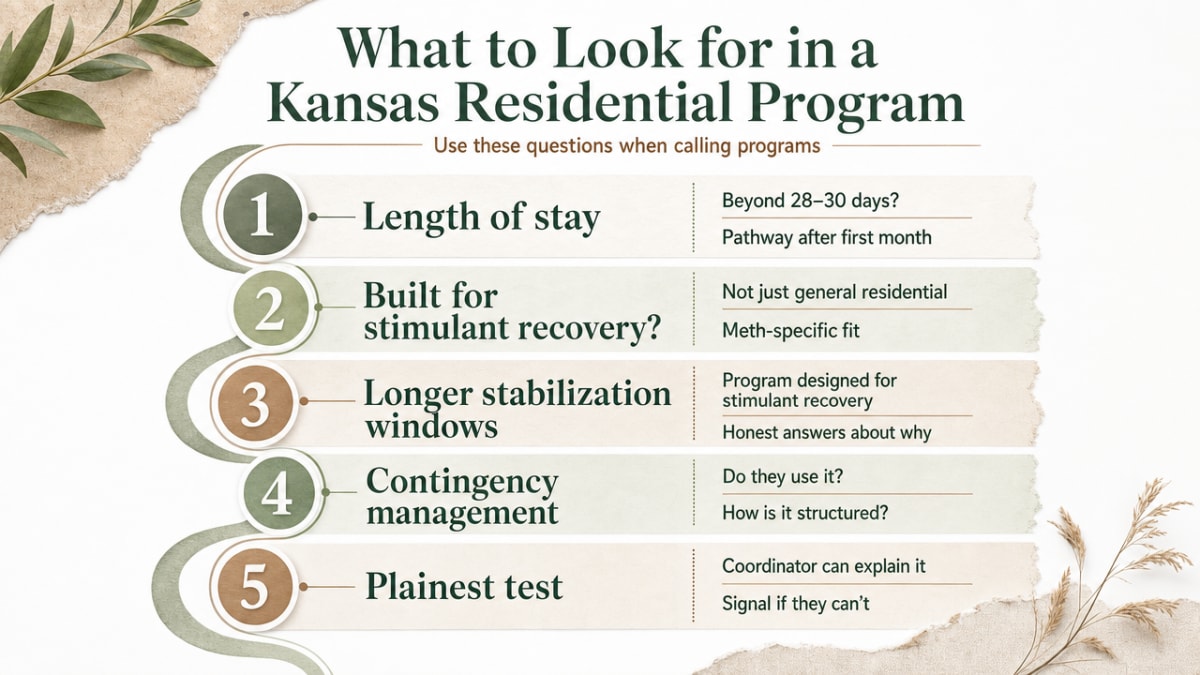
When you’re calling programs, you’re going to hear a lot of similar-sounding language. Here’s how to cut through it and figure out whether a facility is actually built for stimulant recovery or whether meth is just one more item on a general menu.
Ask about length of stay, not just “residential.” A program that only offers 28 or 30 days may still be the right first step for some people, but if meth is the primary drug, ask what the pathway looks like beyond that first month. Programs designed for stimulant recovery build in longer stabilization windows and have honest answers about why 2.
Ask if they use contingency management. This is the plainest test. If the intake coordinator has never heard of it or can’t describe how it’s structured in the program, that’s a signal. The ASAM/AAAP guideline names it as the standard of care for stimulant use disorder 4.
Ask how they handle co-occurring conditions. “We refer out for that” is a different answer than “our psychiatrist and therapists treat trauma, depression, and addiction together on the same care plan.” For meth recovery specifically, integrated care is not a nice-to-have—NIDA’s principles put it at the center 8.
Ask what the first two weeks look like medically. Meth withdrawal isn’t like alcohol withdrawal, but the psychiatric symptoms during acute stabilization are serious. You want a program with clinical oversight during the crash, not just a bed and a chore chart.
Ask about family involvement and discharge planning. Recovery that ends the day you walk out the door usually doesn’t hold. A program should be able to tell you, without hedging, what step-down care and family support look like after residential.
Sunflower Recovery’s 60-Day Program in Osawatomie
If you’ve read this far, you already know why a rushed month of treatment tends not to hold for meth. Sunflower Recovery’s 60-day residential program in Osawatomie was built with that timeline in mind. Sixty days gives your brain a real chance to move past the wall, not just the acute crash—two full months of consistent sleep, three meals a day, and structured behavioral work while the dopamine system slowly comes back online 5.
The clinical approach is trauma-informed and dual diagnosis from day one. If depression, anxiety, PTSD, or an eating disorder is part of why meth kept working for you, those get treated on the same care plan as the stimulant use—not handed off to figure out later. That integration matches what NIDA names as essential for lasting recovery 8.
Sunflower also uses Huml Health biometric wearables to track sleep quality, heart rate variability, and stress patterns—the exact biomarkers that crater during meth withdrawal—so your care team can see, in data, when your nervous system is actually settling. Call to ask about residential treatment built for stimulant recovery.
Start your meth recovery journey with support
Connect with compassionate professionals who understand stimulant challenges and can guide your next step toward stability.
Frequently Asked Questions
How is methamphetamine addiction treatment different from treatment for other drugs?
Meth is a stimulant, so recovery doesn’t hinge on managing physical withdrawal the way alcohol or opioid detox does. The heavy lifting is psychological: dopamine depletion, anhedonia, and disrupted sleep that stretch for weeks. Behavioral therapies—especially contingency management and CBT—carry the strongest evidence, and they need structured time to work 1.
What does meth withdrawal actually feel like, and how long does it last?
The first week or two is a crash: heavy sleep, ravenous hunger, deep depression, and strong cravings. Then comes the harder phase—flatness, fog, and no pleasure from anything—that can last several weeks or longer. NIDA is clear that staying in treatment long enough is critical, because your brain needs real time to heal 8.
Are there medications that treat methamphetamine addiction?
No medication is FDA-approved specifically for meth addiction. Some may be used off-label, but the ASAM/AAAP guideline notes the evidence base is limited compared with behavioral care 4. Medications still matter for treating co-occurring depression, anxiety, or sleep problems—just don’t wait for a pill to exist before starting the treatment that already works.
What if my loved one has tried a 28-day program before and relapsed?
That’s incredibly common, and it isn’t a character verdict. A month often ends right when the anhedonia phase is at its worst. Look for a program with a longer residential arc, structured contingency management, and integrated care for trauma or mental health conditions 4, 8. Relapse after short treatment usually reflects a mismatch, not a failure of will.
Can meth-induced psychosis or paranoia be treated in a residential program?
Yes. Most meth-induced psychotic symptoms—hearing voices, paranoia, delusional thinking—improve significantly with sustained sleep, nutrition, and medical support during the first weeks of stabilization. The ASAM/AAAP guideline addresses managing stimulant intoxication and withdrawal in exactly these situations, which is why residential clinical oversight during acute recovery matters so much 4.
What happens if I don’t have insurance or have Medicaid in Kansas?
Kansas uses SAMHSA block grant funds through KDADS to prioritize treatment for uninsured and low-income residents, though those slots are limited and often waitlisted at community mental health centers 7. Private residential programs vary on public payers—Sunflower Recovery, for example, accepts commercial insurance but not Medicare or Medicaid. Ask each program directly before committing.
References
- Current and Emerging Treatments for Methamphetamine Use Disorder. https://pmc.ncbi.nlm.nih.gov/articles/PMC9185770/
- Initial Report to the Methamphetamine Treatment Study Committee of the Nebraska Legislature. https://ncc.nebraska.gov/sites/default/files/doc/Methamphetamine_Treatment_Study_2005_Report.pdf
- Rural Law Enforcement Methamphetamine Initiative State Strategic Plan – Kansas. https://www.kansas.gov/kbi/de/docs/Kansas%20Methamphetamine%20Strategic%20Plan.pdf
- The ASAM/AAAP Clinical Practice Guideline on the Management of Stimulant Use Disorder. https://pubmed.ncbi.nlm.nih.gov/38669101/
- Methamphetamine – National Institute on Drug Abuse (Research Report PDF). https://nida.nih.gov/sites/default/files/methrrs.pdf
- Methamphetamine – National Institute on Drug Abuse (Educational Slides). https://nida.nih.gov/sites/default/files/e-methamphetamine-slides.pdf
- Substance Abuse and Mental Health Services Administration Block Grant – Kansas (KDADS). https://www.kdads.ks.gov/services-programs/behavioral-health/substance-abuse-and-mental-health-services-administration-block-grant
- Principles of Drug Addiction Treatment: A Research-Based Guide (3rd ed.) – NIDA. https://nida.nih.gov/publications/principles-drug-addiction-treatment-research-based-guide-third-edition
- Drug Overdose Deaths Involving Psychostimulants – CDC. https://www.cdc.gov/drugoverdose/data/stimulants.html
- Kansas Drug Overdose Trends – Kansas Department of Health and Environment (KDHE) [example Kansas overdose report]. https://www.kdhe.ks.gov/documentcenter/view/12345