
Key Takeaways
- Kansas classifies amphetamine as a controlled stimulant, and state law narrowly limits prescribing to conditions like ADHD and narcolepsy while requiring documented medical justification 6, 7.
- Adderall misuse in Kansas usually starts with a real prescription or a diverted pill from a classmate or coworker, not a street supply, which is why high-functioning students and professionals delay reaching out 11, 8.
- Because no FDA-approved medication treats stimulant use disorder, care leans on behavioral therapy, trauma-informed dual-diagnosis treatment, and honest reassessment of underlying ADHD, anxiety, or sleep problems 1, 3.
- Kansas readers can start with a single confidential call to a program like Sunflower Recovery in Osawatomie, which offers residential, PHP, and IOP levels and accepts most commercial insurance.
When the pill that made you functional becomes the problem
You probably didn’t start Adderall to get high. You started it to keep up. Maybe a doctor wrote the script in your sophomore year because you couldn’t finish anything on time. Maybe a friend handed you one before finals and it was the first day in months your brain felt quiet. Maybe you’re a nurse, a resident, or a first-year associate who needed to get through a 14-hour shift, and one 20 mg tablet made that possible.
Somewhere along the way, the math changed. You started taking a little more than prescribed. Or you ran out early and asked around. Or you noticed the 4 p.m. crash getting harder, so you added another dose to soften it, and then another one to sleep through the anxiety that came after. You’re still showing up. Grades are okay. Charts are done. Nobody at work has said anything.
That’s the tricky part. Adderall addiction rarely looks like the drug stories you grew up hearing. It looks like a high-functioning person who is quietly terrified of running out of pills, counting what’s left at 2 a.m., and wondering when this stopped feeling like medicine.
If that’s where you are, or where someone you love is, you’re not being dramatic and you’re not too far gone. Kansas has real treatment for this, and calling doesn’t mean signing up for anything. It means telling the truth to one person who won’t be surprised by any of it.
Who actually ends up here
The people who call about Adderall aren’t the people you’d expect from a rehab brochure. They’re the honors student who tutored your kid last summer. The ICU nurse pulling three twelves in a row. The 34-year-old attorney who’s been “handling it” since law school. The mom with an ADHD diagnosis from 2019 who started taking her son’s dose too because hers stopped working. The founder running on 40 mg and cold brew who hasn’t had a real weekend since the seed round.
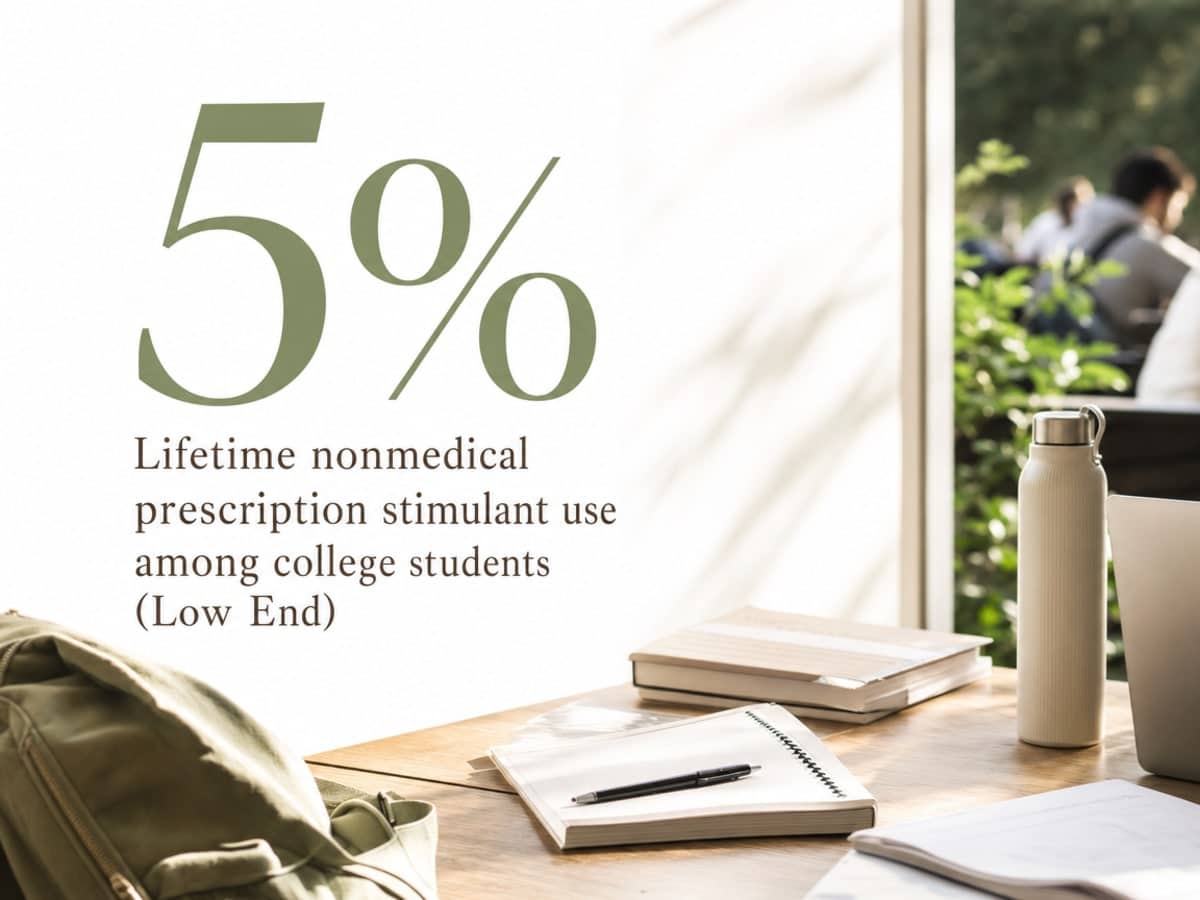
A literature review of nonmedical prescription stimulant use on U.S. college campuses found lifetime rates ranging from roughly 5% to over 35%, depending on the school and how researchers asked the question 10. That’s a huge spread, and it tells you something important: this isn’t a rare, hidden problem tucked into one type of student. It’s a common one, spread unevenly across pressure cookers. High-achieving campuses, competitive majors, health sciences programs, and graduate schools sit at the higher end. That’s part of why you might feel like everyone around you is doing the same thing you’re doing. On your campus or in your unit, statistically, a lot of them are.
NIDA describes the pattern plainly: college students and young adults often misuse prescription stimulants to try to enhance school or work performance, which raises the risk of addiction and other harms 8. The reason matters. Most people who end up in treatment for Adderall didn’t start chasing a high. They started chasing a deadline, a shift, a diagnosis, a version of themselves that could keep up.
So if you’re sitting there wondering whether you belong in this conversation because you’re still functioning, still passing, still getting promoted — you do. Functional is exactly what this looks like, right up until it doesn’t.
Adderall is not meth: why the treatment picture is different
People hear “stimulant addiction” and picture something that doesn’t look anything like their life. A stranger in a parking lot. A pipe. A missing job, a missing decade. If that’s the image you’re carrying around, no wonder you keep telling yourself this isn’t that.
It isn’t that. But it’s still stimulant use disorder, and it belongs in the same conversation about treatment — just with a very different starting point.
Start with where the pills come from. Nonmedical users of prescription stimulants most often get them from friends with legitimate prescriptions, which makes diversion the dominant supply pathway 11. That is a completely different pipeline from illicit methamphetamine or cocaine, which move through street markets. The person selling you a 20 mg blue tablet before finals is probably a classmate, not a dealer. The person handing you a spare from her weekly pack in the break room is a coworker. That matters, because it shapes how the problem hides. There is no obvious rock-bottom moment. No arrest. No dirty apartment. Just a Venmo request and a pill.
The user profile is different too. NIDA describes the typical pattern: students and young professionals reaching for these medications to push through school or work, not to get high 8. The motivation is performance. That means the identity around the drug is “I’m someone who gets things done,” not “I’m someone with a drug problem.” Which is exactly why people wait so long to call.
The clinical picture changes accordingly. Someone entering treatment for meth or crack is often dealing with visible medical, legal, and housing crises alongside the addiction. Someone entering treatment for Adderall is more often dealing with panic attacks, insomnia, disordered eating, a fraying relationship, an ADHD question that was never really answered, and the private fear of losing a license, a scholarship, or a title. The addiction is real. The wreckage just tends to be quieter and more internal.
Treatment reflects that. The evidence base for stimulant use disorder — behavioral therapies, trauma-informed care, integrated treatment for co-occurring conditions — applies to you 1. But the entry point is different. You don’t need a detox from a street drug supply. You usually need help stopping a medication you can still get, a plan for the anxiety and sleep problems underneath, and an honest look at whether ADHD is part of the story. That’s what a program built for prescription-stimulant misuse actually does.
How you know it crossed the line
There isn’t a single moment. There’s a drift, and one day you look up and you’re somewhere you didn’t plan to be.
Some of the honest signals: you’re taking more than the bottle says, or more often than the bottle says. You’ve asked a friend for one, or bought one, or lied to a prescriber to get an early refill. You’ve tried to stop or cut back and couldn’t get through a week. The dose that used to work doesn’t work anymore, so you keep nudging it up. You feel flat, foggy, or panicky when you don’t have it. You’re not sleeping, or you’re using something else — weed, alcohol, benzos, melatonin by the handful — just to come down.
There are quieter signals too. You’ve stopped eating real meals. Your heart races on a normal Tuesday. You’re irritable in a way that scares the people who live with you. You’ve started planning your week around when the next script hits. You count pills at night.
None of this requires a rock bottom to be real. Prescription stimulant misuse carries genuine addiction risk, especially when the pattern shifts from following a prescription to chasing an effect 8. If you’re recognizing yourself in more than one of these, the line is already behind you. That’s not a verdict. It’s just information you can finally use.
What Kansas law actually says about Adderall
If you’re trying to figure out whether what you’re doing is legal, illegal, or somewhere in between, it helps to know what the state actually says.
Kansas classifies amphetamine — the active ingredient in Adderall — as a controlled substance with stimulant effects on the central nervous system. House Bill 2540 lists “amphetamine, its salts, optical isomers and salts of its optical isomers” in the state’s schedule of controlled stimulants 6. That’s the same tier of regulation the state applies to other high-risk prescription medications. Having pills that weren’t prescribed to you, or giving yours to someone else, is not a gray area under Kansas law.
The prescribing side is tighter than most people realize. Kansas Statute 65-2837a limits when a physician or mid-level practitioner can write for amphetamines at all. The allowed indications are narrow — attention-deficit/hyperactivity disorder and narcolepsy are the main ones — and the law says “the patient’s medical record shall adequately document the purpose for which the drug is being given” 7. Your prescriber is required to write down why. That’s not a formality. It’s the paper trail that separates a legitimate script from a diverted one.
Two things follow from this. First, the friend in your program who “has extras” is breaking Kansas law when she sells or shares them, and so are you when you take them. Second, if you have a real prescription and you’re worried about how you’ve been using it, telling a treatment provider is not the same as telling law enforcement. Clinicians treating substance use disorder aren’t there to build a case. They’re there to help you get out of the pattern before it costs you something you can’t get back — a nursing license, a bar admission, a residency slot, custody.
Knowing the law isn’t meant to scare you. It’s meant to make one thing clear: the ground you’re standing on is narrower than it feels, and reaching out for help is the move that widens it again.
What treatment for Adderall addiction actually involves
Why therapy carries most of the weight (and what the medications can and can’t do)
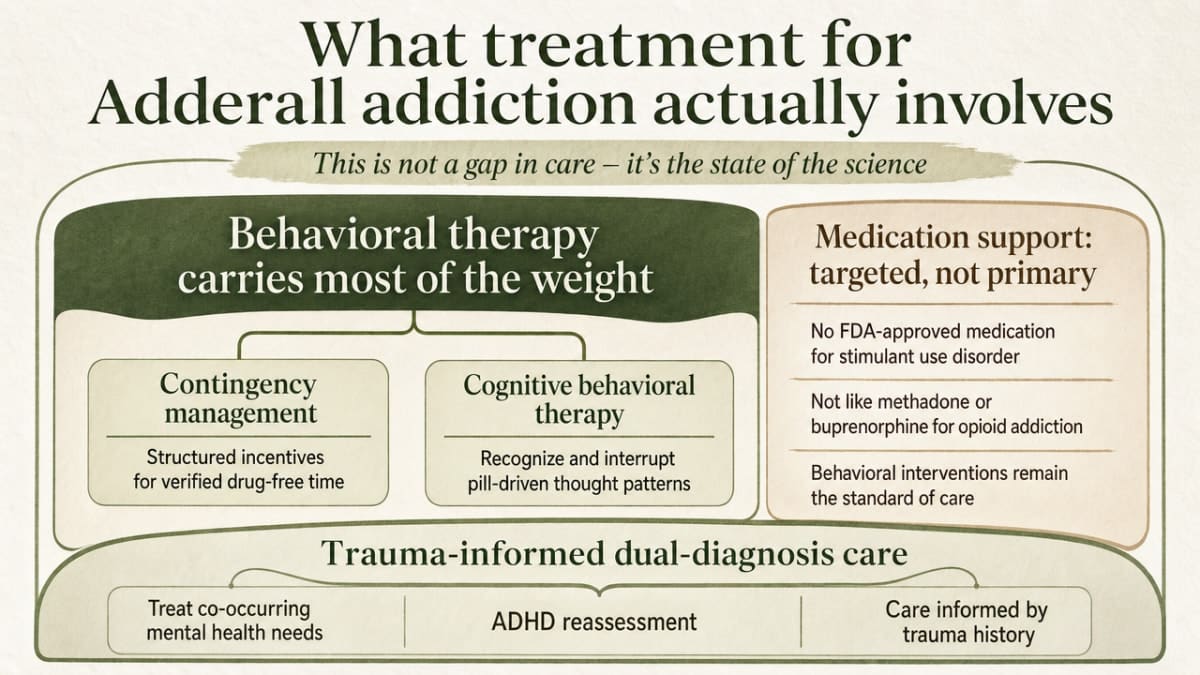
The behavioral work that has the most evidence behind it is contingency management, which uses structured incentives for verified drug-free time, and cognitive behavioral therapy, which teaches you how to recognize and interrupt the thought patterns that push you back toward a pill 1. These aren’t soft add-ons. For Adderall specifically, they are the treatment. In practice, that looks like weekly individual therapy, group sessions with people who understand the professional or academic pressure you’re carrying, and concrete skills for the moments that used to end with you swallowing something.
Medications still have a role, just a smaller and more targeted one. A recent review of pharmacotherapies for stimulant use disorder found that agents like bupropion, topiramate, and certain antipsychotics show modest and mixed results, and no single medication has emerged as a clear standard 2. What that means for you: a good prescriber may use medication to take the edge off depression, anxiety, or sleep problems that show up when you stop, but they won’t hand you a pill that erases the craving. The work happens in the therapy room. The medications, when used, are there to make that work possible.
Trauma-informed dual diagnosis: treating the anxiety, depression, or burnout underneath
Almost nobody starts misusing Adderall in a vacuum. There is usually something underneath — a panic disorder that pre-dates the first pill, a depression you’ve been outrunning with productivity, an eating disorder the appetite suppression made easier to hide, a childhood you haven’t really talked about, a job that has been quietly breaking you for two years.
SAMHSA’s guidance is blunt about this: many people with stimulant use disorders have histories of trauma and co-occurring mental health conditions, and trauma-informed, person-centered care is central to treatment that actually works 1. A separate review of integrated care for substance use disorders with co-occurring psychiatric conditions reaches the same conclusion — combined, long-term treatment that addresses both sides at once produces better outcomes than treating one and hoping the other resolves 5.
In practical terms, that means a program worth calling won’t ask you to “get clean first” and then deal with your anxiety later. It will screen for depression, PTSD, generalized anxiety, disordered eating, and sleep disorders on day one, and build the plan around what it finds. If the reason you reach for a pill at 6 a.m. is that you haven’t slept a full night in a year, sleep is part of treatment. If the reason you can’t sit still in group is that a trauma memory shows up every time you try, that’s what a trauma-trained clinician is there for. The addiction and the reason for it get treated at the same time, by the same team.
The ADHD question: what if you actually need a stimulant to function
This is the question that keeps a lot of people from calling. If you have real ADHD — diagnosed at seven, or at twenty-seven, or last spring by a psychiatrist who took an hour with you — the idea of “treatment” can feel like a threat. You’re not looking to swap one problem for a bigger one. You’re looking for a way out that doesn’t leave you unable to work.
Here’s what the clinical literature actually says. A review of treatment strategies for adults with co-occurring ADHD and substance use disorders concluded that “the simultaneous treatment of both conditions is likely to be the optimal approach,” with careful monitoring when stimulants are part of the plan 3. A second paper focused specifically on prescribing stimulants to people with ADHD and a substance use disorder found that, with the right guardrails, stimulant treatment does not necessarily worsen the addiction — and can improve outcomes for both 12.
The guardrails matter. Clinical guidance points toward:
- long-acting formulations or prodrugs rather than short-acting immediate-release tablets,
- shorter prescriptions with more frequent check-ins,
- coordination with a treatment team,
- and use of the state’s prescription monitoring program to track what’s actually happening 4.
Non-stimulant ADHD medications, such as atomoxetine or certain alpha-agonists, are also on the table, especially early in recovery when the risk of misuse is highest 3.
What this looks like for you: a real ADHD assessment, done by a clinician who is not the friend who first suggested you probably had it. An honest conversation about whether the way you were using Adderall was still treating ADHD, or had drifted into something else. A plan that might include no stimulant for a while, a different medication, or a carefully monitored return to a long-acting stimulant later — depending on you, not on a rule. You are not being asked to choose between recovery and being able to function. Those are the same choice.
What care looks like at Sunflower Recovery in Osawatomie
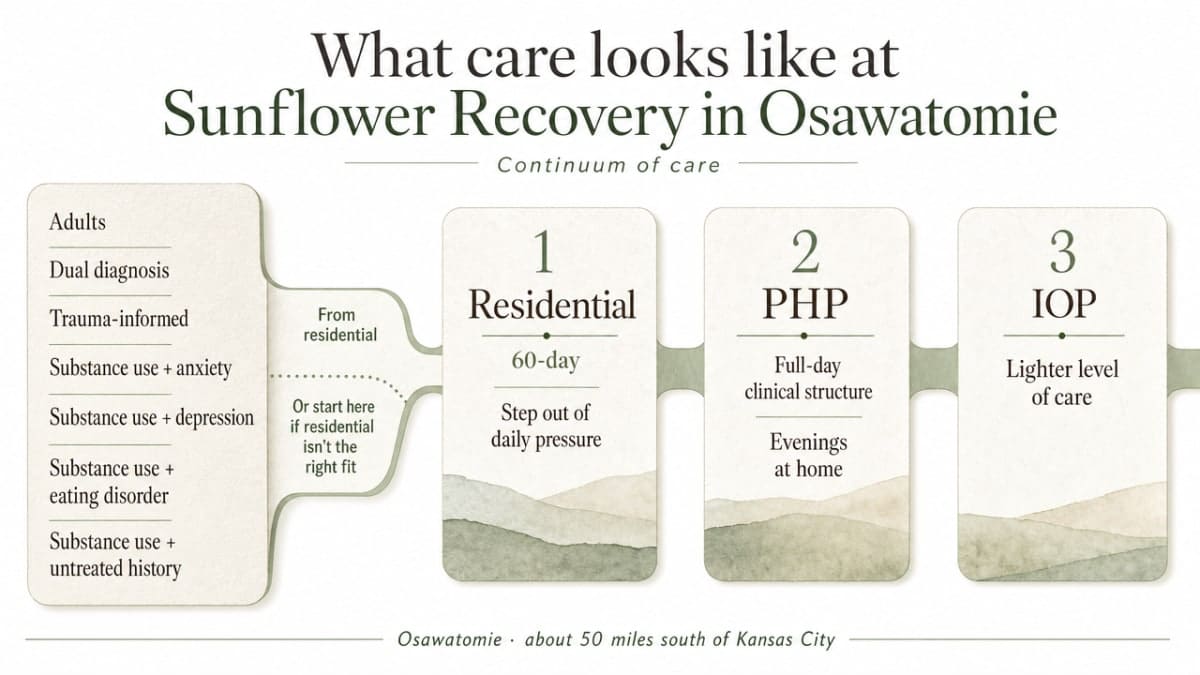
Sunflower Recovery Center sits about 50 miles south of Kansas City, in Osawatomie. It’s a trauma-informed dual diagnosis addiction recovery program built for adults whose substance use is tangled up with something else — anxiety, depression, an eating disorder, a history that never got its own treatment. That’s the exact overlap most Adderall cases live inside.
Care runs on a continuum, not a single door. A 60-day residential program is available when you need to actually step out of the pressure that’s been feeding the pill count — the on-call schedule, the study group chat, the household that won’t slow down without you. From there, or as a starting point if residential isn’t the right fit, the Partial Hospitalization Program gives you full-day clinical structure with evenings at home. The Intensive Outpatient Program is the lighter footprint, built to hold you steady while you’re back at work or in class.
Underneath all three levels, the clinical model matches what the evidence base for stimulant use disorder actually calls for: behavioral therapy as the primary engine, integrated treatment for co-occurring psychiatric conditions, and trauma-informed care threaded through the whole thing 1, 5. A multidisciplinary team builds a custom plan, which for an Adderall case usually means a real ADHD reassessment, a look at sleep and eating, family programming when the people at home are part of the picture, and discharge planning so month three doesn’t collapse back into month one.
One piece worth naming: Sunflower uses Huml Health wearable technology to track sleep quality, heart rate variability, and stress in real time. For a reader whose Adderall use wrecked their sleep and pinned their nervous system on high for years, that data isn’t a gimmick — it’s how the team sees your recovery moving before you can feel it yourself.
On insurance: most commercial plans are accepted. Medicare and Medicaid are not. If you’re not sure what your plan covers, a call can sort that in one conversation.
If you’re the spouse or parent making the call
A quick shift, because this part isn’t for the person taking the pills. It’s for you — the wife who found the empty bottle a week early, the dad who noticed his daughter hasn’t slept a real night since October, the partner who’s been watching someone they love disappear into a version of themselves that runs on 30 mg and won’t eat dinner.
You don’t need them to agree with you before you call. You can ask questions on your own. A good program will talk with you about what you’re seeing at home, walk you through what treatment for prescription-stimulant misuse actually involves, and help you think through how to bring it up without turning it into an ambush. Trauma-informed dual-diagnosis care is built to hold both people in the room — the one using and the family carrying it 5.
You’re not overreacting. You’re the one who’s been paying attention. That counts.
How to start, even if you’re still working, still enrolled, still holding it together
You don’t have to blow up your life to get help for this. That’s the fear that keeps most people stuck — the assumption that calling means dropping out of school, telling your boss, losing the license, becoming a different person on Monday. It doesn’t.
A first call is a conversation. You describe what’s actually happening — the dose, the pattern, the sleep, the last week — and someone on the other end tells you what a plan could look like given your job, your semester, your insurance. Sunflower’s continuum runs from a 60-day residential stay to a Partial Hospitalization Program to an Intensive Outpatient Program, so the level of care can match the life you’re still living, not override it. Most commercial insurance is accepted; Medicare and Medicaid are not.
You don’t have to be sure. You don’t have to be ready. You don’t have to have hit anything. If you’re taking more than prescribed and you can’t stop on your own, that’s enough. Pick up the phone.
Speak with someone who understands prescription misuse
Get confidential support for Adderall addiction that began with a prescription—no judgment, just understanding.
Frequently Asked Questions
Is it still addiction if I started with a real Adderall prescription?
Yes, it can be. The medical name is stimulant use disorder, and it doesn’t care whether the pills came from a pharmacy or a friend. If you’re taking more than prescribed, can’t cut back, or feel like you can’t function without it, the origin story doesn’t change the diagnosis 1. A legitimate script is how a lot of these cases start.
Do I need to stop taking Adderall completely if I actually have ADHD?
Not necessarily. Clinical guidance supports treating ADHD and a substance use disorder at the same time, often with long-acting stimulant formulations, shorter prescriptions, closer monitoring, and prescription monitoring program checks 3, 4. Non-stimulant ADHD medications are also an option, especially early in recovery 3. The plan depends on a real reassessment, not a blanket rule about never taking a stimulant again.
Is there a medication that treats Adderall addiction the way Suboxone treats opioid addiction?
No. There is no FDA-approved medication for stimulant use disorder, and the current standard of care leans on behavioral therapies like contingency management and CBT 1. A recent review found that options like bupropion or topiramate show modest, mixed results and aren’t a standard treatment 2. Medication can still help with depression, anxiety, or sleep problems underneath the addiction.
Can I go to treatment in Kansas without leaving school or my job?
Often, yes. Sunflower Recovery offers a continuum that includes a Partial Hospitalization Program with full-day clinical structure and an Intensive Outpatient Program with a lighter footprint, so care can flex around a class schedule or a shift. Residential is there when the pressure at home or work is exactly what’s feeding the pill count. A first call sorts out which level fits.
Does Sunflower Recovery accept insurance for Adderall addiction treatment?
Sunflower accepts most commercial insurance plans. Medicare and Medicaid are not accepted. If you’re not sure what your specific plan covers for residential, PHP, or IOP, one phone call with the admissions team can verify benefits and walk you through what your out-of-pocket costs would actually look like before you commit to anything.
How do I bring this up with someone I love without pushing them away?
Lead with what you’ve noticed, not with a label. Name the specific things — the sleep, the weight, the empty bottle a week early, how they seem lately — and ask what’s going on. Avoid ultimatums on the first conversation. Trauma-informed dual-diagnosis programs are built to include family, and calling one before the conversation gives you language and a plan 5.
References
- Treatment of Stimulant Use Disorders. https://library.samhsa.gov/product/treatment-stimulant-use-disorders/pep20-06-01-001
- Pharmacotherapies for stimulant use disorder and co-occurring psychiatric conditions. https://pmc.ncbi.nlm.nih.gov/articles/PMC12444448/
- Treatment Strategies for Co-Occurring ADHD and Substance Use Disorders. https://pmc.ncbi.nlm.nih.gov/articles/PMC2676785/
- ADHD Treatment in the Context of a Co-Occurring Substance Use Disorder. https://test.deadiversion.usdoj.gov/mtgs/stimulant_safety/sept_2025/Yule.pdf
- Treatment for Substance Use Disorder With Co-Occurring Mental Illness. https://pmc.ncbi.nlm.nih.gov/articles/PMC6526999/
- Kansas Register: House Bill 2540 – Schedule of Controlled Substances. https://sos.ks.gov/publications/Register/Volume-41/Issues/Issue-23/06-09-22-50223.html
- Kansas Statute 65-2837a: Prescription of Amphetamines. https://kslegislature.gov/b2025_26/laws/065_000_0000_chapter/065_028_0000_article/065_028_0037a_section/065_028_0037a_k/
- NIDA Research Report: Prescription Stimulants. https://www.drugabuse.gov/publications/research-reports/prescription-drugs/stimulants
- 2023 National Survey on Drug Use and Health: Detailed Tables. https://www.samhsa.gov/data/report/2023-nsduh-annual-national-report
- Nonmedical Use of Prescription Stimulants Among College Students: A Review of the Literature. https://www.ncbi.nlm.nih.gov/pmc/articles/PMC4309786/
- Prescription Stimulant Misuse: Epidemiology, Motivations, and Consequences. https://www.ncbi.nlm.nih.gov/pmc/articles/PMC3773493/
- Prescription stimulants in individuals with ADHD and substance use disorders. https://www.ncbi.nlm.nih.gov/pmc/articles/PMC4043468/