
Key Takeaways
- Today’s cannabis is far more potent than what most public-health messaging was built around, and higher-potency products carry meaningfully higher dependence and withdrawal risk 4.
- Kansas City’s split legality shapes how people use — Missouri dispensaries, Kansas homes, and a lot of quiet use that stays hidden even when it stops working.
- Signs worth noticing include morning use, sleep that collapses without cannabis, climbing tolerance, hidden consumption, failed cutback attempts, and using through emotions rather than around them.
- Before committing to anything, compare what a program offers on withdrawal support, evidence-based therapy like MET-CBT 7, attention to underlying anxiety or trauma, and whether abstinence or moderation fits your situation.
The weed you started with isn’t the weed you’re using now
If you first tried weed in a friend’s basement in the early 2000s, you were probably smoking flower somewhere around 4 to 8 percent THC. If you’re a regular user in 2024, whatever you’re pulling from a vape cart, a dab rig, or even a pre-roll from across the state line is a different substance in almost every meaningful way. Concentrates can run north of 80 percent THC. Even mid-shelf dispensary flower routinely tests at 20 to 30 percent. The plant didn’t evolve. The market did.
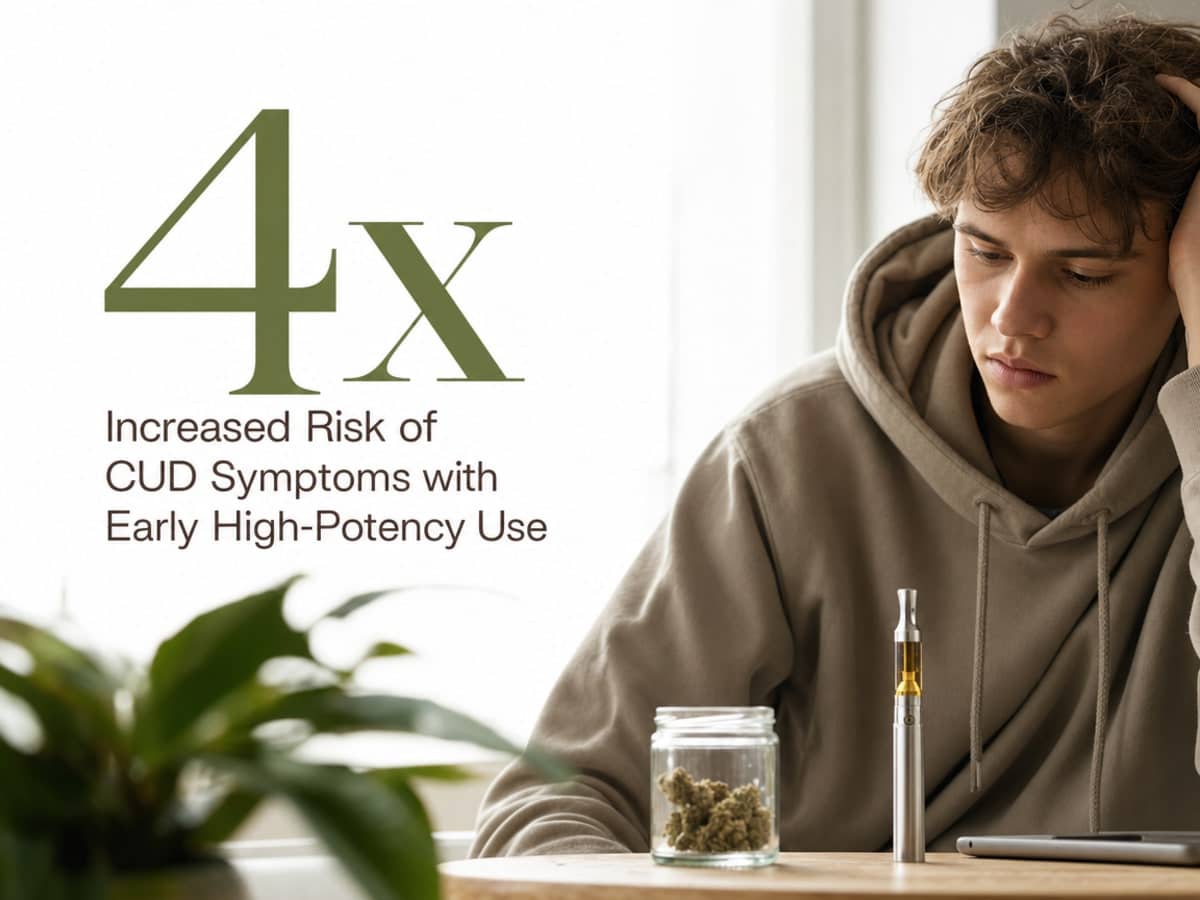
This matters because the whole idea that “weed isn’t really addictive” was built on a product that mostly doesn’t exist anymore. Higher-potency cannabis is linked to more tolerance, more physical dependence, and stronger withdrawal, and one study found that people who started with high-potency products had roughly four times the risk of developing cannabis use disorder symptoms within their first year of use compared with those who started on lower-potency cannabis 4. That’s not a moral claim about you. It’s a shelf-life claim about what’s in the jar.
So if you’ve been quietly wondering why cutting back feels harder than it “should,” or why a tolerance break wrecks your sleep for a week, or why the amount that used to last you a month barely lasts a weekend now — you’re not weak, and you’re not imagining it. The chemistry got stronger. Your nervous system responded the way any nervous system would.
You don’t have to accept a diagnosis to keep reading. You just have to be willing to look at what actually changed. That’s already something.
So can you actually get addicted to marijuana?
What the numbers actually say (and don’t say)
Short answer: yes. Longer answer: the risk isn’t the same for everyone, and knowing where you actually sit on the spectrum matters more than any yes-or-no headline.
Here’s the shape of it. Roughly 9% of people who ever try marijuana will develop an addiction to it. That jumps to about 17% for people who started as teenagers. And for people who use daily, the range climbs to somewhere between 25% and 50% 5. Those aren’t scare numbers pulled from a DARE pamphlet — they’re the epidemiology, and they’ve held up across reviews.
Notice what those numbers do and don’t say. They don’t say weed is as addictive as opioids. They don’t say every daily user is doomed. What they say is that risk scales with pattern. Someone who tried it twice in college and someone who’s been dabbing every morning for four years are not running the same experiment on their brain. The plant is the same word on paper. The relationship to it is completely different.
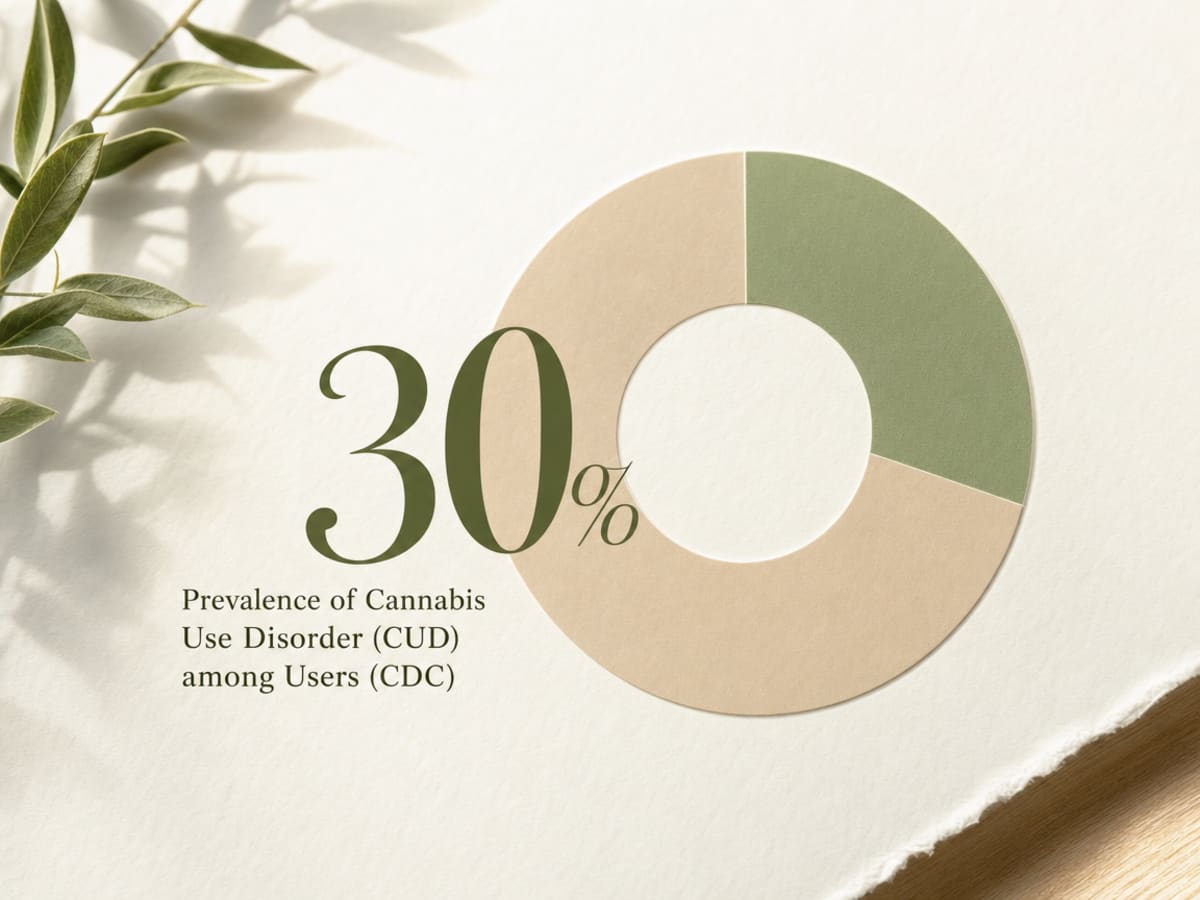
The CDC frames the same picture from another angle: about 3 in 10 people who currently use cannabis meet criteria for cannabis use disorder 2. That’s among users, not among the general population — an important scope detail that almost never survives the trip from research paper to Reddit thread. If you’re a daily high-potency user in Kansas City reading this at 11 p.m., the honest read of the data is that you’re in the tier where the odds have gotten meaningful, not that you’re a statistic waiting to happen.
What the numbers can’t tell you is what’s happening inside your own week. That part, only you know. And you already know some of it, or you wouldn’t have typed what you typed into the search bar.
Why this doesn’t mean everyone who smokes has a problem
It has to be said, because otherwise this page starts sounding like the thing it’s trying not to be.
Plenty of adults in the Kansas City metro use cannabis without developing a disorder. That’s real. Researchers who’ve looked closely at the evidence base have pointed out that cannabis’s effects are genuinely heterogeneous — outcomes vary by dose, product, age of first use, mental health history, and context 10. A weekend gummy after a long week is not the same physiological event as waking up to a dab pen. Treating them as the same thing is how public health messaging loses people’s trust.
So if you’re reading this and thinking, “I use, but I don’t think it’s a problem” — that might be completely accurate. The goal here isn’t to talk you into a diagnosis. It’s to give you honest information so that you can tell the difference between use that fits your life and use that’s quietly taking things from it.
If the numbers in the last section didn’t feel like they were about you, they probably weren’t. If a couple of them made your stomach drop a little, that’s worth sitting with for a minute. Neither reaction has to lead anywhere today. You’re just gathering data on yourself, which is what a person who’s thinking clearly does.
How to tell if your use has quietly changed
Most people who end up in a cannabis treatment conversation didn’t notice a single moment where things tipped. It happened in the way most drift happens — gradually, then all at once. So instead of asking yourself the big scary question (“Am I addicted?”), it’s more useful to look at the small, specific things that tend to shift when cannabis has moved from something you use to something you rely on.
Here’s what actually shows up in people’s lives, drawn from what clinicians recognize as the pattern of cannabis use disorder 1:
The morning has changed. You wake up and reach for the pen before you’re fully upright. Or you tell yourself you’ll wait until after work, and by lunch that plan has quietly renegotiated itself. First-thing use is one of the loudest signals, because it’s not about the high anymore — it’s about leveling out.
Sleep has become a hostage situation. You’ve tried a night without, and you didn’t sleep. Not “slept badly.” Didn’t sleep. That’s not a personality trait. That’s your endocannabinoid system telling you it’s gotten used to outside help.
The amount keeps climbing. What used to be a two-hit night is now half a cart. The half-gram of concentrate that lasted a week is gone by Wednesday. Tolerance isn’t a moral failing — it’s biology doing exactly what biology does when high-THC products are around consistently 1.
You’ve started hiding it. Not from strangers. From your partner, your roommate, your kid. You brush your teeth twice. You vape on the porch instead of the couch. The secrecy is doing more work than the substance at this point.
Cutting back hasn’t worked the way you expected. You’ve told yourself “just weekends” or “just after 7 p.m.” and watched the rule quietly dissolve. Maybe more than once. That failed-cutback pattern is one of the clearest markers clinicians look for.
You’re using through things, not around them. Anxiety spikes — you hit the pen. A hard conversation looms — you hit the pen. Boredom, grief, a bad performance review, a Tuesday. Cannabis has become the answer to feelings that used to have other answers.
You don’t need to check every box. You don’t need to check most of them. If two or three of those landed uncomfortably close, that’s worth paying attention to — not panicking about. Noticing is the whole task right now. Everything else can wait until you’ve had a chance to sit with what you noticed.
The Kansas City piece: two states, one metro, a lot of quiet use
Kansas City is one address and two very different sets of rules. Missouri legalized recreational cannabis in 2022. Kansas has not. If you live in the metro, you probably know exactly where the closest dispensary is on the Missouri side, and you probably also know the specific bridge you cross to get home. That drive is doing something to how people here use.
What it produces, in practice, is a lot of quiet use. Purchases happen on one side of the state line. Storage, consumption, and any consequences happen on the other. Partners don’t always know. Employers definitely don’t. The cart lives in a glove compartment or a drawer that doesn’t get opened when guests are over. None of this is unique to Kansas City, but the state-line geography sharpens it.
The problem with quiet use is that it stays quiet even when it stops working. You can’t easily tell your primary care doctor. You’re not going to bring it up at a family dinner in Overland Park. So the internal conversation about whether things have shifted happens entirely inside your own head, which is exactly the place it’s hardest to think clearly.
Cannabis use among adults your age is genuinely common — about 42% of adults 19 to 30 reported past-year cannabis use in 2023, with roughly 1 in 10 using daily 11. You are not the only person in your zip code having this thought tonight. You’re just the one currently reading about it.
What withdrawal actually feels like — and why it scares people out of trying
Here’s the thing almost nobody warns you about before you try to cut back: cannabis withdrawal is real, it’s uncomfortable, and it’s temporary. That last word is the one that gets left off most Reddit threads, which is part of why people give up on day three and decide they must “need” the pen after all.
What tends to show up, roughly in this order: sleep falls apart first. You lie down at your normal time and your brain refuses to power down. When you do sleep, the dreams come back loud — often vivid enough to wake you up. Appetite goes weird, sometimes gone entirely for a few days. Irritability spikes in a way that’s noticeable to the people around you before it’s noticeable to you. Anxiety climbs, sometimes to levels that feel worse than anything the weed was covering up. Sweating, headaches, and a low-grade physical restlessness are common. Higher-potency use tends to produce more of all of it, because the body had more to adjust to 4.
The rough shape of the timeline: symptoms usually start within 24 to 72 hours, peak somewhere around day three to seven, and taper over two to three weeks. Sleep is often the last thing to come back to baseline, and that lag is what most people cite when they say they “couldn’t do it.”
What gentle treatment for cannabis dependence looks like
The therapy part: MET, CBT, and being talked with instead of at
The therapy that actually works for cannabis dependence doesn’t look like the movies. Nobody yells at you. There’s no circle of folding chairs where you have to introduce yourself with a label you don’t believe. The two approaches with the most evidence behind them are motivational enhancement therapy (MET) and cognitive behavioral therapy (CBT), and both are built around the same premise: you are the expert on your own life, and the clinician’s job is to help you look at it honestly.
MET starts where you actually are, ambivalence and all. If half of you thinks you have a problem and half of you thinks you don’t, a good MET clinician doesn’t argue with either half. They ask better questions. What’s the weed doing for you? What’s it costing? What would you want to be different a year from now? The point is to let your own reasons surface, because reasons you talk yourself into stick better than reasons someone hands you 6.
CBT is the practical layer on top of that. It’s noticing the specific triggers — the drive home, the moment after dinner, the first work email that makes your shoulders tighten — and building actual alternatives for each one. Not willpower. Substitutions.
A 2025 meta-analysis of psychosocial interventions for cannabis use disorder found that MET-CBT increased both point and continuous abstinence compared with inactive controls, though the researchers were careful to note the certainty of the evidence is still low 7. That’s the honest read: this is the best-supported approach available, and it’s not magic. It’s a real thing that helps a lot of people, told to you without a sales pitch.
The part most cannabis programs miss: the anxiety or trauma underneath
Here’s the pattern that trips up a lot of cannabis treatment: the person stops smoking, feels worse, and everyone acts surprised. But if the weed was doing a job — quieting a nervous system that runs hot, muting a memory that won’t stay put, taking the edge off a depression that’s been there since long before the first bong — then removing it without addressing the underlying thing is just uncovering the wound. Of course you go back.
This is where dual-diagnosis, trauma-informed care actually matters, and it’s Sunflower’s specific reason for existing. The clinical team looks at the anxiety, the depression, the sleep disorder, the trauma history — whatever’s underneath — as part of the same conversation, not as a separate problem to handle later. Because “later” is usually when relapse happens.
If you’ve tried to cut back before and it didn’t hold, this is often why. It wasn’t that you lacked discipline. It was that the weed was doing work, and nothing else was in place to do that work when it left. Treatment that ignores that setup will keep failing you, and it’s not your fault that it did.
None of this means the trauma has to become the center of your identity. It means someone should be paying attention to it while you’re doing the harder physical part of stepping back from the substance. That’s it. Attention, not excavation on a schedule that isn’t yours.
Sleep, HRV, and the first two weeks off
The first two weeks off cannabis are the ones people quit on, and sleep is usually the reason. So it helps to have something better than a guess about how your body is actually doing.
Sunflower uses Huml Health wearables during treatment to track sleep quality, heart rate variability, and stress markers in real time. That sounds like a tech pitch, but here’s what it actually does: on day four, when you’re lying awake at 3 a.m. convinced your body will never sleep again, the data can show your clinical team that your HRV is already starting to recover, that you got more slow-wave sleep than you thought, that your resting heart rate is trending back down. Or it can show them the opposite, and they adjust the plan.
The point isn’t the gadget. The point is that early abstinence is the exact moment when the story your anxious brain tells you (“this is never going to get better”) and the story your nervous system is quietly telling (“I’m already recalibrating”) are often two different stories. Having the second one on a screen, in numbers, changes what people are able to sit through. It turns the worst week into a week with evidence attached.
You don’t have to call it addiction to make the call
Here’s the part most people get stuck on. To make the call, you feel like you have to first agree with yourself that you’re an addict. That’s a big word to swallow at 11 p.m. on a Tuesday when you’re not sure what you believe about your own use yet. So people don’t call. They keep sitting with the question instead.
You don’t have to do that. When you call Sunflower, you’re not signing up for anything. You’re not admitting to a label. You’re having a conversation with someone whose job is to help you figure out whether treatment is even the right next step for you — and to tell you honestly if it’s not. Sometimes the honest answer is that a few sessions of outpatient counseling is plenty. Sometimes it’s that a structured program would actually give your nervous system the runway it needs. Sometimes it’s that you’re doing better than you thought, and here are two things to keep an eye on.
The clinicians who take these calls are trained in the kind of client-centered, non-confrontational approach that assumes you’re the expert on your own life 6. Nobody’s going to pressure you into a bed. Nobody’s going to tell you what you are.
If you’re still reading, that’s the thing to notice. Call to talk it through. Not to commit to anything. Just to stop having this conversation alone.
Reach Out For Gentle Marijuana Recovery Support
Talk with a caring admissions specialist about your marijuana use and get clear next steps for support.
Frequently Asked Questions
Is marijuana really addictive, or is that just old anti-drug messaging?
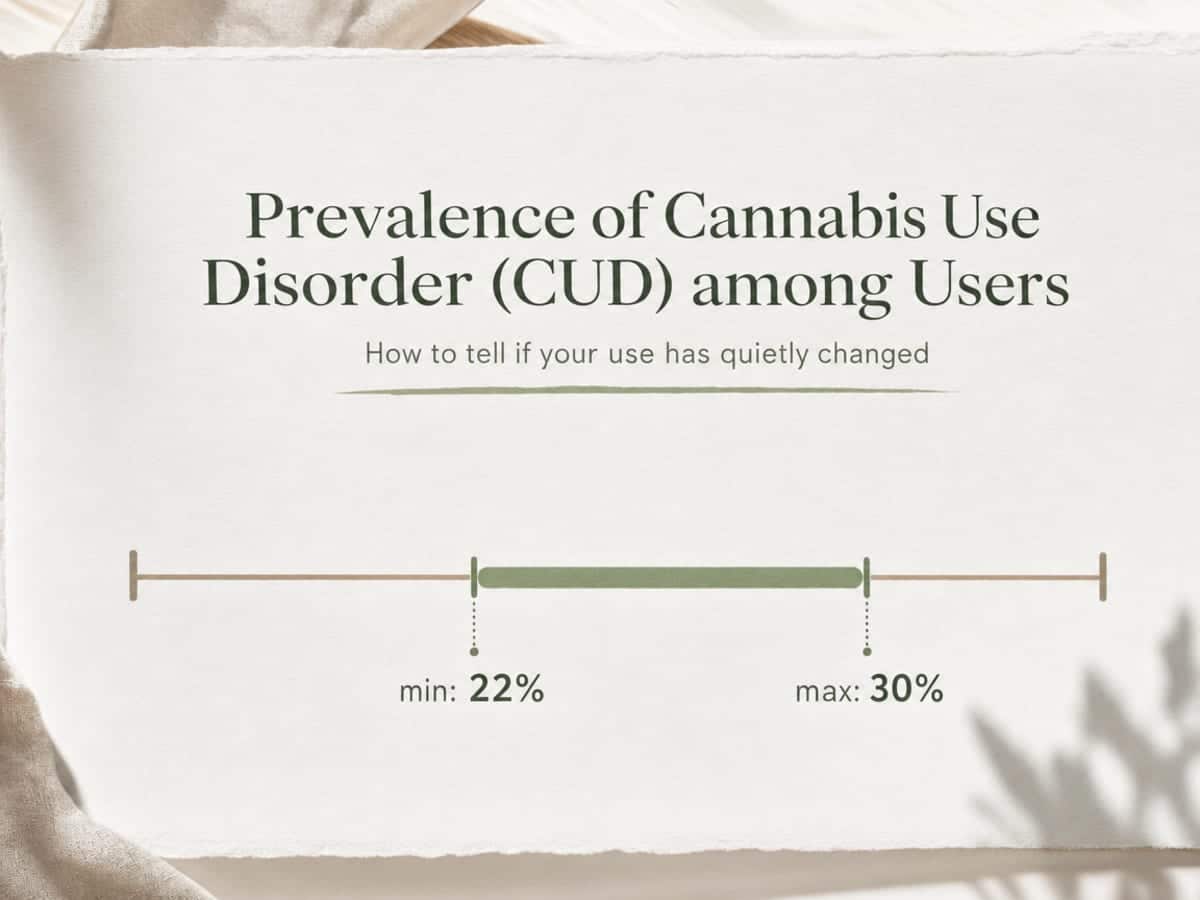
It’s really addictive for some people, and the research on that is solid — NIDA estimates that between 22% and 30% of people who use cannabis develop cannabis use disorder 1. That’s not DARE-era exaggeration; that’s current epidemiology. What’s changed since the old messaging is that today’s high-potency products carry more dependence risk than the flower most public-health campaigns were built around. The addiction is real. The framing around it just took a while to catch up.
How do I know if I need treatment or if I can just cut back on my own?
Honest test: try cutting back for two weeks. If you can, and it holds, you probably don’t need a program. If you notice you keep renegotiating the rule, or the first few nights of sleep are bad enough that you give up, that’s useful information. A single phone call with a clinician can help you figure out whether outpatient counseling is enough or whether something more structured would give you a better shot at making it stick.
What does cannabis withdrawal feel like, and how long does it last?
Sleep goes first — usually within the first 24 to 72 hours. Vivid dreams, irritability, appetite changes, sweating, and anxiety spikes are all common, and higher-potency users tend to feel more of it 4. Symptoms typically peak around day three to seven and taper over two to three weeks. Sleep is often the last thing to come back to baseline. It’s uncomfortable, but it’s finite. The people who make it past day seven usually describe the second week as noticeably easier.
I live in Missouri where weed is legal — does that change anything about getting help?
Legality doesn’t change whether a substance can create dependence, and it doesn’t change what treatment looks like. Sunflower works with people from both sides of the state line. What legalization does change is access — Missouri residents often use more, more consistently, and with easier availability of high-potency products, which is a real risk factor. The clinical conversation is the same. You don’t have to explain or defend anything about how you got the cannabis you’ve been using.
Do I have to stop completely, or can treatment help me just use less?
For some people, cutting back to a sustainable level is a workable goal, and a good clinician will talk through that honestly with you rather than push abstinence as the only option. For others — usually people with heavier daily use, co-occurring anxiety or depression, or a history of failed cutback attempts — full abstinence tends to hold better than moderation. Neither answer is a moral position. It’s a practical question about what your specific nervous system can sustain.
What happens if I call Sunflower but I’m not sure I actually want treatment?
Nothing you don’t agree to. The first call is a conversation, not an intake. You can describe what’s going on, ask questions, and hang up without committing to anything. The clinicians who take these calls use a client-centered, non-confrontational approach — the same evidence-based style federal guidance recommends for people who feel uncertain about their use 6. If treatment isn’t the right fit, they’ll say so. If it might be, you’ll leave the call knowing what the options actually look like.
References
- Cannabis (Marijuana). https://nida.nih.gov/research-topics/cannabis-marijuana
- Cannabis Facts and Stats. https://www.cdc.gov/cannabis/data-research/facts-stats/index.html
- Association of cannabis potency with mental ill health and addiction: a systematic review. https://pubmed.ncbi.nlm.nih.gov/35901795/
- Advancing the science on cannabis concentrates and behavioural health. https://pmc.ncbi.nlm.nih.gov/articles/PMC9878551/
- The Problem with the Current High Potency THC Marijuana. https://pmc.ncbi.nlm.nih.gov/articles/PMC6312155/
- Brief Counseling for Marijuana Dependence: A Manual for Treating Adults. https://library.samhsa.gov/product/brief-counseling-marijuana-dependence-manual-treating-adults/sma15-4211
- Effectiveness and safety of psychosocial interventions for the treatment of cannabis use disorder: A systematic review and meta-analysis. https://pubmed.ncbi.nlm.nih.gov/40318070/
- Randomized Controlled Trial of Motivational Enhancement Therapy and Cognitive Behavioral Therapy for Adolescent Marijuana Users. https://pmc.ncbi.nlm.nih.gov/articles/PMC3177997/
- The Health Effects of Cannabis and Cannabinoids. https://www.ncbi.nlm.nih.gov/books/NBK423845/
- Time to acknowledge the mixed effects of cannabis on health: a summary and critical review of the NASEM 2017 report. https://pubmed.ncbi.nlm.nih.gov/29271031/
- Cannabis and hallucinogen use among adults remained at historic highs in 2023. https://nida.nih.gov/news-events/news-releases/2024/08/cannabis-and-hallucinogen-use-among-adults-remained-at-historic-highs-in-2023