
Key Takeaways
- For Independence residents, the real decision isn’t Missouri versus Kansas but whether a program’s model actually treats what’s driving the use, not just the substance itself.
- Missouri’s treatment gap leaves roughly 891,000 people without care 12, which is why crossing into the Kansas City metro for an open bed is often practical, not dramatic.
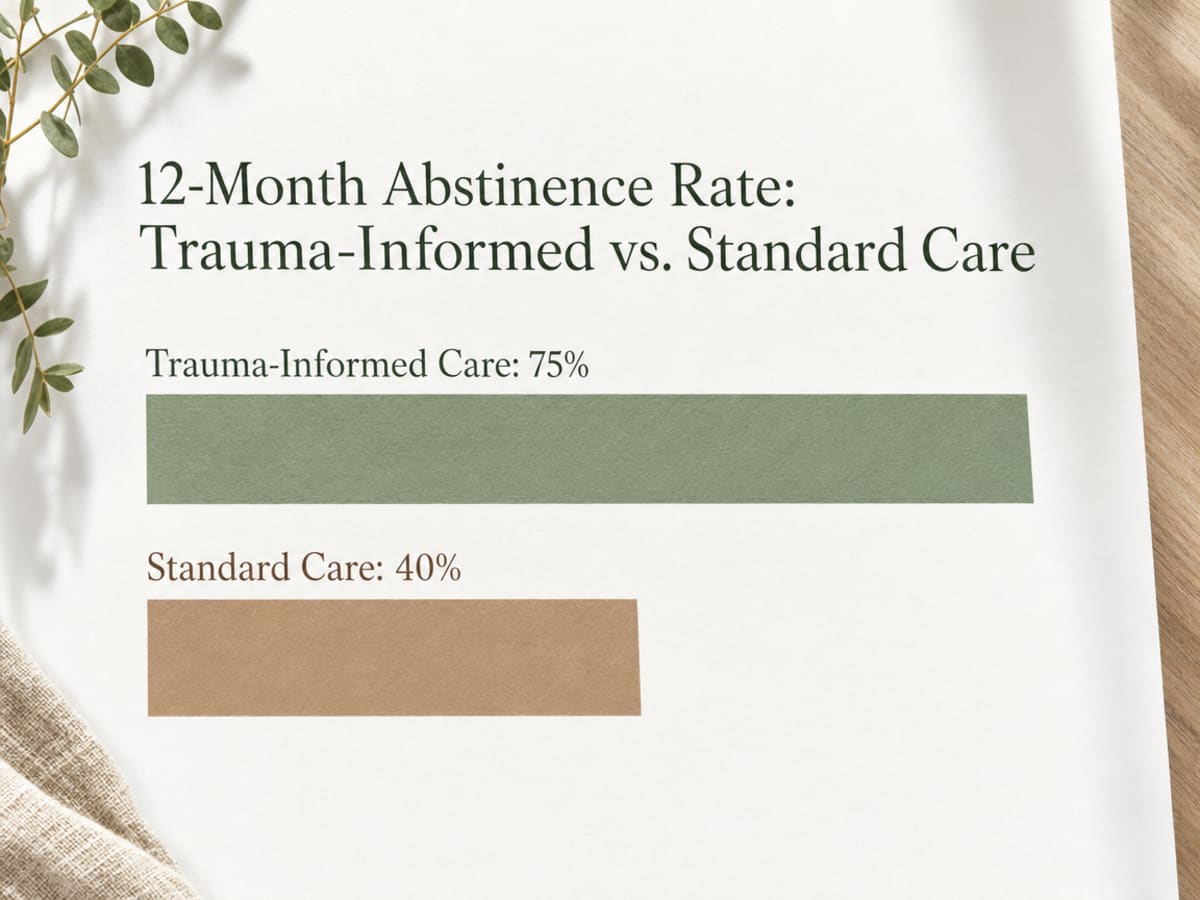
- Integrated, trauma-informed care matters more than location — one study showed 75% drug abstinence at 12 months with trauma-focused services versus 40% with standard care alone 3.
- Before committing, compare how programs handle co-occurring mental health, trauma-informed staffing, weekly schedules, insurance networks across state lines, and what discharge planning looks like ninety days out.
What You’re Actually Choosing Between
If you’re reading this from a kitchen table in Independence at 11 p.m., or from a parking lot off Noland Road because you needed to make the call somewhere your kids couldn’t hear, take a breath. You are not late. You are here.
The choice in front of you is smaller than it feels. It isn’t Missouri versus Kansas. It isn’t stay versus flee. It’s this: what kind of program is most likely to help the person you’re trying to help — you, your partner, your grown kid — actually stay better a year from now?
That question sorts itself into a few real options. You can stay close, at an outpatient program a few miles from home. You can go inpatient somewhere in Jackson County. Or you can look at residential programs a short drive west, across the state line into the Kansas City metro on the Kansas side, where several centers focus specifically on treating addiction alongside the trauma, depression, or anxiety underneath it.
None of those options is inherently right or wrong. What matters is whether the program matches what’s actually going on. If the drinking or the pills or the kratom is sitting on top of something older — a loss, an assault, a childhood that never quite let up — a program that only treats the substance will keep missing. SAMHSA has said for years that when both are present, they should be treated together, not in sequence 6.
So the real question isn’t where. It’s what. The next few pages walk you through how to tell the difference.
Why Independence Residents Look Beyond Their Zip Code
People in Independence don’t drive past the Truman Library, up I-435, and across the state line because they think Kansas is fancier. They do it because the math on treatment in Missouri doesn’t work in their favor.
Here’s what the numbers actually say. In Missouri, roughly 1.03 million people aged 12 and older meet criteria for a substance use disorder in a given year. About 275,000 of them get any kind of treatment. That leaves close to 891,000 Missourians who need care and aren’t getting it 12. The gap isn’t a rounding error. It’s the reason the phone lines are busy, the waitlists are real, and the bed you called about yesterday is gone today.
When you live in a city of about 120,000 people inside a metro that spills across two states, your search naturally spills across two states too. You already cross the line for work, for the airport, for a Chiefs game. Crossing it for a treatment program that has an open bed and treats what’s actually wrong is not a dramatic act. It’s how the Kansas City metro works.
There’s another piece worth naming. Not every program in your immediate area treats addiction and mental health together. Some do detox and 12-step and send you home. Some do outpatient counseling but don’t have a psychiatrist on staff who can adjust your medication. If what’s driving the use is untreated depression, or PTSD, or an eating disorder no one’s ever asked you about, a program that only addresses the substance is going to feel like putting a bandage on a broken bone.
Looking regionally isn’t giving up on your city. It’s admitting that the right program for you may not sit within the Independence city limits — and that’s okay. Most people who get well had to go somewhere to do it.
The Model Matters More Than the Map
Here is the sentence to hold onto: the kind of program you pick will predict your outcome more than the exit you take off the highway.
A randomized study of women in community substance abuse treatment programs put numbers on this. At 12-month follow-up, the group that received integrated trauma-focused services alongside standard addiction treatment had a 75% drug abstinence rate. The group that got standard care alone came in at 40% 3. That is one study, one population, one setting — women in urban community programs — and it should not be stretched into a promise about any individual. But the gap between those two bars is not small, and it points at something the field has been saying for a while. When trauma is part of the picture, treating it in the same room as the addiction changes what happens a year later.
Read that again if you need to. The intervention wasn’t a fancier building. It wasn’t a different city. It was a different model of care layered onto the same kind of program.
That’s the part worth carrying into your search. When you call a rehab and ask what they do, you are not really asking about their address. You are asking whether their clinicians are trained to recognize trauma and treat it in an integrated way, whether there’s a psychiatrist who can adjust medication for depression or anxiety while you’re there, whether the treatment plan will change if what you actually need turns out to be different from what the intake paperwork said.
SAMHSA’s guidance lines up with this. Their advisory on treating co-occurring disorders names integrated care as the preferred model — mental health and substance use handled concurrently, by a coordinated team, not passed back and forth between two systems that don’t talk to each other 4. That principle doesn’t care about state lines. It cares about how a program is built.
So when you’re comparing a program 10 minutes from your house in Independence with one 45 minutes west in Kansas, the useful question isn’t which one is closer. It’s which one is actually going to treat what’s driving the use. If the closer program does that well, stay close. If it doesn’t, distance is a small price for a model that has a better chance of working.
You are allowed to choose the program that fits the problem. That is not disloyalty to your city. That is paying attention.
The Trauma Underneath the Use
Most people don’t start drinking because they love the taste. Most people don’t chase pills because pills are fun. The use is doing a job. It’s numbing something, quieting something, letting you sleep, letting you get through a shift, letting you tolerate being in your own skin.
That’s the part a lot of programs skip past. They treat the drinking or the using like it’s the whole problem. Get you sober, teach you the steps, send you home. And for some people that works. For a lot of others — probably including whoever you’re reading this for — it doesn’t, because the thing underneath the use never got named, let alone treated.
SAMHSA’s own literature is direct about this. More than half of women seeking substance abuse treatment report at least one lifetime trauma, and trauma-related disorders should not keep anyone out of treatment or be left off the treatment plan 10. The rates for men are not small either. And when PTSD and a substance use disorder show up together, people tend to have more severe symptoms, more relapses, and more physical health problems than either condition would cause on its own 9.
You may already know this in your body. You may know exactly when the drinking got heavier. A death. A deployment. A relationship that took something from you. A childhood you don’t talk about. Or you may have no idea — just a feeling that something is off and the substance is the only thing that turns the volume down.
Either way, a program that asks about it — really asks, on day one, with clinicians trained to hear the answer — is different from one that doesn’t. Trauma-informed care as an organizational standard means the whole staff is trained to recognize trauma, avoid re-traumatizing people during treatment, and build the plan around what actually happened to you rather than around a checklist 2.
You are not broken for needing that. You are paying attention to something the last program may have missed.
What Residential Care Actually Does Differently
Outpatient care asks you to fit recovery into the life you already have. Residential care asks the opposite: for a stretch of weeks, life gets rebuilt around the work.
That difference is not just about beds and meals. When you live on-site, the substance is not within reach at 9 p.m. on a hard Tuesday. The people you drank with are not in the next room. The job that grinds you down is on hold. What replaces all of that is structure — a daily schedule of individual therapy, group work, medical check-ins, and time to sleep — plus staff who are trained to notice when something is off before you have to say it out loud.
For someone with trauma sitting under the addiction, that container matters. A 2025 study of a residential program using a structured trauma-informed model found significant reductions in substance involvement at three months, along with improvements in depression, anxiety, and PTSD symptoms 5. The authors were careful about their limits — smaller sample, no long follow-up — but the direction is consistent with what SAMHSA has said for years. When trauma and addiction are treated together, in a setting built for it, people tend to get further than they do when the two are handled in parallel or one at a time 1.
Residential also changes what a bad day costs. In outpatient, a bad day can mean a relapse before your next appointment. Inside a program, a bad day means a conversation with a clinician that afternoon and a plan by morning. The margin for error is wider.
None of this makes residential care the right answer for everyone. Some people have kids they can’t leave, jobs that won’t hold, or a level of use where PHP or IOP is a better clinical fit. But if you have tried outpatient before and it didn’t hold, or if what’s underneath the use has never actually been treated, a stretch of weeks in a program built for both is a different intervention — not just a longer version of the same one.
How to Think About Drive Time as a Clinical Variable
Drive time is not just a logistics question. It’s a clinical one, and it cuts in different directions depending on the level of care you’re choosing.
For outpatient treatment, closeness genuinely matters. A study of 1,735 urban outpatient clients found that people who traveled less than a mile to their program were 50% more likely to complete treatment than those who traveled more than a mile, and people who traveled more than four miles tended to have shorter stays 7. That makes intuitive sense. Outpatient care asks you to show up two, three, sometimes five days a week around a job, kids, and a car that may or may not start. Every extra mile is another chance for the appointment to lose to real life.
Residential care changes that math. You are not commuting. You move in. The drive from Independence happens twice — once on admissions day, once on the way home — plus family visit days in between. What was a daily barrier in outpatient becomes a handful of planned trips.
From most of Independence, the drive to Osawatomie, Kansas runs about 45 minutes to an hour on a normal day. You pick up I-435 south, then I-35 southwest toward Ottawa, then a short stretch of state highway. It is a straight, unglamorous drive through farmland — the kind you can do in the dark with coffee. For a spouse or parent making a Sunday visit, it’s a manageable morning, not an expedition.
Crossing the Kansas Line: Insurance, Family Visits, and Logistics
The state line looks bigger on a map than it does in practice. If you have a commercial insurance plan through work — Blue Cross, Aetna, Cigna, United, most of the plans people in Independence carry — that plan almost always covers care at in-network facilities in Kansas the same way it covers care in Missouri. Networks are built by insurers, not by state governments. A five-minute call to the number on the back of your card will tell you exactly which Kansas-side programs are in-network and what your out-of-pocket looks like. Any decent admissions team will make that call with you or for you.
Medicaid is the exception worth naming. If you’re on MO HealthNet, out-of-state coverage gets complicated, and some Kansas facilities — including Sunflower — don’t participate in Medicaid at all. That’s a real barrier, and it’s worth asking about on the first call so you don’t spend a week chasing a program that can’t take your coverage.
Family visits are the other logistics question that tends to loom large before it happens. From most of Independence, Osawatomie sits about 45 minutes to an hour southwest. That’s a Sunday morning with coffee, not a plane ticket. Most residential programs have structured family days, family therapy sessions by phone or video during the week, and clear visitation windows on weekends. Your spouse can drive down, do family group, have lunch, and be home by dinner.
Admissions day itself is usually one trip. Someone drives you, or the program helps arrange transportation. You bring a bag. The car goes home. The next time you make that drive is when you’re leaving — which, by then, is a different trip than the one you took to get there.
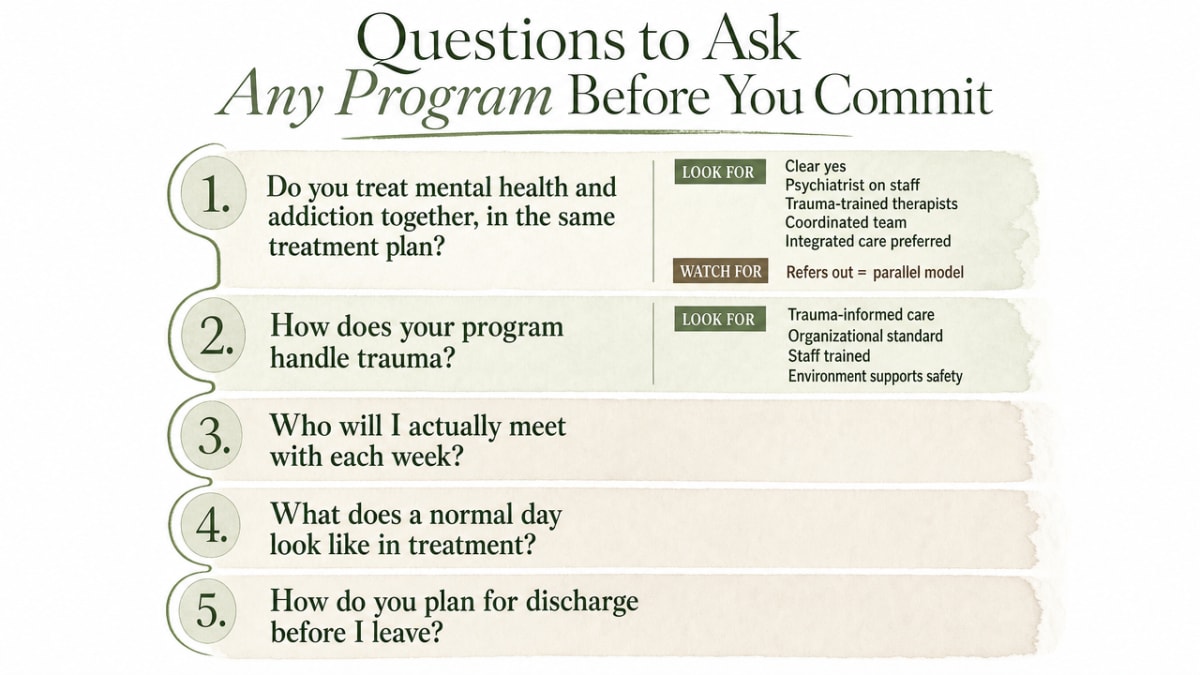
Questions to Ask Any Program Before You Commit
Admissions calls tend to sound the same at first. Warm voice, quick intake questions, promises to help. What separates a program that will actually do the work from one that just wants your bed filled shows up in how they answer specific questions. Ask these before you say yes.
- Do you treat mental health and addiction together, in the same treatment plan?
- The answer you want is a clear yes, with names — a psychiatrist on staff, therapists trained in trauma work, a coordinated team. SAMHSA is direct that integrated care is the preferred model for people with co-occurring conditions, not a specialty upgrade 4. If the program treats one and refers out for the other, that’s a parallel model, not an integrated one.
- How does your program handle trauma?
- Listen for whether trauma-informed care is an organizational standard — staff trained, environment designed, plans built around what happened to the person — or a single group on Wednesdays. TIP 57 is clear that trauma-related disorders should not exclude anyone from addiction treatment and need to be addressed in the plan itself 10.
- What does a week actually look like?
- Ask for the schedule. Individual therapy hours per week, group topics, medical check-ins, family programming, time for sleep. Vague answers here usually mean vague programming.
- What happens if the plan isn’t working?
- Good programs adjust. Ask how often treatment plans get reviewed and who’s in the room when they do.
- What does discharge look like?
- Not the day you leave — the ninety days after. Ask about step-down to PHP or IOP, medication continuity, and how they hand you off.
You are allowed to ask all of this. A program that gets impatient with the questions is telling you something.
One Option Worth Naming
If a program that treats addiction and trauma together, in a residential setting, sounds like what you or your person actually needs, Sunflower Recovery is one option worth putting on your list. It sits in Osawatomie, Kansas — about 45 minutes to an hour southwest of Independence via I-435 and I-35. The program is built around trauma-informed dual diagnosis care, with a 60-day residential track and step-down PHP and IOP for when it’s time to come back closer to home.
Sunflower takes most commercial insurance plans. It does not participate in Medicare or Medicaid, so if that’s your coverage, ask on the first call and they’ll help point you toward a program that fits.
Missouri residents are welcome, and honestly, common. If you want to talk through whether the program matches what’s actually going on, call. A real person will answer. You don’t have to have your decision made before you dial.
Connect for Safe, Trauma-Informed Recovery Support
Start your personalized path out of crisis with a team that understands Independence challenges.
Frequently Asked Questions
Can I use my Missouri insurance at a rehab in Kansas?
In most cases, yes. Commercial plans through work — Blue Cross, Aetna, Cigna, United — build networks by insurer, not by state. Kansas facilities are routinely in-network for Missouri members. Call the number on the back of your card, or let the program’s admissions team run a benefits check. MO HealthNet (Medicaid) is the exception; some Kansas programs, including Sunflower, don’t take Medicaid at all.
How far is Osawatomie, Kansas from Independence, MO?
About 45 minutes to an hour on a normal traffic day. From most of Independence you pick up I-435 south, connect to I-35 southwest toward Ottawa, and finish on a short stretch of state highway. It’s a straight drive through farmland — the kind you can do with coffee and the radio, not a trip that requires planning around weather or airports.
Will my family be able to visit if I go out of state for treatment?
Yes. A 45-minute to one-hour drive from Independence to Osawatomie is a Sunday morning, not a plane ticket. Most residential programs schedule weekend visitation windows, family therapy sessions by phone or video during the week, and structured family days. A spouse or parent can drive down, participate in family group, share a meal, and be home by dinner.
What is dual diagnosis treatment, and do I need it?
Dual diagnosis treatment means addiction and a co-occurring mental health condition — depression, anxiety, PTSD, an eating disorder — get treated together, in the same plan, by a coordinated team. SAMHSA calls integrated care the preferred model when both are present 6. If your use is sitting on top of something older that has never been treated, or if past rehabs only addressed the substance, dual diagnosis care is likely what you need.
Why choose residential rehab instead of an outpatient program closer to home?
Outpatient works when your daily environment is stable enough to support recovery between appointments. When it isn’t — when the substance is at home, when the people you used with are next door, when a bad Tuesday means a relapse before your next session — residential changes the container. You live on-site for weeks, with therapy, medical support, and staff trained to notice when something’s off. For people with trauma underneath the use, that structure is often what finally lets the work land 5.
What should I do if I’ve tried rehab before and it didn’t work?
First, you are not the failure. A lot of programs treat the substance and stop there. If what’s driving the use — trauma, depression, anxiety — never got named or treated, the last program was solving a different problem than yours. Ask the next program specifically how they handle mental health alongside addiction, whether trauma-informed care is built into the whole program, and whether the plan will adjust if what you actually need turns out to be different 4.
References
- Integrated Treatment for Co-Occurring Disorders Evidence-Based Practices (EBP) KIT. https://www.samhsa.gov/resource/ebp/integrated-treatment-co-occurring-disorders-evidence-based-practices-ebp-kit
- A Systematic Review of Trauma Informed Care in Substance Use and Related Settings. https://pubmed.ncbi.nlm.nih.gov/39641885/
- Effects of Integrated Trauma Treatment on Outcomes in Women’s Community Substance Abuse Treatment Programs. https://pmc.ncbi.nlm.nih.gov/articles/PMC2219564/
- Substance Use Disorder Treatment for People with Co-Occurring Disorders. https://library.samhsa.gov/sites/default/files/pep20-06-04-006.pdf
- Feasibility and outcomes of a trauma-informed model of care in residential alcohol and other drug treatment. https://pubmed.ncbi.nlm.nih.gov/39566845/
- Managing Life with Co-Occurring Disorders. https://www.samhsa.gov/mental-health/serious-mental-illness/co-occurring-disorders
- Distance traveled to outpatient drug treatment and client retention. https://pubmed.ncbi.nlm.nih.gov/14693257/
- Effects of Integrated Trauma Treatment on Outcomes in Women’s Community Substance Abuse Treatment Programs. https://www.ncbi.nlm.nih.gov/pmc/articles/PMC2219564/
- A Review of the Literature – Trauma-Informed Care in Behavioral Health Services. https://www.ncbi.nlm.nih.gov/books/NBK207192/
- TIP 57: Trauma-Informed Care in Behavioral Health Services. https://library.samhsa.gov/sites/default/files/sma14-4816.pdf
- Behavioral Health Barometer: Missouri, Volume 6. https://www.samhsa.gov/data/sites/default/files/reports/rpt32842/Missouri-BH-Barometer_Volume6.pdf
- 2023 NSDUH: State Estimates of Substance Use and Mental Health, Missouri Tables. https://www.samhsa.gov/data/sites/default/files/reports/rpt56188/2023-nsduh-sae-state-tables_0/2023-nsduh-sae-state-tabs-missouri.pdf
- CDC Drug Overdose Deaths: Dashboard. https://www.cdc.gov/drugoverdose/fatal/dashboard/index.html