
Key Takeaways
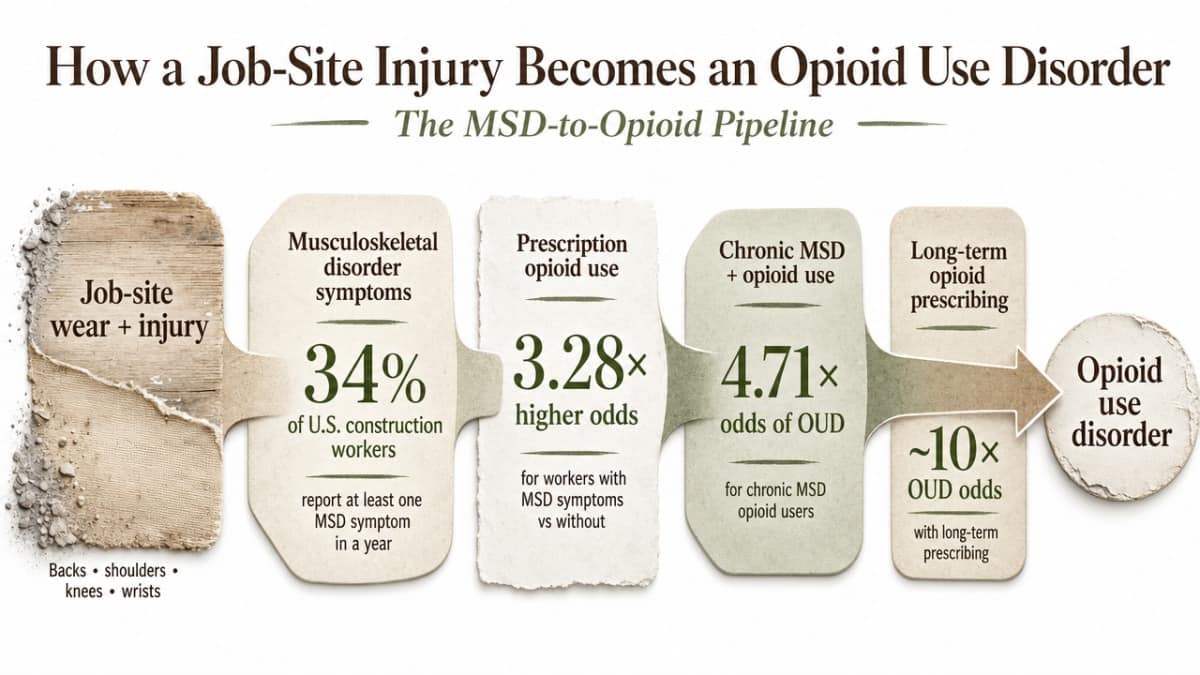
- Construction injuries funnel workers into long-term opioid prescriptions, and long-term prescribing raises the odds of a later opioid use disorder nearly tenfold in claims data 14.
- Stigma, masculine job-site culture, and fear of being labeled unreliable keep Kansas tradesmen silent, and distress rises while help-seeking drops as the problem worsens 3.
- Work-ready treatment in Osawatomie pairs injury care, non-opioid pain management, trauma-informed dual diagnosis, and fitness and sleep tracking for a body that still has to work.
- A fifteen-minute verification-of-benefits call clarifies commercial insurance coverage at Sunflower Recovery before any commitment; Medicare and Medicaid are not accepted.
The Short Walk from a Back Tweak to a Prescription Bottle Problem
You know the day. You were setting a header, moving a stack of drywall, coming down off a scaffold wrong. Something in your low back said no. You iced it, took what the doc gave you, and went back Monday because that’s what you do. The bottle was supposed to be for a week. Somehow it kept getting refilled.
If you’re reading this, you already know how the rest goes. The pills stopped touching the pain the way they used to. You started counting hours until the next dose. Maybe a buddy handed you something stronger. Maybe you found kratom or 7-OH at the gas station and told yourself it wasn’t really a drug. Maybe the beer after work turned into six, and the six turned into whatever kept you asleep.
None of this makes you weak. It makes you a construction worker with a body that got hurt doing hard work, and a health system that reached for a prescription pad. About 16% of U.S. construction workers use prescription analgesics in a given year, and roughly 10% use prescription opioids — most of it tied to work-related injury and musculoskeletal pain 15. You are not the exception on the crew. You’re the rule nobody talks about at lunch.
What follows is straight talk about how the pipeline works, why the guys around you don’t say anything, and what treatment looks like when it’s built for a body that still has to swing a hammer.
How a Job-Site Injury Becomes an Opioid Use Disorder
The MSD-to-Opioid Pipeline Nobody Warned You About
Nobody hands you a pamphlet at the union hall about this. But the pipeline is well-documented, and it starts with the thing you already know: your body takes a beating. Backs, shoulders, knees, wrists. Twenty years of kneeling on subfloor. Ten years of lifting sheetrock overhead. A fall from a step ladder that you played off because the GC was watching.
Roughly a third of U.S. construction workers — about 34% — report at least one musculoskeletal disorder symptom in a given year, and when researchers looked at prescription opioid use among those workers versus workers without MSD symptoms, opioid use was more than three times higher (adjusted odds ratio of 3.28) in the MSD group 13. That is not a coincidence. That is a system working exactly the way it was set up to work: you hurt yourself doing your job, the clinic gives you a script, and the script does what scripts do.
The chronic part is what gets people. Back, shoulder, and knee injuries in construction don’t heal clean. They flare when it’s cold, when you’re framing all day, when the load is off by a few pounds. The medical literature has been clear for years that MSDs in this trade are persistent and often lifelong 10. So the prescription doesn’t stay a one-week thing. It becomes how you get out of bed. It becomes how you finish the shift.
Workers’ compensation systems have historically written a lot of these scripts, and reviewers have flagged for years that long-duration opioid prescribing through comp is tied to delayed recovery and higher risk of dependence 11. None of this is on you. It’s the road that was paved for you.
When Long-Term Scripts Turn Into Something Else
Here is the number that ought to be on a poster in every trailer.
Ten times. Think about what that means. If you got a rotator cuff surgery two years ago and the scripts kept coming, you are not in the same lane as somebody who took a five-day course after a wisdom tooth pull. You are in a lane where the odds of developing a real, diagnosable opioid use disorder are stacked against you by an order of magnitude — not because you did anything wrong, but because that is what long-term exposure to these medications does to the human brain and body.
This is the part where most guys start blaming themselves. Don’t. The study doesn’t say you’re weak. It says the prescription pathway itself is the risk factor. When somebody hands you a 90-day supply of oxycodone for a chronic back problem, they are handing you dice that are already loaded. Knowing that is the first thing that lets you stop treating this like a character flaw and start treating it like what it is: a predictable outcome of a broken pain-management system.
Alcohol, Kratom, 7-OH, and What Actually Shows Up on the Crew
The prescription bottle is one lane. It is rarely the only lane.
When the pills run out or the doctor cuts you off, the pain doesn’t. So the crew figures things out. A twelve-pack after work to sleep through the throbbing. Kratom powder from the gas station because a buddy said it takes the edge off. 7-OH tablets stacked at the counter next to the energy shots, marketed like a supplement, hitting like something else entirely. Maybe something stronger passed along by a guy on second shift.
None of this is unusual. Construction carries a disproportionate share of workplace overdose fatalities compared with other industries 1, and NIOSH has been explicit that the mix of high injury rates, seasonal layoffs, and heavy opioid prescribing has built a real crisis in the trade 2. Fatal injury counts in construction remain among the highest of any sector 9, which is another way of saying: this is a job where a lot of people get hurt, a lot of people get medicated, and a lot of people are hurting in ways that don’t show up on an OSHA form.
If you’re stacking substances — pills plus alcohol, kratom plus 7-OH, whatever the combination is — you are not an outlier. You are somebody whose body has been asking for relief and finding it wherever it can. Treatment that only names the opioids and ignores the rest isn’t treatment. It’s paperwork.
Why Guys on the Crew Don’t Ask for Help
The Foreman’s Fear: Being Labeled Unreliable
Ask any journeyman what happens to a guy who gets tagged as unreliable, and you already know the answer. He gets called last. He gets the crap jobs. He gets the layoff when the weather turns. In a trade where your next paycheck depends on the GC picking up the phone, being labeled anything — hurt, slow, shaky, off — is a professional death sentence.
Researchers who sat down with construction managers heard exactly this. Workers on their crews delayed asking for help or did it in secret because they were scared that disclosing a mental health or substance problem would tank their career or brand them as somebody who couldn’t be trusted on-site 6. The same study found that workers almost never walked up and said the words out loud. They waited for a peer or a foreman to notice something was off, and even then, the conversation happened in a truck bed or a parking lot, never in front of the crew 6.
The systematic review of male workers in high-risk industries backs this up across the board: stigma, masculine norms, and fear of losing the job come up in study after study as the reasons guys keep quiet 12. So if you have been sitting on this for months, or years, you are not being stubborn for no reason. You are doing the math the way you were taught to do it. The problem is the math has changed, and the cost of staying silent is now higher than the cost of making the call.
Distress Goes Up, Help-Seeking Goes Down
Here is the cruel part of how this works. The worse it gets, the less likely you are to reach out.
A study of 511 construction workers found that psychological distress in the trade ran above national averages, and that as distress went up, the likelihood of seeking help went down — not up, the way you might expect 3. The researchers traced part of that drop to two specific gaps:
- workers didn’t feel confident talking to guys on the crew about what was going on, and
- they didn’t actually know how to get help even if they wanted to 3.
Read that again. The guys who need it most are the least likely to call. Not because they don’t care about their families or their careers. Because the deeper you get, the more shame stacks on top, and the harder it is to say the sentence out loud. A mixed-methods study of 264 commercial construction workers found the same pattern: stigma was directly tied to psychological distress and to sleep problems, and the masculine culture of the job site plus job insecurity were named by workers themselves as what kept them quiet 5.
If this describes you, the read isn’t that something is wrong with you. The read is that you are exactly the guy this pattern predicts. That’s useful information. It means the silence is the symptom, not the identity.
Why an App Won’t Fix This
You might be thinking: fine, I’ll download something. Watch a video. Do it on my phone at night so nobody knows.
Researchers tried that. A randomized controlled trial of a smartphone stigma-reduction program built specifically for male construction workers ran for six weeks and showed no significant effect on self-blame, shame, or the parts of the brain that stop you from asking for help 4. Light-touch digital tools didn’t crack the culture. They didn’t get guys to make the call.
That’s not a knock on you for trying. It’s the evidence that this particular problem needs more than a screen. It needs a real conversation, with a real person, in a program built for a body that hurts and a career that matters. That’s the phone call, not the app.
What Work-Ready Treatment Actually Looks Like in Osawatomie
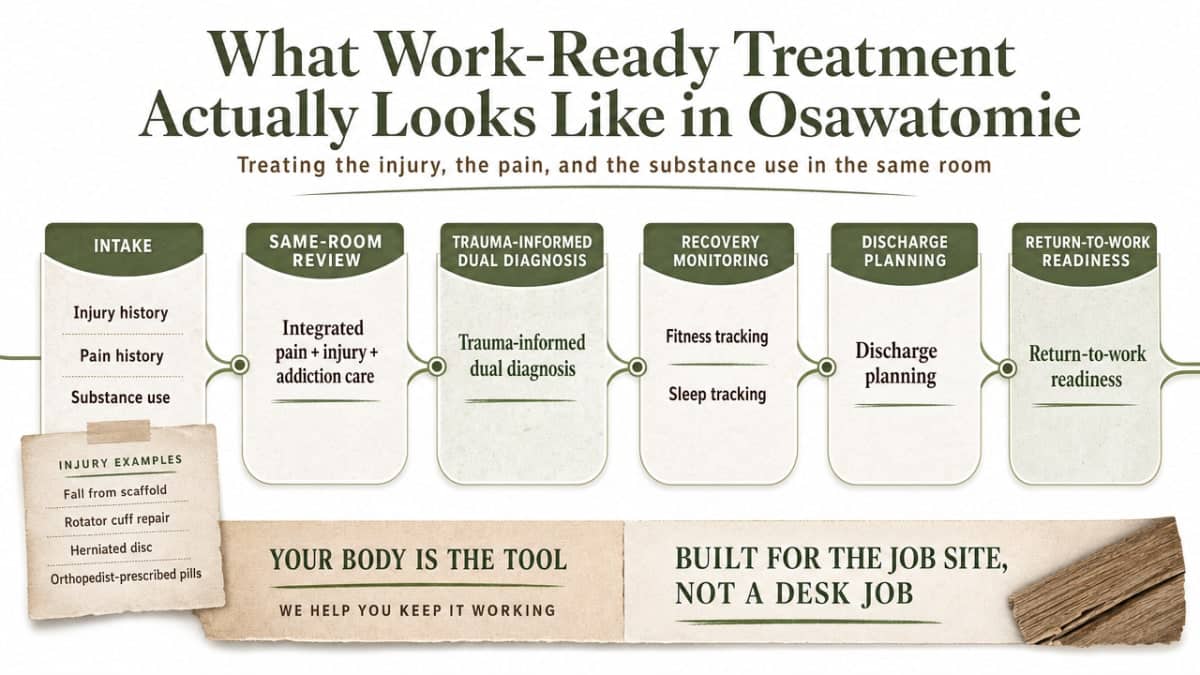
Treating the Injury, the Pain, and the Substance Use in the Same Room
Most rehab programs are built for people whose main job is sitting at a desk. That is not you. Your body is the tool. If treatment ignores the shoulder that still catches when you reach overhead, or the low back that flares every time the temperature drops, it is going to fail you the second you walk back onto a job site.
Work-ready treatment starts by putting the injury and the substance use on the same table. At Sunflower Recovery in Osawatomie, that means the intake conversation asks about the fall from the scaffold, the rotator cuff repair, the herniated disc, and the pills the orthopedist wrote — not just the drinking or the opioid use. NIOSH has spent years pointing out that integrated pain, injury, and addiction strategies are what this trade actually needs, and that safer prescribing without a real treatment plan leaves workers stranded 2. Cutting somebody off from opioids without addressing the pain underneath is how relapses happen. Nobody on the clinical team here is going to pretend the pain isn’t real.
What that looks like in practice: a 60-day residential program with medical oversight, non-opioid pain management options, physical activity built into the day, and a treatment plan that adjusts as your body changes over the two months. You are not being asked to white-knuckle a chronic back problem. You are being asked to let a team of people who know both addiction medicine and chronic musculoskeletal pain build you a plan that doesn’t require a prescription bottle to get through Tuesday.
Trauma-Informed Dual Diagnosis: The Missing Piece for Injured Workers
Here is what most guys on the crew have never been told out loud: what happened to you on the job may qualify as trauma, and that changes how treatment has to work.
The fall you almost didn’t walk away from. The buddy who went off the fifth floor. The near-miss with the trench collapse that you never talked about because the crew moved on the next morning. The chronic pain itself, the kind that wakes you up at 3 a.m. and makes you dread the alarm. SAMHSA’s federal guidance on trauma-informed care — Treatment Improvement Protocol 57 — tells clinicians to screen every client with a possible trauma history early in treatment, not to wait for a period of abstinence first, and to specifically help clients see how substances have been used to manage trauma symptoms in the short term while quietly making everything worse in the long term 7. That is the framework. It is not soft. It is the standard.
Dual diagnosis means the team is looking at what is riding alongside the substance use: depression, anxiety, PTSD, the sleep that stopped working years ago, the eating patterns that fell apart when the pain took over. Treating only the drinking or only the opioids while ignoring the trauma and the mood disorder is why so many guys go through a 30-day program and end up right back where they started by Labor Day. The pieces have to be worked at the same time.
What this looks like on the ground in Osawatomie: individual trauma-focused therapy, groups where you are sitting with other adults who have been through the same physical work and the same silence, and clinicians who are not going to flinch when you describe what actually happened on the job. You do not have to have the words for it on day one. That is part of what the program is for.
Fitness, Sleep, and the Body You Still Have to Work In
You are going back to a physical career. The program has to respect that.
Fitness programming at Sunflower is not a wellness gimmick. It is built in because the body you are working to get sober is the same body that has to swing a hammer, climb a ladder, and carry a bundle of shingles up a pitch when you leave. Rebuilding strength, mobility, and cardiovascular capacity during the 60 days matters as much as the therapy hours. A body that moves better hurts less, and a body that hurts less is not begging for a pill at the end of the day.
Sleep is the other piece. If you have been using opioids, alcohol, kratom, or 7-OH to knock yourself out at night, your natural sleep architecture is wrecked. That doesn’t come back on its own. Sunflower uses Huml Health biometric wearables during treatment to track sleep quality, resting heart rate, and heart rate variability, so the clinical team can actually see what your recovery is doing to your body in real time and adjust the plan when something isn’t working. It is not surveillance. It is data that lets the team catch problems — poor sleep, elevated stress markers — before those problems become the reason you reach for something on a Wednesday night.
The Kansas Piece: Osawatomie, Kansas City, and What Insurance Covers
Getting help in Kansas means getting help somewhere you can actually get to. Sunflower Recovery sits in Osawatomie, about an hour south of Kansas City, on ground that feels more like the country than a clinic. That matters when you are used to being outside and the idea of a fluorescent-lit hospital wing makes your skin crawl. Guys drive in from Kansas City job sites, from Wichita, from Topeka, from small towns along I-35 and K-7.
Kansas as a whole has been living through the same overdose wave as the rest of the country. The Kansas Department of Health and Environment tracks opioid and polysubstance overdose data statewide, and the numbers make clear that this is not a coastal problem or a big-city problem 8. What KDHE does not break out is occupation — nobody is publishing a Kansas-specific number for construction workers alone, so anyone who quotes one is guessing. What is clear is that the workers dying and getting hospitalized are your neighbors.
On the money side: Sunflower accepts most commercial insurance, including plans you likely carry through a union, a signatory contractor, or a spouse’s job. Medicare and Medicaid are not accepted — that is the honest answer, not a runaround. A verification-of-benefits call takes about fifteen minutes and tells you exactly what your plan covers before you commit to anything.
What Happens on the First Call, and What Happens After Discharge
The first call is not a commitment. It’s a conversation. Someone picks up, asks what’s going on, and listens. You can use a first name. You can say the pills, the drinking, the kratom, the 7-OH out loud without a script. You’ll get asked about the injury, the work, the insurance card in your wallet, and what you’re worried about — the job, the family, the crew finding out. Nobody is going to push you onto a bed that afternoon. If residential is the right call, the team walks you through what the 60 days actually look like, from the medical intake to the day you drive home.
Discharge planning starts before you leave, not the week you’re packing up. The clinical team builds out what comes next: continued therapy through the Partial Hospitalization Program or Intensive Outpatient Program if you need a step down, a plan for pain management that isn’t a bottle of oxycodone, family sessions if that’s part of the picture, and a return-to-work strategy that respects the reality of a physical trade. You leave with a plan, not a pamphlet.
Call and talk it through. You don’t have to commit to anything on the first call.
Talk to Someone Who Understands Construction Life
Start your recovery journey with support built for Kansas tradespeople facing pain, stress, and tough job cultures.
Frequently Asked Questions
Can I go to treatment without losing my job or my spot on the crew?
In most cases, yes. Federal law protects your job when you seek treatment for a substance use disorder, and many workers use FMLA or short-term disability to cover the time away. Your employer does not get a diagnosis. Union brothers and foremen have walked this path before you. The bigger risk to your career is staying silent until something happens on-site that you can’t walk back.
What if my pain is real and I still need something for my back after treatment?
Your pain is real. Nobody at Sunflower is going to pretend otherwise. Treatment includes non-opioid pain management, physical therapy-style movement work, and a discharge plan that includes a strategy for chronic musculoskeletal pain 10. You leave with names of clinicians who understand construction injuries and can manage pain without dropping you back onto the same prescription pathway that got you here 11. Nobody is asking you to just tough it out.
Does Sunflower Recovery take my insurance?
Sunflower accepts most commercial insurance plans, including the ones carried through most union locals, signatory contractors, and spouses’ employer plans. Medicare and Medicaid are not accepted — that’s the straight answer. A verification-of-benefits call takes about fifteen minutes and tells you exactly what your specific plan covers for residential, PHP, or IOP before you commit to anything. No pressure, no obligation to enroll after the call.
I’m using kratom or 7-OH to get through shifts. Is that really addiction treatment territory?
Yes. Kratom and 7-OH act on the same opioid receptors as prescription pain pills, and dependence is real, even if the gas station sells them next to the beef jerky. If you’ve tried to stop and couldn’t, or you’re using them to sleep, work, or manage pain, that’s the same territory. Sunflower treats kratom and 7-OH dependence directly, alongside alcohol and prescription opioid use. You’re not the first caller with this.
My husband won’t call. What can I do as his wife or foreman?
You can call for him. The research is clear that construction workers rarely walk up and ask for help directly — they wait for somebody who knows them to notice and open the door 6. You can ask the questions, get the insurance verified, and understand what the program looks like before you bring it to him. Family programming is part of the treatment. Sometimes the first call from a spouse is what moves the whole thing.
How long will I be away from the job site?
Residential treatment at Sunflower runs 60 days. That sounds like a long time when you’re staring at a mortgage and a truck payment. It is also the length of program the clinical team has found gives injured workers with chronic pain a real shot at not being back in a bottle by Thanksgiving. Step-down options like PHP and IOP let you keep working while continuing care. Discharge planning starts before day one ends.
References
- Overdose Fatalities at Worksites and Opioid Use in the Construction Industry. https://stacks.cdc.gov/view/cdc/85344
- Addressing the Opioid Overdose Epidemic in Construction. https://www.cdc.gov/niosh/bulletin/2021/opioids-in-construction.html
- Exploring the relationship between psychological distress and likelihood of help seeking in construction workers: The role of talking to workmates and knowing how to get help. https://pubmed.ncbi.nlm.nih.gov/32955473/
- A smart-phone intervention to address mental health stigma in male construction workers: A randomized controlled trial. https://pmc.ncbi.nlm.nih.gov/articles/PMC5769092/
- Mental Health Stigma and Wellbeing Among Commercial Construction Workers: A Mixed Methods Study. https://pubmed.ncbi.nlm.nih.gov/32541624/
- Construction Managers’ Experiences of Help-Offering: A Qualitative Study. https://pmc.ncbi.nlm.nih.gov/articles/PMC12027290/
- TIP 57: Trauma-Informed Care in Behavioral Health Services (Full PDF). https://library.samhsa.gov/sites/default/files/sma14-4816.pdf
- Drug Overdose Reports & Resources (Kansas Department of Health and Environment). https://www.kdhe.ks.gov/1308/Overdose-Reports-Resources
- National Census of Fatal Occupational Injuries in 2022 – Detailed tables (construction-related entries). https://www.bls.gov/iif/oshwc/cfoi/work_rel_inj_ill_age_2022.htm
- Work-related musculoskeletal disorders and associated pain among construction workers: A review. https://pubmed.ncbi.nlm.nih.gov/30362596/
- Opioid prescriptions in workers’ compensation: A review of current evidence and policy. https://pubmed.ncbi.nlm.nih.gov/31188705/
- Barriers to mental health help-seeking among male workers in high-risk industries: A systematic review. https://pubmed.ncbi.nlm.nih.gov/34080359/
- Musculoskeletal Disorders and Prescription Opioid Use Among U.S. Construction Workers. https://pmc.ncbi.nlm.nih.gov/articles/PMC7799490/
- Predictors of Long-Term Opioid Use and Opioid Use Disorder Among Construction Workers. https://pubmed.ncbi.nlm.nih.gov/33231876/
- Pain and Prescription Opioid Use Among US Construction Workers. https://pmc.ncbi.nlm.nih.gov/articles/PMC8842216/
- TIP 57: Trauma-Informed Care in Behavioral Health Services. https://library.samhsa.gov/product/tip-57-trauma-informed-care-behavioral-health-services/sma14-4816
- Trauma-Informed Care in Behavioral Health Services (Supplemental Guidance). https://library.samhsa.gov/sites/default/files/sma15-4912.pdf