
Key Takeaways
- Kansas City’s management-heavy workforce and Missouri’s 35,000+ annual treatment admissions show senior professionals aren’t outliers — delaying care is what compounds career and health risk 3, 7.
- 42 CFR Part 2 and Missouri Statute 630.140 create a layered confidentiality shield that blocks routine subpoenas, controls redisclosure, and requires your written consent before records move 8, 9, 5.
- A 60-day residential path in Osawatomie sits about 45 minutes from the Plaza — close enough for family sessions, removed enough from the streets and triggers where recognition happens.
- Before committing, compare how a program handles Part 2 subpoena protocols, consent scoping, redisclosure notices, dual-diagnosis delivery under TIP 42, and when discharge planning actually begins 10, 11.
The Delay That Costs More Than the Treatment
You already know something is wrong. You’ve known for a while. The Sunday-night dread has a specific texture now, and you’ve started tracking your own drinking, or your own pill count, the way you track a quarterly close. What you’re weighing isn’t whether you have a problem. It’s whether getting help will cost you more than the problem itself.
That calculation is where careers actually break.
The research is clear on this, even if the conversation around it usually isn’t. Adults who enter community and employment-oriented treatment programs are 1.65 to 2.07 times more likely to be employed afterward than those who don’t, according to a peer-reviewed analysis of U.S. adults with substance use disorders 1. The same study found that perceived stigma erodes those gains. Treatment helps. Fear of being seen entering treatment is what damages the career trajectory.
So the delay isn’t neutral. Every quarter you wait, the judgment errors compound, the physical margin narrows, and the people closest to you learn to work around the version of you that’s shrinking. The treatment isn’t what threatens the career you’ve built. Continuing to hide is.
This piece is for the Kansas City executive weighing that math right now, or the spouse or chief of staff reading it on their behalf. What follows is not a brochure. It’s a straight look at how discreet, structured care actually works, what the law protects, and what a real path forward looks like from where you’re sitting.
Why Kansas City Executives Wait Too Long
The Productivity Culture That Rewards Hiding
The culture you operate in was built to reward output, not honesty about strain. That isn’t a moral failure on your part. It’s the water you swim in. A qualitative study of faculty at a large university, one of the closest available analogs to a high-responsibility corporate environment, found that addiction disclosure was rare and that non-disclosure was directly shaped by “alcohol and productivity cultures” of the workplace 2. Faculty feared reputational harm more than they feared the underlying condition. The same dynamic runs through partner tracks, C-suites, and closely held businesses in Kansas City.
What this means for you, practically: the environment you’ve succeeded in has been quietly teaching you that hiding is the safer bet. Miss a deadline and there are consequences. Show vulnerability about substance use and the consequences feel unbounded. So you compensate. You schedule around the drinking, or the pills, or the kratom. You take the early flights so nobody sees the tremor. You handle the Monday board call, then collapse.
That pattern can hold for a long time. It usually holds until it doesn’t. And workplace stigma research confirms this isn’t paranoia on your part — stigma toward people who use substances functions as a real, daily barrier in professional environments 12. Naming that clearly is the first honest step.
The Local Scale of the Problem
You are not the outlier you feel like at 2 a.m. Kansas City is a management-heavy metro — the Bureau of Labor Statistics counts roughly 67,850 management jobs in the area, with a mean annual wage of $123,160 7. That’s the population you belong to: senior professionals with decision authority, compensation that makes treatment financially accessible, and reputational exposure that makes them delay it anyway.
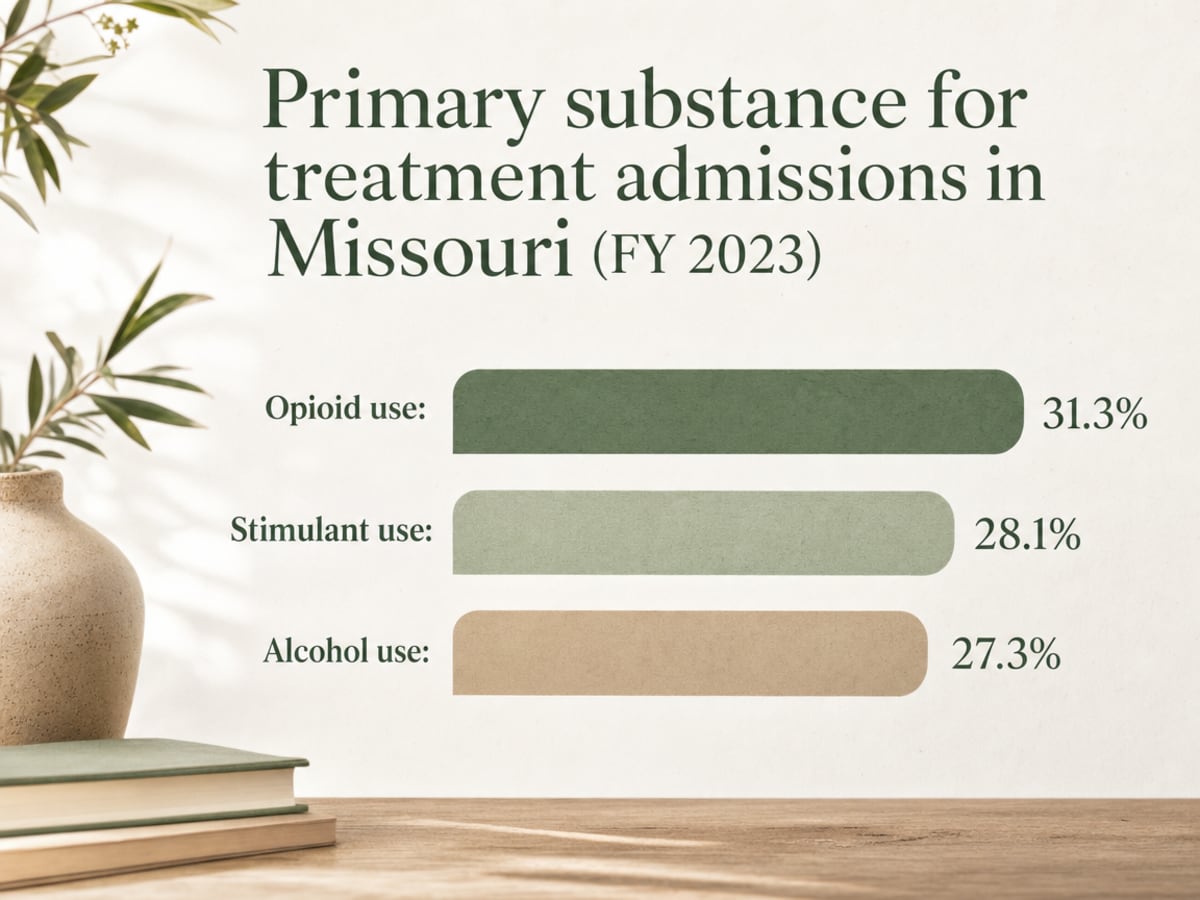
Missouri’s own treatment data tells a related story about what senior professionals are actually being treated for, and it isn’t what stereotypes suggest. In fiscal year 2023, more than 35,000 Missouri residents were admitted to substance use disorder treatment services. The primary substances broke down as:
- 31.3% opioid use
- 28.1% stimulant use
- 27.3% alcohol use 3
Alcohol is present, but it isn’t the whole picture. The pills prescribed after a knee surgery three years ago, the stimulants that started as focus support during a brutal deal cycle, the drinking that grew from client dinners into something else — those are the shapes this takes for people in your position.
The scale matters for one reason. If you are quietly worried that entering treatment will mark you as unusual in your professional circle, the numbers say the opposite. What’s unusual is getting help early enough that the rest of your life stays intact. Most of the 35,000 admissions last year came after the wait was too long. You have the option to make a different call.
The Confidentiality Architecture Behind Discreet Care
42 CFR Part 2 and What It Actually Prevents
The federal rule that matters most for you is 42 CFR Part 2. It exists specifically because Congress recognized decades ago that people with substance use disorders would not seek care if their records could be pulled into ordinary legal, employment, or public proceedings. The protection is narrower and stronger than HIPAA.
Here is what it actually does. Any federally assisted substance use disorder program — which covers essentially every accredited residential treatment provider in the country — is prohibited from disclosing “records of the identity, diagnosis, prognosis, or treatment” of any patient without specific written consent or a qualifying court order 8. The regulatory text goes further: those records “may not otherwise be used or disclosed in any civil, criminal, administrative, or legislative proceedings” absent the narrow exceptions built into the rule 9.
Read that sentence twice. It means a subpoena arriving from opposing counsel in a shareholder dispute, a business divorce, a custody matter, or a regulatory inquiry does not, on its own, unlock your treatment records. A judge must make specific findings under Part 2’s court-order standard before those records move. That is a very different bar than the one that applies to your general medical file.
The rule was updated in a 2024 final action, with full compliance required by February 16, 2026 8. The update tightened protections around how consented disclosures can be used and clarified restrictions on records in legal proceedings. For a Kansas City executive weighing whether treatment can be entered without becoming discoverable material in the next deal or dispute, this is the legal spine of the answer.
Missouri Statute 630.140 and the Redisclosure Rule
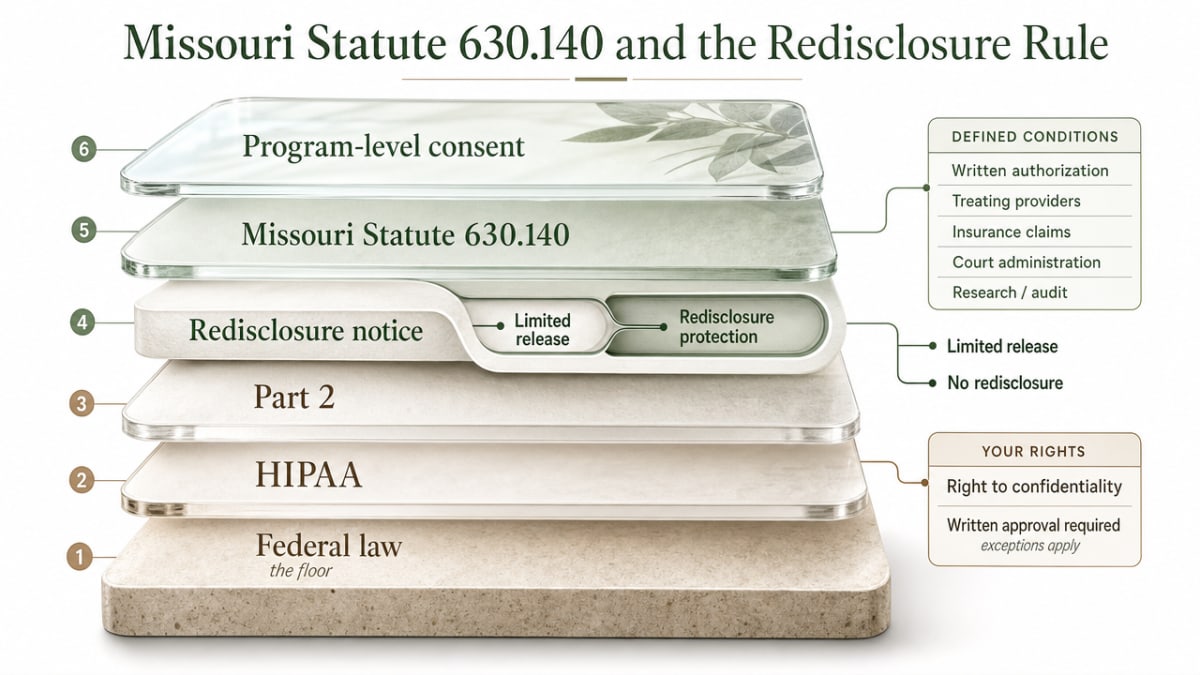
Federal law is the floor. Missouri adds its own layer. Under Section 630.140 of the Missouri Revised Statutes, mental health and substance use facilities may release patient information only under defined conditions: written authorization from you, coordinated care with treating providers, insurance claim processing, court administration under narrow standards, or specific research and audit purposes 5. The Missouri Department of Mental Health states the underlying right plainly — every consumer “has the right to confidentiality of information and records in accordance with federal and state law and regulation,” and written approval is required before information is released, subject to the enumerated exceptions 4.
The piece most executives miss is the redisclosure protection. When you authorize a limited release — say, to a specific attorney, an insurance carrier, or a family member — the records do not lose their protected status once they arrive. Federal Register materials on the Part 2 final rule confirm that records disclosed at the patient’s request “retain their status as protected part 2 records in the hands of downstream recipients,” who receive notice that federal rules prohibit unauthorized redisclosure 10.
In practical terms: if you consent to share a treatment summary with your general counsel, that document does not then float freely into board packets, HR files, or opposing discovery. The protection travels with the record. That layered structure — Part 2 federal, redisclosure notice, HIPAA overlay, Missouri statute 630.140, and program-level consent controls at the facility itself — is what discreet executive treatment is legally built on.
Where the Fear Is Rational Anyway
Legal protection is real. It is also not the same as social protection, and pretending otherwise would be dishonest with you.
What this changes is the planning, not the decision. A discreet path is built by anticipating the social exposure the law cannot reach: choosing a facility outside your immediate metro, thinking through the cover story with your spouse or chief of staff before admission rather than after, and defining in advance who inside your organization needs to know and who does not. The legal architecture buys you the room to make those choices deliberately. It does not make them for you.
What a 60-Day Residential Path Actually Looks Like
The Osawatomie Corridor: Close but Removed
Geography is doing quiet clinical work here. Sunflower Recovery Center sits in Osawatomie, Kansas — roughly 45 minutes southwest of the Country Club Plaza, an hour from downtown Kansas City. That distance is not decorative. It is short enough that your spouse can drive out for a family session on a Thursday afternoon and be home for dinner. It is long enough that you are not in a facility your neighbor might drive past on the way to a soccer game.
That matters because, as covered earlier, the exposure risks the law does not cover are the ones a colleague running into you at a gas station creates. Osawatomie removes you from the specific streets, restaurants, and social routes where recognition happens. It also removes you from the trigger environments — the office lobby, the drive home, the drawer where the pills live. You cannot do the clinical work while you are still inside the map that produced the problem.
The corridor works in both directions. Close enough that critical, pre-planned work touchpoints remain possible when clinically appropriate. Removed enough that the default is quiet.
Trauma-Informed, Dual-Diagnosis Care Without the Wellness Vocabulary
The clinical model matters more than the setting, and this is where a lot of executive-oriented programs lose the plot. If treatment is styled as a spa with a therapist attached, the underlying condition does not resolve. You return to the same pressure with the same coping architecture and a slightly better tan.
What actually works for the population you belong to is integrated dual-diagnosis care built on a trauma-informed foundation. SAMHSA’s TIP 42 defines this approach directly: trauma-informed care means “creating a treatment environment that is responsive to the unique needs of individuals with histories of trauma” 11. That framework treats the substance use and the underlying driver — depression, anxiety, unresolved trauma, an eating disorder, chronic burnout that hardened into something clinical — as one clinical problem, not two.
For most senior professionals, the substance is not the origin. It is the tool. The drinking managed the anxiety that started after the acquisition. The stimulants managed the exhaustion that started when your father died and you kept working through the funeral week. The pills that started as a prescription became the only way to stop the loop at night. Removing the substance without addressing what it was doing for you is why so many people relapse within 90 days of a first attempt.
At Sunflower, the 60-day residential structure is built to give the underlying condition time to surface and be treated. A multidisciplinary team develops a custom plan — individual therapy, group work with a cohort of adults dealing with comparable complexity, family programming your spouse can participate in, structured fitness, and discharge planning that begins in the first two weeks rather than the last two. It is clinical work, done in a residential setting, without the group-home aesthetic. The vocabulary is medical. The outcomes are the point.
Measurable Recovery: Biometric Tracking and Executive-Legible Milestones
You run your work on data. Recovery, done well, can be run the same way. Sunflower integrates Huml Health biometric wearable technology into the residential program — real-time tracking of sleep quality, resting heart rate, heart rate variability, and stress recovery. Your clinical team uses that data to adapt the treatment plan as it goes. If your HRV is not recovering, that is a signal, not a mystery. If your sleep architecture is still fragmented in week three, the medication or the therapy protocol adjusts.
This is not a gadget layer. It is the difference between a program that hopes you feel better and a program that measures whether your nervous system is actually stabilizing.
The milestones matter too, and they are ones you can recognize. Sleeping through the night without waking at 3 a.m. Sitting through a family session without the tightness in your chest. Returning a phone call clear-headed. Completing a week where the impulse showed up and you watched it pass. Small wins, in the executive-legible sense — small only because they are countable, not because they are minor. They are the foundation the next quarter of your life gets built on.
Delay vs. Structured Absence: What Each Actually Costs
Put the two paths side by side, honestly.
On one side is continued delay. The drinking or the pills or the stimulants stay in the schedule. Judgment errors keep compounding in ways only you can see clearly — the deal you should have walked from, the email you should not have sent at 11:47 p.m., the board question you fumbled and had to recover from over the following week. Your physical margin narrows. Your spouse learns to work around a version of you that keeps shrinking. Your assistant covers for the mornings. The exposure risk you were trying to avoid by hiding does not go down over time. It goes up, because the behavior gets harder to compensate for as the underlying condition progresses.
On the other side is 60 structured days. Handled deliberately, with the confidentiality architecture already covered, this is a planned, private absence — not a public event. What it preserves is measurable: clinical stabilization of both the substance use and the underlying driver, legal protection of the records that document it, a discharge plan built while you are still in treatment rather than improvised after, and the version of your judgment that made you successful in the first place.
The outcome evidence backs this framing. A peer-reviewed analysis of adults with substance use disorders in the U.S. found that participation in community-oriented and employment-oriented treatment programs increased the odds of being employed by 1.65 and 2.07 times, respectively — and that perceived stigma blunted those gains 1. Read that carefully. Treatment protects the career. What erodes the gain is not the treatment itself. It is the exposure fear that made you wait, and the visibility of the entry.
That is exactly what a discreet, structured path is designed to solve. The absence is finite. The delay is not.
What to Ask Before You Commit to a Program
Before you sign anything or step onto a plane, there are a handful of direct questions that will tell you whether a program is actually built for someone in your position — or whether it’s borrowing the language without the underlying structure.
Ask how the program complies with 42 CFR Part 2, and specifically how it will respond to a subpoena. A serious program will describe its court-order protocol, not just wave at the regulation 9. Ask what the consent form looks like, who by name and role can be contacted, and whether that list can be narrowed to one person — your spouse, your general counsel, no one else.
Ask about redisclosure notices on any document that leaves the facility. If a treatment summary goes to your carrier, the downstream recipient should receive the federal notice that prohibits onward sharing 10. If the intake coordinator can’t explain that in plain language, keep looking.
Ask how dual-diagnosis is actually delivered, not just claimed. Who diagnoses the co-occurring condition, when in the stay, and how does the trauma-informed framework SAMHSA lays out in TIP 42 shape the daily schedule 11? Ask what discharge planning starts on which day. Ask what happens if you need to take one pre-scheduled call in week five.
The answers should sound clinical and specific. If they sound like marketing, that is the answer.

Calling Sunflower: A Direct, Private Conversation
There is no form to fill out first. The most useful next step, when you’re ready or when the person reading this on your behalf is ready, is a phone call. Not to enroll. To ask questions in real time, without a paper trail forming, and to hear how the admissions team actually talks about confidentiality, dual-diagnosis care, and the practical mechanics of a 60-day residential stay 45 minutes from the Plaza.
What that call sounds like matters. You should be able to describe your situation in general terms and hear specific answers back — how consent is scoped, who at Sunflower would know your name and who would not, how the clinical team handles the first 72 hours, what a discharge plan looks like on paper. If any of that turns vague or salesy, you have your answer about the program.
Bring the questions from the previous section. Bring your spouse, your chief of staff, or your general counsel if that’s easier than making the call alone. Ask what the intake day actually looks like. Ask what you can bring with you.
One conversation does not commit you to anything. It does give you information the Sunday-night version of you cannot get on your own. That is the honest starting point.
Take the First Step Toward Confidential Recovery
Connect with someone who understands executive challenges and start building your discreet, structured plan today.
Frequently Asked Questions
Will my employer, board, or colleagues be notified if I enter treatment?
No. Under 42 CFR Part 2, a federally assisted treatment program cannot disclose your identity, diagnosis, or records without your specific written consent or a qualifying court order 9. You control who is notified and who is not. If nobody at your company needs to know, nobody is told.
How does 42 CFR Part 2 differ from standard HIPAA protections?
HIPAA governs medical records broadly. Part 2 is narrower and stronger for substance use records specifically. It bars the use of those records in civil, criminal, administrative, or legislative proceedings absent narrow exceptions, and requires a specific court-order standard rather than a routine subpoena 8, 9. Your general medical file does not carry that same shield.
Can I stay connected to critical work responsibilities during a 60-day residential program?
Limited, pre-planned touchpoints are possible when clinically appropriate — a scheduled call, a signature, a board vote. What is not compatible is running your job from residential treatment. The clinical work requires enough separation from the pressure environment to let the underlying condition surface and be treated. Your team can plan the coverage before you arrive.
How far is the Osawatomie facility from Kansas City, and why does the distance matter?
Osawatomie sits roughly 45 minutes southwest of the Country Club Plaza. Close enough that your spouse can drive out for a family session and be home for dinner. Far enough that you are removed from the specific streets, restaurants, and social routes where a colleague might recognize you — and from the trigger environments that produced the pattern.
What happens if my spouse or chief of staff is the one making this call for me?
That is common and welcomed. A trusted person can ask the initial questions, gather logistics, and hear how confidentiality is scoped without any protected record being created about you. Missouri law requires your written approval before any information is released 4, so the early conversation stays exploratory until you decide to move forward yourself.
What should I ask a program before committing to protect my confidentiality?
Ask how they respond to a subpoena under Part 2, who by name receives your consent form, and whether that list can be narrowed to one person. Ask whether documents leaving the facility carry the federal redisclosure notice 10. Ask how dual-diagnosis is diagnosed and when discharge planning begins. Specific answers signal a serious program.
References
- Treatments, Perceived Stigma, and Employment Outcomes among People with Substance Use Disorders. https://pmc.ncbi.nlm.nih.gov/articles/PMC8776030/
- A Qualitative Exploration of Addiction Disclosure and Stigma Among University Faculty. https://pmc.ncbi.nlm.nih.gov/articles/PMC8306368/
- 2024 Status Report on Missouri’s Substance Use and Mental Health. https://dmh.mo.gov/alcohol-drug/reports/status-report/2024
- Confidentiality – Missouri Department of Mental Health. https://dmh.mo.gov/mental-illness/confidentiality
- Missouri Revised Statutes – Section 630.140: Records and Information – Confidentiality. https://revisor.mo.gov/main/OneSection.aspx?section=630.140
- Employer Perceptions about Addiction Recovery and Hiring Decisions. https://dc.etsu.edu/cgi/viewcontent.cgi?article=1716&context=honors
- Kansas City, MO‑KS – May 2023 Occupational Employment and Wage Estimates. https://www.bls.gov/oes/2023/may/oes_28140.htm
- Fact Sheet 42 CFR Part 2 Final Rule. https://www.hhs.gov/hipaa/for-professionals/regulatory-initiatives/fact-sheet-42-cfr-part-2-final-rule/index.html
- 42 CFR Part 2 — Confidentiality of Substance Use Disorder Patient Records. https://www.ecfr.gov/current/title-42/chapter-I/subchapter-A/part-2
- Confidentiality of Substance Use Disorder Patient Records; Final Rule (Federal Register excerpt). https://public-inspection.federalregister.gov/2020-14675.pdf?1594653313
- Substance Use Disorder Treatment for People With Co‑Occurring Disorders (SAMHSA TIP 42, updated). https://www.psychiatry.wisc.edu/wp-content/uploads/2023/05/SAMHSA-TIP-42.pdf
- “A huge, unwieldy barrier to push through on a daily basis”: The effects of stigma on alcohol and other drug workers and workplaces. https://pubmed.ncbi.nlm.nih.gov/40628020/