
Key Takeaways
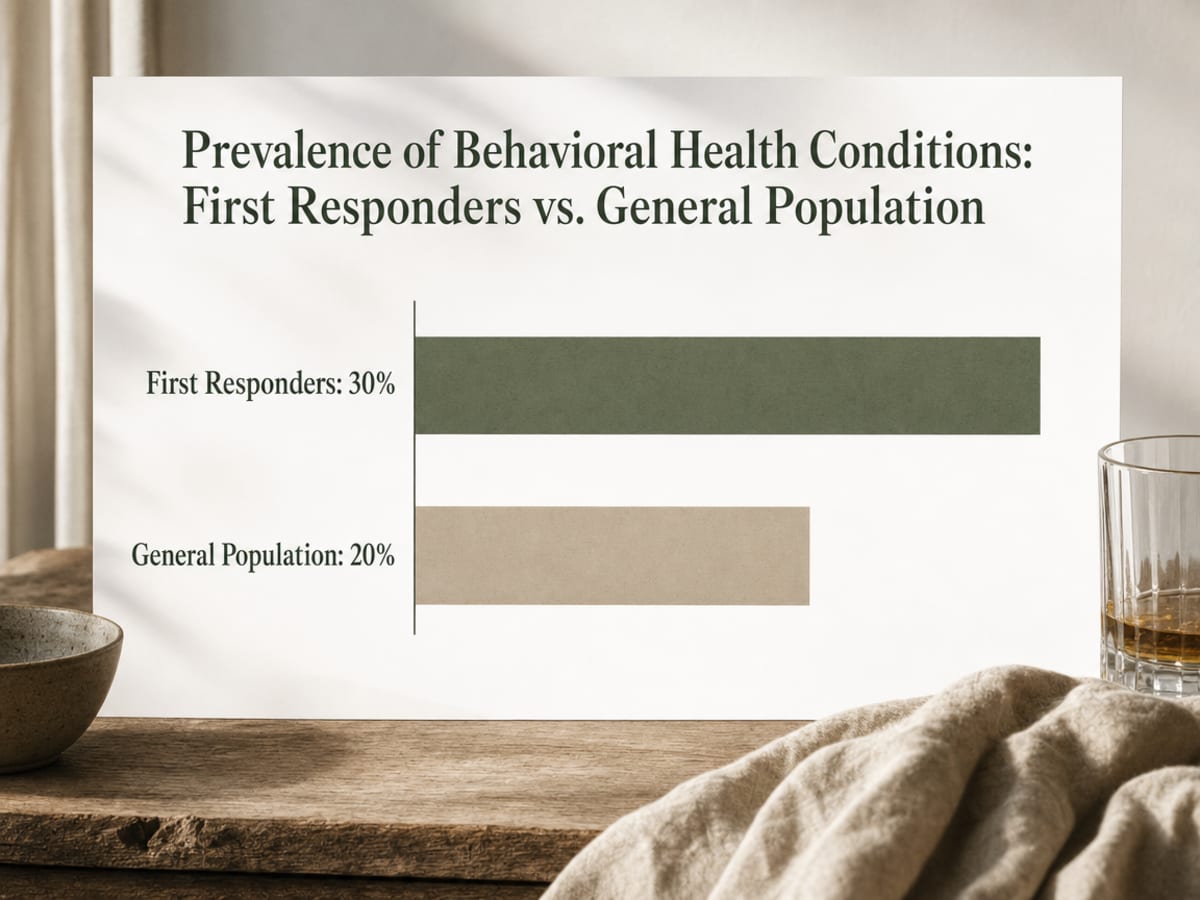
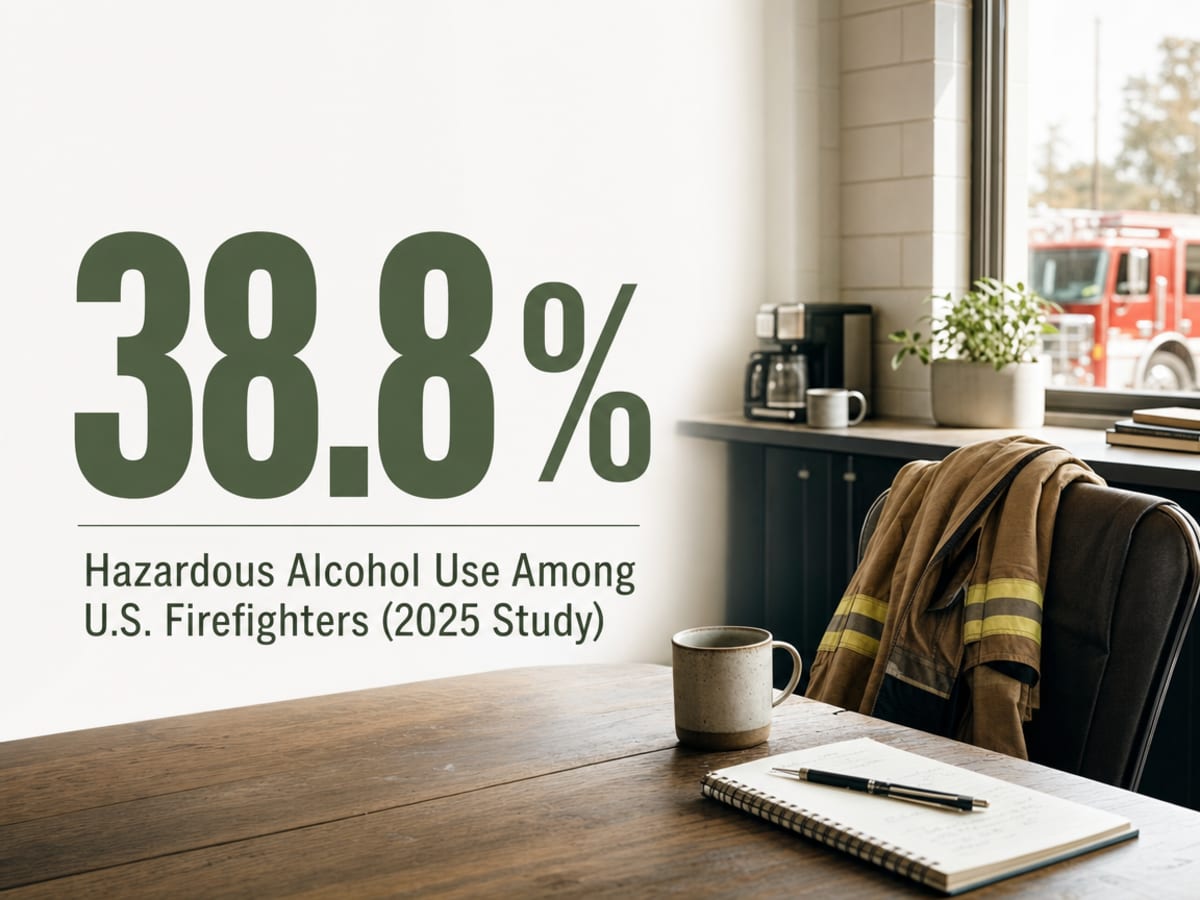
- Roughly 30% of first responders develop conditions like PTSD or depression 11, and in a 2025 study 38.8% of career firefighters screened positive for hazardous alcohol use 7.
- PTSD symptoms, not raw call volume, drive problem drinking 5, which is why integrated dual diagnosis care treating trauma and substance use together outperforms sequential rehab-then-therapy handoffs.
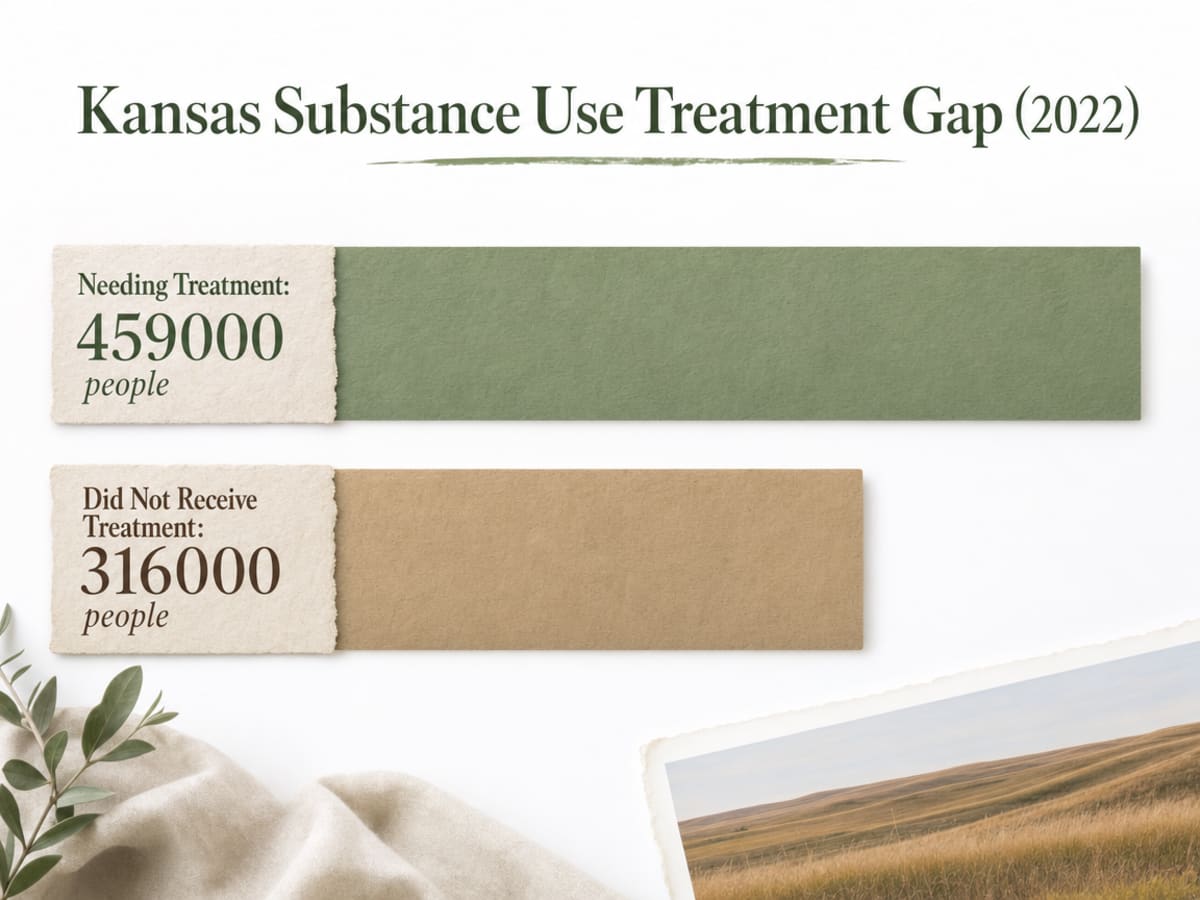
- Kansas has a real access gap — about 316,000 residents who needed substance use treatment in 2022 went without it 2— and small-department confidentiality concerns shape where responders can safely seek care.
- Before committing to a Kansas program, ask specifically about 42 CFR Part 2 protections, responder caseload numbers, dual diagnosis structure, trauma-work sequencing, and FMLA and shift-schedule logistics.
What the job does to sleep, and why the drink stopped working
You already know the pattern. You come off a bad run — a pediatric code, a domestic that went sideways, a fatality on I-35 — and by the time you’re home the adrenaline is still humming in your chest. Sleep won’t come. So you pour one. Then another. It works for a while. That’s the part nobody warns you about: it actually works, until it doesn’t.
The job stacks up. One call doesn’t do it. Ten years of calls do. SAMHSA estimates that about 30% of first responders develop a behavioral health condition like depression or PTSD, compared with roughly 20% of the general population 11. That gap isn’t a character flaw. It’s what cumulative exposure to other people’s worst days does to a nervous system that was never designed to metabolize this much.
Somewhere in there, the drink stops turning the noise down. You need more of it. You wake at 3 a.m. anyway. The intrusive image from that call three summers ago shows up when you’re brushing your teeth. Your spouse notices you’re not really there at dinner. You’re starting to dread the shift before you’ve even left for it.
None of that means you’re weak. It means the tool you were using to cope has run out of runway — and there’s a different kind of help built for exactly this.
The small-department problem: confidentiality when everyone knows your truck
Here’s what national talking points about “stigma” miss. In a 12-person rural department, stigma isn’t abstract. It’s the dispatcher who lives two blocks from you. It’s the fact that your engine has your last name stenciled inside the cab. It’s the parking lot at the county building where anyone from the sheriff’s office can see who’s coming and going.
If you’re a career firefighter in Wichita or a Kansas City metro officer, you have some crowd to hide inside. If you’re a deputy in Rooks County or a volunteer captain outside Chanute, you don’t. A two-week absence in a town of 4,000 gets explained by the town, not by you. That’s a real barrier, and it’s the one most treatment websites gloss over with a line about being “first responder friendly.”
What actually protects you is boring, procedural stuff. Federal 42 CFR Part 2 rules apply to substance use treatment records and are stricter than standard HIPAA — a program can’t confirm you’re even there without your written consent. Good programs will walk you through exactly who can and can’t be told what, in plain language, before you commit to anything.
Distance helps too. A residential program an hour or two from your district — far enough that your truck isn’t in the lot, close enough that your spouse can visit — is a different equation than trying to do outpatient in the same town where you run calls. You get to choose the geography of your own privacy.
Why alcohol becomes the default, and what the research actually says
Hazardous drinking among career firefighters
Alcohol wins by default because it’s legal, cheap, socially built into the job, and it works fast. A cold one after shift isn’t suspicious. Nobody at the station looks at you sideways for it. And the pharmacology cooperates — a few drinks will blunt the intrusive thoughts and get you closer to sleep than lying in the dark trying to breathe through them.
The scale of this pattern is measurable. In a 2025 study of 546 U.S. career firefighters, 38.8% screened positive for hazardous alcohol use based on AUDIT cut scores — a validated screening tool, not a self-report of “do you think you drink too much” 7. That’s not a small subgroup on a bad week. That’s roughly two in five career firefighters in the sample drinking at a level a clinician would flag. The same study found that psychological symptom measures — depression, anxiety, PTSD — explained more than 14% of the variance in drinking and 29% of the variance in suicide risk 7.
Two things matter about that number. First, it’s specific to career firefighters; volunteer patterns and law enforcement patterns look different. Second, it doesn’t mean 38.8% of firefighters are “alcoholics.” It means the drinking has crossed a line where it’s likely to be doing damage — to sleep architecture, to mood regulation, to the relationships waiting for you at home. That line matters because it’s the point where the tool stops paying for itself.
PTSD symptoms, not just exposure, drive the drinking
Here’s the finding that should change how you think about your own drinking, if you’re honest with yourself. It’s not the number of bad calls that predicts problem drinking. It’s what those calls did to your nervous system afterward.
A 2022 study in Drug and Alcohol Dependence looked at work-related traumatic events, PTSD symptoms, and substance use across a mixed sample of first responders. When the researchers ran the numbers, PTSD symptoms were significantly associated with alcohol and drug use above and beyond other variables — and exposure itself only affected substance use indirectly, through PTSD symptoms 5. Two firefighters can run the same fatality. One processes it and moves on. The other develops hypervigilance, intrusive memories, and disrupted sleep — and that one is the one who ends up drinking more.
This matters for how you understand what’s happening to you. If you’ve been telling yourself you’re just “dealing with the job the way everyone deals with the job,” the research pushes back gently. You may be dealing with untreated PTSD symptoms that are pulling the drinking behind them. The drinking is downstream.
That reframe is what makes trauma-informed treatment different from a standard 30-day program that treats the alcohol like it’s the whole problem. If you only treat the drinking, you leave the engine running. The intrusive images come back. The sleep never returns. And whatever you were using — alcohol, kratom, weed, the pills your knee surgeon prescribed and you never stopped filling — finds its way back into the picture.
Emotion regulation, anxiety sensitivity, and why willpower talks miss
If you’ve ever sat through a well-meaning “just make better choices” conversation and wanted to throw something, there’s a reason it landed that way. The research on firefighter drinking keeps pointing at mechanisms below the level of choice.
A 2023 study in the Journal of Dual Diagnosis found that among firefighters, PTSD symptom severity was linked to drinking-to-cope motives specifically through heightened emotion regulation difficulties 6. Translated: when the nervous system can’t down-regulate on its own, alcohol becomes the external regulator. A separate 2020 study found that anxiety sensitivity — the tendency to interpret your own body’s stress signals as dangerous — partially explained the relationship between PTSD symptoms and coping-motivated drinking 9. And a 2019 study showed that firefighters with high PTSD symptoms combined with high impulsivity had the highest alcohol use severity of any group in the sample 8.
Willpower talks miss because they aim at the wrong target. You don’t have a decision-making problem. You have a nervous system that learned, correctly, that a stiff drink brings the alarm down when nothing else will. That’s a skill deficit, not a moral one — and skills can be taught. Emotion regulation training, exposure work done in the right sequence, and medication when appropriate all target the actual mechanism instead of shaming you about the coping tool you built when nobody gave you a better one.
Firefighter, officer, deputy, medic, dispatcher: the exposure patterns aren’t the same
Treating a rural deputy the same way you’d treat a metro paramedic misses the point of what the job did to each of them. The exposures rhyme, but they don’t match.
The best data on this comes from a review of traumatic stress in first responders that pulled together PTSD prevalence estimates by role.
- Law enforcement officers develop PTSD at rates ranging from 6% to 32%.
- EMTs and paramedics land between 9% and 22%.
- Firefighters run the highest, at 17% to 32%.
- The general adult U.S. lifetime rate sits around 7% to 12% 10.
Those are wide ranges, and the width tells you something — sub-populations inside each role (rural vs. urban, career vs. volunteer, patrol vs. investigations) sit at very different points on the curve.
What matters underneath the numbers is the shape of the exposure. A patrol officer gets a lot of low-grade hypervigilance punctuated by acute violence and the moral weight of use-of-force decisions. A paramedic gets long stretches of the same pediatric and geriatric calls, plus the specific trauma of hands-on failed resuscitations. A firefighter gets fewer runs but longer duration on scene, mass-casualty potential, and the sensory load of fire and recovery. A dispatcher — often left out of these conversations — absorbs the audio of every call without any of the physical action to metabolize the stress.
Treatment that ignores those differences ends up generic. A program that only knows how to talk about fire behavior won’t reach the officer who’s replaying a fatal shooting. A group that lumps everyone into “trauma survivors” without naming the job flattens what you actually need to work through. When you’re evaluating a Kansas program, ask specifically who on staff has worked with your role, and what a treatment plan for someone in your seat looks like week by week.
The Kansas treatment gap, and where it leaves responders
Zoom out from the station for a minute. The problem you’re sitting with isn’t just yours, and it isn’t just a first responder problem — it’s built into the shape of behavioral health access in Kansas.
In 2022, roughly 459,000 Kansans aged 12 and older met criteria for needing substance use treatment. About 316,000 of them did not receive any treatment in the past year 2. That’s a majority of the people who needed care going without it. A separate single-day count from March 2019 found only 10,492 Kansans actively enrolled in substance use treatment statewide, with nearly half in outpatient settings 3. The gap between who qualifies and who’s actually getting help is not a statistical footnote — it’s the water everyone in Kansas is swimming in.
For responders, that gap has a particular shape. Rural districts have fewer clinicians within reasonable driving distance, and the ones who exist are often the same providers your neighbors use. Waitlists for anything trauma-informed can stretch weeks. Programs that take commercial insurance don’t always take yours, and the ones that do may not have staff who understand shift work, let alone the difference between running compressions on a stranger and running them on someone you knew.
The takeaway isn’t that the system is hopeless. It’s that finding the right program is a real search, not a Google-and-go. The rest of this article is about how to do that search without wasting the courage it took to start it.
What good trauma-informed treatment looks like when the patient wears a badge
Integrated dual diagnosis: treating PTSD and the drinking together
The old model handed you off. You’d go to a 28-day program for the drinking, get sober, and then — if you were lucky and still standing — someone might mention you should “see a therapist about the trauma stuff” on your way out the door. That approach fails responders more often than not, because the PTSD symptoms that were pulling the drinking are still there when you get home, and the sleep is arguably worse without the alcohol muffling it.
Integrated dual diagnosis care treats both at the same time, in the same building, with clinicians who talk to each other. That means your addiction counselor knows what your trauma therapist is opening up in the morning session, and your psychiatrist is dosing sleep and anxiety medication with the drinking history in mind. It’s the difference between running two separate playbooks and running one.
For this population the integration matters more than usual. The firefighter research keeps landing on the same point — drinking-to-cope motives run through emotion regulation deficits tied to PTSD symptoms 6. If a program only treats the alcohol, it’s asking you to give up your regulator without replacing it. Real integrated care builds the replacement skills — grounding, paced breathing that actually works under stress, medication when it’s indicated — before it takes the drink away.
The sequencing debate: stabilize first, or open the trauma?
Here’s the honest part most treatment centers won’t tell you on a sales call. Clinicians disagree about when to open the trauma work.
The review that mapped PTSD prevalence across responder roles also flagged a real clinical tension: some exposure-based PTSD treatments can be contraindicated when there’s active substance dependence, severe suicidality, or heavy dissociation 10. Push into the trauma too fast, before the nervous system has any stability, and you can make things worse — including the drinking you came in to address. Wait too long, and you leave the engine that’s driving the drinking untouched.
Good programs handle this by staging the work. The first two to three weeks usually focus on stabilization: getting the alcohol or other substances out of your system safely, sleep starting to reorganize, medication dialed in if you need it, and grounding skills you can actually use when an intrusive memory hits at 2 a.m. Then, when the floor is steady enough to hold weight, formal trauma processing — EMDR, cognitive processing therapy, prolonged exposure done carefully — enters the plan.
Peer support, culture fluency, and clinicians who know the difference between a Signal 7 and a code 3
You can tell within about ten minutes whether a clinician has worked with responders before. It’s not about jargon — it’s about what doesn’t need explaining. You shouldn’t have to teach your therapist what a working code feels like, why you check exits when you sit down in a restaurant, or why the phrase “just take some time off” lands as an insult when your crew is already short.
Culture fluency shows up in small things. Group composition matters — a group with two officers, a paramedic, and a firefighter runs differently than a group of civilians where you’re the only one who’s ever done chest compressions on a child. Peer support integration matters too. A program that partners with trained peer support officers, or that has responders on staff in recovery themselves, gives you someone who’s been in the seat and come back.
Ask directly. How many responders has this program treated in the last year? Who on the clinical team has that background? Is there a peer component, and is it real or decorative? The answers tell you whether you’ll spend the first two weeks translating your life, or actually working on it.
Questions to ask any Kansas treatment center before you commit
By the time you’re ready to make the call, you’ve already done the hardest part. What you need next is a script — because the person on the other end of the phone is trained to sell you on their program, and you need to know what a good answer sounds like before you hear it.
Here’s what to ask, and what you’re actually listening for.
On confidentiality: “What do my department, my chief, my licensing board, and my insurance carrier see if I come to you?” A good program will walk you through 42 CFR Part 2 protections, explain what your insurance EOB will and won’t say, and tell you exactly what’s shareable only with your written consent. If they wave it off with “don’t worry, everything’s confidential,” push harder.
On responder experience: “How many firefighters, officers, deputies, or medics have you treated in the past year? Who on your clinical team has that background?” You’re looking for a specific number and named roles, not a warm generality. Ask whether groups are mixed with civilians or whether there’s a responder cohort.
On dual diagnosis: “Do you treat PTSD and substance use in the same building, with the same team, at the same time?” Integrated care matters here because drinking-to-cope motives in firefighters run through PTSD-driven emotion regulation deficits 6. Programs that only treat the alcohol leave the driver untouched.
On sequencing: “When do you start trauma processing, and how do you decide someone’s ready?” A thoughtful answer names stabilization first, then EMDR or CPT when the floor holds. A program that starts exposure work on day one — or won’t do trauma work at all — is telling you something 10.
On logistics: “What does the schedule look like for someone coming off shift work? How do you handle FMLA paperwork? Can my spouse visit, and when?” You need a program that understands your calendar, not one that expects you to fit theirs.
If any answer feels rehearsed, ask a follow-up. The right program won’t flinch.
Making the call: what happens in the first 48 hours
The call itself is shorter than you think. Fifteen, maybe twenty minutes. You don’t have to have a plan yet. You don’t have to know whether you want residential or outpatient. You don’t have to have talked to your spouse. You just have to dial.
What happens on the other end, if the program is any good, is a clinical assessment — not a sales pitch. Someone asks about your drinking or use, your sleep, whether you’re having intrusive memories, whether you’ve thought about hurting yourself. They ask about your job and your schedule. They ask what you’re worried about, and confidentiality is usually the first thing on the list. A good intake counselor will name that fear before you have to.
Inside 48 hours, you’re typically looking at three things: a level-of-care recommendation, an insurance verification, and a start date. If detox is medically indicated, that gets scheduled first. FMLA paperwork can start moving in parallel — most departments accept a clinician’s letter without a diagnosis attached.
You’ve already been the person people call when everything’s on fire. Making one call for yourself is not weakness. It’s the same instinct pointed in a new direction. Sunflower Recovery Center takes that call in Kansas, and the conversation stays between you and the clinician on the line.
Start your confidential first responder recovery journey
Connect with someone who understands your unique challenges and will help guide your next steps toward recovery.
Frequently Asked Questions
Will my department find out if I go to treatment in Kansas?
Not from the treatment center itself. Substance use records are protected under federal 42 CFR Part 2 rules, which are stricter than HIPAA — a program cannot confirm you are even a patient without your written consent. What your department sees depends on what you file. FMLA paperwork typically needs a clinician’s note, not a diagnosis. Ask any program to walk you through disclosures line by line before you commit.
Can I keep my job and my certification if I ask for help with drinking or drug use?
In most cases, yes — especially if you seek help before an incident forces the issue. Kansas peace officer, EMS, and fire certifications each have their own boards and rules, and voluntary treatment is generally treated very differently from post-incident referral. Talk to a union rep, peer support officer, or an attorney familiar with public safety licensure before you assume the worst.
Do I have to stop drinking before I can start trauma work for PTSD?
Not entirely, but sequencing matters. Some exposure-based PTSD treatments can be contraindicated during active substance dependence, severe suicidality, or heavy dissociation 10. Good programs stabilize you first — safe withdrawal, sleep starting to reorganize, grounding skills in place — then bring in EMDR or cognitive processing therapy. You work on both together in one program, but the trauma processing is staged, not front-loaded.
What makes first responder treatment different from a standard rehab program?
Two things. First, the clinical center of gravity shifts to trauma — because PTSD symptoms, not just exposure, drive substance use in this population 5. Second, culture fluency changes what happens in the room. You shouldn’t have to teach your therapist what a working code feels like or why the crew’s opinion matters. Ask how many responders the program has treated and who on staff shares that background.
My spouse is a deputy and won’t call anyone. What can I actually do?
You can call for information yourself. Most programs will talk to a family member about what treatment looks like, how confidentiality works, and what a first conversation with your spouse might sound like — without your spouse’s name attached to anything. You can also reach out to a peer support officer in their agency or a chaplain. Pressure rarely works. A door left visibly open often does.
What should I ask a Kansas treatment center on the first phone call?
Five things. What exactly does my department and insurance see? How many firefighters, officers, or medics have you treated in the past year? Do you treat PTSD and substance use together, in the same building? When do you start trauma processing, and how do you know someone’s ready? How do you handle FMLA paperwork and shift-work schedules? Rehearsed answers are a warning sign.
References
- 2021-2023 Behavioral Health Barometer Reports: Kansas, Volume 8. https://www.samhsa.gov/data/data-we-collect/nsduh-national-survey-drug-use-and-health/state-reports-barometers/2021-23-KS
- Kansas – National Survey on Drug Use and Health: 2022 State-Level Tables. https://www.samhsa.gov/data/sites/default/files/reports/rpt44486/2022-nsduh-sae-state-tables/NSDUHsaeKansas2022.pdf
- Behavioral Health Barometer: Kansas, Volume 6. https://www.samhsa.gov/data/sites/default/files/reports/rpt32833/Kansas-BH-Barometer_Volume6.pdf
- Kansas (KS) | CBHSQ Data. https://www.samhsa.gov/data/report/kansas-ks
- Posttraumatic stress disorder symptoms, work-related trauma exposure, and substance use in first responders. https://pubmed.ncbi.nlm.nih.gov/35623285/
- PTSD Symptom Severity and Alcohol Use among Firefighters: The Role of Emotion Regulation Difficulties. https://pubmed.ncbi.nlm.nih.gov/37802496/
- Alcohol Misuse and Correlates with Mental Health Indicators among Firefighters. https://pubmed.ncbi.nlm.nih.gov/39511710/
- PTSD symptom severity and impulsivity among firefighters: Associations with alcohol use. https://pubmed.ncbi.nlm.nih.gov/31276966/
- Posttraumatic stress, alcohol use severity, and alcohol use motives among firefighters: The role of anxiety sensitivity. https://pubmed.ncbi.nlm.nih.gov/32087474/
- Conceptualization, Assessment, and Treatment of Traumatic Stress in First Responders. https://pmc.ncbi.nlm.nih.gov/articles/PMC6624844/
- First Responders: Behavioral Health Concerns, Emergency Response, and Trauma. https://www.samhsa.gov/sites/default/files/dtac/supplementalresearchbulletin-firstresponders-may2018.pdf