
Key Takeaways
- Kansas law under K.S.A. 65-4924 gives licensing agencies discretion to refer impaired healthcare providers to a monitoring committee instead of pursuing immediate discipline 1.
- Self-referring before a report is filed or diversion is discovered keeps the alternative-to-discipline pathway open, while waiting until after an incident narrows options significantly.
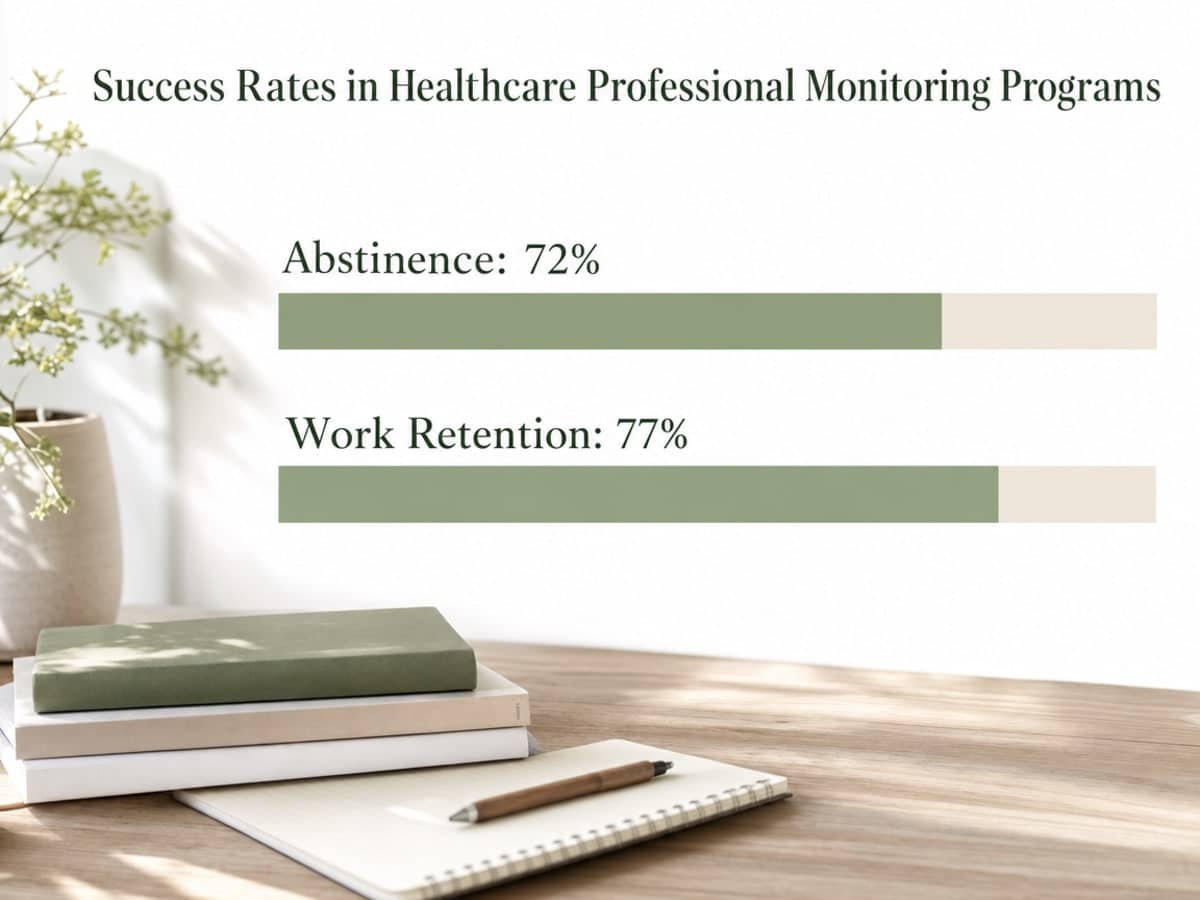
- Pooled monitoring program data shows 72% of healthcare professionals remained abstinent and 77% were still working at follow-up when they engaged with structured treatment 3.
- Kansas clinicians should consult a licensure attorney before speaking to employers or boards, then contact a treatment program that can coordinate with monitoring agreements 10.
Reading This at 2 A.M.: What Kansas Law Actually Says About Your License
You are probably reading this in the dark. Maybe in your car after a shift. Maybe next to someone who is asleep and does not know. You are a nurse, a physician, a PA, a CRNA, a pharmacist, a paramedic, and somewhere along the way the thing you knew how to warn patients about became the thing you are doing yourself. You are not the first Kansas clinician to sit exactly where you are sitting right now.
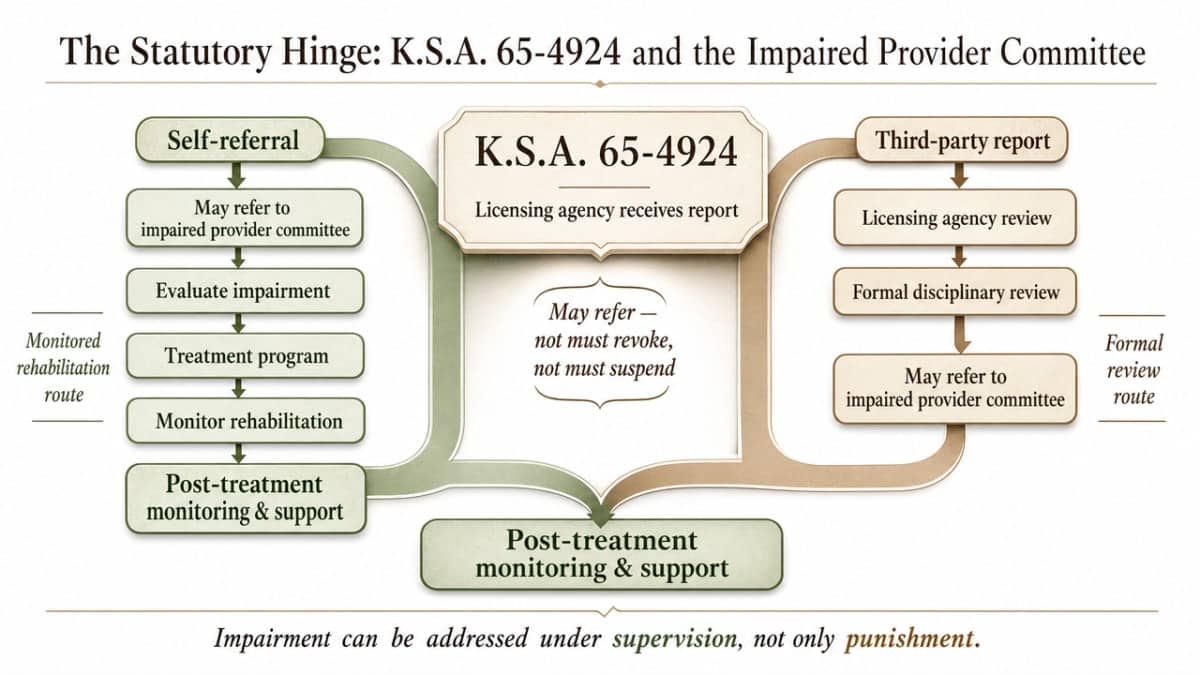
Here is what you need to know before you decide anything else: Kansas law does not require your board to end your career the moment you ask for help. Under K.S.A. 65-4924, when a licensing agency receives a report that a provider cannot practice safely because of drug or alcohol abuse, the agency may refer that matter to an impaired provider committee that can contract for treatment, monitor rehabilitation, and support you after treatment ends 1. That statutory word — may — is the whole hinge. Kansas built a legal pathway that treats impairment as something to rehabilitate, not only something to punish.
That does not mean the road is simple, and it does not mean confidentiality is unlimited. It does mean that self-reporting on your own terms, before diversion is discovered or a patient is harmed, sits in a very different legal category than being reported by an employer after the fact. The rest of this article is the map — Kansas-specific, clinician-to-clinician, without the sales pitch.
The Statutory Hinge: K.S.A. 65-4924 and the Impaired Provider Committee
Kansas built a specific legal door for you, and most clinicians who need it have never read the statute that opens it. K.S.A. 65-4924 sets out what happens when a licensing agency in Kansas receives a report that a healthcare provider cannot practice safely because of physical or mental disability or the abuse of drugs or alcohol. The statute says the agency may refer the matter to an impaired provider committee — a committee empowered to contract with treatment programs, evaluate impairment, monitor treatment and rehabilitation, and provide post-treatment monitoring and support 1.
Read that again. May. Not must revoke. Not must suspend. The Kansas Legislature wrote in a lane that treats impairment as something to rehabilitate under supervision, not only something to punish. That lane exists because patient safety and clinician recovery are not opposing goals when monitoring is real and treatment is competent 8.
Here is the practical shape of the two doors in front of you. Behind door one, you reach out first. You engage in treatment, sign a monitoring agreement, submit to biological testing, and the committee tracks your rehabilitation while you work toward safe return to practice. Behind door two, someone else reports you — a coworker, a pharmacy audit, a supervisor after an incident — and the board opens a formal file with discipline on the table. Both doors can end at monitoring. Only one of them starts there.
The statute does not guarantee confidentiality without limits, and it does not erase the possibility of discipline if patient harm has already occurred. What it does is give a Kansas clinician who is not yet in crisis a legal structure in which asking for help is a recognized, monitored, career-preserving act rather than a confession. That is the hinge everything else in this article turns on.
What Happens When a Report Reaches Your Board
Say the report is already on its way. A charge nurse noticed the waste discrepancies. A colleague pulled a supervisor aside. Pharmacy flagged an override pattern. What actually happens next is not the licensure execution most clinicians imagine at 2 a.m.
Your board opens a file. An investigator is assigned. You will typically be asked for a written response, and you may be asked to submit to an evaluation. This is the moment where Kansas law gives the licensing agency a choice: proceed toward formal discipline, or refer the matter to an impaired provider committee that can contract with a treatment program, evaluate the extent of impairment, and monitor your rehabilitation 1. The committee route is not automatic. It is a decision the agency may make, and the factors that influence it include whether patient harm occurred, whether you have engaged with treatment already, and how you present when the investigator calls.
Here is the part nobody tells you: what you do in the days between a report being filed and your first contact with the investigator matters. A clinician who has already started an evaluation, contacted a treatment program, and paused practice voluntarily walks into that conversation as a person actively addressing impairment. A clinician who has done nothing walks in as a person the board must decide what to do about. Both are frightened. Only one has evidence on the table 8.
Confidentiality Is Real, But It Is Conditional
You need the truth about this before you make a call, because the word “confidential” gets used loosely and the stakes are your license.
Physician health programs and their equivalents for other clinicians operate under what the literature calls conditional confidentiality — your treatment and monitoring information is protected from broad disclosure, but ongoing communication with the licensing board is tied to your compliance and to patient safety 10. Translation: if you show up, do the work, meet the terms of your monitoring agreement, and stay safe to practice, the board typically sees a compliance report, not your therapy notes. If you miss testing, relapse without disclosure, or present a safety concern, that protection narrows fast.
Your medical records at a treatment facility are still protected by federal 42 CFR Part 2 and HIPAA — a treatment center cannot fax your file to your employer or your board because someone asked. What changes when you sign a monitoring agreement is that you authorize specific, defined information sharing as a condition of participation. That is a trade, and it is a real one 8.
Here is the honest frame: confidentiality in this system is not a vault. It is a contract. Kept, it protects your career. Broken, it becomes the record. Knowing that before you pick up the phone lets you ask the right questions of any program or attorney you speak with.
What the Outcomes Data Actually Shows
You have probably run the math in your head already. If I get help, does that end my career anyway? The evidence says something different than the story fear tells you at 2 a.m.
A 2021 systematic review and meta-analysis of monitoring programs for healthcare professionals with substance use disorders pooled results across studies and found that 72% of participants were abstinent during follow-up and 77% were still working at the end of the follow-up period 3. Read that again as a clinician. About three out of four healthcare professionals who went through structured treatment plus long-term monitoring were both sober and still practicing. The scope matters: the review pooled programs that combined treatment, biological testing, workplace monitoring, and formal agreements, follow-up windows varied by study, and abstinence rates across the included studies ranged from 30% to 94% depending on program design and cohort. This is not a promise. It is the shape of what tends to happen when clinicians engage with real monitoring instead of hiding.
A separate five-year cohort study of physicians treated for substance use disorders in U.S. physician health programs reached the same direction of finding: most physicians who completed treatment and stayed with monitoring remained abstinent and kept their licenses over five years 4. The physician-specific literature reinforces that these programs, whatever their imperfections, have consistently favorable outcomes when clinicians engage early and comply 5.
Here is what those numbers actually tell you. The clinicians in these studies are not statistical strangers. They are nurses, physicians, and prescribers who made the same call you are considering. Structured treatment plus monitoring is not the end of a career. Untreated impairment, discovered after a patient event, more often is.
Risk Textures by Profession
Nurses: Diversion, KNAP-Style Alternatives, and Return to Practice
If you are a nurse, the risk pattern that most often ends careers is not intoxication on shift — it is diversion. Waste discrepancies, override patterns, patient pain scores that do not track with the record. You already know this because you have watched pharmacy audits happen to other people. The nursing literature is direct about it: diversion behaviors are a distinct and well-documented pattern among nurses with substance use disorders, and they are usually what triggers formal action 6.
The counterweight in most states, Kansas included, is an alternative-to-discipline pathway for nurses whose impairment can be addressed through structured treatment and monitoring rather than public discipline. The evidence review on nursing impairment describes these programs as prioritizing rehabilitation and safe practice, with the aim of returning nurses to work under supervision instead of ending their careers 6. Confidential, treatment-focused engagement can reduce relapse and support safe return to practice — when the nurse enters before diversion is discovered, not after.
The practical read: if you are diverting or on the edge of it, the window where an alternative-to-discipline route is realistically on the table narrows every shift. Reaching out now, while you still control the timeline, is what keeps that door open.
Physicians and APRNs: PHP-Style Monitoring and DEA Exposure
For physicians and APRNs, the risk texture is different. You have prescribing authority. You have a DEA registration. You have access to controlled substances not through a Pyxis override but through your own signature, and the epidemiology reflects that — access to controlled substances and occupational stress are among the most consistent risk factors identified in the physician-specific literature 5.
The response infrastructure is different too. Physician health programs (PHPs) are the structural analogue to nurse assistance programs, and the evidence base on their outcomes is unusually strong for this kind of intervention. The five-year cohort of physicians in U.S. PHPs found that most who completed treatment and stayed with monitoring remained abstinent and kept their licenses over the five-year window 4. That result has held up across reviews of physician SUD treatment 5.
The piece prescribers often underestimate is DEA exposure. Voluntary surrender or restriction of your DEA registration is a common component of a monitoring agreement, especially early in treatment. That sounds like career loss until you sit with the alternative — a diversion investigation, a DEA administrative action, or a board order after patient harm carries substantially heavier and more permanent consequences than a negotiated, time-limited restriction while you are in monitoring.
Pharmacists: DEA Registrant Risk and Controlled Substance Access
Pharmacists sit in a category all their own. You are a DEA registrant, you have direct access to the full inventory, and your workplace runs on the exact kind of audit trail that surfaces diversion — perpetual inventory, biennial reconciliation, dispensing reports the board can pull. The same access that defines the profession is the access that creates the risk pattern, echoing the broader clinician finding that controlled substance access is a leading contributor to substance use disorders in healthcare 5.
When a pharmacist is reported, the exposure is multi-front: the Kansas licensing agency, the DEA registration, and potentially the employer’s own loss-prevention process. K.S.A. 65-4924’s impaired provider committee framework applies to Kansas healthcare providers broadly, which means the same statutory door toward monitored rehabilitation is available to pharmacists who engage before an audit closes 1. Sooner is materially better here — audit trails do not get quieter with time.
First Responders, Paramedics, and Dentists: Different Reporting Structures
First responders, paramedics, and dentists live under reporting structures that do not map cleanly onto the nurse or physician playbook. If you are a paramedic or EMT, your certification runs through EMS regulation and your agency’s fitness-for-duty process, and the first conversation is often with an employer’s EAP rather than a state board. Firefighters and law enforcement layer in union representation and department policy on top of licensure. Dentists sit closer to the physician model — a licensing board, a DEA registration if you prescribe, and access to controlled substances through your own practice.
What all of these share with the nursing and physician pathways is the underlying pattern the literature keeps confirming: structured, confidential engagement with treatment and monitoring produces better outcomes than waiting to be discovered 6, 5. What differs is who you call first, what your reporting obligations look like, and how your monitoring agreement is structured. That is worth an hour with a Kansas licensure attorney before you say anything on the record to a supervisor or investigator.
When Burnout and Moral Injury Are the Substrate
Most of the clinicians who end up in monitoring programs did not start using because they wanted to. They started using because something underneath got unbearable. The literature is unambiguous on this: high occupational stress and burnout are consistently associated with increased risk of substance misuse among healthcare professionals 7. You already know the shape of it. Twelve-hour shifts stacked against a staffing model that pretends they are not. A pediatric code that did not go the way it should have. Two years of pandemic that nobody has actually processed. The Ativan or the bourbon or the fentanyl waste you did not quite waste was the thing that let you go back in the next day.
Naming that is not an excuse. It is a clinical fact that shapes what treatment has to do to actually work for you. Substance use riding on top of unaddressed trauma, depression, or moral injury does not respond well to abstinence-only programming that treats the drug as the whole problem. The evidence on co-occurring disorders points toward trauma-informed, integrated care — treatment that addresses the substance use and the underlying condition in the same room, with the same team 9. For a clinician whose substrate is occupational, that integration is not a nice-to-have. It is the difference between six months sober and five years practicing.
If Criminal Charges Are Also in the Picture
Diversion can cross from a licensure matter into a criminal one, and if you are already there, the calculus changes. Possession of a controlled substance obtained through diversion, fraudulent prescriptions, or theft from an employer can trigger criminal charges alongside the board action. That is a two-front situation, and you should not respond to either front without a Kansas attorney who has handled both.
Kansas does have a policy tilt toward treatment as an alternative to further prosecution in certain drug cases. K.S.A. 21-6825 establishes a certified drug abuse treatment program for eligible defendants who enter diversion agreements, with treatment terms not to exceed 18 months 2. That statute is not healthcare-specific, and it does not resolve your licensure exposure. What it does show is that the same state that wrote the impaired provider committee framework also built treatment-based off-ramps into its criminal code. Engaging with treatment early gives your attorney something to work with on both sides of the file.
What Treatment Looks Like When the Patient Is the Clinician
Treatment designed for the general population and treatment designed for a clinician are not the same thing, and the difference matters for whether you actually get better. You already know the pharmacology. You have run codes on overdoses. Sitting through a lecture on what dopamine does is not the intervention you need. The intervention you need is the one that treats what is underneath — the trauma, the depression, the moral injury, the anxiety that got loud enough to reach for something to quiet it 9.
That is why the shape of care matters. Integrated dual diagnosis treatment addresses the substance use and the co-occurring condition in the same room, with the same team, rather than sending you to two disconnected programs that never talk to each other 9. For a clinician whose use is riding on top of burnout and cumulative occupational stress, that integration is the mechanism 7. Residential care gives you the structure to actually stop for long enough to feel what you have been outrunning. Partial hospitalization and intensive outpatient step you back toward practice without dropping you off a cliff.
What treatment looks like when the patient is the clinician also means clinicians who understand licensure. A program that can coordinate with a monitoring agreement, document what a committee needs to see, and hold the line on confidentiality inside its legal limits is doing work that a generic rehab is not equipped for 10. You do not need to be handled with kid gloves. You need to be handled by people who know what is at stake.
The Kansas Logistics: Getting From This Article to a Phone Call
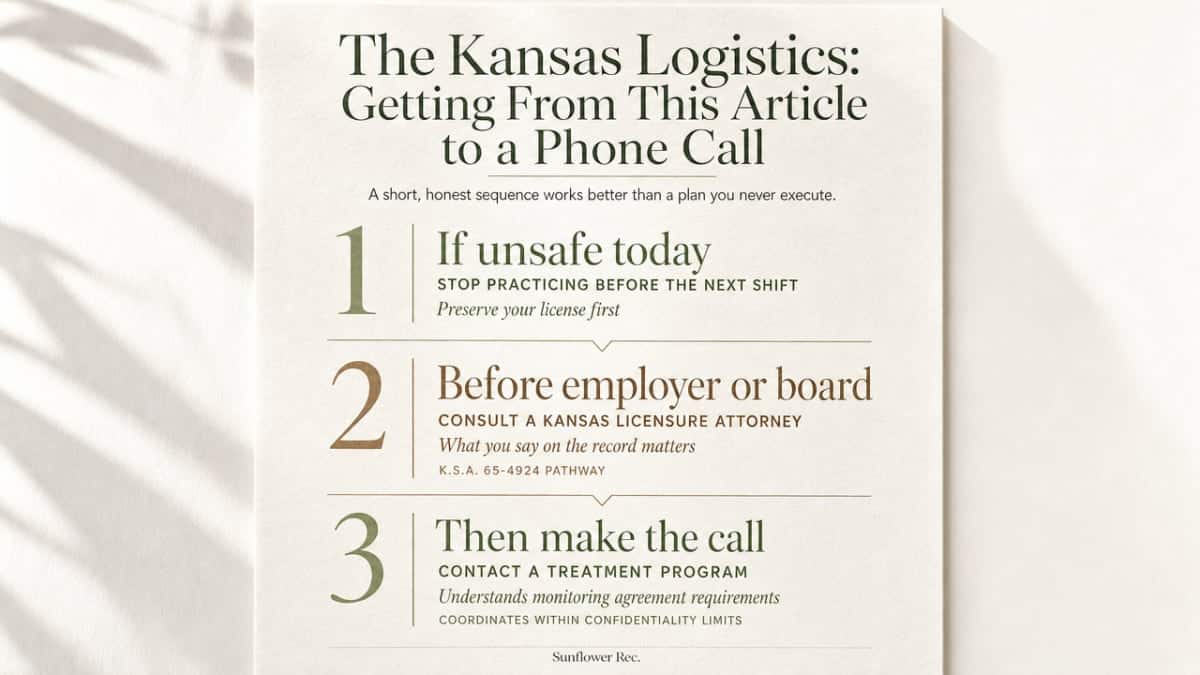
The distance between reading this and picking up the phone is where most careers actually end. Not in the treatment center. In the gap.
A short, honest sequence works better than a plan you never execute.
- If you are in acute danger to yourself or a patient today, stop practicing before the next shift. That single decision does more to preserve your license than any legal maneuver.
- Before you talk to your employer or your board, spend an hour with a Kansas licensure attorney who has handled impaired provider matters — what you say on the record shapes whether K.S.A. 65-4924’s monitoring pathway stays available to you 1.
- Call a treatment program that understands what a monitoring agreement requires and can coordinate with a committee inside the legal limits of confidentiality 10.
Sunflower Recovery Center is in Osawatomie, works with most commercial insurance (not Medicare or Medicaid), and provides trauma-informed dual diagnosis care across residential, PHP, and IOP levels — the shape of care that matches what burnout-driven clinician substance use actually needs 9. A confidential call is a conversation, not a commitment. That call is the small win. Make it tonight.
Protect your license—start confidential recovery now
Speak privately with a compassionate team who understands healthcare professionals’ unique risks and needs.
Frequently Asked Questions
Will I automatically lose my license if I self-refer for addiction treatment in Kansas?
No. Under K.S.A. 65-4924, a Kansas licensing agency may refer an impaired provider to a committee that contracts for treatment and monitors rehabilitation rather than moving straight to discipline 1. Self-referring before a report is filed, before patient harm, and before diversion is discovered is the scenario where that monitored pathway is most likely to be available.
Who is required to report me to my licensing board, and when?
Reporting duties vary by profession and role — supervisors, employers, and in some cases treating clinicians can have mandatory reporting obligations when a provider cannot practice safely 8. A treatment center itself is bound by federal 42 CFR Part 2 and HIPAA and cannot release your record to an employer or board without your authorization. Ask a Kansas licensure attorney about your specific role.
How confidential is treatment when I’m a licensed healthcare professional?
Treatment records themselves are strongly protected. Physician health programs and their equivalents operate under conditional confidentiality — information sharing with a licensing board is tied to your compliance and to patient safety 10. If you meet monitoring terms, the board typically sees compliance status, not therapy notes. Miss testing or relapse without disclosure and those protections narrow.
What happens to my DEA registration if I’m a prescriber entering treatment?
Voluntary surrender or restriction of your DEA registration is a common early term in a prescriber’s monitoring agreement, given that controlled substance access is a leading risk factor in physician SUD 5. It sounds permanent, but it usually is not. A negotiated, time-limited restriction while you engage in treatment is materially different from a DEA administrative action after diversion is discovered.
Can I keep working during treatment, or will I have to take leave?
It depends on your level of care and your monitoring terms. Residential treatment requires a leave of absence. PHP and IOP can be structured around a phased return to practice under supervision. Long-term monitoring data across healthcare professionals shows most participants are still working at follow-up when they engage with structured programs 3. Work retention is a designed outcome of these agreements, not an afterthought.
What if diversion has already been discovered at my workplace?
The window is narrower, but the impaired provider committee route under K.S.A. 65-4924 is not automatically closed 1. Do not respond to your employer or an investigator on the record before you speak with a Kansas licensure attorney — what you say shapes whether monitoring stays on the table. Engaging with an evaluation and treatment before your first formal interview gives your attorney something concrete to work with 8.
References
- K.S.A. 65-4924 – Impaired health care provider statute. https://ksrevisor.gov/statutes/chapters/ch65/065_049_0024.html
- K.S.A. 21-6825 – Certified drug abuse treatment program for divertees. https://www.kslegislature.gov/li_2024s/b2023_24/statute/021_000_0000_chapter/021_068_0000_article/021_068_0025_section/021_068_0025_k/
- Success Rates of Monitoring for Healthcare Professionals with Substance Use Disorders. https://pmc.ncbi.nlm.nih.gov/articles/PMC7828295/
- Five-year outcomes in a cohort study of physicians treated for substance use disorders in the United States. https://pmc.ncbi.nlm.nih.gov/articles/PMC4957425/
- Substance Use Disorders in Physicians: Epidemiology and Treatment. https://pmc.ncbi.nlm.nih.gov/articles/PMC4379159/
- Impairment and Substance Use in Nursing: A Review of the Evidence. https://pmc.ncbi.nlm.nih.gov/articles/PMC6571529/
- Occupational stress and substance use in health care professionals. https://pmc.ncbi.nlm.nih.gov/articles/PMC6139276/
- Ethical and Legal Issues in Caring for Impaired Health Professionals. https://pmc.ncbi.nlm.nih.gov/articles/PMC4813411/
- Dual diagnosis and trauma-informed care in addiction treatment. https://pmc.ncbi.nlm.nih.gov/articles/PMC8059233/
- Confidentiality, Reporting, and Physician Health Programs. https://pmc.ncbi.nlm.nih.gov/articles/PMC6207874/