
Key Takeaways
- Kansas law makes pregnant women and parents with dependent children a priority admission category, with assessments offered within 24 hours and treatment within 48 hours at the eight Designated Women’s Programs 4.
- Mandated reporting and child removal are separate processes; the KDHE workflow treats caregiver substance use as a reason to connect families to services, not a trigger for automatic separation 1.
- Level of care should match household logistics — residential, PHP, or IOP — with MOUD continuation, breastfeeding coordination, and postpartum depression screening built into the plan 7, 16.
- A first call to the Kansas Parent Helpline (1-800-CHILDREN), SAMHSA (1-800-662-HELP), or a program like Sunflower can be anonymous and is enough to start 5, 8.
The 3 A.M. Thought You Haven’t Said Out Loud
It usually comes during a night feeding. The baby is finally asleep on your chest, the house is quiet, and the thought lands anyway: I can’t keep doing this the way I’m doing it.
Maybe it’s the bottle of wine that used to be one glass. Maybe it’s the leftover pills from your C-section that you refilled once, then twice. Maybe it’s the kratom you started taking to get through the sleep deprivation, or the Xanax a friend gave you for the panic attacks nobody knows you’re having. Whatever it is, you’re the only one awake with it, and you’ve been carrying it alone for a while now.
You’ve probably already Googled some version of this question and closed the tab before anyone walked in. You want to know if you can get help without losing your baby. Without becoming a case file. Without being the mom or dad who couldn’t handle it.
That fear is the reason this article exists. Not a checklist of warning signs. Not a lecture. Just a plain walk-through of what Kansas actually does when a parent asks for help, what the law does and doesn’t require, and how a treatment program can be built around a nursing schedule and a co-parent’s shift work.
You don’t have to decide anything yet. Keep reading.
What Kansas Actually Does When a Parent Asks for Help
Priority Admission Isn’t a Slogan — It’s a Timeline
Here’s something most parents don’t know until someone tells them: Kansas treats pregnant and parenting women as a priority admission category by law, not by favor. That means the system is built to move faster for you than it does for other adults calling the same day.
The eight Kansas Designated Women’s Substance Use Disorder Treatment Programs run under a specific mandate through the Kansas Department for Aging and Disability Services. Pregnant women must be offered an assessment within 24 hours of first contact and admitted into treatment within 48 hours, as clinically indicated. Women with dependent children and women who use IV drugs are also given priority admission at these programs, which are designed to serve women and their children together rather than treating you as an isolated patient who happens to have a family at home.4
Read that again slowly, because it changes what the phone call means. When you dial a designated program, you are not begging for a spot on a waitlist. You are activating a timeline the state already promised you. A same-week bed is not a fantasy. It is the baseline.
That doesn’t mean every program in Kansas operates under the designated-women’s mandate. Sunflower Recovery, for example, is a private residential and outpatient program in Osawatomie, not one of the eight designated sites, and its intake process runs on its own schedule and admissions criteria. But the state’s priority-admission rules matter even outside those eight programs, because they set the tone for how Kansas expects new parents to be handled — quickly, with children factored in, and without the assumption that you should wait weeks to be evaluated.
If you call and someone tries to push you out three weeks, ask directly whether priority admission applies. Then ask what the next-available assessment looks like this week.
Mandated Reporting Is Not the Same as Losing Your Baby
The fear underneath everything usually sounds like this: If I tell a doctor or a treatment program that I’m using, they’ll call DCF, and someone in a state office will decide whether I get to keep my kid.
Some of that is true. Kansas clinicians are mandated reporters. But mandated reporting and child removal are two different events, run by different people, with very different thresholds. A report is a phone call describing a concern. A removal is a decision, usually made after investigation, that a child is not safe in the home. Those two things are not the same, and the distance between them is where most Kansas parents who seek treatment actually live.
The KDHE workflow for clinicians working with pregnant and postpartum women who use substances specifically frames caregiver substance use as a signal to connect the family to prevention services — substance use disorder treatment, parent skill-building, kinship navigation — not as an automatic pathway to separation.1The workflow’s whole point is that engagement in treatment is protective, and pulling families toward services is the goal.
The Kansas DCF longitudinal data backs this up in a different way. The state has been tracking out-of-home placements by primary removal reason from SFY2012 through SFY2025, with “Substance Affected Infant” and “Alcohol Abuse Parent” listed as their own categories. Removals do happen, especially for infants under one, and the report shows the pattern year over year.6That is the honest picture — not a reassurance that nothing ever happens, and not a warning that everything will. The category exists because substance-related removals are a real part of Kansas’s caseload, and the state tracks them to understand where prevention can do more.
What that data does not say is that calling a treatment program creates a removal. Removals are driven by safety findings during a specific investigation — infant withdrawal at delivery, unsafe supervision, an unattended child, a positive toxicology at birth combined with a lack of any plan. A mother calling an outpatient program during a nap to ask about IOP hours is not that event.
Treatment is closer to the protective side of the ledger than most parents realize when they’re staring at the phone at 3 a.m.
The Postpartum Window Nobody Warns You About
Nobody hands you a discharge folder that says the next twelve months are the most dangerous ones. But that’s what the research shows.
The reasons aren’t a mystery to anyone living them. Sleep is broken. Hormones crash. A body that just did something enormous is expected to hold everything together while running on four-hour stretches. If you were using before the baby came, the pressure to “just get through” doesn’t ease up — it doubles. If you weren’t using before, the leftover pills, the nightly wine, the kratom that helps you function at 6 a.m. can slide into something else without a clear line in the sand.
None of that means you failed. It means the window matters, and the window is now.
The First Phone Call — What To Actually Say
The hardest part is dialing. The second-hardest part is not knowing what will come out of your mouth once someone answers.
You don’t have to have a speech ready. You don’t even have to give your name on the first call if you don’t want to. Here are the three numbers a Kansas parent can actually use, and what each one is built to do.
Kansas Parent Helpline — 1-800-CHILDREN (1-800-244-5373). This is the number behind Hope Starts Now, the state’s outreach to pregnant and parenting women dealing with opioid use or other substance use. It’s free, it’s anonymous, and it’s answered by a trained person whose whole job is to listen, not to judge or file a report. They can point you toward Kansas-specific treatment options and talk through what a next step might look like — 24 hours a day, in English or Spanish.5If you want a Kansas-aware voice on the other end and you’re not ready to share identifying details, start here.
SAMHSA National Helpline — 1-800-662-HELP (4357). This is the federal line. It’s also free, confidential, and available 24/7, 365 days a year, for individuals and family members dealing with substance use or mental health concerns.8It’s not Kansas-specific, but the referral database includes local treatment options, and some parents feel safer with a national line for the very first call because it feels one step further removed from anyone who might know them.
A direct call to a treatment program like Sunflower. This is the call where a real assessment gets scheduled, insurance gets checked, and someone starts building a plan around your week. It’s not anonymous in the same way — you’ll share your name and insurance eventually — but it’s the call that moves you from information-gathering into an actual appointment.
You can use them in any order. Many parents call the Parent Helpline or SAMHSA first, ask every question they’re too scared to ask a program, and then call Sunflower or another treatment provider a day or a week later, once the ground under them feels a little more solid. That’s not stalling. That’s pacing.
Whichever number you dial first, you can open with something as simple as, I have a baby at home and I think I need help, and I don’t know what happens if I ask. That’s enough. The person on the other end will take it from there.
How a Program Fits Around a Nursing Schedule, a Toddler, and a Co-Parent
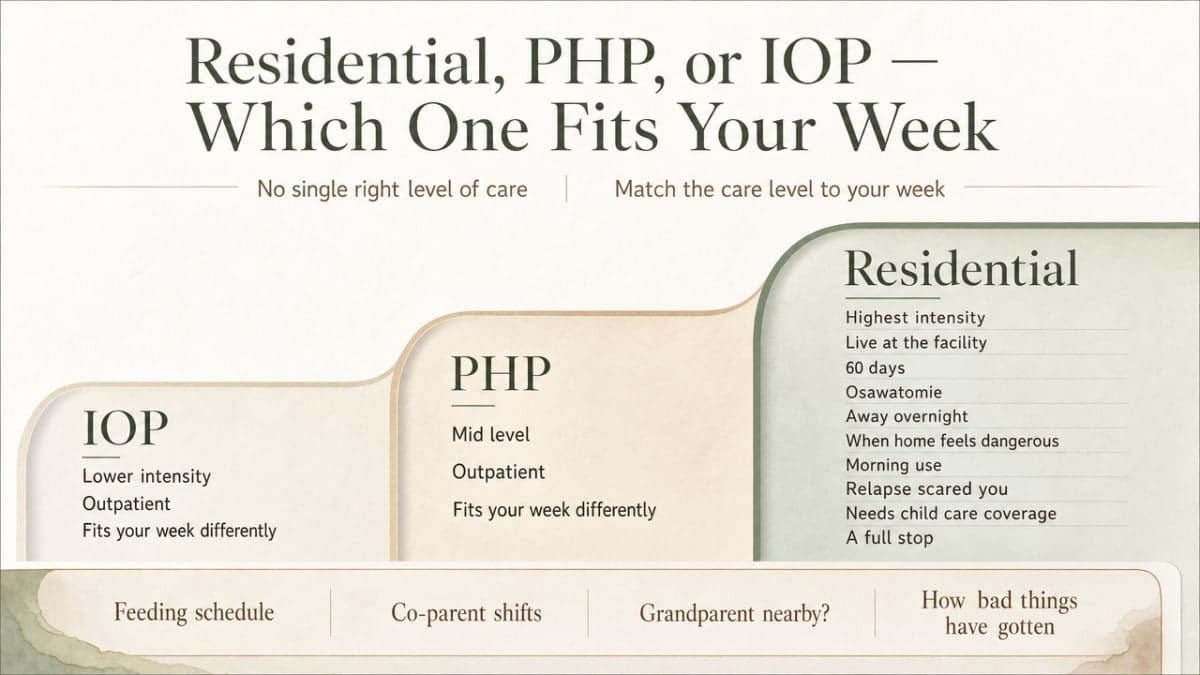
Residential, PHP, or IOP — Which One Fits Your Week
There is no single right level of care for a new parent. There is only the one that matches what your week actually looks like — the feeding schedule, the co-parent’s shifts, whether there’s a grandparent within driving distance, and how bad things have gotten.
Residential means you live at the facility. At Sunflower, the residential track runs 60 days in Osawatomie. It’s the deepest option, and it’s the one most parents flinch at first because it means being away from your baby overnight. It’s also the option people choose when the situation at home has become dangerous — when using has moved past the evening wine and into the morning, or when a relapse has already scared you. If a co-parent, partner, or family member can take primary care of your child for that stretch, residential gives you something outpatient can’t: a full stop.
Partial Hospitalization (PHP) is the middle option. You’re at the program during the day for structured clinical hours, then home at night. For a parent with a nursing baby or a toddler on a nap schedule, PHP can be workable if a partner, a family member, or paid childcare can cover daytime hours.
Intensive Outpatient (IOP) is the lightest of the three, usually a few evenings or mornings per week for a few hours at a time. IOP is often what parents step down into after residential or PHP, and it’s sometimes the starting point for a parent whose use hasn’t reached the acute stage but who knows the trajectory.
Sunflower offers all three, which matters because your needs at week one probably aren’t your needs at week eight. A stepped plan — residential to PHP to IOP, or PHP straight to IOP — is more common than picking one and staying there.
MOUD After Delivery, Breastfeeding, and Postpartum Depression Screening
If you were on buprenorphine or methadone during pregnancy, the postpartum period is not the moment to stop. National clinical guidance from SAMHSA and ACOG is that medications for opioid use disorder should be continued postpartum, and that breastfeeding is generally compatible with MOUD when the pediatric team is looped in.7Continuing is protective. Stopping abruptly in the first weeks after delivery is one of the risk factors that makes this period so dangerous in the first place.
The same guidance is direct about mental health: screening for postpartum depression should be routine, and other co-occurring conditions — anxiety, PTSD from a traumatic birth, prior trauma resurfacing — should be assessed alongside the substance use.7This is the dual-diagnosis piece. Treating the drinking or the pills without touching the depression that’s underneath rarely holds.
When you’re talking to an intake coordinator, ask specifically how they handle MOUD continuation, how they coordinate with your OB or pediatrician, and how postpartum mental health is built into the plan from day one. Those aren’t add-ons. They’re the plan.
Childcare, Transportation, and the Logistics That Actually Decide It
The clinical fit isn’t usually what stops a parent from starting treatment. The logistics are.
Who watches the baby during a 9 a.m. PHP session? What happens on days the co-parent works a double? Is there a car? Is the pump going to keep up during a six-hour day away? A 2024 SAMHSA issue brief on holistic MOUD programs for pregnant and parenting women names these directly — childcare, transportation, peer support, and co-located pediatric care — as the practical supports that decide whether a parent actually shows up or quietly drops off.16
Not every Kansas program offers on-site childcare, and Sunflower is honest about being a treatment facility, not a daycare. But the intake conversation is where you spell out the constraints — the pump schedule, the toddler’s naps, the co-parent’s Tuesday shift — and see what the program can shape around them. If a coordinator can’t answer those questions, that’s information too.
For Dads and Non-Birthing Partners
Most perinatal-SUD content acts like you don’t exist. You do.
If you’re the dad, the non-birthing partner, the second parent — and you’re the one who’s drinking too much after the baby’s asleep, or who never stopped the pills after your own back surgery, or who’s using to stay awake through a night shift and a newborn — this section is yours.
The clinical facts are the same. Postpartum in a household is a high-risk window for the whole family, not just the person who gave birth, and family-based treatment models that include partners in therapy and recovery planning show better engagement and retention than treating one adult in isolation.12You are part of the picture the program should be building.
You may not get priority admission under the Kansas Designated Women’s mandate — that specific timeline is written for pregnant women and women with dependent children.4But Sunflower’s residential, PHP, and IOP tracks are open to you, and the intake call is the same. Say you have a baby at home. Ask how it works around your partner’s schedule. Start there.
When Parenting Work Becomes Part of the Treatment
There’s a version of treatment that treats you like a patient who happens to have a baby waiting at home. And there’s a version that treats the parenting itself as part of what needs healing. Those are not the same program.
The research on this is pretty clear. When substance use treatment integrates parenting skills training, attachment-focused work, and space to actually think about your relationship with your child, parents show better engagement, better retention, and better outcomes than they do in adult-only tracks that stop at the clinical door.11Family-based approaches that fold in partners and family dynamics — not just individual therapy — show the same pattern.12
What that looks like in practice is a program that asks about your baby by name. That gives you room in a therapy session to talk about the moment you snapped at your toddler and hated yourself for it, without treating that as off-topic. That helps you understand how your own history — the childhood you don’t talk about, the trauma from the birth, the pattern you swore you wouldn’t repeat — is threaded through both the using and the parenting.
Sunflower’s family program and trauma-informed approach are built to hold that combination. You’re not being asked to become a better parent through willpower. You’re being given the clinical support to work on the substance use and the parenting as the same problem, because in real life they already are.
Kansas START and Family First: Prevention, Not Punishment
If you’ve heard “child welfare” and pictured a caseworker at your door, it’s worth knowing what Kansas is actually spending its energy on right now — and it isn’t removal-first.
Sobriety Treatment and Recovery Teams (START) is an evidence-based practice built specifically for families where parental substance use is the main child-welfare concern. In legislative testimony to Kansas’s Joint Committee on Child Welfare System Oversight, DCCCA described using START to improve safety, permanency, well-being, and recovery outcomes for children and parents together, with services launched in seven counties as of July 1, 2023.13The whole design point is that pulling a parent into treatment and support keeps a family intact more often than pulling a child out does.
That direction isn’t only a Kansas idea. The federal Family First Prevention Services Act shifted foster-care dollars toward evidence-based mental health treatment, substance use treatment, and in-home parenting programs for families at risk of entering foster care.14Kansas’s investment in START sits inside that federal shift.
None of this makes the fear go away. But it does tell you what the system is trying to be right now: a hand extended earlier, not a door closed later.
Calling Sunflower: A Script for the Questions You’re Afraid to Ask
When you’re ready to call Sunflower, you don’t need a script that sounds put together. You need a short list of the things you actually want to know, so you don’t hang up realizing you forgot to ask the one that mattered.
Here are the questions worth writing on the back of a receipt before you dial:
- I have a baby at home. Can you walk me through how residential, PHP, and IOP would each look for someone in my situation?
- If I’m still breastfeeding or pumping, how does that work during a treatment day?
- I’m on buprenorphine (or was during pregnancy). How do you coordinate MOUD with my OB or my baby’s pediatrician?
- What do you actually do with the information I share? What triggers a report, and what doesn’t?
- My insurance is through my spouse’s employer. Can you check coverage without them getting a notification?
- If my co-parent works nights, can we build the schedule around that?
You are allowed to ask all of these on the first call. You are allowed to ask none of them and just say, I have a baby and I’m scared, tell me how this works. Either one is a real starting place.
Talk to Someone Who Understands Parenting Pressures
Get real answers about balancing recovery with your family’s unique needs—without judgment or obligation.
Frequently Asked Questions
If I call a treatment program in Kansas, will they automatically report me to DCF?
No. Kansas clinicians are mandated reporters, but reporting is triggered by specific safety concerns — like an unattended child or an unsafe home situation — not by a parent voluntarily calling to ask about treatment. The KDHE workflow frames caregiver substance use as a signal to connect families to prevention services, not to separation.1
Can I keep breastfeeding if I start medication for opioid use disorder after delivery?
In most cases, yes. CDC guidance, aligned with SAMHSA and ACOG, supports continuing buprenorphine or methadone postpartum, and breastfeeding is generally considered compatible with MOUD when your pediatric team is coordinating care.7Ask the intake coordinator how they work with your OB and pediatrician on lactation, dosing, and infant monitoring from day one.
How fast can a pregnant or parenting woman actually get into treatment in Kansas?
At the eight Kansas Designated Women’s Substance Use Disorder Treatment Programs, pregnant women must be offered an assessment within 24 hours of initial contact and admitted into treatment within 48 hours, as clinically indicated. Women with dependent children also receive priority admission.4Other programs run on their own timelines, so ask directly about next-week availability.
What if I can’t do residential because I have a nursing baby or a toddler at home?
Residential isn’t the only option. Partial Hospitalization (PHP) runs during the day and lets you home at night; Intensive Outpatient (IOP) is a few sessions per week. Sunflower offers both. Practical supports like childcare and transportation planning are what actually decide whether a parent shows up consistently, so raise those in the intake call.16
Is there a way to ask questions anonymously before I commit to anything?
Yes. The Kansas Parent Helpline at 1-800-CHILDREN, behind the Hope Starts Now initiative, is free, anonymous, and answered 24/7 by trained staff who listen without judgment.5The SAMHSA National Helpline at 1-800-662-HELP is also free, confidential, and available around the clock for individuals and family members.8Neither requires your name.
What about dads and non-birthing partners — are there options for us too?
Yes. The Kansas Designated Women’s priority-admission mandate is written for pregnant women and women with dependent children, so that specific 24/48-hour timeline may not apply to you.4But programs like Sunflower’s residential, PHP, and IOP tracks are open to any parent. Family-based treatment that includes partners shows better engagement and retention than treating one adult alone.12
References
- Workflow: Pregnant/Postpartum Women Using Substances. https://www.kdhe.ks.gov/DocumentCenter/View/27296/Perinatal-Provider-Workflow-PDF
- Perinatal Substance Use | KDHE, KS. https://www.kdhe.ks.gov/600/Perinatal-Substance-Use
- Resource and Reference Guide for Providers: Perinatal Substance Use. https://www.kdhe.ks.gov/DocumentCenter/View/5137/Resource-and-Reference-Guide-for-Providers-PDF?bidId=
- Kansas Designated Women’s Substance Use Disorder Treatment. https://www.kdads.ks.gov/services-programs/behavioral-health/services-and-programs/kansas-designated-women-s-substance-use-disorder-treatment
- Hope Starts Now | KDHE, KS. https://www.kdhe.ks.gov/1220/Hope-Starts-Now
- Out of Home Placement by Primary Removal Reason, SFY2012–SFY2025. https://www.dcf.ks.gov/services/PPS/Documents/FY2025%20DataReports/FCAD_Summary/RemovalsByPrimaryReasonFY2025.pdf
- Opioid Use and Pregnancy | Overdose Prevention, CDC. https://www.cdc.gov/overdose-prevention/hcp/clinical-care/opioid-use-and-pregnancy.html
- National Helpline for Mental Health, Drug, Alcohol Issues. https://www.samhsa.gov/find-help/helplines/national-helpline
- Pregnant and Parenting Women Residential Addiction Treatment (North Dakota). https://www.hhs.nd.gov/behavioral-health/pregnant-and-parenting-women
- Substance Use Disorders in Pregnancy: Clinical, Ethical, and Legal Considerations. https://www.ncbi.nlm.nih.gov/pmc/articles/PMC4934958/
- Parenting and Substance Use: Overview of Evidence and Treatment Approaches. https://www.ncbi.nlm.nih.gov/pmc/articles/PMC6523024/
- Family-Based Treatment for Substance Use Disorders: Evidence and Outcomes. https://www.ncbi.nlm.nih.gov/pmc/articles/PMC6225920/
- Joint Committee on Child Welfare System Oversight October 27, 2025 (Testimony). https://kslegislature.gov/li/b2025_26/committees/ctte_jt_child_welfare_ovst_1/documents/testimony/20251027_30.pdf
- The Social Security Act and the Family First Prevention Services Act: Implications for Child Welfare. https://www.ssa.gov/policy/docs/ssb/v73n2/v73n2p1.pdf
- Substance Use Disorders in Pregnancy and the Postpartum Period. https://www.ncbi.nlm.nih.gov/pmc/articles/PMC7088318/
- Innovative and Holistic Programs that Offer Medications for Opioid Use Disorder to Pregnant and Parenting Women – Issue Brief. https://library.samhsa.gov/product/innovative-holistic-programs-offer-medications-opioid-use-disorder-pregnant-parenting-women-issue-brief/pep24-02-009