
Key Takeaways
- Substance misuse in older adults is routinely mistaken for aging, with up to 15 percent of older primary care patients meeting criteria for at-risk drinking 2.
- Kansas administers substance use services through KDADS alongside aging supports, but federal researchers found no evidence of Medicaid coverage for adult residential mental health treatment in the state 8.
- Coverage type shapes options more than geography: Medicare handles most outpatient care, KanCare rarely covers residential, and commercial or retiree plans open the widest range of settings.
- Before calling a Kansas program, gather substance use details, current prescriptions, and insurance information, then ask whether they serve adults over 60 and accept your coverage.
When It Looks Like Aging But Isn’t
You’ve been told, maybe more than once, that what you’re feeling is just part of getting older. The wine at dinner has crept from one glass to three. The pain pills your doctor started you on after surgery haven’t quite stopped. You wake up foggy, you fell last month reaching for something in the kitchen, and your daughter has that worried look again. And still, everyone keeps saying: this is what your 60s, 70s, 80s look like.
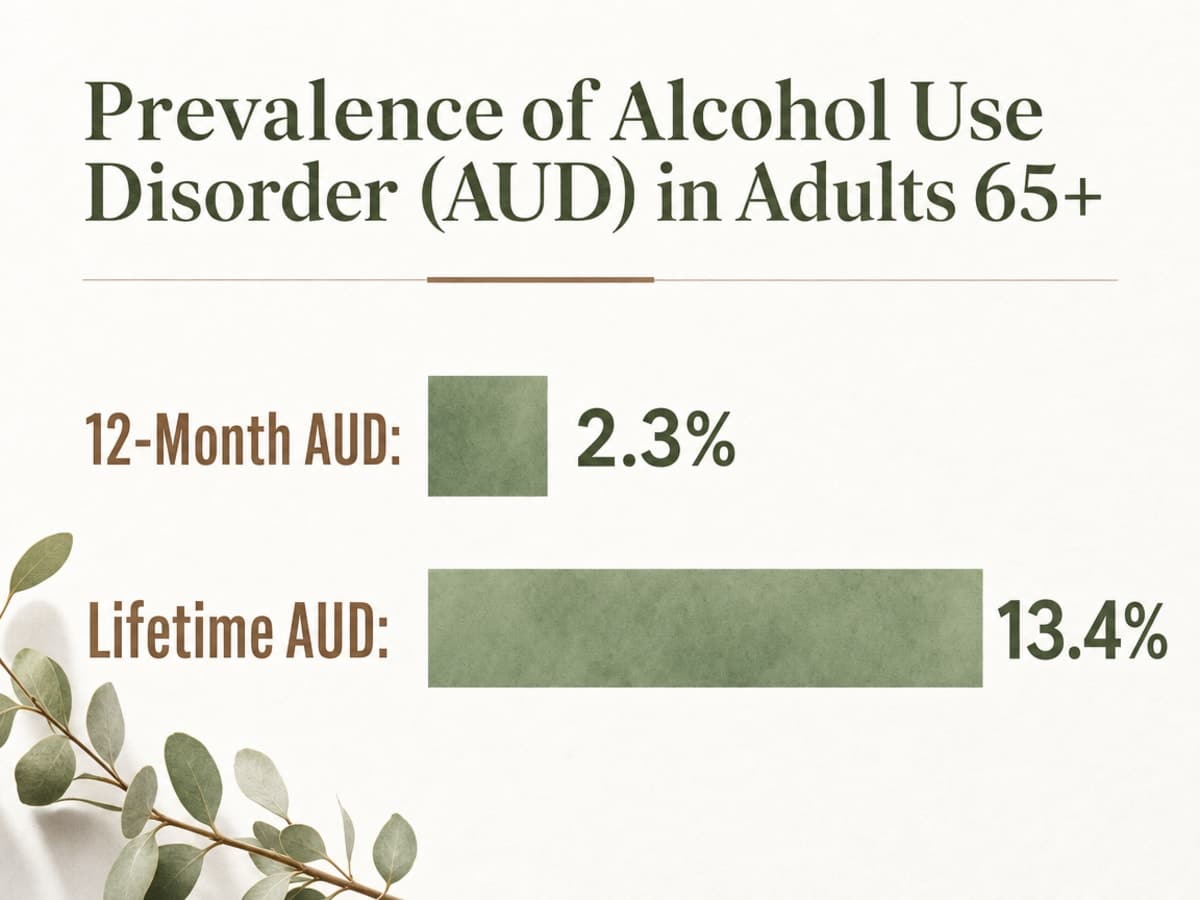
It might not be. Substance misuse in older adults gets missed constantly, even by clinicians, because the signs look almost exactly like aging itself. SAMHSA’s clinical guidance is direct about this: substance use disorders among older adults often go unrecognized and untreated, and some healthcare providers mistake the symptoms for normal age-related changes 2. In healthcare settings, up to 15 percent of older patients may meet criteria for at-risk drinking 2. That’s not a rare edge case. That’s one in seven people in your primary care waiting room.
If you’re reading this because something feels off, either about your own use or about a parent who isn’t quite themselves anymore, you’re not being dramatic. You’re paying attention to something the system is trained to overlook.
What follows is written for you specifically, not for a 22-year-old in their first treatment episode. The biology is different after 60. The medications are different. The losses stacked on top of use, the retirement, the widowhood, the pain that never really left, are different. Kansas has real options, and there are also real gaps you deserve to know about before you make a call. Let’s walk through both.
The Signs That Get Filed Under ‘Just Getting Older’
Here is what makes substance misuse in older adults so easy to miss: the symptoms look like the calendar. A fall in the bathroom. Forgetting the name of a neighbor you’ve known for fifteen years. Sleeping badly, or sleeping at odd hours. Not wanting to go to church anymore. Snapping at your spouse over something small. Every single one of those can be aging. Every single one of those can also be alcohol, benzodiazepines, opioids, or some combination quietly interacting inside a body that no longer processes them the way it did at 40.
A 2023 clinical review of substance use disorders in older adults groups the warning signs into four buckets: physical, cognitive, psychiatric, and social 4:
- Physical: falls, unexplained bruises, poor hygiene, and weight changes.
- Cognitive: disorientation, memory lapses, and trouble following a conversation you used to track easily.
- Psychiatric: sleep disturbance, mood swings, new anxiety, and depression that doesn’t lift.
- Social: the quietest and often the earliest — pulling back from friends, family friction, sometimes legal or financial trouble that seems out of character 4.
Read that list again slowly. If you’re 70, you have probably been to a doctor’s appointment where you mentioned two or three of those things and been told, gently, that this is what your age looks like. You were not necessarily wrong to accept the answer. But you were not necessarily given the whole answer either.
SAMHSA’s clinical protocol is blunt about the cost of this mix-up. Substance use disorders in older adults often go unrecognized and untreated because providers, family members, and patients themselves mistake the symptoms for normal age-related changes 2. The result is that people spend years on medications that treat the wrong problem, or no medications at all, while the underlying use keeps growing.
Two things matter here. First, you are not being paranoid for wondering. The overlap is real and it’s clinically documented. Second, noticing the pattern in yourself, or in a parent, is not a diagnosis. It’s a reason to ask a different question at the next appointment than the one you’ve been asking. Instead of “is this normal for my age,” the more useful question is: could anything I’m taking, or drinking, be part of what I’m feeling?
That single reframe is often the beginning of care that actually fits.
Why the Rules Change After 60
Your body at 68 is not your body at 38, and alcohol knows it before you do. Muscle mass drops. Total body water drops. The liver processes ethanol more slowly. So the same two glasses of wine you’ve had with dinner for forty years now leave a higher blood alcohol level, hang on longer, and interact with more of what’s happening inside you. Nothing about you changed on purpose. The math just shifted.
This is why the clinical guidelines aren’t the same for a 45-year-old and a 70-year-old, and it’s the piece almost no one explains at a routine appointment. The National Institute on Alcohol Abuse and Alcoholism recommends that adults 65 and older keep it to one standard drink per day, no more than seven per week, and no more than three on any single occasion 4. Not because older adults are being singled out. Because that’s what the physiology now supports.
The screening tools your doctor uses, or should be using, reflect the same shift. The U.S. Preventive Services Task Force endorses a single-question screener for risky drinking, and the threshold changes with age.
Two practical things come out of this. First, if you’ve been measuring your drinking against what felt normal in your 40s, you may be well over the current threshold without feeling like anything changed. That doesn’t make you a failure. It makes you someone whose body is telling the truth faster than the culture around you is willing to. Second, if a clinician has never asked you about a four-drink day, or asked your parent, that is a gap in the visit, not a signal that everything’s fine.
The good news buried in all this is that the same physiology that makes older bodies more sensitive to alcohol also makes them, in many cases, more responsive to treatment. When the input changes, the output changes too. That’s worth holding onto as you keep reading.
Polypharmacy: The Medical Reality Treatment Has to Account For
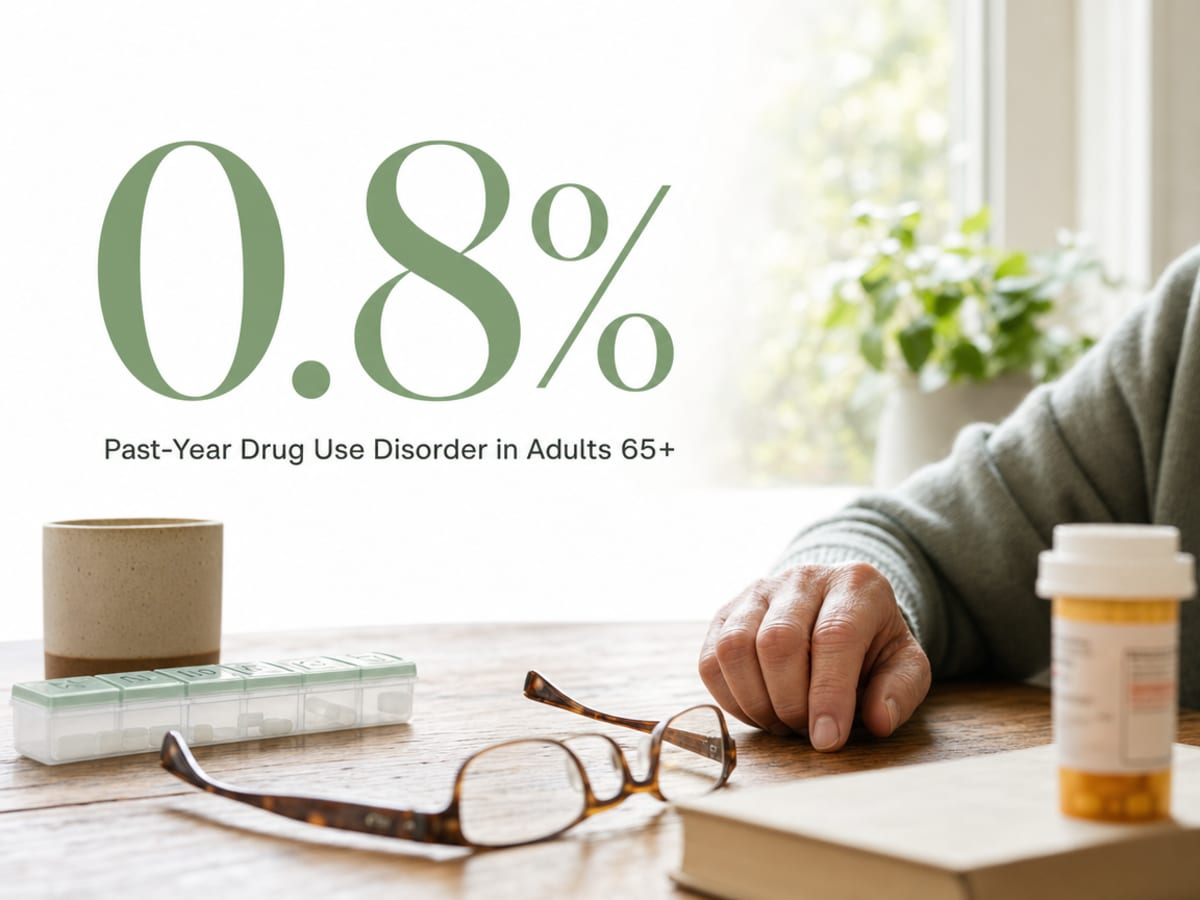
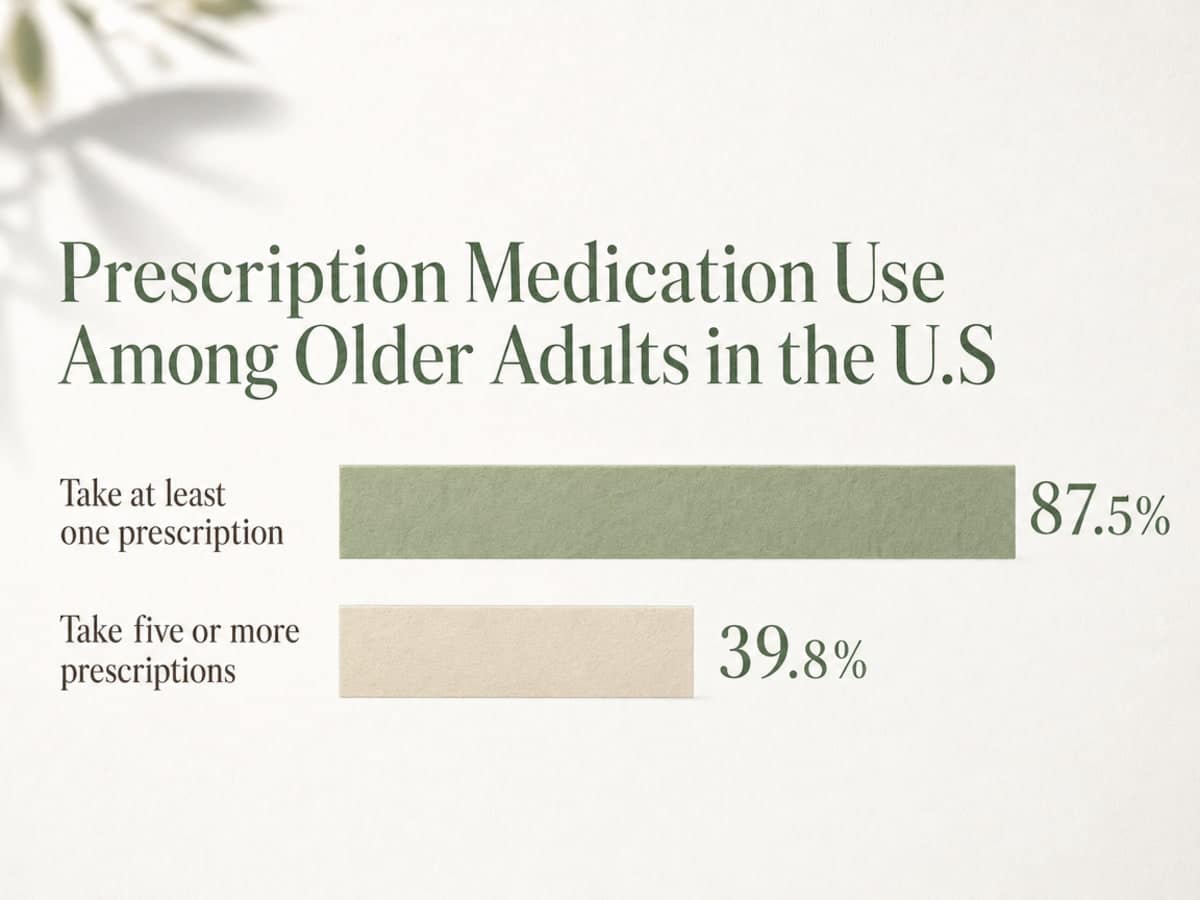
Open the medicine cabinet of almost any 70-year-old in Kansas and you’ll find a small pharmacy. Blood pressure medication. Something for cholesterol. A pill for reflux. Maybe a sleep aid that started as a two-week prescription seven years ago. An anti-anxiety medication from the year your spouse got sick. Vitamin D. A low-dose opioid left over from the knee surgery. This is not unusual. This is the norm.
That second number is the one that matters for treatment planning. When nearly 40 percent of older adults are on five or more prescriptions at the same time 2, any conversation about alcohol, opioids, benzodiazepines, or kratom has to happen inside that reality, not next to it. A glass of wine is not just a glass of wine when it’s landing on top of a benzodiazepine and a blood pressure medication. A leftover hydrocodone is not a discrete event when the person taking it is also on an antidepressant and a sleep aid.
SAMHSA’s clinical guidance names this directly: substance misuse in older adults interacts dangerously with chronic health conditions and polypharmacy 2. The interactions can look like the very things everyone is already blaming on age. More falls. Deeper confusion. Sleep that gets worse instead of better. Pain that seems to require more medication, not less.
This is why treatment built for a 30-year-old does not transfer cleanly to a 68-year-old. A geriatric-aware program has to start with a full medication review, not just a substance history. It has to coordinate with the prescribers who wrote each of those bottles. And in many cases, it has to work on carefully deprescribing medications, especially benzodiazepines, that carry known risks for falls, cognitive impairment, and dependence in older adults 4. That deprescribing is delicate work. It cannot be done by stopping cold. It has to be planned, monitored, and paced to the body doing the tapering.
If you’re the one whose cabinet looks like the one above, the point isn’t guilt. You did what your doctors told you to do, one prescription at a time, over decades. The point is that any honest treatment plan has to see all of it at once, and treat you as the whole person carrying it, not as a single-substance case.
What Kansas Actually Offers — and Where the Gap Is
Kansas has more addiction treatment infrastructure than most people realize, and one significant gap that anyone helping an older adult should know about before they start dialing.
On the offering side, the Kansas Department for Aging and Disability Services (KDADS) administers the state’s behavioral health system, which includes substance use disorder services, community mental health centers, and crisis resources under one aging-and-disability umbrella 1. That structural choice matters for you. It means the same state agency that oversees senior services also oversees the SUD system, so the coordination between aging supports and addiction care is at least on paper part of how Kansas is built.
The continuum itself covers the levels of care an older adult typically needs. Under Kan. Admin. Regs. § 26-52-17, licensed crisis intervention centers in Kansas are required to have policies for acute detoxification, medication-assisted treatment, substance use disorder assessments, and nicotine replacement therapy, all under KDADS standards 9. That regulation adopts ASAM’s 2020 criteria for medically monitored and medically managed intensive inpatient care, which are the same clinical benchmarks a geriatric-aware program would use to decide whether your parent needs a hospital-level setting or something less intense 9. Below that acute tier, Kansas offers residential treatment, partial hospitalization, intensive outpatient, and traditional outpatient options across the state.
Now the gap. When federal researchers looked at Kansas residential treatment, they found no evidence of Medicaid coverage for adult residential mental health treatment in the state 8. Read that carefully. It does not mean nothing is covered. It means that if you or your parent needs longer residential care and your primary coverage is Medicaid, the residential mental health side of the bill is where you’re most likely to hit a wall. Kansas did not expand Medicaid the way many states did, and the residential piece has been a documented access problem for years. For an older adult with a co-occurring depression or anxiety diagnosis on top of alcohol use, this is the seam where families most often get stuck.
What that means in practice: your coverage type shapes your realistic options more than your zip code does.
- Medicare only. Medicare covers a range of outpatient SUD services, medication management, and hospital-based detox when medically necessary. It does not typically cover long-term residential rehab. If your parent is on Medicare, ask any program specifically about Medicare-billable outpatient and partial hospitalization tracks.
- Medicaid (KanCare). Expect outpatient coverage. Do not assume residential coverage. Confirm with the program directly and ask about the specific level of care being proposed.
- Commercial insurance, including retiree plans. This is where residential and PHP options open up meaningfully. Many Kansans over 60 still carry commercial coverage through a spouse’s employer or a retiree plan, and those plans often cover the levels of care Medicare and Medicaid won’t. Sunflower Recovery Center in Osawatomie, for example, accepts most commercial insurance and offers residential, PHP, and IOP, but does not participate in Medicare or Medicaid — which is exactly the kind of detail that determines whether a program is a real option for your situation.
- Private pay or a mix. Some families combine partial insurance coverage with private pay to bridge what Medicaid won’t fund. This is worth asking about explicitly.
None of this is meant to discourage you. It’s meant to save you three phone calls. When you contact a program, lead with the coverage type and the level of care you think is needed. A good intake team will tell you within one conversation whether they can serve you, and if not, where in Kansas you should call next.
What Geriatric-Aware Treatment Looks Like in Practice
A program built for older adults doesn’t just lower the volume on a 30-year-old’s treatment plan. It rebuilds the clinical work around a different body, a different history, and often a different reason for using in the first place.
The first difference is at intake. Instead of a substance history that starts and ends with what you drank last week, a geriatric-aware assessment uses tools validated for your age group. The Short Michigan Alcoholism Screening Test–Geriatric (SMAST-G) was the first brief alcohol screener developed specifically for older adults, and SAMHSA recommends behavioral health providers screen older clients at least annually, before starting new medications, and after events like a fall or a cognitive change 3. That last piece matters. The screening is not a one-time event at admission. It gets repeated at the moments when substance use is most likely to be driving what looks like a new medical problem.
The second difference is medical coordination. A full medication reconciliation happens up front, not as an afterthought. The clinical team reads every bottle against every other bottle, and against your drinking or opioid history, before making a single treatment recommendation. Where benzodiazepines are involved, a careful taper is planned rather than a quick stop, because abrupt discontinuation in an older body carries real risks for seizures, falls, and cognitive decline 4.
Medication for alcohol use disorder is worth asking about directly. The 2023 geriatric SUD review notes that naltrexone appears particularly effective and well tolerated in older adults with alcohol use disorder when monitored carefully 4. That is a meaningful piece of clinical news for anyone who assumed medication options belonged only to younger patients.
The third difference is what therapy actually addresses. For a 68-year-old, the underlying material is rarely a chaotic early adulthood. It is more often grief that never fully processed, chronic pain that outlasted a surgery, a spouse’s illness or death, retirement that took away structure, or trauma from decades earlier that the drinking has been quietly managing. Trauma-informed dual diagnosis care, like the approach used at Sunflower Recovery Center in Osawatomie, is built for exactly that layering — treating the depression, anxiety, or unresolved trauma alongside the substance use rather than sequentially.
One newer tool worth naming: biometric wearables can track sleep quality, heart rate variability, and stress patterns in real time during residential and outpatient care. For an older adult whose sleep has been off for years and whose medications are being adjusted, that data helps the clinical team see how the body is actually responding, night by night, rather than relying only on self-report at the next appointment.
If You’re the Adult Child or Spouse Reading This
A quick shift in who this section is talking to. If you’re the daughter, son, or spouse who has been quietly worrying, the next few paragraphs are for you specifically. Then we’ll turn back to the person themselves.
You are probably not imagining it. The falls that started last winter, the second glass of wine turning into a bottle, the pill bottle that empties faster than the refill schedule says it should, the way conversations drift and repeat. When you’ve tried to raise it, you have likely been told you’re overreacting, or that this is just what getting older looks like. Sometimes that answer came from the person you love. Sometimes it came from their doctor.
Here is what you can do this week without staging a confrontation. Ask if you can come to the next medical appointment. Bring the actual bottles, or a photograph of the shelf. Ask the clinician directly whether any of the current symptoms could involve alcohol or medication interactions, and whether a screening tool for older adults, like the SMAST-G, has ever been used 3. That single question changes the visit.
You are not betraying anyone by asking. You are doing the thing the system was supposed to do and didn’t. Small step, real weight.
Making the First Call: What Happens Next
Picking up the phone is often the hardest part, and it’s also the part you can do today without committing to anything. A first call to a Kansas treatment program is a conversation, not a admission. You are gathering information. They are gathering information. Nobody is signing anything.
Here is what tends to help that call go smoothly. Have three things nearby:
- A rough list of what’s being used (alcohol, prescription medications, anything else) and roughly how much.
- A list of current prescriptions with doses if you have them.
- Your insurance card.
Lead with your age or your parent’s age, your coverage type, and the shortest honest version of what’s going on. Something like: “I’m 71, I’m on Medicare with a supplement, I’ve been drinking more since my husband died, and my doctor mentioned my liver numbers are off.” That single sentence tells an intake coordinator more than an hour of small talk.
Ask two questions before anything else:
- Do you serve adults over 60, and what does that look like in your program?
- Do you take my coverage, and if not, what payment options exist?
A geriatric-aware team will answer both without hesitation. If you feel dismissed or hurried, that is data. Call somewhere else.
You made it this far in the article. That already counts.
Start the Next Step Toward Safe Recovery Today
Connect directly with a caring team ready to guide you through tailored addiction support for older adults.
Frequently Asked Questions
How do I know if my drinking or medication use is actually a problem and not just aging?
Start with a different question than “is this normal for my age.” Ask instead: is what I’m using affecting my sleep, my balance, my mood, my relationships, or my ability to do things I used to do easily? SAMHSA’s clinical guidance says older adults should be screened at least annually and after events like falls or cognitive changes 3. Bring that up at your next appointment.
Does Kansas Medicaid cover residential addiction treatment for older adults?
Federal researchers reviewing Kansas found no evidence of Medicaid coverage for adult residential mental health treatment in the state 8. Some outpatient services are covered under KanCare, and the picture can shift by diagnosis and level of care. Confirm coverage program by program before you assume anything. If your parent has commercial or retiree insurance alongside Medicare, that combination usually opens more residential options than Medicaid alone.
What screening tools do clinicians use for adults over 60?
The Short Michigan Alcoholism Screening Test–Geriatric, or SMAST-G, was the first brief alcohol screener developed specifically for older adults, and SAMHSA recommends its use as part of routine care 3. Primary care clinicians also use the USPSTF single-question screener, which asks about days with four or more drinks for women and all adults over 65 7. If neither has been used with you, ask why.
My parent takes several prescriptions. Can they still safely go through detox or treatment?
Yes, and the presence of multiple prescriptions is exactly why a geriatric-aware program is important. Substance misuse in older adults interacts dangerously with polypharmacy, and clinical teams have to plan around that from day one 2. Where benzodiazepines are involved, safe treatment means a careful taper rather than a quick stop, because abrupt discontinuation in an older body carries real risks 4. Bring every bottle to intake.
Is medication-assisted treatment like naltrexone safe for someone in their 70s?
The 2023 clinical review on geriatric substance use disorders notes that naltrexone appears particularly effective and well tolerated in older adults with alcohol use disorder when monitored carefully 4. That is genuinely encouraging news for a group often assumed to be out of medication options. Safety depends on liver function, current medications, and ongoing monitoring, so this is a conversation to have with a prescriber who knows the full picture.
What should I say when I call a treatment program on behalf of an older family member?
Lead with three pieces of information: your family member’s age, their insurance type, and a short honest description of what’s happening. Then ask two questions. Do you serve adults over 60, and what does geriatric-aware care look like in your program? Do you take our coverage, and if not, what payment options exist? A team that works with older adults will answer both without hesitation. Hesitation is data.
References
- Behavioral Health | Department for Aging and Disability Services. https://www.kdads.ks.gov/services-programs/behavioral-health
- Chapter 1—Older Adults and Substance Misuse: Understanding the Issue. https://www.ncbi.nlm.nih.gov/books/NBK571034/
- Chapter 3—Identifying, Screening for, and Assessing Substance Misuse in Older Adults. https://www.ncbi.nlm.nih.gov/books/NBK571039/
- Substance Use Disorders in the Geriatric Population. https://pmc.ncbi.nlm.nih.gov/articles/PMC10241125/
- 2021–2022 NSDUH: Older Adult Behavioral Health. https://www.samhsa.gov/data/report/older-adult-behavioral-health-report-2021-2022
- A Day in the Life of Older Adults: Substance Use Facts. https://www.samhsa.gov/data/sites/default/files/report_2792/ShortReport-2792.html
- Clinical Guideline: Screening and Behavioral Counseling Interventions in Primary Care to Reduce Unhealthy Alcohol Use in Adults. https://health.uconn.edu/sbirtacademy/wp-content/uploads/sites/101/2015/02/USPTF-Recommendation-Statement.pdf
- Kansas Summary — State Residential Treatment for Behavioral Health Conditions. https://aspe.hhs.gov/sites/default/files/2021-08/StateBHCond-Kansas.pdf
- Kan. Admin. Regs. § 26-52-17 – Alcohol and substance abuse services. https://www.law.cornell.edu/regulations/kansas/K-A-R-26-52-17
- Kan. Stat. § 21-6825 – Certified Drug Abuse Treatment Program for Diversion. https://www.kslegislature.gov/li_2024s/b2023_24/statute/021_000_0000_chapter/021_068_0000_article/021_068_0025_section/021_068_0025_k/
- Behavioral Health among Older Adults: Results from the 2021 and 2022 National Surveys on Drug Use and Health. https://library.samhsa.gov/product/behavioral-health-among-older-adults-results-2021-2022-national-surveys-drug-use-health/pep24-07-018