
Key Takeaways
- In Johnson County, overlapping social circles across Overland Park, Leawood, and Prairie Village make being seen at a local outpatient office a real daily risk, not a paranoid one.
- Three stacked legal protections guard treatment records: HIPAA as a baseline, federal 42 CFR Part 2 requiring written consent for disclosures, and Kansas Statute 65-5602’s patient-held privilege 7, 3.
- A residential setting about an hour south in Osawatomie puts physical distance between daily social geography and care, while still allowing family sessions and a step-down through PHP, IOP, and aftercare.
- Before calling, weigh what matters locally: how records move under FMLA and licensing rules, whether the program treats trauma and co-occurring diagnoses, and how the step-down phases hand off back into normal life.
The Real Barrier in Johnson County Isn’t Clinical — It’s Being Seen
If you’re reading this at 2 a.m. with the browser window ready to close the second someone walks in, that took something. You already know the clinical part. You know what you’re using, roughly how much, and that it stopped working a while ago. That isn’t what’s keeping you stuck.
What’s keeping you stuck is the math of visibility. Your firm’s holiday party is in three weeks. Your kid’s teacher is a neighbor. The partner track, the custody agreement, the board seat, the license renewal — every one of those has a person attached to it, and most of those people live within four miles of your house. In a county where the coffee line at a Leawood shop can produce two people you know before you order, the fear of being seen going to treatment is often louder than the fear of what happens if you don’t go.
That fear is rational. It also isn’t the whole picture. Federal and Kansas law build a specific, named set of protections around addiction treatment records that most people never learn about until they need them 7, 3. And geography — a short drive south, out of your daily loop — can turn those legal protections into something you can actually feel. That’s what the rest of this piece is about.
Why Privacy Feels Different in Overland Park, Leawood, and Prairie Village
Privacy in Johnson County isn’t paranoid. It’s arithmetic. Your dentist’s office manager is on your HOA board. Your kid’s soccer coach works two floors down from your husband. The pediatrician saw your sister-in-law last Tuesday. When your social, professional, and school circles overlap the way they do in Overland Park, Leawood, Prairie Village, Lenexa, and Mission Hills, the odds of a chance sighting are not theoretical. They’re daily.
That’s why the standard advice — “just call someone local” — lands wrong here. A local outpatient office on a Tuesday at 4 p.m. means a parking lot someone recognizes. It means an intake form that asks where you work, which happens to be a name on your neighbor’s client list. It means the pharmacy in your grocery store filling something you’d rather not explain to the cashier who taught your daughter’s confirmation class.
None of that means treatment is impossible. It means the setting matters as much as the clinical model. And the setting includes distance.
The urgency isn’t invented, either. Kansas recorded 3,013 overdose deaths between 2020 and 2024 — roughly 21 deaths per 100,000 residents each year, tracked at the county level through KDHE’s data systems 9. That number is statewide, not Johnson County alone, and it doesn’t tell you your personal risk. What it tells you is that the pattern reaching your ZIP code is the same pattern reaching every ZIP code, and that the window between “I’ve got this handled” and “something happened” is narrower than the story you’ve been telling yourself.
The research on stigma backs up what your gut already knows. Fear of being seen — by employers, licensing boards, custody evaluators, neighbors — is one of the most consistent reasons people delay care for substance use, even when they have every resource to pay for it 6. That instinct to look for treatment outside your immediate zip code isn’t avoidance. It’s a reasonable response to a real social geometry. The next section covers what the law actually does with that instinct once you act on it.
What Actually Protects Your Treatment Records
Before you make a call, you deserve to know what happens to the record of that call. Not in vague reassurance language — in actual law. Three separate frameworks stack on top of each other when you enter licensed addiction treatment in Kansas, and each one was written specifically because lawmakers understood that people don’t seek care they can’t trust to stay private.
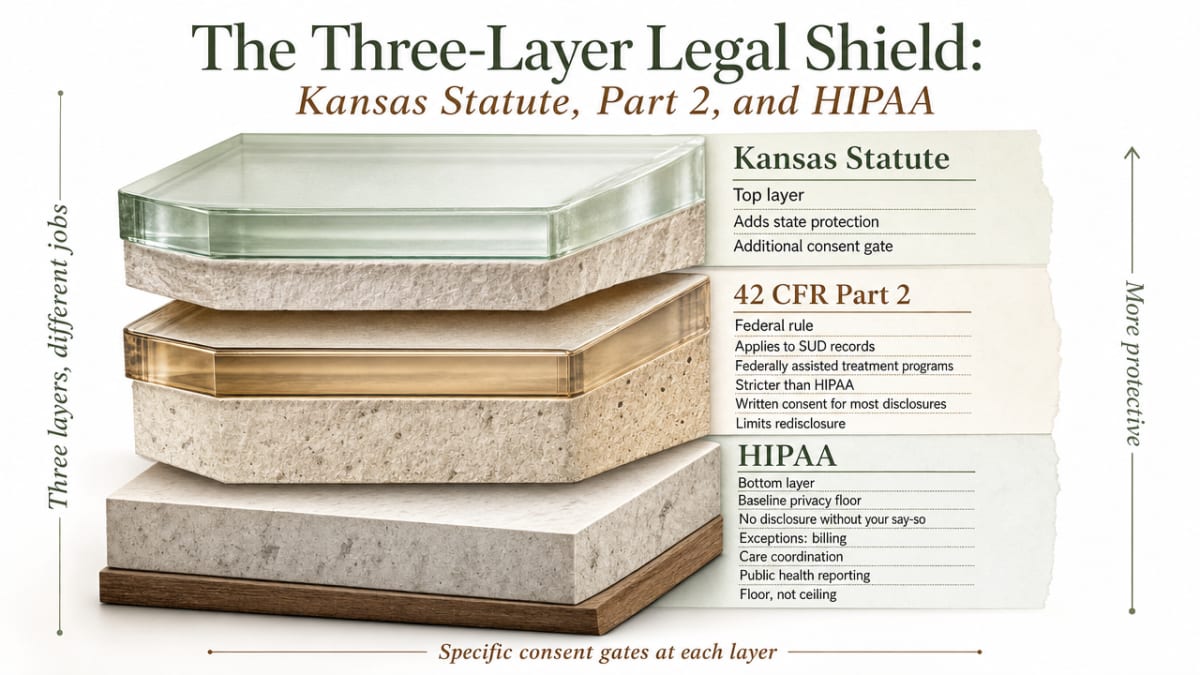
The Three-Layer Legal Shield: Kansas Statute, Part 2, and HIPAA
Think of it as three layers, each with a different job.
The bottom layer is HIPAA. You’ve signed the forms at every doctor’s office in Johnson County. It sets the baseline: your medical information can’t be handed out without your say-so, with a defined set of exceptions for billing, coordination, and public health reporting. It’s the floor, not the ceiling.
The middle layer is the one most people have never heard of, and it’s the one that matters most for you. It’s called 42 CFR Part 2. It’s a federal rule that applies specifically to substance use disorder records held by federally assisted treatment programs — which includes essentially every licensed residential program in the country. Part 2 is stricter than HIPAA. It requires your written consent for most disclosures that HIPAA would otherwise allow, and it limits redisclosure by anyone who receives your records 7. The recent final rule updates modernized how Part 2 works alongside HIPAA for care coordination, but the core promise held: strong privacy protections remain for these records 2. In plain terms, a hospital can’t casually forward your SUD treatment history to your primary care doctor, your employer’s health plan, or a court, the way general medical records sometimes move.
The top layer is Kansas-specific. Kansas Statute 65-5602 creates something called the treatment facility privilege — a state-level protection that lets you prevent disclosure of your treatment and your confidential communications with clinicians at a licensed facility 3, 8. It’s a privilege that belongs to you, the patient, not to the facility. That distinction matters: you hold the key. The statute is short, specific, and enforceable in Kansas courts.
Stacked together, these layers do something the marketing brochures can’t. They put your treatment record behind three separate consent gates, each with its own narrow list of exceptions, each answerable to a different authority. A subpoena that would pry open a general medical file often hits a wall at the Part 2 layer. A curious insurance downstream request that HIPAA might tolerate gets stopped by the Kansas privilege. This isn’t theoretical protection. It’s the architecture that keeps your name out of places you didn’t put it.
The Exceptions You Should Know By Name
Any honest read of privacy law includes the exceptions, because pretending there aren’t any is how trust breaks. Kansas Statute 65-5603 lists them in specific terms, and it’s a short list 1.
Your records or communications can be disclosed:
- in involuntary commitment proceedings;
- for a court-ordered examination — meaning a judge, not a curious lawyer, has directed it;
- when a mandatory report to a public official is required, the kind of reporting that applies to any healthcare provider;
- when it’s necessary for your emergency treatment, provided the head of the facility documents the reasons in writing and makes that statement part of your record 1;
- when there’s a threat of substantial physical harm to an identifiable person;
- for accreditation or scholarly study, but only under strict anonymity conditions that strip identifying information 1.
Read that list again. What isn’t on it: your employer asking. Your neighbor’s cousin at the insurance company. A background check for a board seat. A custody attorney on a fishing expedition. A journalist. A landlord. The person in the pew behind you. None of that meets the standard. The exceptions were written narrowly on purpose, because the legislature understood that if the exceptions swallowed the rule, no one would ever call.
Why SUD Records Get Stricter Treatment Than General Medical Records
There’s a reason substance use disorder records sit behind an extra federal gate that a broken ankle doesn’t. It goes back to the 1970s, when Congress recognized that people were dying in part because they wouldn’t seek treatment they didn’t trust to stay confidential. Fear of exposure — to employers, to police, to family, to licensing boards — kept people using long past the point they wanted to stop 5. Stronger privacy wasn’t a courtesy. It was a public health tool.
The research since has kept confirming what the original policy assumed. Stigma remains one of the most consistent barriers to care for substance use, and confidentiality protections directly reduce that barrier by making it safer to walk through the door 6. Part 2 wasn’t drafted to hide something shameful. It was drafted because lawmakers understood that a person weighing treatment against career risk needed the scale tipped, and that tipping it saved lives.
What that means for you: the extra layer isn’t a burden the system tolerates. It’s a feature the system was built around. Your call is legally treated differently than a call about your cholesterol, because the law already knows why you’re nervous to make it.
Distance as a Clinical Tool: The Case for a Short Drive South
Here’s something the intake brochures rarely say out loud: for a lot of people in Johnson County, the drive itself is part of the treatment. Not the mileage — the separation.
Osawatomie sits roughly 45 to 60 minutes south of Overland Park, straight down 169. That’s close enough that your spouse can come for a family session on a Saturday morning and be home by dinner. It’s also far enough that you are not going to run into your paralegal at the vending machine, and your car is not parked outside a strip-mall office three exits from your house. That gap — near enough for family, out of range of your daily loop — is the geographic thesis of residential care for someone whose life is heavily networked in one zip code.
There’s a clinical reason it matters. Recovery in the first weeks is fragile because the cues that trigger use are everywhere in your normal environment: the drive past a certain restaurant, the group text that pings at 5 p.m., the drawer, the neighbor, the hour of day. Stepping physically out of that loop for 60 days lowers the number of decisions you have to win each afternoon from dozens to zero. The stigma research is blunt about the flip side too — proximity to your daily social geography is one of the specific things that keeps people from engaging with care in the first place 6.
The step-down piece keeps the distance from becoming isolation. Residential moves into PHP, then IOP, then aftercare, and by the later phases you’re driving less and living more of your normal life again — but by then, you’ve built something to bring home.
What Trauma-Informed, Dual Diagnosis Care Actually Looks Like
Once you’ve decided you can afford the privacy, the next question is whether the care itself is worth showing up for. Not brochure care — actual care that changes what your evenings feel like six months from now. For most people in Johnson County who’ve stayed functional for a long time, that means two things running in parallel: the substance use, and whatever the substance use has been managing.
Treating What Happened, Not Just What You’re Using
Trauma-informed dual diagnosis care starts from a different question than most people expect. It doesn’t lead with what you’re using or how much. It leads with what you’ve been carrying.
For a lot of high-functioning adults who end up in residential treatment, the drinking or the pills or the kratom or the stimulants didn’t arrive out of nowhere. They arrived on top of something — a loss you never got to process, a childhood you learned to manage instead of feel, a marriage that ended in a way you never told anyone about, a job that asked you to be someone you weren’t for a decade. The substance did a job. Numbing, sleeping, performing, softening the edges of a day that was sharper than you could say out loud.
Dual diagnosis just means the clinical team is trained to see both at once. The addiction is real and gets treated. So does the depression underneath it, or the anxiety, or the eating disorder, or the PTSD that never got a name. Treating one without the other is the reason a lot of people relapse after 30 days — the drug is gone but the reason it worked is still there.
Personalized Care and Biometric Tracking Through Withdrawal
Withdrawal is not the same for everyone. Two people using the same substance at similar volumes can have wildly different first weeks — sleep patterns, heart rate, stress response, appetite, all moving on separate timelines. A generic protocol treats them as one person. A personalized plan treats them as two.
That’s where the individualized part earns its keep. A multidisciplinary team — medical, psychiatric, therapy, nutrition — builds a plan around your actual history, your co-occurring diagnoses, and what you need to feel safe enough to engage. It gets adjusted as your body settles.
Biometric monitoring through a Huml Health wearable adds a quiet data layer to that adjustment. Sleep quality, heart rate variability, stress markers — measured continuously rather than guessed at in a 10 a.m. check-in. When your sleep collapses on night four, the team sees it before you have to explain it. It’s one tool inside a broader personalized approach, not the point of the treatment.
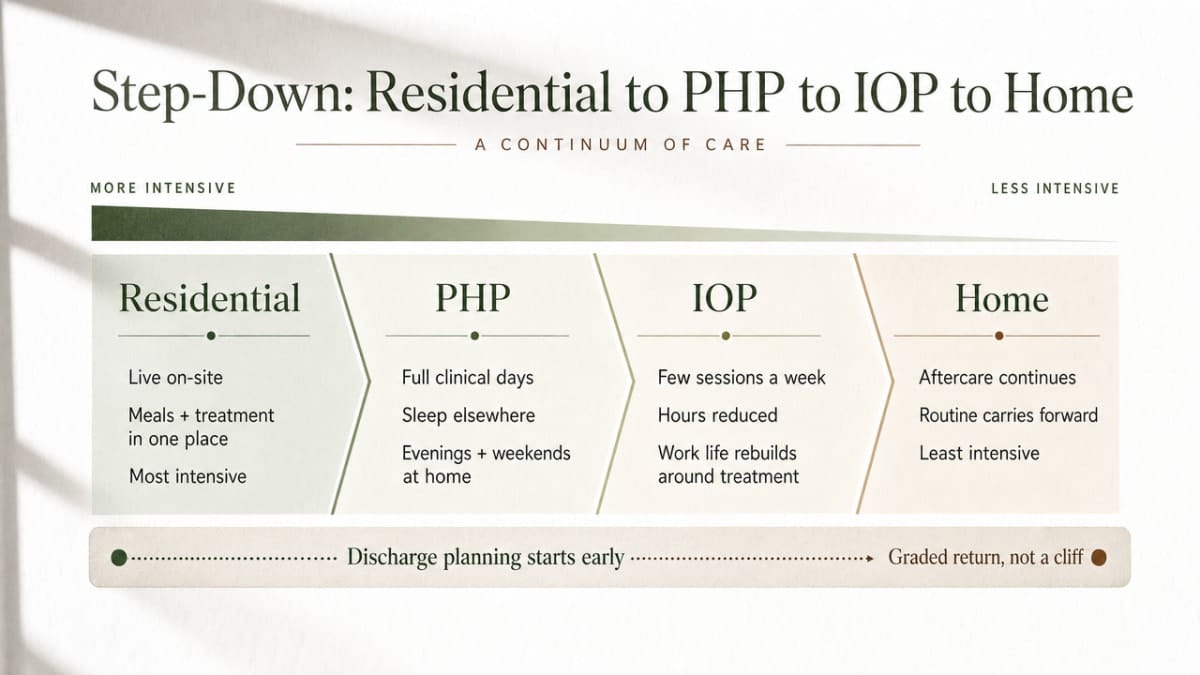
Step-Down: Residential to PHP to IOP to Home
Sixty days of residential care isn’t the whole plan. It’s the first phase of a longer arc, and the handoff between phases is where a lot of programs quietly lose people.
- Residential is the intensive stretch — you sleep there, eat there, and do the work of the day inside the same walls.
- When your team decides you’re ready, you move to a Partial Hospitalization Program (PHP): full clinical days, but you’re sleeping somewhere else, often stepping back into a home routine on evenings and weekends.
- From there, Intensive Outpatient (IOP) reduces the hours further — usually a few sessions a week — and lets you rebuild your work life around treatment rather than the reverse.
- Aftercare picks up from there, and by then the drive from Johnson County is mostly memory.
Discharge planning starts early, not on the last day. The point is a graded return, not a cliff. Each step is designed so the skills you built in the last one still hold in the next one, with less scaffolding and more of your real life around you.
The Fears You Haven’t Said Out Loud Yet
You’ve probably run every scenario in your head at 3 a.m. — the ones you haven’t typed into a search bar because typing them makes them real. It helps to say them plainly. Most of what you’re afraid of has a specific answer, and the answer is usually better than the story you’ve been telling yourself in the dark.
Your Employer, Your License, Your Custody Case
Start with the employer. If you use FMLA or short-term disability, your HR department learns you have a serious health condition and its expected duration. They do not automatically learn the diagnosis. The medical certification goes to a third-party administrator or the plan, not to your manager, and your SUD treatment records themselves stay behind the Part 2 gate that requires your written consent to move 7.
The license question — nursing, law, medicine, finance, real estate — depends on your board’s specific self-reporting rules, not on the treatment facility disclosing anything on its own. A licensed program cannot report you to your board. What it can do is help you document voluntary, proactive care, which is usually what boards want to see when self-reporting is triggered by something else.
Custody is the one people fear most, and the one most misunderstood. A treatment record does not float into a family court file. It gets there only through a court order or your own signed release 1. Judges in Kansas generally view voluntary treatment as a mitigating fact, not evidence of unfitness. The thing that damages a custody case is untreated use, not the paper trail of treating it.
The Coffee Shop Problem: Local Outpatient vs. Residential Distance
Here’s the scenario you’ve already pictured. You pick a local IOP in Overland Park. It meets Tuesday and Thursday, 5:30 p.m. Third week, your kid’s swim coach walks out of the office next door as you’re walking in. You have exactly two seconds to invent a reason you’re there.
A residential setting 45 minutes south removes that math entirely. Your car is not in a shared parking lot. Your intake is not scheduled around your neighbor’s Pilates class. There is no lobby where someone you know is waiting for a different appointment. The physical separation is what makes the legal privacy 7 feel like actual privacy in your daily life — not a promise on a form, but a set of miles between you and the people whose knowing would cost you something.
Making the Call Without Making It Public
The call itself is the part people rehearse the longest and put off the hardest. It helps to know what actually happens on the other end.
You don’t have to give your legal name to ask questions. You can call from a cell phone that isn’t on a family plan, at a time your day allows, and ask about admission, insurance verification, what a typical week looks like, and how records are handled — all before you say yes to anything. The intake conversation is itself protected under the same Part 2 framework that covers your treatment records once you’re admitted 7. Nothing about that first call travels to your employer, your insurance company beyond what’s needed for benefits verification, or anyone in your neighborhood.
If insurance is the piece you’re stuck on, the admissions team runs the benefits check on your behalf and tells you what your commercial plan actually covers. Most commercial plans are accepted; Medicare and Medicaid are not. You’ll get real numbers before you make a decision, not after.
Sunflower Recovery Center sits about an hour south of Overland Park in Osawatomie — close enough for your family to be part of the work, far enough for the setting to feel like yours. When you’re ready, that call is the whole first step. The rest is built to meet you there.
Speak With Someone Who Understands Right Now
Connect directly for confidential guidance and immediate next steps, just a short drive from Johnson County.
Frequently Asked Questions
Does my insurance company get told I went to addiction treatment?
Your plan sees what’s needed to pay the claim — dates of service, level of care, diagnosis codes. That’s it. Your therapy notes, session content, and treatment history stay behind Part 2’s consent gate and don’t get forwarded to your employer’s HR team or downstream vendors 7. Verification happens between admissions and the plan, not through your workplace.
Do I have to tell my employer I’m going to residential treatment?
Not by name. FMLA and short-term disability require certification of a serious health condition and expected duration — not a diagnosis. That paperwork routes to a third-party administrator, not your manager. Your actual treatment records require your written consent to move anywhere 7. Most people describe it as a medical leave. That’s accurate and sufficient.
How long is residential treatment, and can my family visit?
The residential stretch runs 60 days, followed by PHP and IOP step-downs. Family programming is built into the arc, not tacked on. Osawatomie is about an hour south of Overland Park, so a spouse can drive down for a Saturday session and be home that night. Kids, parents, and partners are part of the work, not visitors to it.
What should I bring, and what happens the first 48 hours?
Comfortable clothes, toiletries without alcohol, a book, a photo or two. Admissions sends a specific list once you’re scheduled. The first 48 hours are medical: intake assessment, physical, psychiatric evaluation, and a plan for whatever withdrawal looks like for you. You’ll meet your team, sleep in your room, and start slow. Nothing about day one is performance.
What happens after residential — do I have to keep driving back?
Less than you’d think. PHP has heavier clinical hours but you sleep at home. IOP drops to a few sessions a week, scheduled around work. By aftercare, most contact is virtual check-ins and occasional in-person appointments. The commute shrinks as your life expands back into it. Discharge planning starts early so the handoff between phases doesn’t leave gaps.
Can I make the initial call without committing to admission?
Yes. You can ask questions, get insurance verified, hear what a week actually looks like, and hang up. No admission, no obligation, no note in a file that follows you. The call itself sits under the same Part 2 protections as treatment records once you’re admitted 7. Call from a cell phone that’s yours. Ask everything. Decide after.
References
- 65-5603 Kansas Statutes: Exceptions to privilege. https://ksrevisor.gov/statutes/chapters/ch65/065_056_0003.html
- Fact Sheet: 42 CFR Part 2 Final Rule – HHS. https://www.hhs.gov/hipaa/for-professionals/regulatory-initiatives/fact-sheet-42-cfr-part-2-final-rule/index.html
- Chapter 65—Public Health (Kansas Statutes, including Article 56 on Confidential Communications and Information). https://ksrevisor.gov/statutes/ksa_ch65.html
- Overdose Data Dashboard | KDHE, KS. https://www.kdhe.ks.gov/1309/Data-Dashboard
- Confidentiality and Privacy in Health Care from the American Perspective. https://www.ncbi.nlm.nih.gov/pmc/articles/PMC3066051/
- Stigma and Substance Use Disorders: Clinical and Policy Implications. https://www.ncbi.nlm.nih.gov/pmc/articles/PMC4351133/
- 42 CFR Part 2 — Confidentiality of Substance Use Disorder Patient Records. https://www.ecfr.gov/current/title-42/chapter-I/subchapter-A/part-2
- 2026 Kansas Statutes. https://www.kslegislature.gov/laws/040_000_0000_chapter/040_002_0000_article/040_002_0105a_section/040_002_0105a_k
- Drug Overdose Deaths in Kansas 2020-2024 – KDHE. https://www.kdhe.ks.gov/DocumentCenter/View/55471/2020-2024-Kansas-Overdose-Deaths-PDF
- Substance Use Disorder & Overdose Prevention | KDHE, KS. https://www.kdhe.ks.gov/1298/Substance-Use-Disorder-Overdose-Preventi