
Key Takeaways
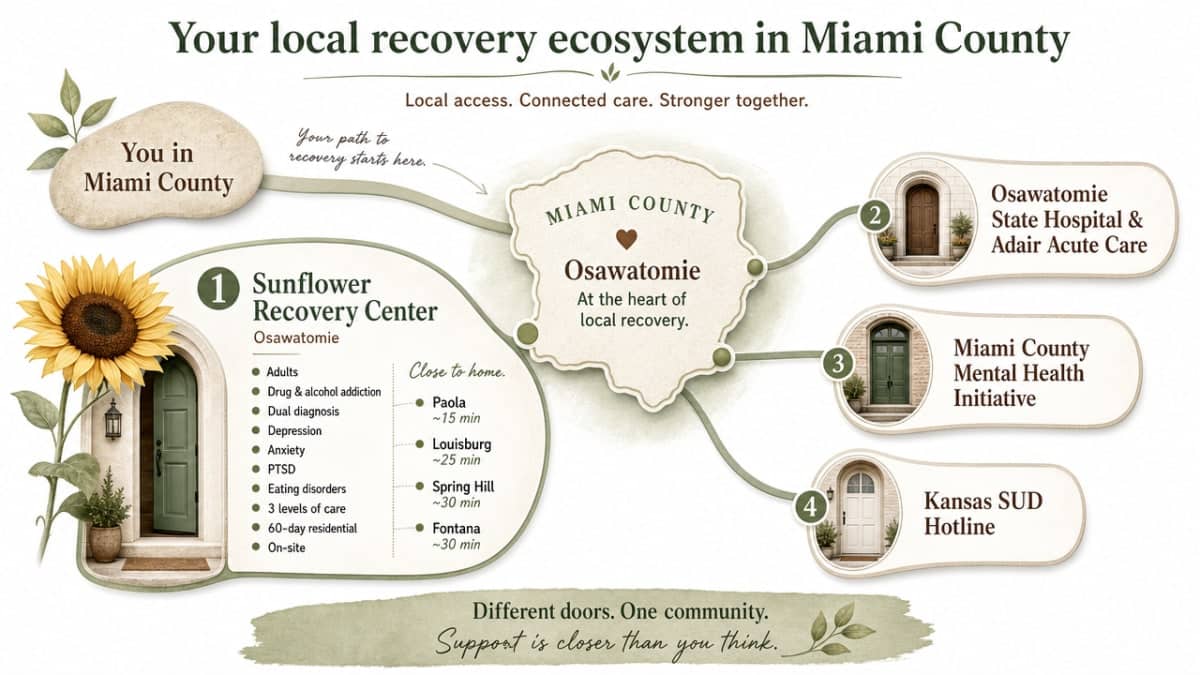
- Miami County residents have four local options: Sunflower Recovery Center in Osawatomie, Osawatomie State Hospital and Adair Acute Care, the county Mental Health Initiative, and the 24/7 Kansas SUD Hotline.
- Choosing the right door depends on whether the situation is a psychiatric crisis, a substance use disorder, or both, since roughly half of adults with SUD also carry a mental health condition 8.
- Compare programs by level of care offered (residential, PHP, IOP, aftercare), whether dual diagnosis and trauma-informed care are truly integrated, and which insurance they accept before committing.
- Sunflower takes most commercial plans but not Medicare or Medicaid; KanCare or Medicare holders can be routed to a matching Kansas program through Carelon Behavioral Health via 866-645-8216 1.
You already know something has to change
You have probably already tried to stop. Maybe more than once. Maybe last week. So this isn’t a page about warning signs or a quiz to tell you what you already know in your bones.
You live in Miami County. Osawatomie, Paola, Louisburg, Spring Hill, Fontana — the drive between any of them is short, but the drive to admitting you need real help can feel like the longest one you’ve ever taken. If you are the spouse, parent, or adult child reading this on someone else’s behalf, the same is true for you. You are tired. You are scared. You are still here, still looking.
That counts.
What follows is a plain map of what addiction treatment actually looks like in Miami County right now — the private residential and outpatient care at Sunflower Recovery Center in Osawatomie, the state psychiatric hospital down the road, the county’s mental health initiative, and the 24/7 Kansas hotline you can call tonight 2. No sales pitch. Just the local lay of the land, and what happens after you pick up the phone.
What addiction looks like in Kansas right now
Before you read another word, know this: whatever you are using, whatever combination of things you are using, you are not the only one in Kansas walking into this. Not by a long shot.
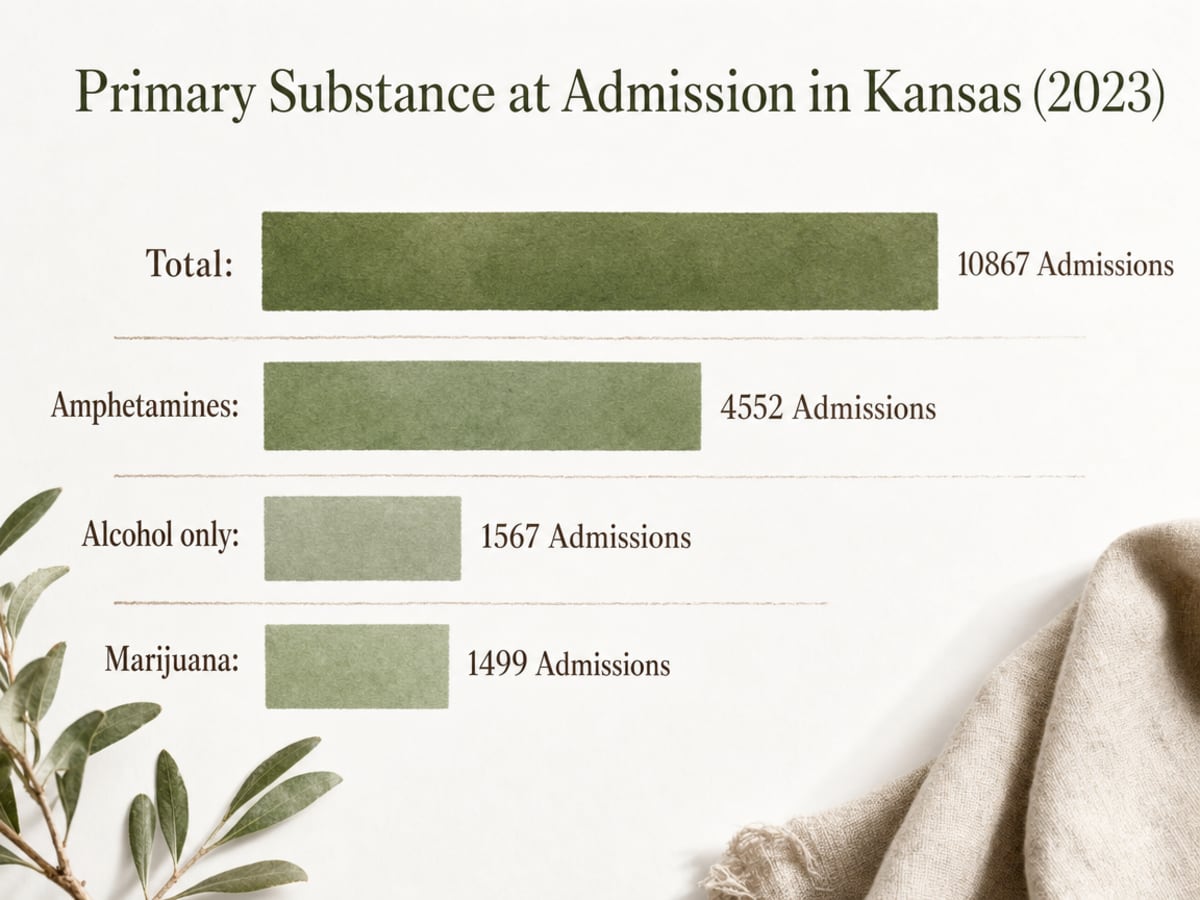
In 2023, Kansas recorded 10,867 admissions to substance use disorder treatment across the state 6. That is roughly the population of Paola and Osawatomie put together — and it is only the people who actually made it through the door. The rest are still where you might be right now: sitting in a truck in a driveway, staring at a phone, thinking about calling.
The mix probably surprises people who assume this is only an opioid story. Amphetamines were the number one primary substance at admission that year, with 4,552 people entering treatment for meth or related stimulants 6. Alcohol only accounted for 1,567 admissions. Marijuana was the primary substance for 1,499 more 6. Opioids, cocaine, and polysubstance use fill out the rest. If your drug of choice is meth, or beer after work, or weed you cannot put down, or pills, or some tangled combination of all of the above — you are somewhere on that chart. You are not an outlier.
Here in Miami County, the picture is not separate from the state picture. It is the state picture, playing out on Old Kansas City Road and 279th Street and behind the closed doors of houses in Louisburg and Spring Hill and Fontana. The Kansas Department of Health and Environment tracks overdose trends countywide through its dashboard, and the same 24/7 hotline that serves Kansas City serves Osawatomie 2. Same crisis. Same resources. Different zip code.
The reason this matters: shame keeps people from calling. Statistics do not fix shame, but they can make it a little smaller. Ten thousand Kansans last year decided the next step was worth taking. You can be one of them.
Your local recovery ecosystem in Miami County
Sunflower Recovery Center in Osawatomie
Sunflower Recovery Center sits right in Osawatomie, the county seat. For a lot of people reading this, that means the drive to treatment is shorter than the drive to a decent grocery store. From Paola, it’s about fifteen minutes. From Louisburg, maybe twenty-five. From Spring Hill or Fontana, half an hour, tops.
The center treats adults for drug and alcohol addiction, and it treats what usually comes with it: depression, anxiety, PTSD, eating disorders, and the other quiet things that make putting the bottle or the pipe down feel impossible. That’s the dual-diagnosis piece, and it matters because most people walking into treatment are not carrying just one thing.
Three levels of care live under one roof here. There is a 60-day residential program where you sleep, eat, and do the work on-site. There is a Partial Hospitalization Program (PHP) — full days of treatment, evenings at home. And there is an Intensive Outpatient Program (IOP) for people who need real structure but also need to keep working or parenting. Family programming and discharge planning are built in, not tacked on.
Insurance-wise, Sunflower accepts most commercial plans. It does not accept Medicare or Medicaid. That’s a real limitation, and it’s better to know now than at the intake desk.
Osawatomie State Hospital and Adair Acute Care
A few minutes from Sunflower, on the same Osawatomie campus, sit two state psychiatric hospitals: Osawatomie State Hospital (OSH) and Adair Acute Care. KDADS describes OSH as licensed by the State of Kansas to provide care and treatment for adults diagnosed with psychiatric disorders regardless of ability to pay 11. Together, the two hospitals serve adults from 45 Kansas counties in collaboration with 12 Community Mental Health Centers 15.
Here’s what that means for you. If someone in your family is in a full psychiatric crisis — actively suicidal, psychotic, unsafe to themselves or others — the state hospital is the emergency-level piece of the puzzle, not an addiction treatment center. OSH and Adair stabilize. Sunflower and other SUD programs do the addiction and dual-diagnosis work that follows.
It’s useful to know your neighbors. Nobody in this county has to build a treatment plan from scratch — the pieces already exist, and they talk to each other.
The Miami County Mental Health Initiative and the Kansas SUD Hotline
Two more pieces round out the local map, and both are free to use.
The Miami County Mental Health Initiative is the county’s own effort to coordinate behavioral health resources, raise awareness, and help residents actually find care instead of hitting a dead end 10. It’s not a treatment facility. Think of it as the connective tissue — the reason a school counselor in Paola, a deputy in Louisburg, and an ER nurse in Osawatomie can point to the same list of options when someone finally asks for help.
Then there’s the Kansas Substance Use Disorder Hotline: 866-645-8216, available 24/7 2. When you call, you’ll be routed through Carelon Behavioral Health, which handles standardized alcohol and drug assessments and referrals for the whole state 1. You can call at 2 a.m. on a Tuesday. You can call from your car in the Casey’s parking lot. Nobody will lecture you. They will help you figure out the next step.
So the local map looks like this: a private residential and outpatient center (Sunflower), a state psychiatric hospital campus (OSH and Adair), a county-level coordinating body (the Mental Health Initiative), and a 24/7 state hotline. Four doors. Same county. All of them open.
Why dual diagnosis and trauma-informed care are the real question
When addiction shows up with depression, anxiety, PTSD, or an eating disorder
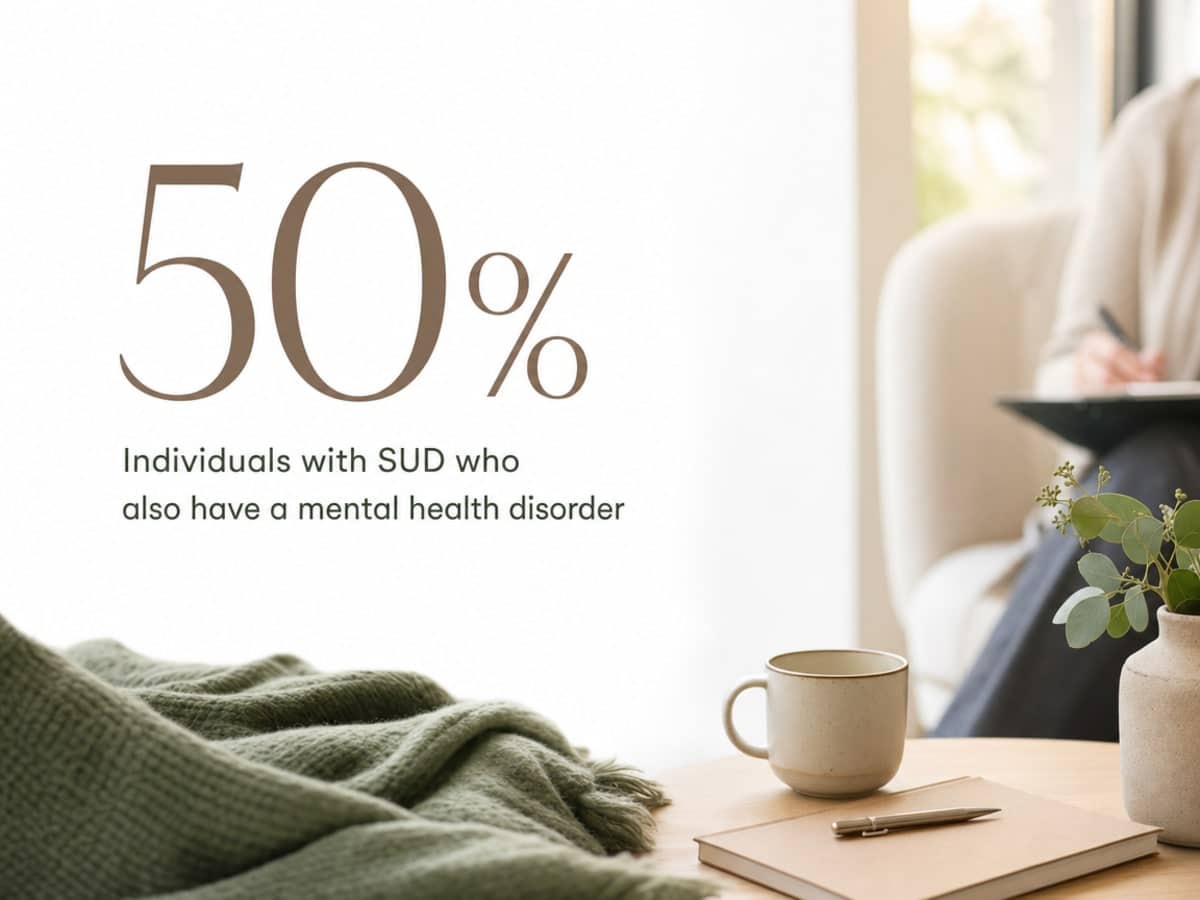
Here’s something worth knowing before you pick a treatment door: about half of people with a substance use disorder also meet criteria for at least one mental health condition 8. Depression. Anxiety. PTSD. Bipolar disorder. Eating disorders. If your drinking got worse after your marriage ended, or the meth started making sense after the deployment, or the pills quieted a panic that started in high school and never really left — you are not two separate problems stacked on top of each other. You are one person carrying two things that feed each other.
This is why the treatment door you choose matters. A program that only treats the substance and hands you a pamphlet for the depression is going to miss the reason you started using in the first place. So is a program that treats the depression and calls the drinking a “lifestyle issue.”
Dual diagnosis means both get treated in the same building, by the same team, at the same time. At Sunflower Recovery Center in Osawatomie, that includes depression, anxiety, PTSD, and eating disorders alongside the substance use — because the clinical reality is that most adults walking in the door are carrying more than one label, whether anyone has said it out loud yet or not.
What trauma-informed actually means (the six SAMHSA principles)
“Trauma-informed” has become one of those phrases that gets stuck on every treatment website. So it’s fair to ask what it actually means when a program uses the words.
SAMHSA and KDHE point to six principles that a real trauma-informed program is built around:
- safety;
- trustworthiness and transparency;
- peer support;
- collaboration and mutuality;
- empowerment, voice, and choice;
- and attention to cultural, historical, and gender issues 4.
In plain terms — you are not surprised by what happens next, you know what the rules are, you get a say in your own treatment plan, other people who’ve been there are part of your care, and the staff notices that a Black veteran from Kansas City and a farmer’s wife from Fontana might need the same clinical care delivered in different ways.
The research is clear that this is not a poster on the wall. Implementing trauma-informed care takes staff training, ongoing supervision, and organizational commitment — not just a policy binder 9. SAMHSA’s TIP 57 goes further and tells clinicians to screen every client for trauma history using validated tools, but never to force anyone to describe overwhelming events in detail before they are ready 14.
So when you are looking at a program, that’s the question underneath the marketing: does the staff actually work this way, every shift, or is “trauma-informed” just a word on the brochure? You can ask. A good program will not flinch at the question.
Levels of care: residential, PHP, IOP, and aftercare
The word “treatment” hides a lot of different things behind it. Kansas officially recognizes a whole ladder of care — acute detoxification, inpatient treatment, intensive outpatient, opioid maintenance, peer mentoring, and therapeutic community treatment 1. You do not have to memorize that list. You just need to know where on the ladder you probably belong right now, and that a good program will help you figure it out honestly.
- Residential (60-day).
- You live at the facility. You sleep there, eat there, do group and individual therapy there. Phones and outside contact are structured. This is the level of care that makes sense when home is where the using happens, when the people around you are still using, or when detox and the first weeks of sobriety are going to need medical eyes on them. At Sunflower Recovery Center in Osawatomie, the residential program runs 60 days — long enough for the fog to actually lift, and long enough for the underlying depression, PTSD, or eating disorder to start getting real attention alongside the substance use.
- Partial Hospitalization Program (PHP).
- Full clinical days — think five to six hours, five days a week — with evenings and weekends at home or in sober housing. PHP is the step down from residential for a lot of people, and the step up from “I tried once-a-week counseling and it wasn’t enough” for others.
- Intensive Outpatient Program (IOP).
- Fewer hours, usually three days a week, built around a job or kids or both. IOP is real treatment — group therapy, individual sessions, family work — not a check-in. For someone in Paola or Louisburg who cannot step away from work but knows weekly meetings alone will not hold, this is the level that fits.
- Aftercare and discharge planning.
- This is the part most people skip and later wish they hadn’t. Before you leave residential or PHP, someone should be sitting down with you to build the next ninety days — what meetings you’ll go to, who your outpatient therapist is, how you’ll handle the first wedding or funeral or bad Tuesday. At Sunflower, discharge planning is built into the program, not something they hand you on the way out the door.
You will not know for sure which rung you belong on until an assessment. That’s what the intake call is for. The point is that all four rungs are available inside Miami County, which is not something every rural Kansas county can say.
What happens in the first 24 hours after you call
Most people picture something dramatic. A van pulling up. A clipboard. Someone taking your phone away. That’s not what the first day looks like.
Here’s what actually happens when you call Sunflower Recovery Center in Osawatomie, or the Kansas SUD Hotline at 866-645-8216. A person answers. They ask your name, or a name you feel safe giving. They ask what’s going on — not for a life story, just enough to figure out how sick you are and how fast you need help. If you call the state hotline, you’ll be routed through Carelon Behavioral Health for a standardized assessment and referral 1. If you call Sunflower directly, the intake conversation happens with their team.
The next questions are practical. What are you using, and how much, and when was the last time? Do you have insurance, and what kind? Are you safe where you are right now? Is anyone with you? Nobody is grading your answers. They are trying to figure out whether you need a medical detox bed tonight, whether residential is the right starting point, or whether PHP or IOP fits your life better.
If residential is the plan, admission can often happen the same day or the next morning. You’ll get a list of what to bring — a few days of clothes, insurance card, ID, any prescription bottles. You will not be asked to pack your whole life.
The hardest part is the dialing. Everything after that, someone else helps you carry.
Paying for treatment: insurance, work, and family logistics
Money is usually the second call people make, right after the first one. Here is the honest version.
If you do have commercial insurance, call the number on the back of your card before you call anywhere else, or let Sunflower’s intake team do the verification for you. They’ll check your benefits for residential, PHP, and IOP separately, because plans often cover them at different rates. Ask about your deductible, your out-of-pocket max, and whether prior authorization is needed. Write the answers down. Your brain is doing a lot right now; paper helps.
For work: the Family and Medical Leave Act covers most people who have been at a job a year or more. Treatment for a substance use disorder is a qualifying condition. Your HR department does not need to know your diagnosis — only that you have a serious health condition and a provider’s paperwork. For family: a spouse, parent, or adult child can sit in on the intake call with your permission. Kids can be told an age-appropriate version of the truth. You do not have to hold all of this alone.
Why waiting is the bigger risk right now
You are probably telling yourself you’ll call next week. After the holiday. After payday. After one more try on your own.
Here’s the part that’s hard to hear, and worth hearing anyway. From 2019 to 2022, Kansas saw a continued rise in overdose deaths involving synthetic opioids, especially illicitly manufactured fentanyl 7. Fentanyl is showing up in pills that look like Xanax, in meth, in coke, in things that used to be predictable. The dose that felt fine on Friday can kill you on Tuesday. That is not a scare tactic. That is the supply right now, in Miami County and everywhere else.
Waiting also costs you the softer things. Another argument with your kid. Another morning your spouse checks your breath. Another Sunday spent hating yourself. Those add up in ways a statistic cannot show.
The Kansas SUD Hotline runs 24/7 at 866-645-8216 2. Sunflower Recovery Center is fifteen minutes from Paola. You do not have to feel ready. You just have to make the call before the next thing happens.
How to take the next small step today
You do not have to decide about the next sixty days right now. You just have to decide about the next ten minutes.
Pick one of these. Call Sunflower Recovery Center in Osawatomie and ask what an assessment looks like. Call the Kansas SUD Hotline at 866-645-8216, which runs 24/7 and routes you through Carelon Behavioral Health for a standardized assessment and referral 1. Or hand this page to the person in your kitchen who has been waiting for you to say something, and let them make the call with you.
If you are the family member reading this, your small step is the same. Dial the number. Say what you’re seeing. You do not need the right words.
You read this far. In Miami County — Osawatomie, Paola, Louisburg, Spring Hill, Fontana — the next door is closer than it feels. Ten minutes. One call. That’s all today has to be.
Reach Out Locally for Real Support Today
Connect with a Miami County team member ready to guide your next step toward recovery.
Frequently Asked Questions
Is there addiction treatment right here in Miami County, or will I have to travel?
Yes, treatment is right here. Sunflower Recovery Center in Osawatomie offers residential, PHP, and IOP care for adults, all inside Miami County. Osawatomie State Hospital and Adair Acute Care handle psychiatric crisis on the same campus 11. For most residents of Paola, Louisburg, Spring Hill, or Fontana, the drive is under thirty minutes. You do not have to leave the county to start.
What happens when I call the Kansas SUD Hotline at 866-645-8216?
A real person answers, 24/7 2. You’ll be routed through Carelon Behavioral Health for a standardized alcohol and drug assessment and a referral to a treatment provider that fits your situation and insurance 1. They’ll ask what you’re using, how much, and how urgently you need help. No lecture. No judgment. Just a next step. You can call from your car, at 3 a.m., without an appointment.
I have depression and PTSD along with my substance use. Can that be treated at the same time?
Yes, and it should be. About half of adults with a substance use disorder also meet criteria for at least one mental health condition, which is why integrated dual-diagnosis care exists 8. Sunflower Recovery Center treats depression, anxiety, PTSD, and eating disorders alongside the substance use, in the same building, with the same clinical team. Treating one and ignoring the other is what makes relapse so common.
What does trauma-informed care actually mean in practice?
It means the program is built around six principles: safety, trustworthiness and transparency, peer support, collaboration, empowerment and choice, and attention to cultural, historical, and gender issues 4. In practice, staff screen for trauma using validated tools but never force you to describe overwhelming events before you’re ready 14. It takes real training and ongoing supervision, not a poster on the wall 9. You can ask a program how they do it.
Does Sunflower Recovery Center accept Medicaid or Medicare?
No. Sunflower accepts most commercial insurance plans, but it does not participate in Medicare or Medicaid (KanCare). If that’s your coverage, don’t give up — call the Kansas SUD Hotline at 866-645-8216, and Carelon Behavioral Health will route you to a Kansas program that accepts your plan 1. There is a door for you, just a different one. Being honest about this now saves a hard phone call later.
What levels of care are available, and how do I know which one I need?
Kansas recognizes detox, inpatient, intensive outpatient, opioid maintenance, peer mentoring, and therapeutic community care 1. Sunflower offers 60-day residential, PHP (full days, evenings home), and IOP (three days a week around work or kids). You don’t have to figure out the right level yourself — that’s what the intake assessment is for. Call, describe what’s happening, and a clinician will help you land on the honest answer.
References
- Substance Use Disorder Treatment Services – KDADS. https://www.kdads.ks.gov/services-programs/behavioral-health/services-and-programs/substance-use-disorder-treatment-services
- Overdose Data Dashboard | KDHE, KS. https://www.kdhe.ks.gov/1309/Data-Dashboard
- Overdose Reports & Resources | KDHE, KS. https://www.kdhe.ks.gov/1308/Reports-Resources
- Trauma-Informed Approach Fact Sheet – KDHE. https://www.kdhe.ks.gov/DocumentCenter/View/6368/Trauma-Informed-Approach-Fact-Sheet-PDF
- Trauma Guidance | KDHE, KS. https://www.kdhe.ks.gov/1376/Trauma-Guidance
- 2023 Treatment Episode Data Set: Admissions (TEDS-A) – Kansas. https://www.samhsa.gov/data/node/51056
- Drug Overdose Deaths: Kansas – State Mortality Booklet (2024). https://www.cdc.gov/drugoverdose/pdf/statemortalitybooklets/State_Mortality_Booklet_Kansas_2024_508.pdf
- Prevalence and Correlates of Co-Occurring Substance Use Disorders and Mental Health Conditions. https://www.ncbi.nlm.nih.gov/pmc/articles/PMC8022143/
- Implementing Trauma-Informed Care in Substance Use Disorder Treatment. https://www.ncbi.nlm.nih.gov/pmc/articles/PMC7746113/
- Miami County Mental Health Initiative. https://www.miamicountyks.gov/1065/Miami-County-Mental-Health-Initiative
- Osawatomie State Hospital (OSH) | Department for Aging and Disability Services. https://www.kdads.ks.gov/state-hospitals/osawatomie-state-hospital-osh
- Implementing trauma-informed care in substance use disorder treatment: perspectives from the field. https://pubmed.ncbi.nlm.nih.gov/29202520/
- Trauma-Informed Care in Behavioral Health Services. https://library.samhsa.gov/sites/default/files/sma15-4420.pdf
- TIP 57: Trauma-Informed Care in Behavioral Health Services. https://library.samhsa.gov/product/tip-57-trauma-informed-care-behavioral-health-services/sma14-4816
- Osawatomie State Hospital FY 2027 Budget Narrative. https://budget.kansas.gov/wp-content/uploads/494-OSH-FY-2027-Budget-Narrative-FY-2027-Budget-Narrative.pdf