
Key Takeaways
- The weeks right after discharge carry the highest relapse risk, which is why Kansas programs must plan for post-discharge staff contact and scheduled follow-up, not just referral slips 8.
- Sober living, relapse prevention, and aftercare are not interchangeable — aftercare is an ongoing relationship with a named coordinator who initiates contact for months, not a housing option or a worksheet.
- Structured continuing care with staff-initiated calls outperforms ‘call us if you need us’ models, and stacking formal aftercare with a weekly mutual-help meeting produces the strongest year-one outcomes 9, 10.
- Before signing a Kansas discharge form, ask for the alumni coordinator’s name, the date of the first call, the six-month check-in schedule, and who reaches out if you go quiet.
The Week After Discharge Is the Hardest Week
You finish treatment. Someone hands you a folder. You walk out the door. And then it is Tuesday afternoon and you are standing in your own kitchen, and nobody is scheduling your day for you anymore.
That drop-off is real. It is not a failure of willpower or a sign you did treatment wrong. Clinicians who study what happens after discharge have known for years that the weeks right after you leave a program are the highest-risk window in the entire recovery timeline, especially if your history is longer or more severe 4. The structure that held you steady for 30 or 60 days is suddenly gone, and the old cues — the drive home, the person you used to call, the hour between work and dinner — are still exactly where you left them.
This is what an aftercare program is supposed to solve. Not with a pamphlet. Not with a phone number you might call if things get bad. With a named person who calls you, a schedule you can count on, and a plan that stretches out for months, not days 6.
The rest of this guide walks you through what that actually looks like in Kansas — what the law requires, what the research supports, and what to ask before you sign your discharge paperwork.
Three Terms People Mix Up: Sober Living, Relapse Prevention, and Aftercare
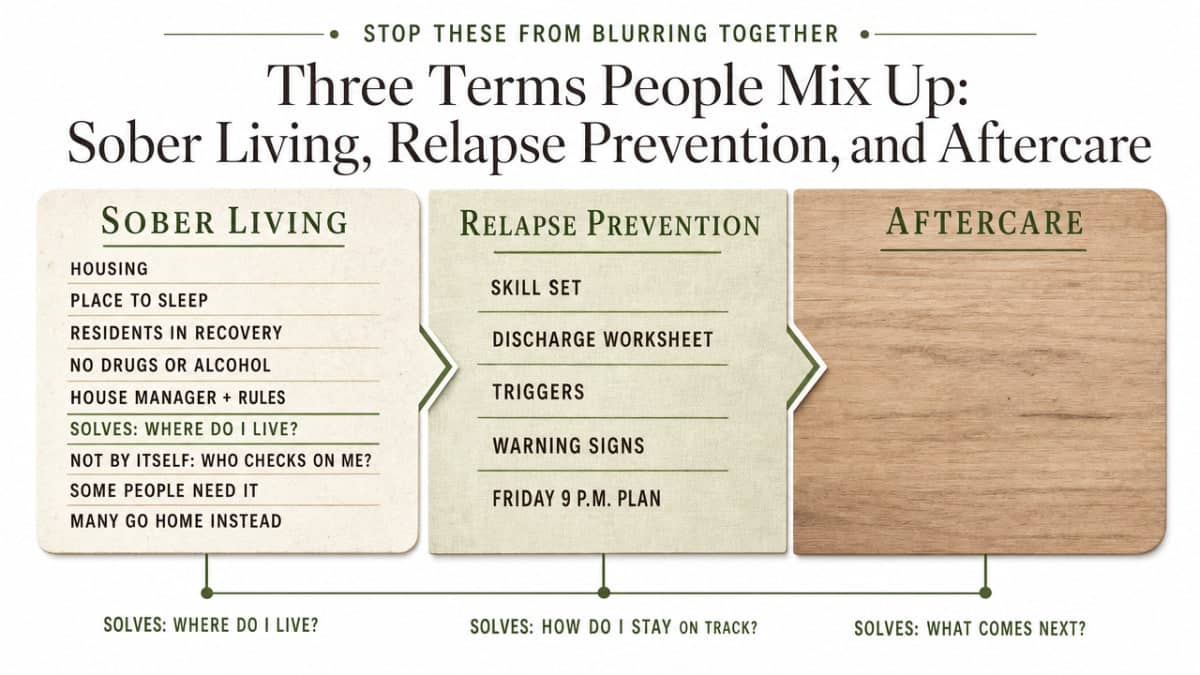
Before you can ask good questions about what happens after discharge, you need three words to stop blurring together in your head. Facilities use them almost interchangeably in brochures, and that vagueness is part of why people end up disappointed a month after treatment ends.
- Sober living
- Sober living is housing. It is a place to sleep where the other residents are also in recovery, drug and alcohol are not allowed, and there is usually a house manager and a set of rules. It solves the where-do-I-live problem. It does not, by itself, solve the who-checks-on-me problem. Some people need it. Many people go home to a spouse or a parent and never set foot in one.
- Relapse prevention
- Relapse prevention is a skill set. It is the worksheet in your discharge folder that maps your triggers, your warning signs, and what you will do at 9 p.m. on a Friday when the craving lands. You learn it during treatment. You carry it with you. It is a plan, not a program.
- Aftercare
- Aftercare — the term clinicians increasingly call continuing care — is the ongoing relationship. It is the named person who calls you next Tuesday. It is the alumni event on the calendar for the second Saturday of next month. It is the check-in six months from now when you thought everyone had forgotten about you.
The National Institute on Drug Abuse groups the pieces that make up aftercare into a short list: mutual aid groups, recovery coaching, recovery housing, recovery management checkups, and recovery community centers 3. Notice that recovery housing is one item on that list, not the whole list. And notice that a relapse-prevention plan is not on the list at all — because it belongs to the treatment episode itself, not to what comes after.
Holding that line matters. When you ask a facility about aftercare and they answer by describing sober living options or handing you a trigger worksheet, they answered a different question than the one you asked.
What Kansas Law Requires on Your Discharge Day
Before you evaluate whether a program’s aftercare is any good, it helps to know what every licensed program in the state already has to do. Kansas has a regulatory floor. It is not the ceiling, and it is not the same thing as a real continuing-care relationship, but it tells you the minimum you should expect the day you leave.
The floor lives in two places: a case-management rule that describes what staff have to do for you before you walk out, and a set of KDADS discharge-plan rules that describe what has to be written down. Both matter, because the paperwork tells you whether the follow-through has any chance of happening.
The Case Manager’s Job Before You Leave
Kansas Administrative Regulation 26-52-18 spells out the case-management role in behavioral-health facilities. Case managers are required to identify the services you will need after discharge and arrange referrals to community mental health centers and other follow-up services 5. That is the job. Not “hand you a list.” Identify what you need and make the connection.
The federal snapshot of Kansas residential rules goes a step further for you. It requires a plan for post-discharge contact by staff with you, and, when appropriate, with a family member or another person you designate 8. Someone from the facility is supposed to reach out after you leave. That is a state expectation, not an add-on.
When you ask who that person will be, you should get a name.
What Has to Be Written in Your Discharge Plan
The 2024 KDADS regulations for licensed crisis intervention centers spell out what a discharge plan must contain:
- your diagnosis,
- the reasons for discharge,
- your post-discharge medications,
- scheduled appointments with follow-up providers,
- specific post-discharge care instructions,
- and contact information for community mental health and substance use providers 7.
The plan itself must be developed by a behavioral health professional, not handed to you as a template.
For residential SUD care, Kansas also requires an individualized treatment plan completed within seven days of admission, updated at least every 30 days, with discharge planning built in from the start 8. Discharge is not a last-day event. It is supposed to be part of the plan from week one.
Read your paperwork. If the appointments are not scheduled, they are not real yet.
Why ‘Call Us If You Need Us’ Is Not Enough
Here is the sentence that quietly fails more people than any other: Give us a call if you’re struggling. It sounds caring. It sounds available. It puts the entire burden of the next twelve months on the person least equipped to carry it — you, on your worst day, deciding whether you deserve to reach for help.
The research on continuing care is unusually clear on this point. When aftercare is structured — meaning scheduled contacts, planned duration, and someone on staff whose job is to follow up whether you ask or not — outcomes improve in ways that as-requested aftercare does not match. One frequently-cited trial found abstinence or low-frequency use rates of 51% in the first six-month segment and 39% in the second among people receiving structured continuing care, compared to 39% and 25% in the comparison group that had to initiate contact themselves 10. That is not a small gap. That is the difference between one in four people holding on and one in two.
The mechanism is not mysterious. When you are white-knuckling week three and your sleep is still a mess, the last thing your brain wants to do is dial a number and admit it. A scheduled call flips the direction of the effort. The coordinator dials you. You just have to pick up. And when you do pick up, the check-in surfaces things you would not have volunteered — the fight with your partner, the coworker who offered you a drink, the fact that you have been sitting in your car outside the liquor store for ten minutes twice this week.
Broader reviews reach the same conclusion from a different angle: longer-duration continuing care with active efforts to keep people engaged produces more consistently positive results than brief or passive models 6. Active. Longer. Those two words are doing the work. A program that ends on discharge day and hands you a business card is not aftercare. It is a goodbye with good wishes attached.
Who Actually Calls You: The Alumni Coordinator Role
Ask any facility who is responsible for keeping in touch with you after discharge, and the answer separates real aftercare from a folder full of good intentions. In a structured continuing-care model, that responsibility belongs to a named human being — often called an alumni coordinator — whose entire job is you and the people who left the program before and after you.
This is not a receptionist who might remember your name. It is not the therapist you saw in residential, who is now full up with the next cohort. It is a role built around one function: keeping the connection alive after your clinical episode ends. The alumni coordinator maintains the contact list, places the scheduled follow-up calls, runs the quarterly events, and — this is the part that matters most on your quiet weeks — notices when you go silent.
Kansas expects this contact to happen. The federal snapshot of state residential rules specifies that programs must have a plan for post-discharge contact by staff with you, and with a family member or designated supporter when you agree to it 8. What the rule does not specify is who owns the follow-through. In programs without an alumni coordinator, that duty gets diffused across a clinical team already carrying a full caseload, and diffused duty is the same thing as no duty by month three.
Peer-based roles matter here too. Systematic reviews of peer recovery support find that peer-delivered contact improves treatment engagement and retention, and that peer-led linkage after discharge reduces relapse and readmission 1, 2. When the person on the other end of the phone has walked the same road, the call stops feeling like a survey.
When you interview a program, ask for the coordinator’s name. Ask how many alumni they follow. Ask whether they will still be the person calling you in month nine.
What Twelve Months of Aftercare Looks Like
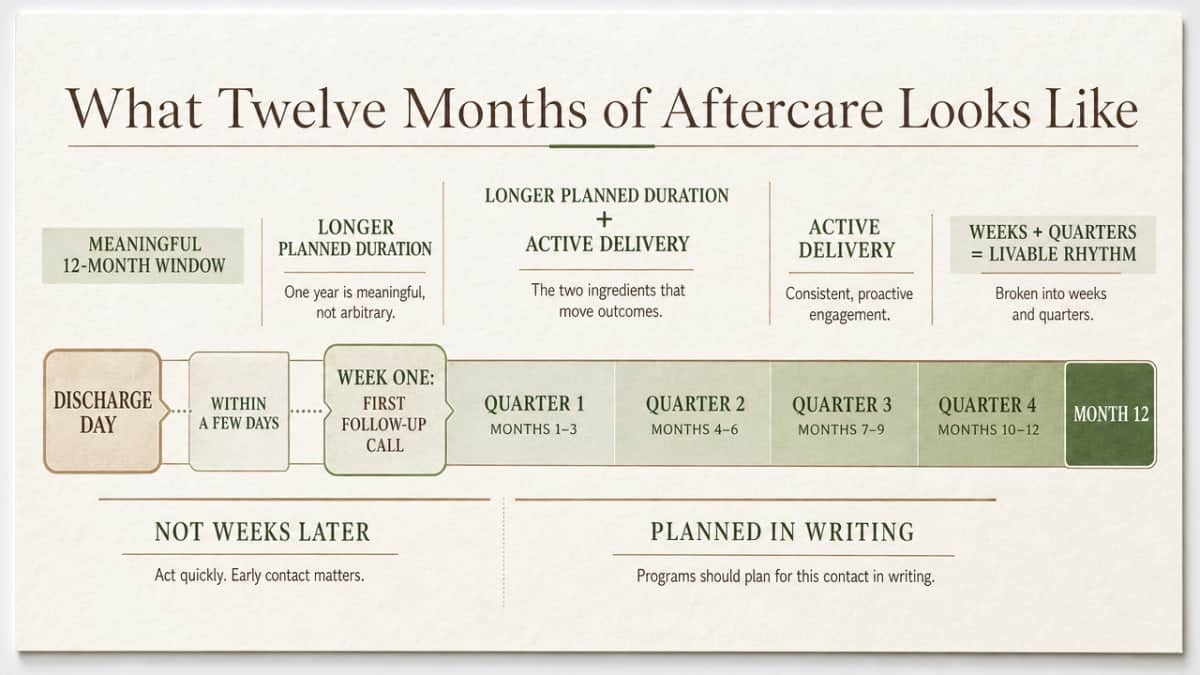
Twelve months is not an arbitrary number. It is roughly the window in which continuing-care research keeps finding meaningful separation between people who stayed engaged and people who tapered off after a few weeks. Reviews of the field consistently point to longer planned duration and active delivery as the two ingredients that move outcomes 6, 10. A year sounds like a long time when you are standing on discharge day. Broken into weeks and quarters, it starts to look like a rhythm you can actually live inside.
Here is what that rhythm tends to look like when a program takes continuing care seriously, rather than treating it as a farewell email with a phone number attached.
Week One: The First Follow-Up Call
The first call should come within a few days of discharge, not weeks. Kansas expects programs to plan for this contact in writing before you leave 8. A good first call is short and specific. Did you make it to your first outpatient appointment? Do you have your medications? Is anyone at home drinking around you? Are you sleeping? The coordinator is not looking for a therapy session. They are looking for the small cracks — the missed appointment, the pharmacy that never filled the script, the roommate situation nobody mentioned in family week. Answering honestly on that first call is one of the most protective things you can do in year one.
Month One to Six: Check-Ins and Quarterly Events
Through the first six months, expect scheduled contact on a predictable cadence — often weekly at first, then every two weeks, then monthly as you stabilize. Between calls, quarterly alumni events give you a room full of people who understand exactly what a Tuesday night craving feels like. This is the stretch where structured aftercare pulls ahead of the call-if-you-need-us model most clearly 10. Layering a mutual-help meeting on top of the check-ins matters here 9. If you skip an event or miss two calls in a row, a real coordinator notices and reaches back out. That is the whole point of the role.
Month Six to Twelve: The Long Tail That Matters Most
Months six through twelve are where a lot of people quietly disappear from aftercare — and where the evidence for continuing engagement is strongest 6. You feel better. Work is picking up. The urgency of week one is gone. This is exactly when a scheduled check-in earns its keep. Recovery management checkups at this stage catch drift before it becomes relapse: a returning sleep problem, a new prescription, a job change, a breakup. If something slips, re-entry is faster because your file is still open and your coordinator already knows you. Year one ending is not the goal. A warm handoff into year two is.
Stacking Supports: Aftercare Plus a Meeting Beats Either Alone
Formal aftercare works. A weekly meeting works. Doing both together works better than either one alone, and the size of that difference is worth understanding before you decide what your week is going to look like on the outside.
In the continuing-care evidence base, patients who attended any 12-step meetings after treatment reported 72.7% six-month abstinence at 24-month follow-up, compared to 56.0% among people who did not attend 9. That gap is meaningful on its own. But the number that should stick with you is what happens when you stack: patients who attended weekly AA and a formal aftercare program for a full twelve months reported 90% past-year abstinence at the one-year mark 9. Two supports, not one. Both delivered on a schedule. For a full year.
The logic is not that AA is magic or that formal aftercare is magic. It is that these two supports catch different things. Your alumni coordinator sees the clinical picture — your medications, your outpatient appointments, whether your sleep is repairing itself. The meeting sees the daily-life picture — the Wednesday you white-knuckled, the sponsor who called you out on a resentment, the person six months ahead of you on the same road. When one net has a hole, the other one is usually holding.
This is also why programs that push you toward mutual-help meetings early are not outsourcing your care. They are widening the base. The Kansas discharge-plan requirements already expect your paperwork to include contact information for community providers and follow-up appointments 7. A good coordinator uses that first week to help you pick a home group, not just a therapist. If you have never been to a meeting, ask which one your coordinator would go to first if they were you. Ask what to do if the first one is not a fit.
You do not have to love the meeting on week one. You have to keep going.
If You Have a Dual Diagnosis or High-Severity History
If your history includes a mental health diagnosis alongside your substance use — depression, anxiety, PTSD, an eating disorder — or if this is not your first treatment episode, aftercare is not optional decoration on top of your care. It is where the outcome gets decided. Continuing-care research is direct on this point: the benefits of ongoing structured support are largest for people with greater problem severity, not smallest 4.
What that means in practice is that your plan should be denser, not lighter. A weekly call in month two instead of a monthly one. A named contact at your outpatient provider, not just a referral slip. Your psychiatric medications tracked alongside your recovery check-ins, so a sleep problem in month three does not quietly become a relapse in month four. Kansas discharge-plan rules already require your paperwork to list post-discharge medications, scheduled follow-up appointments, and contact info for community providers 7— but the paperwork only works if someone is holding both threads.
Tell your coordinator the whole picture on day one. The trauma, the previous attempts, the diagnoses you carry. That is the map they need to actually help you.
What Happens If You Slip
A slip is not the end of your recovery. It is a clinical event, and how quickly you get back into care is what shapes what happens next.
The reason a scheduled continuing-care relationship matters here is that your file is still open. You do not have to start over. You do not have to explain yourself to a new intake coordinator on your worst day. Continuing-care research consistently finds that longer-duration, actively-delivered aftercare produces quicker re-entry into treatment when someone does relapse 6. The coordinator who called you last Tuesday is the same person you call this Tuesday. That single fact removes about ten of the fifteen reasons people hesitate to reach out.
Tell your coordinator early. Not after a week of hiding it. A slip on Friday is a phone call on Saturday, not a confession in month three. What follows is usually a step up in support — more frequent check-ins, a same-week appointment with your outpatient provider, a review of your medications, sometimes a return to a higher level of care for a short stretch. That is not a punishment. That is the system doing its job.
One slip does not erase the year you built. Silence about it is what does the damage.
How Family Fits Into the Plan
Your spouse, your parent, your adult kid — the person who drove you to intake or picked you up on discharge day — is not a bystander in your aftercare. Kansas residential rules actually anticipate this. Programs must plan for post-discharge contact by staff with you and, when you agree to it, with a family member or another designated supporter 8. That consent piece matters. You decide who is looped in and how much they hear.
What that looks like in practice is straightforward. Your alumni coordinator can add one family member to a check-in cadence, share the schedule of quarterly events they are welcome to attend, and give them a specific person to call if they see something you might not — the returning irritability, the missed appointment, the quiet weekend that turned into two.
Tell your family what to watch for and what not to do. Ask them to come to one event with you in the first three months. A recovery that involves the people you go home to is sturdier than one you carry alone.
The Question to Ask Before You Sign a Discharge Form
You are going to be handed a lot of paper in the last 24 hours of your stay. Somewhere in that stack is a discharge plan. Before you sign it, ask one question out loud, to a person, and wait for a specific answer:
What happens after my discharge date?
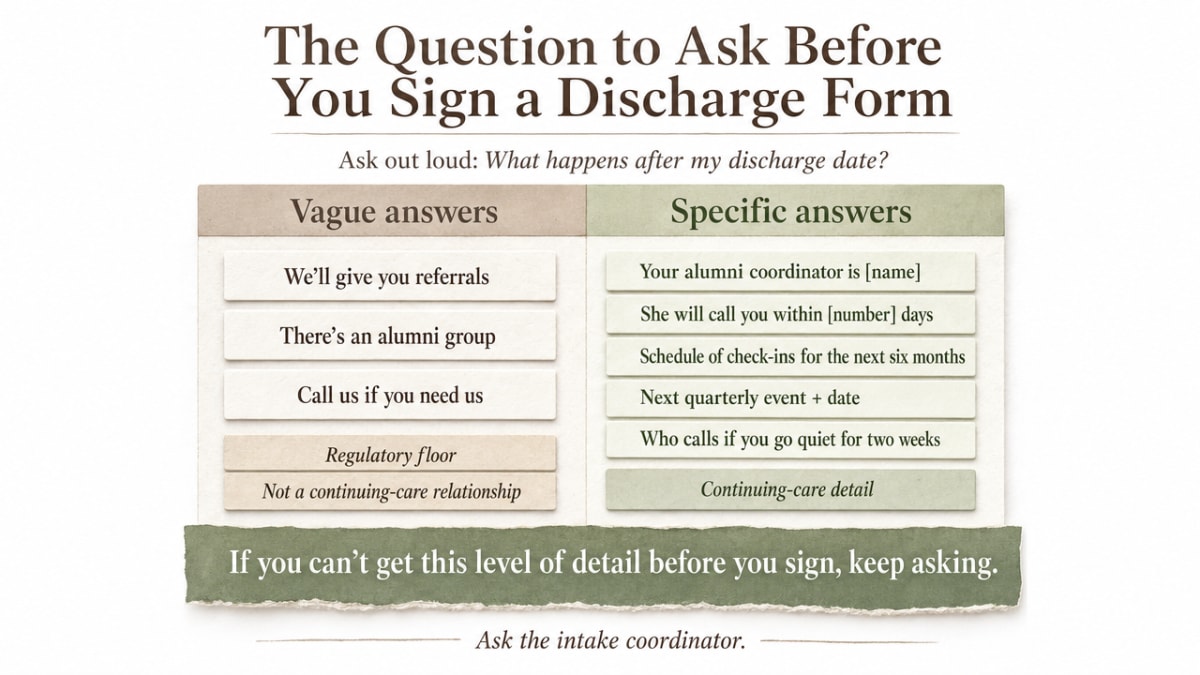
The vague answers sound like this: We’ll give you referrals. There’s an alumni group. Call us if you need us. Those answers describe the regulatory floor Kansas already requires 5, 7. They do not describe a continuing-care relationship.
The specific answers sound like this: Your alumni coordinator is [name]. She will call you within [number] days. Here is the schedule of check-ins for the next six months. Here is the next quarterly event and the date. Here is who calls if you go quiet for two weeks.
If you cannot get that level of detail before you sign, keep asking. Ask the intake coordinator. Ask the clinical director. Bring your spouse or your parent into the room and ask again. This is a fair question, and the answer is the difference between a program that walks out the door with you and a program that waves from the porch. Call Sunflower and ask it.
Connect for Support Beyond Your Discharge Date
Get clear answers on what structured aftercare looks like after treatment ends.
Frequently Asked Questions
Who calls me after I leave treatment, and how soon?
Your alumni coordinator — a named person, not a general line — should place the first call within a few days of discharge. Kansas rules expect programs to plan for post-discharge staff contact with you and, if you agree, with a family member you designate 8. Ask for that person’s name and the date of the first call before you sign your discharge paperwork.
How long does an aftercare program actually last?
Plan for at least twelve months of scheduled contact, not a few weeks. Continuing-care research consistently finds that longer planned duration with active outreach produces more consistently positive outcomes than short or client-initiated models 6. Expect a heavier cadence early — weekly, then every two weeks — tapering to monthly check-ins by month six, with quarterly alumni events threaded through the year.
What happens if I relapse while I’m in aftercare?
You call your coordinator. Your file is still open, so you do not start over with a new intake on your worst day. Longer, actively-delivered continuing care is associated with quicker treatment re-entry when someone relapses 6. What follows is usually a step up — more frequent check-ins, a same-week appointment with your outpatient provider, a medication review, sometimes a brief return to a higher level of care.
Does insurance cover aftercare in Kansas?
Coverage varies by plan. Most commercial insurance covers the clinical pieces that support aftercare — outpatient therapy, medication management, IOP step-downs — but alumni coordination and events are often provided by the facility at no additional charge to former patients. Ask your program directly what is billed to insurance, what is included in your treatment episode, and what, if anything, has a fee.
Can my spouse or parent be part of the aftercare plan?
Yes, with your consent. Kansas residential rules specifically anticipate post-discharge staff contact with a family member or designated supporter when you agree to it 8. You choose who is included and how much they hear. A good coordinator can add one family member to the check-in schedule, share the alumni event calendar, and give them a specific person to call if they notice something concerning.
What if I move out of Kansas during my first year of recovery?
Tell your coordinator before you go. Scheduled calls can continue by phone from anywhere, and a coordinator whose job is linkage can help you find outpatient providers and mutual-help meetings in your new city — the same work case managers do at discharge, just extended down the road 5. Do not let a move be the reason the connection quietly ends. Ask for a handoff plan.
References
- Peer Recovery Support Services and Recovery Coaching for Substance Use Disorder: A Systematic Review. https://pubmed.ncbi.nlm.nih.gov/41551498/
- Recovery support services as part of the continuum of care for substance use disorder: a systematic scoping review. https://pubmed.ncbi.nlm.nih.gov/39873444/
- Recovery – National Institute on Drug Abuse (NIDA). https://www.nida.nih.gov/research-topics/recovery
- Impact of Continuing Care on Recovery From Substance Use Disorder. https://pubmed.ncbi.nlm.nih.gov/33500871/
- Kan. Admin. Regs. § 26-52-18 – Case management services. https://www.law.cornell.edu/regulations/kansas/K-A-R-26-52-18
- Impact of Continuing Care on Recovery From Substance Use Disorder. https://pmc.ncbi.nlm.nih.gov/articles/PMC7813220/
- Kansas Department for Aging and Disability Services – Crisis Intervention Center Regulations (Discharge and Aftercare Requirements). https://sos.ks.gov/publications/Register/Volume-43/Issues/Issue-09/02-29-24-51910.html
- Kansas Summary – State Residential Treatment for Behavioral Health Conditions. https://aspe.hhs.gov/sites/default/files/2021-08/StateBHCond-Kansas.pdf
- The Continuing Care Model of Substance Use Treatment. https://pmc.ncbi.nlm.nih.gov/articles/PMC4007701/
- Continuing Care Research: What We’ve Learned and Where We’re Going. https://pmc.ncbi.nlm.nih.gov/articles/PMC2670779/
- The Institute of Medicine’s Continuum of Care. https://www.samhsa.gov/resource/sptac/institute-medicines-continuum-care
- Recovery Resource Center. https://www.samhsa.gov/substance-use/recovery/recovery-resource-center