
Key Takeaways
- Alcohol withdrawal follows a predictable timeline from hour 6 through 72-plus, with seizures most likely between hours 24 and 48 and delirium tremens emerging after 48 hours 10.
- Home detox tends to fail because untrained caregivers can’t dose benzodiazepines by CIWA-Ar scoring, can’t sequence thiamine before glucose, and can’t remove the drink that ends the shakes at hour 18.
- A seizure, deep confusion, hallucinations that won’t shake off, chest pain, a runaway heart rate, or inability to keep water down means calling 911 first, not a Kansas City detox line 12.
- Before choosing where to go in Kansas City, compare whether the program uses CIWA-Ar scoring, front-loaded benzodiazepines, thiamine-first protocols, and a handoff into residential, PHP, or IOP care after stabilization 3, 7.
If your hands are shaking right now, read this first
If you’re reading this at 2 a.m. because your hands are shaking and your last drink is wearing off, you’re in the right place. Take a breath. You don’t have to figure this out alone, and you don’t have to figure it out perfectly.
Here’s what you need to know before anything else: alcohol withdrawal is a real medical event, not a test of willpower. Your body has adjusted to alcohol, and when it drops away, your nervous system goes into overdrive. That’s why you feel the tremors, the sweats, the racing heart, the wave of dread that has nothing to do with the day you had. It’s chemistry, not character.
Most people who go through withdrawal will feel miserable but recover. A smaller group runs into complications that need a medical team, fast 10. The tricky part is that you can’t always tell in advance which group you’re in, especially if you’ve been drinking heavily for a long time or you’ve had a rough withdrawal before.
The rest of this article walks you through what withdrawal looks like hour by hour, which symptoms are red flags, why home detox tends to fail even motivated people, and what medically supervised care in Kansas City actually involves. Read as much as you need. Then make one phone call.
What alcohol withdrawal actually feels like, hour by hour
Withdrawal doesn’t hit all at once. It rolls in on a timeline that’s pretty predictable if you know what to look for, and knowing where you are on that timeline is the first honest tool you have tonight.
Hours 6 to 12 after your last drink. This is where most people first notice something is wrong. Your hands start to tremble, especially when you reach for something. You sweat through your shirt even though the room is cool. Your stomach turns. Anxiety climbs for no reason you can point to. Your heart feels like it’s working too hard. Sleep, if it comes at all, is thin and full of odd dreams. A lot of readers recognize this stage because they’ve been living inside it every morning for months, taking the edge off with a drink before work.
Hours 12 to 24. Symptoms sharpen. Some people start hearing or seeing things that aren’t there — a voice, a shadow moving in the corner, bugs on the wall. This is called alcoholic hallucinosis, and it can happen while you’re still oriented enough to know something is off 10. That awareness doesn’t make it less frightening. Your blood pressure and pulse climb. The tremor gets harder to hide.
Hours 24 to 48. This is the window where withdrawal seizures are most likely. They usually come without warning, often in people who didn’t think their drinking was “that bad” 10. One seizure raises the risk of another, and it also raises the risk of what comes next.
Hours 48 to 72 and beyond. Delirium tremens can begin in this window. It looks different from earlier hallucinations — deep confusion about where you are, severe agitation, a racing heart, high fever, dangerous swings in blood pressure. People in DT often don’t recognize family members and can’t be reasoned with. This is the stage that lands people in an ICU 10.
Two important things about this timeline. First, it’s a guide, not a promise. If you’ve had withdrawal seizures before, if you drink around the clock, or if you have other medical problems, your version can move faster and hit harder. Second, wherever you are on this clock right now, earlier is always better than later for getting help. The care team’s job gets simpler the sooner you make the call.

How dangerous is this, really
Here’s the honest answer: for most people, alcohol withdrawal is miserable but survivable. For a smaller group, it turns into something a hospital has to fix, and a smaller group still doesn’t make it out without help. The problem is that you can’t always tell in advance which group is yours.
Look at the numbers. Among people going through alcohol withdrawal, hallucinations show up in roughly 2 to 8 percent. Seizures happen in up to 15 percent. Delirium tremens develops in about 3 to 5 percent. And when delirium tremens goes unrecognized or untreated, mortality can climb as high as 50 percent 10. That last figure is the one that should stop you cold — not to scare you, but to make one decision easier. It applies specifically to untreated DT, not to withdrawal in general, and not to people who got care in time.
Put another way, most people who quit drinking will not have a seizure. Most will not develop DT. But if you’re the reader who does, the difference between a good outcome and a catastrophic one is usually measured in how quickly a medical team got involved. Front-loaded, protocol-driven treatment in a hospital setting cuts progression to DT and shortens the whole ordeal 7.
A few things raise your personal risk above the average:
- Drinking heavily for years.
- Prior withdrawal seizures.
- A prior episode of DT.
- Round-the-clock drinking to prevent morning shakes.
- Other medical problems — heart trouble, liver disease, poor nutrition, benzodiazepine or opioid use on top of alcohol.
- Being older.
- Being dehydrated already.
If any of those describe you, you don’t fit the “most people” picture, and you shouldn’t gamble on it.
The point of this section isn’t to convince you that you’re doomed. It’s the opposite. These outcomes are treatable when someone is watching for them. The medications work. The monitoring works. What doesn’t work is guessing at home, alone, and hoping you land in the lucky majority. You deserve better odds than a coin flip, and better odds exist — they just require picking up the phone before things escalate rather than after.

Why home detox keeps failing people who are trying their hardest
Almost everyone who ends up in a detox unit has tried to quit at home first. Usually more than once. That’s not a failure of effort — it’s a failure of the plan. Home detox asks you to be the patient, the nurse, the pharmacist, and the person who calls 911 all at the same time, while your nervous system is misfiring. It’s a setup that doesn’t work for most people who need it most.
The first problem is timing. Withdrawal symptoms can peak while you’re asleep, or while the family member watching you finally steps out to pick up soup. A seizure at hour 30 doesn’t wait for someone to notice. By the time symptoms tip from “bad” to “dangerous,” the window to prevent complications has usually already closed 11.
The second problem is medication. The drugs that actually treat withdrawal — benzodiazepines, given in the right dose at the right time — aren’t available in your medicine cabinet, and they shouldn’t be. Getting the dose wrong in either direction causes real harm. Under-treatment lets seizures and delirium tremens develop. Over-treatment causes respiratory depression. Trained teams calibrate this in real time using structured scoring 1. You can’t calibrate it from your couch.
The third problem is nutrition. Heavy drinkers are almost always low on thiamine, and giving glucose or a sugary drink before replacing thiamine can trigger permanent brain injury called Wernicke’s encephalopathy 8. Most people trying to detox at home reach for orange juice and crackers. They’re doing exactly what feels right and running straight into a risk they never heard of.
The red flags that mean call 911, not a rideshare
Most of this article is about getting into supervised care before things go sideways. This section is different. If any of what follows is happening right now, stop reading and call 911. Sunflower’s medical team is the right next call after you’re stable — not the first call when your body is already in crisis.
A seizure, or a suspected seizure. If you’ve lost consciousness, bitten your tongue, wet yourself without warning, or woken up on the floor with no memory of falling, that’s a seizure until proven otherwise. One withdrawal seizure makes the next one more likely, often within hours 10. Do not drive. Do not let someone drive you. Emergency responders can start treatment on the way.
Signs of delirium tremens. Deep confusion about where you are or what day it is. Seeing or hearing things you can’t shake off. A pounding heart, drenching sweats, a fever. Wild agitation that doesn’t settle. DT is a medical emergency that needs an ICU, not a lobby 12.
Chest pain, trouble breathing, or a heart rate that won’t come down. Withdrawal strains the cardiovascular system hard. These symptoms in someone who’s been drinking heavily are not something to wait out.
You can’t keep water down for more than a few hours. Dehydration makes every other withdrawal symptom worse and can tip a stable situation into a dangerous one.
Call 911, or have someone drive you to the nearest emergency department. Once you’re stable, Sunflower’s team can pick up the handoff for the days and weeks that follow.
What medically supervised withdrawal actually looks like
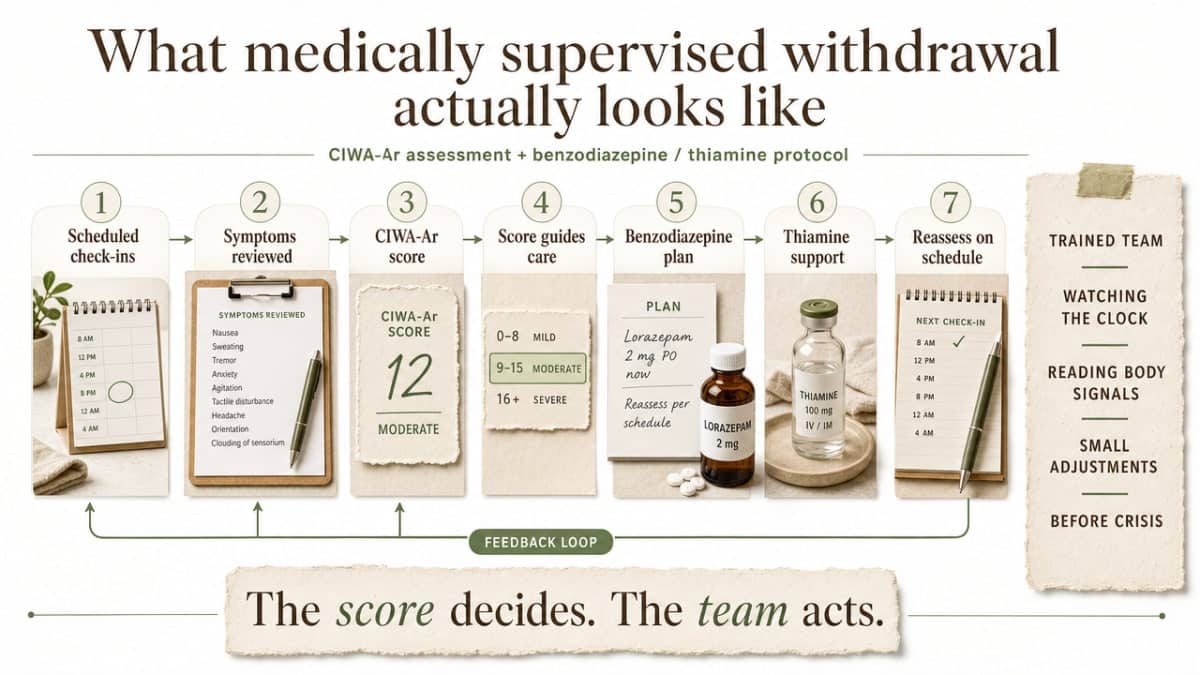
The phrase “medical detox” can sound vague, almost like a spa retreat with a nurse’s station. It isn’t. Supervised withdrawal is a specific set of steps that a trained team runs on a schedule, with the goal of catching trouble before it turns into a crisis. The whole point is that someone else is watching the clock, reading your body’s signals, and making the small adjustments you can’t make for yourself while you’re shaking.
Two pieces do most of the work: a scoring system that turns your symptoms into numbers, and a medication plan that responds to those numbers. Together, they replace guesswork with a rhythm. You don’t have to decide when you need help — the score decides for you, and the team acts on it.
Assessment: the CIWA-Ar score and why it matters
The first thing a nurse or clinician does is sit down with you and run through a short assessment called the CIWA-Ar. It’s a ten-item checklist that scores how bad your tremor is, whether you’re sweating, how anxious you feel, whether you’re hearing or seeing things, how your stomach is doing, and a few other markers. Each item gets a number. The numbers add up to a total.
That total isn’t just paperwork. It tells the team how much medication you need right now and how often to check you again — sometimes every hour, sometimes every two, sometimes every four. When the score climbs, so does the response. When it settles, the team backs off. Hospitals that use CIWA-Ar and similar structured protocols see fewer ICU transfers and shorter stays, because trouble gets caught while it’s still small 3, 11. You don’t have to explain how bad you feel in words your foggy brain can find. The score does the talking.
Medications: benzodiazepines, thiamine, and the order they’re given in
Benzodiazepines are the workhorses of alcohol withdrawal treatment. Drugs like diazepam and lorazepam calm the same brain circuits that alcohol used to quiet down, which is why they stop the tremor, ease the anxiety, and — most importantly — prevent seizures and delirium tremens from developing. In an emergency department, a doctor might give 5 to 10 mg of IV diazepam or 2 to 4 mg of IV lorazepam and repeat as needed until symptoms come under control 2. In a supervised detox setting, the same medications are given on a schedule that the CIWA-Ar score drives. Getting enough medication early — a strategy called front-loading — reduces the odds of progression to DT and shortens the whole process 7.
Then there’s thiamine, which sounds boring until you understand what it prevents. Heavy drinkers are almost always low on this vitamin, and if a nurse hangs a bag of IV fluids with glucose before replacing thiamine, the sugar can trigger a permanent brain injury called Wernicke’s encephalopathy. That’s why every reputable protocol gives thiamine first — typically 100 mg IV or IM daily — along with folic acid and a multivitamin, for the first several days 1, 8. It’s a small detail with life-long consequences, and it’s exactly the kind of detail that gets missed at home.
You are not the only person in Kansas City going through this
One of the quieter cruelties of heavy drinking is how alone it makes you feel. You watch other people at the barbecue nurse a single beer for an hour and wonder what’s wrong with you. You hide the recycling. You count the hours until you can pour the next one without anyone noticing. It starts to feel like a private problem that only you have.
It isn’t. In Missouri, an estimated 591,000 people aged 12 and older met criteria for alcohol use disorder in the past year — about 11.34 percent of the population 13. In the Kansas City metro area specifically, roughly 157,000 people aged 12 and older were classified as having a substance use disorder in the past year, about 8.6 percent of residents 14. That’s not a rounding error. That’s a stadium full of your neighbors.
This matters for a practical reason, not a sentimental one. The nurses, doctors, and counselors who work in Kansas City withdrawal programs have seen your story before. Not a version of it — your specific version. The whiskey in the desk drawer. The wine that started at noon. The morning shakes you learned to hide during meetings. Whatever brought you to this page, someone answering the phone tonight has helped a person who looked and sounded a lot like you, and helped them get through the next 72 hours safely. You are joining a large group of people who found a way out, not standing at the edge of one.
What the first phone call to Sunflower Recovery sounds like
A lot of readers stall out here. You’ve read this far, you know home detox is a bad plan, and now the phone feels like it weighs forty pounds. That’s normal. Almost no one makes this call feeling ready. They make it feeling scared, ashamed, exhausted, or all three at once, and they make it anyway.
Here’s what actually happens when you dial. Someone picks up — a real person, not a menu tree. They will ask you a few plain questions:
- When did you have your last drink.
- About how much you’ve been drinking, on an average day.
- Whether you’ve had withdrawal seizures before, or a prior episode of DT.
- Whether you’re taking any other medications or substances.
- Whether anyone is with you right now.
There’s no lecture attached to any of these questions. The person on the other end is building a picture so the medical team can figure out the safest next step for you specifically.
If your answers suggest active withdrawal that’s already dangerous — a recent seizure, signs of DT, chest pain — they will tell you to hang up and call 911, or they’ll help you decide which Kansas City emergency department to head to. Sunflower is honest about this. Their medical team handles the days that follow acute stabilization; a hospital handles the moments when your body is in true crisis.
If you’re in the more common window — shaking, sweating, scared, still oriented — the conversation shifts to logistics. Insurance verification. When you can get to Osawatomie. Who can drive you. What to bring, and what not to bring. If cost is the thing making you hesitate, say so on the call. If you’d rather talk to someone else first, SAMHSA’s free, confidential helpline runs 24/7 at 1-800-662-4357 and can point you to other Kansas City options 17. The goal of the first call isn’t to close a sale. It’s to get you somewhere safe by tomorrow.
After the shakes stop: the handoff into real treatment
Detox is the doorway, not the room. Once your CIWA-Ar scores have come down, the tremor has quieted, and you’ve slept through a night for the first time in months, the real work starts — and it’s a different kind of work than the last 72 hours. The medical team stops watching your vitals every hour. The counselors start asking harder questions.
This is the point where Sunflower’s trauma-informed team picks up the thread. Most people who drink heavily aren’t drinking because they love the taste. They’re drinking because something underneath — anxiety, depression, old trauma, an eating disorder, grief nobody signed off on — got loud enough that alcohol became the quietest option available. If that layer doesn’t get treated, the odds of a second withdrawal a few months from now go up sharply. Structured, protocol-driven care after acute stabilization is what reduces the cycle, not willpower 3.
What that looks like practically: a 60-day residential program, or a partial hospitalization or intensive outpatient track if residential isn’t the right fit, plus family programming so the people who’ve been scared alongside you get support too. You don’t have to decide the whole shape of it tonight. You just have to get through the doorway first.
Before you try to white-knuckle another night
You’ve read enough now to know two things. Alcohol withdrawal isn’t something to muscle through alone, and the version that starts tonight is easier to treat than the version that starts tomorrow. That’s not a scare tactic. It’s just how the timeline works.
If you’re shaking, sweating, and telling yourself you’ll try one more time to ride it out at home, pause. That plan has probably failed before, and it wasn’t because you weren’t trying hard enough. It failed because the plan itself asks too much of one person in a body that’s misfiring.
Pick up the phone. Call Sunflower Recovery’s medical team and tell them where you are on the timeline in this article. If your symptoms already crossed into the red flags — a seizure, deep confusion, chest pain — call 911 first, then Sunflower for what comes after. If you want a second voice before you call anyone local, SAMHSA’s helpline is free, confidential, and open right now at 1-800-662-4357 17.
You reading this far is already a step. Make the next one a phone call.
Get Safe, Medical Support for Alcohol Withdrawal
Speak with a professional now to ensure your alcohol detox is safe, monitored, and never done alone.
Frequently Asked Questions
Is it safe to detox from alcohol at home in Kansas City?
For most people who have been drinking heavily every day, no. Home detox skips the two things that keep withdrawal survivable — structured symptom scoring and properly dosed benzodiazepines — and it puts thiamine replacement at risk too 11. If your drinking has been light and short-term, your doctor may clear you for outpatient monitoring. If you’ve had morning shakes, prior seizures, or a rough withdrawal before, home is not the right setting.
How long does alcohol withdrawal last?
The acute phase usually runs about 72 to 96 hours from your last drink. Tremors, sweating, and anxiety often start within 6 to 12 hours, peak around 24 to 48 hours, and ease by day four or five. Delirium tremens, when it happens, tends to emerge between hours 48 and 72 10. Sleep problems, mood swings, and cravings can linger for weeks — which is why detox alone isn’t the whole picture.
When should I go to the ER instead of calling a detox center?
Call 911 or head to the nearest emergency department if you’ve had a seizure, you’re deeply confused about where you are, you’re seeing or hearing things you can’t shake, your chest hurts, your heart is racing and won’t slow, or you can’t keep water down 12. Those signs mean your body needs hospital-level care right now. Once you’re stable, Sunflower’s medical team can pick up the days that follow.
What happens during medically supervised alcohol withdrawal?
A nurse assesses you using a structured scale called CIWA-Ar, scoring tremor, sweating, anxiety, and other symptoms. Those numbers drive a benzodiazepine schedule — usually diazepam or lorazepam — that calms your nervous system and prevents seizures 1. You get thiamine before any glucose, plus folic acid and a multivitamin, to protect your brain 8. Vitals and scores are rechecked on a rhythm until symptoms settle. You’re not doing this alone.
I’ve tried to quit before and it didn’t work. Will this time be different?
Past attempts didn’t fail because you’re weak. They failed because withdrawal is a chemical event your body pushes back against, hard, around hour 18. In a supervised setting, someone else manages that discomfort with medication, and the option to drink isn’t in the room. Early, protocol-driven care also reduces the odds of severe complications and shortens the whole process 7. Different setup, different odds. Trying again is not starting over.
What happens after detox is over?
Detox stabilizes your body. What kept you drinking is usually still there — anxiety, depression, unresolved trauma, grief, sometimes an eating disorder underneath. Sunflower’s trauma-informed team takes the handoff with a 60-day residential program, partial hospitalization, or intensive outpatient care, plus family programming so the people around you get support too. Structured care after acute stabilization is what reduces the odds of another withdrawal a few months from now 3.
References
- Clinical management of alcohol withdrawal: A systematic review. https://pmc.ncbi.nlm.nih.gov/articles/PMC4085800/
- Management of Alcohol Withdrawal in the Emergency Department. https://pmc.ncbi.nlm.nih.gov/articles/PMC7093658/
- Improving Alcohol Withdrawal Outcomes in Acute Care. https://www.ncbi.nlm.nih.gov/pmc/articles/PMC4022573/
- Comparative outcome in patients with delirium tremens. https://pmc.ncbi.nlm.nih.gov/articles/PMC5659078/
- Alcohol withdrawal and delirium tremens in the critically ill. https://pubmed.ncbi.nlm.nih.gov/23184039/
- Alcohol withdrawal syndrome presentations to emergency departments. http://lists.upstate.edu/pipermail/toxvtc/attachments/20250128/df439d2b/attachment-0003.pdf
- The Impact of Early Screening for Severe Alcohol Withdrawal Syndrome on Delirium Tremens and Hospital Length of Stay. https://digitalcommons.wcupa.edu/cgi/viewcontent.cgi?article=1272&context=all_doctoral
- Alcohol Withdrawal in Hospitalized Patients (NCBI Bookshelf). https://www.ncbi.nlm.nih.gov/books/NBK604324/
- A strategy of escalating doses of benzodiazepines and phenobarbital administration reduces the need for mechanical ventilation in delirium tremens. https://med.uc.edu/docs/default-source/emergency-medicine-docs/grr/journal-club/a-strategy-of-escalating-doses-of-benzodiazepines-and-phenobarbital-administration-reduces-the-need-for-mechanical-ventilation-in-delirium-tremens.pdf
- Alcohol Withdrawal. https://pubmed.ncbi.nlm.nih.gov/39926251/
- The ASAM Clinical Practice Guideline on Alcohol Withdrawal Management. https://pubmed.ncbi.nlm.nih.gov/32511109/
- Delirium Tremens: Assessment and Management. https://pmc.ncbi.nlm.nih.gov/articles/PMC6286444/
- 2023 NSDUH State Estimates: Missouri. https://www.samhsa.gov/data/sites/default/files/reports/rpt56188/2023-nsduh-sae-state-tables_0/2023-nsduh-sae-state-tabs-missouri.pdf
- Substance Use and Mental Disorders in the Kansas City MSA. https://www.samhsa.gov/data/sites/default/files/NSDUHMetroBriefReports/NSDUHMetroBriefReports/NSDUH-Metro-Kansas-City.pdf
- Behavioral Health Barometer: Missouri, Volume 6. https://www.samhsa.gov/data/sites/default/files/reports/rpt32842/Missouri-BH-Barometer_Volume6.pdf
- 2023 Missouri State Report: Underage Drinking Prevention and Enforcement. https://library.samhsa.gov/sites/default/files/missouri-iccpud-state-report-2023.pdf
- National Helpline for Mental Health, Drug, Alcohol Issues (SAMHSA). https://www.samhsa.gov/find-help/helplines/national-helpline