
Finding Anxiety Treatment Near Me: A Step-by-Step Guide
Key Takeaways
- Redefine ‘near me’ around clinical fit, not zip code, because fragmented care across separate providers often fails people with co-occurring anxiety and substance use 4.
- Write a ten-minute personal inventory of anxiety patterns, substance use, past treatment, and constraints before searching, so intake calls produce plans that actually match your situation 7.
- Use primary care for referrals and medical screening, or call the SAMHSA helpline at 1-800-662-HELP when you need faster, confidential routing to local programs 6, 9.
- Look for structured CBT with psychoeducation, somatic skills, cognitive restructuring, exposure, and relapse prevention, since watered-down versions skipping exposure rarely deliver the outcomes the research supports 2.
- Vet programs with direct intake questions about screening, integrated teams, exposure practice, medication coordination, and benzodiazepine policy to confirm true dual diagnosis capability rather than parallel referrals 4, 11.
- Treat telehealth as a legitimate extension of local care, since research shows virtual therapy is non-inferior to in-person treatment for most anxiety presentations 3, 10.
- Match level of care—outpatient, IOP, PHP, or residential—to what your week can hold, and ask how programs handle transitions and continuity between levels 4, 5.
- Expect the first 30 days to focus on logistics, skills, and medication adjustment rather than dramatic relief, and treat leaving a poor-fit program as useful data, not failure 5, 8.
What “near me” should actually mean when anxiety isn’t the only thing going on
If you typed “anxiety treatment near me” into a search bar this week, you already know the results page is misleading. It hands you a map pin, a five-star rating, and a phone number — but it doesn’t tell you whether that office can actually treat what you’re carrying. And if anxiety is sitting next to a substance use issue, a depressive episode, an eating disorder, or old trauma, the closest provider is often the wrong one.
Here’s the quieter truth: for people with co-occurring conditions, the real failure isn’t distance. It’s fragmentation. You end up with a therapist who doesn’t ask about drinking, an addiction counselor who doesn’t touch the panic attacks, and a primary care doctor caught in the middle. SAMHSA is direct about this — integrated screening and treatment for mental and substance use disorders produces better quality of care and better outcomes than parallel services that never quite talk to each other 4.
So let “near me” mean something more useful than zip code. Let it mean near your actual clinical picture. A program that screens for both conditions on day one. Clinicians who understand why a benzodiazepine prescription might not be safe for you when it would be fine for someone else 11. Therapy that follows a real structure, not just a label.
That shift — from geography to clinical fit — is what the rest of this guide is built around. You’ve already done the hardest part by searching. The next steps are smaller than they feel.
Start with one honest inventory before you start searching
Before you open another tab or read another set of reviews, sit with a notebook for ten minutes. The search results will still be there. What’s harder to find later is a clear-eyed snapshot of what you’re actually dealing with — and that snapshot is what makes a good intake call possible.
Write down four things. First, your anxiety pattern: is it constant background worry, sharp panic attacks, social situations, intrusive thoughts, or some combination? Note when it started getting worse. Second, what else is going on. Drinking more than you want to. Using kratom, cannabis, stimulants, or prescription medications in ways that have started to feel out of your control. Restricting food or binge eating to manage the noise in your head. Old trauma that’s louder than it was a year ago. NIMH guidance is direct here: be honest about symptoms when you reach out, even the ones that feel embarrassing, because treatment plans built on partial information rarely fit 7.
Third, what you’ve already tried — past therapy, medications, support groups, what helped, what didn’t. Fourth, your real constraints: insurance, work schedule, childcare, transportation, whether you can take time off.
This isn’t a diagnostic exercise. It’s a sorting exercise. Anxiety disorders are usually treated with therapy, medication, or both, and finding the right plan often takes some trial and adjustment 8. The clearer your starting picture, the less time you waste on programs that were never built for what you’re carrying.
The first call: primary care, the SAMHSA helpline, or both
Why a primary care visit is a legitimate first step
If you already have a primary care doctor you trust, that’s often the most useful phone number on your contacts list right now. Not because your PCP will be the one treating your anxiety long-term, but because they can screen, rule out medical contributors like thyroid issues or medication interactions, write a referral that insurance will actually cover, and start a conversation about whether medication makes sense while you find a therapist. A systematic review of contemporary anxiety care in primary care found that psychological treatments delivered in this setting are effective, and that outcomes are stronger when a specialist is involved or closely coordinated with the PCP 9. That last part is the point. Use primary care as a launching pad, not a final destination.
NIMH frames this same step plainly: if you’re unsure where to go, ask your health care provider for a referral to a mental health professional 7. Walk in with the inventory you wrote in the last section. Tell them about the anxiety and the substance use in the same visit, even if your hand shakes saying it. A PCP who hears the full picture can route you toward an integrated program instead of two disconnected referrals.
When to skip ahead and call the SAMHSA National Helpline
Sometimes primary care isn’t the right first call. If you don’t have a PCP, if your next available appointment is six weeks out, or if the substance use piece feels more urgent than the anxiety piece this week, go directly to the SAMHSA National Helpline at 1-800-662-HELP. It runs 24/7, it’s free, it’s confidential, and it provides treatment referral and information for mental and substance use disorders specifically 6. You don’t need insurance information ready. You don’t need to know what level of care you want. You just need to describe what’s happening.
The people answering have access to local treatment databases that Google doesn’t surface well, including integrated dual diagnosis programs in your state. Ask them directly: which nearby programs treat anxiety and substance use in the same setting, and which accept your insurance? Making this call counts as progress. Write down what they tell you — names, numbers, intake hours — because decision fatigue will erase it otherwise.

What evidence-based anxiety care should look like locally
When a local program says they “do CBT,” that phrase can mean almost anything — or almost nothing. The version that has decades of evidence behind it is structured. It moves through specific components in a specific order, and a good clinician can name them when you ask.
UCSF’s evidence-based treatment guidance breaks structured cognitive behavioral therapy for anxiety into five working parts: psychoeducation (learning how anxiety actually works in your body and brain), somatic management (breathing, grounding, and other skills to lower physical arousal), cognitive restructuring (catching and reworking the thoughts that fuel the spiral), exposure (stepwise, planned contact with what you’ve been avoiding), and relapse prevention (a written plan for when symptoms creep back) 2. Exposure is the piece most often missing from watered-down versions. If a program is treating panic, social anxiety, or OCD-flavored worry without ever doing graduated exposures, you’re not getting the version that the research supports.
Medication is the other half of the conversation. NIMH frames anxiety treatment as psychotherapy, medication, or both, and notes that many people benefit from a combination 8. When medication is indicated, SSRIs are the first-line choice in the evidence base, not benzodiazepines 2. That distinction matters a lot for you specifically, and the next section gets into why.
So when you call a local office, ask plainly: what does your CBT protocol actually include, and how many sessions does a typical course run? Do you do in-session exposures, or only talk about them? Who prescribes medication if I need it, and how do you coordinate with my therapist? You’re not being difficult by asking. You’re doing what the evidence base assumes a good patient will do. A program that welcomes these questions is showing you something important about how they work. A program that gets vague is also showing you something — listen to that too.
Vetting a local program for true dual diagnosis capability
Why integrated beats parallel care for co-occurring anxiety and substance use
Here’s the pattern that quietly breaks people: you find a therapist who’s good with anxiety but tells you the substance use is “outside their scope.” You find an addiction program that’s strong on recovery but treats your panic attacks as a symptom that will fade once you’re sober. Months pass. Both conditions keep feeding each other.
Integrated care means one clinical team is responsible for both diagnoses at the same time, in the same treatment plan, with the same notes. SAMHSA puts it plainly: integrating screening and treatment for mental and substance use disorders leads to better quality of care and better health outcomes than running those services in parallel 4. The reason is mechanical, not philosophical. When the team treating your drinking also tracks your anxiety symptoms week to week, they can see when one is driving the other. They can adjust exposure work around early sobriety. They can spot when a medication change is helping your mood but quietly raising your relapse risk.
This isn’t theoretical anymore. A randomized clinical trial delivered integrated anxiety treatment inside substance use disorder specialty clinics and found it feasible and showed preliminary effectiveness for treating both conditions at once 5. The Harvard Review’s literature on co-occurring anxiety and SUD points the same direction: integrated psychosocial interventions show real promise for improving both anxiety and substance use outcomes 11.
So when you’re vetting a local program, the question isn’t “do you also treat anxiety?” It’s “does the same team treat both, and how do they coordinate week to week?”
The intake call script: eight questions to ask before you commit
Intake calls are exhausting when you’re already running on empty. Write these questions down before you dial, and check them off as you go. You don’t have to ask them gracefully. You just have to ask them.
- Do you screen for both anxiety and substance use at intake, or do I need to bring it up? A program that screens for both as standard practice is showing you their clinical model. One that waits for you to volunteer it is showing you something different.
- Is the same clinical team responsible for treating both conditions, or will I be referred out for one of them? Integrated care means one team, one treatment plan 4.
- What does your CBT protocol actually include — psychoeducation, somatic skills, cognitive restructuring, exposure, and relapse prevention? These are the structured components the evidence base supports 2. A clinician who can name them is doing the real version.
- Do you conduct in-session exposures, or only assign them as homework? Exposure is the active ingredient for panic, social anxiety, and OCD-flavored worry. If it’s never done in session, ask why.
- Who handles medication, and how do they coordinate with my therapist each week? You want a real answer, not “we have a psychiatrist on staff.”
- What’s your approach to benzodiazepines for patients with substance use histories? The answer reveals more than almost any other question 11.
- Do you offer telehealth sessions, and can I mix in-person and virtual visits during my course of treatment? This matters for continuity if your schedule or transportation shifts.
- What does a typical treatment plan look like over the first 90 days, and how do you measure whether it’s working? Programs that can’t describe their outcomes measurement are guessing.
If an intake coordinator can’t answer most of these, ask to speak with a clinician. If that’s also a wall, keep calling other programs. You’re allowed to interview them.
Medication conversations: SSRIs, benzodiazepines, and why the policy matters
If anxiety has been loud for a long time, medication may come up early in your treatment plan. The evidence base here is clearer than most people realize, and it matters more than usual when substance use is part of your picture.
SSRIs are the first-line medication for anxiety disorders when medication is indicated 2. They’re not addictive, they take a few weeks to reach full effect, and a prescriber should walk you through the typical timeline and side-effect curve before you start. SNRIs are another standard option. NIMH’s framing is that many people do best with a combination of psychotherapy and medication, and that finding the right plan can take some adjustment 8.
Benzodiazepines — Xanax, Klonopin, Ativan, Valium — are a different conversation. Current guidelines for generalized anxiety and panic disorder recommend against routine benzodiazepine use, limiting them to short-term measures for severe acute anxiety 1. For someone with a substance use history, the calculus gets tighter. The Harvard Review literature on co-occurring anxiety and SUD describes ongoing debate about prescribing benzodiazepines in these patients precisely because of addiction risk 11.
A good program won’t refuse to discuss medication. They’ll discuss it carefully, explain why SSRIs come first, and tell you what they would and wouldn’t prescribe given your history. That’s the conversation you want.
Telehealth as a real extension of “near me”
If you live in a rural Kansas county, an outer suburb, or anywhere the nearest integrated dual diagnosis program is a 90-minute drive, telehealth isn’t a compromise. It’s a way to keep the word “near” honest.
The research has caught up to what a lot of patients already suspected. A 2025 narrative synthesis of 10 studies comparing telemedicine and in-person psychological interventions for anxiety disorders found telemedicine non-inferior in efficacy to in-person therapy, with high satisfaction and high retention, and outperforming self-help programs 3. A 2024 randomized controlled trial comparing telehealth and in-person CBT for youth anxiety reached a similar conclusion: both modalities were comparably effective at reducing anxiety symptoms and functional impairment, and caregivers actually reported higher satisfaction with telehealth on some measures 10. The synthesis does note small effect-size differences sometimes favoring in-person care for generalized anxiety 3, which is worth a real conversation with your clinician — not a reason to dismiss virtual care outright.
For dual diagnosis specifically, the practical case for telehealth is strong. You can keep weekly therapy when your work schedule shifts. You can stay in treatment during a week when leaving the house feels impossible. You can see a clinician who actually specializes in co-occurring anxiety and substance use, even if that clinician is 200 miles from your couch.
A few things to ask a local program: do they offer hybrid scheduling, mixing in-person and virtual sessions during the same course of treatment? Can group work, medication management, and individual therapy each move between modalities as your life changes? Is the telehealth platform HIPAA-compliant and stable on your internet connection? In-session exposures for things like panic, social anxiety, or contamination fears can absolutely happen over video — ask how they structure them. The point isn’t choosing virtual over in-person. It’s refusing to let geography be the thing that ends your treatment.
Matching level of care to where you actually are right now
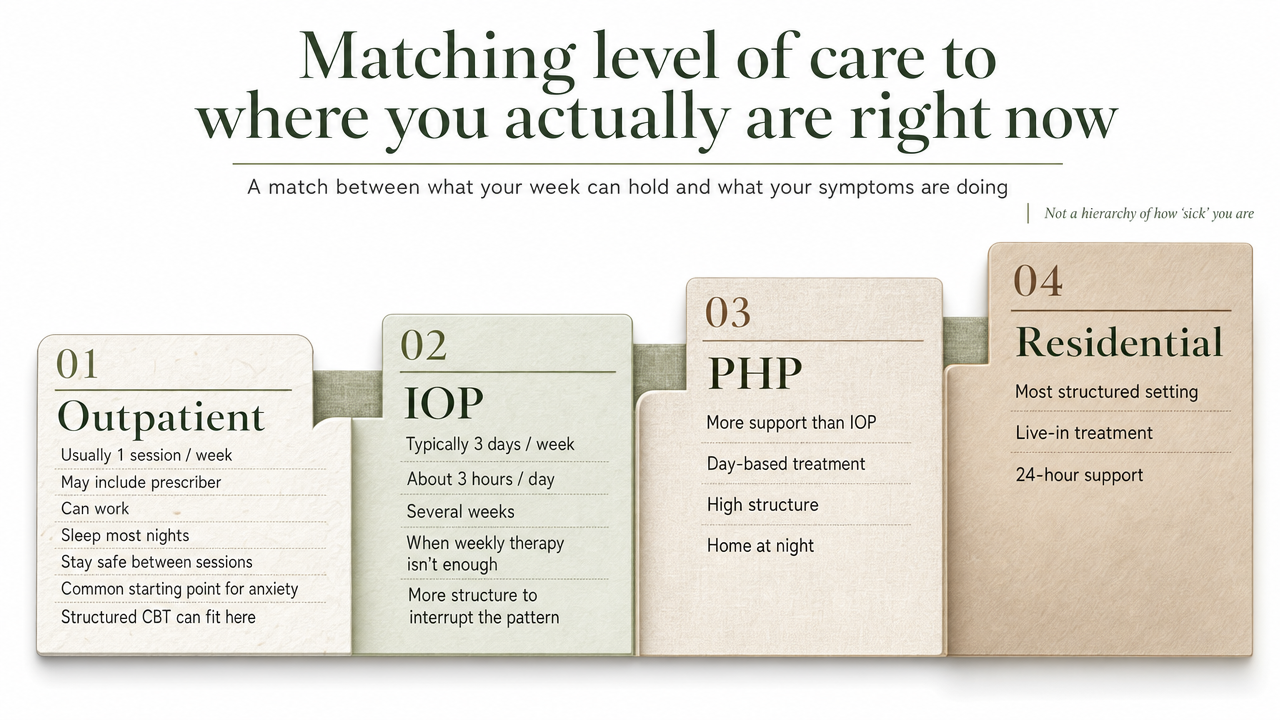
Level of care is shorthand for how much structure you need around you while you’re getting treatment. It’s not a hierarchy of how “sick” you are. It’s a match between what your week can hold and what your symptoms are doing.
Weekly outpatient therapy — usually one session a week, sometimes paired with a prescriber — works when you can still go to work, sleep most nights, and stay safe between sessions. For many people with anxiety, this is the right starting point, especially when paired with a structured CBT protocol 2. If a primary care doctor is coordinating with a specialist, this level can carry real weight 9.
Intensive outpatient programs (IOP) typically run three days a week, three hours a day, for several weeks. They make sense when weekly therapy isn’t enough to interrupt the pattern — when panic attacks are stacking up, when drinking is creeping back, when you’re functional on paper but losing ground. Partial hospitalization (PHP) is more intensive still, five days a week, and often acts as a step down from residential or a step up from IOP when symptoms are sharper.
Residential treatment means you live on site, usually for 30 to 90 days. For dual diagnosis specifically, this level is worth considering when substance use has made outpatient unsafe, when home isn’t a recovery-friendly environment, or when previous outpatient attempts have unraveled. The integrated-care evidence base supports treating both conditions concurrently at whichever level you land on 4, 5.
One practical note: levels of care aren’t a one-way ladder. Stepping down from IOP to weekly therapy is a normal arc. So is stepping up when life shifts. Ask any program you call how they handle transitions between levels and whether your clinical team stays consistent across them. Continuity matters more than the label on the door.
What the first 30 days of treatment usually feel like
The first month is rarely a straight line, and it helps to know that going in. Week one is mostly logistics and disclosure — paperwork, intake assessments, telling your story to people who actually listen. You may leave the first session feeling lighter or more raw. Both are normal.
Weeks two and three are where the structured work starts. If you’re in evidence-based CBT, you’ll likely begin with psychoeducation and somatic skills before any real exposure work 2. If medication is part of your plan, SSRIs take several weeks to reach full effect, and the first two often bring side effects that fade 8. Tell your prescriber what you’re noticing, even the small things.
By week four, you’re not “better” — you’re oriented. You know your clinician’s rhythm, you’ve practiced a few skills under real pressure, and you have data on what’s helping. For dual diagnosis specifically, this is when the integrated piece starts paying off: one team adjusting both anxiety work and substance use support based on what they’re seeing together 5.
Make the call. Finish the intake. Show up for session three when session two felt hard. Those are the wins worth counting right now.
If the first program isn’t the right fit
Sometimes you do everything right — the inventory, the calls, the intake — and three weeks in, something feels off. The clinician keeps redirecting away from the substance use. The CBT never moves past psychoeducation into actual exposure work 2. The medication conversation gets pushed off again. You’re allowed to notice that, and you’re allowed to act on it.
Leaving a program isn’t failure. It’s data. Tell your current team what isn’t working before you go — sometimes the plan shifts and stays useful. If it doesn’t, call back the SAMHSA helpline or your PCP with new information: what you tried, what was missing, what you need next 6, 7. A second program will move faster because you already know your own answers. The integrated-care evidence base assumes some matching takes time 5. You haven’t lost ground. You’ve narrowed the search.
Take the First Step Toward Calmer Days
Connect with a caring admissions specialist to start your personalized anxiety treatment journey today.
Frequently Asked Questions
What’s the difference between integrated dual diagnosis care and just seeing a therapist and an addiction counselor separately?
Integrated care means one clinical team treats both conditions in the same plan, with shared notes and weekly coordination. Parallel care splits you between providers who rarely communicate, which is the pattern most likely to stall progress. SAMHSA is clear that integrated screening and treatment produces better quality of care and outcomes than running services side by side 4.
Should I tell my primary care doctor about my substance use when I bring up anxiety?
Yes, even if it feels uncomfortable. NIMH guidance is direct about discussing symptoms openly so your provider can route you to the right care 7. A PCP who hears both pieces in the same visit can refer you to an integrated program instead of writing two disconnected referrals. The substance use detail also changes which anxiety medications are appropriate for you.
Is telehealth therapy actually as effective as seeing someone in person for anxiety?
For most anxiety presentations, yes. A 2025 narrative synthesis of 10 studies found telemedicine non-inferior to in-person therapy, with high satisfaction and retention 3. A randomized trial of telehealth versus in-person CBT for youth anxiety reached the same conclusion on symptom and functional outcomes 10. Small differences sometimes favor in-person care for generalized anxiety, which is worth discussing with your clinician.
Will a good program prescribe benzodiazepines like Xanax or Klonopin for my anxiety?
Probably not as a routine treatment. Current guidelines for generalized anxiety and panic disorder recommend against routine benzodiazepine use, limiting them to short-term measures for severe acute anxiety 1. For someone with a substance use history, the calculus is tighter still because of addiction risk 11. Expect a careful conversation about SSRIs first, with benzodiazepines used sparingly if at all.
How do I know if I need outpatient therapy, an IOP, or residential treatment?
Match the level to what your week can actually hold. Weekly outpatient works when you can function, sleep, and stay safe between sessions 2. IOP fits when symptoms are stacking up but you’re still home each night. Residential makes sense when substance use has made outpatient unsafe or home isn’t recovery-friendly. An intake clinician can recommend a starting level after assessment.
What if I can’t find an integrated program within driving distance of where I live?
Start with the SAMHSA National Helpline at 1-800-662-HELP, which maintains state-level databases of integrated programs that don’t always show up in search results 6. Then expand your definition of “near” to include telehealth, since the evidence supports virtual CBT as comparably effective for many anxiety presentations 3. A hybrid plan, with occasional in-person visits and weekly telehealth, often covers the gap.
References
- Management of generalized anxiety disorder and panic disorder in adults. https://pmc.ncbi.nlm.nih.gov/articles/PMC10785994/
- Evidence-Based Treatment Guidelines for Anxiety. https://capp.ucsf.edu/evidence-based-treatment-guidelines-anxiety-
- Comparing Telemedicine and In-Person Psychological Interventions for Anxiety Disorders: A Narrative Synthesis. https://pmc.ncbi.nlm.nih.gov/articles/PMC12415301/
- Managing Life with Co-Occurring Disorders. https://www.samhsa.gov/mental-health/serious-mental-illness/co-occurring-disorders
- Integrating Treatment for Co-Occurring Mental Health Conditions. https://pmc.ncbi.nlm.nih.gov/articles/PMC6799972/
- National Helpline. https://www.samhsa.gov/find-help/national-helpline
- Help for Mental Illnesses. https://www.nimh.nih.gov/health/find-help
- Anxiety Disorders. https://www.nimh.nih.gov/health/topics/anxiety-disorders
- Contemporary treatment of anxiety in primary care: a systematic review and meta-analysis. https://pmc.ncbi.nlm.nih.gov/articles/PMC8126070/
- A comparison of telehealth and in-person therapy for youth anxiety: A noninferiority randomized controlled trial. https://pmc.ncbi.nlm.nih.gov/articles/PMC11724934/
- Treatment of Co-occurring Anxiety Disorders and Substance Use Disorders. https://pmc.ncbi.nlm.nih.gov/articles/PMC4355945/