
Key Takeaways
- Kansas statute K.S.A. 40-2,105a and the federal MHPAEA require BCBS group plans to treat addiction benefits on par with medical benefits, including cost-sharing and authorization rules.
- Coverage depends heavily on plan type: fully insured Kansas plans fall under state oversight, self-funded ERISA plans answer to the Department of Labor, and FEP plans follow OPM rules.
- Lucet conducts BCBS behavioral health utilization review for detox, residential, PHP, and IOP, so documenting reviewer names, dates, and medical necessity criteria supports any future appeal.
- Kansas members should verify benefits by asking whether the plan is fully insured or self-funded, request written summaries, and appeal denials through internal, external, or state-level review.
Understanding Your BCBS Card for Addiction Treatment in Kansas
You’re likely here because someone you care about, or perhaps even you, is struggling with addiction and you’re trying to understand what your Blue Cross Blue Shield (BCBS) insurance covers. This is a significant step.
The good news is that BCBS plans in Kansas generally cover addiction treatment. Both federal and Kansas laws require behavioral health benefits to be treated comparably to medical benefits in most group plans. However, the specifics of your coverage depend on how your plan is funded, the level of care needed, and the outcome of the plan’s review process.
This guide will help you navigate these details in clear language, without sales pitches or false promises.
Behavioral Health Parity: Kansas and Federal Laws
Kansas Parity Statute Explained
Kansas law K.S.A. 40-2,105a mandates that if a group health plan covers medical and surgical care, it must also cover mental health and substance use treatment. Crucially, the rules for addiction care cannot be stricter than those for medical care. This means the same deductible, copay, coinsurance, and out-of-pocket maximums apply. Visit and treatment limits must also be comparable for both inpatient and outpatient care. For instance, your BCBS plan cannot charge a higher copay for a therapy session than for a doctor’s visit, nor can it impose shorter rehab stays compared to hospitalizations for physical ailments. If such discrepancies occur, it may indicate a parity violation, giving you grounds to challenge the decision.
The Kansas Insurance Department has enforced this rule since 1998, initially for employers with 51 or more workers. If you have a Kansas-based group BCBS card and your employer is not self-insured, this state statute is a powerful tool for advocating for your benefits.
Federal Parity and Recent Developments
Beyond Kansas law, the federal Mental Health Parity and Addiction Equity Act (MHPAEA) ensures that behavioral health benefits are on par with medical benefits nationwide. This includes rules regarding prior authorization and medical necessity reviews, which cannot be applied more stringently to addiction care than to other medical conditions.
While a new federal rule aimed at tightening parity enforcement was finalized in 2024, its implementation has been paused until litigation is resolved. However, the core MHPAEA statute remains in effect. This means your plan must still comply with the fundamental parity law. Advocates have consistently highlighted that behavioral health patients often face narrower networks and more denials than medical patients, and these concerns remain valid for challenging plan decisions. Your rights under MHPAEA are intact, even if some newer enforcement tools are temporarily on hold.
Understanding Your BCBS Plan Type
The type of BCBS plan you have significantly impacts your coverage. Two people with similar-looking cards might receive different answers from the same treatment facility due to how their plan is funded and regulated.
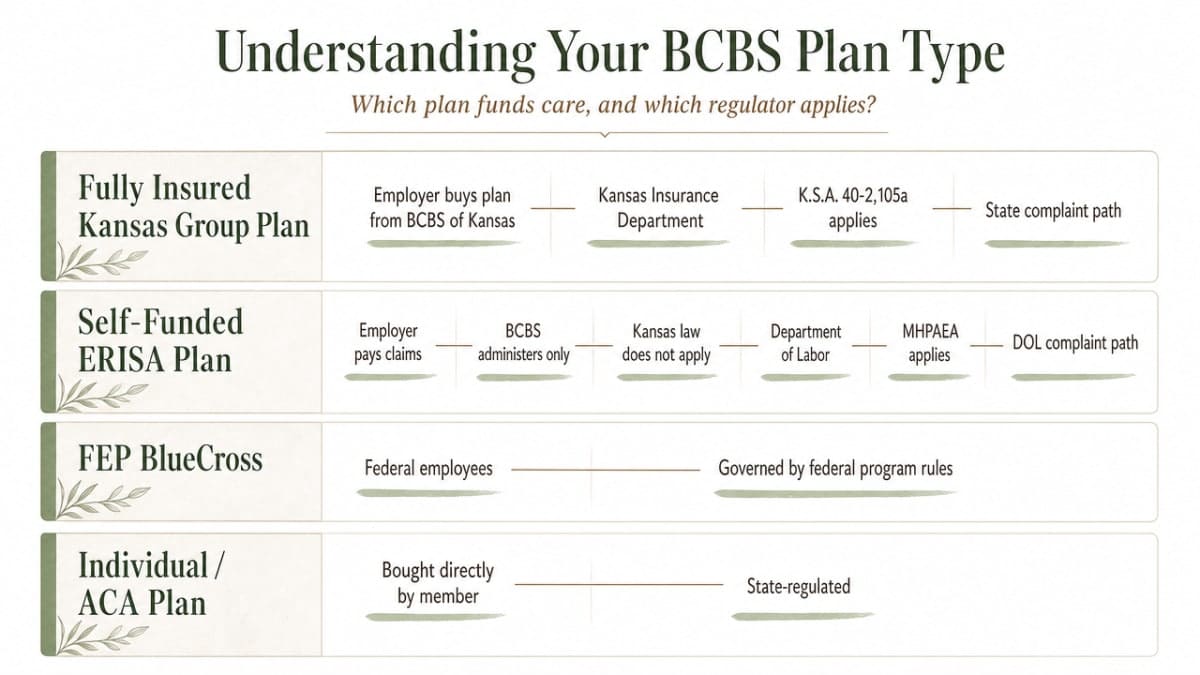
There are four main types of BCBS plans you might encounter:
- Fully Insured Kansas Group Plan: Your employer purchases this plan from BCBS of Kansas. It is regulated by the Kansas Insurance Department, and K.S.A. 40-2,105a applies directly. Complaints can be filed with the state.
- Self-Funded ERISA Plan: While it may look similar, your employer pays the claims and uses BCBS solely for administration. Kansas law does not apply here; instead, the federal Department of Labor regulates these plans, and MHPAEA still applies. Complaints should be directed to the DOL.
- FEP BlueCross: This plan is specifically for federal employees and is governed by federal parity rules under the Office of Personnel Management.
- BlueCard from Another State: If you have a BlueCard from another state and are seeking treatment in Kansas, your home-state Blue plan determines your benefits, but Kansas providers can bill through the BlueCard network.
BCBS Review Process for Levels of Care
Medical Detox Coverage
Medical detox is often the initial step in addiction treatment. BCBS reviewers focus on whether inpatient medical supervision is necessary. They look for documented withdrawal risks, such as a history of seizures, high tolerance to alcohol, benzodiazepine use, opioid use with medical complications, or unstable vital signs. The facility’s clinical team collects this information during intake to support the request for medical detox. These decisions are based on “medical necessity criteria,” which, under federal parity law, cannot be applied more strictly to addiction care than to other medical admissions. Concerns about denials at this stage have been raised by Kansas advocates.
Residential Treatment Coverage
Residential care, where individuals live at the facility, is subject to the most scrutiny by BCBS. Because it is the most expensive option, reviewers will assess whether a lower level of care could be effective. The clinical team at the rehab will build a case based on factors such as prior treatment attempts, the safety of the home environment, co-occurring conditions (e.g., depression, PTSD), and medical complications from substance use. Specific documentation strengthens the case for residential care.
Families in Kansas have reported being told they must “fail” at outpatient treatment before residential care is approved. Such requirements can violate parity if not applied equally to medical admissions. Residential stays are typically reviewed every seven to fourteen days, requiring ongoing justification of continued care based on progress and risk.
Partial Hospitalization and Intensive Outpatient
Partial Hospitalization Programs (PHP) and Intensive Outpatient Programs (IOP) are generally more accessible for BCBS coverage. PHP involves spending most of the day at the facility and returning home at night, offering intensive programming without the cost of an inpatient bed. IOP is a less intensive option, with group and individual sessions scheduled around work or family commitments.
For both PHP and IOP, reviewers require documentation of a treatment plan, measurable goals, consistent attendance, and active engagement. Missed sessions or unaddressed relapse can trigger a review that might lead to a higher level of care or termination of coverage. When verifying benefits, inquire about the number of approved sessions per week at each level and the documentation required for re-reviews, as these details can vary by plan type.
Continuing Care and Step-Down
Maintaining continuity of care after intensive treatment is crucial for long-term recovery. BCBS plans typically cover ongoing outpatient therapy, medication management, and often medications for opioid use disorder (MOUD), though access to MOUD can vary across Kansas. When inquiring about benefits, ask about visit limits for outpatient therapy, whether telehealth is covered equally to in-person visits, and how prescriptions for buprenorphine or naltrexone are handled under your pharmacy benefit. If behavioral health is managed separately, you may need to navigate a different phone tree for these benefits.
Lucet: BCBS’s Behavioral Health Review Partner
When contacting BCBS about rehab in Kansas, you will likely interact with Lucet, a company BCBS uses for behavioral health care navigation and utilization management. Lucet’s role is to determine if the requested level of care meets medical necessity criteria. They will inquire about your substance use history, withdrawal symptoms, prior treatment, mental health diagnoses, and home situation. While the rehab facility’s clinical team usually manages most of this communication, you may be asked to participate, and your answers are important.
Lucet reviewers are bound by the same parity rules as BCBS, meaning they cannot apply stricter standards to addiction care than to medical admissions. Kansas advocates have identified utilization review as a point where parity often breaks down in practice. Therefore, it is advisable to document the reviewer’s name, date, and questions asked. This documentation is vital for any potential appeal if a claim is denied.
Common Substances Treated in Kansas
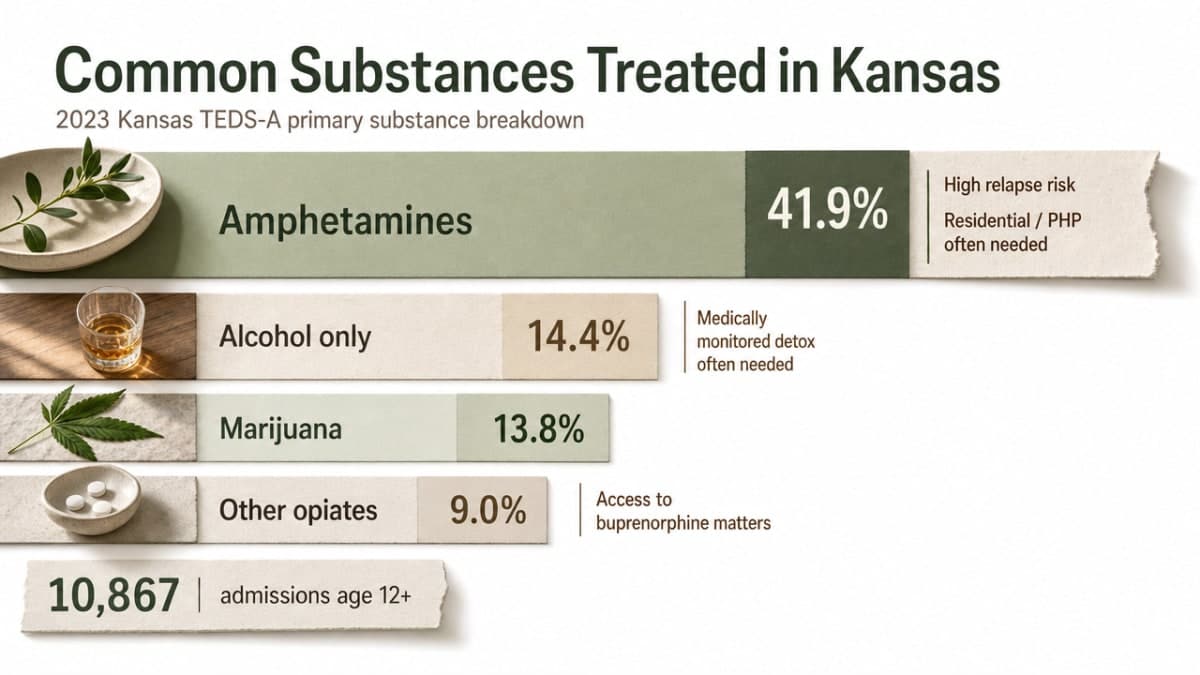
If you are seeking treatment, know that you are not alone. In 2023, Kansas treatment programs recorded 10,867 admissions for individuals aged twelve and older. Methamphetamine and other stimulants were the primary substance in 41.9% of these cases, followed by alcohol at 14.4%, marijuana at 13.8%, and other opioids at 9.0%.
The prevalence of methamphetamine use in Kansas influences the nature of rehab. While stimulant withdrawal may not always require the same medical detox as alcohol or benzodiazepines, the psychological impact and high relapse risk often necessitate residential or PHP levels of care. Alcohol remains a significant factor, frequently requiring medically monitored detox. Opioid use, though numerically smaller, highlights the importance of access to medications like buprenorphine, which has been uneven across the state. When verifying benefits, specify the substance of concern, as coverage conversations can differ significantly for various substances.
Step-by-Step Benefit Verification Process
Navigating insurance can be complex, but following these steps can simplify the process:
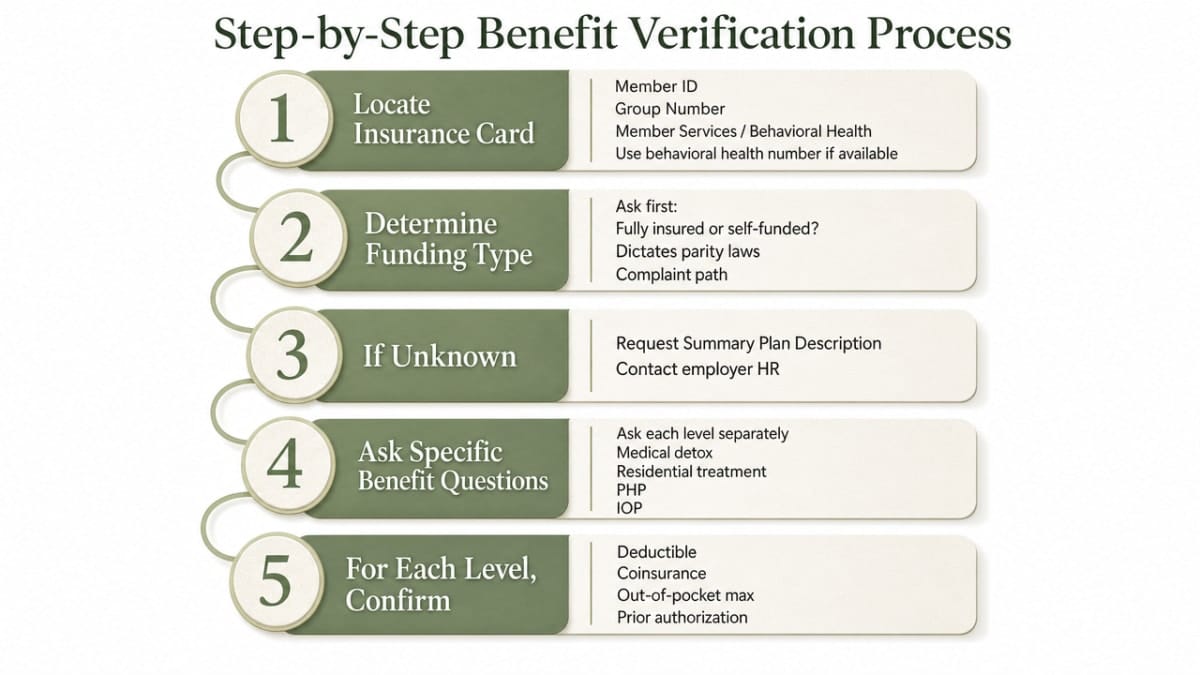
- Locate Your Insurance Card: Find your member ID, group number, and the “Member Services” or “Behavioral Health” phone number. Use the behavioral health number if available.
- Determine Funding Type: Your first question to the representative should be: “Is this plan fully insured or self-funded?” This answer dictates which parity laws protect you and where to file a complaint if necessary. If they cannot provide this information, request your Summary Plan Description or contact your employer’s HR department.
- Ask Specific Benefit Questions: Instead of a general “Do you cover rehab?”, inquire about medical detox, residential treatment, PHP, and IOP separately. For each level, ask about deductibles, coinsurance, out-of-pocket maximums, prior authorization requirements, and typical approval durations (days or sessions).
- Inquire About Lucet: Ask, “Will Lucet handle utilization review for this admission? Do I contact them or does the facility?” Try to get a direct line for the reviewer if possible.
- Document Everything: Record the representative’s name, date, time, and a reference number for the call. If a rehab admissions team assists with verification, request a written benefit summary. Federal consumer protections entitle you to this information.
These steps empower you to gather the necessary facts about your plan’s coverage.
Appealing a Denied Claim
A denial for rehab coverage is not a final decision; it initiates an appeals process that you have a legal right to pursue. Plans often lose appeals, so it is important to understand your options.
Carefully read the denial letter. It must specify the reason for denial, the medical necessity criteria used, and instructions for appeal. Missing information in the letter itself can be a point of contention. Keep all documentation.
Typically, you have two levels of internal appeal with BCBS, followed by an external review by an independent third party. For fully insured Kansas plans, the Kansas Insurance Department can assist with complaints and external review requests. For self-funded ERISA plans, the federal Department of Labor is the appropriate contact. FEP members should go through the Office of Personnel Management.
Ask the rehab’s clinical team to write a letter of medical necessity detailing withdrawal risk, co-occurring diagnoses, prior treatment history, and why a lower level of care is unsafe. This letter should explicitly compare the review process to a comparable medical admission, forming the basis of an MHPAEA challenge. If an “expedited appeal” is mentioned, utilize it, especially if delaying treatment poses serious risks.
Understanding Cost Variables
While no one can provide an exact cost without verifying benefits, you can inquire about the variables that determine your financial responsibility:
- Deductible: Ask how much of your deductible has been met and when it resets (calendar year or plan renewal date).
- Coinsurance: After the deductible, determine the percentage you pay for in-network versus out-of-network behavioral health services.
- Out-of-Pocket Maximum: Understand your maximum out-of-pocket limit and how close you are to reaching it, as the plan covers 100% of covered services once this limit is met.
- Network Status: Confirm if the facility you are considering is in-network. Out-of-network coverage is often significantly lower.
- Prior Authorization and Concurrent Review: Ask if prior authorization is required and if concurrent review can shorten a stay.
- Pharmacy Benefits: Inquire how your pharmacy benefits handle medications for opioid or alcohol use disorder.
These questions will provide a clear picture of potential costs before committing to treatment.
Sunflower Recovery and BCBS Coverage
Sunflower Recovery, located in Osawatomie with a Kansas City presence, accepts most commercial insurance plans, including BCBS. They do not participate in Medicare or Medicaid networks.
Sunflower Recovery offers a continuum of care that BCBS reviewers often seek, including a 60-day residential program, PHP, and IOP. Their clinical focus on trauma and co-occurring conditions like depression, anxiety, and eating disorders is particularly relevant, as BCBS reviewers frequently inquire about co-occurring diagnoses at various levels of care.
To determine if Sunflower Recovery is the right fit, you can contact them directly to verify your BCBS benefits, or call the number on your insurance card to inquire about coverage at their facility. Either approach will provide you with concrete answers regarding your treatment options.
Connect with an admissions expert now
Get clear answers about BCBS coverage and your next steps for admission.
Frequently Asked Questions
Does Blue Cross Blue Shield cover rehab in Kansas?
Yes, in most cases. BCBS plans in Kansas generally cover addiction treatment, and both Kansas law and federal parity law require behavioral health benefits to be treated on par with medical benefits in most group plans. Your exact coverage depends on your plan’s funding type, the level of care you need, and prior authorization requirements.
How do I find out if my specific BCBS plan is fully insured or self-funded?
Call the member services number on your card and ask directly: “Is my plan fully insured or self-funded?” If they cannot answer, ask for your Summary Plan Description or contact your employer’s HR benefits office. The answer determines whether Kansas law protects you or federal ERISA rules apply, and it changes where you file a complaint later.
What is Lucet, and why is BCBS asking me to talk to them?
Lucet is the company BCBS uses to handle behavioral health care navigation and utilization review. When you request rehab, a Lucet clinician decides whether the level of care meets medical necessity criteria. They must follow the same parity rules BCBS follows. Write down the reviewer’s name and the date of the call in case you need to appeal.
Do I need prior authorization before starting detox or residential treatment?
Usually yes for residential care and often for medical detox. The rehab’s admissions team typically handles the request, but you should confirm the requirement when you verify benefits. Under parity law, authorization rules cannot be stricter for addiction care than for comparable medical admissions. If the plan requires you to “fail” outpatient first, document it.
What can I do if BCBS denies my claim for rehab?
You have the right to appeal, and plans lose appeals more often than families expect. Read the denial letter for the medical necessity criteria used and file an internal appeal, then request external review. For fully insured Kansas plans, contact the Kansas Insurance Department. For self-funded plans, contact the U.S. Department of Labor. Ask about expedited appeals.
Will my BCBS plan work at a Kansas rehab if I live out of state?
Usually yes, through the BlueCard program. Your home-state Blue plan sets the benefits and cost-sharing, but a Kansas facility can bill through BlueCard as if it were local. Call your home plan’s member services line to confirm the Kansas facility’s network status and any prior authorization requirements before admission. Private insurance funds a large share of Kansas treatment.
References
- Parity Compliance Toolkit: Applying Mental Health and Substance Use Disorder Parity Requirements to Medicaid and CHIP. https://www.medicaid.gov/medicaid/benefits/downloads/bhs/parity-toolkit.pdf
- Statement of U.S. Departments of Labor, Health and Human Services, and the Treasury Regarding Enforcement of the Final Rule on Requirements Related to the Mental Health Parity and Addiction Equity Act. https://www.cms.gov/files/document/statement-regarding-enforcement-final-rule-requirements-related-mhpaea.pdf
- The Mental Health Parity and Addiction Equity Act (MHPAEA). https://www.cms.gov/marketplace/private-health-insurance/mental-health-parity-addiction-equity
- Mental Health Parity and Addiction Equity Act (MHPAEA). https://www.cms.gov/marketplace/about/oversight/other-insurance-protections/mental-health-parity-and-addiction-equity-act-mhpaea
- Bulletin on Mental Health Issues – Kansas Insurance Department. https://insurance.ks.gov/department/LegalIssues/bulletins/1998-4.html
- Parity for Mental Health and Substance Use Disorder Benefits. https://www.medicaid.gov/medicaid/managed-care/guidance/parity-for-mental-health-and-substance-use-disorder-benefits
- Access to and Outcomes of Substance Use Disorder Treatment Services for Adolescents and Young Adults. https://www.samhsa.gov/data/report/access-and-outcomes-sud-treatment-services-adolescents-young-adults
- Key Resources and Tools for TEDS | CBHSQ Data. https://www.samhsa.gov/data/data-we-collect/teds-treatment-episode-data-set
- New report clears a path for Kansas’ response to substance use. https://aai.ku.edu/news/article/new-report-clears-a-path-for-kansas-response-to-substance-use
- 2023 Treatment Episode Data Set: Admissions (TEDS-A) – Kansas. https://www.samhsa.gov/data/node/51056
- Kansas Mental Health Coalition – House Insurance and Pensions Committee Informational Hearing (Feb. 8, 2021). https://kslegislature.gov/li_2022/b2021_22/committees/ctte_h_insurance_and_pensions_1/documents/testimony/20210208_03.pdf
- Behavioral Health Barometer: Kansas, Volume 5. https://www.samhsa.gov/data/sites/default/files/cbhsq-reports/Kansas-BH-BarometerVolume5.pdf