
Key Takeaways
- Cocaine use in the Kansas City metro often hides inside functioning careers and families, with weekend binge patterns that delay treatment far longer than they should.
- Kansas cocaine treatment admissions dropped roughly 85% between 2001 and 2023 even as use rates held steady, leaving a large under-treated population across Jackson and Johnson counties 11.
- No FDA-approved medication treats cocaine use disorder, so effective care pairs contingency management, the current standard for stimulants, with cocaine-specific CBT 10, 12.
- Before choosing a program, compare whether it offers cocaine-specific behavioral care, concurrent treatment for depression, anxiety, or trauma, confidentiality protections, insurance verification, and a level of care that fits your life.
The Cocaine Problem That Doesn’t Look Like a Problem
You still make it to work. You answer the emails. You show up for the kids’ games, the client dinners, the Sunday family thing at your in-laws’ place in Overland Park. On paper, nothing is wrong.
That is the part that makes cocaine so hard to name. It rarely announces itself the way people expect. It shows up in a bathroom stall at a downtown steakhouse, in a car parked behind a Westport bar, in a hotel room after a long shift. Then Monday comes and you put on a shirt and go back to being fine.
Cocaine is not methamphetamine, and pretending they’re the same drug does you a disservice. Meth tends to run people down in ways strangers can see. Cocaine hides. It hides inside careers and mortgages and marriages that look, from the outside, like they’re working. Which is exactly why people wait so long to ask for help — and why the shame gets so loud when they finally do.
If you’re reading this at 2 a.m. after another weekend that got away from you, or you’re watching someone you love disappear a little more each Sunday, you are not alone in this. Kansas City has a quieter cocaine problem than the news suggests, and there is a specific kind of treatment built for it. Not a lecture. Not a boot camp. A plan.
This piece walks you through what that looks like — and how to make the first call when you’re ready.
Who Actually Uses Cocaine in Kansas City
The High-Functioning Pattern Hiding in Plain Sight
Think about who you know who uses. It’s rarely the person you’d expect from a D.A.R.E. pamphlet. It’s the nurse pulling a second shift at a hospital in Midtown. The realtor closing three deals a month in Leawood. The line cook who stays until 2 a.m. on Saturday and still coaches his kid’s soccer team on Sunday morning. The lawyer, the bartender, the electrician, the pharma rep.
Cocaine has a reputation as a “functional” drug, and that reputation is part of what keeps people stuck. If you’re still hitting your numbers at work, still paying the mortgage, still showing up — it’s easy to tell yourself this isn’t really a problem. It’s just a Friday thing. A stress thing. A once-in-a-while thing that happens to be once a week.
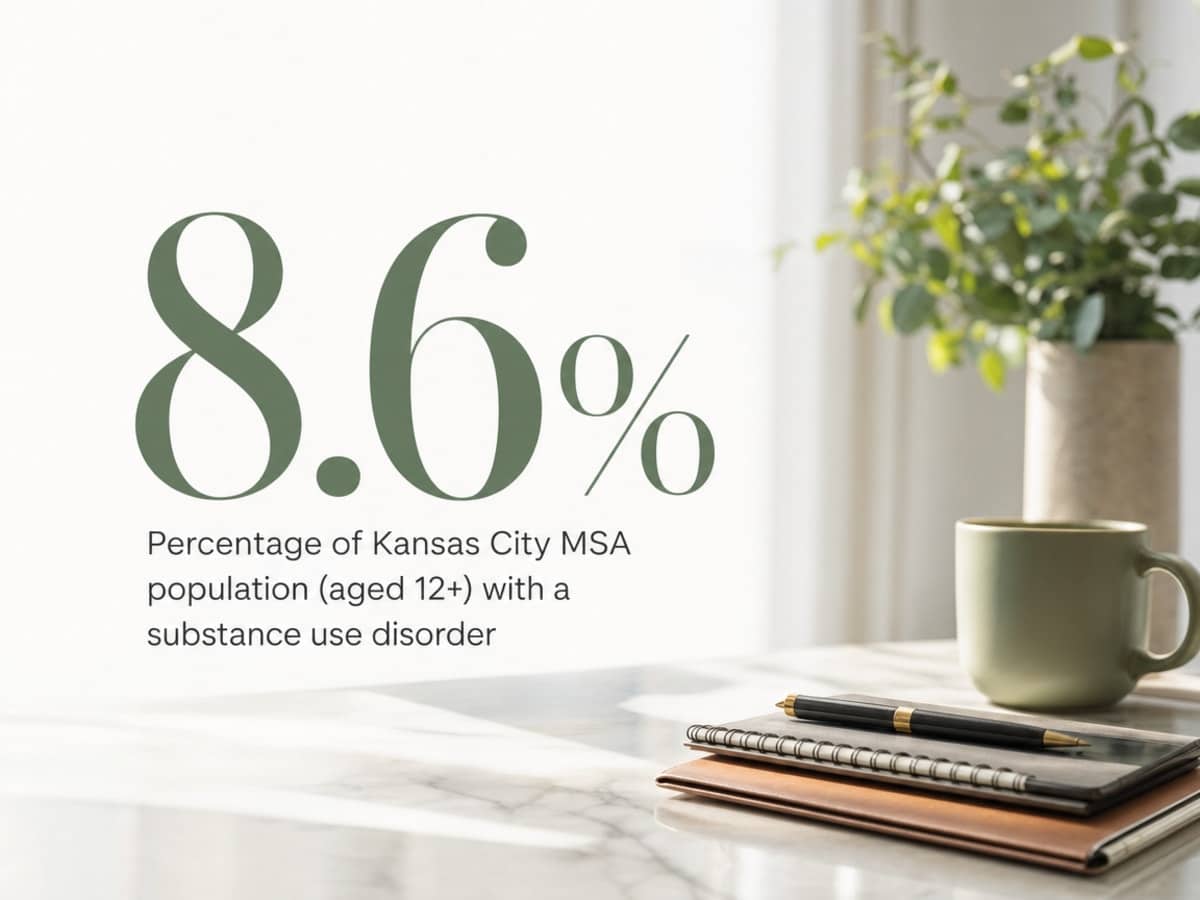
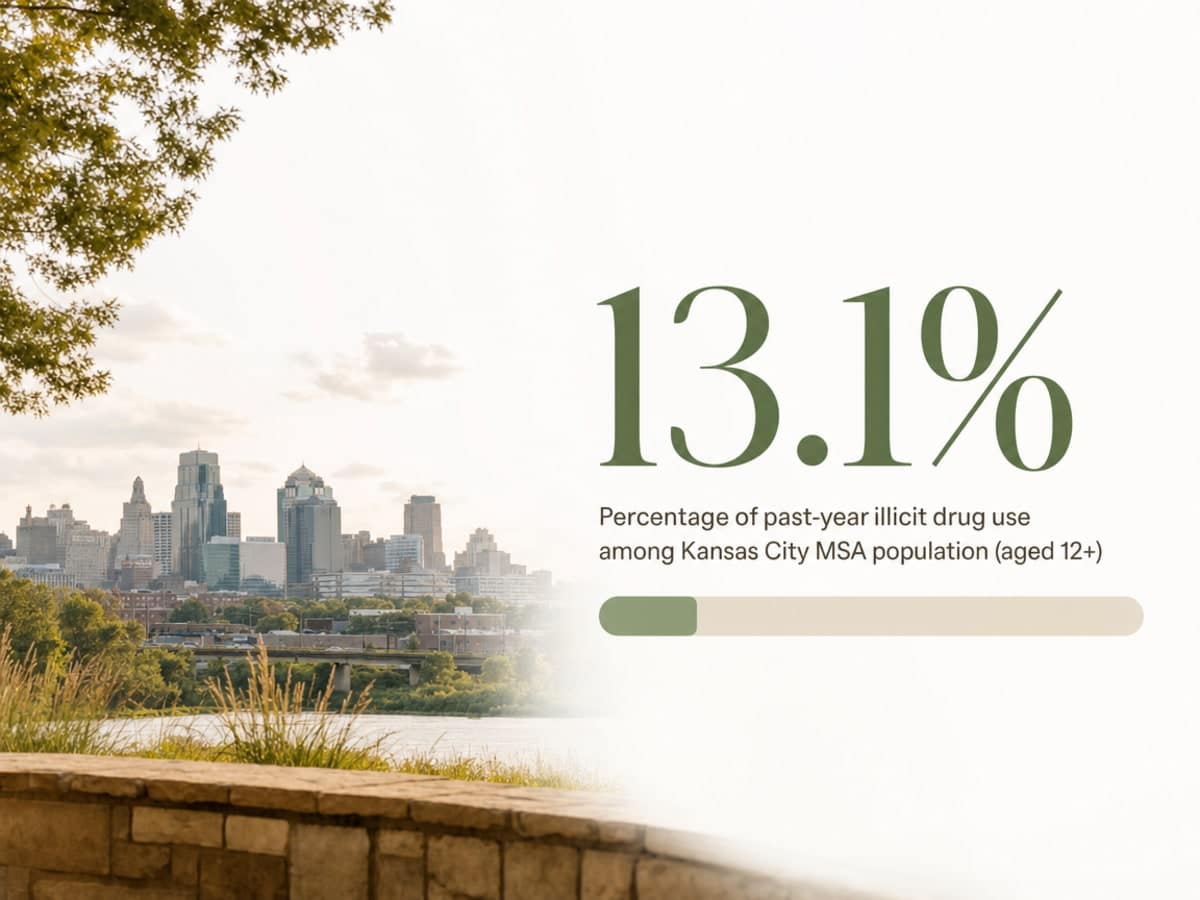
You are not the only person in the Kansas City metro living this double life. SAMHSA estimates that roughly 239,000 people aged 12 and older in the Kansas City MSA use an illicit drug in a given year — about 13.1% of the population — and 157,000 (8.6%) meet criteria for a substance use disorder 1. That’s a lot of people in the same grocery stores, PTA meetings, and office parks as you. Most of them look completely fine from the outside.
The pattern that tends to bring cocaine users to the edge is not a single dramatic collapse. It’s the slow accumulation:
- The Sunday depressions that get heavier.
- The Monday shame that lasts a little longer each week.
- The credit card statements you don’t open.
- The lie you told your partner that you’re still keeping track of.
- The nosebleeds.
- The heart flutter you googled at 3 a.m. and then closed the tab on.
None of that means you are weak. It means the drug is doing exactly what cocaine does to a functioning nervous system, and the pattern is treatable. Being high-functioning is not a disqualifier from care. Often it’s the reason care has been delayed too long.
Cocaine Is Not Meth: Why the Distinction Matters for Treatment
A lot of treatment pages lump cocaine and methamphetamine together under “stimulants” and move on. Clinically, the medications and behavioral tools overlap. But the lived pattern doesn’t, and if the pattern doesn’t get named correctly, the treatment plan can miss.
Meth tends to run in extended stretches — days awake, appetite gone, visible weight loss, the kind of deterioration a coworker or parent notices without being told. Cocaine works in shorter arcs. A binge on Friday night into Saturday morning. A crash Sunday. A rebuild Monday through Thursday, where you drink coffee, work hard, and promise yourself this weekend will be different. Then Friday comes.
That rhythm matters because it fuels the specific denial cocaine users carry: if I only use on weekends, it’s not addiction. Cocaine use disorder doesn’t care what day of the week it is. It’s about loss of control, continued use despite harm, and the way the drug reorganizes what you look forward to. A weekend-only pattern that you cannot stop is still a pattern that meets criteria.
The stigma is also different. Meth carries a heavy public stereotype. Cocaine still carries a whiff of glamour — a nightlife drug, a professional drug, something that supposedly signals success. That stereotype makes it harder to say the word “addiction” out loud, especially if you’re a professional with a license, a security clearance, or a public role. About two-thirds of Kansans see monthly cocaine use as high-risk, but only around 1.36% report past-year use 3. The math tells you what you already sense: most people using cocaine are doing it quietly, and most people around them do not know.
Treatment built for cocaine takes all of this seriously — the binge pattern, the crash depression, the professional shame, the fear of being seen walking into a building with the word “rehab” on it. It’s a different conversation than the one built for meth, and you deserve the one built for you.
The Under-Treatment Gap in Kansas
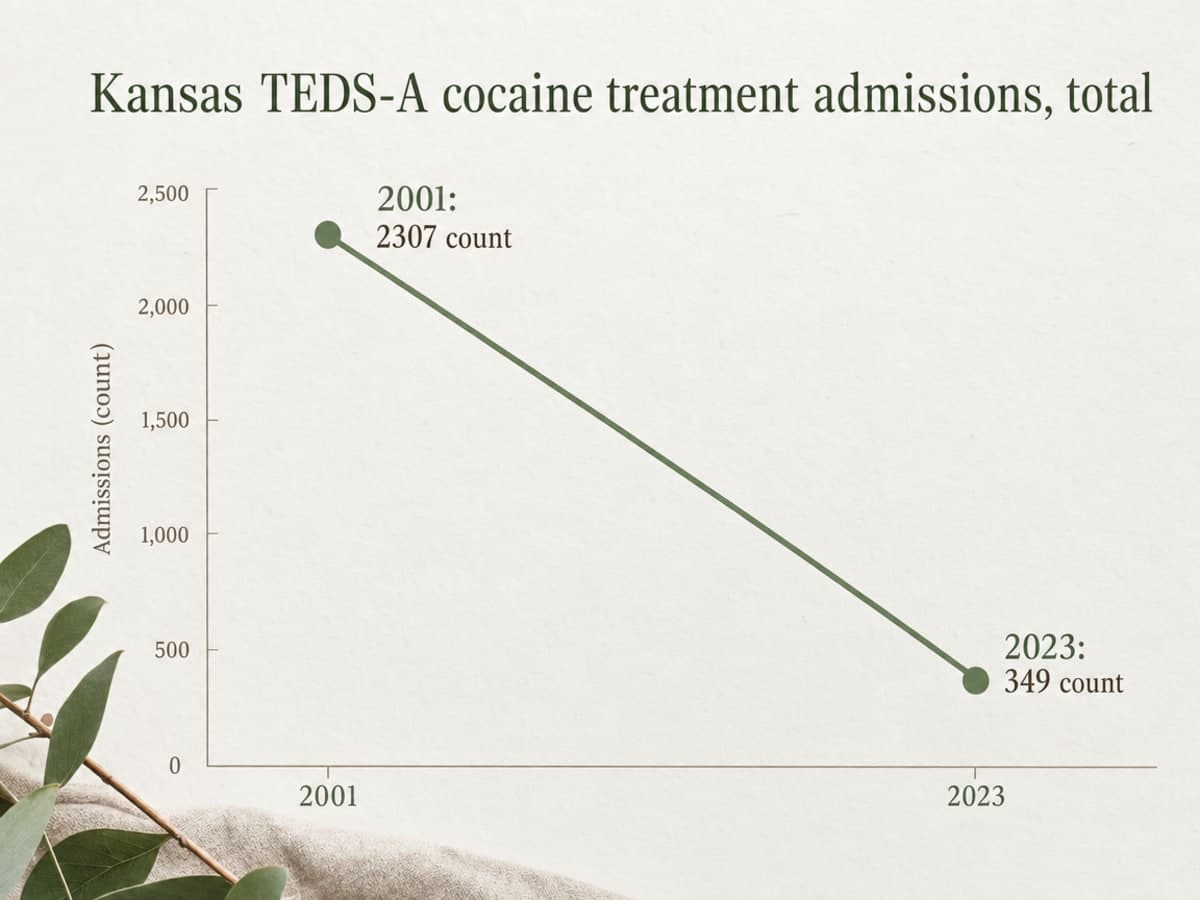
Here is a number that should stop you for a second. In 2001, Kansas recorded 2,307 treatment admissions for cocaine 11. By 2023, that number had fallen to 349 — roughly an 85% drop 11.
Read that the way it deserves to be read. It does not mean cocaine went away. Kansas past-year cocaine use has stayed roughly in line with the national rate for decades 11, and about 1.36% of Kansans aged 12 and older still report using cocaine in a given year 3. The drug did not leave. The people using it stopped showing up in treatment.
That gap is what this article is really about. Somewhere between those two numbers is a whole population of people — professionals, parents, service workers, tradespeople across Jackson County and Johnson County — who are using and not getting help. They may have tried once. They may have decided rehab was for someone else. They may have looked at the sign on a building and driven past. They may have been told, by a therapist who didn’t specialize in stimulants, that they should just cut back.
If you have been counting yourself out of the treatment number because you told yourself it wasn’t bad enough yet — you are exactly who this gap is made of. And you are exactly who care is built for.
What Real Cocaine-Specific Treatment Looks Like
Why There Is No Pill for This
Here is something a lot of people don’t know until they start asking questions. For opioid use disorder, there are medications — buprenorphine, methadone, naltrexone — that a doctor can prescribe to steady the brain while the rest of recovery happens. For cocaine use disorder, there is no equivalent. No FDA-approved medication exists that treats cocaine addiction directly 4, 10.
That is not a reason to lose hope. It’s a reason to understand how care is actually built. Because there’s no pill to lean on, the treatments that work for cocaine are behavioral — structured, specific, and delivered by people trained in what actually moves the needle for stimulants. The heavy lifting is done by two names you’ll see again and again: contingency management and cognitive behavioral therapy 4, 10.
If a provider tells you the plan is “just come to group and share,” that is not cocaine-specific care. It’s generic addiction programming borrowed from other drugs. You deserve something built for the actual chemistry and pattern you’re dealing with.
Contingency Management: The Standard of Care
Contingency management sounds clinical, but the idea is simple. You get something concrete — a small reward, a voucher, a modest prize — for turning in a clean drug screen. That’s it. Show up, test negative, get reinforced. Do it again. Do it the week after that.
If it sounds too basic to work, that’s the reaction almost everyone has. Then you look at the research. The federal HHS review of three decades of evidence concluded that contingency management is the most effective available treatment for stimulant use disorder — roughly twice as effective as alternatives like CBT alone, counseling, or motivational interviewing 10. The ASAM/AAAP clinical practice guideline calls it the current standard of care for stimulant use disorders, cocaine included 12. SAMHSA’s advisory frames it as a primary, potentially life-saving intervention for the more than 4 million Americans who meet criteria for a stimulant use disorder 5.
What it looks like in practice: most clinical CM programs run on a 12-week schedule with drug screenings two to three times per week 4. Each negative screen earns a reinforcer. Consecutive negatives earn escalating rewards, so the momentum builds. Miss a week, and you reset — not as punishment, but because the whole model is built around rewarding what you actually did.
For a high-functioning professional used to being told to “just want it more,” CM can feel almost too tangible. That’s the point. Willpower is not a treatment plan. A schedule, a screen, and a reinforcer you actually care about — that’s a treatment plan. It gives your nervous system a reason to choose differently on Friday at 9 p.m. before your prefrontal cortex has to win the argument alone.
CBT for Cocaine: Mapping Triggers, Building Skills
Cognitive behavioral therapy is the other half of the equation, and for cocaine specifically, it has its own playbook. The NIDA-developed CBT manual for cocaine addiction describes it as“a short-term, focused approach”that helps you recognize situations where you’re most likely to use, avoid them when you can, and cope more effectively when you can’t 13.
In session, that means real work with real specifics. A therapist walks you through what’s called a functional analysis of your last use — not to shame you, but to map it. What was the trigger? A text from a certain friend? Closing a big deal? The Friday afternoon energy drop? What did the drug do for you in that moment — dull an anxiety, sharpen a shift, give you permission to feel something? What happened next?
Once the pattern is on paper, you build skills against each piece:
- Refusal scripts for the friend who always offers.
- A plan for the Friday drop that doesn’t involve driving past the dealer’s block.
- New words for the feeling you were trying to reach.
- Real strategies for the crash on Sunday when the depression comes back louder than before.
CBT for cocaine is not talking about your childhood for an hour a week. It’s structured, homework-driven, and short-term by design 9, 13. You leave sessions with something to do, and you come back with data on whether it worked.
How CM and CBT Work Together Over Time
The reason good programs pair these two isn’t marketing. It’s what the research keeps finding. Contingency management drives rapid, measurable reductions in cocaine use during active treatment — better retention, cleaner screens, more weeks strung together than any other approach in that window 7, 8. But once the incentives end, some of that traction fades.
CBT works on a different clock. Its effects tend to show up in the months after treatment, when the skills you built keep pulling weight in situations no one is monitoring 7, 8. On its own, CBT is slower to bite. Paired with CM, it does exactly what CM can’t: teach you how to stay standing when the reinforcers are gone.
Think of it this way. CM buys you the early weeks of clean time your brain desperately needs to reset. CBT builds the internal architecture that keeps those weeks going after the program ends. AHRQ’s review of stimulant use disorder interventions specifically calls out CM combined with additional behavioral approaches like community reinforcement as producing sustained abstinence for cocaine use 6.
Any Kansas City program serious about cocaine should be able to explain how it uses both.
Trauma-Informed Dual Diagnosis Care
Here’s the part a lot of programs miss. Cocaine rarely sits alone.
Underneath the binge pattern is usually something else — untreated depression, an anxiety disorder that predates the first line, unprocessed trauma from a childhood or a relationship or a night you don’t talk about. The crash after a weekend of use isn’t just chemistry. It’s the depression the drug was covering up, coming back with interest. The Monday shame isn’t just guilt. For a lot of people, it’s a trauma response with a familiar shape.
Trauma-informed care means the people treating you assume that hard things happened, and they build the whole program — how you’re greeted, how groups are run, how feedback is given — around not re-injuring you. It means your history is treated as context, not confession. Sunflower Recovery Center’s model is built around exactly this: cocaine and the depression, anxiety, or trauma underneath it, addressed at the same time by the same team. For a lot of people in the Kansas City metro, that integration is what finally makes treatment stick.
What a Week in Treatment Actually Feels Like
One of the biggest reasons people put off calling is that they cannot picture what they’d actually be doing all week. So here’s a plain description.
Most cocaine-specific outpatient treatment runs on a rhythm. You come in two or three times a week for drug screening — a quick urine test, in and out — because that’s what contingency management is built around 4. A negative screen earns a small reinforcer that day. String a few together and the reward grows. Miss one and you reset without shame; the plan is designed to reward what you actually do, not punish what you didn’t.
Alongside that, you sit with a therapist for individual CBT sessions. The first ones feel more like detective work than therapy. You map the last time you used — what happened that morning, who texted, what you were feeling by 4 p.m., what the drug promised you at 9 p.m. You leave with a specific assignment for the week: a script to use if a certain friend calls, a plan for Friday between the last meeting and getting home.
Groups are smaller than most people expect. Six to ten people, mostly professionals and working adults, talking about real-week problems — a wedding coming up, a business trip, a partner who found the credit card statement. Trauma work is paced carefully; nothing gets ripped open in week one 12.
If your use pattern is heavier, or the crashes are getting dangerous, a residential stay or partial hospitalization program gives you a full day of structure and a night away from your triggers. Either way, the week has a shape. You know what’s next.
Confidentiality, Insurance, and the First Phone Call
The reason people don’t call isn’t usually money. It’s the fear of being seen. Of a name on a chart. Of a coworker who happens to know somebody who works there. That fear is legitimate, and it deserves a direct answer.
Federal privacy protections for substance use treatment records are stricter than standard medical records. Your employer does not get a call. Your family does not get a call unless you sign a release saying they can. A phone inquiry doesn’t create a record with your insurer either — verification of benefits is a routine check, not an enrollment.
On cost: Sunflower Recovery Center accepts most commercial insurance plans. You can call and have someone verify your specific benefits before you commit to anything. That conversation takes about fifteen minutes and tells you what your plan actually covers for residential, PHP, or IOP care.
Kansas licensed providers are also required to offer crisis intervention for anyone presenting with a substance use diagnosis 14. If you’re calling at a bad moment, someone answers.
The first call is a conversation. Not an intake, not a commitment. Confidential, no judgment, and yours to end whenever you want.
Sunflower Recovery Center in the Kansas City Metro
Sunflower Recovery Center sits about 45 minutes south of downtown Kansas City in Osawatomie, Kansas — close enough that people from Jackson County, Johnson County, and Wyandotte County can access care without uprooting their whole life, far enough that the address isn’t across the street from your office.
The clinical model is built for exactly the reader this article has been talking to. A 60-day residential program for people who need distance from their triggers. A partial hospitalization program and intensive outpatient program for people whose lives can bend around treatment but not stop for it. Contingency management and CBT are woven into care for stimulants, and co-occurring depression, anxiety, and trauma are treated concurrently — which the ASAM/AAAP guideline calls a strong recommendation, not an optional add-on 12.
Sunflower accepts most commercial insurance plans. Medicare and Medicaid are not part of the network. A quick benefits check by phone tells you what your plan covers before you decide anything.
You can call Sunflower today. The conversation is confidential, and no one is going to judge you. That is the whole first step.
Start Your Confidential Cocaine Recovery Conversation Now
Speak privately with a caring team member about your next steps toward stimulant recovery in Kansas City.
Frequently Asked Questions
Is there a medication that treats cocaine addiction?
No. Unlike opioid use disorder, there is no FDA-approved medication that treats cocaine use disorder directly 4, 10. That’s why effective care leans on behavioral treatments — contingency management and CBT do the heavy lifting, often paired together. Medications may still be used to treat co-occurring depression, anxiety, or sleep problems that show up alongside cocaine use.
Can I get cocaine treatment in Kansas City without anyone at my job finding out?
Yes. Federal privacy protections for substance use treatment records are stricter than standard medical records. Your employer isn’t notified, and family members aren’t contacted unless you sign a release. A benefits verification call doesn’t create a claim or an enrollment. If you use FMLA or short-term leave, the reason stays between you and your provider.
Do I need to go to inpatient rehab, or can I keep working during treatment?
Both paths exist. Intensive outpatient and partial hospitalization programs are built for people who need to keep working while getting real treatment — evenings, mornings, or partial-day schedules. Residential is for people whose triggers, crash patterns, or safety concerns need distance from daily life. A clinical assessment on the first call helps sort which level fits your situation.
What if I only use cocaine on weekends? Is that really addiction?
It can be. Cocaine use disorder isn’t measured by frequency — it’s measured by loss of control, continued use despite harm, and how the drug reorganizes your life. A weekend-only pattern that you’ve promised yourself you’d stop, spent more on than planned, or hidden from people who love you meets clinical criteria more often than not. The day of the week doesn’t disqualify you.
What happens on the first phone call to Sunflower Recovery Center?
A real person answers. You’ll talk through what’s going on — how much, how often, what else is happening in your life. They’ll ask about insurance and verify your benefits, usually within the same call. Nothing is committed to on that call. Kansas licensed providers are also required to offer crisis intervention if you’re calling from a hard moment 14.
Will my insurance cover cocaine addiction treatment?
Most commercial insurance plans cover substance use treatment, including residential, PHP, and IOP levels of care. Sunflower accepts most commercial insurance and can verify your specific benefits by phone before you commit to anything. Medicare and Medicaid are not part of the network. The verification call takes about fifteen minutes and tells you exactly what your plan pays for.
References
- Substance Use and Mental Disorders in the Kansas City MSA. https://www.samhsa.gov/data/sites/default/files/NSDUHMetroBriefReports/NSDUHMetroBriefReports/NSDUH-Metro-Kansas-City.pdf
- Kansas City, MO-KS | CBHSQ Data Report. https://www.samhsa.gov/data/report/kansas-city-mo-ks
- KANSAS – 2022 NSDUH State Estimates. https://www.samhsa.gov/data/sites/default/files/reports/rpt44486/2022-nsduh-sae-state-tables/NSDUHsaeKansas2022.pdf
- Treatment of Stimulant Use Disorders. https://library.samhsa.gov/product/treatment-stimulant-use-disorders/pep20-06-01-001
- Advisory: Contingency Management for the Treatment of Substance Use Disorders. https://library.samhsa.gov/sites/default/files/contingency-management-advisory-pep24-06-001.pdf
- Stimulant Use Disorders and Behavioral Health Integration. https://integrationacademy.ahrq.gov/products/topic-briefs/stimulant-use-disorders-and-behavioral-health-integration
- Cognitive–Behavioral Therapy Plus Contingency Management for Cocaine Abuse. https://pmc.ncbi.nlm.nih.gov/articles/PMC1224747/
- A comparison of contingency management and cognitive-behavioral therapy for stimulant abusers. https://pubmed.ncbi.nlm.nih.gov/16445555/
- Cognitive-Behavioral Therapy for Substance Use Disorders. https://pmc.ncbi.nlm.nih.gov/articles/PMC2897895/
- Contingency Management for the Treatment of Substance Use Disorders. https://aspe.hhs.gov/sites/default/files/documents/a0cc6fcdb2968be95f60bb1c2c94eb70/contingency-management-sub-treatment.pdf
- Cocaine – Kansas Drug Threat Assessment. https://www.justice.gov/archive/ndic/pubs3/3600/cocaine.htm
- The ASAM/AAAP Clinical Practice Guideline on the Management of Stimulant Use Disorder. https://pmc.ncbi.nlm.nih.gov/articles/PMC11105801/
- A Cognitive-Behavioral Approach: Treating Cocaine Addiction. https://www.ojp.gov/ncjrs/virtual-library/abstracts/therapy-manuals-drug-addiction-manual-1-cognitive-behavioral
- Kan. Admin. Regs. § 26-52-17 – Alcohol and Substance Abuse Services. https://www.law.cornell.edu/regulations/kansas/K-A-R-26-52-17
- Overdose Data Dashboard – Kansas Department of Health and Environment. https://www.kdhe.ks.gov/1309/Data-Dashboard
- Drug Overdose Deaths – CDC. https://www.cdc.gov/drugoverdose/deaths/index.html