
Key Takeaways
- Federal parity law, ACA essential health benefits, and KanCare’s Section 1115 SUD demonstration together mean nearly every Kansas insurance plan covers some form of addiction treatment 1, 8, 3.
- Real out-of-pocket cost in Kansas comes down to three numbers on your specific plan: deductible, coinsurance, and out-of-pocket maximum — not whether rehab is covered at all.
- Network status, prior authorization, and concurrent review are where Kansas families get squeezed, and parity rules give you grounds to appeal denials that treat SUD care worse than medical care 1, 10.
- Call the member services number on your card, ask the eight benefits-verification questions, and write down names and reference numbers before committing to any Kansas facility.
The question behind the question: can your family afford to say yes to treatment?
You’re not really asking about insurance. You’re asking whether saying yes to rehab is going to wreck your family financially on top of everything else you’re already carrying. That fear is one of the biggest reasons people wait months, sometimes years, before making the call. It’s also one of the most common reasons families in Kansas talk themselves out of the help their loved one needs.
Here’s what’s true, and what you deserve to hear plainly: in almost every Kansas insurance scenario, addiction treatment is covered in some form. Federal law requires it. Your out-of-pocket cost will depend on your specific plan, your deductible, and whether the facility is in your network — but the answer is rarely zero coverage, and it’s almost never the bankruptcy-level number people fear when they Google this at 2 a.m.
The fact that you’re reading this means you’re already doing the hard part. The next few minutes will give you the actual rules, the real cost traps, and the exact questions to ask so you can get a straight answer instead of another sleepless week.
The short answer for Kansas: yes, with conditions worth understanding
If you have insurance in Kansas, it almost certainly covers some form of addiction treatment. That’s not marketing talk — it’s how three overlapping rules actually work. Federal parity law says that if your plan covers mental health and substance use disorder care at all, it can’t treat that care worse than a broken ankle or a heart procedure 1. The Affordable Care Act requires most individual and small-group plans to include SUD treatment as an essential health benefit 8. And KanCare, Kansas Medicaid, finances a full continuum of SUD services, from outpatient counseling up through residential care 3.
What that means for you: the question is rarely “is anything covered?” It’s “what’s my share, which facilities are in my network, and what will my plan want me to prove before it pays?” Those answers are knowable, usually in one phone call. The rest of this article walks you through them.
The federal floor: what your plan is legally required to do
Parity in plain English: MHPAEA and why SUD care can’t be treated worse than a broken leg
The Mental Health Parity and Addiction Equity Act — MHPAEA for short — is the single most important law standing between you and a surprise bill. Here’s what it actually says, without the legalese: if your health plan covers mental health and substance use disorder treatment, it has to cover that treatment on the same terms as it covers medical and surgical care 1. Not better. Not worse. The same.
That means your plan can’t charge you a $75 copay for a therapy visit while a visit to your primary care doctor costs $25. It can’t cap your inpatient rehab days at 15 while your appendix surgery has no day limit. It can’t require you to jump through prior-authorization hoops that don’t exist for a cardiology consult. The rule covers five big categories: copays, deductibles, visit limits, prior authorization standards, and network adequacy 1.
One important caveat: MHPAEA doesn’t force a plan to offer SUD benefits in the first place. It only says that if the plan offers them — and nearly all do — the plan has to play fair 1. For most Kansans with employer or Marketplace coverage, that distinction is academic. Your plan already covers SUD care. Parity just makes sure it covers it honestly.
The 2024 ‘meaningful benefits’ rule and what it changes for residential and IOP
Parity got sharper teeth in 2024. New federal rules introduced a standard called “meaningful benefits,” and it matters directly for anyone trying to get residential rehab or an intensive outpatient program covered. Under the updated rule, if your plan pays for any SUD benefit in one category of care, it has to provide meaningful benefits for that condition in every category where it pays for medical or surgical care — inpatient, outpatient, and emergency 9.
Translated: if your plan covers a hospital stay for pneumonia, it can’t quietly refuse to cover an inpatient stay for alcohol withdrawal. If it covers outpatient physical therapy, it can’t decide that intensive outpatient addiction treatment is somehow a lesser category. The 2024 rules were written specifically because insurers had been drawing those lines for years, and regulators had seen enough.
You don’t need to memorize the citation. You just need to know it exists — because if a plan tells you residential rehab isn’t a covered level of care, that answer deserves a second look.
ACA Marketplace plans: SUD treatment is an essential health benefit
If you bought your insurance through Healthcare.gov, or you work for a small Kansas employer, you’re covered by another layer of protection on top of parity. The Affordable Care Act requires non-grandfathered individual and small-group plans to include mental health and substance use disorder services as one of ten essential health benefits — and those benefits must be delivered in line with parity rules 8.
Practically, that means SUD treatment isn’t a bonus add-on your Marketplace plan might skip. It’s built into the design of the plan. Detox, counseling, medication for addiction, outpatient care, and inpatient treatment all fall inside that essential benefits umbrella. Your job isn’t to prove your plan should cover rehab. Your job is to figure out your deductible, your network, and how much your specific plan will ask you to pay.
What coverage actually looks like by plan type
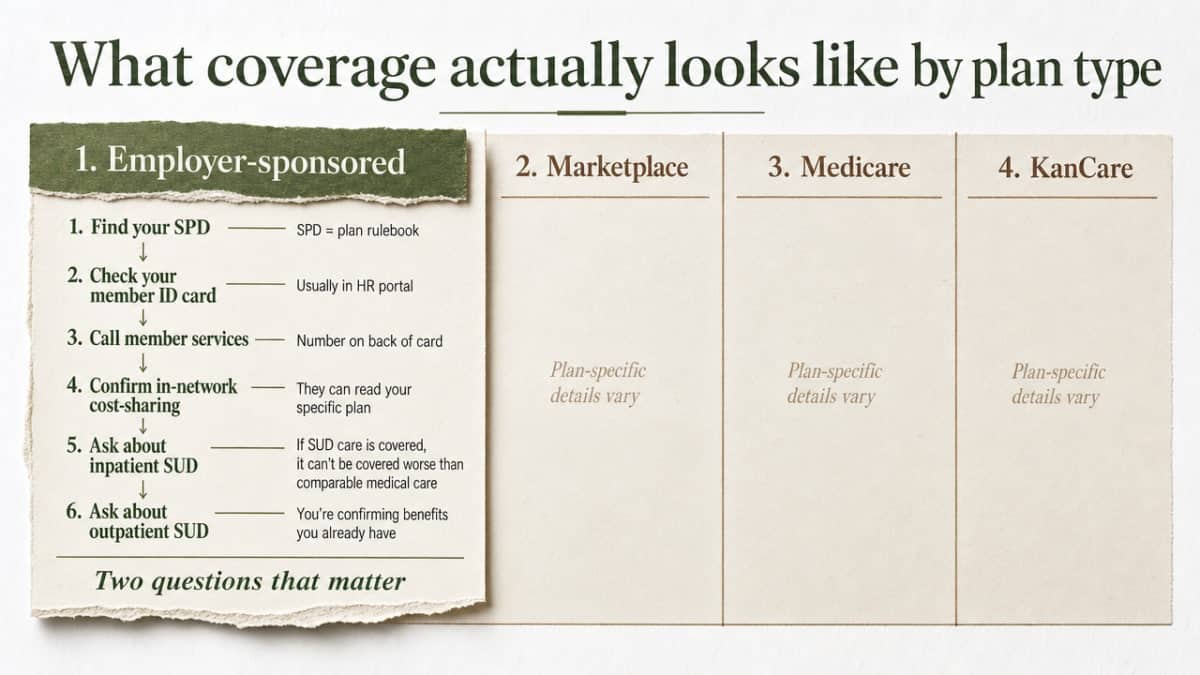
Employer-sponsored plans: the SPD, the member services line, and the two questions that matter
If you get insurance through your job or your spouse’s job, you have two documents worth more than any Google search: your Summary Plan Description (SPD) and your member ID card. The SPD is the plan’s rulebook. It’s usually buried in your HR portal under “benefits” or “plan documents.” The number on the back of your card connects you to member services, who can read your specific plan out loud.
Under MHPAEA, if your employer’s plan covers SUD care — and the large majority do — it has to cover that care no worse than a comparable medical procedure 1. So when you call, you’re not begging for a favor. You’re confirming benefits you already have.
Two questions cut through the noise: What’s my in-network cost-sharing for inpatient and outpatient SUD treatment? and What prior authorization does my plan require before treatment starts? Those two answers tell you almost everything you need to move forward.
ACA Marketplace plans purchased through Healthcare.gov
If you bought your plan on Healthcare.gov, or you work for a small Kansas business that offers coverage, your rehab benefits are stronger than you might think. Non-grandfathered individual and small-group plans have to cover mental health and substance use disorder services as one of the ten essential health benefits, and they have to do it in line with parity rules 8.
What that means for your bronze, silver, or gold plan: SUD treatment isn’t optional. Detox, counseling, medication for addiction, outpatient programs, and inpatient care all sit inside the benefits your premium already pays for. Your real variables are the metal tier’s deductible and coinsurance percentage, and whether the facility you want sits inside your plan’s network. Ask member services for a written list of in-network SUD providers before you commit to anywhere.
KanCare (Kansas Medicaid): all ASAM levels of care, including residential
If you or your family member is on KanCare, here’s the part most Kansas rehab articles skip entirely: Kansas Medicaid covers a full continuum of addiction treatment, not just outpatient counseling. Under the state’s Section 1115 SUD demonstration, KanCare finances every critical ASAM level of care for substance use disorder and opioid use disorder, including outpatient services, intensive outpatient, partial hospitalization, residential treatment in state-certified facilities, and withdrawal management 3. Medication for addiction treatment is covered too — buprenorphine products, naloxone, and, since 2020, methadone through opioid treatment programs 4.
KanCare also has to comply with federal parity, so the coverage rules can’t be more restrictive than the plan’s medical and surgical benefits 2. You’ll go through your assigned managed care organization for authorization, and services are delivered by providers listed in the Kansas Medical Assistance Program SUD Services Provider Manual 12.
One honest note: not every Kansas facility accepts KanCare. If a specific center says they can’t take your Medicaid coverage, that’s a network limitation at that facility — not a limit on what Medicaid pays for. Ask your MCO for a list of in-network SUD providers by ASAM level.
Medicare and dual-eligible coverage: narrower but not zero
If you’re on Medicare, your SUD benefits are real but narrower than commercial or Medicaid coverage. Part A generally covers inpatient hospital-based detox and treatment. Part B covers outpatient counseling, medication management, and structured outpatient programs. Part D covers most addiction medications.
What’s missing is the wide bench of freestanding residential rehab options that commercial plans and KanCare will pay for. If you’re dually eligible — Medicare plus KanCare — your Medicaid coverage typically fills gaps Medicare leaves, including access to residential care 3. Call your plan and ask specifically what levels of SUD care are covered and which providers accept your coverage before you make travel plans or hold a bed.
Where the real money hides: deductibles, coinsurance, and the out-of-pocket max
Coverage isn’t the same as free. Even a strong plan that fully covers rehab as a benefit will still route your bill through three numbers that decide what you actually pay: your deductible, your coinsurance, and your out-of-pocket maximum.
- Deductible
- Your deductible is what you pay before your plan starts sharing costs. If your family deductible is $3,000 and you haven’t used much healthcare this year, that money comes off the top. If your spouse had surgery in March and the deductible is already met, you may walk into treatment with it behind you.
- Coinsurance
- Your coinsurance is the percentage you owe after the deductible — often 10% to 30% of the negotiated in-network rate. On a 30-day residential stay, that percentage matters more than any brochure.
- Out-of-pocket maximum
- Your out-of-pocket maximum is the ceiling. Once you hit it, your plan pays 100% of covered in-network care for the rest of the plan year. This is the number that turns “I could lose everything” into a knowable, planned expense. Under parity, that ceiling can’t be stricter for SUD care than for medical care 1.
Write those three numbers down before you call anyone. They’re your real budget.
Three cost traps that catch Kansas families, and how to push back
Prior authorization denials before treatment even starts
Prior authorization is the gate your plan puts in front of treatment. Before your insurer agrees to pay for residential rehab or an intensive outpatient program, a utilization reviewer at the plan reads your clinical documentation and decides whether the level of care is “medically necessary.” Sometimes that gate opens fast. Sometimes it doesn’t.
Here’s the pushback lever most families don’t know they have: under parity, your plan’s prior authorization rules for SUD care can’t be more restrictive than the rules it uses for comparable medical or surgical care 1. If your plan approves a knee replacement in 24 hours but takes eight days to review a residential SUD request — and can’t explain why — that’s a non-quantitative treatment limitation problem, and SAMHSA’s guidance says you can appeal it or file a complaint 10. Ask the reviewer, in writing, which clinical criteria they applied. Then ask for the same criteria used on the medical side.
Out-of-network balance billing when the ‘nearest’ facility isn’t in-network
Network status is where the cost math gets ugly. An in-network facility has agreed to your plan’s negotiated rates. An out-of-network facility has not — which means after your plan pays its portion, the facility can bill you for the balance. On a 30-day residential stay, that gap can be the difference between a manageable bill and a life-altering one.
Before you admit anywhere, ask your plan for a written list of in-network SUD providers at the level of care you need. If the plan tells you no in-network residential facility is available within a reasonable distance, that’s a network adequacy issue — and parity requires network standards for SUD care to be comparable to medical care 1. Get that answer in writing too. It’s the paper trail you’ll need if you have to appeal later.
Concurrent review and ‘medical necessity’ cuts to length of stay
Approval on day one doesn’t mean approval through day thirty. Most plans run what’s called concurrent review, checking in every few days to decide whether continued treatment is still medically necessary. This is the trap that surprises families most: you’re two weeks in, your loved one is finally opening up in therapy, and the plan calls to say it’s cutting the stay short.
You have more room to push back than the phone call suggests. Ask the clinical team at the facility to submit an updated medical necessity letter tied to specific ASAM criteria. Ask the plan for the exact clinical reason for the denial in writing. If the standards being applied to your SUD stay are tighter than those used for medical inpatient care, that’s a parity issue you can appeal 1, 10. Peer-to-peer review — your doctor talking directly to the plan’s reviewer — is often the fastest path to reversal.
More treatment providers take insurance than you think
One of the quiet myths that keeps families stuck is the belief that “no good rehab takes my insurance.” The data tells a different story. A federal ASPE analysis of SUD treatment facilities across the United States found that between 2013 and 2016 — the window right after the ACA’s coverage expansions — the share of facilities accepting private insurance rose from 66% to 70%, and the share accepting Medicaid rose from 60% to 63% 5. That study looked at facilities nationwide, not just Kansas, and it captured a specific post-ACA period, so treat it as a trend indicator rather than a current Kansas facility count.
The point isn’t the exact percentage. The point is direction: more programs, not fewer, are working with insurance plans now than a decade ago. If the first facility you call can’t take your coverage, that’s a reason to keep calling, not a reason to assume the whole system is closed to you. Ask your plan for its in-network SUD provider list at the level of care you need, and work down it.
The 10-minute benefits verification call: exactly what to ask
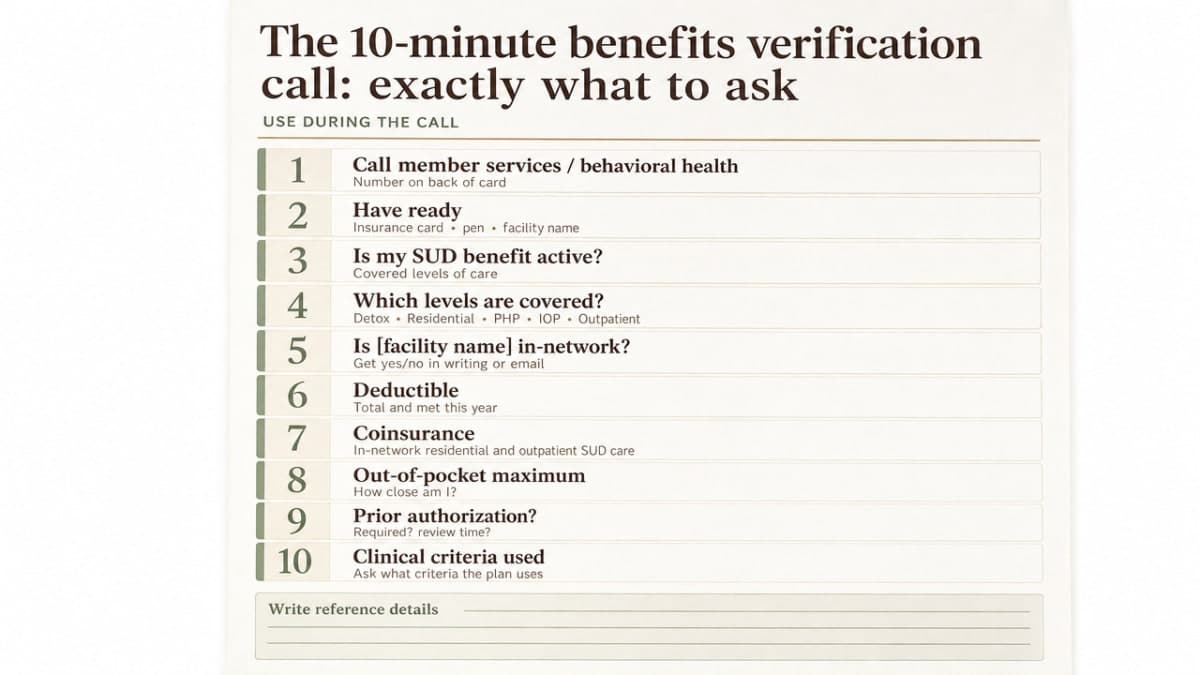
You can get most of what you need in one phone call. The number is on the back of your insurance card, under “member services” or “behavioral health.” Have your card, a pen, and the name of the facility you’re considering ready. Then work this list:
- Is my SUD benefit active, and what levels of care are covered? Ask specifically about detox, residential, partial hospitalization (PHP), intensive outpatient (IOP), and standard outpatient.
- Is [facility name] in-network for my plan? Get a yes or no, and ask for it in writing or by email.
- What’s my deductible, and how much of it have I met this year?
- What’s my coinsurance for in-network residential and outpatient SUD care?
- What’s my out-of-pocket maximum, and how close am I?
- Is prior authorization required, and how long does the review take? Ask what clinical criteria the plan uses.
- How often is concurrent review done during a residential stay? Every 3 days? Every 7?
- What’s the appeals process if a level of care is denied or cut short?
If you’re denied: appeals, complaints, and your rights under parity
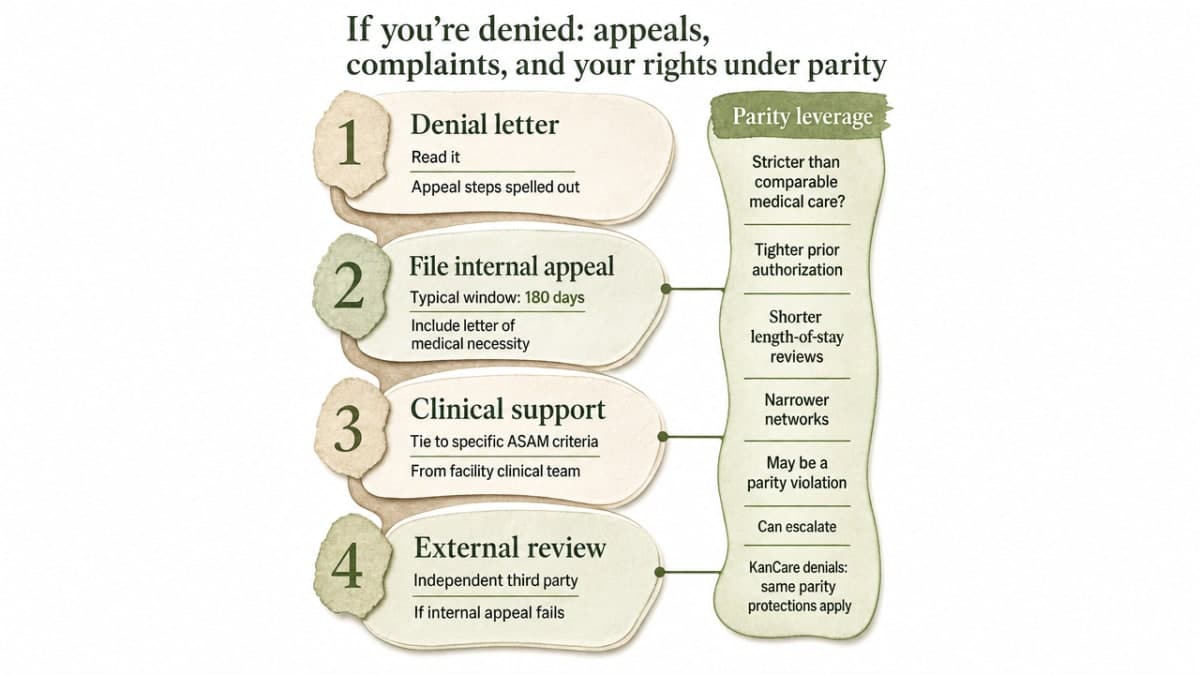
A denial isn’t the final word. It’s the start of a process, and the process is written in your favor more often than people realize.
Every plan has an internal appeals procedure, and every denial letter has to spell it out. Read it. You typically have a set window — often 180 days — to file. Ask the facility’s clinical team to write a letter of medical necessity tied to specific ASAM criteria, and include it with your appeal. If the internal appeal fails, most plans owe you an external review by an independent third party.
Parity is your leverage. If your plan’s SUD denial uses standards stricter than what it applies to comparable medical care — tighter prior authorization, shorter length-of-stay reviews, narrower networks — that may be a parity violation you can escalate 1, 10. For KanCare denials, the same parity protections apply, and complaints can go to your MCO and the state 2. Ask for every denial reason in writing. Paper wins these fights.
What if you have no insurance at all?
If you’re uninsured right now, treatment is still possible — the path just looks different. Kansas receives federal Substance Abuse Block Grant funding through KDADS, which supports licensed SUD providers in serving people who can’t pay privately 11. Ask any facility about sliding-scale fees, scholarship beds, and state-funded slots. Some accept payment plans. Others can help you enroll in KanCare on the spot if you qualify — Medicaid covers residential, outpatient, and medication for addiction treatment across every ASAM level 3. Don’t assume the door is closed until you’ve asked the specific question: What options do you have for someone without insurance today? The answer is almost never nothing.
You’ve already done the hard part by asking
Reading this far means you’ve done something a lot of people can’t bring themselves to do — you’ve looked at the money question honestly instead of letting it keep you frozen. That counts. It’s the move that opens every other door.
Here’s what to hold onto: your plan almost certainly covers something. Parity law, essential health benefits, and KanCare’s SUD coverage give you a real floor to stand on 1, 8, 3. The unknowns are your deductible, your network, and the paperwork — and one phone call answers most of them.
Make the call. Ask the eight questions. Write down the answers. If you’d rather have someone walk it through with you, verifying your insurance takes minutes, it’s free, and it’s confidential. You don’t have to figure this out alone tonight.
Speak with an admissions specialist right now
Get real answers about your insurance coverage and next steps for starting treatment today.
Frequently Asked Questions
Does my insurance have to cover rehab in Kansas?
How much will I actually pay out of pocket for rehab if I have insurance?
Your real cost depends on three numbers: your deductible, your coinsurance percentage, and your out-of-pocket maximum. Once you hit that maximum, your plan pays 100% of covered in-network care for the rest of the plan year. Ask member services for all three before you admit anywhere.
Does KanCare (Kansas Medicaid) cover residential rehab?
Yes. Under Kansas’s Section 1115 SUD demonstration, KanCare finances every critical ASAM level of care, including outpatient, intensive outpatient, partial hospitalization, residential treatment, withdrawal management, and medication for addiction treatment 3. Not every Kansas facility accepts KanCare, so ask your MCO for an in-network provider list.
What if my insurance denies coverage or cuts my stay short?
What questions should I ask when I call my insurance company?
Ask what SUD levels of care are covered, whether the facility is in-network, your deductible and how much is met, your coinsurance, your out-of-pocket maximum, whether prior authorization is required, how often concurrent review happens, and the appeals process. Write down names, dates, and reference numbers.
What if I don’t have insurance at all?
Treatment is still possible. Kansas receives federal Substance Abuse Block Grant funding through KDADS that supports licensed SUD providers 11. Ask facilities about sliding-scale fees, scholarship beds, and payment plans. Some can help you enroll in KanCare on the spot if you qualify 3.
References
- Mental Health and Substance Use Disorder Parity. https://www.dol.gov/agencies/ebsa/laws-and-regulations/laws/mental-health-and-substance-use-disorder-parity
- Parity. https://www.medicaid.gov/medicaid/benefits/behavioral-health-services/parity
- KanCare Section 1115 Demonstration Extension – SUD Components (Centers for Medicare & Medicaid Services). https://www.medicaid.gov/sites/default/files/2023-12/ks-kancare-extension-ca.pdf
- Kansas KanCare SUD Mid-Point Assessment. https://www.medicaid.gov/medicaid/section-1115-demonstrations/downloads/ks-kancare-sud-mid-pnt-asesmnt.pdf
- Examining Substance Use Disorder Treatment Demand and Provider Capacity in a Changing Health Care System. https://aspe.hhs.gov/reports/examining-substance-use-disorder-treatment-demand-provider-capacity-changing-health-care-system-1
- Mental Health Benefits (U.S. Department of Labor). https://www.dol.gov/general/topic/health-plans/mental
- Mental Health Parity and Addiction Equity Act (MHPAEA) – CMS Marketplace Guidance. https://www.cms.gov/marketplace/about/oversight/other-insurance-protections/mental-health-parity-and-addiction-equity-act-mhpaea
- Improving Health Coverage for Mental Health and Substance Use Disorder Patients. https://www.dol.gov/sites/dolgov/files/ebsa/laws-and-regulations/laws/mental-health-parity/improving-health-coverage-for-mental-health-and-substance-use-disorder-patients.pdf
- Requirements Related to the Mental Health Parity and Addiction Equity Act (Final Rules, 2024). https://www.cms.gov/files/document/mhpaea-final-rule-omnibus-clean-9424-final-posting508.pdf
- Know Your Rights: Parity for Mental Health and Substance Use Disorder Benefits. https://library.samhsa.gov/product/know-your-rights-parity-mental-health-and-substance-use-disorder-benefits/pep21-05-00-003
- Kansas Register: KDADS Substance Abuse Block Grant COVID-19 Mitigation Funding RFA. https://sos.ks.gov/publications/Register/Volume-41/Issues/Issue-02/01-13-22-49704.html
- KanCare SUD Implementation Plan (CMS Approval). https://www.medicaid.gov/Medicaid-CHIP-Program-Information/By-Topics/Waivers/1115/downloads/ks/KanCare/ks-kancare-cms-appvl-sud-implementation-plan-20190807.pdf