
Key Takeaways
- Kansas City-area treatment admissions span opioids, meth, alcohol, and marijuana, with overdose deaths on the Kansas side reaching 724 between 2020 and 2023 3.
- Missouri and Kansas law support voluntary admission and least-restrictive care, meaning a phone call to admissions is a legally backed starting point, not a favor 1, 10.
- Care runs on a ladder from medical detox through residential, PHP, IOP, and aftercare, with ASAM Criteria guiding where someone starts 6.
- Before committing, compare accreditation, staff-to-patient ratio, dual diagnosis capability on-site, physical address, and how insurance or Medicaid limits shape length of stay 5.
If You’re Reading This at 2 a.m., Start Here
If you’re up right now, phone in hand, trying to figure out whether tomorrow is the day you finally do something about the drinking or the pills or the powder — you’re not the first person in Kansas City to sit exactly where you’re sitting. And you’re not broken for taking this long to look.
Maybe you’re the one struggling. Maybe you’re a parent, a spouse, a sibling who’s been carrying a knot in your stomach for months. Either way, what you probably want from the internet at this hour is not a sales pitch. You want to know what actually happens when someone goes to residential rehab around here. How you get in. What the first few days feel like. Whether insurance will cover it. Whether the place is real.
That’s what this article is. A plain walk-through of what drug and alcohol rehab in the Kansas City area actually looks like — the phone call, the drive in, day one, week one — and where an accredited, nearby program like Sunflower Recovery in Osawatomie, Kansas fits into that picture.
You don’t have to have it figured out to keep reading. You just have to keep reading.
What’s Actually Driving People Into Treatment Around Kansas City
When you picture who ends up in a Kansas City rehab bed, the picture in your head is probably too narrow. It’s not just the person you saw nodding off on a downtown bench. It’s your co-worker who’s been quietly refilling the same prescription for three years. It’s the college student home for the summer who can’t stop vaping something they bought online. It’s the 55-year-old who started drinking a little more after the divorce and now can’t stop shaking in the morning.
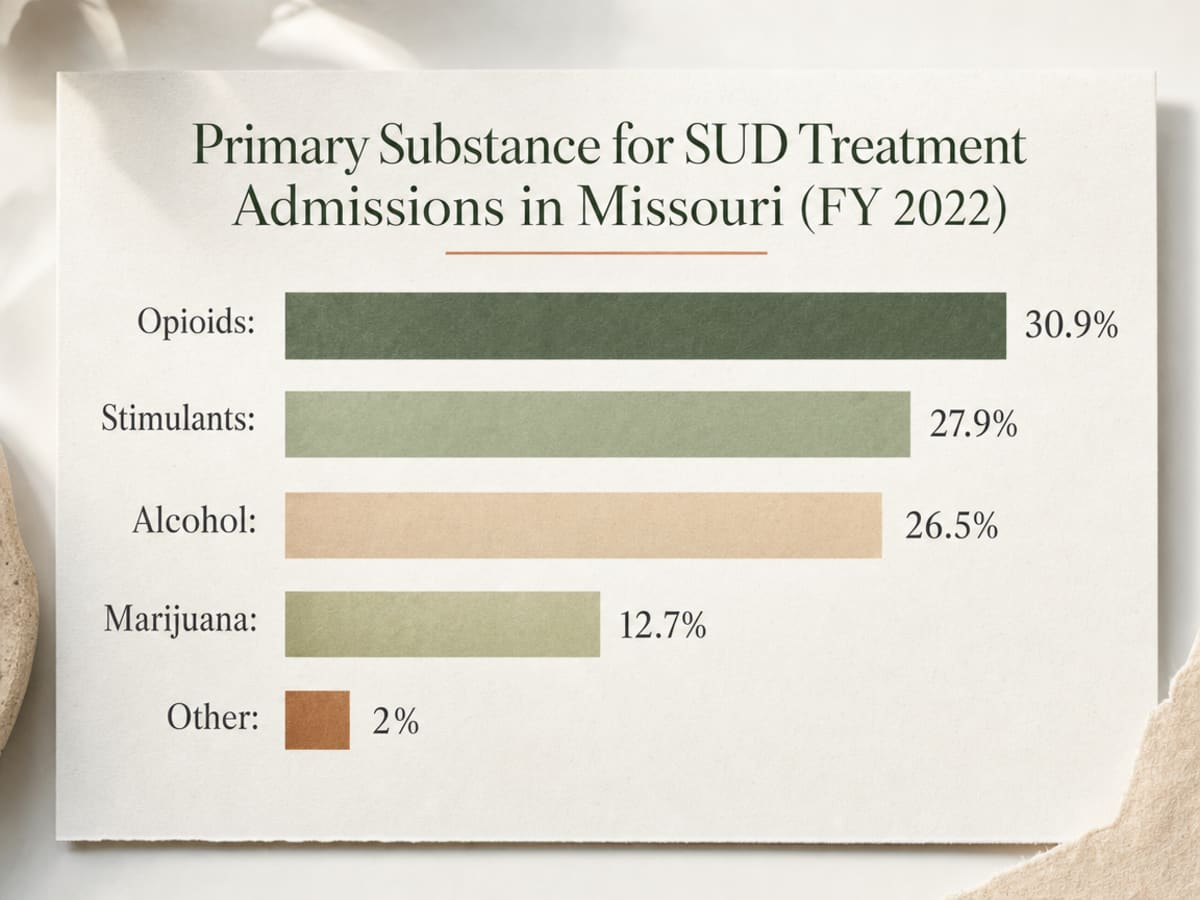
The state data backs that up. Nearly 38,000 Missouri residents were admitted to substance use disorder treatment through the Missouri Division of Behavioral Health in fiscal year 2022, and the reasons they walked in the door were surprisingly spread out:
- Opioids topped the list at 30.9% of admissions.
- Stimulants — mostly methamphetamine — were close behind at 27.9%.
- Alcohol accounted for 26.5%.
- Marijuana was 12.7%, and everything else combined made up the last 2.0% 2.
Kansas City sits right in the middle of that mix. Programs on both sides of the state line see the same rough pattern show up in their admissions week after week — pills, meth, alcohol, sometimes all three in the same person. That’s part of why any decent residential program has to be built for more than one kind of story. The 22-year-old detoxing off fentanyl and the 48-year-old detoxing off vodka are going to need different medical monitoring, different group topics, and different aftercare plans. But they’re both going to be there. Sometimes in the same room.
Whatever you’re using, whatever your family is using — you are not an unusual case. You’re a common one. And there are people in this metro who do this work every day.
The Overdose Reality on the Kansas Side of the Metro
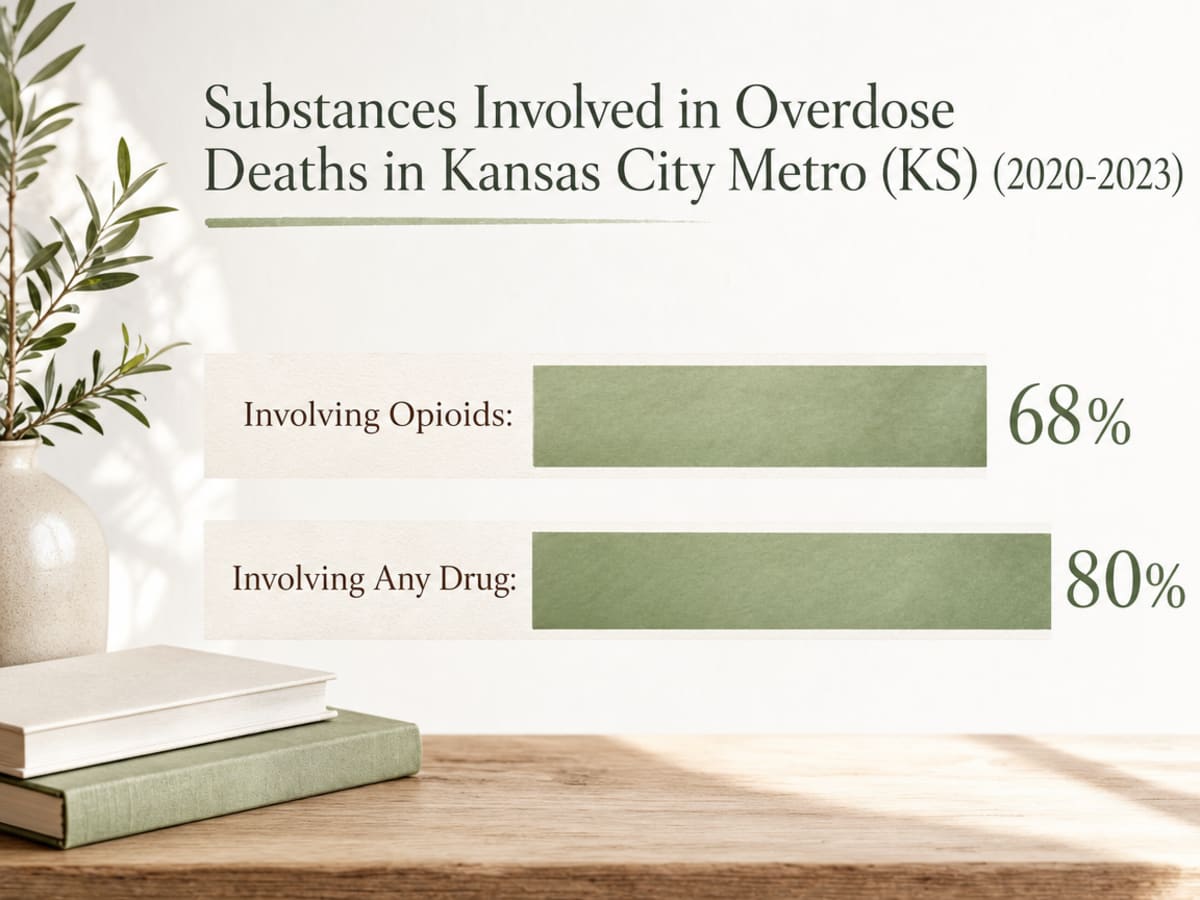
Cross the state line and the picture gets sharper. Between 2020 and 2023, the Kansas City Metro region on the Kansas side recorded 724 overdose deaths, an age-adjusted rate of 17.4 per 100,000. Sixty-eight percent of those deaths involved opioids. Eighty percent involved some kind of drug 3.
Read those numbers slowly. That’s not a distant national statistic. That’s Wyandotte County. That’s Johnson County. That’s people who drove the same highways you drive, shopped at the same grocery stores, dropped their kids off at the same schools.
What that data doesn’t show is the person who almost died last Tuesday and didn’t. The 3 a.m. Narcan save in a bathroom. The kid whose friends got scared and drove him to the ER. For every fatal overdose in that count, there are people still breathing this morning who are one bad night away from being the next entry.
The First Phone Call: What Admissions Actually Sounds Like
The scariest part of rehab isn’t rehab. It’s picking up the phone. You rehearse what you’re going to say. You hang up twice before it rings. You worry the person on the other end will be judgmental, or bored, or reading from a script.
Here’s what actually happens on a good admissions call. Someone answers — usually within a minute or two — and asks you a few basic questions:
- What are you using, and how much.
- When was the last time.
- Have you tried to stop before, and what happened when you did.
- Do you have any medical conditions.
- Do you have insurance, and if so, whose.
That’s most of it. They’re not testing you. They’re figuring out whether you need medical detox first, what level of care fits your situation, and whether their program is actually the right match. Sometimes the honest answer is that another program down the road is a better fit, and a decent admissions team will tell you that.
Missouri law actually leans into this. RSMo 631.050 says treatment should happen on a voluntary basis whenever possible, and that people should be placed in the least restrictive level of care that will still work 1. Kansas is similar — licensed facilities are required to admit and treat people struggling with alcohol and drugs 10. Translation: you are not begging for a favor. You are asking for something the system is legally set up to provide.
If you’re calling for someone else, you can do most of this without them on the line. Admissions staff can walk you through options, check benefits, and help you plan a conversation. If you’re the one using, and you’re scared to say the real numbers out loud — say them anyway. The person on the other end has heard worse this week. Probably today.
Detox, Then Residential: The Levels of Care in Plain English
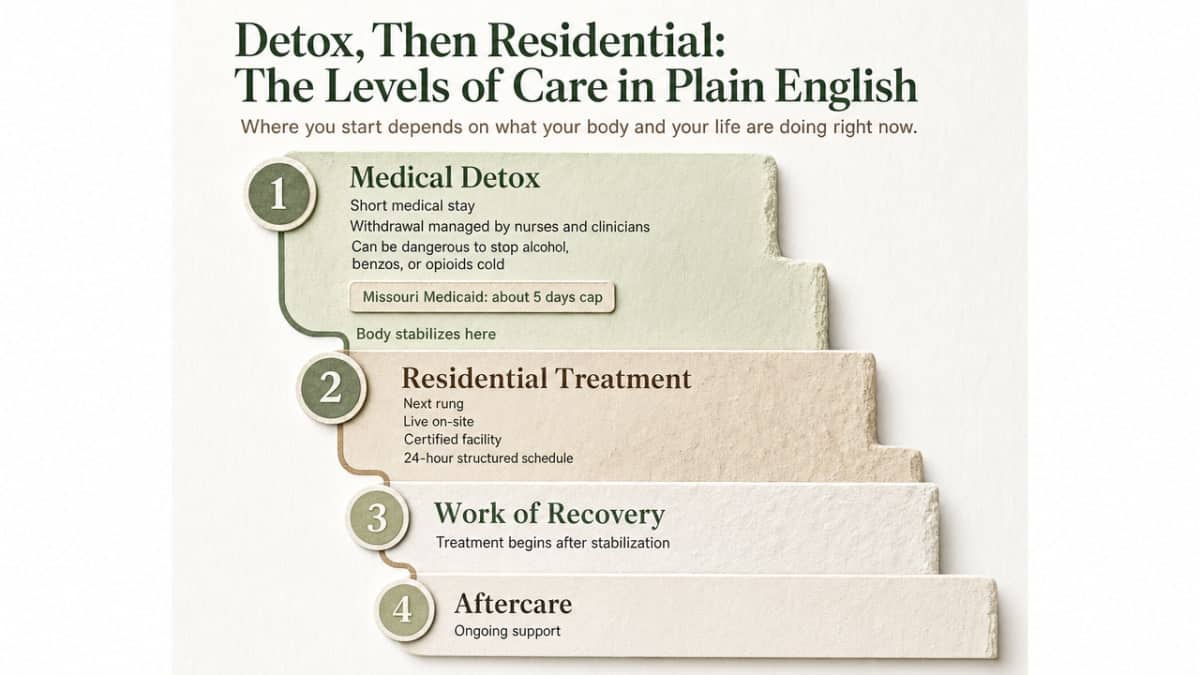
Rehab isn’t one thing. It’s a ladder, and where you get on the ladder depends on what your body and your life are doing right now.
At the bottom rung is medical detox. If you’ve been drinking heavily every day, or using benzos, or using opioids in real quantities, stopping cold can be dangerous — sometimes fatal with alcohol and benzos. Detox is a short medical stay where nurses and clinicians manage the withdrawal so you don’t have to white-knuckle it alone. In Missouri, Medicaid caps medically monitored withdrawal management at about five days 4. That’s not the whole treatment. That’s just getting your body stable enough to actually do the work.
The next rung is residential treatment. This is what most people picture when they hear “rehab.” You live on-site, in a certified facility, with a 24-hour structured schedule of therapy, groups, medical check-ins, and time to sleep and eat like a human again. Under Missouri’s Medicaid 1115 demonstration, residential stays are capped at 60 consecutive days, with the state aiming for a 30-day average length of stay 5. Commercial insurance plans vary — some cover longer, some shorter. A program like Sunflower runs a 60-day residential model on the commercial-insurance side.
Step down from there and you get partial hospitalization (PHP) — most of the day at the treatment center, evenings at home or in sober living — and then intensive outpatient (IOP), which is a few sessions a week around a job or family life. At the top rung is regular outpatient and aftercare: a therapist, a support group, maybe medication.
How does anyone decide which rung you start on? Most Kansas City programs use the ASAM Criteria — a national assessment framework that looks at six dimensions of your situation:
- Withdrawal risk
- Other medical issues
- Emotional and mental health
- How ready you are for change
- Relapse risk
- What your home environment is like 6
It’s not a script. Someone with a supportive spouse and a mild alcohol problem might do fine in IOP. Someone using fentanyl daily with a history of trauma and nowhere safe to sleep needs residential, full stop.
Missouri law also nudges the system toward the least restrictive level of care that will actually work, and toward a coordinated continuum so you can step down without falling off 1. Translation: you’re not signing up for one rigid track. You’re getting on a ladder, and the goal is to keep climbing down it, gently, until you’re standing on solid ground.
The Drive In, Day One, Night One
The morning you check in usually starts earlier than you want it to. You didn’t sleep. You’ve packed and unpacked the same bag twice. Someone is probably driving you — a parent, a partner, a friend who’s been quietly worried for a long time. The car is quieter than usual. That’s normal.
The drive from most parts of the Kansas City metro to a residential program like Sunflower in Osawatomie is under an hour. Just long enough to think too much. If you can, don’t try to talk yourself out of it in the car. You already made the decision on the phone. This ride is just the part where your body catches up with what your head already agreed to.
When you arrive, day one is mostly paperwork, a medical intake, a bag check, and meeting the people who’ll be around you for the next stretch. A nurse will ask about your last use — the real answer, not the polished one. A clinician will start building your individualized rehabilitation plan, which Missouri law actually requires programs to create for each person rather than running everyone through the same script 1. You’ll get shown where you sleep, where you eat, where the bathroom is. Small things. They matter more than you’d think.
Night one is the hard one. The lights are unfamiliar. Your body is starting to notice what you didn’t give it. If you’re detoxing, someone is checking on you through the night. You are not being watched because you’re in trouble. You’re being watched because you’re worth watching over. Try to sleep. If you can’t, that’s okay too. You made it here. That was the hard part.
What the First Week Actually Looks Like
By day two or three, your body starts to remember what a normal morning feels like. You wake up in the same bed you fell asleep in. Someone knocks on the door. Breakfast is real food, on a real plate, at a real time. That sounds small. It isn’t.
The rhythm of the week is more structured than you’d guess and less rigid than you’d fear. Mornings usually start with a check-in — how did you sleep, how are you feeling, are you having cravings, are your withdrawal symptoms easing. Then a group session, where five or eight or ten other people are working through some version of the same thing you are. Some of them will remind you of your uncle. One will remind you of yourself at nineteen. You don’t have to talk the first day. Most people don’t.
Afternoons tend to hold your one-on-one time with a therapist and whatever your individualized plan calls for — trauma work, family sessions, medication reviews, sometimes fitness or movement. Missouri statute requires programs to build these plans around you specifically, not around a template 1. If a program is doing it right, your Wednesday afternoon isn’t a copy of the person’s next door.
Evenings soften. There’s downtime. Journaling, phone calls home during set hours, a group activity, or just sitting outside. The first week is not about breakthroughs. It’s about your nervous system learning that it’s safe to exhale. If you make it to day seven still there, still trying — that counts. That’s the win of the week.
Trauma, Depression, and the Case for Dual Diagnosis Care
For a lot of people who end up in a Kansas City rehab bed, the drinking or the pills weren’t the first thing to go wrong. Something else came first — a childhood you don’t talk about, a loss you never really put down, a depression that started before you had a word for it, an eating disorder that’s been running in the background since high school. The substance came later. It was the thing that finally worked when nothing else did.
That’s the piece a lot of programs miss. If you treat only the drinking, and leave the trauma or the depression sitting there untouched, you’re asking someone to give up the one tool that was keeping them functional and then handing them nothing to replace it with. It’s not a mystery why that ends the way it usually ends.
Dual diagnosis care means the therapy work in the building is actually built for both things at once. The same clinical team that helps you get through withdrawal is also helping you look at what you’ve been drinking around. The trauma work isn’t a bonus workshop on Thursday afternoon. It’s the point.
This matters practically when you’re choosing a program. Ask directly: do you treat co-occurring mental health conditions on site, or do you refer that out? A trauma-informed answer sounds like a specific plan. A vague answer sounds like a brochure.
How to Tell a Legitimate Program from a Marketing Front
If you’ve been Googling for more than ten minutes, you’ve probably noticed something weird. A lot of the top results are call centers, not treatment centers. They collect your information, quote you a facility somewhere, and disappear. That industry exists. It’s frustrating, and it’s a big part of why you’re second-guessing yourself right now.
A real program has real credentials you can check in about five minutes. In Missouri, all residential mental health and substance use treatment is regulated, and the Department of Mental Health requires certification of residential treatment programs 9. Ask for the program’s certification status. Ask if they’re accredited by a nationally recognized body like CARF or the Joint Commission — Missouri’s Medicaid 1115 demonstration actually requires that kind of accreditation for residential providers treating certain populations, and reputable commercial-pay programs typically hold it too 5. If the person on the phone gets vague, that’s your answer.
A few other things worth asking, plainly:
- Where is the actual facility located — the physical address, not a P.O. box?
- Who is the medical director, and are they licensed in Kansas or Missouri?
- What is the clinical staff-to-patient ratio?
- Do you treat co-occurring mental health conditions on-site, or do you refer that out?
- Can I tour the campus, or speak to someone who’s completed the program?
Trust the answers that get specific. Be careful of the ones that pivot to how quickly they can “get you a bed” without asking a single question about your medical history. Urgency is a real thing in this work. But a program that treats you like a lead instead of a person on day one will treat you that way on day thirty.
Paying for It: Insurance, Medicaid Limits, and Honest Constraints
Money is the question everyone is scared to ask first and ends up asking anyway. Here’s the honest version.
Most residential programs in the Kansas City area fall into one of two lanes. Some accept Medicaid, and they operate under Missouri’s rules — stays capped at 60 consecutive days, a state goal of a 30-day average length of stay, and residential providers required to hold accreditation from a nationally recognized body 5. Medically monitored withdrawal management under Medicaid is limited to about five days, and room and board isn’t always covered the way people assume it is 4. Those rules aren’t there to punish anyone. They’re there because someone has to draw a line, and the state drew it there.
Other programs, Sunflower included, work with commercial insurance and don’t participate in Medicare or Medicaid. If you have a plan through your job, a spouse’s job, the marketplace, or a private policy, that’s the lane to check. A verification call takes about fifteen minutes. You give them your member ID, and someone reads your benefits back to you in plain language — what’s covered, what your out-of-pocket looks like, how many days are authorized to start.
If you don’t have commercial coverage, say so early. A good admissions team will point you toward a program that can actually take you rather than run you in circles.
Where Sunflower Recovery Fits — a Short Drive from Kansas City
Sunflower Recovery Center sits about 50 miles south of downtown Kansas City, in Osawatomie, Kansas. Close enough that your family can drive down for a visit. Far enough that you’re not detoxing in the same zip code as the liquor store you know by heart.
A few specifics worth knowing up front. Sunflower is an accredited residential program that runs at a 1:1 clinical staff-to-patient ratio, which is unusual — most programs are staffed at much higher ratios. That matters when you’re doing trauma work, because the person walking you through it actually has the time to walk you through it. The 60-day residential model gives your nervous system, your body, and your relationships a real runway to change, rather than a rushed two-week reset.
The care model is trauma-informed and built for dual diagnosis — addiction alongside depression, anxiety, PTSD, eating disorders, or the tangle of all of the above. Programming includes individual therapy, group work, family sessions, fitness, and a step-down continuum into PHP and IOP so you’re not dropped off a cliff on day 60 1.
The Next Step
You don’t have to be sure. You don’t have to have your bag packed. You just have to make one call and let someone else help you figure out what’s actually possible from where you’re standing tonight.
If you’re in the Kansas City area and you want to talk to a real person about residential treatment — what your insurance covers, whether Sunflower’s 60-day program fits your situation, or just what a first week would look like — call (866) 489-8799 or verify your insurance online to reach Sunflower’s admissions team today.
Start Your Recovery Journey With One Call
Connect directly with an admissions expert who understands what you’re facing and can guide you step by step.
Frequently Asked Questions
How long does residential rehab usually last?
It depends on your situation and your coverage. Commercial insurance plans vary a lot — some authorize 30 days to start, some cover longer stays like Sunflower’s 60-day model. Missouri Medicaid caps residential at 60 consecutive days with a 30-day average length-of-stay goal 5. What matters more than the number is whether the program builds a step-down plan into PHP or IOP so you’re not dropped off a cliff.
Do I need to detox before I go to residential treatment?
Sometimes yes, sometimes no. If you’ve been drinking heavily every day, using benzos, or using opioids in real quantities, you likely need medical detox first — withdrawal from alcohol and benzos can be dangerous. Under Missouri Medicaid, medically monitored withdrawal management is limited to about five days 4. The admissions team will ask about your last use on the phone and route you accordingly. Don’t guess. Tell them the truth.
Will my insurance cover rehab in the Kansas City area?
Most commercial plans cover some form of residential treatment, but the details vary — deductible, days authorized, in-network status. A verification call takes about fifteen minutes. You give your member ID, and someone reads your benefits back in plain language. Sunflower works with most commercial insurance and does not participate in Medicare or Medicaid. If that’s your coverage, admissions will point you toward a program that can take you.
What should I pack for a residential rehab stay?
Less than you think. Comfortable clothes for a couple of weeks, basic toiletries (usually alcohol-free), any prescription medications in their original bottles, a photo or two, a journal if you write. Skip anything with drawstrings, mouthwash with alcohol, or valuables you’d hate to lose. The admissions team sends a specific packing list before you arrive. Don’t overthink it — if you forget something, family can bring it during visitation.
Can I go to rehab voluntarily, or does someone have to force me?
Voluntary is the norm and the preference. Missouri law is explicit: treatment should happen on a voluntary basis whenever possible 1. Kansas licensed facilities are required to admit and treat people struggling with substances 10. You do not need a court order, a doctor’s referral, or a family intervention to walk in the door. You just need to make the call. Wanting to try is enough to start.
What happens after residential treatment ends?
Residential is one rung on a ladder, not the finish line. Missouri statute actually requires programs to build a continuum of coordinated services so you can step down without falling off 1. That usually means partial hospitalization (PHP), then intensive outpatient (IOP), then regular outpatient with a therapist and a support group. Discharge planning starts early in your stay — housing, work, family, medications, and who you call at 2 a.m.
References
- RSMo Section 631.050 – Facilities and programs standards for alcohol and drug abuse treatment. https://revisor.mo.gov/main/OneSection.aspx?section=631.050&bid=30895
- Annual Status Report on Missouri’s Substance Use and Mental Health – Section A (FY 2022). https://dmh.mo.gov/sites/dmh/files/media/pdf/2024/01/sr2023-section-a_1.pdf
- Drug Overdose Deaths in Kansas 2020–2023 Quick Facts (SUDORS Data by PHEP Regions). https://www.kdhe.ks.gov/DocumentCenter/View/43963/SUDORS-Data-By-PHEP-Regions
- Comprehensive Substance Treatment and Rehabilitation Manual (Missouri DSS, 2023). https://mydss.mo.gov/sites/mydss/files/media/pdf/2023/08/Comprehensive%20Substance%20Treatment%20and%20Rehabilitation%2008%2014%202023.pdf
- Missouri Substance Use Disorder & Serious Mental Illness Section 1115 Demonstration (CMS Approval). https://www.medicaid.gov/sites/default/files/2023-12/mo-sud-smi-demo-ca.pdf
- ASAM Criteria – Medicaid Innovation Accelerator Program Resource Guide. https://www.medicaid.gov/state-resource-center/innovation-accelerator-program/iap-downloads/reducing-substance-use-disorders/asam-resource-guide.pdf
- Drug Overdose Dashboard – Fatal Overdoses. https://health.mo.gov/data-dashboards-tools/fatal-drug-overdose-dashboard
- Data & Surveillance Systems | Missouri Department of Health and Senior Services. https://health.mo.gov/data-dashboards-tools/data-surveillance-systems
- Missouri Summary — State Residential Treatment for Mental Health and Substance Use Disorder. https://aspe.hhs.gov/sites/default/files/2021-08/StateBHCond-Missouri.pdf
- 76-12a31. https://ksrevisor.gov/statutes/chapters/ch76/076_012a_0031.html