
Key Takeaways
- Integrated care treats substance use and mental health conditions concurrently through one team sharing records, sessions, and a unified plan, unlike sequential or parallel models that leave dangerous coordination gaps.
- Only about 7% of people with co-occurring disorders actually receive integrated care 13, so a ‘dual diagnosis’ label alone does not guarantee the coordinated treatment evidence supports.
- Trauma frequently underlies both conditions, and TIP 57 confirms trauma work should not be delayed until sobriety is achieved but woven into a single care plan from intake 6.
- When vetting a program, ask who shares the chart, how trauma enters the plan, what happens during a crisis, and how care continues across residential, PHP, IOP, and aftercare.
Why the Old Treatment Path Kept Failing You
You’ve likely experienced a cycle of detox followed by rehab, perhaps a 30-day program that initially offered hope. However, the return of depression, panic, or insomnia often led to relapse within months. This isn’t a personal failing, but rather a flaw in the treatment approach.
Historically, the standard was to address addiction first, deferring mental health issues. You might have been told your depression was merely withdrawal or that anxiety would subside with sobriety. This approach, known as sequential care, treats conditions separately, leaving individuals to manage half their recovery alone.
Research consistently shows that when substance use and mental health conditions coexist, treating them concurrently, by the same team, in the same setting, yields superior results 4, 8. This is because these conditions are deeply intertwined; addressing one without the other often undermines the entire recovery process.
This article will explore what integrated care truly entails, the evidence supporting its effectiveness, and how to distinguish it from less effective models.
What Integrated Care Actually Means (And What It Isn’t)
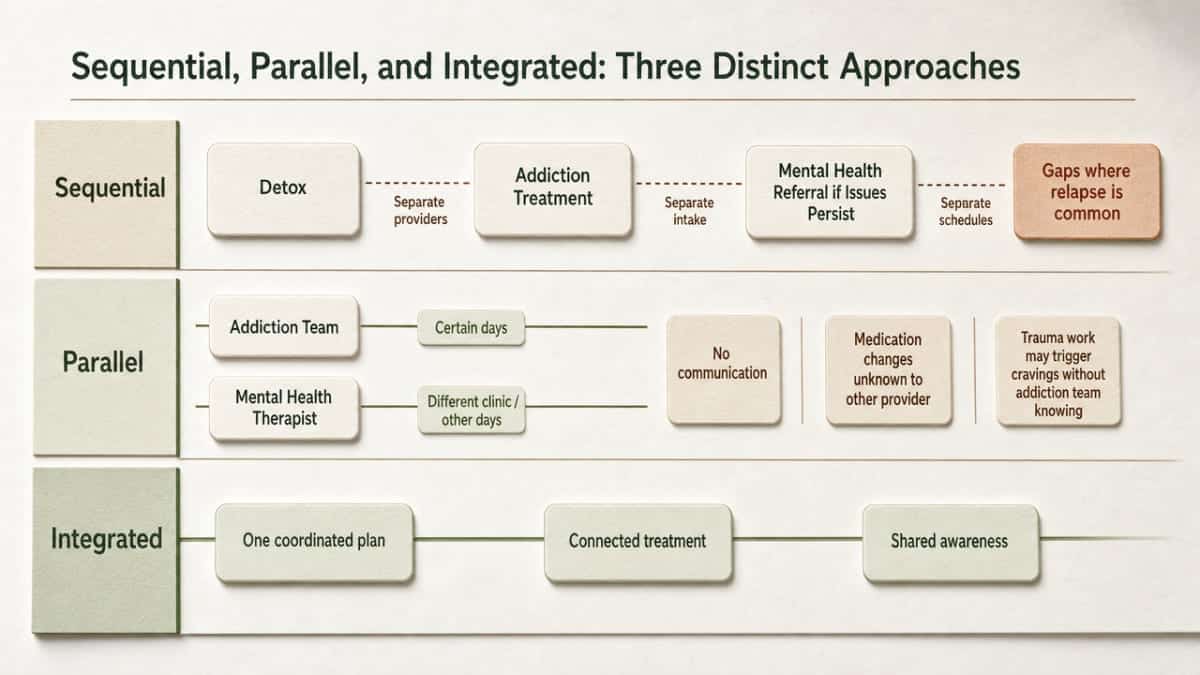
Sequential, Parallel, and Integrated: Three Distinct Approaches
Programs may claim to treat “co-occurring disorders” but offer vastly different experiences. Understanding the distinctions is crucial.
- Sequential care
- A linear process: one treatment concludes before another begins. For example, detox, then addiction treatment, with mental health referrals only if issues persist. This often involves separate providers, intake processes, and schedules, creating gaps where relapse is common.
- Parallel care
- Involves simultaneous but uncoordinated treatment. You might see an addiction team on certain days and a mental health therapist at a different clinic on others. Both teams are working, but without communication. This lack of coordination can lead to issues, such as medication adjustments by one provider being unknown to the other, or trauma work triggering cravings without the addiction team having context.
- Integrated care
- As defined by SAMHSA, combines interventions for both disorders “in the same session or series of sessions,” delivered by a unified team that shares records, treatment plans, and a physical space 4. In this model, your therapist is aware of your psychiatrist’s prescriptions, and your group counselor knows about upcoming trauma anniversaries. When you discuss a craving, the accompanying flashback is addressed within the same conversation.
The key difference lies in the real-time communication and shared understanding among your treatment providers.
The Access Gap Almost Nobody Talks About
Despite being the preferred model, integrated care is not widely available. A 2021 study revealed that only about 7% of individuals with co-occurring disorders receive integrated care 13. This study focused on adults in the U.S. treatment system with diagnosed substance use and mental health conditions, examining how many received combined treatment versus separate care. This low percentage means that the responsibility of finding integrated care often falls on the individual or their family.
Assuming every program labeled “dual diagnosis” adheres to SAMHSA’s integrated model can lead to enrollment in programs that are, at best, parallel, and often sequential. If past treatment failed because it addressed only one condition, you were likely among the 93% who didn’t receive integrated care. Recognizing this empowers you to ask more informed questions during future intake calls.

What the Evidence Actually Says
The Outcomes Integrated Care Is Associated With
SAMHSA’s guidance highlights that integrated screening and treatment for co-occurring disorders yield a broad range of positive outcomes beyond just sustained sobriety. These include reduced substance use, improved psychiatric symptoms, decreased hospitalization, fewer arrests, and greater housing stability 3. Housing stability, in particular, is critical, as relapse often jeopardizes living situations, employment, or custody arrangements, demonstrating that recovery encompasses overall life stability.
Considering these outcomes in the context of personal history reveals their significance: fewer emergency room visits during panic attacks, reduced legal issues stemming from impaired judgment, and improved mental health that supports consistent sobriety and stable living conditions.
The Surgeon General’s report on health care systems and substance use similarly concludes that coordinating primary care, mental health, and substance use services leads to better outcomes than treating each in isolation 11. This holistic approach underscores that “whole person” care is not just a slogan but a description of the tangible benefits of coordinated treatment.
While integrated care is not a guaranteed cure, it consistently offers the most robust support for achieving the kind of stability essential for lasting recovery.
Where the Research Is Strong, and Where It’s Still Mixed
It’s important to understand the evidence transparently. NIDA’s research synthesis indicates that integrated treatment for co-occurring substance use and mental illness is “consistently superior compared with separate treatment of each diagnosis” 8. This is particularly evident for conditions like depression, anxiety, and PTSD when paired with substance use disorders. Therapies such as CBT-based interventions and trauma-focused approaches like Seeking Safety, when delivered within an integrated program, outperform the same therapies offered in separate clinics 8. SAMHSA’s review corroborates this, finding that integrated programs generally lead to better outcomes for psychiatric symptoms and substance use 1.
However, a 2019 review noted that some systematic reviews show no significant difference between integrated interventions and usual care for certain outcomes 9. The authors pointed to methodological challenges, including small sample sizes, high dropout rates, and inconsistent definitions of “integrated” across studies. The evidence base is stronger for some conditions and populations than others.
Despite these nuances, integrated care remains the model most consistently linked to improved outcomes and is recommended by major federal guidelines 5, 2. It offers the most evidence-supported opportunity for achieving the stability described by the aforementioned outcomes, though it is not a panacea.
Trauma as the Connective Tissue
Why Trauma Screening Rewrites the Whole Plan
Treating substance use without addressing trauma is an incomplete approach. Trauma is often a central, rather than secondary, factor in dual diagnosis. SAMHSA emphasizes that trauma exposure increases the risk for both substance use and mental health disorders, and individuals with serious mental illness and trauma histories frequently present with co-occurring substance use 7. The conditions you experience may share a common traumatic root that has not been explored.
A trauma-informed program also prioritizes preventing retraumatization. TIP 42 describes this as creating an environment responsive to individuals with trauma histories, focusing on building resilience and avoiding harm 5. This manifests in practical ways, such as how staff communicate, the flexibility to leave a group without judgment, and clear explanations of processes. These elements are foundational to effective clinical work.
Therapies That Treat Trauma and Substance Use in the Same Room
Integrating trauma into the treatment plan also changes the therapeutic approaches. The outdated method of stabilizing addiction before addressing trauma, often months later, is ineffective because trauma memories and cravings are interconnected and don’t adhere to a schedule. A trauma trigger on one day can quickly lead to a relapse in substance use due to this intrinsic link.
NIDA’s review highlights interventions specifically designed for this overlap. Seeking Safety, a present-focused therapy, concurrently treats trauma-related symptoms and substance use within the same sessions 8. Similarly, CBT-based interventions adapted for co-occurring PTSD and substance use disorder demonstrate superior outcomes when delivered together compared to separate clinics 8.
Practically, this means participating in a group where the connection between trauma and substance use is a given. If a craving arises after a difficult family call, the clinician addresses both the craving and the underlying family dynamics as part of a single conversation, rather than compartmentalizing them. The clinical literature emphasizes the need for integrated clinicians to possess competencies in motivational enhancement, relapse prevention, CBT, and medication coordination for both conditions 12. This ensures that one clinician, or a cohesive team, can manage both aspects of care without fragmentation.
This is the essence of trauma-informed dual diagnosis care: a unified approach within the same setting, with the same team, and a single comprehensive plan.
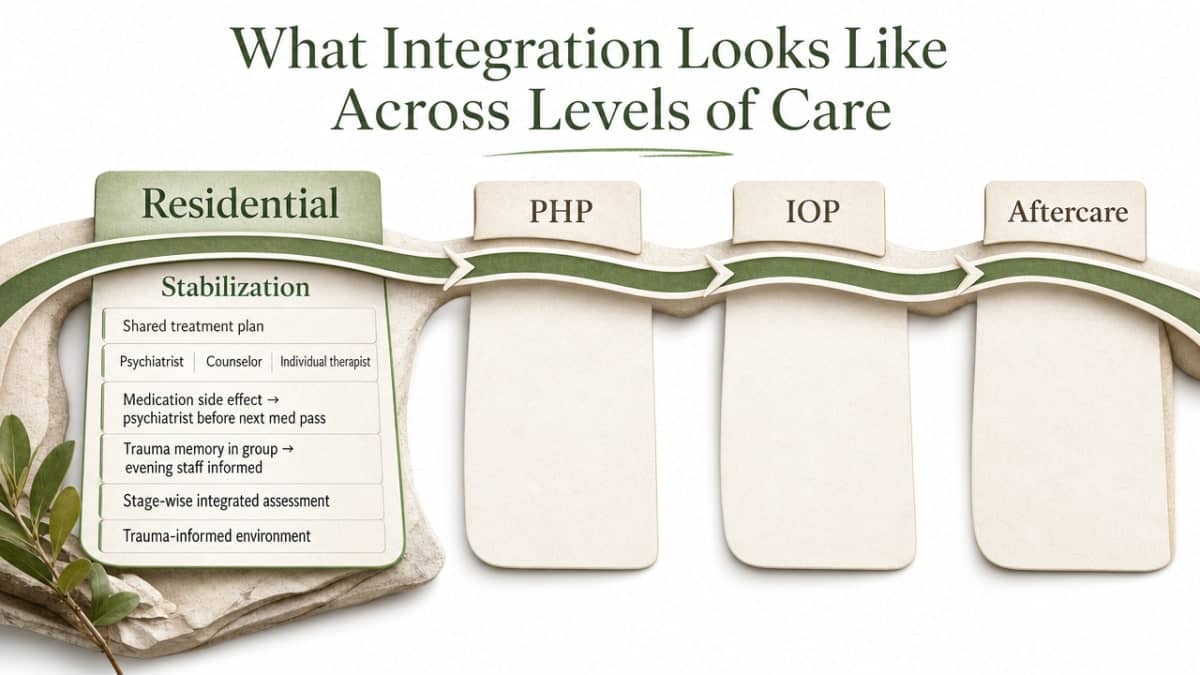
What Integration Looks Like Across Levels of Care
Residential: Stabilization Without Splitting You in Two
Residential treatment is often where individuals arrive feeling overwhelmed, with mental health symptoms surfacing after detox. At this critical stage, integrated care is paramount because individuals lack the capacity to coordinate their own treatment.
In an integrated residential program, the psychiatrist managing medication, the counselor leading group therapy, and the individual therapist all operate from a shared treatment plan 5. If you report a medication side effect to your therapist, that information is communicated to the psychiatrist before the next medication pass. If a trauma memory emerges in a group, the evening staff are informed to provide appropriate support.
TIP 42 describes this as stage-wise, integrated assessment within a trauma-informed treatment environment 5. From the patient’s perspective, this means a seamless experience where addiction and mental health conditions are addressed cohesively, with all providers communicating regularly.
PHP and IOP: Where Real Life Meets the Treatment Plan
Partial Hospitalization Programs (PHP) and Intensive Outpatient Programs (IOP) mark a transition towards greater independence. While still structured, you begin to reintegrate into daily life, facing stressors like work, relationships, and personal responsibilities that previously fueled substance use.
This is where sequential and parallel programs often falter. If your PHP focuses solely on addiction and your mental health provider is separate, gaps quickly appear. A depressive episode over the weekend might go unnoticed by your group counselor, or a medication change might not be incorporated into your treatment plan. Integrated PHP and IOP maintain a cohesive plan as external stressors increase. The same team, or one operating under the same integrated model, adjusts your care as new challenges arise. TIP 42 emphasizes the importance of coordination across residential, PHP, IOP, and community levels for long-term success, not just initial stabilization 5.
The clinical literature also highlights the value of an integrated clinician capable of managing motivational enhancement, relapse prevention, and medication coordination for both conditions within a single therapeutic relationship 12. This reduces the number of handoffs and the need to repeatedly recount your history to new providers.
Aftercare and the Long Arc of Recovery
Recovery extends beyond formal treatment. The period following structured programming is crucial, as the plan is tested against everyday life. Integrated aftercare is not merely a list of referrals but a continuation of coordinated care at a lower intensity. This might involve ongoing psychiatry appointments that share notes with your outpatient therapist, relapse prevention groups that are aware of your trauma history, and check-ins that monitor both conditions.
SAMHSA’s IDDT framework views recovery as a long-term process, not a finite event 2. Outcomes such as stable housing, reduced hospitalizations, and sustained mental health are measured over years 3. An effective aftercare plan anticipates challenges and provides a coordinated response, preventing the need to restart treatment with unfamiliar providers.
Across all levels of care, the principle remains consistent: a single plan, a communicative team, and comprehensive attention to both conditions.
How to Recognize a Program That Treats You as a Whole Person
When evaluating treatment programs, it’s essential to differentiate genuinely integrated care from marketing claims. Here are key questions to ask:
- Ask who’s in the room, and when. A truly integrated program should clearly state that the psychiatrist, addiction counselor, and therapist share your chart and collaborate as a team. If mental health services are referred out, it indicates parallel or sequential care, despite any “dual diagnosis” label 4.
- Ask how trauma gets on the plan. A trauma-informed program screens for trauma at intake and integrates these findings into the treatment plan from the outset, rather than deferring trauma work. TIP 57 clarifies that trauma symptoms should not exclude you from any part of treatment 6. If a program suggests trauma work begins “after you’re stable,” inquire about their definition of stability and who determines it.
- Ask what happens when things get hard. An effective program has a coordinated response for challenging situations, such as dysregulation, medication adjustments, or cravings during group therapy. The answer should reflect a planned, integrated approach, not an improvised one.
- Ask about the arc, not just the stay. Integrated care acknowledges that recovery is a long-term process. The transition between residential, PHP, IOP, and aftercare is a common point of vulnerability 2, 5. A program that treats the whole person will have a clear plan for long-term support, extending beyond the initial treatment period.
You have the right to ask these questions and to continue asking until you receive clear, satisfactory answers.
Moving Forward
The effectiveness of a treatment plan hinges on its structure, not just its promises. The evidence consistently points to the benefits of a unified approach: one team, one shared record, and both conditions addressed concurrently. This integrated model is likely what was missing from previous, unsuccessful treatment attempts.
Begin by making one call. Inquire about the composition of the treatment team, how trauma is incorporated into the plan, and the protocols for managing difficult situations. Prioritize coordinated responses over confident but vague assurances. If a program cannot articulate how its mental health and addiction specialists collaborate, that is a significant indicator.
Recovery from co-occurring conditions is a long-term journey, sustained by consistent and integrated care. You deserve treatment that addresses all aspects of your well-being. Sunflower Recovery Center is founded on this principle.
Start Your Integrated Dual Diagnosis Recovery Journey
Connect with a caring team ready to guide your whole-person recovery from both addiction and mental health challenges.
Frequently Asked Questions
What is the difference between dual diagnosis and co-occurring disorders?
These terms are synonymous. “Co-occurring disorders” is the preferred clinical term used by SAMHSA and in official guidelines to describe the simultaneous presence of a substance use disorder and a mental health condition 5. “Dual diagnosis” is a more common, informal term used in treatment settings and everyday conversation. Both refer to the same clinical reality.
Which condition should be treated first, the substance use or the mental health disorder?
Neither should be treated in isolation. The recommended approach is to treat both conditions concurrently within the same course of care, by a team that shares a unified plan 4. The traditional method of addressing sobriety first and mental health later often leads to relapse, as the two conditions are interconnected. Both require simultaneous attention.
How do I know if a treatment program is actually integrated and not just marketing itself that way?
Ask specific questions during the intake process. Inquire if the psychiatrist, addiction counselor, and therapist share a single patient chart and meet as a team. Determine if both conditions are addressed within the same sessions, or if mental health services are outsourced. Crucially, ask how trauma is screened for and integrated into the treatment plan 6. Vague answers or separate clinics for mental health services likely indicate parallel or sequential care, despite any “dual diagnosis” branding.
Can I get trauma treatment while I’m still using or early in recovery?
Yes. SAMHSA’s guidelines explicitly state that trauma symptoms or a trauma-related diagnosis should not prevent access to mental health or substance use treatment, and all co-occurring conditions should be addressed within the same care plan 6. Trauma-informed programs are designed to safely manage this work from the outset, without requiring a period of “sobriety” as a prerequisite.
Why did I relapse after completing rehab that seemed to work?
Relapse often occurs because treatment focused on only one aspect of your co-occurring conditions. If underlying depression, anxiety, PTSD, or an eating disorder remained unaddressed while you concentrated on substance use, these untreated conditions continued to drive the cycle. Integrated care is designed to prevent this, as evidence consistently shows that treating both conditions together is more effective than treating them separately 8. The relapse was likely a systemic flaw in the treatment approach, not a personal failing.
Does integrated dual diagnosis care work for every mental health condition?
The evidence for integrated care is strongest for co-occurring depression, anxiety, and PTSD with substance use disorder 8. For other mental health conditions, the research is more varied, with some systematic reviews not finding significant differences between integrated care and standard care for certain outcomes 9. However, integrated care remains the model recommended by federal guidelines across the spectrum of co-occurring disorders 5, though no reputable program will guarantee recovery for every individual.
References
- Integrated Treatment for Co-Occurring Disorders: The Evidence. https://library.samhsa.gov/sites/default/files/ebp-kit-the-evidence-10242019.pdf
- Integrated Treatment for Co-Occurring Disorders Evidence-Based Practices (EBP) Kit. https://www.samhsa.gov/resource/ebp/integrated-treatment-co-occurring-disorders-evidence-based-practices-ebp-kit
- Managing Life with Co-Occurring Disorders. https://www.samhsa.gov/mental-health/serious-mental-illness/co-occurring-disorders
- Substance Use Disorder Treatment for People with Co-Occurring Disorders (TIP-related material). https://library.samhsa.gov/sites/default/files/pep20-06-04-006.pdf
- TIP 42: Substance Use Disorder Treatment for People With Co-Occurring Disorders. https://library.samhsa.gov/sites/default/files/SAMHSA_Digital_Download/PEP20-02-01_004.pdf
- TIP 57: Trauma-Informed Care in Behavioral Health Services. https://library.samhsa.gov/sites/default/files/sma14-4816.pdf
- Trauma-Informed Care in Behavioral Health Services. https://library.samhsa.gov/sites/default/files/sma15-4420.pdf
- Common Comorbidities with Substance Use Disorders. https://nida.nih.gov/sites/default/files/1155-common-comorbidities-with-substance-use-disorders.pdf
- Integrating Treatment for Co-Occurring Mental Health Conditions and Substance Use Disorders. https://pmc.ncbi.nlm.nih.gov/articles/PMC6799972/
- Whole person care: Outcomes from a 5-year care model integrating primary care into a behavioral health clinic. https://pubmed.ncbi.nlm.nih.gov/36931824/
- HEALTH CARE SYSTEMS AND SUBSTANCE USE DISORDERS (Surgeon General’s Report chapter). https://www.ncbi.nlm.nih.gov/books/NBK424848/
- Integrated treatment of co-occurring mental illness and addiction: clinical intervention, program, and system perspectives. https://pubmed.ncbi.nlm.nih.gov/15618940/
- Improving medication access within integrated treatment for co-occurring disorders. https://pmc.ncbi.nlm.nih.gov/articles/PMC8726008/
- Co-occurring trauma- and stressor-related and substance use disorders in adolescents. https://pmc.ncbi.nlm.nih.gov/articles/PMC11600332/