
Key Takeaways
- Family programs in Kansas are structured clinical components with therapy sessions, education blocks, and communication coaching — not visitation — and research links this involvement to lower substance use and better family functioning up to a year post-treatment 1.
- Not every family offering is equivalent: brief education nights differ sharply from structured family therapy, and dual-diagnosis cases involving trauma, depression, or anxiety require longer, trauma-informed work rather than a single class 6.
- Location logistics matter when choosing a Kansas facility like Sunflower in Osawatomie — roughly an hour from Kansas City, ninety minutes from Topeka, three hours from Wichita — so weekly attendance and remote options should be clarified upfront.
- Before committing, call and ask specifics: session frequency and format, how dual diagnosis is handled, what the program offers if your loved one is resistant 4, insurance coverage, and what participation will require of you.
You are not on the sidelines of this recovery
You have probably heard some version of this advice already: support them, but don’t enable them. Stay hopeful. Set boundaries. Take care of yourself. It is not bad advice, exactly. It is just incomplete, and it can leave you feeling like your job is to stand at the edge of your loved one’s addiction and wait.
You are not standing at the edge. You are already inside this. You have been for a long time — probably longer than you have let yourself admit. The late-night phone calls, the money that disappeared, the version of your son or your husband or your sister that you no longer recognize. That is not sideline work. That is the front row.
Here is what the research keeps showing, across randomized trials and systematic reviews: when family members are brought into treatment as active participants rather than visitors, substance use goes down and family functioning improves, with benefits that hold up to a year after treatment ends 1. Your involvement is not decorative. It is one of the clinical variables.
This article is written for you — the parent, the partner, the adult child, the sibling. Not the person heading into treatment. The pages that follow lay out what a family program actually asks of you at a Kansas facility like Sunflower Recovery Center, what the evidence says it gives back, and how to decide whether to make the call.
What a family program actually is (and what it isn’t)
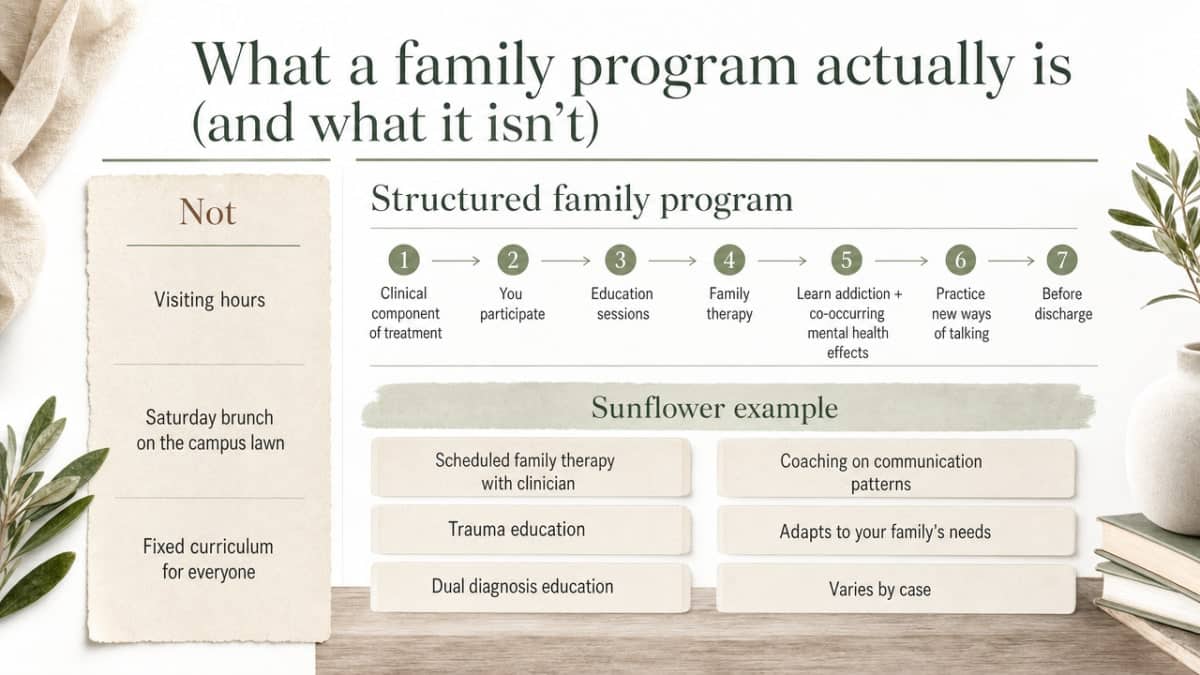
A family program is not visiting hours. It is not a Saturday brunch on the campus lawn. It is a structured clinical component of your loved one’s treatment that pulls you in as a participant — someone who attends education sessions, sits in on family therapy, learns what addiction and co-occurring mental health conditions actually do to a brain and a household, and practices new ways of talking to each other before discharge.
At Sunflower, that looks like scheduled family therapy sessions with your loved one’s clinician, education on trauma and dual diagnosis, and coaching on communication patterns that have probably calcified in your home over years. The specifics vary by case, which is part of the point — a good program adapts to what your family actually needs, not a fixed curriculum handed to everyone.
Here is what it is not. It is not an intervention service, the kind you have seen on television where a professional shows up at the house. It is not couples counseling in disguise, though partners are often deeply involved. It is not a place where you sit and are told the addiction is your fault, and it is not a place where your loved one is told none of this affects you. Both of those framings are wrong, and both cause harm.
It is also not optional in the way a movie is optional. Research reviews of the last decade keep landing on the same conclusion: including family members in treatment reduces substance use and improves how families function together 8. That finding is why programs like Sunflower’s exist as a distinct track, staffed by clinicians who work with the family system, not just the person in the residential bed.
Think of it less as a benefit offered to you and more as a piece of the treatment plan that has your name on it.
What the evidence actually says about your involvement
The outcomes that shift when family is in the room
When people talk about family support in recovery, they usually mean the emotional kind. Show up. Believe in them. Do not give up. Those things matter. But when researchers measure what actually changes in a person’s treatment when their family is pulled in as a participant rather than a cheerleader, the shifts are clinical, not just emotional.
SAMHSA’s Advisory 39, which synthesizes decades of family therapy research, names four outcomes that move when loved ones are structurally involved in treatment: engagement in care, retention through the full course of treatment, relapse prevention, and long-term abstinence 7. Those are not soft outcomes. Engagement is whether your son actually enters the door. Retention is whether he stays past week two, when everything in him wants to leave. Relapse prevention is the six months after discharge, when the risk is highest. Long-term abstinence is the year mark and beyond.
The 2026 systematic review of randomized controlled trials on family-based interventions found that these effects hold up. Compared with individual-only approaches, family-centered treatment produced reductions in substance use and improvements in family functioning that were still measurable a full year after treatment ended 1. That is a rare finding in this research. Most treatment effects fade. Family involvement does not fade as quickly.
What this means for you is straightforward. When you show up to family sessions, when you learn what the clinicians are teaching your loved one, when you practice the new communication in real time — you are not sitting in the audience. You are part of the mechanism that makes treatment work longer. That is a lot to sit with, and you do not have to be perfect at it. You just have to show up.
Not every family method delivers the same thing
Here is a distinction worth carrying with you into any conversation about a family program: brief family education and structured family therapy are not the same intervention, and they do not produce the same results. This matters because a lot of facilities offer a single evening class, call it a family program, and stop there.
The research pulls these approaches apart pretty cleanly. Behavioral couple and family therapy, studied in a systematic review of adult mental health treatment, produced small-to-moderate reductions in substance use — but the striking finding was the large improvement in relationship adjustment compared to individual-only treatment 3. In plain English: the partner or family member sees a real change in how they relate to each other, not just in how much the person is drinking or using. If you have been feeling like a stranger in your own marriage, that is the finding that speaks to you.
Brief Strategic Family Therapy, tested in a multisite randomized trial against treatment as usual for adolescents, was significantly better at engaging and retaining families in care and at improving parent-reported family functioning, though the differences in self-reported drug use trajectories were more modest 5. The lesson embedded in that finding is that structured family therapy pulls families into treatment and keeps them there — which then creates the conditions for the substance use work to happen.
For dual-diagnosis cases, the Family Intervention for Dual Disorders trial compared a brief family education program with a longer, structured intervention that added communication and problem-solving skills. Clients in the longer program had significantly less severe overall psychiatric symptoms, and their relatives improved more in their own mental health functioning and in their understanding of co-occurring disorders 6. When mental illness and addiction are both in the room, brief education does not carry the weight.
When you call a facility, ask what the family program actually contains. Not the brochure version. The schedule.
When your loved one resists treatment
This is probably the question that has been sitting in your chest the whole time you have been reading. What if he will not go? What if she keeps saying she is fine? What if the person you love has already refused three times?
You have likely heard about CRAFT — Community Reinforcement and Family Training — which is often marketed as the family-focused method that gets resistant loved ones into treatment. The honest picture from the research is more mixed than the marketing. A 2024 randomized trial compared CRAFT with structured manual-based counselling for concerned family members of treatment-resistant young adults. At 24 weeks, 33% of participants in the CRAFT group reported that their young adult had entered treatment, compared with 31% in the counselling group. There was no significant difference between the two approaches in treatment entry, substance use, or family functioning 4.
Read that carefully. Both groups saw about a third of resistant young adults enter treatment. That is not nothing — it is real movement. But it also means no single family method reliably drags a resistant loved one across the threshold. Anyone who promises you otherwise is selling something.
What the research does support is that motivational approaches, applied consistently over time to a family system, shift the conditions around a resistant person 12. You cannot make the decision for your loved one. You can change what your side of the conversation sounds like, which sometimes changes what becomes possible for them.
Why dual diagnosis changes what family work needs to look like
If your loved one is struggling with more than addiction alone — depression that predates the drinking, anxiety that never quite lifts, trauma from childhood or combat or an assault nobody talks about, an eating disorder running underneath the substance use — then the family program you choose needs to be built for that reality. Not retrofitted. Built for it.
Here is why. In the Family Intervention for Dual Disorders trial, researchers compared a brief family education program with a longer, structured intervention that added communication skills and problem-solving work for families of people with co-occurring severe mental illness and substance use disorder. Both approaches helped. But clients in the longer program had significantly less severe overall psychiatric symptoms, and their relatives improved more in their own mental health functioning and in their grasp of what co-occurring disorders actually involve 6. Brief education alone did not carry that weight.
Trauma is the other thread you will find running through most dual-diagnosis cases. SAMHSA’s guidance on trauma-informed care describes trauma as something that affects individuals, families, communities, and generations — meaning what your loved one carries did not start with them, and what your household lives with will not end with them unless someone in the system does the work 10. That is not a comfortable idea. It is also the reason a real dual-diagnosis family program spends time on the family history, not just on the addiction of the moment.
Sunflower’s clinical model is built around this exact intersection: trauma, mental health, and substance use, treated together rather than in sequence. For you, that means the family sessions will not stop at what your husband is drinking or what your daughter is using. They will move into the harder territory — what happened before the using started, and what is happening in the family now that keeps everyone stuck. It is more demanding than a single education night. It is also what the evidence suggests actually helps when dual diagnosis is what you are dealing with.
What participation will ask of you
Time, honesty, and sitting with the hard parts
The first thing a family program asks for is time — not enormous amounts of it, but reliable amounts. A weekly family therapy session. Education blocks you attend either in person at Osawatomie or remotely. Reading and small assignments between sessions. If you have been running your household on adrenaline and half-sleep for months, even those blocks will feel like a lot at first. That is normal, and you can plan around it.
The second thing it asks for is honesty. Not confession-style honesty, and not a public accounting of every fight you have had. The kind of honesty that says, out loud, what has actually been happening in your house. What you have been covering up for at work. What you stopped telling your sister about a year ago. Clinicians cannot help a family system they cannot see, and family programs move faster when the first session is not spent excavating basic facts.
The third thing — and this is the one people underestimate — is your willingness to sit with hard parts about yourself. Family therapy is not about assigning blame, but it is about looking at patterns. How you respond when your partner drinks. What you said the last time your son relapsed. What your own parents modeled about conflict or drinking or silence. The 2023 review of family therapy for substance abuse identifies improved communication and reduced conflict as core mechanisms of change 8. Those mechanisms do not move unless somebody in the room is willing to look at their own part.
You do not have to be good at any of this on day one. You just have to keep showing up.
Caregiver exhaustion is a clinical variable, not a character flaw
If you are tired in a way that sleep does not fix, you are not weak. You are describing something clinicians recognize. Living alongside active addiction — especially when a co-occurring mental health condition is in the mix — wears on the body, the marriage, the friendships you used to have, and the version of yourself you used to be. That exhaustion is not the reason you failed to fix this. It is one of the things a real family program treats.
The behavioral couple and family therapy research shows large improvements in relationship adjustment for the family member, not just for the person with the substance use disorder 3. Read that again. The person coming in as the loved one gets something clinically measurable back. That is not a pep-talk framing. That is what the outcome data says.
SAMHSA’s motivational interviewing guidance is explicit that ambivalent family members — people who are exhausted, resentful, unsure whether they want to keep participating at all — belong inside the treatment conversation, not outside it 12. If you show up to a first session feeling like you have nothing left, tell the clinician that. It is useful information, not a disqualification.
Your exhaustion has been part of the system for a long time. A family program that is worth calling knows how to work with it, not around it.
How a Kansas family program fits into the wider picture
Kansas geography, Osawatomie, and the drive from your town
Osawatomie sits in Miami County, about an hour south of downtown Kansas City and a little over three hours from Wichita by car. If you are coming from the KC metro — Overland Park, Olathe, Lenexa — the drive is manageable on a weekday evening. Topeka is roughly ninety minutes. From Lawrence, closer to an hour. Rural western counties are a longer haul, and some families work with the intake team on remote participation for the parts of the program that can be done that way.
The geography matters because family involvement is not a one-time visit. If the drive feels impossible every week, the program will not do what it is supposed to do. Talk about that on the first call. Sunflower’s intake staff can walk you through which family sessions are in person, which can happen by secure video, and how the schedule tends to work for people driving in from two counties over.
Kansas has been hit hard by the overdose crisis, and KDHE’s overdose data dashboard tracks fatal and nonfatal overdoses by county across the state 9. The urgency you are feeling is not in your head. It is also not a reason to pick the closest program by default. Pick the one that actually treats the thing your loved one is living with.
Sunflower’s continuum and where family shows up in it
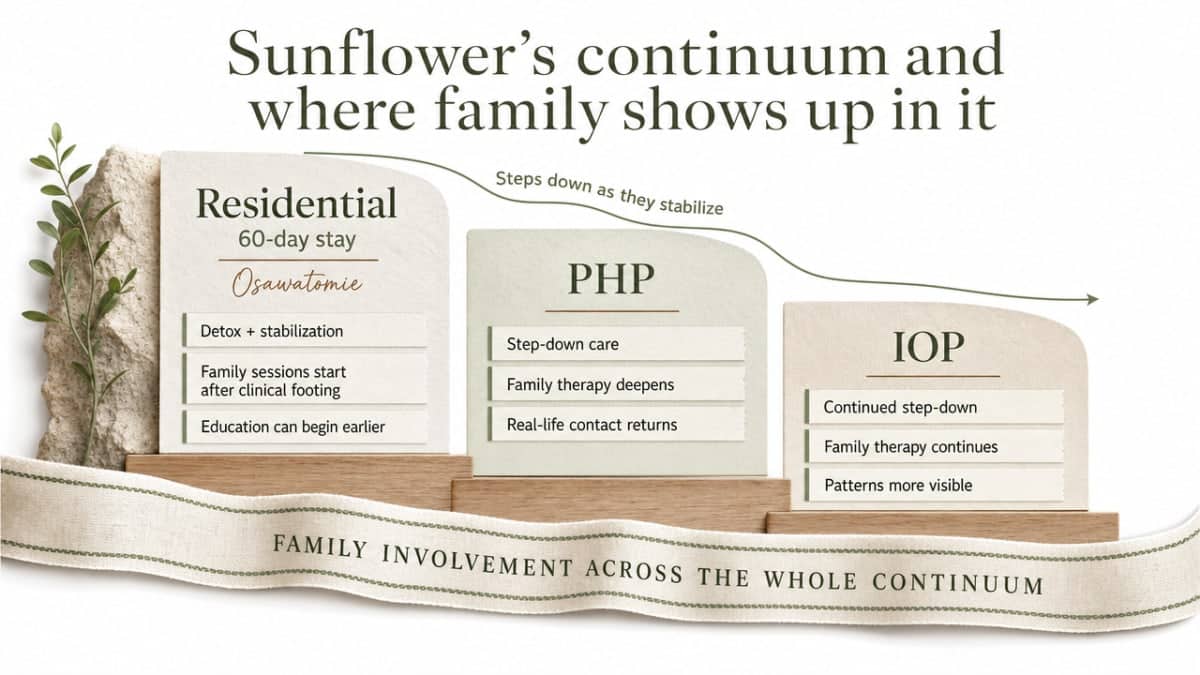
Sunflower’s clinical program moves through three phases: a 60-day residential stay in Osawatomie, then a Partial Hospitalization Program, then an Intensive Outpatient Program. Your loved one steps down through those levels as they stabilize. Family involvement is not saved for the end. It shows up across the whole continuum, in different shapes at different stages.
In residential, the first weeks are often about detox and stabilization, and family sessions tend to start once your loved one has some clinical footing. Education blocks for you can begin earlier — you do not have to wait for them to be ready to start learning what you are dealing with. During PHP and IOP, family therapy typically deepens, because your loved one is back in daily contact with real life and the patterns you both live in are more visible in the room.
This staged approach matters clinically. The 2024 systematic review of family intervention models for young adults with substance use problems frames family members as active co-participants across phases of care, not attendees at a single event 2. The longer arc is where the change actually consolidates.
For dual-diagnosis cases — which describes most of who Sunflower treats — the trauma-informed model runs through every phase. That means the family work you do at week three of residential is connected to the family work you do at week ten of IOP. It is one thread, pulled through the whole program.
Questions to ask when you call
When you pick up the phone, you do not need a script. You just need a handful of questions that separate a real family program from a brochure. Write these down before you dial, because your brain will not hold them steady in the moment.
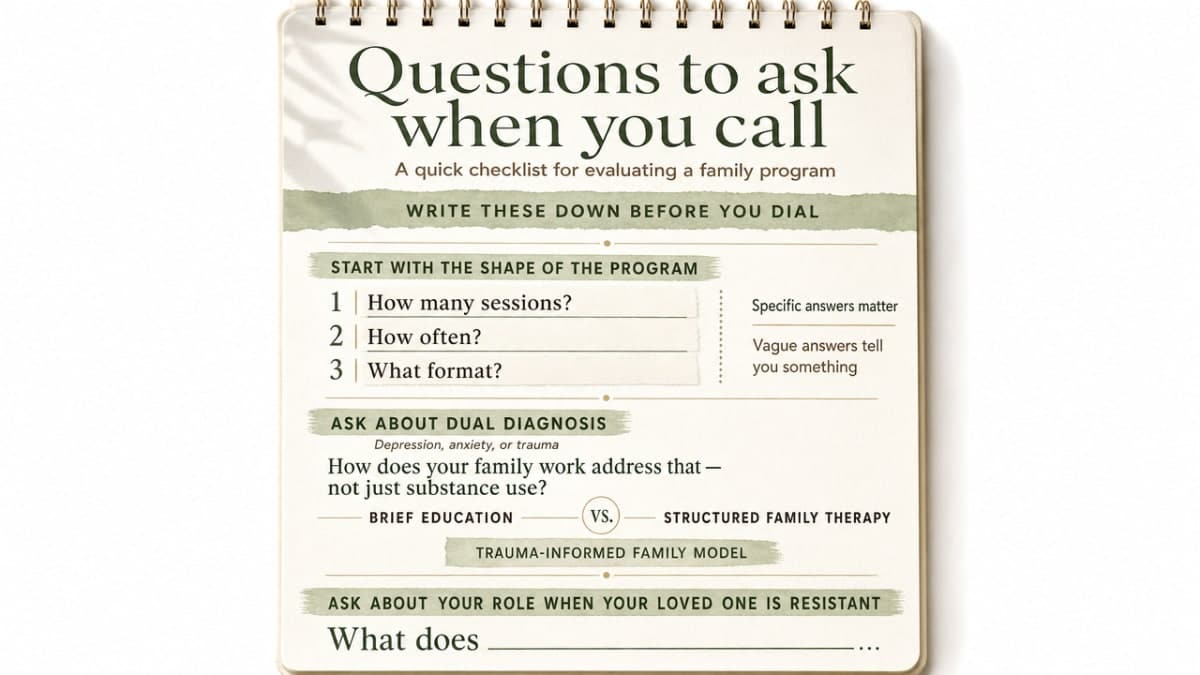
Start with the shape of the program. What does the family component actually include — how many sessions, how often, in what format? A serious program answers this specifically. If the answer is vague, that tells you something.
Then ask about dual diagnosis. My loved one also struggles with depression, anxiety, or trauma. How does your family work address that, not just the substance use? This is where brief education programs and structured family therapy separate from each other, and where Sunflower’s trauma-informed model is meant to hold its weight 6.
Ask about your role when your loved one is resistant. What does the family program offer me if they are refusing treatment right now? A good program has an answer for this that does not oversell what any single method can do 4.
Ask logistics honestly. I live in Wichita, or Topeka, or a rural county. Which sessions require me on campus in Osawatomie, and which can happen by video?
Ask about insurance. Do you take my plan? What is not covered? Sunflower accepts most commercial insurance and does not participate in Medicare or Medicaid, so get that clarified early.
Then ask the question underneath all the others: What will you ask of me? The answer will tell you whether this is a program you can actually walk into.
Start Real Family Healing With One Call Today
Connect with a caring expert about family support options for lasting addiction recovery.
Frequently Asked Questions
What actually happens in a family program at a Kansas addiction treatment center?
You attend scheduled family therapy sessions with your loved one’s clinician, sit in on education blocks about addiction and co-occurring mental health conditions, and practice new communication patterns before discharge. It is structured clinical work, not visitation. Research shows this kind of family involvement reduces substance use and improves family functioning up to a year after treatment ends 1.
Do I have to participate if my loved one is the one in treatment?
You are not required to, but your participation is one of the clinical variables that shifts outcomes. SAMHSA’s Advisory 39 identifies family involvement as a factor in engagement, retention, relapse prevention, and long-term abstinence 7. If you are exhausted or ambivalent, say so on the first call. That is useful information for the clinical team, not a reason to opt out.
What if my husband, son, or partner refuses to go to treatment?
Refusal is common and does not disqualify you from a family program. A 2024 randomized trial of family support methods for resistant young adults found about a third entered treatment within 24 weeks — real movement, but no single method reliably forces the decision 4. What you can change is how you show up in the conversation. Motivational approaches applied consistently shift the conditions around a resistant person 12.
How is family work different when there is a mental health diagnosis alongside addiction?
Brief education is not enough when depression, anxiety, or trauma sits underneath the addiction. The Family Intervention for Dual Disorders trial found that longer, structured family work led to less severe psychiatric symptoms and better mental health functioning for relatives, compared with brief education alone 6. At Sunflower, the family sessions move into trauma history and household patterns, not just current substance use.
Does insurance cover the family program at Sunflower?
Sunflower accepts most commercial insurance plans. The center does not participate in Medicare or Medicaid. Coverage for the family component varies by plan, and the intake team can verify your specific benefits before you commit. Ask directly what is covered, what is not, and whether your out-of-pocket obligations change across the residential, partial hospitalization, and intensive outpatient phases of your loved one’s care.
How far in advance do I need to plan around the drive to Osawatomie?
Osawatomie is about an hour south of downtown Kansas City, ninety minutes from Topeka, and roughly three hours from Wichita. Some family sessions happen on campus; others can be done by secure video, especially during the outpatient phases. Talk through the schedule on your first call so the driving load is realistic. A weekly commitment you can actually keep matters more than an ambitious one you cannot.
References
- Family-Based Interventions for Substance Use Disorders: A Systematic Review of Randomized Controlled Trials. https://pmc.ncbi.nlm.nih.gov/articles/PMC13068785/
- Family Intervention Models for Young Adults with Substance Abuse: A Systematic Review. https://pmc.ncbi.nlm.nih.gov/articles/PMC11572604/
- Couple and family involvement in adult mental health treatment: a systematic review. https://pubmed.ncbi.nlm.nih.gov/23321286/
- Community Reinforcement and Family Training versus counselling for concerned significant others of treatment-resistant young adults with substance use problems: a randomized trial. https://pubmed.ncbi.nlm.nih.gov/38225922/
- Brief Strategic Family Therapy Versus Treatment as Usual: Results of a Multisite Randomized Trial for Substance Using Adolescents. https://www.ncbi.nlm.nih.gov/pmc/articles/PMC3440775/
- A Randomized Controlled Trial of Family Intervention for Dual Disorders. https://pmc.ncbi.nlm.nih.gov/articles/PMC3627753/
- The Importance of Family Therapy in Substance Use Disorder Treatment (Advisory 39). https://library.samhsa.gov/sites/default/files/pep20-02-02-016.pdf
- Effects of Family Therapy for Substance Abuse: A Systematic Review. https://pubmed.ncbi.nlm.nih.gov/36564902/
- Kansas Overdose Data Dashboard (KDHE). https://www.kdhe.ks.gov/1309/Data-Dashboard
- TIP 57: Trauma‑Informed Care in Behavioral Health Services. https://store.samhsa.gov/product/TIP-57-Trauma-Informed-Care-in-Behavioral-Health-Services/SMA14-4816
- TIP 61: Behavioral Health Services for American Indians and Alaska Natives. https://store.samhsa.gov/product/TIP-61-Behavioral-Health-Services-for-American-Indians-and-Alaska-Natives/SMA18-5070
- TIP 35: Enhancing Motivation for Change in Substance Use Disorder Treatment. https://store.samhsa.gov/product/TIP-35-Enhancing-Motivation-for-Change-in-Substance-Use-Disorder-Treatment/PEP19-02-01-003