
Key Takeaways
- Kansas requires whole-person care by design: KDADS-regulated crisis centers must handle withdrawal and stabilization, while KanCare mandates person-centered case management covering housing, employment, and psychiatric needs 1, 2.
- Genuine holistic treatment in Kansas layers nutrition, movement, mindfulness, and trauma-informed therapy onto real clinical care, including medication for opioid or alcohol use disorder when appropriate.
- When choosing a program, ask who handles withdrawal, how trauma responses are managed in group, whether staff are Kansas-licensed, and whether the facility accepts KanCare or only commercial insurance.
- The next step is one phone call: reach Carelon Behavioral Health of Kansas at 1-866-645-8216 through KDADS for an assessment or provider referral 4.
What “whole-person” actually means when you’re the person
If you’re reading this at 2 a.m. after another night that didn’t go the way you promised yourself it would, take a breath. You’re not broken. You’re one of a very large group of people carrying something heavy.
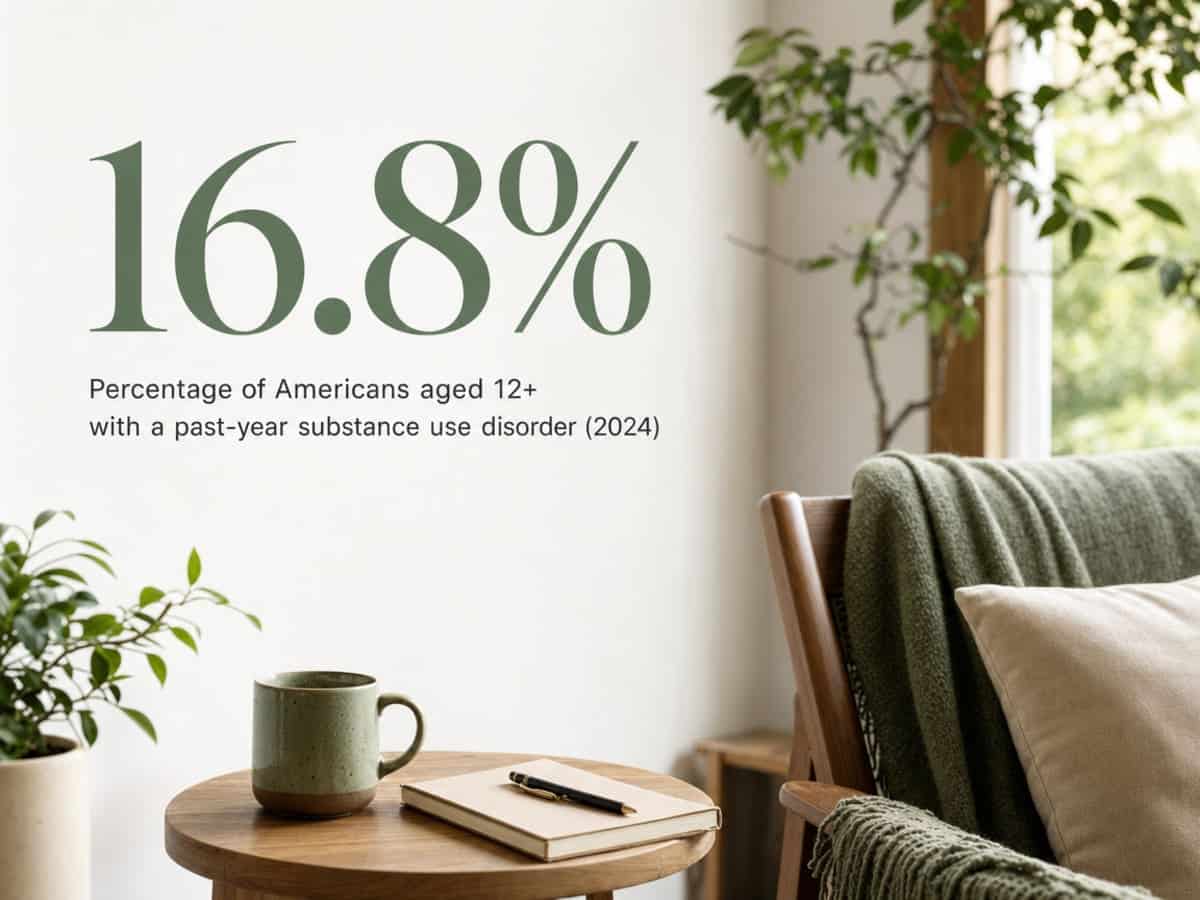
In 2024, SAMHSA’s National Survey on Drug Use and Health found that 16.8% of Americans aged 12 and older, roughly 48.4 million people, had a substance use disorder in the past year 14. That number counts people across every income bracket, every zip code, every kind of family. It counts the person who drinks alone after work and the person who can’t remember when they last ate a real meal. It counts you, if that’s where you are. The scope matters: this is national, past-year, self-reported. It doesn’t tell you how anyone got better. But it does tell you that if you’re looking for help right now, you’re looking alongside millions of other people.
Here’s what “whole-person” or “holistic” care is supposed to mean, in plain language. It means a treatment team pays attention to more than the substance. They pay attention to what you eat, how you sleep, whether your body has moved today, what happened to you before the drinking or the pills started, and what your nervous system is doing right now, in this chair, in this room.
It is not incense and vague talk about balance. It is clinical care that refuses to pretend the rest of your life isn’t part of the problem, or part of the way out.
Holistic is not the opposite of clinical
There’s a version of “holistic” that deserves the skepticism it gets. Candles, crystals, a yoga mat, and a promise that if you just breathe deeply enough, the cravings will lift. If you’ve been in and out of treatment before, you’ve probably sat through some version of that and walked out angry.
That’s not what a serious whole-person program looks like in Kansas. Real holistic addiction treatment includes the same things a good clinical program includes: a medical assessment, safe withdrawal management when needed, evidence-based therapy like CBT or EMDR, medication for opioid or alcohol use disorder when it’s the right call, and licensed clinicians who can diagnose and treat co-occurring conditions. Kansas regulation for crisis intervention centers spells this out in plain terms, requiring stabilization, treatment for acute withdrawal, monitoring, and clear pathways to ongoing care 2. None of that is optional. None of it gets replaced by a meditation cushion.
What whole-person care adds is everything a body and life need to actually hold onto that clinical work. Food that doesn’t spike and crash your blood sugar. Movement that helps you sleep. Mindfulness practices that give you thirty seconds between a craving and a decision. Trauma-informed staff who don’t flinch when the story gets hard. Case management that thinks about your housing, your job, your family, your legal situation. Kansas Medicaid, through KanCare, actually requires person-centered case management that connects you to family, medical, employment, educational, and psychiatric services alongside SUD treatment 1. The state is telling programs, on paper, that treating the substance without treating the surrounding life doesn’t count.
So when a Kansas program calls itself holistic, the right question isn’t whether they’ve replaced clinical care with wellness. It’s whether their clinical care is strong enough to carry the weight, and whether the wellness pieces around it are specific, staffed, and built into your daily schedule, not tacked on as an afternoon extra.
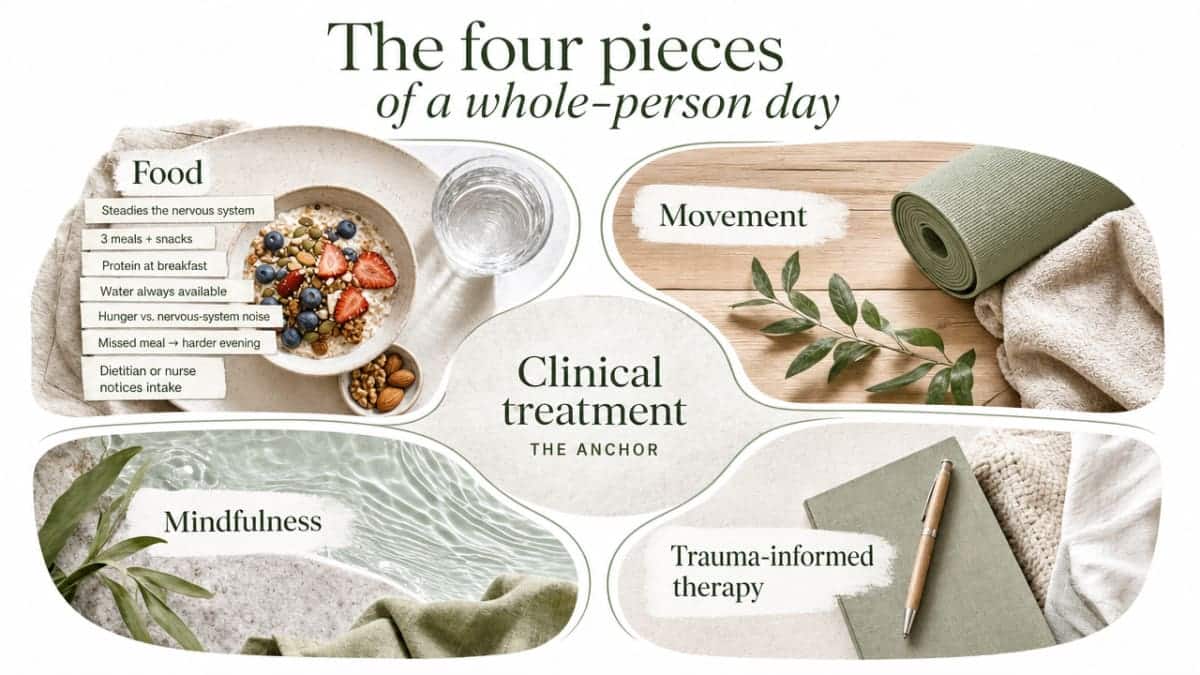
The four pieces of a whole-person day
Food that steadies a nervous system
By the time you walk into treatment, your body has usually been running on a mix of caffeine, sugar, whatever the substance is, and not much else. Blood sugar swings feel like anxiety. Dehydration feels like a craving. A missed meal at 3 p.m. can turn into a very bad decision at 7 p.m. You may have forgotten what actual hunger feels like versus the noise your nervous system is making.
A serious whole-person program treats food as clinical care, not a hotel amenity. That means three real meals and snacks on a schedule, protein at breakfast so your morning doesn’t crater, water you don’t have to hunt for, and a dietitian or nurse who notices if you’re pushing food around your plate instead of eating it. It means someone paying attention to the people who arrive underweight, the people who arrive over-reliant on energy drinks, and the people whose relationship with food has been part of the problem for years.
The research supports the specificity here. A 2023 study of a wellness-oriented policy intervention in SUD treatment settings found that clients who received nutrition counseling drank fewer sugar-sweetened beverages, and clients who received physical activity counseling actually moved more, with the effect strengthening after the policy was in place 5. Small, targeted counseling changed daily behavior. That’s what you want a program’s kitchen and clinical team doing on your behalf, on a day when you’re too tired to think about what to eat.
Movement as medication for the body you have now
Nobody is asking you to run a marathon. The fitness piece of whole-person care is not about aesthetics or athletic performance. It’s about giving your body a way to burn off stress hormones, sleep at night, and start feeling like a place you can live inside again.
What that looks like in a good Kansas program is unglamorous and doable. A walk outside on days the weather cooperates. Stretching that helps if your back has been locked up for months. Light strength work to rebuild what months or years of use took from you. Yoga that focuses on breath and grounding, not advanced postures. Group activity that gets you talking to another human while you’re both slightly out of breath, which is often easier than talking in a chair.
The same 2023 wellness intervention that changed clients’ eating habits also increased their physical activity when staff actually counseled them about it 5. Movement doesn’t happen because a schedule says it should. It happens because a person you trust says, today we’re going to walk for twenty minutes, and then walks with you.
If you have injuries, chronic pain, or a body that has been through a lot, tell them. A whole-person program adapts. It doesn’t demand you perform. Rebuilding a body that’s been under siege is slow work, and every session where you show up counts more than how hard you pushed.
Mindfulness: what it does, what it doesn’t
Here’s where a lot of holistic programs get evasive. They’ll tell you meditation and mindfulness will change your life without saying what the research actually shows. You deserve the real version.
Mindfulness practices in addiction treatment usually take the form of Mindfulness-Based Relapse Prevention, or MBRP. It’s a structured program that teaches you to notice a craving, a body sensation, or a hard emotion without immediately reacting to it. That thirty-second gap between the urge and the action is the whole game.
A landmark 2014 randomized clinical trial compared MBRP against standard cognitive-behavioral relapse prevention and treatment-as-usual for people in aftercare. At the 12-month follow-up, MBRP participants reported significantly fewer days of substance use and less heavy drinking than either the standard relapse prevention group or the treatment-as-usual group 7. That’s a real finding, and it’s why serious programs teach these skills.
But you should also know the other side. A 2017 meta-analysis pooling nine randomized trials with 901 participants found no statistically significant differences between MBRP and comparison treatments on relapse or frequency of use overall. It did find that MBRP consistently helped with withdrawal symptoms, cravings, and the negative consequences of use 8. A separate 2021 review reported decreases in frequency of use, heavy drinking days, cravings, withdrawal, and relapse probability among MBRP participants, though outcomes varied across studies 11. For opioid-dependent patients specifically, mindfulness training improved quality of life and reduced craving and relapse rates 12.
What that mixed evidence means for you: mindfulness reliably helps with what a craving feels like in your body and what withdrawal does to your mood. It may or may not, on its own, keep you from using again. It is an adjunct to clinical treatment, not a substitute for it. A program that hands you a meditation app and calls it holistic care is not doing the work. A program that teaches you MBRP skills alongside therapy, medication when appropriate, and real medical care is using mindfulness the way the evidence supports.
Therapy that treats trauma as the driver, not the backstory
If you’ve been in treatment before and the therapist asked about your childhood on day one and then never came back to it, you already know something was missing. For a lot of people, the substance is the thing that finally quieted a nervous system that has been on high alert since long before the first drink.
Trauma-informed care isn’t a therapy technique. It’s a way an entire program is built. SAMHSA’s guidance defines it as a strengths-based framework that assumes trauma is common, recognizes how it shows up in behavior, and responds by integrating that knowledge into every policy and practice while actively working to avoid retraumatizing you 15, 16. The core principles are safety, trustworthiness, peer support, collaboration, empowerment, and giving you a sense of control over what happens to you 18.
In practice, that means the intake process explains what’s about to happen before it happens. It means staff don’t touch you without asking. It means when a memory surfaces in group and your body goes cold, the clinician knows what’s happening and helps you come back to the room instead of pushing through. It means you’re not asked to tell your worst story to prove you belong there.
Trauma-informed programs treat substance use and the underlying conditions together, not in sequence. If depression, anxiety, PTSD, or an eating disorder is part of what’s driving the drinking or the pills, they get treated in the same building, by the same team, at the same time. This is what dual diagnosis care means when it’s done seriously. It’s also where a lot of previous treatment attempts fell short. If nobody addressed why you needed the substance to survive your own life, staying stopped was always going to be a battle you fought alone.
When food, mood, and substances are tangled together
For a lot of people, especially women, the drinking or the pills didn’t start alone. They arrived alongside a complicated relationship with food, a body you’ve learned to fight with, or a mood disorder that made numbing feel like the only strategy left. If that’s you, a program that treats the substance while ignoring the eating is going to send you home into the same trap.
A 2026 study of a 10-week program for women in SUD treatment tested what happens when you actually address these things together. Participants worked on nutrition, physical activity, body image, and eating behaviors alongside their substance use treatment. By the end, they showed statistically significant improvements in general nutrition, physical activity, and intuitive eating, plus meaningful reductions in thin-ideal internalization, body dissatisfaction, binge eating, and disordered eating patterns 6. That’s not a small result. It’s evidence that treating the eating and the substance use in the same room, with the same team, changes both.
What this looks like in practice: a clinician who screens for eating disorders on intake, meal support that isn’t punitive, group work that names body image without demanding you love your body today, and a treatment plan that adjusts if restricting or bingeing shows up as a coping strategy when the substance is gone. If you’ve been quietly carrying this second thing for years, tell whoever assesses you. It changes the shape of the care you need.
How Kansas actually connects you to care
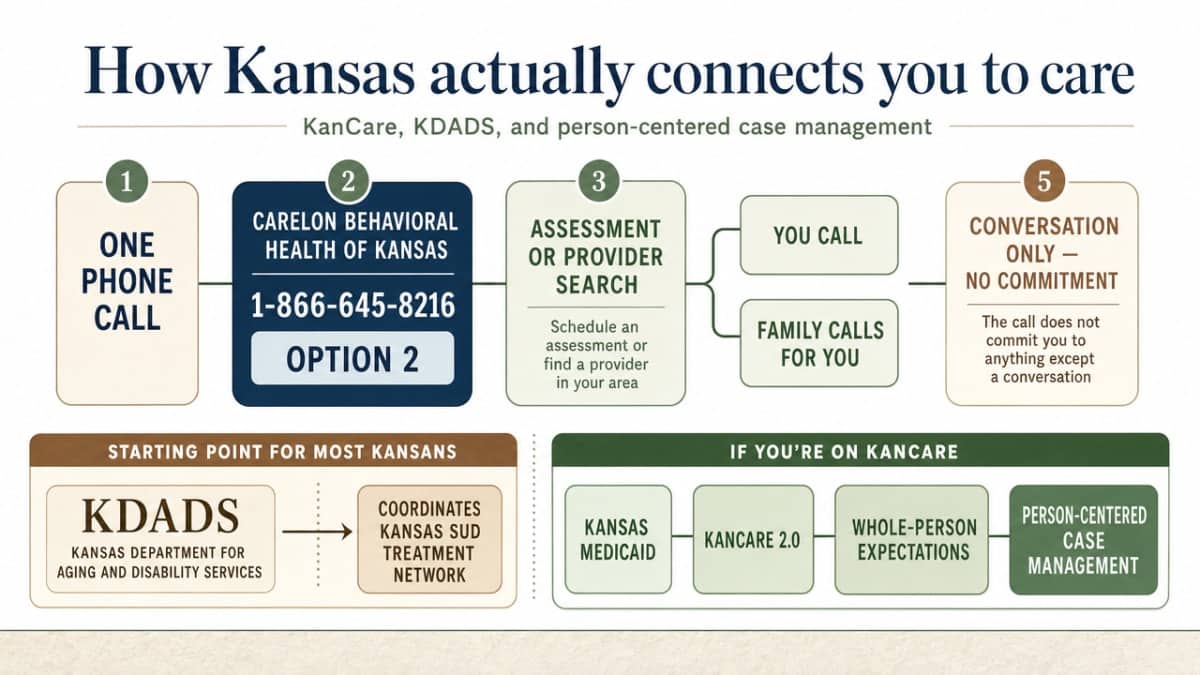
KanCare, KDADS, and person-centered case management
You don’t need to figure out the whole Kansas system to get help. You need one phone number and someone on the other end who can point you at the next step.
For most Kansans, that starting point is the Kansas Department for Aging and Disability Services. KDADS coordinates the state’s substance use disorder treatment network, and its published pathway is to call Carelon Behavioral Health of Kansas at 1-866-645-8216 and select option 2 to schedule an assessment or find a provider in your area 4. You can make that call yourself. A family member can make it for you. It doesn’t commit you to anything except a conversation.
One honest note on coverage. Not every Kansas program participates in Medicaid or Medicare, and some accept only commercial insurance. Ask about coverage on the first call. It’s a fair question, and the answer shapes what’s actually available to you.
What to ask a program before you say yes
You are allowed to interview a treatment program. You are allowed to ask hard questions before you hand over the next sixty days of your life. If a program flinches at any of these, that tells you something.
Ask who does the clinical work. Are the therapists licensed in Kansas? Is there a physician or advanced practice provider on staff who can prescribe medication for opioid or alcohol use disorder if that’s the right call? Who handles withdrawal, and where do you go if you need a higher level of care than they can provide on site 2?
Ask how trauma is handled. Not whether they’re “trauma-informed” as a marketing phrase, but what happens if a memory surfaces in group and you dissociate. Do staff know how to help you come back to the room? Is the intake process explained to you before it happens 15, 18?
Ask what a typical day actually looks like. When do you eat, and who plans the meals? What movement is on the schedule and who leads it? How much therapy is one-on-one versus group? What happens on weekends?
Ask what happens after. Discharge planning should start early, not the week you leave. Who helps you line up outpatient care, a sober living arrangement if you need one, and a way to keep going once you’re back in your own kitchen at 7 p.m. on a Tuesday?
Making the whole-person picture measurable
One fair critique of holistic care is that it can feel unmeasurable. If you can’t tell whether the meditation is working or the walks are helping, how do you know the program is doing anything at all?
Some Kansas programs answer that question with data. Sunflower Recovery Center in Osawatomie, for example, uses Huml Health biometric wearables during treatment to track sleep quality, heart rate variability, and stress patterns across each day. That turns abstract wellness talk into something you and your clinical team can actually see. When sleep stabilizes after two weeks of consistent meals and evening wind-down, that shows up on the screen. When a group session spikes your stress response and takes hours to settle, that shows up too, and your therapist can adjust what happens next.
This is not a gadget for its own sake. It’s a way of confirming that the nutrition work, the movement, the mindfulness practice, and the therapy are landing where they’re supposed to land, in a nervous system that has been out of regulation for a long time. It also gives you evidence. If you’ve been told before that recovery is about willpower, watching your resting heart rate drop across three weeks of sober sleep is a different kind of proof, and it belongs to you.
If you’re the one making the call
If you’ve read this far, something in you is still looking. That counts. Whether you’re the person who needs help or the person calling on someone else’s behalf, the next step is smaller than it feels. It is one conversation.
You can call KDADS through Carelon Behavioral Health of Kansas at 1-866-645-8216 and ask for an assessment 4. You can call a specific program and ask what a whole-person day actually looks like inside their building, who leads the fitness sessions, who plans the meals, and how they handle a hard moment in group. Sunflower Recovery Center in Osawatomie is one of the Kansas programs that builds care that way, and you’re welcome to call and ask how their fitness program, nutritional support, and trauma-informed clinical work fit together for someone in your situation.
If you’ve tried before and it didn’t hold, that’s information, not a verdict. The version of care that treats the substance and the surrounding life at the same time is a different door. You don’t have to be ready for everything today. You just have to make the call.
Start Your Healing Journey With One Call
Connect directly with experts who understand your whole-person recovery needs and are ready to support your next step.
Frequently Asked Questions
Is holistic addiction treatment a replacement for medical detox or clinical therapy?
No. A serious whole-person program includes medical assessment, safe withdrawal management, licensed therapy, and medication for opioid or alcohol use disorder when it’s clinically appropriate. Kansas regulation actually requires crisis intervention centers to provide stabilization, treatment for acute withdrawal, and clear pathways to ongoing care 2. Nutrition, movement, and mindfulness sit alongside that clinical foundation. They don’t replace it.
Does mindfulness actually prevent relapse, or is that just wellness marketing?
The honest answer is mixed. A 2017 meta-analysis of nine randomized trials found no significant differences between Mindfulness-Based Relapse Prevention and comparison treatments on relapse or frequency of use overall, though it did show benefits for cravings, withdrawal, and negative consequences 8. Mindfulness reliably helps with what a craving feels like and how you respond in the moment. It works as an adjunct to clinical treatment, not a substitute.
Will KanCare or Kansas Medicaid cover holistic addiction treatment?
KanCare covers SUD treatment and requires person-centered case management that connects you to family, legal, medical, employment, educational, and psychiatric services alongside your clinical care 1. Whether a specific program participates in KanCare is a separate question. Some Kansas facilities accept only commercial insurance and don’t participate in Medicaid or Medicare. Ask about coverage on your first call so you know what’s actually available to you.
What if I have an eating disorder alongside substance use?
Tell whoever assesses you. A 2026 study of a 10-week program for women in SUD treatment found statistically significant improvements in nutrition, physical activity, intuitive eating, and reductions in binge eating, body dissatisfaction, and disordered eating patterns when both were treated together 6. A program that ignores the eating and treats only the substance sends you home into the same trap. You need clinicians who screen for it and build it into your plan.
How do I know if a Kansas program is genuinely trauma-informed?
Ask specific questions instead of accepting the label. SAMHSA defines trauma-informed care through safety, trustworthiness, peer support, collaboration, empowerment, and active resistance to retraumatization 15, 18. In practice, that means staff explain what’s about to happen before it happens, don’t touch you without asking, and know how to help you come back to the room if a memory surfaces in group. If a program can’t describe those specifics, the label is marketing.
I’ve tried treatment before and it didn’t work. Why would whole-person care be different?
Because a previous attempt may have treated the substance while leaving everything around it untouched. If nobody addressed the trauma, the sleep, the eating, the mood disorder, or the reason you needed to numb in the first place, staying stopped was always going to be a fight you were losing. Whole-person care treats those things in the same building, at the same time, with the same team. That’s a different door than the one that didn’t hold before.
References
- KanCare 2.0 Substance Use Disorder Section 1115 Demonstration Interim Evaluation Report. https://medicaid.gov/medicaid/section-1115-demonstrations/downloads/ks-kancare-appvd-int-eval-rpt-sud-01042023.pdf
- Kan. Admin. Regs. § 26-52-17 – Alcohol and substance abuse crisis intervention centers. https://www.law.cornell.edu/regulations/kansas/K-A-R-26-52-17
- Kansas Tobacco Guideline for Behavioral Health Care – Implementation Toolkit. https://smokingcessationleadership.ucsf.edu/sites/smokingcessationleadership.ucsf.edu/files/2023-08/KS-Tobacco-Guideline-Behavioral-Health-Care-Implementation-Toolkit.pdf
- Substance Use Disorder Treatment Services – KDADS. https://www.kdads.ks.gov/services-programs/behavioral-health/services-and-programs/substance-use-disorder-treatment-services
- Addressing nutrition and physical activity in substance use disorder treatment: Client reports from a wellness-oriented, tobacco-free policy intervention. https://pubmed.ncbi.nlm.nih.gov/37234703/
- Impact of a Program to Improve Nutrition, Body Image, and Health-Related Behaviors for Women in Treatment for Substance Use. https://pubmed.ncbi.nlm.nih.gov/41817478/
- Relative efficacy of mindfulness-based relapse prevention, standard relapse prevention, and treatment as usual for substance use disorders: A randomized clinical trial. https://pubmed.ncbi.nlm.nih.gov/24647726/
- Mindfulness-Based Relapse Prevention for Substance Use Disorders: A Systematic Review and Meta-Analysis. https://pmc.ncbi.nlm.nih.gov/articles/PMC5636047/
- Mindfulness-Based Relapse Prevention for Substance Use Disorders. https://www.rand.org/pubs/research_reports/RR1031.html
- Mindfulness meditation in the treatment of substance use disorders and preventing future relapse. https://pmc.ncbi.nlm.nih.gov/articles/PMC6247953/
- Effectiveness of Mindfulness-Based Relapse Prevention in the Treatment of Substance Use Disorders: A Review. https://pmc.ncbi.nlm.nih.gov/articles/PMC8533446/
- Effectiveness of Mindfulness-Based Relapse Prevention on Quality of Life and Craving in Opioid-Dependent Patients. https://pmc.ncbi.nlm.nih.gov/articles/PMC6593172/
- 2024 NSDUH Detailed Tables. https://www.samhsa.gov/data/report/2024-nsduh-detailed-tables
- SAMHSA Releases Annual National Survey on Drug Use and Health. https://www.samhsa.gov/newsroom/press-announcements/20250728/samhsa-releases-annual-national-survey-on-drug-use-and-health
- Trauma-Informed Care in Behavioral Health Services (SAMHSA TIP 57 – Part 1 Excerpts). https://library.samhsa.gov/sites/default/files/sma15-4420.pdf
- Trauma-Informed Care in Behavioral Health Services (TIP 57, full text). https://www.ncbi.nlm.nih.gov/books/NBK207201/
- Trauma-Informed Care in Behavioral Health Services – Literature Review (Part 3). https://library.samhsa.gov/sites/default/files/sma14-4816_litreview.pdf
- Trauma-Informed Approaches and Programs. https://www.samhsa.gov/mental-health/trauma-violence/trauma-informed-approaches-programs