
Key Takeaways
- Skip the televised intervention playbook. Federal guidance points to a calm, one-on-one, sober-timed conversation grounded in what you’ve personally observed, not accusations or labels 1, 5.
- Prepare before you speak: pick a sober moment, gather two or three specific observations, research treatment options with a phone number ready, and settle your own emotional state so the message actually lands.
- Open with what you’ve noticed rather than what they’ve done wrong, then ask an open question and listen — the same collaborative principle behind motivational interviewing’s evidence base 9.
- Name a concrete next step, like calling a specific program together tomorrow, because vague asks get vague answers and a prepared ask gives the yes somewhere to land 5.
- If they’re intoxicated, stop and reschedule; if they deny the problem, return to your observations instead of arguing labels, and avoid preaching, threats, or guilt 4.
- Expect the first conversation to fall short. Recovery is a process, and repeated family engagement over time reduces substance use more reliably than any single confrontation 2, 10.
- Address what sits underneath the substance use — trauma, anxiety, depression — by asking about dual-diagnosis programs that treat co-occurring conditions alongside addiction.
- Know when safety overrides patience: call 911 or 988 for immediate danger, keep naloxone on hand, and use SAMHSA’s helpline for referrals once the crisis passes 2, 6.
Before You Say Anything: What the Evidence Actually Tells Us
You’ve probably pictured this conversation a hundred times. Maybe you’ve imagined the crying, the confession, the drive to a treatment center the next morning. Maybe you’ve imagined it going the other way — the door slamming, the silence that lasts weeks. Both versions come from the same place: the televised intervention model, where a room full of tearful relatives corners someone with letters and ultimatums until they break.
Here’s what the research actually says. That model is not what federal treatment agencies recommend. SAMHSA’s own guidance for families tells you to be calm, listen, use neutral and non-judgmental language, and lead with specific examples of what you’ve noticed — not accusations, not labels 1. NIAAA’s alcohol treatment navigator is even more direct: don’t gang up on the person, don’t back them into a corner, and never try this when they’re intoxicated 5. The Indian Health Service adds one more line that quietly demolishes the whole rock-bottom myth: don’t wait for your loved one to hit bottom 4.
So before you rehearse another speech, let that sink in. You are not staging a dramatic showdown. You are having a prepared, one-on-one, sober-timed conversation grounded in what you’ve actually observed. That reframe is the whole article. Everything that follows is how to do it.
The Pre-Conversation Checklist
Pick the Time — and What ‘Sober’ Really Means
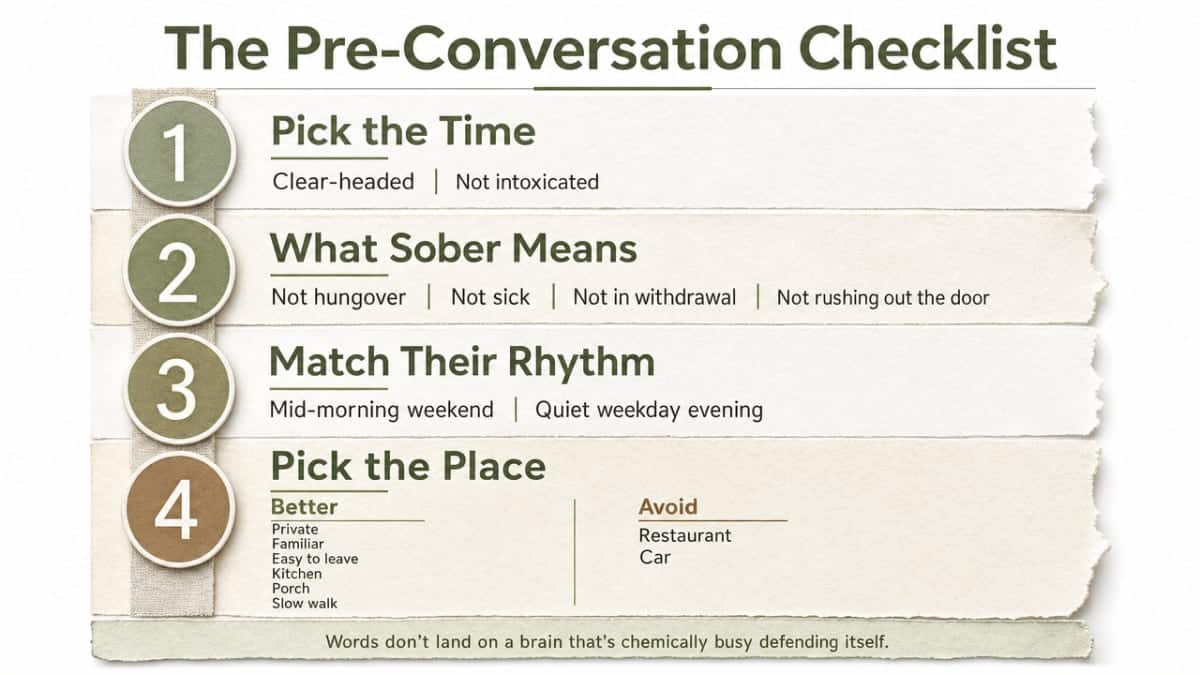
Timing is not a nice-to-have. It is the whole ballgame. NIAAA is blunt about this: don’t try to talk when your loved one is intoxicated 5. The Indian Health Service adds the corollary — don’t argue when they’re high 4. Words don’t land on a brain that’s chemically busy defending itself.
So what does sober actually mean here? Not just “not currently drinking.” You want a window where they’re clear-headed, not hungover, not sick, not sliding into withdrawal, not rushing out the door. For a lot of people that’s mid-morning on a weekend, before the day gets loud. For others it’s a quiet weekday evening after dinner. You know their rhythm better than any article does.
Also pick a place. Somewhere private, familiar, and easy to leave — your kitchen, a porch, a slow walk. Not a restaurant. Not the car (nobody wants to be trapped in a moving vehicle for this). Not in front of their kids or their friends.
And give it time. A rushed conversation feels like an ambush. A conversation that has room to breathe feels like love.
Gather Two or Three Specific Observations, Not a Case File
This part is where a lot of families accidentally sabotage themselves. You’ve been watching this unfold for months, maybe years. You could produce a dossier. Please don’t.
SAMHSA’s guidance is to express concern with specific examples, not accusations or labels 1. Two or three is the sweet spot. More than that and you’re building a prosecution — and they will hear it as one, no matter how gently you talk.
Pick things you personally saw. Not what their coworker told you. Not what you found on their phone. Concrete, recent, first-person:
- “You slept through Sam’s birthday party on Saturday.”
- “I noticed the bottle in the garage was full Monday and empty Wednesday.”
- “You’ve called out of work three times this month.”
Notice what those have in common. No adjectives. No “always” or “never.” No diagnosis. Just what you saw, when you saw it. That is much harder to argue with than “you’re out of control,” and it keeps the conversation about behavior you can both name — which is exactly the neutral, non-judgmental frame the research keeps pointing to 1.
Know the Treatment Options Before You Open Your Mouth
Here’s a moment nobody warns you about. Your loved one says yes. Or a soft, tired version of yes — “okay, maybe.” And you have nothing to hand them. The window closes.
Come prepared. SAMHSA and NIAAA both tell families to know the landscape before starting the conversation 1, 5. You don’t need to be a clinician. You need to know, at minimum:
- That residential rehab exists (typically 30–90 days, live on-site).
- That outpatient options exist — partial hospitalization (PHP) and intensive outpatient (IOP) — for people who can’t leave home or work.
- That dual-diagnosis programs treat addiction and underlying conditions like depression, anxiety, or trauma at the same time. This matters more than most families realize.
- One or two actual programs you’ve looked at, with a phone number saved in your phone.
Have the safety-net numbers ready too. SAMHSA’s National Helpline, 1-800-662-HELP, is free, confidential, and open 24/7 for treatment referrals 6. 988 is the crisis line if things go sideways. The SAMHSA family guide is explicit that helping locate resources is part of the conversation, not a follow-up task 3.
If they say yes at 8 p.m. on a Tuesday, you want to be able to say, “I already called a place. They can talk to you tomorrow morning.” That sentence changes outcomes.
Prepare Yourself Emotionally — Your State Is Half the Conversation
Nobody talks about this part, and it’s the part that decides how the whole thing goes. If you walk in shaking with months of stored-up anger, or crying so hard you can’t finish a sentence, the message doesn’t land. The message becomes your feelings, and your loved one will either try to manage you or shut down entirely.
That doesn’t mean you have to be a robot. It means you need a beat to settle before you sit down. A few things that actually help:
- Write down what you want to say. Not to read aloud — to get it out of your head so you’re not performing it in the moment.
- Talk to someone first. A therapist, a friend who’s been through it, a family support group. SAMHSA specifically points families toward their own support as part of this process 3, 7.
- Decide what you’re not going to do. No ultimatums (unless safety is on the line). No dragging up 2019. No “after everything I’ve done for you.”
- Eat something. Sleep if you can. Sounds trivial. Isn’t.
You are not going to be perfect at this. You’re going to say something you wish you hadn’t. That’s okay. What matters is that you show up regulated enough to actually listen when they answer.
The Opening: Sentence Stems That Actually Work
Lead With What You’ve Noticed, Not What They’ve Done
You’ve rehearsed this. You know the danger of the wrong first sentence — the one that turns the whole talk into a fight before either of you has taken a breath. So here’s the rule that carries most of the weight: start with what you noticed, not what they did wrong.
SAMHSA’s language guidance is clear on this. Neutral, non-judgmental, specific 1. IHS puts it as a hard don’t: don’t preach, don’t threaten, don’t lean on emotional appeals that pile guilt on top of what’s already there 4. That rules out most of what you’ve probably wanted to say.
What actually works sounds more like this:
- “I’ve noticed you haven’t been sleeping. Can we talk?”
- “I’ve been worried about you. I want to say why, and then I want to hear you.”
- “Something’s been on my mind. I’d rather bring it up than keep sitting on it.”
Compare that with the sentences that shut the door before it opens:
- “You’re an addict and you need to admit it.”
- “After everything I’ve done for you, this is what you do?”
- “If you don’t get help, we’re done.”
The first set names something real without naming them as the problem. The second set assigns a label and delivers a verdict. One invites a conversation. The other invites a defense.
Ask Open Questions and Then Actually Listen
After you name what you’ve noticed, stop talking. This is the part that feels impossibly hard when you’ve been holding it in for months, but it’s the part that changes the outcome.
Ask an open question. Not yes-or-no. Not a trap. Something like:
- “How are you doing, really?”
- “What’s been going on for you lately?”
- “Have you thought about talking to someone?”
SAMHSA specifically points families toward asking whether the person has thought about getting help and offering to help find it 1. The reason this framing works isn’t magic. It’s the same principle behind motivational interviewing — the clinical approach with randomized-trial evidence for reducing drug and alcohol use, built on collaboration, open questions, and respect for the other person’s autonomy 9. When someone feels asked instead of told, they’re more likely to say something true.
Then listen. Not the version where you’re mentally loading your next sentence. Actual listening. Let there be silence. Let them cry, or get quiet, or say something that stings. Nod. Say “okay.” Say “that makes sense.” Whatever comes out of their mouth is information you didn’t have five minutes ago.
Name What You’re Asking For — Specifically
At some point in the conversation, you have to say the word. Not as a threat. As a door.
Vague asks give vague answers. “You need help” is not something anyone can actually respond to. “I’d like you to call this treatment center with me tomorrow morning” is. So is “There’s a program that treats the anxiety and the drinking together — will you look at it with me?”
This is why the pre-conversation homework matters so much. If you know one residential program, one outpatient option, and one dual-diagnosis center — with a phone number ready — you can name the exact next step instead of gesturing at an abstract idea 1, 5. NIAAA is direct that families should come to the conversation prepared with treatment information so the ask has somewhere to land 5.
Small, concrete, and yours to help with. That’s the shape of an ask someone can actually say yes to.
When They Push Back: Denial, Anger, and the Silent Treatment
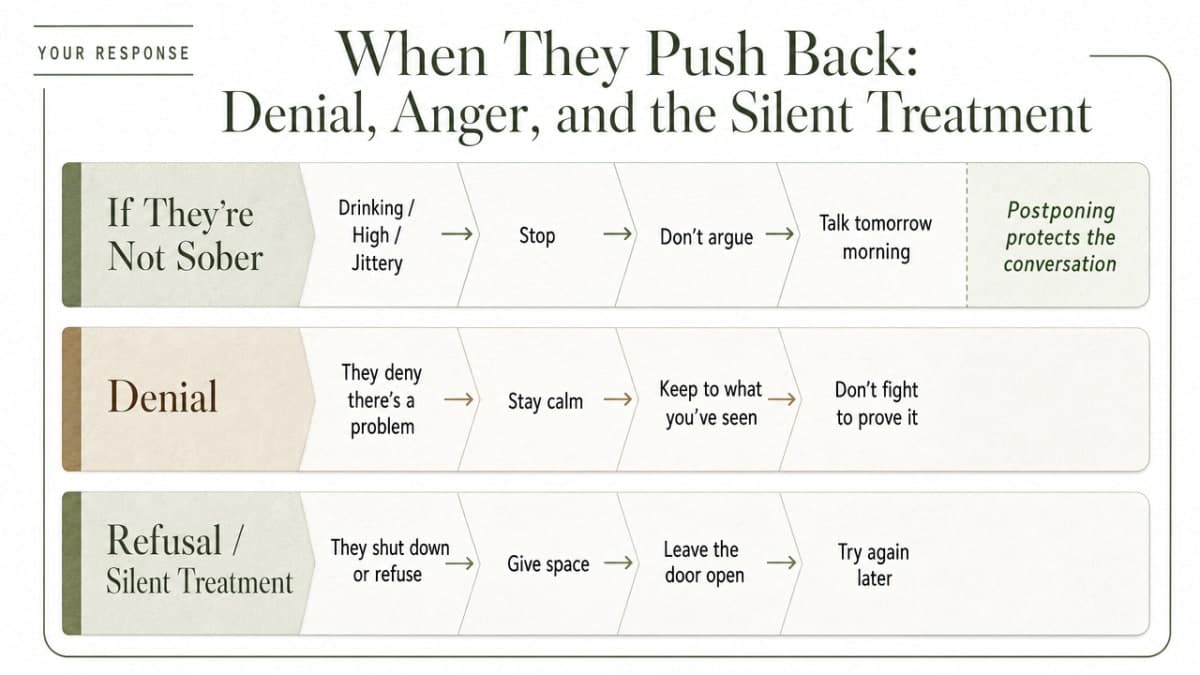
If They’re Not Sober, Stop the Conversation
Sometimes you sit down for the talk and realize, ten seconds in, that they’ve already been drinking. Or they’re high. Or they’re somewhere in that jittery in-between where nothing you say is going to reach them.
Say something small and true. “I want to talk about this, but not right now. Can we do it tomorrow morning?” Then let it go for the night. Postponing is not losing. It’s protecting the version of this conversation that actually has a chance.
When They Say ‘I Don’t Have a Problem’
They will probably say it. Some version of it. “I don’t have a problem.” “I can stop whenever I want.” “You’re overreacting.” “Everyone drinks like this.” It stings, especially when you’ve spent weeks working up the nerve to speak.
Don’t argue the label. That’s the trap. The moment you say “yes you do,” you’re in a debate about a word, and the specific things you noticed disappear.
Go back to what you saw. Calmly. “Okay. I hear you. I’m still worried about the sleeping. I’m still worried about Saturday.” You’re not conceding anything. You’re refusing to fight about vocabulary while holding onto the observations SAMHSA’s guidance told you to lead with in the first place 1. IHS puts the flip side plainly: don’t preach, don’t threaten, don’t stack guilt on top of what’s already there 4.
You can also ask instead of tell. “What would it take for you to feel like something needed to change?” That question respects their autonomy — which is exactly the motivational interviewing principle the trial evidence supports as a way to move someone toward reducing use 9. It’s a longer game than winning the argument. It’s also the game that actually works.
When the First Conversation Fails — Because It Usually Does
Here’s the part nobody prepares you for. You do everything right. Sober timing. Specific examples. Person-first language. Open questions. And they still say no. Or they say yes and then don’t call. Or they walk out of the room.
You have not failed. This is what change actually looks like. SAMHSA is explicit that recovery is a process and that families should keep offering support, keep the door open, and understand you cannot force someone into help unless there’s immediate risk of harm 2. One conversation is rarely the conversation. It’s the first one.
The research backs this up in a way that should take some weight off your shoulders. Family-based approaches like CRAFT — Community Reinforcement and Family Training — work precisely because they treat family communication as an ongoing pattern, not a single ambush 11. And the broader systematic review of family-based interventions found that engaging family members reduces substance use and improves family functioning over time 10. Over time. Not in one night.
So circle back in a week. Or three days. Bring one new observation. Ask one new question. The message you’re sending, again and again, is: I see you, I’m not going away, and there’s a door here whenever you’re ready to walk through it.
The Underneath Part: Trauma, Anxiety, and Dual Diagnosis
Here’s something that might change the whole conversation you’ve been rehearsing. The drinking, the pills, the disappearing for days — a lot of the time, that’s not the actual problem. It’s the coping mechanism. Underneath is something older and quieter: unprocessed trauma, an anxiety disorder that never got named, a depression that started long before the first drink.
This matters because it changes your ask. “Stop drinking” is a demand that ignores why they started. “Get help for what’s underneath” is an invitation that meets them where they actually live. Most people know, on some level, that the substance isn’t the whole story. When you name that out loud, it can land in a way pure abstinence talk never does.
You don’t need to play therapist. You just need to leave room for it. Try something like: “I don’t think this is really about the drinking. I think something’s been hurting for a long time.” Or: “Whatever started this, I want you to have help with all of it — not just the part everyone sees.”
This is also why the treatment option you bring to the table matters. Programs that treat substance use and co-occurring conditions — depression, anxiety, PTSD, eating disorders — at the same time are built for exactly this. Dual-diagnosis and trauma-informed care aren’t clinical jargon; they mean the program won’t hand your loved one a sobriety plan and ignore the reason the drinking started. Sunflower Recovery Center in Kansas is one option built around that integrated model, but the broader point is the same wherever you look: knowing to ask for it puts you ahead of most families walking into their first phone call.
What to Do If Safety Is on the Line
Most of this article is about patience — sober timing, repeated conversations, the long game. This section is not that. If your loved one is in immediate danger, the rules change.
Call 911 for a medical emergency. Call or text 988 for suicide or mental health crisis. Keep naloxone in the house if opioids are anywhere in the picture — and know how to use it before you need it.
Once the immediate danger passes, SAMHSA’s National Helpline at 1-800-662-HELP is available 24/7 and confidential for treatment referrals when they’re ready to talk about what comes next 6. Your safety counts here too. Leave the room, leave the house, call someone. The conversation about rehab can wait. Staying alive cannot.
After Yes: The First 72 Hours
They said yes. Or the tired, half-yes that counts as yes. Whatever you do in the next three days matters more than the conversation you just finished.
The first thing: don’t leave the room emotionally. This is when a lot of families exhale, step back, and give their loved one “space to process.” Space is where second thoughts live. Stay close without hovering. Sit with them. Make food. Watch something dumb on TV. Presence is the point.
The second thing: make the call together. If you did your homework, you have a number saved. Dial it while you’re both still sitting down. If you don’t, SAMHSA’s National Helpline at 1-800-662-HELP is 24/7 and confidential, and they can walk you through residential and outpatient options in real time 6. Speakerphone is fine. Let your loved one hear that the people on the other end are calm and used to this call.
The third thing: handle the logistics they can’t. Pack the bag. Call the employer with a vague “medical leave” line. Arrange the ride. Feed the dog. Every barrier you clear is one fewer reason for the yes to unravel before intake.
Expect wobble. Ambivalence is not betrayal — it’s the shape of change 2. Keep going.
Taking Care of the Person Who Started the Conversation
You. This part is about you.
You’ve been carrying this for a long time. The 3 a.m. thoughts, the rehearsed speeches in the shower, the phone checks, the pretending everything’s fine at work. Whether your loved one said yes, said no, or said nothing at all, you are exhausted in a way that doesn’t show up on the outside.
SAMHSA’s family guide is explicit that supporting a loved one through this includes taking care of yourself — family support groups, your own therapist, learning as much as you can so you’re not doing this on adrenaline alone 3, 7. Al-Anon, Nar-Anon, and community family programs exist because thousands of people are sitting exactly where you’re sitting tonight.
Give yourself credit for what you already did. You started the conversation. Most people don’t. That took courage, and it counts, whatever happens next.
Speak to Someone Who Truly Understands Recovery
Connect with a caring expert who’ll guide you through the next steps for your loved one’s healing.
Frequently Asked Questions
What if my loved one refuses to talk about rehab at all?
Refusal is not the end of the road. SAMHSA frames recovery as a process and tells families to keep offering support without forcing the issue, unless there’s immediate risk of harm 2. Circle back in a few days with one new observation. Keep the door open. Repeated, calm conversations move the needle more than any single confrontation.
Should I stage a formal intervention with family and friends?
Probably not. NIAAA specifically warns against ganging up on the person or backing them into a corner, because it triggers defense instead of openness 5. A one-on-one conversation, when they’re sober, with someone they trust, tends to work better than a group ambush. Save the wider circle for support after they say yes.
When is the right time to bring up rehab?
When they’re sober, rested, and not rushing somewhere. NIAAA is direct that intoxicated moments are the wrong ones 5, and IHS adds that arguing while someone is high goes nowhere 4. Pick a quiet, private setting with room to breathe — a morning at home works better than a night out or a hallway conversation.
What should I do if they get angry or shut down?
Don’t match the energy. Go back to what you saw, calmly, and skip the argument about labels. IHS warns against preaching, threatening, or piling on guilt when someone pushes back 4. Ask an open question instead: “What would need to change for you to want help?” That respects their autonomy and keeps the door open 9.
Do I have to wait until they hit rock bottom?
No. The Indian Health Service says this plainly: don’t wait for your loved one to hit bottom 4. “Rock bottom” is a TV idea, not a clinical one, and waiting can mean waiting through an overdose or worse. Earlier conversations, grounded in specific observations, give someone a chance to change before things get dangerous.
What if my loved one also has anxiety, depression, or trauma?
Then a dual-diagnosis program matters. Substance use often sits on top of untreated mental health conditions, and programs that treat both at once are built for exactly that. Frame the ask around getting help for what’s underneath, not just stopping the drinking or using. Sunflower Recovery Center’s trauma-informed model in Kansas is one option built around this integrated approach.
References
- How to Talk to Someone About Help For Mental Health, Drug, or Alcohol Issues. https://www.samhsa.gov/find-support/helping-someone/how-to-talk-to-someone-about-help
- Mental Health, Drug, or Alcohol Issues: How to Help Someone. https://www.samhsa.gov/find-support/helping-someone
- Helping a Loved One Dealing with Mental and/or Substance Use Disorders: Family Guide. https://www.samhsa.gov/sites/default/files/samhsa_families_family_support_guide_final508.pdf
- Information for Family and Friends. https://www.ihs.gov/asab/familyfriends/
- Starting the Conversation | Alcohol Treatment Navigator. https://alcoholtreatment.niaaa.nih.gov/support-through-the-process/starting-the-conversation
- National Helpline for Mental Health, Drug, Alcohol Issues. https://www.samhsa.gov/find-help/helplines/national-helpline
- Helping Families Cope with Mental Health and Substance Use Issues. https://www.samhsa.gov/mental-health/children-and-families/coping-resources
- Parent Resources: Talk. They Hear You.. https://www.samhsa.gov/substance-use/prevention/talk-they-hear-you/parent-resources
- Motivational interviewing for substance abuse. https://pmc.ncbi.nlm.nih.gov/articles/PMC8939890/
- Family-based interventions for substance use: A systematic review of randomized controlled trials. https://pmc.ncbi.nlm.nih.gov/articles/PMC13068785/
- Family-based interventions for substance misuse. https://pmc.ncbi.nlm.nih.gov/articles/PMC4150116/