
Key Takeaways
- Medical detox in the Kansas City metro is a short, medically staffed stabilization process, typically three to seven days, and is not the same as addiction treatment 9.
- Missouri regulates three certified detox levels, with medically monitored inpatient withdrawal management capped at 16 beds and a five-day stay, making early intake calls essential 1, 2.
- Withdrawal risk varies by substance—alcohol and benzodiazepines can trigger seizures, while opioids raise overdose risk after tolerance drops—so clinician-guided placement matters more than personal preference 15, 11.
- Before choosing a program, compare psychiatric assessment access, trauma-informed staffing, and the facility’s linkage plan into residential or outpatient care after discharge 5, 13.
The 2 a.m. Decision: What Medical Detox Actually Is
If you are reading this at 2 a.m. with your phone light dim and a glass of something you swore you wouldn’t touch again beside you, take a breath. You are not the first person in Kansas City to sit in this exact chair, and the fact that you are looking things up instead of looking away already counts for something.
Medical detox is a short, medically staffed process that safely guides individuals through withdrawal. It is distinct from rehabilitation and does not offer a cure for addiction. Federal guidance from SAMHSA clarifies that detoxification involves interventions to manage acute intoxication and withdrawal, but it is not, on its own, substance abuse treatment 9. This distinction is crucial, as many mistakenly believe that surviving the initial withdrawal period signifies the end of their journey. Detox serves as the initial step, opening the door to comprehensive treatment.
During detox, a nurse or physician conducts an evaluation, and vital signs are monitored continuously. Medications are administered when appropriate for the specific substance and withdrawal severity to prevent symptoms from becoming dangerous 1. Conversations about subsequent treatment begin, emphasizing that the purpose of detox is to stabilize individuals so they can transition into a program that addresses the underlying addiction.
You do not have to make every decision tonight. You just have to know what this step is.
Detox Is a Bridge, Not the Destination
Medical detox functions as a bridge, connecting an individual’s current state with the path to recovery. It is a brief, structured process designed to safely navigate the acute phase of withdrawal. It is not, however, the final destination of recovery.
Detox provides a safe, clear-headed period to plan the next steps. This is invaluable. One cannot effectively choose residential care while experiencing active withdrawal, much like one cannot undergo surgery while in an ambulance. The bridge of detox exists to enable the commencement of genuine recovery work on the other side.
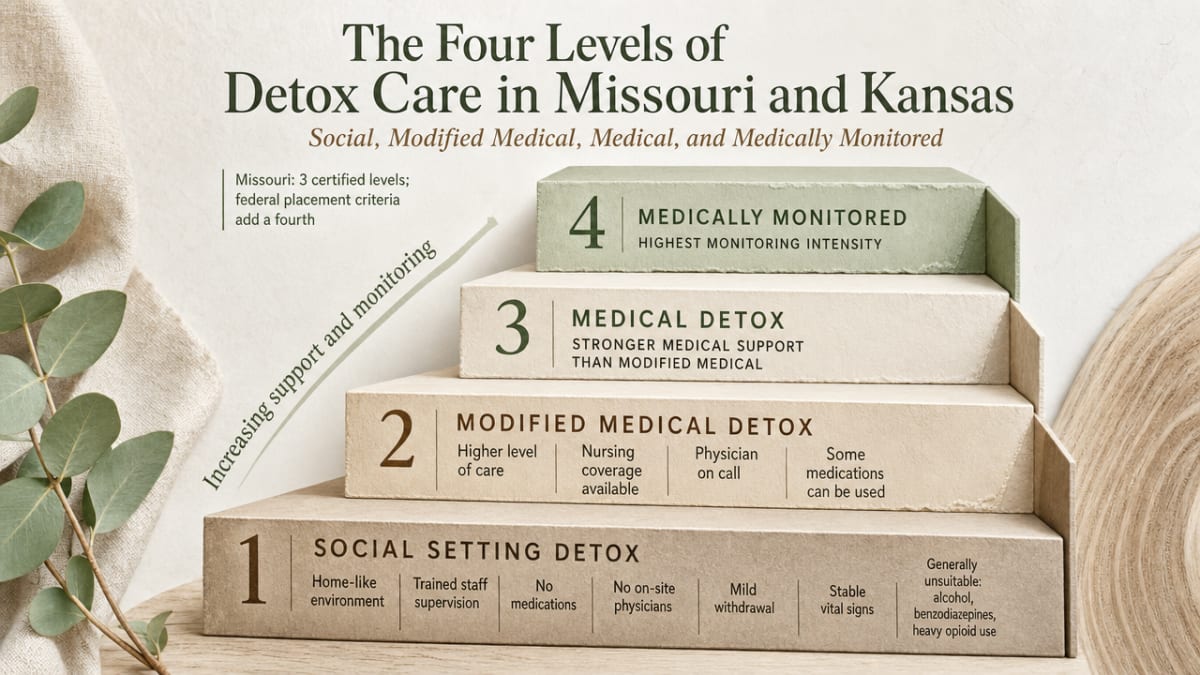
The Four Levels of Detox Care in Missouri and Kansas
Social, Modified Medical, Medical, and Medically Monitored: What Each One Means
The term “detox” encompasses a range of services, and understanding the specific level of care is critical for ensuring safety and effectiveness. In Missouri, three certified levels are outlined in state regulations, with a fourth added by federal placement criteria.
- Social setting detox.
- This level involves no medications or on-site physicians. Trained staff supervise individuals in a home-like environment during withdrawal. Missouri permits this for those with anticipated mild withdrawal and stable vital signs 1. It is generally unsuitable for withdrawal from alcohol, benzodiazepines, or heavy opioid use.
- Modified medical detox.
- This offers a higher level of care, with nursing coverage available and a physician on call. Some medications can be used to alleviate symptoms. It is not a hospital setting 1 and is appropriate for moderate withdrawal in individuals without significant medical or psychiatric complications.
- Medical detoxification.
- This is hospital-based, providing 24/7 medical services. Medications are used as clinically indicated to manage intoxication, impairment, or withdrawal 1. This level is recommended when withdrawal poses risks to cardiac, neurological, or respiratory function.
- Medically monitored inpatient withdrawal management.
- SAMHSA designates this as Level III.7-D: 24-hour medically supervised detox in a freestanding inpatient center 14. In Missouri, these programs are limited to 16 beds, with a maximum stay of five days 2. This five-day limit is intentional, designed to stabilize individuals for transition to subsequent treatment.
How Placement Decisions Actually Get Made
The appropriate level of care is determined by a clinician through an assessment of risk factors, not by personal preference. The assessment considers practical questions: the substance used, quantity, recency of use, history of seizures or delirium tremens during previous withdrawals, pregnancy status, co-occurring medical conditions (e.g., heart disease, uncontrolled diabetes), psychiatric conditions requiring medication, and the availability of sober support at home. Federal placement criteria weigh all these factors when deciding between ambulatory, residential, and hospital-based detox 14.
If you are uncertain about the necessary level of care, you are not expected to determine it alone. An intake phone call with a trained clinician can provide specific guidance after a brief assessment.
Inside the Unit: What the 3 to 7 Days Look Like
Hours 0 to 24: Assessment and Stabilization
The initial 24 hours of detox focus on comprehensive assessment and stabilization. Upon arrival, vital signs are taken, and a detailed intake interview is conducted. This evaluation is critical, as federal detox guidance identifies it as the first of three core components, alongside stabilization and facilitating entry into further treatment 9. Without a thorough evaluation, subsequent care becomes speculative.
Expect questions regarding substance use history (type, amount, frequency, last use), previous withdrawal experiences, seizures, hospitalizations, pregnancy, other medications, mental health history, and post-discharge living arrangements 14. A nurse will measure blood pressure, heart rate, and temperature, and blood samples may be taken. A physician reviews this information to issue medical orders.
Stabilization begins immediately. If vital signs are elevated, or if anxiety, sweating, or tremors are present, medications are administered based on the specific substance and severity of withdrawal 1. Patients receive hydration, nutrition when tolerated, and a bed. The focus is on allowing medical professionals to manage the acute physical symptoms.
Days 2 to 4: Peak Withdrawal and Symptom-Targeted Medication
Days two through four typically represent the peak of withdrawal symptoms. During this period, the body intensely reacts to the absence of the substance, and the primary role of the detox staff is to ensure this experience is manageable and safe.
Medication choices are specific to the substance. For alcohol withdrawal, ASAM recommends risk-stratified care using benzodiazepine protocols for moderate-to-severe symptoms, particularly in inpatient settings for those with significant severity or comorbidities 15. For opioid withdrawal, ASAM guidelines advocate for methadone, buprenorphine, and alpha-2 agonists like clonidine, explicitly advising against abrupt cessation and anesthesia-based ultra-rapid opioid detox due to unacceptable risks 11.
The process is often less dramatic than depicted in media. Nurses regularly check on patients, monitor vital signs overnight, and adjust medication dosages if symptoms intensify. Sleep disturbances and escalating anxiety are also addressed, as staff monitor both physical and emotional well-being 1.
Days 5 to 7: Readiness and the Handoff
By day five, the most intense physical withdrawal symptoms typically subside. Missouri’s five-day cap for medically monitored withdrawal management reflects that the unit’s purpose is stabilization, not addiction treatment itself 2. Prolonging the stay without a plan for subsequent care is not the objective.
This phase focuses on preparing for the transition to ongoing treatment. Federal guidance considers fostering readiness for continued treatment a core component of detox 9. A case manager or counselor discusses residential care options, insurance, transportation, and the specific program that will follow. Completing detox before entering an intensive outpatient program (IOP) ensures a smoother and safer transition 3.
Individuals often feel vulnerable but also clearer than they have in months. This clarity is an opportune moment to commit to the next step in recovery.

What Withdrawal Looks Like by Substance
Withdrawal experiences vary significantly based on the substance used, dosage, duration of use, and individual health factors. While some withdrawals are uncomfortable but manageable at home, others can be life-threatening. Understanding these differences is essential for appropriate care.
Alcohol. Symptoms typically begin 6 to 24 hours after the last drink. Mild withdrawal includes shaking, sweating, and anxiety. Moderate to severe withdrawal can lead to seizures and delirium tremens (DTs), which carry a significant mortality rate. ASAM’s guidelines recommend inpatient care for moderate-to-severe cases and individuals with significant medical or psychiatric comorbidities, with benzodiazepine protocols as the primary pharmacological treatment 15. Heavy, daily drinkers should not attempt to taper alone.
Opioids. Onset depends on the drug: 8 to 24 hours for short-acting opioids (e.g., heroin, oxycodone) and 36 to 72 hours for methadone. Opioid withdrawal is intensely uncomfortable but rarely fatal in healthy adults. The danger lies in the subsequent drop in tolerance, making a return-to-use dose highly susceptible to overdose. ASAM guidance recommends methadone, buprenorphine, or alpha-2 agonists like clonidine over abrupt cessation and explicitly warns against anesthesia-based ultra-rapid opioid detox due to unacceptable adverse event risks 11.
Benzodiazepines. Onset ranges from 1 to 4 days, depending on the drug’s half-life. Similar to alcohol, benzodiazepine withdrawal carries a risk of seizures. Abrupt cessation is unsafe; medically supervised tapers are the standard of care 9.
Stimulants. Cocaine, methamphetamine, and prescription stimulants primarily cause a “crash” rather than life-threatening physical withdrawal. Symptoms include extreme exhaustion, profound depression, sleep disturbances, and intense cravings. There are no FDA-approved medications specifically for stimulant withdrawal; treatment focuses on supportive care, ensuring safety, promoting sleep, and monitoring for suicidal ideation 9.
Kratom and 7-OH. Due to kratom’s partial action on opioid receptors, withdrawal symptoms resemble those of opioid withdrawal: restlessness, muscle aches, gastrointestinal issues, insomnia, and irritability. Symptom-targeted care similar to opioid withdrawal management is appropriate 10.
Polysubstance use. When multiple substances are involved, withdrawal is unpredictable, not merely additive. For example, combined alcohol, benzodiazepine, and opioid use can result in overlapping and staggered withdrawal timelines, necessitating a monitored setting where staff can adapt to shifting symptoms 10.
Why the Mental Health Piece Cannot Be an Afterthought
If substance use has been a coping mechanism, detox will amplify underlying emotional and psychological issues. This often overlooked aspect highlights the importance of integrating psychiatric assessment into the intake process of a well-managed detox unit.
Research indicates that over half of patients admitted to detox settings have at least one co-occurring psychiatric diagnosis, most commonly depression and anxiety 5. This reflects the reality observed by clinicians: the emergence of underlying depression, anxiety spikes as the substance leaves the system, and trauma memories resurfacing when the nervous system is no longer numbed.
Consequently, trauma-informed care must begin on day one. Reviewers of trauma and substance use research note that individuals with significant trauma histories often experience heightened anxiety and dysphoria during withdrawal. This means that staff communication, room environment, privacy protocols, and medication discussions all have clinical significance beyond mere kindness 4.
Practically, inquire whether a detox program offers on-site psychiatric assessment and whether staff are trained in trauma-informed care. This is not being difficult; it is advocating for necessary care.
Why Detox Alone Isn’t Enough — And What Comes Next
Federal guidance supports this perspective. SAMHSA’s opioid-focused guidance from ASAM explicitly states that opioid withdrawal management alone is not a treatment method 11. Similarly, TIP 45 mandates that detox services must prioritize entry into continued treatment, not merely short-term withdrawal management 13. Both expert bodies conclude that detox without a subsequent treatment plan sets individuals up for relapse.
The appropriate next step is often residential treatment, especially when an individual’s history, home environment, or co-occurring conditions require a structured setting. For less severe cases with strong support systems, partial hospitalization or intensive outpatient programs can be effective, but detox should be completed beforehand to avoid managing withdrawal and therapy simultaneously 3. The purpose of a 5-7 day monitored detox stay is to prepare individuals for the actual work of recovery, not to send them home with only discharge papers.
Kansas City-Specific Realities: Access, Regulation, and the Regional Picture
The Kansas City metropolitan area spans a state line, which significantly impacts access to care. In Missouri, detox facilities are licensed under 9 CSR 30-3.120, which defines the three certified levels of care and their corresponding staffing requirements 1. On the Kansas side, the KDHE tracks overdose data, showing that eastern Kansas counties within the KC metro continue to face challenges 8. The Kansas opioid data brief highlights urban counties, including the Kansas City area, as disproportionately affected by opioid-involved overdose deaths 12. These regional complexities can make navigating treatment options more challenging than anticipated.
Capacity is another practical limitation. Missouri caps medically monitored withdrawal management programs at 16 beds, with a five-day maximum length of stay 2. This means that intake calls are crucial, and same-day placement is not always guaranteed. Consequently, a comprehensive handoff plan must be developed during the five-day detox period, not afterward. CDC guidance under Overdose Data to Action encourages local systems to connect individuals from acute care to ongoing treatment before discharge, rather than weeks later 7. When inquiring about detox, ask about the facility’s linkage plan for continued care.
The Sunflower Handoff: From Detox to 60 Days of Residential Care
Sunflower Recovery Center specializes in the crucial phase that follows medical detox. Located in Osawatomie, the residential program offers 60 days of trauma-informed, dual-diagnosis care. This structured environment is designed for the period after physical withdrawal has subsided, allowing the deeper work of recovery to begin. This sequencing aligns with federal guidance emphasizing that detox services should facilitate entry into continued treatment, not conclude after a short stay 13.
Practically, this means that upon calling, Sunflower’s intake team assists in identifying the appropriate detox setting for your situation—whether a hospital-based medical unit for severe alcohol or benzodiazepine withdrawal, or a medically monitored program for moderate opioid or polysubstance use 1. A residential bed at Sunflower awaits after stabilization. The program provides a trauma-informed clinical team, individualized care plans, family programming, and biometric monitoring to track sleep, stress, and heart rate variability as the nervous system re-learns stability without substances.
The 60-day program is a dedicated period where underlying depression, anxiety spikes, and trauma memories that emerge in early sobriety are addressed by clinicians trained to manage these complex co-occurring conditions 4. If you are currently seeking help, consider calling Sunflower Recovery Center to discuss medical detox placement first, followed by admission to their residential program.
Start Your Medical Detox Journey With Support
Connect directly with admissions to safely begin your medically supervised detox in Kansas City.
Frequently Asked Questions
How long does medical detox in Kansas City usually take?
Most medically supervised detox stays range from three to seven days, depending on the substance, severity of withdrawal, and individual health history. Missouri specifically caps medically monitored withdrawal management at a five-day length of stay 2. This duration is sufficient for stabilization but not for comprehensive addiction treatment, serving as a bridge to residential care.
What is the difference between medical detox and residential rehab?
Medical detox focuses on managing the physical symptoms of withdrawal, while residential rehab addresses the underlying addiction. SAMHSA explicitly states that detoxification involves interventions for acute intoxication and withdrawal, and is not, by itself, substance abuse treatment 9. Residential rehab provides therapy, trauma work, and dual-diagnosis care once physical stabilization is achieved. Both steps are necessary, in that order, for comprehensive recovery.
Is it dangerous to try to detox at home from alcohol or benzodiazepines?
Yes, attempting to detox from alcohol or benzodiazepines at home can be extremely dangerous. Moderate-to-severe alcohol withdrawal can lead to seizures and delirium tremens, with ASAM recommending inpatient care for such cases and individuals with significant comorbidities 15. Benzodiazepine withdrawal carries a similar seizure risk. The standard of care involves a medically supervised taper with medications and 24-hour monitoring, not abrupt cessation at home.
What medications are used during medical detox?
Medication protocols vary depending on the substance. For alcohol withdrawal, ASAM guidance supports benzodiazepine protocols tailored to severity 15. For opioid withdrawal, methadone, buprenorphine, and alpha-2 agonists like clonidine are recommended over abrupt cessation, and anesthesia-based ultra-rapid detox is specifically not advised 11. For stimulant withdrawal, care is primarily supportive rather than medication-driven 9. A physician customizes the regimen for each individual.
What happens if I have depression, anxiety, or trauma along with substance use?
It is common for individuals entering detox to have co-occurring mental health conditions. Over half of patients admitted for detox have at least one psychiatric diagnosis, most frequently depression or anxiety 5. A well-managed detox unit conducts a psychiatric assessment during intake and implements trauma-informed practices throughout withdrawal. This is crucial because trauma histories can intensify anxiety and dysphoria as the substance leaves the system 4.
What happens after detox ends, and how do I get into a residential program?
The transition plan should be established during your detox stay. TIP 45 emphasizes that detox must facilitate entry into continued treatment, not merely short-term withdrawal management 13. To arrange placement into a residential program, such as Sunflower Recovery Center’s 60-day program in Osawatomie, contact their intake team before or during detox. They can assist with arranging medical detox first, followed by admission to the residential facility.
References
- 9 CSR 30-3.120 – Detoxification | State Regulations | US Law. https://www.law.cornell.edu/regulations/missouri/9-CSR-30-3-120
- Comprehensive Substance Treatment and Rehabilitation Manual. https://mydss.mo.gov/sites/mydss/files/media/pdf/2023/08/Comprehensive%20Substance%20Treatment%20and%20Rehabilitation%2008%2014%202023.pdf
- Clinical Issues in Intensive Outpatient Treatment. https://library.samhsa.gov/sites/default/files/sma13-4182.pdf
- Trauma and Substance Use Disorders: Implications for Detoxification and Treatment. https://pubmed.ncbi.nlm.nih.gov/28919359/
- Co-occurring Mental Illness and Substance Use Disorders in Detoxification Settings. https://pubmed.ncbi.nlm.nih.gov/32087396/
- Hospitalization for Substance Withdrawal and Mortality Risk: A Cohort Study. https://pubmed.ncbi.nlm.nih.gov/31589016/
- CDC Overdose Data to Action (OD2A) Guidance Document. https://www.cdc.gov/drugoverdose/pdf/pubs/2019-overdose-data-to-action-guidance.pdf
- Overdose Data Dashboard | KDHE, KS. https://www.kdhe.ks.gov/1309/Data-Dashboard
- Detoxification and Substance Abuse Treatment (TIP 45) – NCBI Bookshelf. https://www.ncbi.nlm.nih.gov/books/NBK64115/
- Quick Guide for Clinicians Based on TIP 45: Detoxification and Substance Abuse Treatment. https://nida.nih.gov/sites/default/files/samhsa_detoxification_and_substance_abuse_treatment.pdf
- American Society of Addiction Medicine (ASAM) National Practice Guideline for the Use of Medications in the Treatment of Addiction Involving Opioid Use. https://pmc.ncbi.nlm.nih.gov/articles/PMC4605275/
- Kansas Opioid Dashboard Data Brief (2022) – Kansas Department of Health and Environment. https://www.kdhe.ks.gov/DocumentCenter/View/8220/Kansas-Opioid-Data-2022-PDF
- Chapter: Overview of Detoxification – NCBI Bookshelf (TIP 45). https://www.ncbi.nlm.nih.gov/books/NBK64042/
- Patient Placement Criteria and Levels of Care – NCBI Bookshelf (TIP 45). https://www.ncbi.nlm.nih.gov/books/NBK64111/
- Executive Summary of the ASAM Clinical Practice Guideline on Alcohol Withdrawal Management. https://pubmed.ncbi.nlm.nih.gov/32909985/