
Key Takeaways
- Roughly 26.5% of Missouri adults live with a mental illness each year, and depression and anxiety drive most treatment cases, so seeking care in Kansas City puts you alongside a large local population 12, 13.
- The first two weeks typically move through intake, an introductory therapy session, and, if relevant, a medication conversation, with honest answers being enough to start building a plan.
- Match care to need: weigh CBT, DBT, EMDR, or ACT against your symptoms, and consider stepping from weekly outpatient to IOP, PHP, or residential when between-session functioning slips.
- Before choosing a provider, compare accepted insurance, level-of-care options, and how the program fits Missouri parity protections, since Sunflower serves commercial insurance while community centers cover Medicaid and uninsured pathways 1, 7.
What to Expect in the First Two Weeks of Mental Health Treatment
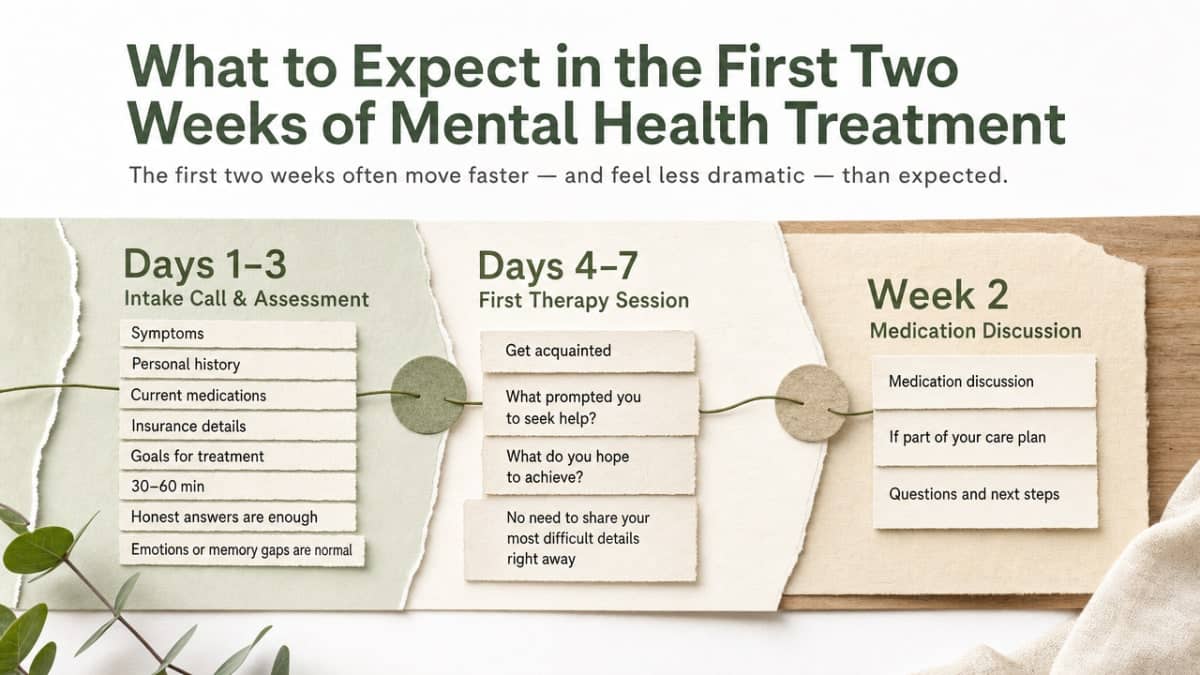
Making the call for mental health support can be the hardest step. Once you do, the initial two weeks often unfold more quickly than anticipated and are less dramatic than portrayed in media.
Days 1–3: The Intake Call and Assessment. A staff member will inquire about your symptoms, personal history, current medications, insurance details, and your goals for treatment. This typically lasts 30 to 60 minutes. There’s no need to have a perfectly articulated story; honest answers are sufficient. Emotional responses or difficulty recalling details are normal and will not disqualify you from care.
Days 4–7: The First Therapy Session. This session is primarily for you and your therapist to get acquainted. Your therapist will ask what prompted you to seek help and what you hope to achieve. You are not expected to share your most difficult memories immediately; sharing one truthful detail is a good start.
Days 8–14: The Medication Discussion (If Applicable). If a prescriber is part of your treatment plan, you will discuss whether medication is a suitable option, not whether it will be mandated. Psychotherapy and medication are the two most common forms of mental health treatment, and either can serve as an appropriate starting point 8.
Taking the step to seek help is significant, and your treatment journey will build from there.
Mental Health Needs in Kansas City
The Scope of Mental Illness in Missouri
If seeking help feels isolating, statistics reveal a widespread need. Approximately 1,248,000 Missouri adults, or about 26.5% of the adult population, experience some form of mental illness annually. Of these, around 301,000 meet the criteria for serious mental illness 12. This significant number indicates that roughly one in four adults you encounter in daily life may be living with mental health challenges.
Focusing on depression, Kansas City’s situation becomes clearer. CDC data from 2024 shows that 23.0% of Missouri adults have received a depression diagnosis at some point, compared to 19% of U.S. adults overall 11. This four-point difference translates to tens of thousands more individuals in the Kansas City metropolitan area who have experienced depression.
The purpose of highlighting these figures is not to reduce individuals to statistics, but to emphasize that the demand for mental health care in this region is substantial. Providers are aware of this need, and your decision to seek help aligns with a common experience, not an unusual one.
Common Reasons for Seeking Treatment
Many individuals harbor a quiet fear when making their first call: Is my situation serious enough to warrant treatment? State treatment data offers a clear answer.
In fiscal year 2022, over 75,000 Missouri residents received mental health treatment through the Department of Mental Health. Among these, 48.7% were diagnosed with depression, and 34.9% were treated for anxiety or fear disorders 13. Combined, these two categories account for approximately five out of every six individuals in the caseload. Other conditions, such as mood disorders beyond depression, PTSD, and psychotic spectrum conditions, make up the remaining portion.
This data suggests that if you’ve been hesitant to seek therapy, believing your struggles—like a heavy chest, racing thoughts at 3 a.m., or persistent low mood—are not “dramatic enough,” the caseload numbers indicate the opposite. Depression and anxiety are the primary reasons most Missourians seek mental health care.
Therefore, if you are experiencing these challenges, you are joining a large group of people facing similar issues. You are not an exception; you are part of the majority.
Therapeutic Approaches: What Each Modality Offers
Cognitive Behavioral Therapy (CBT): Addressing Thought Patterns
Cognitive Behavioral Therapy (CBT) is a foundational approach in modern mental health care, supported by extensive research, particularly for anxiety treatment. It is frequently recommended by Kansas City clinicians for both depression and anxiety 4.
CBT sessions are practical. You and your therapist will examine specific moments from your week—such as a late-afternoon slump that colored your entire day, interpreting a text as rejection, or experiencing chest tightness during your commute. The process involves deconstructing these moments: identifying the initial thought, observing subsequent actions, and exploring alternative interpretations. You often receive exercises to practice between sessions, like noticing and writing down thoughts, and testing their validity. This “homework” is integral to CBT, as it equips you with tools to apply in your daily life, not just during therapy sessions.
Dialectical Behavior Therapy (DBT): Managing Intense Emotions
Dialectical Behavior Therapy (DBT) was developed for individuals who experience emotions intensely and persistently. If you’ve ever rapidly shifted from feeling fine to furious or overwhelmed within a short period, DBT offers relevant strategies.
Sessions are structured like skills training. You learn concrete techniques to navigate distress without impulsive reactions, to identify and articulate your feelings before they become overwhelming, and to maintain engagement in difficult conversations without withdrawing or escalating. Workbooks and acronyms are common components of DBT.
Some programs combine weekly individual sessions with group sessions where skills are practiced collectively. This integrated approach is crucial to the modality’s effectiveness. If your challenges stem more from the intensity of your emotions rather than specific thought patterns, DBT may be a more suitable fit.
Eye Movement Desensitization and Reprocessing (EMDR): Trauma Processing
Eye Movement Desensitization and Reprocessing (EMDR) may sound unconventional, but it is a structured and effective therapy for many trauma survivors.
During EMDR, you identify a memory that continues to cause distress. Your therapist guides you through brief sets of bilateral stimulation—typically eye movements, but sometimes taps or tones—while you focus on the memory. After each set, you report any shifts in feelings, images, or thoughts.
A key benefit of EMDR is that you do not need to narrate the traumatic event in extensive detail repeatedly, unlike some traditional talk therapies. This is significant for individuals who avoid trauma work due to the difficulty of retelling their experiences. EMDR allows the brain to reprocess traumatic memories without requiring a verbal recounting. Sessions can be emotionally taxing but often lead to a sense of release and resolution.
Acceptance and Commitment Therapy (ACT): Embracing Difficult Experiences
Acceptance and Commitment Therapy (ACT) offers a distinct perspective. Instead of attempting to eliminate painful thoughts or endure them, ACT encourages a different question: What kind of life do you truly want to live, and can you pursue it even while experiencing anxiety?
Early sessions often have a philosophical tone. You clarify your core values—such as being a present parent, engaging in meaningful work, or supporting friends. Then, you examine how much time is spent struggling with internal thoughts rather than moving towards these values. The objective is not to achieve a silent mind, but to build a fulfilling life even when your thoughts are loud.
Understanding Mental Health Medication Options
Common First-Line Medications: SSRIs and SNRIs
If a prescriber suggests medication, they will likely discuss SSRIs or SNRIs. These two classes of medications have strong evidence supporting their effectiveness for depression and most anxiety disorders, making them common first choices for clinicians 4.
SSRIs (selective serotonin reuptake inhibitors) increase the availability of serotonin, a brain chemical, between nerve cells. Examples include sertraline, escitalopram, and fluoxetine. SNRIs (serotonin-norepinephrine reuptake inhibitors) work similarly, but also affect norepinephrine. Common SNRIs include venlafaxine and duloxetine. Both SSRIs and SNRIs are considered first-line treatments for panic disorder, generalized anxiety, and social anxiety 5.
It’s important to understand that these medications are not sedatives, nor are they addictive in the same way benzodiazepines can be. They do not alter your personality. Instead, they aim to establish a more stable baseline for your brain, which can enhance the effectiveness of therapy. Medication and psychotherapy are frequently combined intentionally, as they are the two most common tools in mental health care 9.
Medication Timelines and Potential Side Effects
A common misconception about these medications is that they work immediately. Most SSRIs and SNRIs require four to six weeks to reach their full therapeutic effect. During the initial two weeks, symptoms might even feel worse before improving, with increased anxiety, restlessness, or nausea. This is typically a sign of your body adjusting, not the medication failing.
Side effects are a real consideration and should be discussed. Changes in sleep patterns, appetite, and sexual function are common enough that a good prescriber will address them proactively. If one medication isn’t a good fit, it doesn’t mean all medications are unsuitable. Adjusting the dosage, switching to a different medication within the same class, or trying a different class is a normal part of the process.
Choosing Between Therapy, Medication, or Both
There is no universal “right” answer when deciding between therapy, medication, or a combination. For mild to moderate depression, either an antidepressant or psychotherapy can be an appropriate initial step, with patient preference playing a legitimate role in the decision 6.
In practice, if you haven’t tried therapy and have the capacity for weekly sessions, starting there is a solid choice. If your symptoms are severe enough to hinder your ability to engage in therapy—such as difficulty getting out of bed, concentrating, or functioning at work—medication can provide enough relief to make therapy feasible. For moderate to severe symptoms, or when one approach alone hasn’t been sufficient, combining therapy and medication is often more effective than either treatment in isolation.
You have the right to ask questions, to defer starting medication, and to change your mind about your treatment plan.
When Weekly Therapy Requires More Support
Understanding Levels of Mental Health Care
While one hour of weekly therapy is sufficient for many, it may not be enough for everyone. If you find yourself struggling significantly between sessions, missing work, or feeling that your symptoms are progressing faster than your coping skills, it indicates a need for a higher intensity of care. This is not a personal failing, but rather valuable information about your needs.
Consider mental health care as a ladder, with different rungs representing varying levels of support:
- Weekly Outpatient Therapy: Typically one, sometimes two, sessions per week. A prescriber may be added if medication is part of the treatment plan. This is the starting point for most individuals.
- Intensive Outpatient Program (IOP): Approximately 9 hours of programming per week, usually spread across three sessions of about three hours each. This allows you to maintain your job, home life, and evenings while receiving group therapy, individual therapy, and medication management in a coordinated program.
- Partial Hospitalization Program (PHP): Involves roughly 20 or more hours per week, usually on most weekdays. This is nearly full-time treatment during business hours, with the flexibility to return home at night.
- Residential Treatment: You live at the facility, receiving 24/7 structured care, staff support, and clinical services.
Effective programs at every level share core components: illness management skills, family involvement, medication oversight, and structured therapy, all of which are recognized as evidence-based practices by federal guidance 3.

Sunflower’s Mental Health Track: Bridging the Gap
Sunflower Recovery Center offers a mental health track designed for individuals who need more support than weekly therapy but do not require residential care—filling the middle rungs of the treatment ladder.
The track includes both PHP and IOP levels, allowing the intensity of care to be tailored to your specific needs. PHP provides comprehensive daytime treatment on most weekdays, incorporating structured therapy, skills development, and a prescriber as part of the clinical team. IOP offers a more flexible schedule, allowing you to balance treatment with work or family responsibilities, providing enough support to maintain progress while integrating new skills into your daily life.
Two key aspects of Sunflower’s approach are: first, treatment plans are customized by a multidisciplinary clinical team, rather than using a generic template. Second, Sunflower utilizes Huml Health wearable technology to monitor sleep, stress, and heart rate variability. This data informs adjustments to your treatment plan based on your physiological responses, not solely on self-reported information.
If you are wondering whether Sunflower’s mental health track is the appropriate level of care for your situation, we encourage you to call and inquire.
Indicators for Increased Support
You don’t need to be in crisis to benefit from more than weekly therapy. Here are some common signs that it might be time to consider a higher level of care:
- You feel stable after sessions but experience a significant decline in well-being by mid-week.
- You’ve missed several days of work or school recently due to your symptoms.
- You’ve experienced prolonged periods of disrupted sleep for weeks.
- You find yourself relying on alcohol, food, or excessive screen time to cope in the evenings.
- Your therapist has gently suggested a higher level of care on multiple occasions.
- A loved one has openly expressed concern about your well-being.
These indicators do not signify a failure in outpatient therapy. Instead, they suggest that the challenges you are facing require a greater level of support than one hour a week can provide. Seeking a higher level of care is a proactive step to match resources with your needs.
Navigating Payment for Mental Health Care in Missouri
Concerns about cost often deter individuals from seeking mental health care. It’s important to note that in Missouri, mental health benefits are legally required to be on par with medical benefits. Under state Medicaid parity rules, there are no aggregate lifetime or annual dollar limits on mental health and substance use benefits. Additionally, Missouri does not apply quantitative treatment limits that a plan can override based on medical necessity 7. Commercial insurance plans adhere to federal parity laws, meaning deductibles, copays, and visit limits for therapy generally cannot be more restrictive than those applied to medical services like a knee replacement or cardiology visit.
Practically, this means your insurance card is likely more valuable than you might assume. Most Kansas City providers, including Sunflower Recovery Center, accept commercial insurance. Sunflower does not participate in Medicare or Medicaid; if you have these coverages, the community mental health center network is the appropriate pathway for you 1. Regardless of your insurance type, call the number on your card to inquire about your outpatient behavioral health benefits, and allow the treatment center’s admissions team to handle the benefit verification process. This is their role, not something you need to navigate alone.
Mental Health Resources Beyond Sunflower in Kansas City
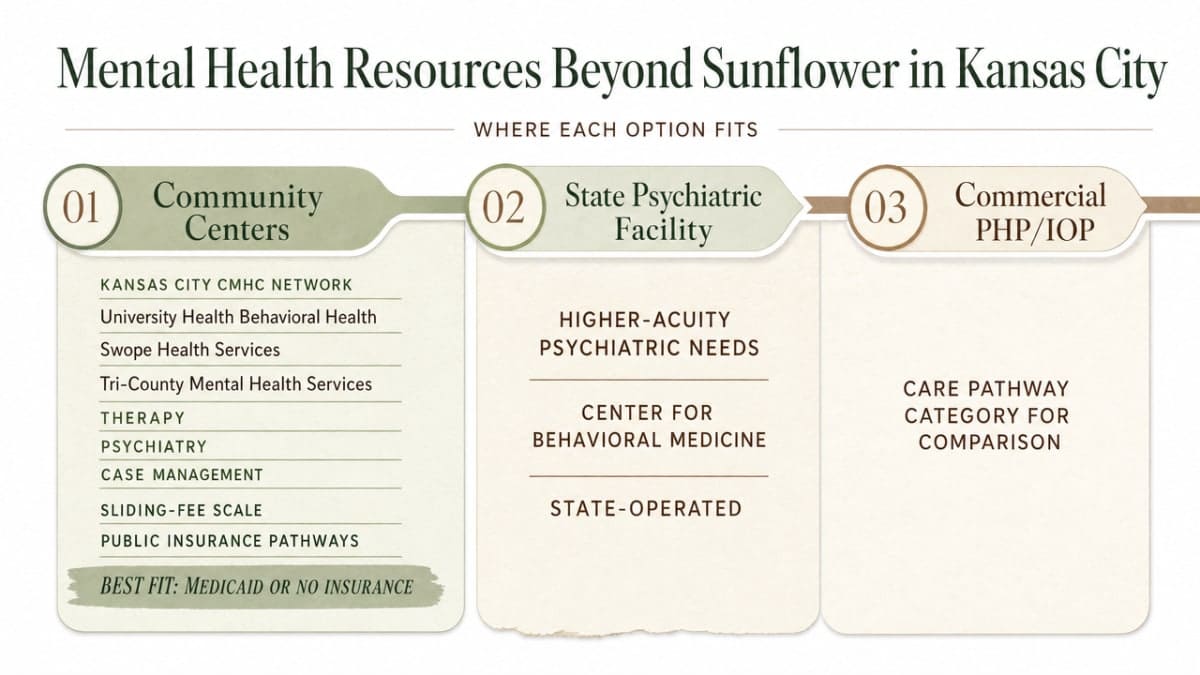
Sunflower is one of several options in the Kansas City metropolitan area, which possesses more mental health infrastructure than many realize. Understanding other available resources is beneficial, especially if your insurance, location, or acuity levels lead you to explore different avenues.
Missouri’s community mental health center network serves the Kansas City area through key providers such as University Health Behavioral Health, Swope Health Services, and Tri-County Mental Health Services. These centers offer therapy, psychiatry, and case management on a sliding-fee scale and through public insurance pathways 1. If you have Medicaid or no insurance coverage, these organizations are designed to meet your needs.
For higher-acuity psychiatric needs, the state operates the Center for Behavioral Medicine on Hospital Hill, which provides comprehensive inpatient psychiatric care 2. This option is for situations where symptoms are severe enough that outpatient or PHP care cannot safely manage them.
Sunflower fits into this landscape as a commercial-insurance-based provider offering PHP and IOP intensity. Our mental health track is available for adults who require more than weekly therapy but do not need psychiatric hospitalization. This provides another distinct choice within the city’s diverse mental health care offerings.
Immediate Support for Crisis Situations
If someone is in immediate danger, call 911 or go to the nearest emergency room. While treatment can begin later, ensuring safety is the first priority.
Speak with someone about starting your care
Get your questions answered and learn what starting mental health treatment here looks like.
Frequently Asked Questions
Will I be forced to take medication if I start mental health treatment?
No. Medication is a conversation, not a condition of care. You can start with therapy alone, and for mild to moderate depression, either psychotherapy or an antidepressant can be a reasonable first step depending on what you prefer 6. If a prescriber suggests medication later, you get to ask questions, say not yet, or change your mind.
How do I know if I need more than weekly therapy?
Watch the week between sessions. If you leave steady and collapse by Wednesday, if you’re missing work, if sleep has been broken for weeks instead of nights, or if your therapist has mentioned a higher level of care more than once — those are signals. Stepping up to IOP or PHP is not a failure. It is the load meeting the right amount of support.
What actually happens at my first appointment?
Mostly questions and listening. A clinician asks about your symptoms, history, medications, insurance, and what you’re hoping treatment can help with. It usually runs 30 to 60 minutes. You do not need a polished story. You do not need to hand over your hardest memory. Answering honestly is enough, and the plan gets built from there over the next session or two.
Does insurance cover mental health treatment in Missouri?
Usually yes. Missouri parity rules require mental health benefits to be treated comparably to medical benefits, with no aggregate lifetime or annual dollar limits on Medicaid mental health coverage and no quantitative limits that a plan can override on medical necessity grounds 7. Commercial plans follow federal parity similarly. Call the number on your card, or let a treatment center’s admissions team verify benefits for you.
Which therapy type is right for me — CBT, DBT, EMDR, or ACT?
Match the modality to the problem. CBT has the strongest evidence for anxiety and works well when specific thoughts drive your days 4. DBT fits when emotions arrive at full volume. EMDR is built for trauma memories you cannot face retelling. ACT helps when you want to build a meaningful life alongside the hard stuff. A good clinician will help you pick — and adjust.
What should I do if I’m in crisis right now?
Call or text 988. That’s the Suicide and Crisis Lifeline, and it is the number Missouri’s crisis system directs people to first 14. A trained counselor picks up. You do not have to be certain you’re in crisis to use it. If someone is in immediate danger, call 911 or go to the nearest emergency room. Treatment can begin tomorrow. Safety comes first tonight.
References
- Community Mental Health Centers | dmh.mo.gov. https://dmh.mo.gov/mental-illness/help-information/community-mental-health-centers
- Center for Behavioral Medicine | dmh.mo.gov. https://dmh.mo.gov/center-for-behavioral-medicine
- Integrated Treatment for Co-Occurring Disorders: How to Use the Evidence-Based Practices KITs. https://library.samhsa.gov/sites/default/files/ebp-kit-how-to-use-the-ebp-kit-10112019_0.pdf
- Treatment of anxiety disorders – PMC – NIH. https://pmc.ncbi.nlm.nih.gov/articles/PMC5573566/
- Pharmacotherapy of Anxiety Disorders: Current and Emerging Treatment Options. https://pmc.ncbi.nlm.nih.gov/articles/PMC7786299/
- Pharmacotherapy for Depression and Anxiety in the Primary Care Setting. https://pmc.ncbi.nlm.nih.gov/articles/PMC9951804/
- mental-health-parity-compliance.pdf. https://dss.mo.gov/mhd/mc/pdf/mental-health-parity-compliance.pdf
- Psychotherapies. https://www.nimh.nih.gov/health/topics/psychotherapies
- Mental Health Medications. https://www.nimh.nih.gov/health/topics/mental-health-medications
- Anxiety Disorders – National Institute of Mental Health (NIMH) – NIH. https://www.nimh.nih.gov/health/topics/anxiety-disorders
- Mental Health Conditions & Care. https://www.cdc.gov/mental-health/about-data/conditions-care.html
- Section A: INTRODUCTION AND HIGHLIGHTS – DMH – MO.gov. https://dmh.mo.gov/sites/dmh/files/media/pdf/2024/12/sr2024-section-a.pdf
- ANNUAL STATUS REPORT ON MISSOURI’S SUBSTANCE USE …. https://dmh.mo.gov/sites/dmh/files/media/pdf/2024/01/sr2023-section-a_1.pdf
- Crisis Services. https://dmh.mo.gov/behavioral-health/treatment-services/specialized-programs/crisis-services