
Key Takeaways
- Physiological dependence on a prescribed medication is a predictable pharmacological response, not a moral failure, and SAMHSA treats screening as a clinical conversation rather than a confession 4.
- Roughly 3.23% of Kansans 12 and older reported past-year prescription pain reliever misuse, and 62% of the state’s 2020-2024 overdose deaths involved opioids — often mixed with other depressants 10, 7.
- The right pathway depends on the drug class: opioids need medications like buprenorphine or methadone, benzodiazepines and Z-drugs require a supervised taper, and stimulants rely on behavioral therapy 1, 2, 5.
- In Kansas, K-TRACS lets prescribers see controlled substance history, so raising the issue first opens the door to a supervised plan — an intake call is the practical next step 9.
When the Bottle Has Your Name On It
Maybe it started after your back surgery. Maybe it was the anxiety that finally got bad enough that your doctor wrote a prescription and said, “Let’s try this.” Maybe it was Adderall for the ADHD you’d lived with since childhood, or a sleep aid after months of staring at the ceiling at 3 a.m. The bottle had your name on it. The instructions were clear. You followed them.
And now something is wrong.
You’re running out early. You’re counting the hours until the next dose. You tried to skip a day and felt like you had the flu, or worse. You’ve started hiding the pill bottle from your spouse, or making a second appointment with a different doctor because the first one asked too many questions. You don’t recognize yourself in any of the addiction stories you’ve seen — no back alleys, no rock bottom, no dramatic origin story. Just a prescription, a diagnosis, and a slow shift you can’t quite name.
If you’re reading this in Kansas, on your phone, at a kitchen table or in a parked car, take a breath. What you’re describing has a name in the clinical literature, and it has a treatment pathway that does not require you to be someone you’re not. SAMHSA specifically separates physiological dependence from moral failure, and the first step in care is a screening conversation, not a confession 4.
You didn’t do anything wrong to end up here. The next right thing is figuring out what kind of help matches what’s actually happening in your body.
Dependence Is Not a Character Verdict
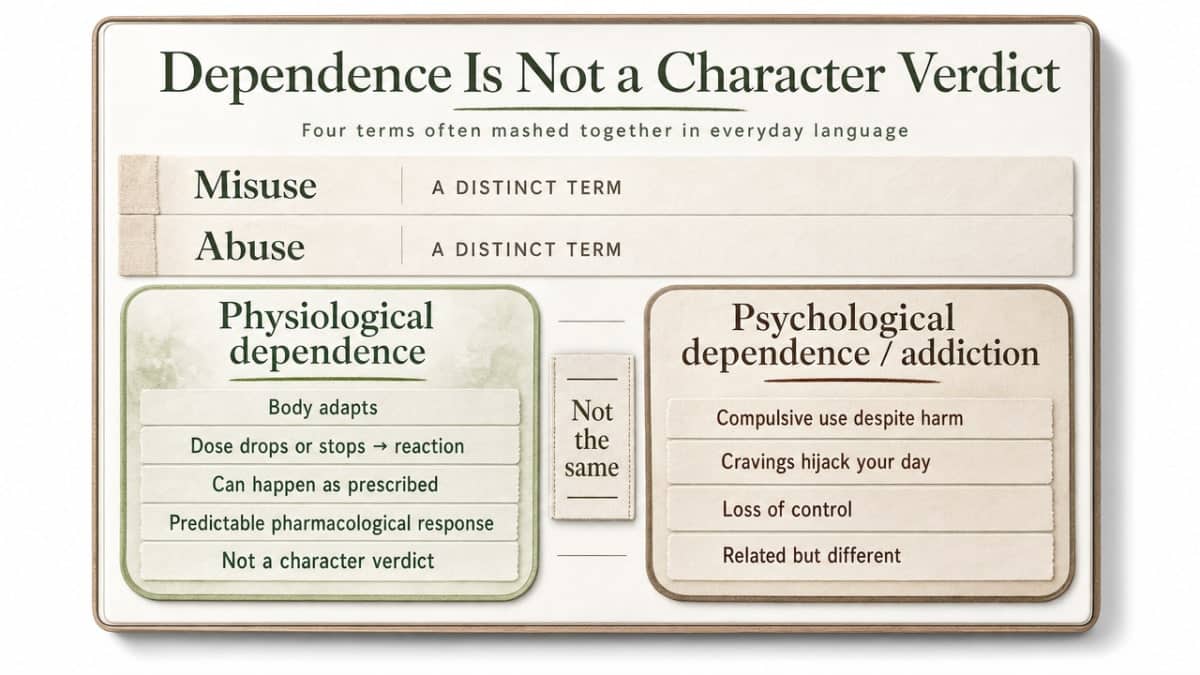
Here’s a distinction that might change how you talk to yourself about this: the clinical world separates physiological dependence from addiction, and they are not the same thing. SAMHSA’s treatment advisory spells out four different terms that often get mashed together in everyday language — misuse, abuse, physiological dependence, and psychological dependence or addiction 4. Physiological dependence means your body has adapted to a medication and will react if the dose drops or stops. That can happen to anyone who takes certain medications long enough, exactly as prescribed. It is a predictable pharmacological response, not evidence of a broken character.
Addiction is a related but different thing — it involves compulsive use that continues despite harm, cravings that hijack your day, and a loss of control that your body-only dependence doesn’t require. The tricky part, the part that keeps people frozen at the kitchen table, is that these can overlap. You can start with pure physiological dependence and, over time, watch it grow into something that looks and feels like addiction. Or you can sit in a gray zone where the two are hard to tell apart without a professional assessment.
That is what a screening conversation is for. SAMHSA’s guidance says the first step is a screening and comprehensive assessment that asks how the medication started, what it’s doing now, and whether other things — anxiety, chronic pain, trauma, depression — are running underneath 4. Nobody is trying to catch you in a lie. The point is to figure out which of the four things is actually happening in your life so the plan matches the problem.
You are allowed to say, out loud, “I took this the way I was told, and something changed.” That sentence is a starting point, not a confession. It’s the same sentence a good clinician will translate into a working diagnosis and a real plan. What you’re feeling is not a verdict on who you are — it’s information about what your body has adjusted to and what kind of help will fit.
How Common This Is in Kansas
You are not the only person at a Kansas kitchen table right now trying to figure out what happened. SAMHSA’s 2022 state survey found that 3.23% of Kansans age 12 and older reported past-year prescription pain reliever misuse 10. “Misuse” in that survey covers taking a medication in a way not directed by the prescriber — a bigger dose, more often, longer than intended, or someone else’s pills. That is a wide definition, and it captures a lot of the quiet in-between behavior that people don’t want to say out loud: the extra pill on a bad pain day, the borrowed Xanax before a flight, the leftover hydrocodone from a dental surgery two years ago.
Put that alongside the national numbers and the picture gets clearer. NIDA reports that in 2021, about 1.3% of Americans age 12 and older misused prescription stimulants in the past year, and roughly 1.4% misused benzodiazepines — around 3.7 million and 3.9 million people, respectively 11. These aren’t people who bought something off the street. They are, in large part, patients whose prescriptions or a family member’s prescription became something more complicated than the label suggested.
Translate the Kansas percentage into people you can picture: a small-town high school gymnasium at full capacity, and then several more like it. That is the scale of Kansans who noticed, in the last twelve months, that their relationship with a prescription medication had shifted. Some are managing it privately. Some are hiding it. Some are reading a page like this one. What matters is that the story you are living has a lot of company in this state — and a lot of clinicians who already know how to help.
Treatment Depends on Which Drug You’re Dependent On
Opioids: Medication Treatment Works, Detox Alone Doesn’t
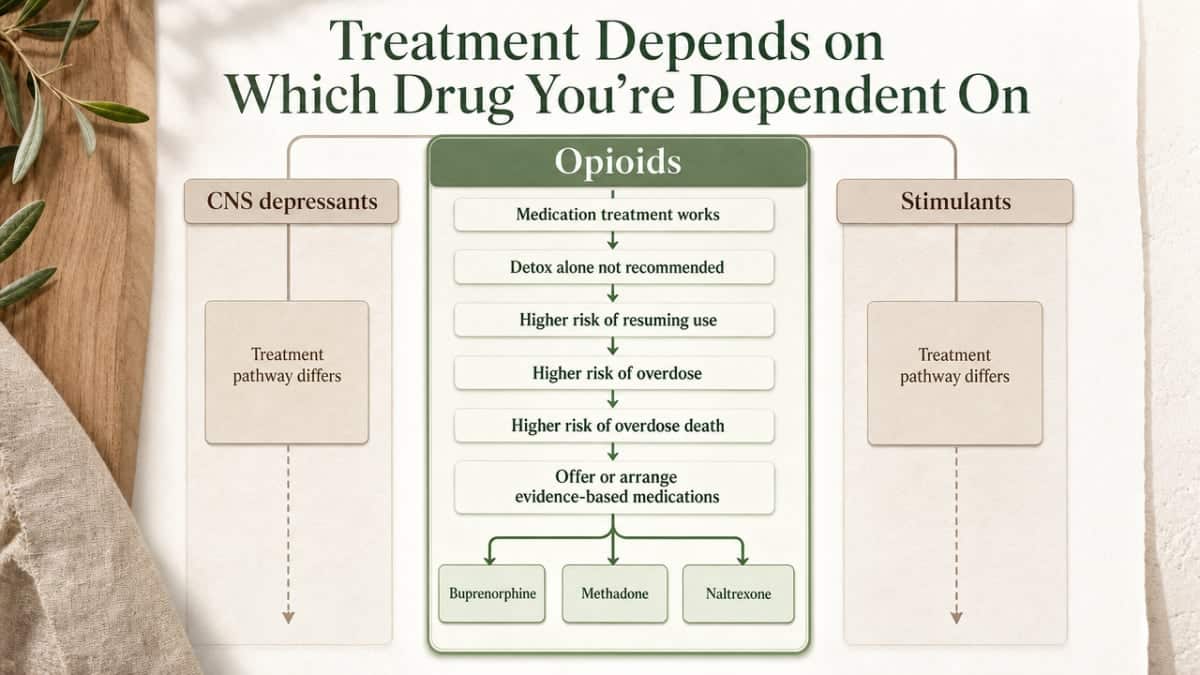
If the medication you’re dependent on is an opioid — hydrocodone after a surgery, oxycodone for a chronic pain condition, tramadol that turned into a daily thing — the clinical answer is pretty settled at this point, and it is not “tough it out.” CDC clinical guidance says clinicians should offer or arrange evidence-based medications for opioid use disorder, and it is direct about the alternative: detoxification on its own is not recommended, because it comes with higher risks of resuming use, overdose, and overdose death 2. That is a plain warning, and it applies just as much to someone whose opioid started in a hospital as to anyone else.
The medications that work are buprenorphine, methadone, and naltrexone. NIDA groups these under the umbrella of medications for opioid use disorder and pairs them with behavioral therapy as the standard of care 1. Buprenorphine in particular has become more accessible in recent years — CDC notes it can be prescribed by any clinician holding a current DEA registration with Schedule III authority 2, which matters if you live somewhere in Kansas without a specialty clinic down the road.
Benzodiazepines, Z-Drugs, and Gabapentinoids: Do Not Quit Cold
Read this part before you do anything: if you’re taking a benzodiazepine — Xanax, Ativan, Klonopin, Valium — or a Z-drug for sleep like Ambien or Lunesta, do not stop on your own. NIDA is unusually blunt about this. Patients dependent on CNS depressants should not stop without medical supervision because withdrawal from these medications can be severe or even life-threatening 1. Seizures, dangerous swings in blood pressure, and delirium are real risks, not scare stories. The bottle in your hand is a legal, prescribed medication, and it can still hurt you badly if you disappear the last few pills over a bad weekend.
The treatment pathway for this class is a supervised taper. That means a clinician gradually reduces your dose on a schedule your body can tolerate, sometimes switching to a longer-acting agent first to smooth the ride. The peer-reviewed guideline on medicines associated with dependence or withdrawal covers this general principle across benzodiazepines, Z-drugs, gabapentinoids like gabapentin and pregabalin, and even certain antidepressants 5. All of these can produce physical dependence, and all of them need a plan, not a cliff.
Behavioral therapy runs alongside the taper. If you started a benzo because of panic attacks or a sleep aid because of insomnia, those problems are still there — the medication was quieting them, not curing them. A good program addresses the underlying anxiety, trauma, or sleep dysfunction while your dose comes down, so you’re not left with the original symptoms and no tools.
If you’re in Kansas and reading this while looking at a pill bottle you were planning to stop tonight: please make one call first. A supervised taper is safer, more comfortable, and far more likely to actually work than trying to power through withdrawal at home.
Prescription Stimulants: Behavioral Therapy Is the Whole Toolkit
Stimulant dependence has a different shape. If your prescription is for Adderall, Vyvanse, Concerta, or Ritalin — often started for ADHD, sometimes for narcolepsy — and something has gone sideways, the treatment picture looks less like the opioid or benzo model. NIDA is straightforward: treatment of prescription stimulant addiction is based on behavioral therapies, and there are no FDA-approved medications for stimulant use disorder 1. There is no buprenorphine equivalent for Adderall. That’s not a gap in your case; it’s a gap in the whole field.
What actually helps is structured behavioral treatment — cognitive behavioral therapy, contingency management, motivational approaches — often combined with careful attention to sleep, nutrition, and the underlying ADHD or attention concerns the medication was originally addressing. Stopping a stimulant abruptly is generally not medically dangerous the way benzo withdrawal can be, but the crash is real: exhaustion, low mood, difficulty concentrating, and a strong pull to use again just to function. A treatment program builds scaffolding around those weeks so you’re not white-knuckling alone.
The practical takeaway across all three drug classes: the plan should match the pharmacology of what you’re actually taking. A generic “detox and go” approach fits none of them well.
The Kansas Overdose Picture and Why Combinations Matter
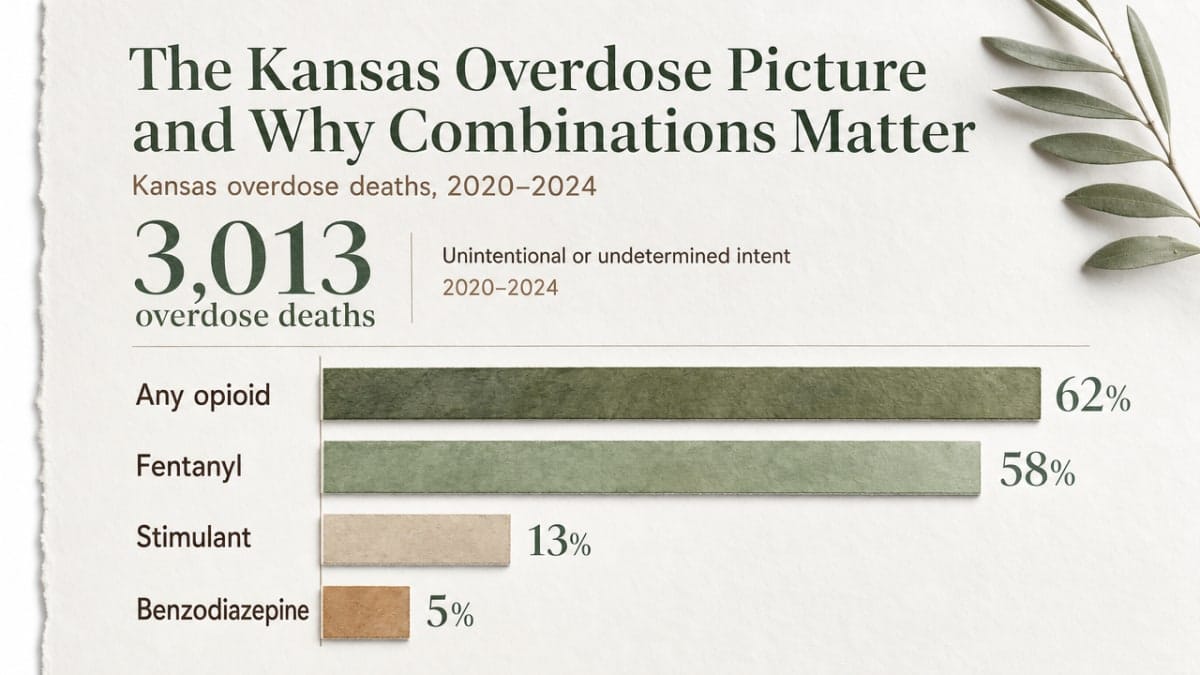
Here is the part of the conversation that is hard to write gently, so it will just be plain: the reason clinicians care so much about which drug class you’re on, and why combinations get flagged fast, is that the fatal risk in Kansas is real and it lives at the intersection of these prescriptions. KDHE recorded 3,013 unintentional or undetermined-intent overdose deaths in Kansas from 2020 through 2024 — roughly 21 deaths per 100,000 people each year 7. That’s not a headline about someone else’s state. That’s your neighbors, the person in front of you at the pharmacy counter, the coworker who quietly stopped showing up.
Look at what was actually in those deaths and the pattern is specific. Of the 3,013:
- about 62% involved any opioid
- 58% involved fentanyl
- 13% involved a stimulant
- 5% involved a benzodiazepine 7
The percentages add up to more than 100 on purpose — many deaths involved more than one substance at once. That overlap is the point of this section.
If you’re taking a prescribed opioid for pain and a prescribed benzodiazepine for anxiety, those two drugs are both slowing your breathing. CDC guidance is specific that clinicians should use particular caution when opioids and benzodiazepines or other CNS depressants are combined 3. Add a Z-drug for sleep, a muscle relaxer, or a couple of drinks on a hard evening, and the math gets worse in a hurry — not because you did anything reckless, but because the effects stack in your body whether you meant them to or not.
The reason this matters for treatment planning, not just prevention, is that a program worth calling will look at your whole medication list before recommending a next step. A supervised taper of one drug while another CNS depressant is still on board is a different clinical picture than tapering in isolation. You don’t have to sort that out yourself. You just have to be honest on the intake call about everything in the cabinet, prescribed or not, so the plan actually fits your body.
K-TRACS, Refill Scrutiny, and What Your Prescriber Sees
If you’ve noticed that refills feel harder to get lately, or your prescriber suddenly asked a lot of questions you’d never been asked before, there’s a database behind that. K-TRACS is the Kansas Prescription Drug Monitoring Program, and since October 1, 2021, Medicaid providers have been required to check it before writing a controlled substance prescription for a Medicaid member — a policy Kansas adopted to align with the federal SUPPORT Act 9. Many non-Medicaid prescribers check it too, as a routine part of prescribing controlled meds.
What that means in practical terms: when your doctor pulls up your record, they can see what controlled substances you’ve been prescribed, by whom, and when they were filled. If you’ve been to more than one prescriber, or filled an early refill, or picked up a benzo from one clinic and an opioid from another, that history is visible in one place. This is not a criminal record and it is not a report to the police. It is a clinical tool.
Here is the part worth sitting with: your prescriber is going to see the pattern eventually. Bringing it up first — before they raise it — changes the whole conversation from “caught” to “asking for help.” A supervised plan, whether that’s a taper, a switch to a medication for opioid use disorder, or a referral to a treatment program, is easier to build when you and your clinician are on the same side of the chart.
What a First Call for Help Actually Looks Like
The picture in your head of a treatment call is probably worse than the real thing. You are not going to be asked to prove you’re an addict. You’re not going to be handed a rehab brochure and told to check in by Friday. The first call is a conversation.
What happens, in practical terms: someone asks how you started the medication, what you’re taking now, how much, how often, what happens when you skip a dose, and whether other things — anxiety, chronic pain, a surgery you never fully recovered from, a stretch of insomnia that never ended — are running underneath. SAMHSA’s advisory frames this as screening and comprehensive assessment, and it specifically includes asking about how the person began using the medication and screening for mental health issues at the same time 4. The point is a match between what your body is doing and what kind of care actually fits.
You can ask questions back. What would a taper look like for me? Do you use medications for opioid use disorder? What insurance do you take? Can I keep working? Will you talk to my prescriber so I’m not caught between two plans? A good intake will answer those without making you feel like you’re being graded.
You don’t have to have your story polished. You just have to be willing to say the true version of one sentence out loud. That’s the whole first call.
Treating the Reason the Prescription Was Written
Here is the piece that gets skipped in a lot of addiction conversations: the medication was doing a job. The opioid was quieting real pain. The benzo was flattening panic attacks that were making it hard to leave the house. The stimulant was letting you focus long enough to keep your job. The sleep aid was giving you five hours instead of two. When the plan is just “come off the medication,” the original problem is still sitting there in the room, waiting.
SAMHSA’s guidance treats this as central, not optional. Its advisory says screening should ask how the person began using the medication and screen for mental health issues at the same time 4. That’s because the anxiety, chronic pain, ADHD, trauma, or insomnia the prescription was written for doesn’t vanish when the pills do. If care doesn’t address the underlying condition, you’re being asked to hold together with willpower what a medication was doing chemically. That rarely lasts.
A treatment plan that actually fits your life looks at both layers. The dependence gets a clinical answer — MOUD, a supervised taper, structured behavioral treatment, whatever your drug class calls for. The original condition gets a real answer too: a pain management approach that isn’t just another opioid, a therapy protocol for panic or trauma, ADHD strategies that don’t rely on the same medication that got complicated. That is the whole point of dual diagnosis care, and it is why the reason the bottle was written matters as much as the bottle itself.
Getting Care in Kansas: Osawatomie, Kansas City, and Next Steps
If you’re weighing what to do next, here is the shape of it. Sunflower Recovery Center is in Osawatomie, with services reaching the Kansas City area, and the programs are built around the exact situation this article has been describing: an adult whose dependence began with a legitimate prescription, and whose original pain, anxiety, trauma, or attention concerns are still part of the picture. Care runs across a continuum — a 60-day residential program, a Partial Hospitalization Program, and an Intensive Outpatient Program — so the level of structure can match your life instead of the other way around. Most commercial insurance is accepted; Medicare and Medicaid are not.
The clinical piece worth naming: treatment here is trauma-informed and dual-diagnosis by design. That matters because the reason the bottle was written matters. A supervised taper for a benzodiazepine paired with real therapy for the panic underneath 1, 5. A medication-supported plan for opioid dependence that doesn’t leave chronic pain unaddressed 2. Behavioral treatment for stimulant dependence that also looks at the ADHD or executive-function piece the prescription was originally aimed at 1. Biometric monitoring through wearable tracking adds a data layer to sleep, stress, and recovery so the plan adjusts to your body, not a template.
One phone call is the whole next step. Not a commitment, not a rehab check-in date — a conversation. You brought yourself this far. That already counts.
Ready for real support? Make the call.
Connect with someone who understands prescription dependence—no judgment, just next steps toward healing.
Frequently Asked Questions
I took my medication exactly as prescribed. How can I be addicted?
You may not be. SAMHSA separates physiological dependence (your body adapting to a medication) from addiction (compulsive use despite harm) — they overlap but aren’t the same 4. Following the label can produce real dependence without any moral failure on your part. A screening conversation is what tells you which one you’re actually living with, and what kind of care fits.
Is it dangerous to stop my benzodiazepine or sleep medication on my own?
Yes. NIDA is direct that people dependent on CNS depressants like benzodiazepines should not stop without medical supervision because withdrawal can be severe or life-threatening 1. Seizures and dangerous blood pressure swings are real risks. A supervised taper — sometimes with a switch to a longer-acting agent — is the safer path. Please make one phone call before that last pill.
Will my doctor cut me off or report me if I ask for help?
K-TRACS is a clinical tool, not a police report 9. And CDC guidance actually warns clinicians against stopping opioids abruptly unless there’s a life-threatening reason 3. Bringing it up first usually shifts the conversation from suspicion to planning — a supervised taper, a referral, or a medication for opioid use disorder 2. You are more likely to keep care by naming it than by hiding it.
What does treatment look like if my problem is with prescription stimulants like Adderall?
Behavioral therapy is the whole toolkit. NIDA notes there are no FDA-approved medications for prescription stimulant use disorder, so treatment relies on approaches like cognitive behavioral therapy and contingency management 1. Stopping isn’t usually medically dangerous, but the crash — exhaustion, low mood, poor focus — is real. A good program builds structure around those weeks and addresses the ADHD or focus concern the prescription was aimed at.
Do I need inpatient rehab, or can I get help while keeping my job and family life?
It depends on your drug class, dose, medical picture, and what’s happening at home. There is a continuum — residential care, Partial Hospitalization Programs, and Intensive Outpatient Programs — so the structure can flex around work and family instead of the other way around. An assessment matches the level of care to your situation. Many people start with outpatient support and never step foot in a residential bed.
What happens if the anxiety, pain, or ADHD the medication was treating comes back?
It probably will, at least at first — the medication was doing a job. SAMHSA specifically says screening should ask why the medication started and screen for mental health issues at the same time 4. Dual-diagnosis care treats both layers: the dependence gets a clinical answer, and the panic, chronic pain, trauma, or attention concern gets its own real plan. You don’t have to hold it together with willpower.
References
- How can prescription drug addiction be treated?. https://www.nida.nih.gov/publications/research-reports/misuse-prescription-drugs/how-can-prescription-drug-addiction-be-treated
- Opioid Use Disorder: Treating. https://www.cdc.gov/overdose-prevention/hcp/clinical-care/opioid-use-disorder-treating.html
- Guideline Recommendations and Guiding Principles. https://www.cdc.gov/overdose-prevention/hcp/clinical-guidance/recommendations-and-principles.html
- Prescription Medications: Misuse, Abuse, Dependence, and Addiction. https://library.samhsa.gov/product/prescription-medications-misuse-abuse-dependence-and-addiction/sma12-4175
- Medicines associated with dependence or withdrawal symptoms. https://pubmed.ncbi.nlm.nih.gov/35609134/
- Kansas Fatal Drug Overdose Vulnerability Assessment. https://www.kdhe.ks.gov/DocumentCenter/View/59744/Kansas-Fatal-Drug-Overdose-Vulnerability-Assessment-PDF?bidId=
- Drug Overdose Deaths in Kansas 2020-2024. https://www.kdhe.ks.gov/DocumentCenter/View/55471/2020-2024-Kansas-Overdose-Deaths-PDF
- Overdose Data Dashboard | KDHE, KS. https://www.kdhe.ks.gov/1309/Data-Dashboard
- Kansas Prescription Drug Monitoring Program. https://www.kdhe.ks.gov/DocumentCenter/View/25811/21169—Medicaid-Required-KTRACS-Lookup-Before-Controlled-Substance-Prescribing-PDF?bidId=
- KANSAS – National Survey on Drug Use and Health (State Estimates). https://www.samhsa.gov/data/sites/default/files/reports/rpt44486/2022-nsduh-sae-state-tables/NSDUHsaeKansas2022.pdf
- What is the scope of prescription drug misuse in the United States?. https://nida.nih.gov/publications/research-reports/misuse-prescription-drugs/what-scope-prescription-drug-misuse