
Key Takeaways
- Impaired control shows up when you repeatedly drink or use more than you planned, a pattern clinicians treat as an early warning sign 8.
- Trying to cut back and not making it stick isn’t a character flaw — it’s a signal that self-management has run out of runway 9.
- Cravings that hum in the background of your day mean the substance has claimed mental real estate willpower alone rarely reclaims 8.
- When work, school, or home responsibilities start taking hits — even quiet ones you’re covering well — the substance is taking a cut you didn’t agree to give it 8.
- Continuing to use while it damages relationships you value points to a widening gap between your behavior and what actually matters to you 9.
- Hobbies, friendships, and routines quietly dropping off the calendar is one of the sneakiest signs, because nothing dramatic marks the exit 8.
- Taking risks your earlier self wouldn’t have taken — driving impaired, mixing substances, using before caregiving — shows the substance is making calls your judgment used to make 8.
- Using despite known physical or mental health consequences, especially alongside anxiety, depression, or PTSD, signals the need for integrated, trauma-informed care 12.
- Needing more of a substance for the same effect means your nervous system has restructured itself around its presence, not that you’re handling it well 8.
- Withdrawal symptoms like shakes, sweats, or racing heart mean physical dependence — and with alcohol or benzodiazepines, stopping alone can be dangerous, making medical detox essential 11.
When Cutting Back Stops Working
You’ve probably tried. Maybe you set a two-drink limit on weeknights. Maybe you moved the vape to a drawer you told yourself you wouldn’t open before noon. Maybe you swapped one substance for another, told yourself kratom or 7-OH was the softer landing, and meant it.
If you’re reading this, some part of that plan didn’t hold. That doesn’t make you weak. It makes you someone whose usual tools have stopped doing the job.
The honest question isn’t “Am I an addict?” That word carries too much weight and not enough information. The more useful question is quieter: is cutting back still working? When repeated, genuine attempts to moderate keep coming apart in the same places, that pattern is itself a sign worth paying attention to 6. Clinicians look for it. So do people who’ve been where you are.
What follows is a walk through nine common signs that professional treatment might be the next step, grouped the way clinicians actually think about them 8. Read it slowly. You don’t need to check every box. You just need to be honest with yourself about which ones sound familiar.
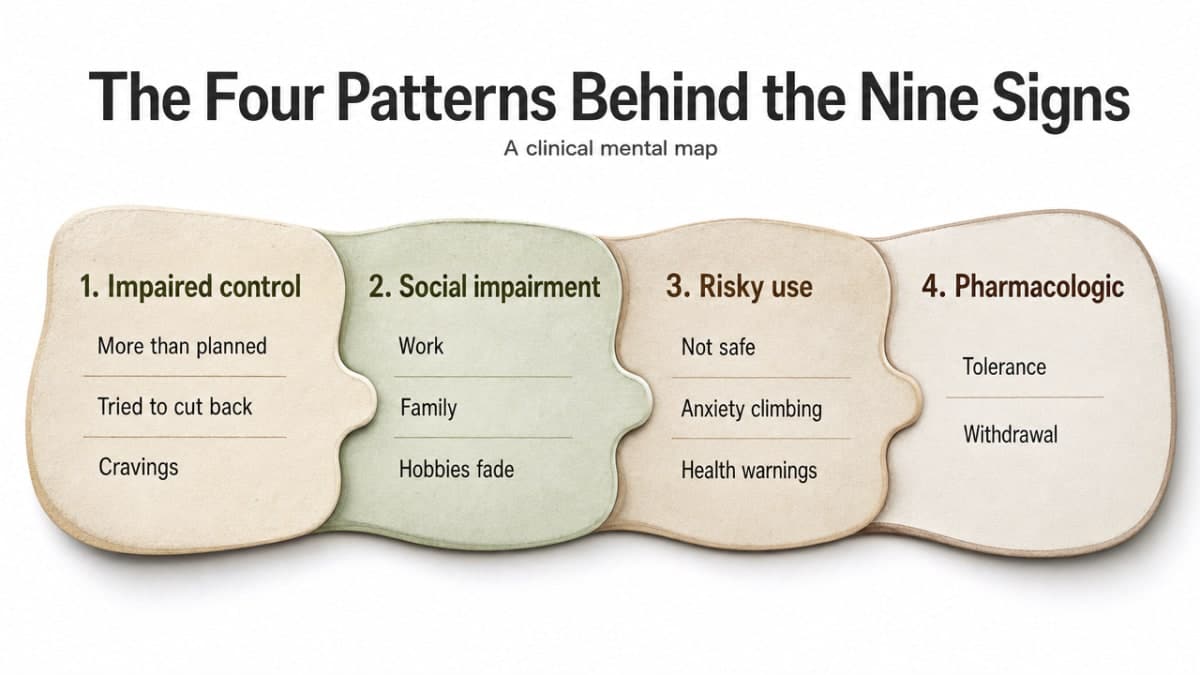
The Four Patterns Behind the Nine Signs
Here’s something that might take some pressure off: the signs of a substance use problem aren’t random. Clinicians don’t sit with a checklist of 30 red flags. They look at four patterns 8.
- Impaired control
- The gap between what you meant to do and what actually happened. Drinking more than planned, trying to cut back and slipping, cravings that won’t quiet down.
- Social impairment
- The way use starts eating into work, family, and the things you used to make time for. Missed shifts. Arguments you keep having. Hobbies that faded out without you noticing.
- Risky use
- Continuing even when it’s clearly not safe, physically or emotionally. Driving after a few. Using while your anxiety is climbing. Knowing your liver panel came back rough and pouring another glass anyway.
- Pharmacologic
- What your body has learned to do. Needing more for the same effect. Feeling sick when you stop.
Count the symptoms you recognize, and you’ll land somewhere on a spectrum: two to three suggests mild, four to five moderate, six or more severe 8. But don’t get stuck on the number. Any of these patterns showing up together is worth taking seriously 9. The nine signs ahead fall into these four buckets. Read them with that map in mind.
Signs Your Control Has Slipped
You Keep Drinking or Using More Than You Meant To
You told yourself two drinks. You had five. You told yourself one hit before bed. You woke up at 3 a.m. remembering you’d taken three more.
This is the sign that hides in plain sight, because from the outside it just looks like a choice. From the inside, it feels different. There’s a moment, usually early, where the plan you set for yourself quietly walks out of the room. You don’t decide to break it. It just stops being the plan.
Clinicians call this impaired control, and it’s one of the first patterns they look at when someone asks whether their use has crossed a line 8. It shows up in NIAAA’s self-check as a straightforward question: in the past year, have you had times when you ended up drinking more, or longer, than you intended 9?
If your honest answer is yes — not once, but as a pattern — that’s information. Not a verdict on who you are. Just information about what the substance is doing that your willpower isn’t overriding.
You’ve Tried to Cut Back and It Hasn’t Stuck
Think about the last time you made a real plan to slow down. Maybe it was a dry January. Maybe it was “only on weekends.” Maybe it was the Sunday morning promise you made to yourself, or to someone you love, that this week would be different.
How long did it hold?
Repeated attempts to cut down — and the fact that they haven’t quite worked — are one of the clearest signals in the entire DSM-5-TR framework 8. NIAAA puts the question this way: more than once, have you wanted to cut down or stop, or tried to, but couldn’t 9? The wording matters. It doesn’t ask whether you succeeded. It asks whether you tried.
Here’s what people miss: the trying is proof of something. It’s proof you already know the use isn’t serving you. It’s proof you’re not in denial. And it’s proof that whatever tool you’ve been using to manage this on your own — discipline, rules, switching substances, tracking apps — isn’t strong enough for what you’re up against 6.
That’s not a personal failing. That’s the definition of when outside help starts to make sense.
Cravings Are Running the Background of Your Day
Craving is the one that’s hardest to explain to anyone who hasn’t felt it. It isn’t wanting a drink the way you want dessert. It’s a pull that sits behind your other thoughts, coloring the meeting, the drive home, the hour before bed.
Sometimes it’s loud. More often, it’s a quiet negotiation you’re barely aware you’re having: how long until, where from, how much is left, who will notice. The DSM-5-TR names craving as its own criterion for a reason — it’s a marker that the substance has claimed real estate in your day-to-day mental life 8.
You might notice it as a specific time (the 5 p.m. tightening in your chest). A specific trigger (a certain person’s text, a certain song). Or just a low-grade static that quiets the moment you use.
If a substance is taking up that much of your attention when you’re not even using it, that’s the substance already at work. And it’s usually the sign that willpower alone has run out of runway 6.
Signs It’s Costing You People and Roles
Work, School, or Home Life Is Taking Hits
There’s a version of this that’s dramatic — the missed deposition, the parent-teacher conference you slept through. But most of the time it’s quieter than that. You’re a beat slower at the morning meeting. You’ve started taking Mondays off more often than you used to. The dishes pile up on a night you would’ve handled them a year ago.
DSM-5-TR names this pattern directly: recurrent use that leads to failing major role obligations at work, school, or home 8. NIAAA frames it as a self-check question — has your drinking or use interfered with taking care of your family, your job, or school 10?
You may be covering well. A lot of people do. You use PTO strategically. You get the deliverable in by 11:59. You tell yourself you’re still functional, and by most outside measures, you are.
But ask yourself what it’s costing to stay functional. If you’re spending more energy managing the fallout than you used to spend doing the actual work, the substance is already taking a cut of your life you didn’t agree to give it 6.
You’re Using Even When It’s Hurting the People You Love
This one is hard to sit with, so take it slowly.
The DSM-5-TR criterion is simple on paper: continued use despite persistent or recurring social or interpersonal problems caused or made worse by the substance 8. NIAAA phrases it as a question you might already have asked yourself in the shower: have you continued to drink or use even though it was causing trouble with your family or friends 9?
In real life, it looks like the argument you keep having with your partner about the same thing. The look your teenager gave you last Thursday. The sibling who’s stopped calling. The friend who said something once, gently, and hasn’t brought it up since — which somehow feels worse.
Here’s what usually gets missed: the people around you aren’t attacking you. Their concern is data. It’s the outside view of a pattern you’re too close to see clearly. Dismissing it — telling yourself they’re overreacting, that they don’t understand the stress you’re under, that they should mind their business — is often the point at which the substance starts protecting itself through you.
If you’re using in a way that keeps costing you the people you love, and you keep using anyway, that gap between your values and your behavior is the sign 6.
Things You Used to Care About Have Quietly Dropped Off
When did you last go for the run? Pick up the guitar? Text the friend group about a Saturday hike?
Giving up or cutting back on important social, occupational, or recreational activities because of substance use is on the DSM-5-TR list for a reason 8. It’s one of the sneakiest signs, because nothing dramatic marks the exit. You didn’t quit the softball league. You just stopped showing up. The book club is still on your calendar. You just haven’t finished a book since spring.
What replaces those activities is usually the substance and the recovery from it — the extra sleep, the hazy afternoon, the evening you needed to unwind because the morning was rough. Over months, this quietly rewrites who you are.
Try a small test. Write down five things that used to matter to you a year or two ago. Not aspirational things — actual things you did. How many of them have you touched in the last thirty days? If the answer is uncomfortable, that’s not a character flaw. That’s the substance taking up the space those things used to fill 6.
Signs You’re Using in Situations That Aren’t Safe
You’re Taking Risks You Wouldn’t Have Taken Before
The person you were five years ago wouldn’t have driven home from that dinner. Wouldn’t have used before picking the kids up. Wouldn’t have mixed the pills with the wine, or taken the edible before the drive, or shown up to work still a little foggy from the night before.
And yet.
Hazardous use — continuing to use in situations where it’s physically dangerous — is on the DSM-5-TR list because it’s one of the clearest signs that the substance is making the calls your judgment used to make 8. NIAAA asks it plainly: have you gotten into situations while or after drinking that increased your chances of getting hurt 9?
The risks don’t always look reckless from the inside. They look like small compromises with yourself. One more before the drive because you feel okay. A vape hit at the top of the stairs. A dose you know is a little more than you should take, on a night you’re already tired.
Each one is a quiet vote against the person you were. If you’re casting those votes more often than you used to, the substance is winning ground you didn’t mean to give it 6.
Your Body or Mind Is Telling You Something and You’re Using Anyway
Your doctor mentioned your liver enzymes. Your sleep has been shredded for months. The anxiety that used to be a Sunday evening thing is now Tuesday, Wednesday, and most of Thursday. You know, somewhere, that the drinking or the use is part of the picture. You do it anyway.
The DSM-5-TR criterion here is continued use despite knowing you have a persistent physical or psychological problem that the substance is likely causing or making worse 8. In plainer language: the evidence is in, and you keep using.
This is where mental health almost always shows up. NIAAA notes that alcohol use disorder frequently co-occurs with depression, anxiety disorders, and PTSD, and that the overlapping symptoms — sleep disturbance, mood changes, concentration problems, suicidal thoughts — tend to get worse, not better, with heavy drinking 12. The same pattern shows up with other substances. NIMH describes the loop directly: mental illness raises the risk of substance use disorder, and substance use disorder raises the risk of mental illness 2.
If you’re using to quiet something — old trauma, panic, grief you never got to sit with — the substance isn’t the whole story. It’s the part of the story you can reach for 7. Treatment that only pulls out the substance and leaves the rest untouched tends not to hold. That’s why integrated, trauma-informed care exists.
Signs Your Body Has Adapted
It Takes More to Feel the Same Thing (Tolerance)
Remember the first time? Two drinks did the whole job. One hit was more than enough. A small dose of kratom took the edge off for hours.
Now the math is different. You need three, then four, to get to the same place. The vape that used to last a week is gone by Thursday. The dose that felt like plenty six months ago barely registers.
That’s tolerance, and it’s one of the two pharmacologic criteria in the DSM-5-TR 8. Your body has adapted. It’s built a resistance to the substance, so it takes more to produce the same feeling — or the same amount produces less of one.
Tolerance isn’t a sign you’re handling the substance well. It’s the opposite. It’s a sign your nervous system has restructured itself around the assumption that the substance will keep showing up. NIAAA lists it plainly in its self-check: in the past year, have you had to drink much more than you once did to get the effect you wanted 9?
If the answer is yes, the substance is already changing you at a level willpower can’t reach.
You Feel Sick When You Stop (Withdrawal)
This is the one that scares people, and it should — but not in the way shame scares. It should scare you toward help, not away from it.
Withdrawal is what happens when the substance leaves and your body, which has been keeping its balance with the substance in the picture, starts firing off alarms. The DSM-5-TR lists a specific cluster of symptoms for alcohol withdrawal:
- tremors
- sweating
- elevated pulse and blood pressure
- insomnia
- anxiety
- nausea or vomiting
- seizures
- and in severe cases, delirium tremens 11
Other substances have their own withdrawal patterns, but the principle is the same. Your body is protesting the absence.
If you’ve ever felt shaky in the morning until you had a drink, sweated through the sheets after a night of not using, felt your heart racing on day two of trying to quit, or reached for the substance specifically to stop feeling sick — that’s withdrawal. It’s a signal that your body has crossed into physical dependence, and it’s the sign where the DIY approach isn’t just less effective. It’s genuinely unsafe.
This is what medical detox exists for. If any of this sounds like you, please don’t white-knuckle it alone. Talk to someone before your next attempt to stop.
What the Underlying Story Usually Is
Somewhere in the middle of reading this, you might have noticed a second layer running underneath the signs. Not just what the substance is doing, but why it got a foothold in the first place.
For a lot of people, the answer isn’t a mystery once they let themselves look at it. There’s an anxiety that never really quieted after a certain year. A grief that got put in a drawer. A childhood you don’t talk about. A period of your life where something happened to you, or around you, that you’ve never fully told anyone.
The research on this is unusually clear. Trauma and PTSD show up alongside substance use disorders often enough that clinicians treat the pair as a rule, not an exception 7. Depression and anxiety travel with heavy substance use in the same way, and the symptoms feed each other — worse sleep, worse mood, worse concentration, and a substance that promises to smooth all of it for a few hours 12. NIMH describes the loop plainly: mental illness raises the risk of a substance use disorder, and a substance use disorder raises the risk of mental illness 2.
If that’s the story underneath your story, pulling out only the substance leaves the wound it was covering. This is why trauma-informed, dual diagnosis care exists — because the substance is usually the last chapter, not the first.
How to Read Your Own Count Without Panicking
If you’ve been mentally tallying as you read, take a breath. The number is useful, but it isn’t the point.
Here’s the framing NIAAA uses, and it’s a kinder one than most people carry in their heads: any of these symptoms can be a reason for concern, and the more of them you see, the more urgent it becomes to make a change 9. Two or three signs sit in the mild range. Four or five, moderate. Six or more, severe 11. That’s the clinical scaffolding.
But severity isn’t a scarlet letter. It’s a signal about how much support the situation probably needs. A mild count doesn’t mean you’re fine and should tough it out — plenty of people at two or three signs are already exhausted from managing this alone. A higher count doesn’t mean you’re broken. It usually means the substance has had more time to dig in, and the road out benefits from more structure.
One more thing worth naming. A lot of people who meet criteria for a substance use disorder never get care, often because they’re waiting for the count to feel bad enough to justify a call 3. You don’t have to earn help by getting worse. You get to make the call at whatever number you’re at right now.
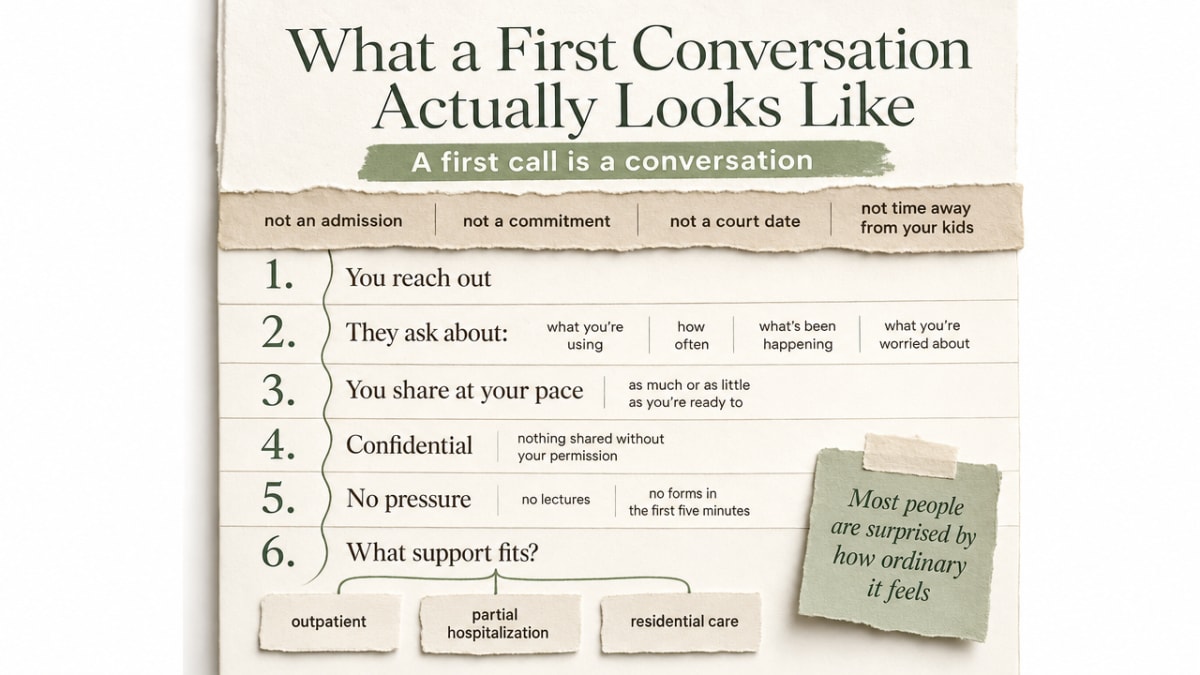
What a First Conversation Actually Looks Like
If you’ve made it this far and something in you is quietly saying yes, here’s what happens next — because the unknown is usually what keeps people from picking up the phone.
A first call isn’t an admission. It isn’t a commitment to residential treatment, a court date, or a stint away from your kids. It’s a conversation. Someone on the other end asks about what you’re using, how often, what’s been happening around it, and what you’re worried about. You can answer as much or as little as you’re ready to. Nothing gets shared without your permission.
Most people are surprised by how ordinary it feels. No lectures. No forms to sign in the first five minutes. Just a person who has heard versions of your story many times before, helping you figure out what level of support actually fits — whether that’s outpatient a few evenings a week, a partial hospitalization schedule, or something more structured if withdrawal or co-occurring depression, anxiety, or trauma is in the picture 12.
If any of this sounds like you, Sunflower Recovery Center offers a free, confidential conversation. One call. No pressure. Just a place to start being honest out loud.
Ready to talk about your next step?
Connect with someone who understands and can help you start your recovery journey today.
Frequently Asked Questions
How many signs do I need to have before treatment is worth considering?
There isn’t a magic number you have to hit first. NIAAA’s framing is that any of these symptoms can be cause for concern, and more symptoms mean a more urgent need for change 9. Two or three signs already sit in the mild range clinically 11. If a pattern keeps showing up despite honest effort, that’s enough to warrant a conversation.
What if I can still function at work — does that mean I don’t have a real problem?
Functioning and struggling aren’t opposites. Plenty of people meet clinical criteria while still hitting deadlines and paying bills. What matters is whether the substance is quietly eating into your role obligations, your relationships, or activities you used to care about — not whether the fallout has become visible to your boss yet 8.
Is it safe to stop drinking or using on my own?
For some substances, no. Alcohol and benzodiazepine withdrawal can produce tremors, elevated pulse, seizures, and delirium tremens — symptoms that can be medically dangerous 11. If you drink heavily every day, or feel shaky and anxious when you skip, please talk to a clinician before your next attempt to stop. Medical detox exists specifically for this reason.
What if my substance use is tied to anxiety, depression, or past trauma?
That’s common, not unusual. Substance use disorders frequently travel with depression, anxiety, and PTSD, and the two feed each other 2. Trauma and PTSD in particular show up alongside substance use often enough that clinicians treat the pair together 7. Integrated, trauma-informed care addresses both — treating only the substance tends to leave the underlying driver in place.
I’ve tried to cut back before and failed. Why would treatment be different?
Because you’d stop trying to do it alone. Repeated failed attempts to cut down aren’t a character flaw — they’re one of the most consistent findings in the help-seeking literature and often the moment self-management runs out of runway 6. Treatment adds medical support, structure, therapy for what’s underneath, and people who’ve helped others through the same wall you keep hitting.
What actually happens on a first confidential call?
You talk. Someone asks what you’re using, how often, and what’s been happening around it. You share what you’re ready to share. Nothing is disclosed without your permission, and nothing commits you to a specific program. The goal is to figure out what level of support fits — outpatient, partial hospitalization, or something more structured if withdrawal or co-occurring conditions are involved 12.
References
- Substance Use Disorder defined by NIDA and SAMHSA. https://wyoleg.gov/InterimCommittee/2020/10-20201105Handoutfor6JtMHSACraig11.4.20.pdf
- Substance Use and Co-Occurring Mental Disorders. https://www.nimh.nih.gov/health/topics/substance-use-and-mental-health
- Treatment Statistics | DrugFacts. https://nida.nih.gov/publications/drugfacts/treatment-statistics
- Alcohol Use and Your Health. https://www.cdc.gov/alcohol/fact-sheets/alcohol-use.htm
- DSM-5 Criteria for Substance Use Disorders: Critique and Clinical Implications. https://www.ncbi.nlm.nih.gov/pmc/articles/PMC6761813/
- Help-Seeking for Alcohol and Drug Problems: A Review of the Literature. https://www.ncbi.nlm.nih.gov/pmc/articles/PMC4605275/
- Trauma, PTSD, and Substance Use Disorders: Overview and Treatment Considerations. https://www.ncbi.nlm.nih.gov/pmc/articles/PMC8025889/
- Table 3, DSM-5-TR Criteria for Diagnosing and Classifying a Substance Use Disorder. https://www.ncbi.nlm.nih.gov/books/NBK565474/table/table-3/
- Understanding Alcohol Use Disorder. https://www.niaaa.nih.gov/publications/brochures-and-fact-sheets/understanding-alcohol-use-disorder
- Treatment for Alcohol Problems: Finding and Getting Help. https://www.niaaa.nih.gov/publications/brochures-and-fact-sheets/treatment-alcohol-problems-finding-and-getting-help
- Alcohol Use Disorder: From Risk to Diagnosis to Recovery. https://www.niaaa.nih.gov/health-professionals-communities/core-resource-on-alcohol/alcohol-use-disorder-risk-diagnosis-recovery
- Alcohol Use Disorder and Common Co-occurring Conditions. https://www.niaaa.nih.gov/health-professionals-communities/core-resource-on-alcohol/mental-health-issues-alcohol-use-disorder-and-common-co-occurring-conditions