
Key Takeaways
- SMART Recovery offers Kansas City residents a non-12-Step, CBT-based alternative built on self-empowerment, four practical skill areas, and eventual graduation rather than lifelong meeting attendance.
- With 157,000 people in the KC metro meeting criteria for a substance use disorder and 106,000 adults facing a depressive episode, one recovery model isn’t enough 8.
- Research on SMART shows generally positive outcomes but modest sample sizes, so credible clinicians use it without overpromising, and a 368-person cohort study is now comparing it directly to AA 3, 10.
- Before acting, compare philosophy fit, meeting format, spiritual framing, and whether integrated dual diagnosis care is needed—the KU Cofrin Logan Center offers hybrid SMART groups, and clinical programs can layer alongside 11.
When the 12-Step Room Feels Wrong, You Still Have Options
You walked into a meeting. Maybe more than one. Someone told you to admit you were powerless, to hand it over to a Higher Power, to keep coming back. And something inside you closed up. Not because you don’t want to get better—you’re reading this, so clearly you do—but because that language didn’t fit the story you’re actually living.
That’s not resistance. That’s information.
In Kansas City, most people are handed one map to recovery: AA, NA, or a variation on the 12 Steps. For some folks, that map works beautifully. For others, it feels like being asked to speak a language they don’t know while their life is on fire. If you’re in the second group, you’ve probably wondered whether the problem is you.
It isn’t. There’s a second legitimate door, and it has a name: SMART Recovery. It’s built on cognitive-behavioral therapy, motivational tools, and the idea that you—not a sponsor, not a Higher Power—are the one steering your recovery 2. Credible Kansas institutions, including the University of Kansas Cofrin Logan Center, already use it as a primary mutual-aid option 11.
This piece walks you through what SMART actually is, how its philosophy differs from 12-Step, what the research honestly says, and how it fits alongside clinical care for trauma or depression—because for many readers, those are part of the picture too.
What SMART Recovery Actually Is
Self-Empowerment Instead of Powerlessness
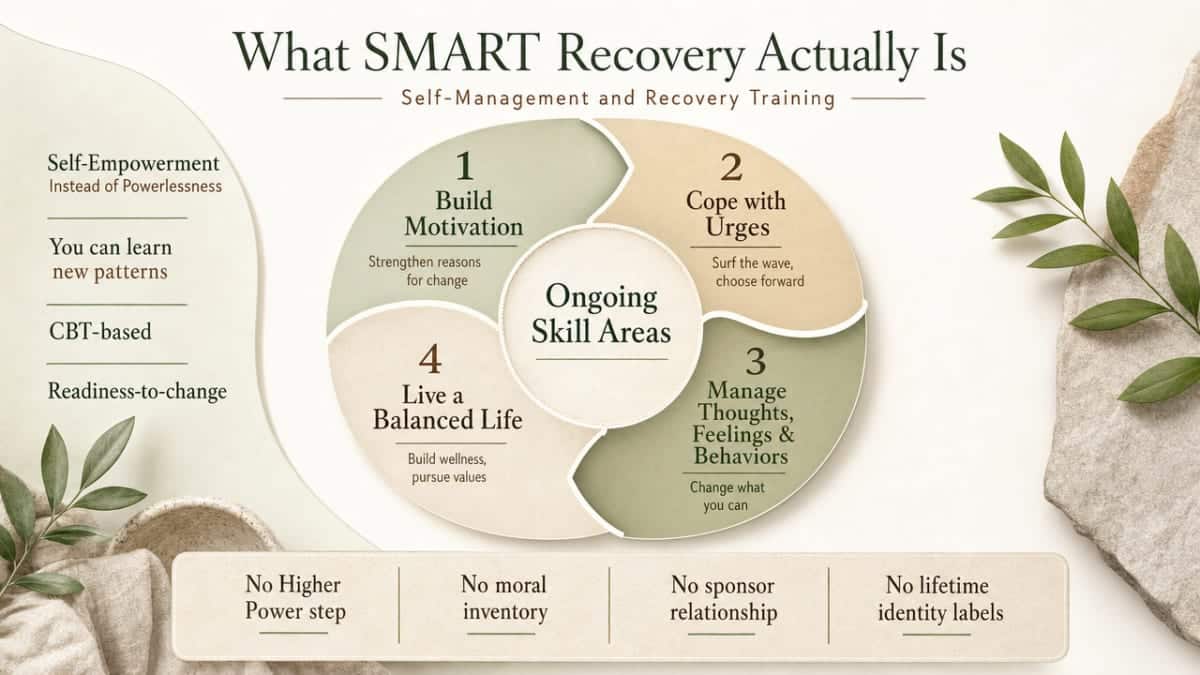
SMART stands for Self-Management and Recovery Training. That name is doing real work. The whole model starts from a different premise than 12-Step: you are not powerless over your addiction. You have a nervous system, a set of habits, a history, and a brain that can learn new patterns. SMART’s job is to help you learn them.
There’s no Higher Power step. No moral inventory. No sponsor relationship. No lifetime identity as an addict or alcoholic. If those elements ever landed wrong for you—or felt like they were asking you to trade one kind of surrender for another—that reaction makes sense inside SMART’s framework, not against it.
The University of Kansas Cofrin Logan Center chose SMART as its primary mutual-aid model precisely because it’s grounded in cognitive-behavioral therapy and readiness-to-change research rather than a spiritual tradition 12. That doesn’t make 12-Step wrong. It means SMART speaks a different language: one of skills, choices, and evidence. For some people, that language is the one they can actually hear.
The Four-Point Program in Plain Language
SMART organizes everything around four points. Not twelve steps in sequence—four ongoing areas you work on, in whatever order your life demands. The Overcoming Addictions clinical trial described SMART as a “four point cognitive-behavioral program” designed to teach the concrete skills that keep people from drinking, using, or gambling 2. Here’s what each point actually asks of you.
Building and maintaining motivation. You look honestly at why you want to change and why part of you doesn’t. SMART uses tools like a cost-benefit analysis: what does using cost you, what does it give you, and does that math still hold up? This is motivational interviewing translated into worksheets you can do on your kitchen table.
Coping with urges. Cravings are treated as normal, temporary, and workable. You learn to name an urge, ride it out, distract, delay, or use techniques like urge surfing. The goal isn’t to never feel the pull. It’s to have a plan for the moment the pull shows up at 9:47 on a Tuesday night.
Managing thoughts, feelings, and behaviors. This is the CBT core. You learn to catch the thoughts that drive using—”I’ve already blown it,” “I can’t handle this feeling,” “one won’t matter”—and work with them instead of being run by them. Emotions get named, not numbed.
Living a balanced life. Recovery isn’t just not using. It’s building a life where not using makes sense. You set short and long-term goals across work, relationships, health, and meaning. You practice tolerating the ordinary discomforts of being a person.
Four points. No hierarchy. You circle back through them as your recovery matures. That structure is deliberately flexible, which is why researchers have been able to translate it into web-based versions and hybrid formats without breaking what makes it work 2.
Tools, Not Lifelong Meetings
One of the harder truths for some people in 12-Step rooms is the expectation of lifelong attendance. You keep coming back, and you keep coming back, because you’re always in recovery. SMART works differently. The point of the tools is that you learn them, use them, and eventually carry them internally—the way someone who learned CBT for anxiety doesn’t stay in therapy forever.
SMART is explicit about the possibility of graduation. When the skills are yours, when your life is stable, you can step back from meetings without it meaning you failed or relapsed. Some people stay involved as facilitators because they want to. Others move on. Both are considered success.
Meetings themselves look different too. They’re facilitated discussions built around a specific tool or worksheet, not a shared reading and testimonials. You don’t have to introduce yourself as an addict. You can talk about a cost-benefit exercise you tried this week and what didn’t work. That structural difference is small on paper and enormous in practice.
SMART vs. 12-Step: An Honest Philosophy Contrast
Both programs want the same thing for you: a life that isn’t organized around substances. They just disagree, at the root, about how you get there. Naming those disagreements clearly matters more than picking a winner, because the fit question is personal and it shapes whether you’ll actually show up.
How you’re framed. The 12-Step tradition asks you to accept powerlessness over your addiction and lean on a Higher Power, however you define that. SMART starts from the opposite premise—self-empowerment—and treats you as the agent of your own change, using cognitive-behavioral therapy and readiness-to-change research as its foundation 12. Neither view is objectively correct. One may match how you already understand yourself; the other may not.
The role of spirituality. 12-Step is spiritually oriented, even in its most secular forms. SMART is explicitly non-spiritual—you can hold any faith or none, and the meeting content won’t ask you to work with that part of your life. For readers who felt the Higher Power language was a barrier, that difference is not cosmetic.
How long you stay. 12-Step often frames recovery as a lifelong fellowship: keep coming back, keep working the steps. SMART is designed around graduation. You learn the four-point cognitive-behavioral toolkit—motivation, urge coping, thought and feeling management, balanced living—and eventually carry those skills without needing weekly meetings 2.
What happens in a meeting. 12-Step meetings center on shared readings, personal testimony, and sponsor relationships. SMART meetings are facilitated discussions built around a specific worksheet or skill from that CBT toolkit. You bring what you tried; you leave with something to try next.
What the evidence looks like. 12-Step has decades of practice-based tradition and a large research literature. SMART has a smaller but growing evidence base, with peer-reviewed reviews finding positive outcomes tempered by modest sample sizes and mixed study designs 10. Credible academic centers, including the University of Kansas Cofrin Logan Center, have adopted SMART as their primary mutual-aid model based on its CBT roots 12.
The honest contrast isn’t better versus worse. It’s this: if surrender language and lifelong fellowship gave you a place to stand, 12-Step is doing exactly what it’s supposed to do. If they didn’t, SMART is a different door built on different bones—and walking through it isn’t giving up on recovery. It’s choosing a model that speaks your language.

What the Research Actually Says
Positive Signals, Still-Growing Evidence Base
Here’s the honest version, because you deserve it.
The peer-reviewed systematic review that most researchers point to when they talk about SMART pulled together twelve studies of adults using the program for alcohol, other substances, and behavioral addictions. Outcomes were generally positive—people reduced use, gained coping skills, reported better quality of life. But the reviewers were careful about what those results can and can’t tell you. Sample sizes were modest. Study designs varied. Mental health outcomes weren’t always measured well. Their conclusion, in plain language: SMART looks promising, and more rigorous research is needed before anyone can make a definitive claim about how it stacks up against other options 10.
Qualitative work adds texture. A study of SMART groups with Aboriginal participants in Australia found that people reduced their substance use, picked up practical skills like goal setting and problem solving, and built social networks that supported their recovery 1. That doesn’t prove SMART works for everyone, but it suggests the tools travel across very different populations—which is a reasonable signal when you’re deciding whether to try it yourself.
Head-to-Head Studies Are Underway
The comparative question—does SMART work as well as AA for people with alcohol use disorder?—is exactly what a 2023 research protocol is set up to answer. It’s a naturalistic, prospective cohort study following 368 adults making a new recovery attempt from alcohol use disorder, tracking them across seven assessments over 24 months as they attend SMART, AA, or other mutual-help groups 3.
That kind of long, real-world comparison is what the field has been missing. When it reports out, you’ll have something better than opinion or tradition to work with.
What this means for you right now: SMART has enough evidence behind it that credible clinicians and academic centers use it, and not so much that anyone should promise you a specific outcome. That’s not a weakness in the model. That’s what honest science looks like while it’s still being done.
Why Kansas City Needs More Than One Recovery Door
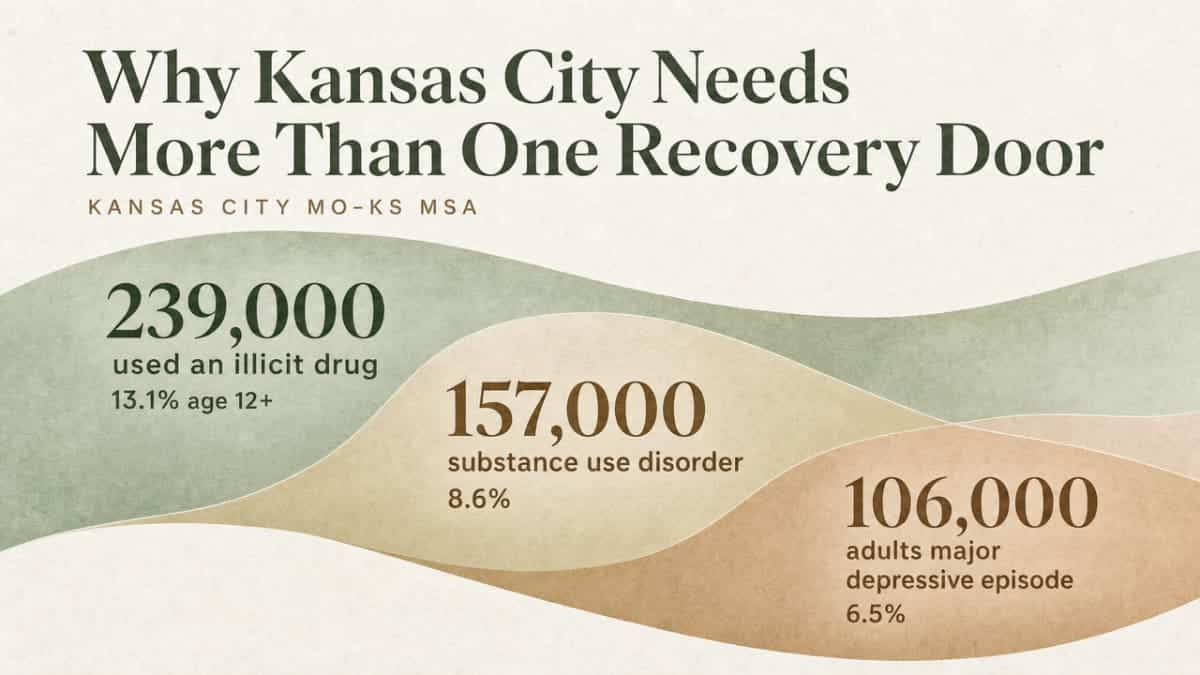
The scale of what’s happening in this metro is the reason a second door matters. According to SAMHSA’s brief on the Kansas City MO-KS MSA, an annual average of 239,000 people aged 12 and older (13.1%) used an illicit drug in the past year, 157,000 (8.6%) met criteria for a substance use disorder, and 106,000 adults (6.5%) experienced a major depressive episode in the past year 8. Those aren’t distant national figures. Those are your neighbors, coworkers, and family members.
Look at those three numbers together and something important shows up. Substance use and depression aren’t running on separate tracks here—they overlap in the same lives. A lot of people carrying a substance use disorder in Kansas City are also carrying something harder to name: a depressive episode, a trauma history, an anxiety pattern that made using feel like the only relief that worked.
When the numbers look like that, offering one recovery model and calling it good isn’t enough. If the 12-Step framing lands for you, use it. If it doesn’t—if the surrender language, the Higher Power step, or the identity of “addict” felt like it made your depression worse instead of better—you shouldn’t have to choose between recovery and honesty about what you actually need.
That’s the practical case for SMART Recovery being available here. Not as a competitor to AA or NA, but as a second legitimate entry point. In a metro where more than 150,000 people are living with a substance use disorder in any given year, one map is not enough map.
Trauma, Depression, and the Case for Integrated Care
Why Dual Diagnosis Changes the Recovery Plan
If you’ve spent years drinking to quiet a panic that started in childhood, or using to outrun a depression you’ve never named out loud, then “just stop using” was never going to be the whole plan. The substance was doing a job. Take it away without addressing the job, and something else will move in to do the work—another substance, a compulsive behavior, or a crash you can feel coming.
That’s the practical reason dual diagnosis changes everything. SAMHSA’s TIP 42 is direct about it: getting sober does not, by itself, resolve PTSD or depression, and both disorders have to be treated at the same time using an integrated model that addresses mental and substance-related needs together 5. Sequential treatment—get sober first, then we’ll deal with the trauma—leaves people white-knuckling through symptoms the substance used to muffle.
TIP 57 adds the piece that matters most for how care actually feels: trauma symptoms should not keep you out of treatment, and all co-occurring issues need to be part of the plan on some level from the start 6. That doesn’t mean digging into your worst memories in week one. It means safety, choice, and pacing come first, so you’re not asked to trade one kind of overwhelm for another.
If your story includes trauma, depression, an eating disorder, or an anxiety pattern that predates the using, integrated care isn’t a luxury. It’s the thing that keeps the recovery you’re building from resting on sand.
SMART’s CBT Toolkit Pairs Well With Clinical Treatment
Here’s where SMART and clinical dual-diagnosis care fit together in a way that isn’t accidental. SMART is built on cognitive-behavioral therapy 2. So is most modern trauma and depression treatment. The vocabulary matches. The skills reinforce each other instead of pulling in opposite directions.
When you learn in therapy how to catch a distorted thought—”I’m broken, so what’s the point”—and rework it, you’re using the same muscle SMART asks you to flex in its thoughts-and-feelings point. When your clinician teaches you grounding for a trauma flashback, that skill lives next to SMART’s urge coping toolkit on the same shelf. A cost-benefit analysis you do in a Tuesday-night SMART meeting can be the exact worksheet your therapist reviews on Thursday.
Contrast that with a program that asks you to accept powerlessness while a trauma clinician is working to rebuild your sense of agency. That doesn’t have to be a dealbreaker—plenty of people hold both frames at once—but for some readers the mismatch matters, and SMART removes it.
SAMHSA’s guidance on co-occurring disorders points squarely at CBT-based coping skills and peer support as core elements of integrated care 5. SMART delivers both, in a format that plays cleanly with residential, PHP, or IOP treatment happening around it.
Accessing SMART Recovery in the Kansas City Region
Local and Virtual Meeting Access
You don’t have to figure out access alone, and you don’t have to drive across the state to find a meeting that fits. The University of Kansas Cofrin Logan Center for Addiction Research and Treatment runs SMART Recovery groups twice a week, in a hybrid format that includes both in-person and virtual attendance, and the groups are open to anyone working through addictive behaviors—not just people with alcohol use disorder 11. That’s a serious signal. When an academic addiction center puts SMART on its regular schedule, it’s treating the model as clinically credible.
The KU program leaders have been public about why they chose SMART as their primary mutual-aid model: it’s grounded in cognitive-behavioral therapy and readiness-to-change research, and it meets people where they are rather than requiring a specific belief system 12. That same program has helped extend access through SMARTline, a phone-based support service designed for people who can’t or won’t walk into a room yet 12.
If your schedule, transportation, childcare, or social anxiety makes a physical meeting hard right now, the virtual and phone options are not consolation prizes. They’re the same program, delivered in the format that works for the life you actually have.
Where Clinical Care Fits Around Mutual Help
A SMART meeting is not treatment. It’s peer support built around a set of tools. For a lot of people that’s enough. For readers whose story includes trauma, depression, an eating disorder, or a substance use pattern that has already put their body or job at risk, mutual help works best with clinical care around it.
That’s the layer Sunflower Recovery Center is built to provide. Trauma-informed dual diagnosis treatment—residential, partial hospitalization, or intensive outpatient—runs on the same cognitive-behavioral vocabulary SMART uses, which is what SAMHSA’s guidance on co-occurring disorders points toward when it calls for integrated, concurrent care rather than sequential handoffs 5. You don’t have to pick between the SMART meeting and the therapy room. They’re doing different jobs on the same recovery.
Sunflower accepts most commercial insurance and does not participate in Medicare or Medicaid. If you’re weighing options, calling to ask what recovery approaches beyond traditional 12-Step look like inside their programs is a reasonable first move—no commitment, just information about what’s on the table.
A Practical Next Step
If you’ve read this far, something in the 12-Step framing probably didn’t fit—and you’ve been carrying that quietly, wondering if it disqualifies you from getting well. It doesn’t. It just means the first door you were shown wasn’t yours.
Here’s what you can actually do this week. Look up the University of Kansas Cofrin Logan Center’s hybrid SMART Recovery groups and sit in on one, virtually if that’s easier 11. You don’t have to share. You don’t have to commit. You’re gathering information about whether the language and the tools feel like something you can work with.
If your story includes trauma, depression, or a substance use pattern that’s already costing you your health, your job, or your relationships, add the second layer. Call Sunflower Recovery Center and ask, plainly, what recovery approaches beyond traditional 12-Step look like inside their residential, PHP, and IOP programs. Ask how their trauma-informed dual diagnosis care lines up with a CBT-based mutual-help model like SMART. Ask what your commercial insurance will cover.
One phone call is not a decision. It’s a conversation about what’s actually on the table for you.
Ready to explore a different recovery path?
Talk with someone who understands non-12-step recovery and can help you start your next steps today.
Frequently Asked Questions
Is SMART Recovery a replacement for 12-Step programs like AA or NA?
No. Think of it as a different door into the same house. SMART uses cognitive-behavioral tools and a self-empowerment frame instead of Steps and a Higher Power 2. If AA or NA has worked for you or someone you love, keep going. If it didn’t fit, SMART gives you another legitimate path—not a downgrade.
Do I have to be an atheist or non-religious to use SMART Recovery?
Not at all. SMART is secular, which means meetings won’t ask you to work with a Higher Power or a spiritual practice. You can hold any faith or none and still use every tool in the four-point program 2. Your spiritual life is your business. The meeting stays focused on skills, thoughts, urges, and building a balanced life.
Is there real scientific evidence that SMART Recovery works?
The honest answer: yes, and it’s still growing. A peer-reviewed systematic review of twelve studies found generally positive outcomes but flagged small samples and mixed designs, so nobody should promise you a specific result 10. A newer cohort study is following 368 adults across 24 months to directly compare SMART, AA, and other mutual-help paths 3.
Can I attend SMART Recovery while also getting clinical treatment for trauma or depression?
Yes, and they tend to reinforce each other. SMART runs on cognitive-behavioral therapy 2, which is the same vocabulary most trauma and depression treatment uses. SAMHSA’s guidance on co-occurring disorders calls for integrated, concurrent care rather than treating one issue and then the other 5. Your therapy work and your SMART meeting are doing different jobs on the same recovery.
Where can I find SMART Recovery meetings in the Kansas City area?
The University of Kansas Cofrin Logan Center for Addiction Research and Treatment runs SMART Recovery groups twice a week in a hybrid format—both in-person and virtual—open to anyone working through addictive behaviors 11. The same program supports SMARTline, a phone-based option if walking into a room feels like too much right now 12. Virtual counts. Phone counts.
Does Sunflower require me to work a 12-Step program during treatment?
No. Sunflower’s residential, PHP, and IOP programs are built around trauma-informed dual diagnosis care, not a required mutual-help track. If SMART’s CBT-based, self-empowerment model fits you better than 12-Step, that’s the conversation to have on the intake call. Ask directly what recovery approaches beyond traditional 12-Step look like inside their programs and how commercial insurance factors in.
References
- A multi‐methods yarn about SMART Recovery: First insights from Australian Aboriginal facilitators and group members. https://pmc.ncbi.nlm.nih.gov/articles/PMC8451896/
- Overcoming Addictions: A Randomized Clinical Trial of a Web-based SMART Recovery Program. https://clinicaltrials.gov/study/NCT01389297
- An investigation of SMART Recovery: protocol for a longitudinal cohort study of adults attending mutual support groups for addiction. https://pmc.ncbi.nlm.nih.gov/articles/PMC9900056/
- Protocol for a systematic review of evaluation research for adults using SMART Recovery and similar programs. https://pmc.ncbi.nlm.nih.gov/articles/PMC4885378/
- TIP 42: Substance Use Disorder Treatment for People With Co-Occurring Disorders. https://www.psychiatry.wisc.edu/wp-content/uploads/2023/05/SAMHSA-TIP-42.pdf
- TIP 57: Trauma-Informed Care in Behavioral Health Services. https://library.samhsa.gov/sites/default/files/sma14-4816.pdf
- Substance Use Disorder Treatment for People With Co-Occurring Disorders (SAMHSA). https://www.ncbi.nlm.nih.gov/books/NBK571020/
- Substance Use and Mental Disorders in the Kansas City MSA. https://www.samhsa.gov/data/sites/default/files/NSDUHMetroBriefReports/NSDUHMetroBriefReports/NSDUH-Metro-Kansas-City.pdf
- Kansas City, MO-KS | CBHSQ Data. https://www.samhsa.gov/data/report/kansas-city-mo-ks
- Systematic review of SMART Recovery: Outcomes, process, feasibility, and participant experiences. https://pubmed.ncbi.nlm.nih.gov/28165272/
- Community Services & Partnerships – Cofrin Logan Center for Addiction Research and Treatment. https://addiction.ku.edu/community-services-partnerships
- Addiction Program Meets People Where They Are. https://intersections.ku.edu/addiction-program-pivots-meet-people-where-they-are
- Kansas City, MO-KS (NSDUH-based dataset description). https://catalog.data.gov/dataset/kansas-city-mo-ks
- Behavioral Health Barometer: Kansas, Volume 4. https://www.samhsa.gov/data/sites/default/files/Kansas_BHBarometer_Volume_4.pdf
- Drug Overdose Deaths in Missouri. https://www.cdc.gov/drugoverdose/data/states/missouri.html