
Key Takeaways
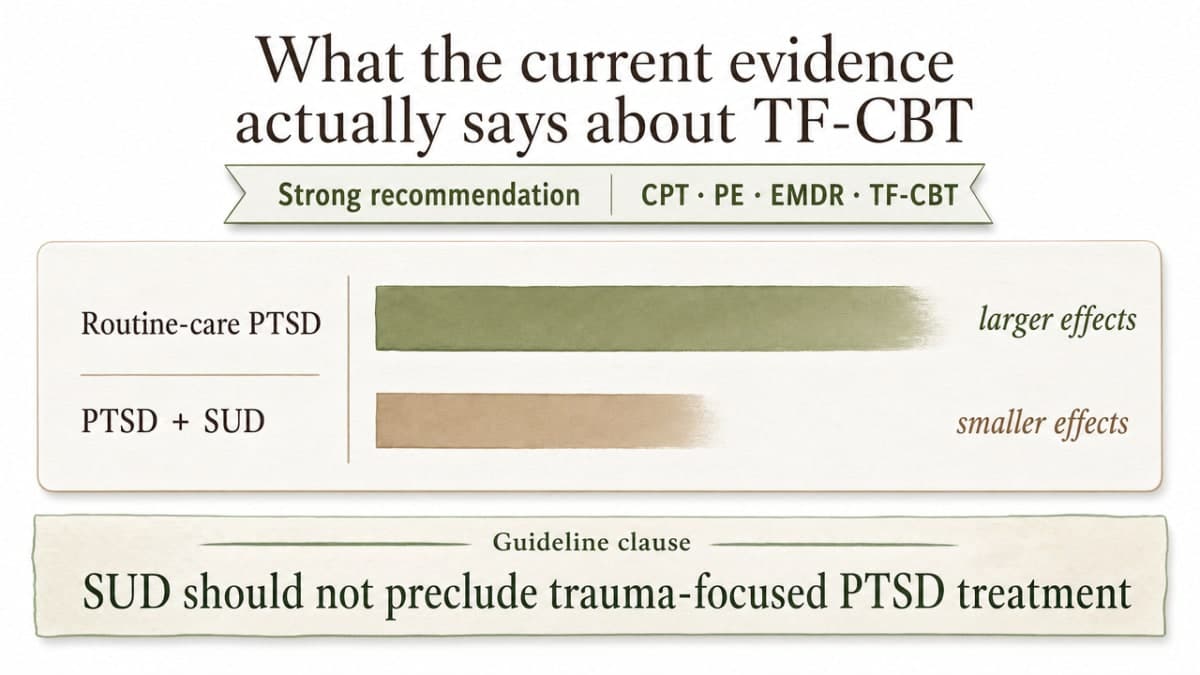
- The 2023 VA/DoD guideline places trauma-focused CBT alongside CPT, PE, and EMDR as strongly recommended, and explicitly states comorbid substance use should not defer trauma work 1.
- Effect sizes shrink in comorbid PTSD and SUD populations compared with general PTSD samples, but community addiction trials show both symptom sets improving together under integrated care 10, 11.
- Dropout, ongoing threat, and unstable housing are the real limiters, not active use — design pacing, re-engagement pathways, and safety planning around them rather than defaulting to stabilize-first.
- Protect fidelity when scaling: preserve the trauma narrative component, invest in supervision for comorbid caseloads, and hold a trauma-informed frame across intake and environment, not just the therapy room 3, 6.
The sequencing question that won’t go away
You already know the argument. A patient walks in with fifteen years of opioid use, two overdoses, and a trauma history that reads like a case study. Someone on the treatment team says, “Let’s get them stable first. Trauma work later.” You have said it yourself. Maybe you still believe it in certain cases.
Here is the harder question worth sitting with: what does “stable” actually mean, and how long has that word been used to defer the work that would help? For long-tenured clinicians, the sequencing debate is not abstract. It shapes intake decisions, level-of-care recommendations, and the conversations you have with referral partners who still treat sobriety as a prerequisite rather than a co-target.
The 2023 VA/DoD clinical practice guideline is direct on this point. Comorbid substance use disorder should not preclude trauma-focused psychotherapy for PTSD 1. That is a strong recommendation from a rigorous GRADE-based process, and it lands differently than the field folklore many of us inherited.
What follows is not a rebuttal to the caution you have earned through hard cases. It is a closer look at what the evidence supports, where it stays honest about limits, and how trauma-focused CBT fits into the clinical decisions you are already making. The sequencing question won’t disappear. But you can answer it with sharper information than you had a decade ago.
What the current evidence actually says about TF-CBT
Guideline status and the comorbidity clause
The 2023 VA/DoD Clinical Practice Guideline for PTSD gives strong recommendations to a short list of manualized trauma-focused psychotherapies: cognitive processing therapy, prolonged exposure, and EMDR, with trauma-focused CBT sitting in the same tier of endorsement 1. That tier is not a suggestion. Under GRADE, a strong recommendation means the guideline panel judged that most well-informed patients would want the treatment and that clinicians should offer it as a default rather than a second thought.
What matters more for your caseload is the clause underneath. The guideline explicitly states that comorbid substance use disorder should not preclude trauma-focused PTSD treatment 1. That single sentence undercuts a habit many programs still carry: routing patients with active use away from trauma work and toward stabilization-only tracks that quietly stretch into months.
You do not have to abandon clinical judgment to honor that clause. What the guideline asks is that SUD not be used as a categorical exclusion. If a patient meets criteria for PTSD and can engage in structured sessions, the burden of proof shifts. You need a reason to withhold trauma-focused treatment, not a reason to offer it.
Effect sizes in routine care vs. comorbid populations
The efficacy numbers you cite to referral partners and skeptical family members deserve a closer look, because they change depending on which population you are talking about. A 2023 systematic review of CBT for adult PTSD delivered in routine clinical care pooled 33 studies with 6,482 participants and found a within-group effect size of 1.75 at post-treatment and 1.70 at roughly six-month follow-up 6. Those are large effects, sustained, in real community settings rather than the tightly controlled conditions of an efficacy trial.
Now hold that against what happens when substance use disorder is in the room. A 2022 systematic review and meta-analysis of psychological interventions for comorbid PTSD and SUD included 27 studies and found modest benefits for trauma-focused intervention plus SUD treatment: a standardized mean difference of −0.36 for PTSD severity at post-treatment and −0.48 at 6 to 13 months 11. The direction is right. The magnitude is smaller. Dropout was high across studies, and the authors judged most findings to be very low quality.
You need both numbers in the same conversation. The routine-care effect size tells you what a general PTSD population can achieve when a program actually delivers the protocol. The comorbid effect size tells you what your caseload — patients carrying a decade or more of substance use alongside trauma — is more likely to produce. The gap is not a reason to withhold treatment. It is a reason to plan for slower gains, more clinical touch, and honest conversations with families who expect the routine-care numbers on a comorbid timeline.
When you explain this to a referring physician who wants to know why trauma work is worth trying with an unstable patient, the answer is that a −0.36 shift in PTSD severity, holding to −0.48 at follow-up, still meaningfully changes what a person can tolerate in the next year of recovery. Small effects, when they are the difference between avoidance and engagement, matter.
Durability at 12 months and what that means for relapse windows
The durability data may matter more to your population than any post-treatment number. A meta-analysis of 22 RCTs with 2,638 adults and at least 12-month follow-up found that trauma-focused treatments produced large PTSD symptom reductions that stayed stable for at least a year after treatment ended, and that trauma-focused work outperformed active controls at follow-up 7. Comorbid depression improvements held as well.
Twelve months is roughly the window where long-term addiction populations face their most concentrated relapse risk. If a patient completes a trauma-focused protocol during residential or intensive outpatient care and the symptom gains erode by month four, you have a different clinical problem than the trial reports. What the durability evidence tells you is that, for adults who complete treatment, the gains generally do not evaporate on the timeline that relapse tends to strike.
That reframes how you talk about trauma work with a patient hesitant to open the material. You are not asking them to endure something whose benefit disappears when discharge paperwork is signed. You are asking them to build a floor that holds through the year when it matters most.
TF-CBT inside a family of trauma-focused therapies
Where CPT, PE, EMDR, and TF-CBT sit next to each other
If you have spent a decade in the field, you have watched brand loyalty attach to individual protocols in ways the evidence does not quite support. A supervisor swears by prolonged exposure. A trainer from the last regional conference is now an EMDR evangelist. A grant-funded initiative pushed everyone into cognitive processing therapy. The honest reading of the current literature is more equalizing than any of those camps admit.
The 2023 VA/DoD guideline places cognitive processing therapy, prolonged exposure, and EMDR at the top tier of strong recommendations, with trauma-focused CBT sitting in the same category of endorsement 1. These are not ranked against each other. They are grouped because the panel judged the evidence base for each strong enough to justify offering it as a default option for adults with PTSD.
Where it gets more granular is in head-to-head comparisons. A 2021 network meta-analysis pooled trials across trauma-focused psychotherapies and found that meta-cognitive therapy and cognitive processing therapy showed superior efficacy compared with several other psychotherapies, while written exposure therapy and narrative exposure therapy produced lower dropout than some competing interventions 4. That is a useful nuance rather than a verdict. Superior efficacy in a network meta-analysis does not mean CPT will outperform TF-CBT in your program next quarter. It means the panels ranking these treatments see a family of options with meaningful within-family variation on efficacy and tolerability.
For your clinical decisions, this means the choice between TF-CBT, CPT, PE, and EMDR is usually a question of protocol fit, therapist training depth, and patient preference — not a question of which modality is objectively best.
The moderator findings worth remembering
Two moderator findings from the recent literature deserve room in your working memory, because they change how you counsel patients and coordinate with prescribers.
The first comes from a 2025 individual-participant data meta-analysis of trauma-focused CBT in adults with PTSD. CBT-TF outperformed inactive comparisons (β = −0.78; OR = 2.34 for remission) but was not significantly different from other active comparison treatments in reducing PTSD severity or achieving remission 5. Read that carefully. Against a waitlist or minimal-contact control, CBT-TF produces meaningful gains and more than doubles the odds of remission. Against another active trauma-focused treatment, the differences wash out. Your choice of modality matters less than your ability to deliver whichever protocol you have trained on with fidelity.
The second moderator finding from the same analysis is more actionable. Patients on psychotropic medication showed lower PTSD symptoms after CBT-TF than patients not on medication 5. That does not prove causation, and it does not mean you should push every patient toward pharmacotherapy before starting trauma work. It does mean that when a psychiatrist on your team is weighing whether concurrent medication makes sense, the evidence does not support the older intuition that medication dulls trauma processing. It may support it.
What actually happens in a TF-CBT arc
The five components, adapted for adults with long histories
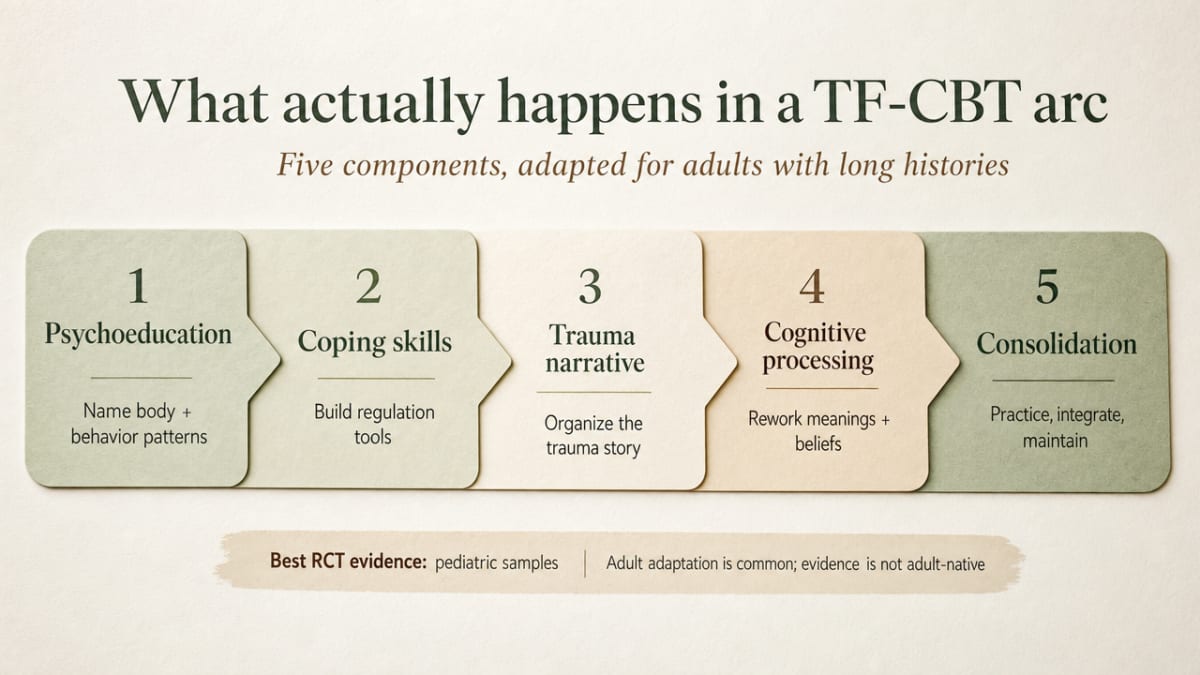
The TF-CBT arc, as it appears in the literature, moves through five recognizable components:
- psychoeducation
- coping skills
- the trauma narrative
- cognitive processing
- consolidation 9
Worth flagging up front — the strongest RCT evidence for this component sequence sits in pediatric samples 8, 9. Adapting it for an adult with a fifteen-year use history is standard practice, but the underlying research base is not adult-native, and you should hold that honestly when you describe the arc to referral partners.
Psychoeducation with your population is not a slide deck about the amygdala. It is naming what has been happening in the patient’s body and behavior for a decade — the hyperarousal that made a drink feel like relief at nineteen, the numbing that made opioids feel like sleep at thirty. Coping skills work looks different too. You are not teaching someone their first grounding technique. You are auditing which regulation strategies got hijacked by substance use and which ones can be recovered or rebuilt.
The trauma narrative is where adult adaptation matters most. A patient with a long history is usually carrying multiple events, not a single index trauma, and the narrative may need to hold several threads. Cognitive processing then targets the beliefs that have calcified over years — the conviction that the assault was deserved, that the neglect was normal, that using was the only reason they survived. Consolidation, the final component, is where you tie the work to relapse prevention explicitly, mapping which trauma-linked triggers still pull toward use and what the patient will do when they do.
Pacing decisions when substance use is active
Pacing is where your clinical judgment does the most work. The protocol has a shape, but the tempo is yours to set, and with active substance use in the picture the tempo question shows up in almost every session.
A few practical calls come up repeatedly. First, session frequency. If a patient is using between sessions and returning with fragmented recall of what you covered last week, weekly is often too slow to hold the thread. Twice-weekly sessions during residential or PHP care let the arc move while the patient is in a container that can absorb the activation. Second, when to enter the trauma narrative. The instinct to delay is not wrong, but delaying past the second or third week of an intensive program often means the patient discharges before the narrative work happens at all. That is the more common failure than premature exposure.
Third, what to do when a session activates use. You do not stop the arc. You slow it, revisit coping skills, and coordinate with the medical team on whether medication adjustments make sense — remembering that patients on psychotropic medication showed lower post-treatment PTSD symptoms in the recent IPD meta-analysis, so concurrent pharmacotherapy is not a threat to the trauma work 5. And when a patient completes their first trauma narrative session without using afterward, name it. That is not a small win. That is the mechanism the protocol was built to produce.
Concurrent trauma and SUD treatment: dropping the ‘stabilize first’ reflex
What community addiction trials show when trauma work runs alongside SUD care
The trial that most directly answers your sequencing question was run inside community addiction treatment, not a university clinic. Patients with co-occurring substance use disorder and PTSD were randomized to CBT for PTSD (including trauma-focused elements) plus usual addiction care, or to usual care alone. The group receiving trauma-focused work showed significantly greater reductions in PTSD severity and, in the same trial, significant reductions in substance use and substance use severity compared with usual care 10.
That does not mean every patient in active use is ready for the trauma narrative next Tuesday. It means the categorical logic — trauma work causes relapse, therefore defer — is not what the data show. What the data show is that trauma-focused CBT delivered inside addiction treatment can move both symptom sets in the direction you want, and that patients who might have been told to come back after six months of sobriety can start meaningful work sooner. The clinical question is no longer whether to integrate. It is how you build the schedule, the coordination, and the safety planning to make integration hold.
Dropout is real. Design for it instead of denying it
The honest counterweight to that argument is dropout. The 2022 review of psychological interventions for comorbid PTSD and SUD flagged high dropout across the 27 included studies, and most of the evidence base was judged very low quality 11. If you have run these groups, none of this surprises you. Patients disappear between sessions three and five. They show up activated, then miss the next two weeks. The trial data reflects the clinic.
You do not solve that by pretending the risk is smaller than it is. You solve it by designing for it. A few concrete moves:
- Front-load psychoeducation and coping skills before the trauma narrative so a patient who drops mid-protocol still leaves with something usable.
- Use twice-weekly sessions during residential or PHP levels of care so the arc completes inside the container.
- Build a re-engagement pathway, not a discharge, when a patient misses sessions — a phone call, a bridge appointment, a lower-intensity contact that keeps the thread alive.
Naming the dropout risk with referral partners protects the work too. Families who understand that not every patient completes the protocol on the first attempt are less likely to interpret a pause as failure. Dropout is a design problem, not a reason to withhold.
Ongoing threat, unstable housing, and the limits of the protocol
Here is where the evidence gets thinner and your clinical judgment has to carry more weight. A systematic review of trauma-focused CBT delivered under ongoing threat pooled 21 studies and found medium to large pre-to-post effects and clear advantages over waitlist, but long-term findings in domestic violence samples were mixed and the authors would not commit to firm conclusions about safety or effectiveness when exposure is still active 12. That is a careful hedge from careful reviewers, and it deserves to shape your intake decisions.
Think about who this actually describes on your caseload. A patient discharging to a household where the person who hurt them still lives there. A patient couch-surfing between using friends. A patient whose primary support system is also the primary threat. The protocol assumes a baseline of physical safety between sessions that these patients do not have. NIMH is direct that PTSD treatment is most effective when ongoing trauma is being addressed 2, and SAMHSA’s trauma-informed framework is explicit that services must actively avoid retraumatization rather than assume the protocol will not cause it 3.
None of that means you refuse trauma work. It means you sequence differently. Housing coordination, safety planning, and coping-skills consolidation move up the arc. The trauma narrative may wait — not for sobriety, but for a physical environment that can hold what opening the material will surface. When you cannot get that environment, present-focused work and stabilization become the honest offer, and you say so plainly to the patient rather than starting a narrative you may not be able to complete safely.
Training, fidelity, and what to protect when you scale trauma-focused work
Scaling trauma-focused work across a clinical team is where fidelity quietly erodes. A supervisor certifies two therapists, a case backlog forces the next hires into abbreviated training, and within eighteen months the protocol running in your building shares a name with what the manual describes but not much else. The routine-care effect sizes that make trauma-focused CBT worth offering — the g = 1.75 post-treatment finding across 6,482 participants in real community settings — were produced by programs that delivered the actual protocol, not a diluted version of it 6.
Protect three things when you build capacity.
- Protect the trauma narrative component. It is the piece most often trimmed under caseload pressure, and it is the piece the evidence base for TF-CBT is built around 9. When a therapist tells you they “do the coping skills part but skip the narrative,” you do not have TF-CBT on that caseload. You have supportive counseling with trauma vocabulary.
- Protect supervision hours for staff working with comorbid PTSD and SUD, because dropout is highest in this population and clinical decisions about pacing, re-engagement, and safety planning are where the work holds or falls apart 11.
- Protect the trauma-informed frame around the protocol. SAMHSA is explicit that trauma-informed services must actively avoid retraumatization, which means intake procedures, group norms, and physical environment all carry weight the individual therapy room cannot compensate for 3.
Where this leaves your next referral conversation
The next time a referring physician asks whether your program can “handle the trauma piece” for a patient still using, you have a cleaner answer than the field gave you a decade ago. Trauma-focused CBT belongs inside dual-diagnosis care, not after it. The 2023 guideline is explicit that comorbid substance use should not push trauma work off the schedule 1, and the community addiction trial data shows both symptom sets moving in the same direction under the same clinical roof 10.
What you owe that referring physician is honesty about the shape of the work. Effect sizes in comorbid populations are smaller than in general PTSD samples. Dropout is real and needs to be designed for. Ongoing threat changes the sequencing. None of that is a reason to hold the line at sobriety-first. It is the operational reality of doing this work well, and it is what programs like Sunflower Recovery Center build their trauma-informed dual-diagnosis approach around. Your next referral conversation can start there.
Ready to Start Healing Past Trauma Together?
Connect directly with skilled professionals who understand the deep roots of trauma and long-term recovery.
Frequently Asked Questions
Should patients achieve sobriety before starting trauma-focused CBT?
No. The 2023 VA/DoD guideline is explicit that comorbid substance use disorder should not preclude trauma-focused PTSD treatment 1. A community addiction RCT found that patients receiving trauma-focused CBT alongside usual SUD care showed greater reductions in both PTSD severity and substance use compared with usual care alone 10. Sequencing decisions matter, but categorical deferral does not match the evidence.
How does TF-CBT compare to CPT, PE, and EMDR for adults with PTSD?
All four sit in the top tier of strong recommendations in the 2023 VA/DoD guideline 1. An individual-participant data meta-analysis found CBT-TF outperformed inactive controls but was not significantly different from other active trauma-focused treatments 5. Network meta-analysis data suggests CPT and meta-cognitive therapy edge out some alternatives on efficacy, while written and narrative exposure show lower dropout 4. Choose based on therapist training depth and patient fit.
What dropout rates should clinicians expect in comorbid PTSD and SUD populations?
High enough to plan around. The 2022 review of 27 psychological intervention studies for comorbid PTSD and SUD flagged consistently elevated dropout across trials, with most evidence rated very low quality 11. Design for it: front-load psychoeducation and coping skills before the trauma narrative, use twice-weekly sessions during residential or PHP care, and build a re-engagement pathway rather than defaulting to discharge when a patient misses sessions.
Do TF-CBT gains hold up over the long relapse windows common in addiction recovery?
Yes, for patients who complete treatment. A meta-analysis of 22 RCTs with 2,638 adults tracking outcomes at 12 months or longer found that trauma-focused treatments produced large PTSD symptom reductions that stayed stable across the follow-up window, with trauma-focused work outperforming active controls at follow-up 7. That durability matters for your caseload because it covers the same twelve-month window where concentrated relapse risk usually plays out.
Is trauma-focused therapy safe when patients face ongoing threat or unstable housing?
The evidence is promising but not definitive. A systematic review of 21 studies delivering trauma-focused CBT under ongoing threat found medium to large pre-to-post effects, but long-term findings in domestic violence samples were mixed 12. NIMH notes PTSD treatment is most effective when ongoing trauma is being addressed 2. Move housing coordination and safety planning up the arc; delay the trauma narrative until the physical environment can hold it.
How do the five TF-CBT components adapt for adults with long addiction histories?
The core sequence — psychoeducation, coping skills, trauma narrative, cognitive processing, consolidation — comes from the pediatric evidence base 9. Adapting for adults means auditing which regulation strategies got hijacked by substance use, holding multiple traumas in the narrative rather than a single index event, targeting beliefs calcified over years, and tying consolidation directly to relapse prevention. The strongest RCT evidence remains pediatric 8, so adult delivery requires clinical judgment.
References
- Synopsis of the 2023 U.S. Department of Veterans Affairs and U.S. Department of Defense Clinical Practice Guideline. https://www.healthquality.va.gov/HEALTHQUALITY/guidelines/MH/ptsd/PTSD-in-Annals-2024.pdf
- Post-Traumatic Stress Disorder (PTSD). https://www.nimh.nih.gov/health/publications/post-traumatic-stress-disorder-ptsd
- Trauma-Informed Care in Behavioral Health Services. https://library.samhsa.gov/sites/default/files/sma14-4816.pdf
- Trauma‑focused psychotherapies for post‑traumatic stress disorder: A systematic review and network meta‑analysis. https://pmc.ncbi.nlm.nih.gov/articles/PMC9539869/
- Efficacy of cognitive behavioral therapies with a trauma focus for posttraumatic stress disorder: An individual participant data meta-analysis. https://pubmed.ncbi.nlm.nih.gov/40388148/
- Cognitive behavior therapy for adult post-traumatic stress disorder in routine clinical care: A systematic review and meta-analysis. https://pubmed.ncbi.nlm.nih.gov/37257304/
- Long-term outcomes of psychological treatment for posttraumatic stress disorder: A systematic review and meta-analysis of randomized controlled trials. https://pmc.ncbi.nlm.nih.gov/articles/PMC8311818/
- A systematic review and meta-analysis of trauma-focused cognitive behavioral therapy for posttraumatic stress disorder in children and adolescents. https://pubmed.ncbi.nlm.nih.gov/36155943/
- Trauma-Focused Cognitive Behavioral Therapy. https://pmc.ncbi.nlm.nih.gov/articles/PMC4396183/
- A cognitive behavioral therapy for co-occurring substance use and posttraumatic stress disorders. https://pmc.ncbi.nlm.nih.gov/articles/PMC2720425/
- A systematic review and meta-analysis of psychological interventions for comorbid post-traumatic stress disorder and substance use disorder. https://pubmed.ncbi.nlm.nih.gov/35558682/
- Trauma-focused cognitive-behavioral therapies for posttraumatic stress disorder under ongoing threat: A systematic review. https://pubmed.ncbi.nlm.nih.gov/34139653/