
Key Takeaways
- EMDR is a structured, eight-phase trauma therapy where you briefly hold a distressing memory while performing a competing task like tracking eye movements, taps, or tones, reducing the memory’s vividness and emotional charge.
- Because traumatic memories trigger body-level alarm responses that insight-based talk therapy often cannot reach, memory-focused work like EMDR directly re-encodes the memory itself rather than reasoning around it.
- Guideline bodies including the 2023 VA/DoD guideline strongly recommend EMDR for PTSD, though head-to-head trials show it performs comparably to other trauma-focused therapies rather than surpassing them 4, 6.
- Outcomes depend heavily on therapist experience, session length of 60 to 90 minutes, and adherence to the full eight-phase protocol including stabilization before any memory processing begins 8, 1.
The therapy your last therapist probably didn’t try
You have been in therapy before, perhaps several rounds. You learned about cognitive distortions, identified patterns, and understood why certain behaviors, like drinking, began. Yet, a specific memory, a smell, or a phone call could still trigger a physical state that no amount of insight could resolve. This often led to cravings and subsequent actions.
If this describes your experience, the issue isn’t your capacity for therapy, but whether previous therapies were designed to address the traumatic memory itself, rather than just helping you think differently about it.
Eye Movement Desensitization and Reprocessing (EMDR) is one of the few approaches that directly targets traumatic memories. It is strongly recommended for PTSD by the 2023 VA/DoD clinical practice guideline, alongside cognitive therapy and exposure therapy 4. EMDR is also offered in specialized PTSD programs at VA medical centers 2. It operates differently from the typical “talk-through-it” therapy model.
This article explores what EMDR does, the evidence supporting it, its role when addiction co-occurs with trauma, and its limitations.
What EMDR actually is, in one honest paragraph
EMDR is a structured trauma therapy where you briefly focus on a distressing memory while simultaneously performing a second task, such as tracking a therapist’s fingers or a light bar moving side-to-side. This second task, known as bilateral stimulation, can also involve alternating taps or tones. You are not hypnotized or asked to relive the memory in extensive detail. Instead, you recall a specific image, note associated feelings, and then divide your attention between the memory and the guided movement. Through repeated sets, the memory tends to become less vivid and emotionally charged, and new, less threatening associations begin to form 13. The therapy follows eight defined phases, from history-taking and stabilization to processing and closure, ensuring memory work occurs within a prepared framework 1. There is no mystique or promise that a single session will erase a lifetime of experience.
The mechanism, without the marketing
Working memory is the load-bearing idea
Your working memory, the mental “scratchpad” used for temporary information like a phone number or visualizing a room, has limited capacity. When you intentionally recall a distressing memory, it occupies this same mental space. Introducing a second task, such as tracking a moving light, creates competition for this limited capacity.
The memory doesn’t vanish; it becomes less vivid and less emotionally intense. Laboratory studies have shown that when individuals recall an upsetting image and then perform a competing visual task, the memory is subsequently rated as less clear and less emotionally intense 12. A review of this research indicated the effect is mediated by the visuospatial sketchpad, a component of working memory 13.
This process is what your therapist facilitates during eye movements while you hold a memory in mind. By asking your brain to perform two tasks simultaneously, the memory is re-encoded with reduced emotional charge. When stored again, it is altered.
This explains why EMDR does not require detailed narration of the memory. The goal is not to talk, but to engage the brain’s processing system.
What changes in the brain, and what we still don’t know
While working memory provides a psychological explanation, the neurological changes are more complex and not fully understood.
A 2024 comprehensive review stated that the exact mechanism by which bilateral stimulation aids trauma processing remains a subject of debate 11. Various hypotheses have been proposed, including a REM-sleep-like state supporting memory integration 15, and models involving interhemispheric communication, autonomic de-arousal, and memory reconsolidation 14. No single theory has been definitively proven.
However, imaging studies show consistent findings. A 2023 neurophysiology review reported that EMDR appears to reduce activity in hindbrain regions associated with autonomic hyperarousal (the body’s alarm system) while increasing activity in the hippocampus and prefrontal areas involved in contextualizing memories and regulating emotion 16. Another study on fear-extinction learning after EMDR found that treatment responders exhibited functional changes in the amygdala, hippocampus, and related cortical structures—the same circuitry involved in learning that a cue is no longer dangerous 17.
In essence, the fear response diminishes, the brain’s ability to differentiate past from present strengthens, and the connection between them shifts. Whether this is due specifically to eye movements, general working-memory load, extinction learning, or a combination, is still being investigated.
This transparency about what is unknown can be reassuring. A therapy that acknowledges its limitations is often worth considering. The clinical outcome depends on the memory losing its intensity, which is a measurable effect, rather than a complete understanding of its neurological mechanism.
The evidence, sorted by how much weight it carries
Guideline bodies place EMDR in the top tier
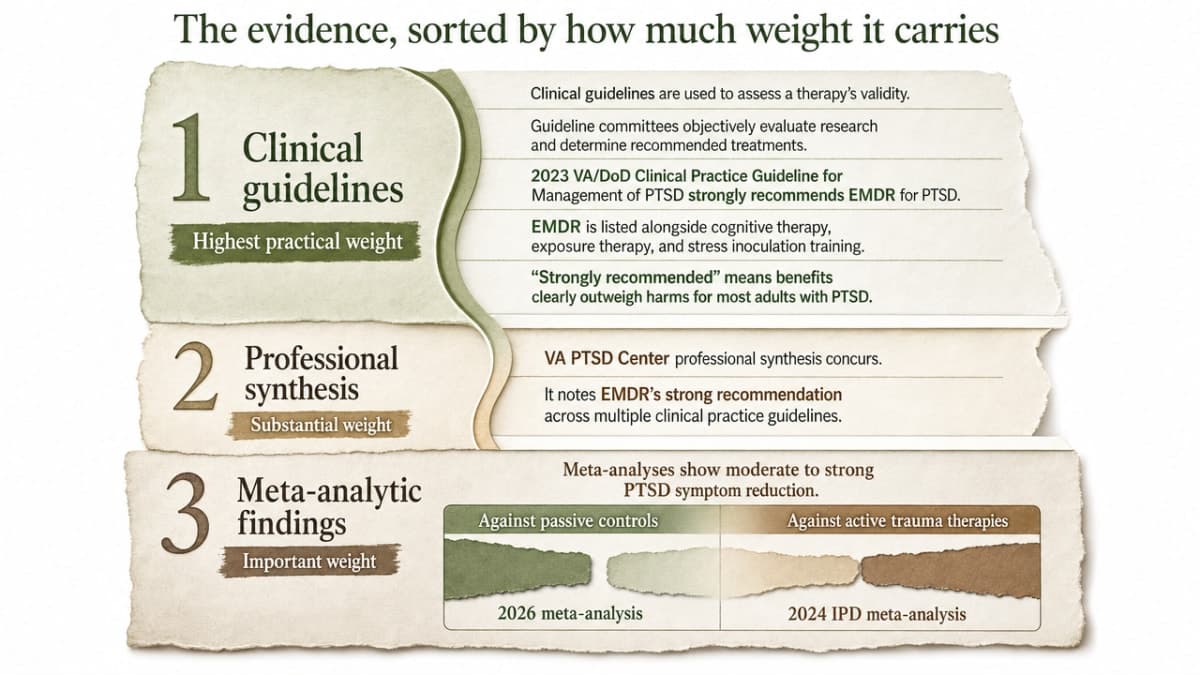
To assess a therapy’s validity, consult clinical guidelines. These committees objectively evaluate research and determine recommended treatments. The 2023 VA/DoD Clinical Practice Guideline for the Management of Posttraumatic Stress Disorder strongly recommends EMDR for PTSD, alongside cognitive therapy, exposure therapy, and stress inoculation training 4. This “strongly recommended” designation signifies that the committee concluded the benefits clearly outweigh the harms for most adults with PTSD.
The VA PTSD Center’s professional synthesis concurs, noting EMDR’s strong recommendation across multiple clinical practice guidelines and meta-analyses showing moderate to strong effects for PTSD symptom reduction 1. The fact that EMDR is offered in specialized PTSD programs at many VA medical centers indicates that a large, evidence-driven health system recognizes its value 2.
While guidelines confirm EMDR’s efficacy as a first-line trauma therapy, they don’t guarantee it’s the best fit for every individual. That determination depends on personal factors, discussed in the following sections.
Effect sizes shrink against active comparators
Online discussions about EMDR often cite large effect sizes for PTSD symptom reduction. These figures are accurate but typically derive from comparisons against passive controls, such as waitlists, usual care, or supportive but non-trauma-focused conditions.
A 2026 systematic review and meta-analysis of randomized controlled trials explicitly differentiated between passive-control and active-control comparisons. Against passive controls, EMDR demonstrated significantly greater effects. However, when compared to other evidence-based trauma treatments (active interventions), the effects were smaller and roughly comparable 5. This illustrates how the reference point influences reported effect sizes.
This observation is not a criticism of EMDR but reflects how all trauma therapy literature behaves. Any active treatment will appear dramatic when compared to no treatment or a placebo. When compared to another effective treatment, the difference narrows because both interventions improve outcomes.
The honest assessment is that EMDR provides meaningful help, though the magnitude of that help is often smaller than the largest quoted numbers, which typically come from easier comparisons.
Head-to-head with other trauma therapies
When comparing EMDR to other established trauma therapies, the most rigorous research indicates no clear winner.
A 2024 individual participant data meta-analysis, which pools patient-level data from randomized studies directly comparing EMDR with other psychological therapies for PTSD, found no significant difference in PTSD symptom severity, response rates, remission rates, or dropout 6. This consistency across four outcomes suggests comparable efficacy.
A 2025 review of clinical and cost-effectiveness reached a similar conclusion regarding EMDR versus trauma-focused CBT (TF-CBT), finding no significant difference in treatment effect, with both improving PTSD symptoms 18. While some older studies and an earlier meta-analysis of eleven studies suggested EMDR might be superior to CBT for post-traumatic symptoms, this advantage often did not persist at follow-up 9. Newer, methodologically stronger research has largely eliminated this perceived gap.
This is positive news. It means you are choosing among several effective, trauma-focused approaches that yield similar average symptom reduction. The deciding factors become personal preferences: which memory-focused method you find tolerable, which therapist you connect with, and which structure fits your life. If a talk-heavy CBT protocol hasn’t addressed the memory itself, EMDR offers a different tool with comparable evidence, rather than a lateral move.
Why memory-focused work sticks when insight-focused talk didn’t
Previous therapy likely taught you to identify triggers, understand your narrative around difficult experiences, and reframe beliefs. While valuable, this insight-based work has limitations. Insight resides in the rational part of your brain, whereas traumatic memories, which can trigger physical reactions before reasoning can intervene, are stored differently.
Memory-focused work, like EMDR, doesn’t attempt to rationalize these states. Instead, it directly engages the memory. When a distressing image is held in mind and a competing task is introduced, the memory is retrieved in an active state, subtly altered by the dual-task demand, and then re-stored in a less charged form 12. This is a process of re-encoding, not reasoning.
This is the practical distinction. A talk-heavy approach encourages you to think about the memory more skillfully. A memory-focused approach aims for the memory itself to be different upon recall. Imaging studies show that EMDR responders exhibit functional shifts in the amygdala, hippocampus, and connected cortical regions, supporting extinction learning—the neural circuitry that determines if a cue still warrants an alarm response 17.
If prior therapy helped you understand your history but didn’t change your body’s reactions, it indicates a limitation of the tool, not a lack of effort. A different tool is available.
When the trauma sits underneath the addiction
Many individuals recognize a pattern: a specific memory or sensation surfaces, and within minutes, their body reacts in ways their rational mind cannot control. The craving that follows isn’t primarily about the substance; the substance is what historically provided reliable relief from the memory’s intensity. Trauma-focused therapy aims to disrupt this cycle.
When the traumatic memory is processed, the trigger may still occur, but the underlying alarm response is quieter. Studies on treatment responders show EMDR is associated with improved fear-extinction learning and functional changes in the amygdala, hippocampus, and related cortical regions—the same circuitry that determines if a familiar cue still warrants a full-body reaction 17. With a quieter alarm, the craving that typically follows has less fuel.
Therefore, processing the trauma layer is not a secondary task in recovery. For many with long-term substance use, trauma is the driving force. Treating only the addiction leaves the underlying engine running, susceptible to future stressors. Conversely, treating only the trauma means the substance use, now a deeply ingrained habit, still requires its own structured support. Both aspects must be addressed concurrently.
EMDR does not resolve addiction directly; it changes the underlying trauma that the addiction was masking. If you have experienced sobriety only to relapse due to an overwhelming memory, this work is designed to address that specific layer.
What moves outcomes: therapist, dose, and structure
Two individuals receiving EMDR for the same trauma can experience vastly different outcomes, often due to factors beyond the therapy label itself.
A 2023 meta-analysis of randomized trials found that EMDR produced small but statistically significant reductions in PTSD, anxiety, and depression symptoms. Crucially, therapist experience and session structure significantly influenced the magnitude of these reductions 8. This means a clinician with extensive experience in EMDR, operating within a program that adheres to a defined phase structure and consistent session cadence, offers a different quality of treatment than someone newly trained in EMDR.
Before committing, consider three key questions:
- How many EMDR cases has the therapist actually processed, beyond just their training?
- Are sessions long enough (typically 60 to 90 minutes) to open and close a memory within the same visit?
- Is the eight-phase protocol being followed, including initial stabilization work, to ensure processing doesn’t begin before you have the necessary regulation skills to safely conclude each session 1?
These details are often more impactful than the modality’s name alone.
What a course of EMDR actually looks like
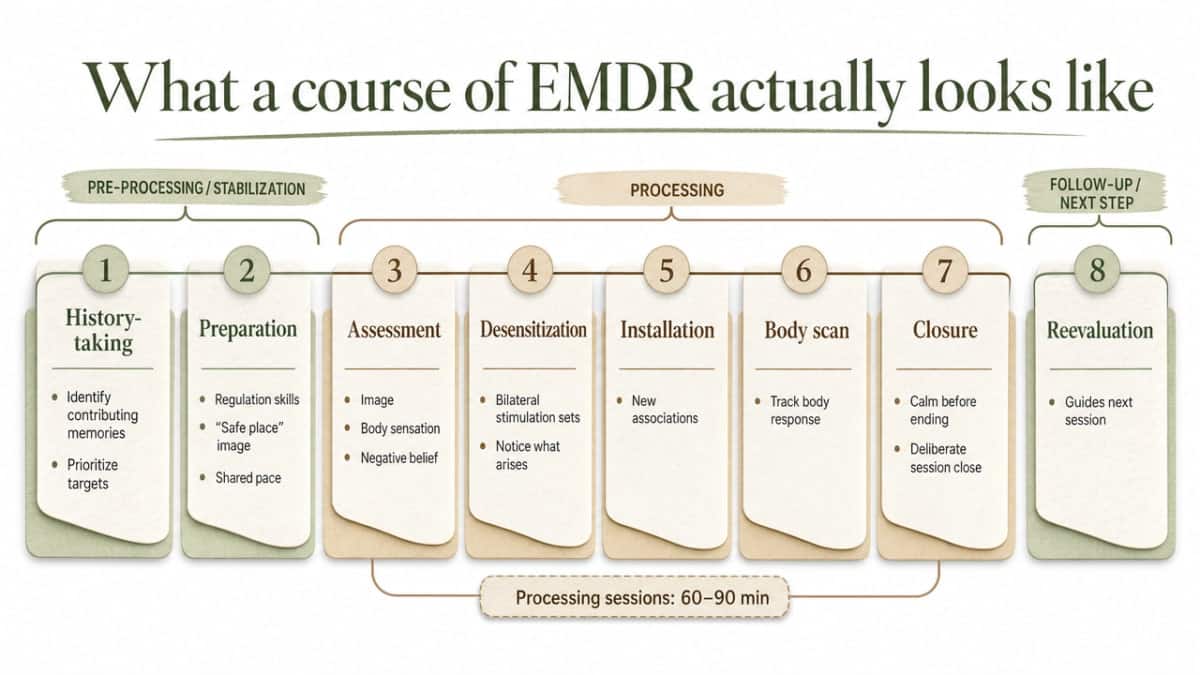
A first EMDR session typically does not involve memory processing. Phase one focuses on history-taking, where the therapist identifies which memories contribute to current symptoms and prioritizes them. Phase two is preparation, involving the development of regulation skills, a “safe place” image, and establishing a shared understanding of the pace before any memory work begins 1.
Processing sessions follow, usually lasting 60 to 90 minutes to allow a memory to be opened, worked through, and closed within the same appointment. You recall an image, a body sensation, and a negative belief linked to the memory. The therapist then conducts sets of bilateral stimulation while you observe what arises between sets. The memory shifts, or new associations emerge, guiding the therapeutic process 1.
Sessions conclude deliberately. You integrate a calmer, more accurate belief, perform a body scan, and utilize stabilization skills from phase two to leave feeling grounded. The total length of treatment varies depending on the number of memory targets. Single-incident trauma may require only a few processing sessions, while long-standing complex trauma, especially when intertwined with substance use, typically takes longer and progresses in stages.
Honest limits and who may need a different path
EMDR is not suitable for everyone or every situation. Several important considerations should be acknowledged.
A broad 2020 systematic review of 76 trials found EMDR outperformed control conditions across various mental health outcomes. However, the authors noted that the underlying study quality was too low to draw definitive conclusions 7. This calls for caution, not dismissal, indicating that the evidence base is real but still developing.
EMDR is also not a standalone addiction treatment. It addresses the trauma layer that often fuels addictive behaviors. The substance use itself still requires concurrent structured care, which is where integrated dual-diagnosis programs, including trauma-informed models like those at Sunflower Recovery Center, provide the necessary additional support.
Start Your EMDR Trauma Healing Journey Today
Connect with a team ready to support your personalized trauma recovery and next steps.
Frequently Asked Questions
Is EMDR better than CBT or other trauma therapies?
No, and any claim to the contrary oversimplifies the evidence. A 2024 individual participant data meta-analysis directly comparing EMDR with other psychological therapies for PTSD found no significant difference in symptom severity, response, remission, or dropout 6. They are comparable, not one superior to the other. The practical choice often depends on which memory-focused method you find tolerable and which therapist you trust.
How many EMDR sessions does it usually take to see results?
The number of sessions varies significantly. A single-incident trauma might resolve in a few processing sessions after the initial preparation phases. However, long-standing complex trauma, especially when combined with substance use, typically requires considerably more time and progresses through multiple stages. Processing sessions are usually 60 to 90 minutes long to allow a memory to be opened and closed within the same appointment 1.
Can EMDR help if my trauma is tied to long-term substance use?
Yes, but only as part of integrated care, not as a standalone solution. Processing the memory can alter the underlying alarm response that contributes to cravings. Studies on treatment responders have observed fear-extinction and functional shifts in the amygdala, hippocampus, and related cortical regions 17. However, the substance use itself still requires its own structured support alongside the trauma work. Both trauma and addiction must be addressed together.
Is it dangerous to reopen traumatic memories in EMDR?
The idea of intentionally reopening a memory might seem counterintuitive to healing. However, the eight-phase EMDR protocol is specifically designed to prevent processing from beginning until you have developed regulation skills, established a “safe place” image, and agreed upon a pacing plan 1. A responsible therapist will dedicate significant time to stabilization first. If your therapist suggests skipping this crucial preparatory phase, it is a reason to pause and reconsider.
Do the eye movements actually matter, or is it just exposure?
The current understanding is that the competing task itself is important, rather than the eye movements specifically. Laboratory research indicates that secondary tasks, including eye movements, can weaken emotional memory retrieval, with this effect mediated by the visuospatial sketchpad of working memory 12, 13. Other forms of bilateral stimulation, such as taps and tones, can serve the same purpose. A 2024 comprehensive review notes that the exact mechanism remains a topic of debate 11.
Who should not start with EMDR?
Memory processing should not be the first intervention if you are in active withdrawal, experiencing a housing or safety crisis, or actively suicidal. Stabilization is the priority in these situations. The broad 2020 review of 76 trials, while finding EMDR outperformed control conditions, also highlighted that the overall study quality was too low to draw definitive conclusions 7. It is essential to begin with a program that prioritizes stabilization as prerequisite work.
References
- Eye Movement Desensitization and Reprocessing (EMDR) for PTSD. https://www.ptsd.va.gov/professional/treat/txessentials/emdr_pro.asp
- Eye Movement Desensitization and Reprocessing (EMDR) for PTSD. https://www.ptsd.va.gov/understand_tx/emdr.asp
- Management of Posttraumatic Stress Disorder and Acute Stress Disorder. https://www.healthquality.va.gov/guidelines/mh/ptsd/
- VA/DoD CLINICAL PRACTICE GUIDELINE FOR THE MANAGEMENT OF POSTTRAUMATIC STRESS DISORDER AND ACUTE STRESS DISORDER. https://www.ptsd.va.gov/professional/articles/article-pdf/id88356.pdf
- A Systematic Review and Meta-Analysis of Randomized Controlled Trials Comparing Passive and Active Control Conditions. https://pubmed.ncbi.nlm.nih.gov/42483107/
- EMDR v. other psychological therapies for PTSD: a systematic review and individual participant data meta-analysis. https://pubmed.ncbi.nlm.nih.gov/38173121/
- Eye movement desensitization and reprocessing for mental health problems: a systematic review and meta-analysis. https://pubmed.ncbi.nlm.nih.gov/32043428/
- Efficacy of EMDR in Post-Traumatic Stress Disorder: A Systematic Review and Meta-analysis of Randomized Clinical Trials. https://pubmed.ncbi.nlm.nih.gov/37882423/
- Systematic Review and Meta-analysis of Randomized Clinical Trials. https://pmc.ncbi.nlm.nih.gov/articles/PMC6217870/
- The Use of Eye-Movement Desensitization Reprocessing (EMDR) Therapy in Treating PTSD and PTSD Symptoms. https://pmc.ncbi.nlm.nih.gov/articles/PMC5997931/
- Revisiting Eye Movement Desensitization and Reprocessing (EMDR): A Comprehensive Review of Current Knowledge and Future Directions. https://pmc.ncbi.nlm.nih.gov/articles/PMC11111257/
- Can working memory account for EMDR efficacy in PTSD?. https://pmc.ncbi.nlm.nih.gov/articles/PMC9623920/
- How Does Eye Movement Desensitization and Reprocessing (EMDR) Therapy Work?. https://pmc.ncbi.nlm.nih.gov/articles/PMC6106867/
- Eye movement desensitization and reprocessing as a treatment for PTSD: current neurobiological theories and a new hypothesis. https://pubmed.ncbi.nlm.nih.gov/29931688/
- EMDR: a putative neurobiological mechanism of action. https://pubmed.ncbi.nlm.nih.gov/11748597/
- The Neurophysiology Behind Trauma-Focused Therapy Modalities: Examining the Dynamic and Interactive Physiological Processes Underlying Trauma Recovery. https://pubmed.ncbi.nlm.nih.gov/34866515/
- 4. Results. https://pmc.ncbi.nlm.nih.gov/articles/PMC7671715/
- Clinical and cost-effectiveness of eye movement desensitization and reprocessing therapy for post-traumatic stress disorder. https://pmc.ncbi.nlm.nih.gov/articles/PMC12514334/