
Key Takeaways
- TRICARE covers the full continuum of substance use care — detox, residential, PHP, IOP, MAT, and outpatient therapy — and Kansas licenses matching treatment categories to deliver it 1.
- Kansas falls under TRICARE West, so TriWest Healthcare Alliance handles enrollment, referrals, pre-authorizations, and network status for behavioral health cases in the state.
- Prime, Select, and Reserve Select share the same clinical benefit but differ on referral rules and cost shares; residential and inpatient detox require pre-authorization on every plan.
- Have a TRICARE ID card or sponsor details ready, then call TriWest or a Kansas admissions team — they can verify benefits and open pre-authorization on your behalf.
What TRICARE Actually Covers If You’re Trying to Get Into Rehab This Week
If you’re reading this at 2 a.m. with a TRICARE card in your hand, here’s the short version: your benefit already covers what you probably need. TRICARE pays for medically necessary behavioral health care across the full continuum — outpatient therapy, medication-assisted treatment, intensive outpatient, partial hospitalization, residential treatment, and inpatient detox — for active duty families, Guard and Reserve members with Reserve Select, retirees, and dependents. Both TRICARE East and TRICARE West administer these services in Kansas, and Kansas has the licensed treatment categories to match nearly every level of care your plan will authorize 1.
You do not need to know your plan type, your region, or your authorization status before you make the first call. You do not need to have a diagnosis in hand. What you need is a phone, your ID card if you can find it, and a willingness to say the sentence out loud: I need help, and I have TRICARE.
The rest of this article walks you through what happens after that sentence — how the benefit works, what to ask, and where Kansas rehab actually lives inside the system.
East or West: Which TRICARE Region Kansas Falls Under and Why It Matters
Kansas sits in the TRICARE West region. That means the contractor handling your claims, referrals, and provider network questions is TriWest Healthcare Alliance, not Humana Military. If you moved to Kansas from a state east of the Mississippi, or if your family straddles both regions, this is the first thing to sort out — because calling the wrong contractor is one of the most common reasons people give up on the first try.
Why does the region matter so much for rehab? Because the contractor is the gatekeeper for almost everything that happens before you walk through a facility door. They confirm your enrollment. They tell you whether your plan requires a referral from a primary care manager. They issue pre-authorizations for higher levels of care like residential and inpatient detox. They maintain the list of network providers in Kansas that accept TRICARE at negotiated rates. And when a Kansas facility submits a claim, they’re the ones paying it.
Kansas already licenses the treatment categories TRICARE tends to authorize — acute detoxification, inpatient, intensive outpatient, opioid maintenance outpatient, and therapeutic community treatment 1. So the in-state supply is there. What differs region to region is the paperwork wrapping around it: how referrals are routed, how prior authorization requests get submitted, and which Kansas facilities are considered in-network versus non-network under your specific plan.
If you’re not sure which region you’re in, look at the back of your TRICARE ID card or your most recent explanation of benefits. If you’re still unsure, call either contractor and they’ll route you. You will not lose your place in line for asking.
The Levels of Care TRICARE Pays For, Matched to Kansas Reality
Here’s where a lot of the fear drains out of this process: the levels of care TRICARE is designed to authorize are the same levels of care Kansas already licenses and delivers every day. Your benefit is not asking Kansas to invent something new for you. It’s paying for treatment that’s already sitting inside the state’s licensed system 1. The next two sections show you exactly how those match up — and where dual diagnosis fits in.
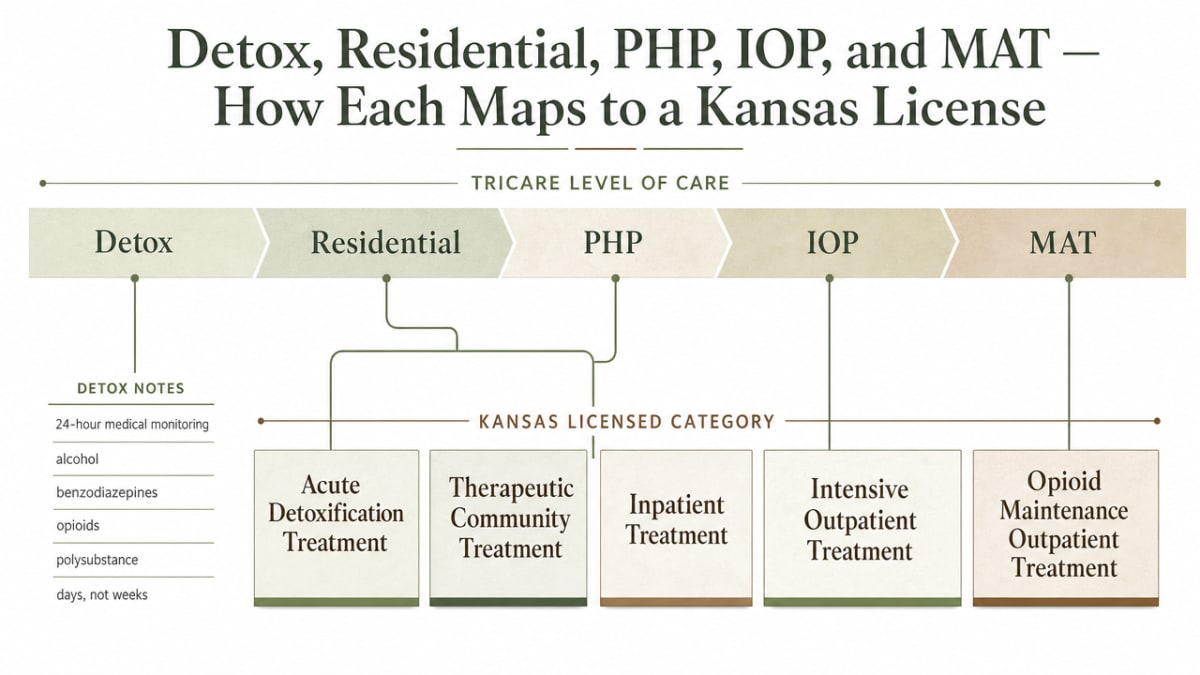
Detox, Residential, PHP, IOP, and MAT — How Each Maps to a Kansas License
Kansas licenses five treatment categories that carry TRICARE-covered care from the first shaky day of withdrawal all the way through step-down outpatient work: Acute Detoxification Treatment, Inpatient Treatment, Intensive Outpatient Treatment, Opioid Maintenance Outpatient Treatment, and Therapeutic Community Treatment 1. Every level of care your TRICARE plan is likely to authorize has a named, regulated home inside that list.
If you or your loved one needs medically supervised withdrawal, that’s Acute Detoxification Treatment on the Kansas side. TRICARE authorizes inpatient detox when withdrawal risk warrants 24-hour medical monitoring — alcohol, benzodiazepines, opioids, and polysubstance use are the most common triggers for this level. You’ll typically move out of detox in a matter of days, not weeks.
Residential and inpatient SUD care under TRICARE lands inside Kansas’s Inpatient Treatment and Therapeutic Community Treatment categories 1. This is where a 30-, 60-, or 90-day stay happens — where you sleep on-site, work with a clinical team every day, and step out of the environment that was keeping the substance use alive. TRICARE covers medically necessary residential treatment for SUD, and Kansas licenses facilities to deliver it.
Partial hospitalization is a bit of a shape-shifter in state licensing. Kansas doesn’t list PHP as a separate category, but PHP programs generally operate under a facility’s inpatient or intensive outpatient license depending on how the day treatment is structured. TRICARE covers PHP as its own distinct benefit — usually five to six hours of clinical programming a day, five days a week, while you sleep at home or in supportive housing.
Intensive outpatient is the cleanest match on the map. TRICARE’s IOP benefit lines up directly with Kansas’s Intensive Outpatient Treatment license 1. Expect three to five group and individual sessions per week for several weeks, designed to keep you working, parenting, or in school while treatment continues.
Medication-assisted treatment and opioid treatment programs — buprenorphine, methadone, naltrexone — are covered under TRICARE and delivered in Kansas through Opioid Maintenance Outpatient Treatment licensure 1. MAT can be prescribed in an office-based setting or through a licensed OTP, and TRICARE pays for the medication, the counseling, and the monitoring visits that go with it.
Outpatient therapy, the standard hour with a licensed counselor or psychiatrist, doesn’t need a specialized SUD license at all. Any Kansas-licensed mental health professional in-network with your plan can bill TRICARE for it.
The point of this crosswalk isn’t to turn you into a benefits analyst. It’s so that when someone at TriWest says a phrase like “residential SUD authorization,” you already know that phrase has a Kansas address.
Dual Diagnosis and Mental Health Coverage Under the Same Benefit
If addiction is only part of what’s going on — if there’s depression underneath, or trauma, or an eating disorder, or anxiety that never really lifted — your TRICARE benefit doesn’t split those problems into separate buckets. Mental health services are covered under the same behavioral health umbrella as substance use treatment. That means you can be treated for both, at the same time, by the same clinical team, without having to pick which crisis is more urgent this week.
This matters in Kansas, where SUD is understood as a chronic, treatable brain disease that rarely shows up alone 2. Most people who walk into residential or PHP care are carrying two or three diagnoses at once. TRICARE authorizes integrated care for co-occurring disorders across outpatient therapy, IOP, PHP, and residential levels, and psychiatric services — medication management, individual therapy with a licensed clinician, group work — are covered inside those same authorizations.
Practically, that means when a Kansas facility submits a treatment plan that names both a substance use diagnosis and a mental health diagnosis, TRICARE reviews it as one clinical picture. You don’t need two separate approvals, two separate providers, or two separate stays. One benefit, one team, one plan.
Prime vs Select vs Reserve Select: What Changes When You Pick Up the Phone
The plan you carry changes three things: how much choice you have about where to go, how much you’ll owe when you get there, and whether you need to route through a primary care manager first. That’s it. The clinical benefit — detox, residential, PHP, IOP, MAT, outpatient therapy — sits underneath all three plans.
If you have TRICARE Prime, you’re in a managed-care structure. A primary care manager coordinates your care, and higher levels of behavioral health — residential SUD, inpatient detox, PHP — typically require a referral before your plan will authorize the stay. The trade-off is lower out-of-pocket cost. If you’re active duty, your cost share for medically necessary behavioral health is generally nothing. Active duty family members pay less than Select enrollees. The catch is the referral loop, which is exactly the part that feels impossible when you’re already exhausted.
TRICARE Select is the fee-for-service option. You can self-refer to a TRICARE-authorized behavioral health provider in Kansas without going through a PCM, which matters when you’re trying to get into a bed this week and don’t want to wait on a referral queue. Select still requires pre-authorization for residential treatment and inpatient stays, but you’re the one initiating it, or the admitting facility is. Cost shares are higher than Prime, and there’s an annual deductible to meet.
Reserve Select is for Guard and Reserve members not on active-duty orders, and it functions much like Select for behavioral health — self-referral is allowed, pre-authorization still applies for higher levels of care, and you pay a monthly premium on top of cost shares.
Referrals, Pre-Authorizations, and the Words That Actually Unstick a Case
Two words do most of the paperwork lifting inside a TRICARE behavioral health case: referral and pre-authorization. They sound similar. They are not the same thing, and confusing them is the reason a lot of Kansas admissions stall for days when they didn’t need to.
A referral is your primary care manager saying, in writing, that you should see a specialist or enter a higher level of care. If you’re on Prime, referrals are usually required before residential SUD, inpatient detox, or PHP will be covered. If you’re on Select or Reserve Select, you can generally skip the referral step for behavioral health and go straight to a TRICARE-authorized provider.
Pre-authorization is different. It’s the contractor — TriWest for Kansas — reviewing the clinical case and approving the specific level of care and the expected length of stay before treatment begins. Residential treatment and inpatient stays require pre-authorization on every TRICARE plan. Outpatient therapy and standard IOP typically do not, though psychological testing and some MAT services can.
Here’s the phrase that unsticks most cases when you’re on the phone:“I need to request pre-authorization for medically necessary substance use disorder treatment.”That sentence puts the case on the clinical review track, not the general benefits track. If a Kansas admissions team is calling on your behalf, they’ll use the same language and submit an ASAM-based clinical assessment to justify the level of care 1. The word urgent also matters — for acute detox or active withdrawal risk, contractors have expedited review pathways. Say the word if it fits your situation.
One more thing worth knowing: a denial at the first level of care isn’t the end. Peer-to-peer reviews, where the facility’s medical director talks directly to the contractor’s reviewer, resolve a meaningful share of initial denials. If someone tells you no, ask what the appeal or peer-review process looks like before you hang up.
Why This Matters in Kansas Right Now
You do not need a reason to ask for help beyond the one you already have. But if part of you is wondering whether this is really that bad, or whether you’re overreacting, the state’s own numbers say the ground you’re standing on is more crowded than it feels.
From 2020 through 2024, 3,013 people died from drug overdoses in Kansas 4. In 2024 alone, Kansas emergency departments logged an estimated 7,578 visits suspected to involve an overdose 5. Zoom out from the ED and the mortuary and the picture gets wider: SAMHSA’s most recent state estimates put substance use disorder prevalence among Kansans aged 12 or older at 16.24% in 2022–2023 — roughly 395,000 people 10. That’s the population of Wichita and Topeka combined, carrying some version of what you’re carrying right now.
KDHE names substance use disorder for what it is: a chronic brain disease that can be treated 2. Not a character flaw. Not a decision you keep failing to make correctly. A treatable condition, sitting inside a state with the licensed infrastructure to treat it and a benefit — yours — designed to pay for that treatment.
None of this is meant to scare you into calling. It’s meant to tell you that if you do call, you are not the first person in Kansas to dial that number this week. You will not be the last.
How to Verify Your TRICARE Benefits in One Afternoon
You can move from “I don’t know if this is covered” to “here’s what my plan will pay for” in a single afternoon. Not weeks. Not a stack of forms. One or two phone calls, a few notes on paper, and you’ll know where you stand.
The three parts below walk through it in order: what to gather before you dial, the specific questions that get you real answers instead of a runaround, and what a Kansas admissions team can lift off your plate once you’re ready to hand it over. If you can only do one of these today, do the first one. The rest gets easier from there.
What to Have Ready Before You Call
You don’t need much. A TRICARE ID card, or a photo of it on your phone, is the single most useful item — it shows your sponsor’s information, your plan, and often your region. If you can’t find the card, don’t stop there. The sponsor’s full name, date of birth, and DoD Benefits Number or Social Security number are enough for a contractor to look up the record.
Have a pen and a piece of paper. Write down the name of the person you speak with, the reference or call number they give you, and the date. If you get transferred, that reference number keeps you from starting over.
That’s it. You do not need to know your plan type. You do not need to know your region. You do not need to have picked a facility. You are calling to learn, not to defend a decision.
The Questions to Ask Humana Military or TriWest
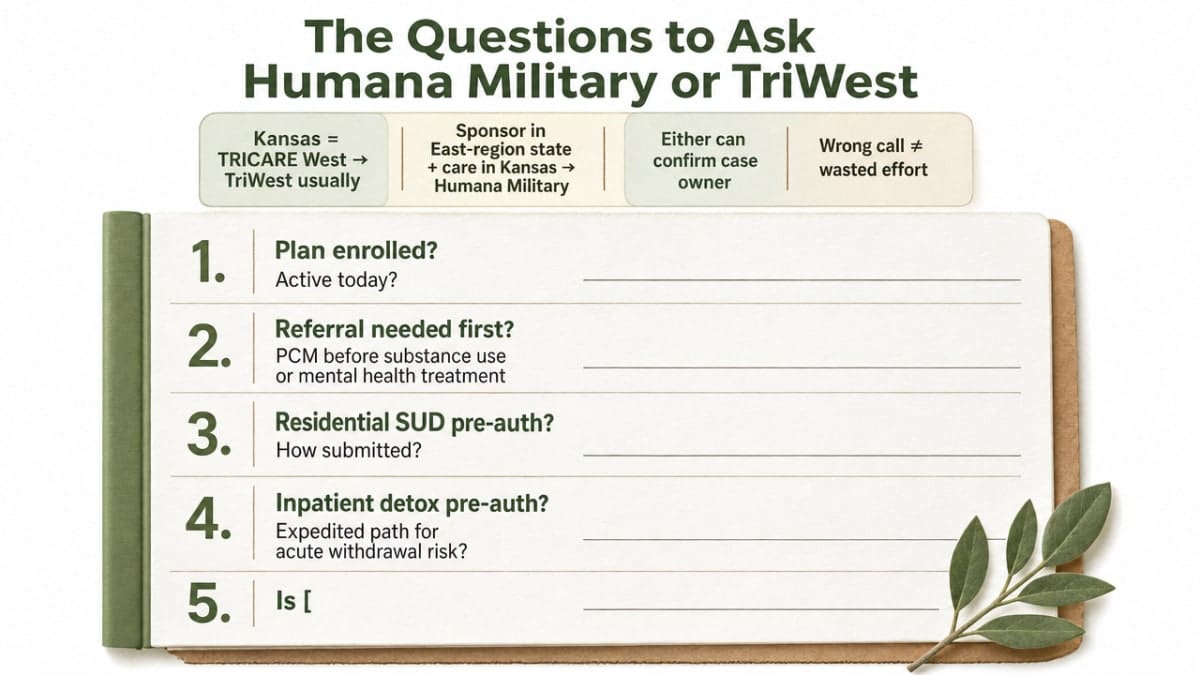
Kansas is a TRICARE West state, so TriWest is the contractor you’ll usually be calling. If you or the sponsor live in an East-region state and are asking about care in Kansas, Humana Military handles the East side. Either contractor can confirm which one owns your case.
Ask these, in this order:
- Which TRICARE plan is this beneficiary enrolled in, and is the enrollment active today?
- Do I need a referral from a primary care manager before starting substance use or mental health treatment?
- Does residential treatment for substance use disorder require pre-authorization on this plan, and how is that request submitted?
- Does inpatient detox require pre-authorization, and is there an expedited pathway for acute withdrawal?
- Is [facility name] a TRICARE-authorized provider, and if not, what are the non-network benefits under this plan?
- What is the cost share for residential, PHP, IOP, and outpatient behavioral health under this plan this year?
Write the answers next to each question. If a question can’t be answered on this call, ask who can answer it and when.
What a Kansas Admissions Team Handles for You
You are not expected to run this process alone. A Kansas facility’s admissions team does verification calls every day, and much of what feels overwhelming on your end is routine on theirs. Once you give them permission to work with your plan, they can pull benefit details directly from TriWest or Humana Military, confirm your cost share in writing, and start the pre-authorization request for residential or detox on your behalf.
They will also complete the clinical assessment — often ASAM-based — that the contractor needs to approve the level of care 1. If a peer-to-peer review becomes necessary, their medical director handles that conversation. You do not have to argue clinical criteria with an insurance reviewer.
What that means practically: after your first call, you can hand the verification thread to admissions and rest for a few hours. The paperwork keeps moving without you holding the phone.
What to Have Ready Before You Call
You need less than you think. A TRICARE ID card, or a clear photo of it on your phone, is the single most useful item — it shows the sponsor’s information, the plan, and often the region. If the card isn’t findable right now, don’t stall on that. The sponsor’s full name, date of birth, and DoD Benefits Number or Social Security number are enough for a contractor to pull up the record.
Grab a pen and a piece of paper. Write down the name of the person you speak with, the reference or call number they give you, and the date. If the call gets transferred, that reference number keeps you from starting the whole story over.
That’s it. You do not need to know your plan type. You do not need to know your region. You do not need to have chosen a facility. You are calling to gather information, not to defend a decision you haven’t made yet.
The Questions to Ask Humana Military or TriWest
Kansas sits in the TRICARE West region, so TriWest is usually the number you’ll dial. If the sponsor lives in an East-region state and you’re asking about care in Kansas, Humana Military handles that side. Either contractor can confirm which one owns your case, so if you call the wrong one, you have not wasted your effort.
Work through these questions in order, and write the answer next to each:
- Which TRICARE plan is this beneficiary enrolled in, and is the enrollment active as of today?
- Do I need a referral from a primary care manager before starting substance use or mental health treatment?
- Does residential treatment for substance use disorder require pre-authorization on this plan, and how is that request submitted?
- Does inpatient detox require pre-authorization, and is there an expedited pathway when there’s acute withdrawal risk?
- Is [facility name] a TRICARE-authorized provider in Kansas, and if not, what are the non-network benefits under this plan?
- What is the cost share for residential, PHP, IOP, and outpatient behavioral health under this plan this year?
If a question can’t be answered on this call, ask who can answer it and by when. Get the reference number for the call before you hang up. That number is what turns your next conversation into a continuation instead of a restart.
What a Kansas Admissions Team Handles for You
You are not expected to run this process alone. A Kansas facility’s admissions team makes verification calls every day, and much of what feels like a mountain from your kitchen table is a checklist on theirs. Once you sign a short release giving them permission to speak with your plan, they can pull benefit details directly from TriWest or Humana Military, confirm your cost share in writing, and open the pre-authorization request for residential or detox before you finish your coffee.
They will also complete the clinical assessment the contractor needs to approve a level of care, typically an ASAM-based intake that documents withdrawal risk, co-occurring conditions, and recommended intensity of treatment 1. If a peer-to-peer review is required, the facility’s medical director handles that call. You do not have to argue clinical criteria with an insurance reviewer, and you do not have to translate your own worst week into billing language.
Hand off the thread after your first call and rest. The paperwork keeps moving without your hand on the phone.
In-Network vs Non-Network in Kansas, and What Makes a Facility TRICARE-Eligible
Not every Kansas rehab that says “we accept TRICARE” is in-network with your plan, and the difference shows up in your out-of-pocket costs. In-network means the facility has a contract with TriWest (or Humana Military if your case is East-region), agrees to negotiated rates, and files claims directly. Non-network means the facility is TRICARE-authorized — meaning it meets the eligibility rules to bill TRICARE at all — but hasn’t signed a network contract. You can still receive care there under most plans, but the cost share is usually higher, and on Prime, non-network care outside of an emergency generally requires a point-of-service election that carries a larger deductible and coinsurance.
So what makes a Kansas facility TRICARE-eligible in the first place? Two things, working together. First, the facility has to hold the appropriate Kansas license for the level of care it delivers — Acute Detoxification Treatment, Inpatient Treatment, Intensive Outpatient Treatment, Opioid Maintenance Outpatient Treatment, or Therapeutic Community Treatment 1. Kansas licenses and regulates alcohol and other drug abuse treatment programs, and facilities offering medical services must be appropriately licensed or certified to operate 8. Second, the facility has to meet TRICARE’s own provider certification standards, which include accreditation (typically Joint Commission or CARF), clinical staffing requirements, and utilization review protocols.
When you ask a Kansas facility whether they take your plan, ask two questions instead of one: are you TRICARE-authorized, and are you in-network with TriWest (or Humana Military) for my specific plan? The answers can differ, and knowing which one you’re getting is the difference between a predictable cost share and a surprise bill.
Making the First Call
You have read enough. The next thing is a phone call — either yours or someone standing next to you making it while you sit down.
Two numbers are worth knowing before you dial. TriWest handles TRICARE West cases, which is where Kansas sits, and they can confirm your enrollment, plan type, and what pre-authorization your specific level of care requires. A Kansas facility’s admissions line — Sunflower Recovery Center among them — can verify your TRICARE benefits directly, open the pre-authorization request for detox or residential on your behalf, and complete the clinical assessment the contractor needs 1. You do not have to choose which call to make first. Whichever number you dial, the other side of the process starts moving.
You do not need to have your plan figured out. You do not need to know whether you’re on Prime or Select. You do not need a diagnosis. You need to say one sentence out loud. That sentence is the whole thing.
Start Your Recovery Journey With TRICARE Support
Connect quickly to verify TRICARE coverage and discuss next steps for treatment in Kansas.
Frequently Asked Questions
Does TRICARE cover inpatient rehab and detox in Kansas?
Yes. TRICARE covers medically necessary inpatient detox and residential substance use treatment across Prime, Select, and Reserve Select. Kansas licenses Acute Detoxification Treatment and Inpatient Treatment as distinct categories, so the in-state supply matches the benefit 1. Pre-authorization is required, and an expedited pathway exists when withdrawal is acute.
Is Kansas in the TRICARE East or TRICARE West region?
Kansas is in the TRICARE West region, administered by TriWest Healthcare Alliance. TriWest handles enrollment verification, referrals, pre-authorizations, and network status for Kansas beneficiaries. If your sponsor lives in an East-region state and you’re seeking care in Kansas, Humana Military may hold the case — either contractor can confirm which one owns yours.
Do I need a referral or pre-authorization before starting rehab?
It depends on your plan. TRICARE Prime typically requires a referral from your primary care manager before residential or PHP care. Select and Reserve Select allow self-referral to a TRICARE-authorized behavioral health provider. All three plans require pre-authorization for residential SUD treatment and inpatient detox, submitted by the admitting facility with a clinical assessment 1.
What’s the difference between TRICARE Prime, Select, and Reserve Select for behavioral health?
The clinical benefit is the same across all three. Prime is managed care with lower cost shares but referral requirements for higher levels. Select is fee-for-service with self-referral, higher cost shares, and an annual deductible. Reserve Select works like Select for Guard and Reserve members not on active-duty orders, with a monthly premium added.
Does TRICARE cover dual diagnosis treatment for addiction and mental health together?
Yes. TRICARE treats mental health and substance use under the same behavioral health umbrella, so co-occurring conditions like depression, trauma, anxiety, or eating disorders can be treated alongside SUD in one authorization. Kansas frames SUD as a chronic, treatable brain disease that rarely appears alone 2, and one clinical team can address both.
What should I have ready when I call to verify my TRICARE benefits?
Ideally, a TRICARE ID card or a photo of one. If it isn’t nearby, the sponsor’s full name, date of birth, and DoD Benefits Number or Social Security number are enough. Keep a pen handy to note the representative’s name, the call reference number, and the date. You don’t need to know your plan type first.
References
- Substance Use Disorder Treatment Services – KDADS. https://www.kdads.ks.gov/services-programs/behavioral-health/services-and-programs/substance-use-disorder-treatment-services
- Substance Use Disorder & Overdose Prevention | KDHE, KS. https://www.kdhe.ks.gov/1298/Substance-Use-Disorder-Overdose-Preventi
- Overdose Reports & Resources | KDHE, KS – Kansas.gov. https://www.kdhe.ks.gov/1308/Reports-Resources
- Drug Overdose Deaths in Kansas 2020-2024. https://www.kdhe.ks.gov/DocumentCenter/View/55471/2020-2024-Kansas-Overdose-Deaths-PDF
- 2026 KDHE Overdose ED Visit Fact Sheet. https://www.kdhe.ks.gov/DocumentCenter/View/56984/2026-KDHE-Overdose-ED-Visit-Fact-Sheet-PDF?bidId=
- Kansas Fatal Drug Overdose Vulnerability Assessment. https://www.kdhe.ks.gov/DocumentCenter/View/59744/Kansas-Fatal-Drug-Overdose-Vulnerability-Assessment-PDF?bidId=
- Behavioral Health Barometer: Kansas, Volume 4. https://www.samhsa.gov/data/sites/default/files/Kansas_BHBarometer_Volume_4.pdf
- Kansas Summary — State Residential Treatment for Behavioral Health Conditions. https://aspe.hhs.gov/sites/default/files/2021-08/StateBHCond-Kansas.pdf
- Colmery-O’Neil Veterans Administration Medical Center (VA Eastern Kansas Health Care). https://www.va.gov/eastern-kansas-health-care/locations/colmery-oneil-veterans-administration-medical-center/
- KANSAS – National Survey on Drug Use and Health. https://www.samhsa.gov/data/sites/default/files/reports/rpt56188/2023-nsduh-sae-state-tables_0/2023-nsduh-sae-state-tabs-kansas.pdf
- Kansas | VA.gov. https://www.va.gov/vetdata/docs/SpecialReports/State_Summaries_Kansas.pdf
- Overdose Data Dashboard | KDHE, KS. https://www.kdhe.ks.gov/1309/Data-Dashboard
- Mental Health Parity – KanCare. https://www.kancare.ks.gov/data-policy/mental-health-parity