
Key Takeaways
- Xanax dependence often develops from legitimate prescriptions that drift past the label’s 2-to-4-week window, not from personal failure or misuse 11.
- Alprazolam’s high potency and short half-life create rebound anxiety between doses, which is a pharmacological reaction rather than the original anxiety returning 2.
- Missouri has already recognized this pattern through overdose surveillance and MO HealthNet’s 21-day benzodiazepine supply limit with prior authorization for extended therapy 15.
- Before choosing a program, weigh whether it offers a paced medical taper, dual-diagnosis care for the underlying anxiety, and honest assessment of co-use with opioids or alcohol 6.
When the Prescription Stops Working the Way It Used To
You remember what it felt like the first time. The panic that had been sitting on your chest for months finally loosened. A doctor listened, wrote a prescription for Xanax, and within an hour of that first small pill, you could breathe again. It worked. That is the part nobody talks about enough, because it makes what happened next feel confusing.
Now the pill still lets you breathe, but only for a few hours. The anxiety comes back sharper between doses. You watch the clock. You count what is left in the bottle before bed and feel a small drop in your stomach when the number is low. Maybe you have already tried to skip a dose, or stretch the time between them, and the shaking or the racing thoughts pulled you right back to the bottle. If you are reading this, some part of you already knows something has shifted.
This is not a story about willpower. Alprazolam, the drug inside Xanax, has a well-documented pattern of producing dependence even when it is taken exactly as a prescriber ordered 1. The medication changed. Your brain changed. Both things are true, and both have names, and both have a path forward that does not involve doing this alone. That path is what the rest of this article is about.
What a Legitimate Xanax Prescription Was Supposed to Look Like
The Label Your Prescriber Started From
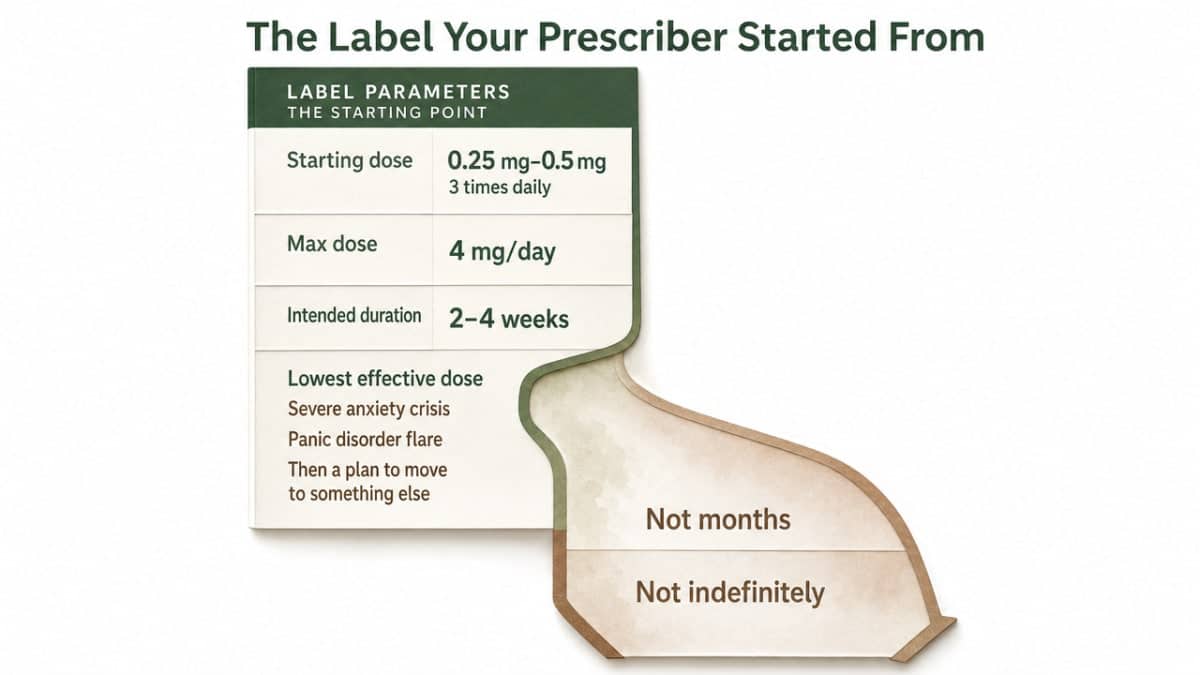
Before you decide anything about yourself, it helps to see what the prescription was actually designed to do. When your doctor wrote that first script for Xanax, they were working from FDA prescribing information that is more specific than most patients ever realize. For generalized anxiety disorder, the recommended starting oral dose of Xanax is 0.25 mg to 0.5 mg three times daily, with a maximum recommended dose of 4 mg per day 9. Those are small numbers. That is on purpose.
Duration was supposed to be small too. Primary-care prescribing guidance is clear that benzodiazepines should be used at the lowest effective dose for a maximum of two to four weeks, typically during a severe anxiety crisis or a panic disorder flare 11. Not months. Not indefinitely. Two to four weeks, and then a plan to move to something else.
Read that gap again, because it matters: a ceiling of 4 mg per day and a duration of 2 to 4 weeks. That is the outline the label sketches out. If you have been on Xanax for a year, or three, or ten, you are not looking at a personal failure. You are looking at a real-world regimen that drifted past what the paperwork ever described. The FDA even revised the Xanax Medication Guide in April 2024 to sharpen the safety language around exactly this kind of drift 9.
None of this is meant to make you distrust the person who wrote the prescription. It is meant to give you back some ground to stand on.
How Weeks Turned Into Months (and Nobody Meant For That to Happen)
Here is the story that plays out in thousands of charts. The first two weeks work. The panic attacks quiet down. You go back for a follow-up, and stopping the medication now feels risky because your anxiety is still there underneath. Your prescriber gives you another month. That month becomes three. Somewhere around month four, the same dose does not do quite what it used to, and the conversation shifts, quietly, to whether the dose should be a little higher.
Nobody decided to keep you on Xanax for a year. It happened one refill at a time. Alprazolam, more than most benzodiazepines, tends to slide into this pattern because it is often prescribed at higher doses and for longer durations than the label recommends, which is precisely what raises the risk of dependence and a difficult withdrawal later 2. Recent reviews describe alprazolam as effective for anxiety when used properly, but note that even appropriate prescribing carries real risks of dependence and prolonged withdrawal when the use extends past its intended window 1.
You may have also felt, at some point, that missing a dose made your anxiety spike harder than before you ever started. That is not you being weak. That is the medication doing what the pharmacology predicts. We will get into why in the next section.
If you have counted refills lately and felt a small flush of shame, put that down for a minute. You are not the first person to end up here, and there is a way out that does not require you to figure it out alone.
Why Alprazolam Specifically Is So Hard to Come Off
Short Half-Life, High Potency, and the Feeling That Your Anxiety Is Getting Worse
If you have ever wondered why Xanax seems harder to stop than other medications people talk about, the answer is not in your head. It is in the pharmacology of alprazolam itself.
Two things about this specific drug make it behave differently than a lot of its cousins. The first is potency. Alprazolam is one of the more potent benzodiazepines by milligram, which is why the FDA-labeled starting dose is measured in fractions of a milligram rather than in tens of milligrams 9. A small pill does a lot of work. The second is a short half-life, which means the drug clears out of your system relatively quickly compared to longer-acting benzodiazepines. Fast in, fast out.
That combination is what makes the between-dose window feel the way it does. The medication takes hold quickly, gives you a few hours of real relief, and then leaves. Your nervous system, which has adapted to having that calming effect on board, notices the absence sharply. You feel it as edginess, tightness in the chest, maybe a racing heart an hour or two before your next scheduled dose. You take the pill. You feel better. And a loop forms that has nothing to do with wanting to get high and everything to do with a body that has started organizing itself around the medication.
Newer clinical reviews name this pattern plainly: alprazolam has a higher misuse liability than other benzodiazepines partly because its rapid onset and short duration reinforce repeated dosing 2. And continued use, even at prescribed doses, can produce clinically significant physical dependence over time 10. None of that requires you to have done anything wrong. It requires only that you kept taking a medication the way it was prescribed, for longer than the label ever intended.
Knowing the mechanism is not a cure. It is a foothold. You are not weak. The drug is fast, strong, and short-acting, and your body responded the way bodies respond.
Rebound Anxiety Is Not Your Original Anxiety Coming Back
Here is one of the most disorienting parts of being on Xanax long-term. You try to stretch a dose, or skip one, and within hours the anxiety comes roaring back, often worse than what first sent you to the doctor. The obvious conclusion, the one that keeps a lot of people stuck, is that your anxiety disorder is getting worse and you need the medication more than ever.
That conclusion is usually wrong, and it matters that you hear that clearly.
What you are feeling in that window has a name: rebound anxiety. It is the nervous system reacting to the sudden drop in alprazolam levels, not your baseline anxiety returning at full volume. Because alprazolam is short-acting and potent, the rebound can feel more intense than the original symptoms, which is exactly what the review literature on alprazolam withdrawal describes 2. Dependence and prolonged withdrawal phenomena can emerge from appropriate anxiety prescribing, not just from misuse 1.
This distinction changes what a real recovery looks like. If you treat rebound anxiety as proof that you still need the drug, you keep taking it. If you understand that a slow, supervised taper lets your nervous system re-learn its own regulation, the path opens up. Your original anxiety may still be there underneath. That part is real. It is also treatable, separately, and with tools that do not run out at the bottom of a bottle.
You Are Not an Outlier: Where Prescription Xanax Use Sits on a National Continuum
One of the quiet cruelties of Xanax dependence is how alone it makes you feel. You look at the bottle and think you must have done something other people did not do, taken it wrong, wanted it too much. The numbers say otherwise, and it is worth sitting with them for a moment because they change the story you tell yourself.
In the 2015-2016 National Survey on Drug Use and Health, about 30.5 million U.S. adults reported using benzodiazepines, roughly 5.2 million reported misusing them at least once, and about 0.3 million met clinical criteria for benzodiazepine dependence 12. That is a ladder, not a cliff. Tens of millions of people took a medication like Xanax, usually because a doctor prescribed it for real anxiety or panic. A smaller group ended up using it in a way that went past what the label described. A smaller group still crossed into what a clinician would formally call dependence.
Wherever you land on that ladder, you are on it with a lot of company. The path from a legitimate prescription into misuse or dependence is common enough that it shows up clearly in national surveillance data, and it is common enough that it drives ongoing regulatory attention to alprazolam specifically 1. Being here does not make you unusual. It makes you one of a very large number of people whose bodies responded to a potent, short-acting benzodiazepine the way that class of medication tends to make bodies respond.
What separates the people who find a way out is not character. It is usually access to someone who knows how to taper this drug safely and how to treat the anxiety underneath. That is the next question worth answering.
The Kansas City and Missouri Picture
What Missouri Overdose Data and MO HealthNet Rule Changes Actually Tell You
If you live in the Kansas City metro, some of what you are experiencing has already been recognized at the state level. That does not fix anything on its own, but it does mean you are not describing a problem nobody sees.
Missouri’s Department of Health and Senior Services runs a public Fatal Drug Overdose Dashboard that tracks overdose deaths across the state on an ongoing basis 8. It is one of the reasons benzodiazepines, alprazolam included, keep getting policy attention here. The dashboard is not a rebuke of your prescription. It is a reminder that the state has been watching this class of medication closely, precisely because the risks are real and the pattern is common.
The policy response has been quiet but pointed. Missouri Medicaid, MO HealthNet, tightened its coverage rules for oral benzodiazepines. For patients new to benzodiazepines, MO HealthNet will approve up to a 21-day supply per claim, and extended therapy generally requires prior authorization along with documentation of medical necessity 15. In plain terms, the state has built in a pause. The system has already recognized that indefinite refills of alprazolam without review is where people get into trouble.
You may not be on MO HealthNet. That is not the point. The point is that the guardrails now written into state policy exist because the pattern you are living inside is well-documented in Missouri, not just in medical journals. Reading that as validation, not judgment, is fair. You are one of many.
If You Are Also Taking an Opioid or Another Sedative
There is one situation that changes the urgency of this conversation. If your Xanax prescription sits alongside an opioid, a sleep medication, muscle relaxants like carisoprodol, or heavier alcohol use, the picture shifts.
You did not put yourself in this position on purpose. Chronic pain and chronic anxiety often travel together, and separate prescribers writing separate scripts is how people end up on both without either doctor fully weighing the interaction. If that is your situation, please do not try to sort it out by cutting either medication yourself. Call a clinician who can look at the whole list at once. That single phone call, made today, is the most protective thing you can do this week.
What Supervised Xanax Treatment Actually Involves
Assessment Before Anything Else
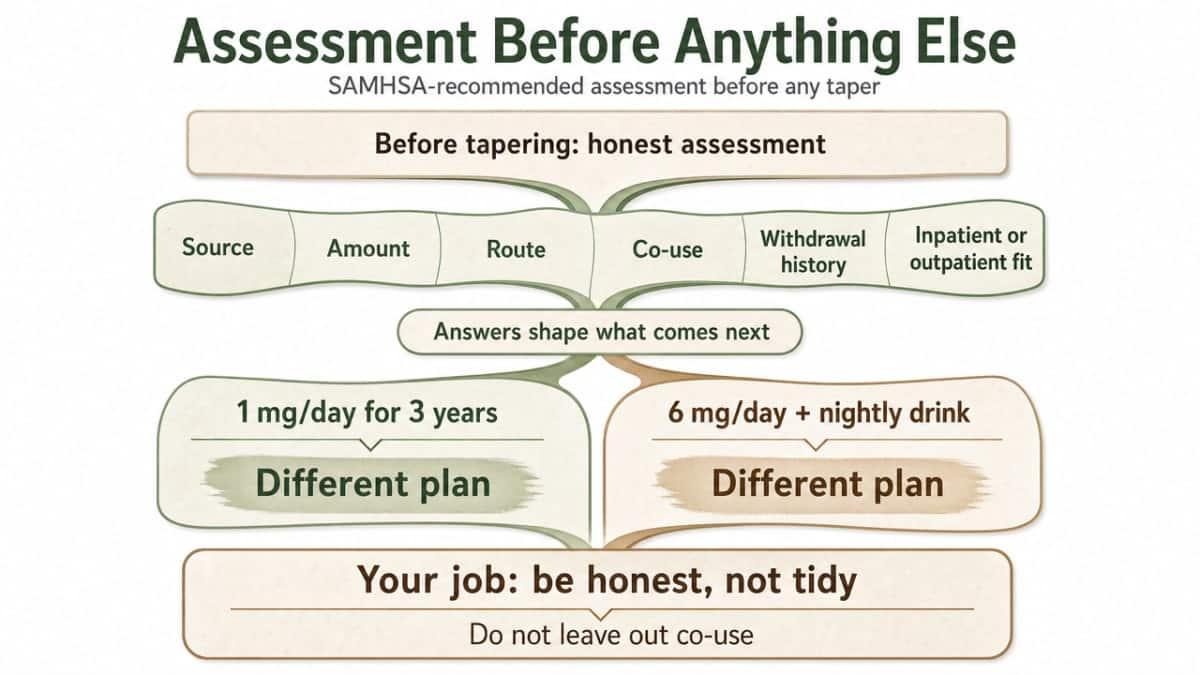
Before anyone talks to you about tapering, a good program will spend time on questions that might feel unrelated. How much Xanax are you actually taking on a typical day, and how much on a bad day? Where are you getting it? Are you also drinking, using any opioids, or taking anything for sleep? Have you tried to stop before, and what happened when you did?
Those questions are not a test. SAMHSA’s clinical guidance recommends that anyone being evaluated for benzodiazepine treatment be assessed on source, amount, route, co-use, withdrawal history, and whether inpatient or outpatient care fits their situation 6. The answers shape everything that comes next. Someone taking 1 mg a day for three years does not need the same plan as someone taking 6 mg a day with a nightly drink.
Your job in this conversation is to be honest, not tidy. Leaving out the wine at dinner or the leftover hydrocodone in the drawer does not protect you. It only means the plan gets built around the wrong picture. Every clinician who does this work has heard worse than whatever you are about to say.
A Taper Paced to Your Nervous System, Not a Calendar
The word “taper” makes it sound simple. Take a little less, then a little less, until you are at zero. In practice, tapering off alprazolam is one of the more delicate discontinuations in outpatient medicine, and it should not be improvised.
The manufacturer’s own guidance suggests reductions not exceeding 0.5 mg every three days, and clinical references note that slower is often better, especially at the lower end of the dose range where each cut represents a larger percentage of what is left 2, 10. Some people can move at that pace. Others need weeks between reductions, or a cross-taper to a longer-acting benzodiazepine that makes each step feel less like falling off a ledge. Abrupt discontinuation is not a shortcut. It can precipitate acute withdrawal that in some cases is medically dangerous, which is why supervision matters 10.
Here is the honest part: a good taper will have hard days. Sleep gets thin. Your body will send you signals that feel like proof you should stop the taper. A clinician watching your progress week to week can tell the difference between a rough patch that will pass and a step that needs to be paused or reversed. You do not have to read those signals alone, and you should not try to.
Treating the Anxiety That Is Still There After the Taper
Here is the part that gets skipped most often, and it is the part that matters most for whether the taper holds.
You started Xanax for a reason. A panic disorder, a generalized anxiety diagnosis, a stretch of your life where the fear would not turn off. When the alprazolam is gone, that original condition is often still there, sometimes clearer than it has been in years because the medication was masking it rather than resolving it. If nobody treats it, the pull back toward the bottle is enormous, and the whole taper can unravel.
This is where dual-diagnosis care stops being a marketing phrase and starts being the actual point. A program that only takes the drug away without treating the anxiety is setting you up to be back in this exact spot a year from now. Evidence-based therapy for panic and generalized anxiety, careful consideration of non-benzodiazepine medications when appropriate, and attention to the trauma or depression that often sits underneath, that is what fills the space alprazolam used to occupy 1. It is slower than a pill. It also lasts.
You are allowed to want both things. To be free of the Xanax and to feel less afraid. A real treatment plan is built around both.
Sunflower Recovery’s Approach for Kansas City Residents
If you live in the Kansas City metro and you have read this far, you already know the shape of what you need. Someone who understands alprazolam specifically. A taper paced to your body, not a schedule. And a real plan for the anxiety that will still be there when the pills are gone. That is the work Sunflower Recovery does, about an hour south of you in Osawatomie, Kansas.
The clinical model is built around dual diagnosis, meaning the Xanax dependence and the original anxiety disorder are treated as two connected problems rather than one. A multidisciplinary team looks at source, amount, co-use, and prior withdrawal history before anyone writes a taper plan, in line with the assessment steps SAMHSA recommends for benzodiazepine patients 6. From there, care can move across a continuum: 60-day residential, partial hospitalization, or intensive outpatient, depending on what your situation actually calls for.
Trauma-informed therapy sits alongside the medical piece, because the anxiety that first sent you to a prescriber usually has roots worth understanding. Sunflower accepts most commercial insurance. It does not participate in Medicare or Medicaid. If you are ready to talk about a medically supervised path off Xanax, call. That single conversation does not commit you to anything except getting information you deserve to have.
Start your path off Xanax with support
Connect with a team ready to guide your safe, structured recovery from Xanax dependence.
Frequently Asked Questions
Am I addicted to Xanax if I took it exactly as prescribed?
Physical dependence and addiction are not the same thing. Continued use of alprazolam, even at prescribed doses, can produce clinically significant physical dependence over time 10. That means your body has adapted to the medication, not that you did anything wrong. A clinician can help sort out where you actually sit and build a plan from there.
Why does my anxiety feel worse between Xanax doses than before I started the medication?
What you are feeling is likely rebound anxiety, not your original disorder getting worse. Alprazolam is potent and short-acting, so your nervous system reacts sharply when levels drop between doses 2. The rebound can feel more intense than what first sent you to a prescriber. This does not mean you need more Xanax. It usually means the pharmacology is doing exactly what it does.
Is it dangerous to stop taking Xanax on my own?
Yes. Abrupt discontinuation of alprazolam can precipitate acute withdrawal that may be medically dangerous, and in some cases fatal 10. Please do not try to quit cold turkey or improvise a taper from what you read online. Call a clinician who can assess your situation and build a supervised plan. That single call is the safest move you can make this week.
How long does a medically supervised Xanax taper take?
It depends on your dose, how long you have been taking Xanax, and how your body responds. The manufacturer suggests reductions not exceeding 0.5 mg every three days, and clinical references note slower is often better, especially near the end of the taper 2, 10. Some people finish in weeks. Others take months. A good clinician paces it to your nervous system, not a calendar.
What happens to my anxiety after I stop taking Xanax?
Your original anxiety is often still there when the alprazolam is gone, sometimes clearer because the medication was masking it 1. That is why the taper alone is not the whole plan. Evidence-based therapy for panic or generalized anxiety, and careful use of non-benzodiazepine options when appropriate, fills the space Xanax used to occupy. Slower than a pill, and it lasts.
Does Sunflower Recovery accept insurance for Xanax treatment in Kansas City?
Sunflower Recovery accepts most commercial insurance plans for Xanax treatment. The facility does not participate in Medicare or Medicaid. If you live in the Kansas City metro and want to talk about a medically supervised path off Xanax, calling to verify your specific plan is the fastest way to know what your coverage looks like. That conversation does not commit you to anything.
References
- Mother’s little helper turned a foe: Alprazolam use, misuse, and abuse. https://pubmed.ncbi.nlm.nih.gov/39260815/
- A Review of Alprazolam Use, Misuse, and Withdrawal. https://pmc.ncbi.nlm.nih.gov/articles/PMC5846112/
- Alprazolam and benzodiazepine dependence. https://pubmed.ncbi.nlm.nih.gov/8262891/
- Prescription Opioid and Benzodiazepine Medications and Occupational Safety and Health. https://www.cdc.gov/overdose-resources/hcp/files/prescription-opioid-and-benzodiazepine-medications-and-occupational-safety-and-health.html
- CDC Clinical Practice Guideline for Prescribing Opioids for Pain — United States, 2022. https://www.cdc.gov/mmwr/volumes/71/rr/rr7103a1.htm
- Recommendations from SAMHSA (TIP 63). https://www.mass.gov/doc/recommendations-from-samhsa-re-benzo-and-bupe/download
- What is the scope of prescription drug misuse in the United States?. https://nida.nih.gov/publications/research-reports/misuse-prescription-drugs/what-scope-prescription-drug-misuse
- Fatal Drug Overdose Dashboard. https://health.mo.gov/data-dashboards-tools/fatal-drug-overdose-dashboard
- HIGHLIGHTS OF PRESCRIBING INFORMATION (XANAX). https://dailymed.nlm.nih.gov/dailymed/fda/fdaDrugXsl.cfm?setid=bb5cf72e-3a41-41a8-9a38-80f974eca33f&type=display
- Alprazolam – StatPearls – NCBI Bookshelf. https://www.ncbi.nlm.nih.gov/books/NBK538165/
- Prescribing benzodiazepines in general practice. https://pmc.ncbi.nlm.nih.gov/articles/PMC6400612/
- Prevalence and correlates of benzodiazepine use, misuse, and use disorders among adults in the United States. https://pmc.ncbi.nlm.nih.gov/articles/PMC10309967/
- Annual Surveillance Report of Drug-related Risks and Outcomes. https://www.cdc.gov/overdose-prevention/media/pdfs/pubs/2019-cdc-drug-surveillance-report.pdf
- Trends in co-prescribed opioids and benzodiazepines, non-prescribed opioids and benzodiazepines, and schedule-I drugs in the United States, 2013 to 2019. https://www.ncbi.nlm.nih.gov/pmc/articles/PMC10827545/
- Benzodiazepines Select-Oral Clinical Edit 2-26-26. https://mydss.mo.gov/sites/mydss/files/media/file/2026/04/Benzodiazepines%20Select-Oral%20Clinical%20Edit%202-26-26.docx