
Key Takeaways
- Roughly 316,000 Kansans who needed substance use treatment in 2022 went without it, and the state logged 10,867 treatment admissions in 2023 15, 16.
- A 2020 Cochrane review found manualized AA and 12-Step Facilitation matched or outperformed other therapies for alcohol abstinence, working mainly through social network change and self-efficacy 1, 5.
- Meetings do not replace medical detox, medications for opioid use disorder, or care for trauma, depression, and eating disorders — federal guidance calls for combining clinical treatment with 12-Step community 24, 12.
- Kansans can call the 24-hour SUD Hotline at 866-645-8216, walk into an AA or NA meeting today, or ask any KDADS-licensed program how it builds 12-Step into PHP and IOP 18, 19, 11.
The Kansas Recovery Landscape at 11pm
If you are reading this at midnight on a phone in Wichita, Topeka, or a small town off I-35, you are not alone in the search. You are trying to figure out whether a meeting in a church basement can actually help, or whether you need something bigger. Maybe you have been to a few AA meetings and they did not stick. Maybe your sister keeps sending you links. Maybe you just watched someone you love nod off at the kitchen table again.
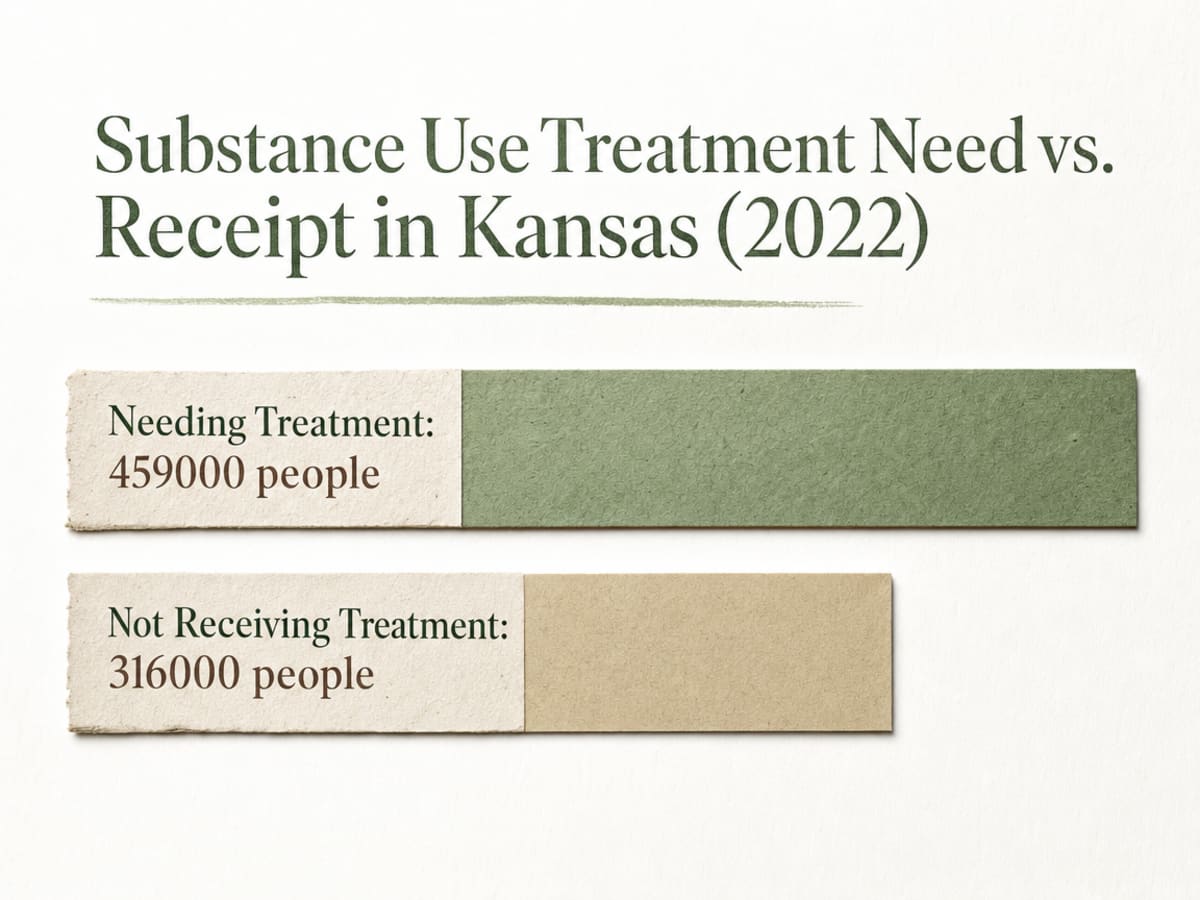
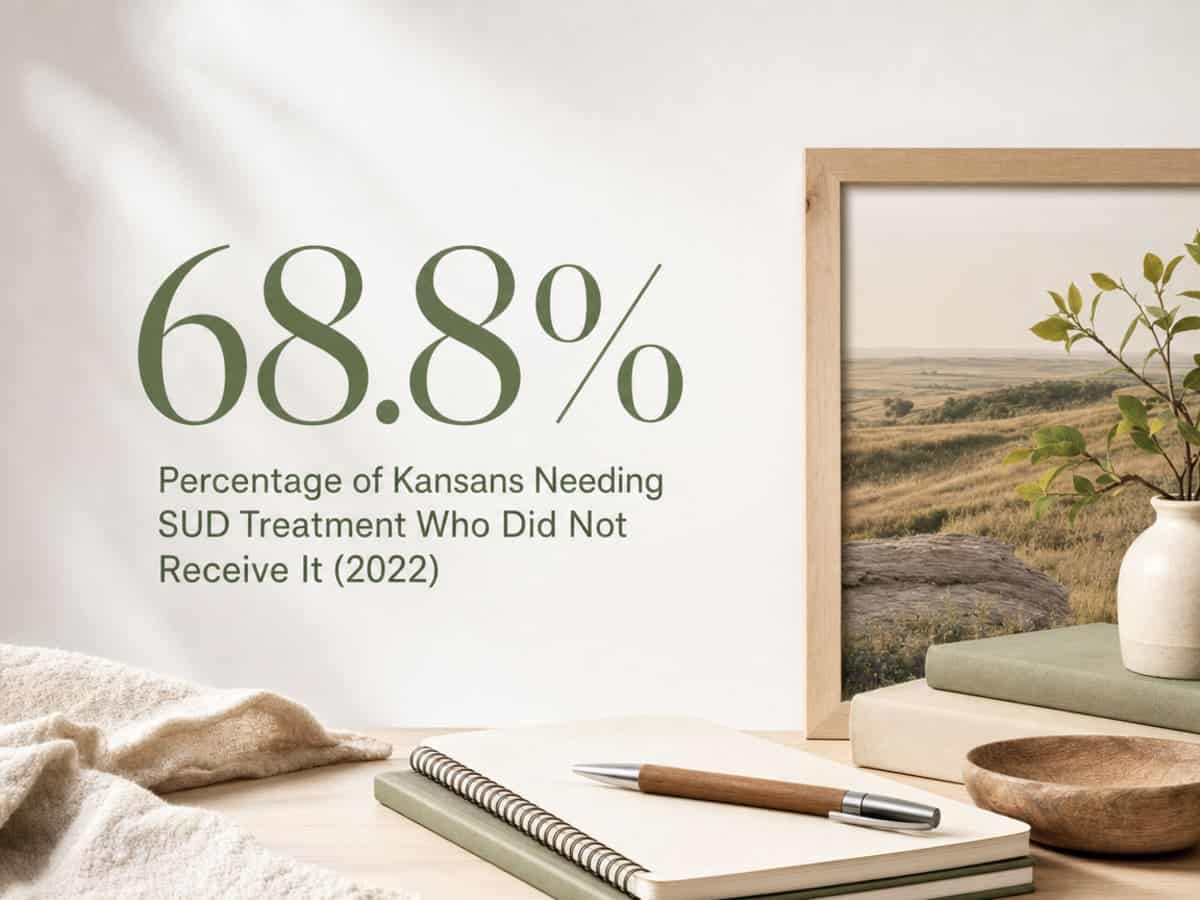
Here is the honest picture. In 2022, an estimated 459,000 people in Kansas aged 12 or older needed substance use treatment, and 316,000 of them were not receiving any 15. That is roughly seven out of every ten Kansans who needed help going without it. You are not the exception. You are the norm the system has been missing.
State data adds one more layer. Kansas recorded 10,867 treatment admissions in 2023 across its reporting system 16. Real people, real intake paperwork, real first phone calls. Some of them made that call at 11pm too.
This guide is written for that moment. It explains what a 12-step addiction program in Kansas actually is today, what the research says about whether it works, and how meetings fit alongside clinical treatment like detox, residential care, PHP, and IOP. It will not lecture you on spirituality or ask you to believe anything before you are ready. It will show you what the path looks like, and what your next call can be.
What 12-Step Actually Is (and What It Is Not)
The Model in Plain Language
Strip away the folklore for a minute. A 12-Step program is a free, peer-led community where people who want to stop drinking or using drugs meet regularly, share what is working, and follow a shared set of practices. That is the whole engine.
The practices are simple to name, even if they are hard to do:
- You show up to meetings.
- You get phone numbers from other people in the room.
- You pick a sponsor, which is a more experienced member who has walked the road you are trying to walk.
- You work through a set of reflection and action steps with that sponsor.
- Over time, you do service work — making coffee, setting up chairs, giving a newcomer a ride 4.
Alcoholics Anonymous is the oldest of these groups. Narcotics Anonymous, Cocaine Anonymous, and others share the same structure for different substances. In Kansas, meetings run in church basements, community centers, hospital conference rooms, and on Zoom. Most are an hour. Most are free. Nobody takes attendance.
What a meeting actually gives you is not a lecture. It is a room full of people who have already survived the night you are trying to survive, and a phone list you can call at 2am 25. That is the model. Everything else is layered on top.
Why Researchers Now Take It Seriously
For a long time, 12-Step got dismissed in academic circles as folk wisdom. That has changed, and it is worth understanding why, because it affects what your treatment team will likely recommend.
In 2020, a large Cochrane review looked at decades of studies on AA and the clinical version of the model, called 12-Step Facilitation, or TSF. The finding was blunt: manualized AA/TSF was superior to other treatments, including cognitive behavioral therapy, for helping people stay abstinent from alcohol, and it performed at least as well on drinking intensity, consequences, and addiction severity 1. The U.S. government’s Healthy People evidence hub picked this up and now lists AA/TSF as an evidence-based option that also produces meaningful health care cost savings 2.
Researchers who used to be skeptics wrote follow-up pieces essentially saying the field needed to update its priors. One peer-reviewed commentary put it plainly: the scientific evidence is now more than sufficient to support AA/TSF as at least on par with, and often superior to, other psychosocial treatments for alcohol use disorder 21.
Why does it work? The mechanism research points less at spirituality and more at concrete social change: your network shifts, your belief that you can stay sober goes up, and your motivation gets reinforced by people who are doing it too 5. A 2022 review called mutual-help groups the most commonly sought source of help for alcohol and drug problems in the U.S., and framed them as public-health infrastructure rather than a soft add-on 8.
What 12-Step Does Not Do on Its Own
Here is where honesty matters most. A meeting is not detox. A sponsor is not a psychiatrist. A phone list is not a medication.
If you are physically dependent on alcohol or benzodiazepines, withdrawal can be dangerous or fatal, and you need medical supervision. If you use opioids, medications like buprenorphine or methadone save lives, and no meeting replaces them. If you have depression, PTSD, bipolar disorder, or an eating disorder underneath your substance use, a room full of caring people cannot diagnose or treat what is driving the use.
Read that carefully. It does not mean 12-Step failed. It means community works best when the clinical layer is also in place. If you are choosing between a meeting tonight and calling a treatment program tomorrow, you can do both.
How Kansas Treatment Programs Are Structured Around You
When you call a Kansas treatment center, you are not just calling a building. You are calling a system the state has set up on purpose. Understanding that system helps you ask better questions when someone picks up the phone.
Substance use disorder treatment facilities in Kansas are licensed and approved by the Kansas Department for Aging and Disability Services (KDADS), which oversees SUD treatment facilities, community mental health centers, and related programs 19. The counselors and therapists inside those programs are regulated separately, through the Kansas Behavioral Sciences Regulatory Board, which sets rules for licensure, continuing education, and confidentiality 20. What that means for you: the person doing your intake is not freelancing. They are working under a state framework designed to keep your information private and your care accountable.
Inside that framework, most programs offer a step-down structure. You might start with medical detox if you need it, move into residential care, then step down to a Partial Hospitalization Program (PHP), and then to an Intensive Outpatient Program (IOP). Federal treatment guidance recommends this kind of continuum of care, especially when a co-occurring mental health condition is part of the picture 24.
Here is where 12-Step enters clinical space. Outpatient programs are specifically designed to orient you to 12-Step groups, and many schedule onsite meetings as part of the weekly rhythm 11. You are not being sent out the door with a phone number and a prayer. You are being introduced to a community while your clinical team is still holding the plan with you.
Sponsorship: The Relationship That Carries the Model
If meetings are the room, sponsorship is the phone call at 6am when you cannot breathe right. A sponsor is a more experienced member of the fellowship who has done the step work you are about to do, and who agrees to walk it with you. In the NIH’s own facilitation manual, a sponsor is described plainly as someone you can call for information, meeting guidance, and help getting active in the fellowship 9. Not a therapist. Not a boss. A guide who has been where you are.
The research on sponsorship is where 12-Step stops being folklore and starts looking like a measurable recovery mechanism. Formal work on the sponsor alliance treats it as a therapeutic bond, similar in some ways to the bond a client has with a counselor, and it can be measured 6. When researchers looked at people already in treatment, more sponsor contact and a stronger sponsor bond were linked to more 12-Step participation and more days sober during follow-up 7.
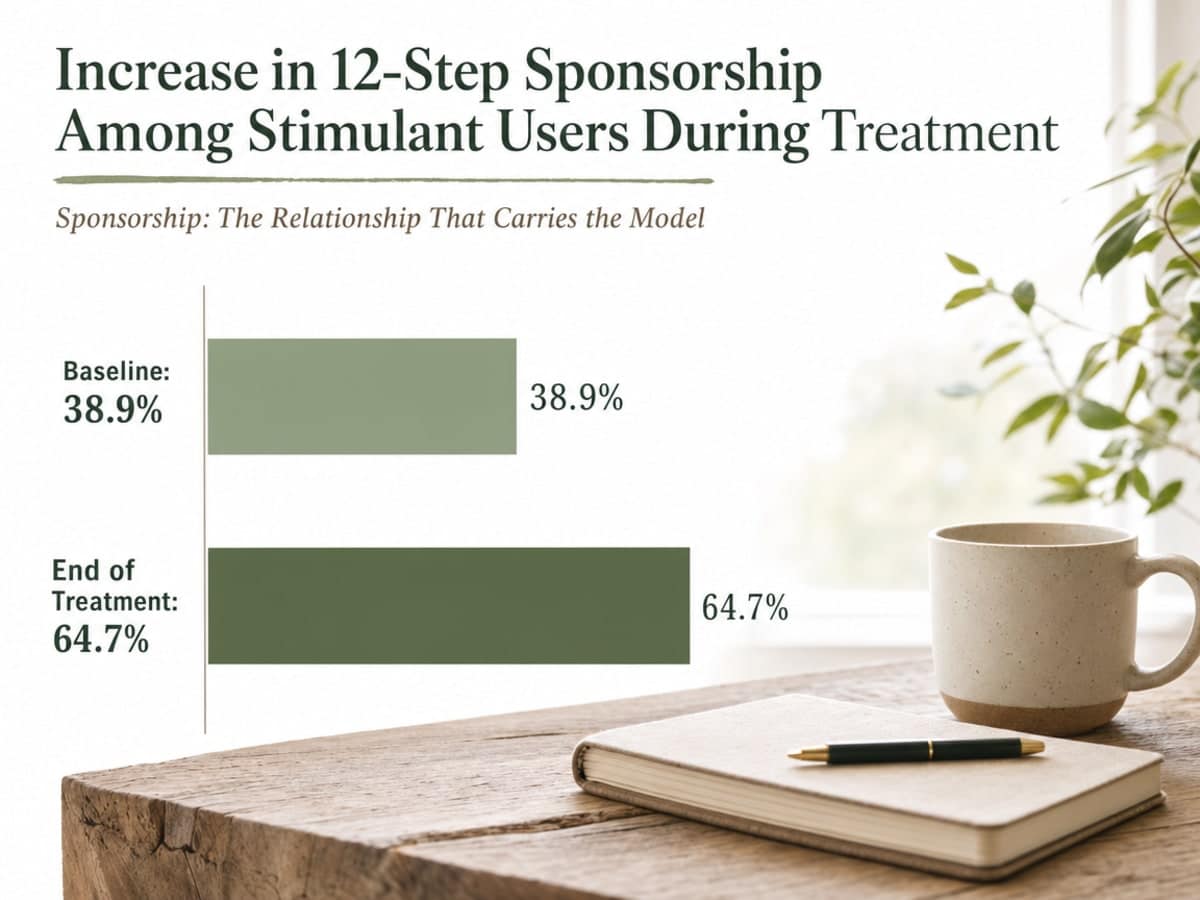
The clearest picture comes from a multisite trial of people who used cocaine or methamphetamine. At the start of the study, 38.9% of participants had a sponsor. By the end of treatment, that number had climbed to 64.7% — and having a sponsor predicted a higher likelihood of abstinence and fewer drug-related problems 13. That is not a small shift. That is a room full of people who did not have a lifeline in January and had one by June.
A few honest notes before you go looking for one:
- You do not need to pick a sponsor on your first night. Most people are told to attend meetings for a few weeks, listen for someone whose recovery you actually want, and then ask.
- The ask itself is small: “Would you sponsor me?”
- You can change sponsors if the fit is wrong.
- Sponsors are peers in recovery, not licensed clinicians — if your day includes suicidal thoughts, active withdrawal, or a psychiatric crisis, your sponsor is not the right call. Your treatment team or the Kansas SUD Hotline is.
What sponsorship carries is the part of recovery that a Tuesday appointment cannot: someone who picks up when the craving hits at 9pm on a Saturday, and who has already survived their own version of that night.
A Blended Recovery Week in Kansas
Words like “integrated care” and “continuum” do not mean much at 11pm. So here is what a real week can look like when clinical treatment and 12-Step community are running side by side. Think of it as a rhythm, not a rulebook.
Monday. Morning group therapy at your PHP or IOP. Afternoon check-in with your individual counselor about the weekend. Evening: an onsite 12-Step meeting held right at the treatment center — a practice that outpatient programs commonly build into the weekly schedule so you do not have to find a meeting on your own 11.
Tuesday. Psychiatry appointment to review medications for depression, anxiety, or opioid use disorder. A quick biometric check-in if your program uses wearables. Later that night, you call the sponsor you asked to work with last week. Ten minutes. You tell them how the med change is landing.
Wednesday. Trauma-focused therapy in the morning. Family session in the afternoon if your spouse or parent is part of your plan. Evening: your home group meeting at a church basement in Kansas City or Osawatomie. Same room, same time, every week. That repetition is part of the medicine.
Thursday. Skills group at the clinical program. Phone contacts with two people from your meeting phone list — one you check on, one who checks on you. This is not filler. Getting phone numbers and using them is one of the core behaviors that structured 12-Step facilitation actually asks of you 4.
Friday. Individual therapy. Step work with your sponsor, usually a written reflection you discuss on a call or over coffee. NIH facilitation manuals treat sponsor selection and step work as central components of the intervention, not extracurriculars 9.
Saturday. Service work at your home group — making coffee, setting up chairs, greeting the newcomer who is where you were three months ago 4. Sunday: rest, a speaker meeting if you want one, and a plan for the week ahead with your counselor on Monday.
That is roughly 12 to 20 clinical hours and 3 to 5 community touchpoints in a single week. Neither side carries the whole load. The clinical team treats what a meeting cannot. The meeting holds what a Tuesday appointment cannot. This is what a blended path in Kansas can look like when someone finally picks up the phone.
When Depression, Trauma, or an Eating Disorder Sits Underneath
For a lot of people in Kansas, the drinking or the pills are not the whole story. There is a layer underneath — the panic that started after the assault, the depression that has been humming since middle school, the eating disorder that got quieter when the wine got louder. If that sounds like you, a meeting alone is probably not going to hold it.
The research is clear-eyed about this. When people with co-occurring psychiatric conditions were placed in 12-Step Facilitation, they did attend more meetings than a comparison group — but on the primary substance-use outcomes, TSF alone did not outperform standard care 12. Translation: getting to the room is a real gain, and the room by itself is not enough when a mood disorder, trauma history, or eating disorder is running the show underneath.
That is not a knock on 12-Step. It is a match problem. Federal treatment principles are explicit that effective care for people with co-occurring conditions has to treat both the substance use and the mental health condition, using a continuum of care rather than a single tool 24. A trauma therapist can do something a home group cannot. A psychiatrist adjusting your SSRI can do something your sponsor cannot. And your sponsor, at 10pm on a Thursday, can do something neither of them is available to do.
What good dual-diagnosis care looks like in practice: an assessment that names the trauma or the depression by its actual name, a therapist trained in trauma-focused work, psychiatric medication management when it fits, and 12-Step community layered on top rather than instead. If a program pushes meetings as a substitute for treating your PTSD or your eating disorder, that is a program mismatch, not a personal failing.
One more honest note. Some meetings will feel safer than others when you are also carrying a mental health diagnosis. That is normal. You may need to try a few rooms before one clicks, and you may need to be selective about what you share and with whom. Your treatment team can help you sort that. Sunflower Recovery Center was built around this exact overlap — adults whose addiction is tangled up with trauma, depression, anxiety, or an eating disorder — and that is the kind of clinical team you want holding the plan while the community layer builds around you.
If You Are Skeptical of the Spiritual Framing
A lot of people close the door on 12-Step before they ever try it, because the word “God” shows up in the readings and they are done. Fair. If you have been burned by religion, or you just do not believe, being told to turn your life over to a higher power can feel like the exit sign.
Here is what the research actually shows about how the model works. When scientists tried to figure out why 12-Step helps people stay sober, spirituality was not the main lever. The bigger drivers were concrete: your social network changes, your belief that you can actually stay sober goes up, and your motivation to keep going gets reinforced by people who are doing it too 5. In plain terms, the room is doing more of the work than the reading.
The higher power language is flexible in practice. Plenty of long-term members interpret it as the group itself, the process, or simply something bigger than their own worst instincts at 2am. You are not required to convert to anything. You are asked to consider that white-knuckling it alone has not worked, and that other people might know something you do not yet.
If a specific meeting feels too religious for you, try another. Rooms vary a lot by city, day, and crowd. And if the framing still does not fit after honest effort, that is useful information for your treatment team — not a verdict on whether you can recover.
Finding Care and Getting Started This Week
Kansas Access Points
You do not need to have this figured out before you make a call. That is what the first call is for.
If tonight is the emergency, start with the Kansas Substance Use Disorder Hotline. It runs 24 hours a day at 866-645-8216, and it exists so someone picks up when the rest of the world is asleep 18. If you or someone in the room is showing signs of overdose — blue lips, slowed breathing, unresponsiveness — call 911 first. The Kansas Department of Health and Environment maintains overdose resources and county-level data that local first responders and public health teams use every day 17.
For treatment itself, Kansas licenses substance use disorder treatment facilities and community mental health centers through KDADS 19. When you call any Kansas program, it is fair to ask three things:
- Are you a KDADS-licensed SUD treatment facility?
- Are your counselors licensed under the state board 20?
- Do you incorporate 12-Step referral or onsite meetings into your outpatient schedule 11?
Those three questions will tell you a lot about who you are talking to.
You can also walk into an AA or NA meeting today without calling anyone. No paperwork. No insurance. Just a chair.
What a Call to Sunflower Recovery Center Looks Like
If you decide to call Sunflower, here is what happens on the other end of the line.
Someone answers. They ask what is going on right now — not your whole life story, just tonight. If you are in withdrawal or in crisis, that shapes the next few questions. If you are steadier and calling on behalf of a family member, that shifts it too. There is no script you have to hit.
From there, an intake conversation covers the basics: what you are using, how long, what has been tried before, whether depression, trauma, anxiety, or an eating disorder is part of the picture. Sunflower is built around adults whose addiction is tangled up with those underlying conditions, and the clinical team plans care as a continuum — residential, PHP, or IOP — depending on where you actually are 24. Insurance verification happens on that same call. Sunflower accepts most commercial insurance and does not participate in Medicare or Medicaid.
Ask directly how 12-Step fits into the treatment plan. Ask about onsite meetings, sponsor guidance during PHP and IOP, and what community support looks like after discharge 11. That is the question that tells you whether the clinical work and the room in the church basement are going to hold you together.
Talk with someone who understands your journey
Get immediate support and guidance for starting a structured, trauma-informed recovery plan.
Frequently Asked Questions
Do I have to be religious to work a 12-Step program in Kansas?
No. The higher-power language is flexible, and many members interpret it as the group, the process, or simply something outside their own worst thinking. Research on why 12-Step actually helps points to social-network change, self-efficacy, and motivation — not spiritual awakening — as the main drivers 5. If a specific meeting feels too religious, try another room in your city or online. Rooms vary widely.
Can 12-Step meetings replace clinical treatment like detox or IOP?
No. A meeting is not medical care. Alcohol and benzodiazepine withdrawal can be dangerous without supervision, opioid use disorder is treated with medications like buprenorphine, and mental health conditions need clinical assessment. Federal treatment guidance is clear that effective care combines behavioral therapy, medications when appropriate, and support services like 12-Step together — not one instead of the others 24. You can go to a meeting tonight and start clinical care this week.
How do I find a sponsor, and what does a sponsor actually do?
Attend meetings for a few weeks. Listen for someone whose recovery you actually want. Then ask them directly: “Would you sponsor me?” A sponsor is a fellow member who has done the step work and agrees to walk it with you — someone you can call for meeting guidance and support 9. In one multisite trial, sponsorship rose from 38.9% to 64.7% during treatment and was linked to more abstinence 13.
Does 12-Step work if I also have depression, trauma, or another mental health condition?
It helps as one layer, not the whole plan. A dual-diagnosis trial found TSF increased meeting participation but did not by itself outperform standard care on primary substance-use outcomes when psychiatric conditions were part of the picture 12. What works: trauma-focused therapy, psychiatric care when needed, and 12-Step community layered on top. If a program pushes meetings as a substitute for treating your mental health condition, that is a mismatch.
What if I need help tonight in Kansas?
Call the Kansas Substance Use Disorder Hotline. It runs 24 hours a day at 866-645-8216, and it exists so someone answers when the rest of the world is asleep 18. If you or someone with you is showing signs of overdose — blue lips, slow breathing, no response — call 911 first. KDHE maintains overdose data and county resources that guide first responders and public health teams across the state 17.
Does Sunflower Recovery Center incorporate 12-Step into treatment?
Yes. Sunflower’s PHP and IOP tracks use the same integration research supports: onsite meeting exposure, sponsor guidance, and continued 12-Step engagement built into the clinical week 11. Because Sunflower is built around adults whose addiction is tangled with trauma, depression, anxiety, or an eating disorder, the clinical team holds the dual-diagnosis work while the community layer builds around it 24. Call to ask directly how 12-Step fits into your specific treatment plan.
References
- Alcoholics Anonymous and other 12-step programs for alcohol use disorder. https://pmc.ncbi.nlm.nih.gov/articles/PMC7065341/
- Alcoholics Anonymous and Other 12-Step Programmes for Alcohol Dependence. https://odphp.health.gov/healthypeople/tools-action/browse-evidence-based-resources/alcoholics-anonymous-and-other-12-step-programmes-alcohol-dependence
- Professional Interventions That Facilitate 12-Step Self-Help Group Involvement. https://pmc.ncbi.nlm.nih.gov/articles/PMC6760425/
- 12-Step Interventions and Mutual Support Programs for Substance Use Disorders: An Overview. https://pmc.ncbi.nlm.nih.gov/articles/PMC3753023/
- Mechanisms of Behavior Change in 12-Step Mutual-Help Organizations. https://pmc.ncbi.nlm.nih.gov/articles/PMC6224158/
- The Sponsor Alliance Inventory: Assessing the Therapeutic Bond Between 12-Step Attendees and Their Sponsors. https://pmc.ncbi.nlm.nih.gov/articles/PMC4804117/
- Therapeutic Alliance: 12-Step Recovery Benefits. https://pmc.ncbi.nlm.nih.gov/articles/PMC5331924/
- The Protective Wall of Human Community: The New Evidence on the Clinical and Public Health Utility of Twelve-Step Mutual-Help Organizations and Related Treatments. https://pubmed.ncbi.nlm.nih.gov/36055739/
- Project MATCH Volume 1: Twelve Step Facilitation Therapy Manual. https://www.niaaa.nih.gov/sites/default/files/match01.pdf
- Combined Behavioral Intervention Manual. https://www.niaaa.nih.gov/sites/default/files/NIAAA-combined-behavioral-intervention-manual.pdf
- Chapter 8. Intensive Outpatient Treatment Approaches. https://www.ncbi.nlm.nih.gov/books/NBK64102/
- 12-Step Facilitation for the Dually Diagnosed: A Randomized Clinical Trial. https://pmc.ncbi.nlm.nih.gov/articles/PMC3976999/
- Predictors and Outcomes of Twelve-Step Sponsorship of Stimulant Users: Secondary Analyses of a Multisite Randomized Clinical Trial. https://pmc.ncbi.nlm.nih.gov/articles/PMC5554108/
- A Pilot Randomized Clinical Trial Testing Integrated 12-Step Facilitation for Adolescent Substance Use Disorder. https://pubmed.ncbi.nlm.nih.gov/28742932/
- KANSAS – National Survey on Drug Use and Health. https://www.samhsa.gov/data/sites/default/files/reports/rpt44486/2022-nsduh-sae-state-tables/NSDUHsaeKansas2022.pdf
- 2023 Treatment Episode Data Set: Admissions (TEDS-A) Kansas. https://www.samhsa.gov/data/node/51056
- Overdose Reports & Resources. https://www.kdhe.ks.gov/1308/Reports-Resources
- Overdose Data Dashboard. https://www.kdhe.ks.gov/1309/Data-Dashboard
- Behavioral Health Licensing. https://www.kdads.ks.gov/licensing-policy/behavioral-health-licensing
- Statutes & Regulations for Addiction Counselors. https://www.ksbsrb.ks.gov/professions/addiction-counselors/statutes-regulations
- Leave the Past Behind by Recognizing the Effectiveness and Cost-Effectiveness of Alcoholics Anonymous and 12-Step Facilitation. https://pmc.ncbi.nlm.nih.gov/articles/PMC8243271/
- A Combined Group and Individual 12-Step Facilitative Intervention Targeting Stimulant Abuse in the NIDA Clinical Trials Network: STAGE-12. https://pmc.ncbi.nlm.nih.gov/articles/PMC3408890/
- Stimulant Abuser Groups to Engage in 12-Step (STAGE-12): NIDA CTN Protocol 0031. https://datashare.nida.nih.gov/sites/default/files/studydocs/265/0031.pdf
- Principles of Drug Addiction Treatment: A Research-Based Guide (Third Edition). https://odphp.health.gov/healthypeople/tools-action/browse-evidence-based-resources/principles-drug-addiction-treatment-research-based-guide-third-edition
- NIDA – Research Reports: Therapeutic Communities – 12-Step Programs. https://archives.drugabuse.gov/publications/research-reports/therapeutic-communities/12-step-programs