
Key Takeaways
- Kansas City’s opioid supply is now dominated by illicit fentanyl and counterfeit pills, making old approaches like cold-turkey quits or cutting back far more dangerous than they were five years ago 7, 9.
- Fentanyl withdrawal peaks between 24 and 72 hours and is best managed with medications like buprenorphine, methadone, naltrexone, or lofexidine — timing of induction matters and should be clinician-guided 5, 6.
- Short detox alone leaves people at high overdose risk because tolerance drops fast; SAMHSA calls for medication, counseling, and naloxone at discharge, plus a step-down from residential to PHP to IOP 10.
- Before choosing a program in the metro, compare on-site withdrawal management, dual diagnosis capacity, continuum of care, and payment fit — Sunflower takes commercial insurance but not Medicare or Medicaid 1.
Why fentanyl changed the rules in Kansas City
If you’re reading this at 2 a.m. because someone you love just used again, or because you did, start here: the drug in the Kansas City metro right now is not the drug people were using five years ago. What used to be heroin, oxy, or a pressed pill from a friend is now, almost without exception, fentanyl or a counterfeit tablet cut with it. That change is why the old playbook — sleep it off, cut back, quit cold turkey this weekend — stopped working.
Fentanyl has become the predominant opioid in Missouri overdose deaths, with Kansas City sitting inside that curve rather than outside it 9. CDC provisional data using the T40.4 code (synthetic opioids other than methadone, which is where fentanyl lives statistically) shows the same pattern nationally: fentanyl, not prescription pills or heroin, is what drives the death count now 8. The DEA’s 2024 National Drug Threat Assessment names illicit fentanyl the most significant and persistent synthetic opioid threat in the country, and counterfeit pills pressed to look like M30 oxycodone or Xanax are showing up in Midwestern cities like this one 7.
Here’s what that means for you, practically. The margin for error is smaller. A dose that felt manageable last month can stop your breathing tonight, because the pill you bought is not the pill you bought last time. Tolerance is unreliable. Withdrawal hits harder and faster. And the local prescribing environment has tightened — Missouri’s statewide prescription drug monitoring program went live in December 2023, which affects how clinicians handle controlled substances across the metro 3.
None of this is meant to scare you. It’s meant to explain why the response has to be different, too.
What fentanyl actually is, and why the old rules don’t apply
Fentanyl is a synthetic opioid. That word — synthetic — is doing a lot of work. It means fentanyl isn’t grown or refined from poppies the way heroin and morphine are. It’s built in a lab, which makes it cheap to produce, easy to smuggle, and easy to press into a pill that looks like something else. It also makes it wildly more potent than the opioids the treatment world spent the last thirty years learning to manage.
The U.S. Surgeon General’s opioid report puts it plainly: fentanyl is considerably more potent than heroin, and illicitly manufactured fentanyl is what’s driving the rapid increase in overdose deaths 4. On the relative potency scale most clinicians reference, morphine sits at 1, heroin lands somewhere around 2 to 5 times stronger, and fentanyl is roughly 50 to 100 times more potent than morphine. That gap is not a rounding error. It’s the difference between a dose you can misjudge and survive, and a dose you can misjudge and stop breathing.
Here’s the part that trips people up. The old opioid rules were built around a supply you could roughly measure — a bag of heroin, a prescription pill with a known milligram count. Your body learned that supply. Tolerance built up in a predictable way. If you used less, your risk dropped. If you took a few days off, you knew to start low when you came back.
Fentanyl breaks all of that. NIDA describes fentanyl addiction as a treatable chronic medical condition, but the pharmacology behind it is unforgiving: fentanyl hits the brain fast, wears off fast, and the withdrawal-craving loop tightens more quickly than it did with heroin or oxy 6. Two things happen at once. Your tolerance climbs steeply, because you need more to feel steady. And the street supply is inconsistent — one counterfeit M30 might have almost no fentanyl, the next might have enough to kill three people. You can’t titrate a drug you can’t measure.
So when someone tells you they’ve been using for six months and they know their limits, believe that they believe it. But the drug they’re using tonight isn’t the drug they used last Tuesday. That’s not a character flaw or a lack of discipline. That’s chemistry and a poisoned supply, and it’s exactly why the response has to be medical, not motivational.
How fentanyl dependence shows up before anyone calls it addiction
Dependence doesn’t announce itself. It settles in.
For most people using fentanyl in the Kansas City metro right now, the story didn’t start with fentanyl. It started with a prescription after a car accident, a surgery, a back injury that never quite healed. Or it started with anxiety no one treated, a panic disorder that made a borrowed pill feel like the first quiet hour in weeks. Or it started with trauma — the kind you carry for years without naming — and the pill turned the volume down. NIDA describes fentanyl addiction as a treatable chronic medical condition, and that framing matters, because chronic conditions have a quiet middle stretch before they become emergencies 6.
Watch for the pattern, not the drama. You wake up feeling flu-ish and it lifts the moment you use. You stopped making plans in the morning because mornings are hard now. You set an alarm for the middle of the night. You’ve noticed that the pill you took last week didn’t hit the same, so you took a second one. You’re spending more, sleeping less, and quietly rearranging your day around the next dose. That is dependence. It’s already medical. It’s already treatable.
Here’s the part no one likes to say out loud: this is also the window where a lot of people die. Not because they’re using more than usual, but because the counterfeit supply saturating Midwestern cities like Kansas City is inconsistent from pill to pill 7. You don’t have to be a heavy user to overdose on a bad tablet. You have to be unlucky once.
If any of this sounds familiar — for you, or for someone you’re watching — you’re not late. You’re early enough to make a different choice.
The 3 a.m. shakes: what withdrawal looks like and why it’s a medical event
The withdrawal timeline, hour by hour
Fentanyl withdrawal doesn’t follow the tidy chart most people picture. It moves fast, and it hurts in ways that surprise even people who have withdrawn from other opioids before. Knowing what’s coming — and when medical support actually helps — is the difference between a long bad night and a preventable relapse.
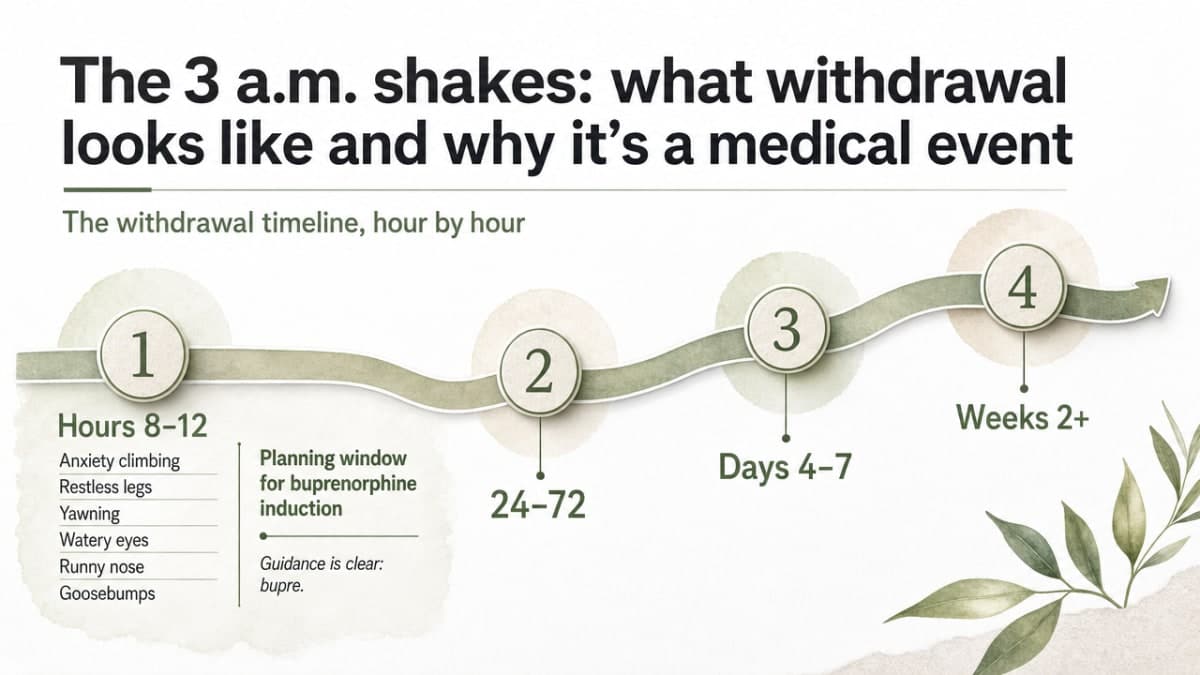
Hours 8 to 12. The first signs are quiet and easy to dismiss. Anxiety climbing. A restlessness in your legs that won’t sit still. Yawning that doesn’t match how tired you are. Watery eyes, a runny nose, goosebumps. Your body is already asking for the drug. This is the window where people talk themselves into “just one more” to sleep it off — and this is also the window where a clinician can start planning a buprenorphine induction, because the guidance is clear: buprenorphine should not be started until signs of withdrawal are actually present 5.
Hours 24 to 72. This is the peak. The 3 a.m. shakes. Vomiting, diarrhea, cramping muscles, chills that alternate with sweats, a racing heart, blood pressure spikes, and cravings that feel less like a wish and more like your body refusing to be in the room. NIDA notes that non-opioid medications like lofexidine can ease withdrawal symptoms during this stretch, alongside buprenorphine or methadone as the primary treatment 6. In a supervised setting, SAMHSA’s TIP 63 describes methadone withdrawal management using individualized doses between 20 and 30 mg per day, gradually reduced over 6 days or more — with at least 24 hours between the last methadone dose and any first dose of buprenorphine 5.
Days 4 to 7. The worst of the physical storm eases. Sleep is still broken. Appetite is strange. Your mood swings from flat to furious for reasons you can’t name. This is where a lot of people leave detox-only programs and use again within hours, because the crisis feels over and the plan runs out.
Weeks 2 and beyond. Post-acute withdrawal. Low energy, anhedonia, disrupted sleep, cravings that spike without warning. This is the stretch that MAT and trauma-informed care are actually built for 6.
Why detox alone is the wrong plan for fentanyl
Here’s the part that gets left out of a lot of brochures: getting through withdrawal is not the same as getting better. And with fentanyl, the gap between those two things has become a survival issue.
The reason is mechanical, not moral. When you stop using fentanyl, your tolerance drops fast. If you use again at your old dose — the dose that felt normal a week ago — your body isn’t the same body that took it. That’s how post-detox overdoses happen. Add a counterfeit supply where you can’t verify what’s in the pill, and the risk stacks on top of itself.
A five-day detox that hands you a bag of clothes and a bus schedule isn’t treatment. It’s a gap. What actually helps is medically supervised withdrawal that flows directly into ongoing care — medication for opioid use disorder, counseling, dual diagnosis work, and a step-down plan that doesn’t drop you off a cliff. If a program’s offer ends when the physical symptoms do, keep looking.
What evidence-based treatment looks like
Medication for opioid use disorder: buprenorphine, methadone, naltrexone, lofexidine
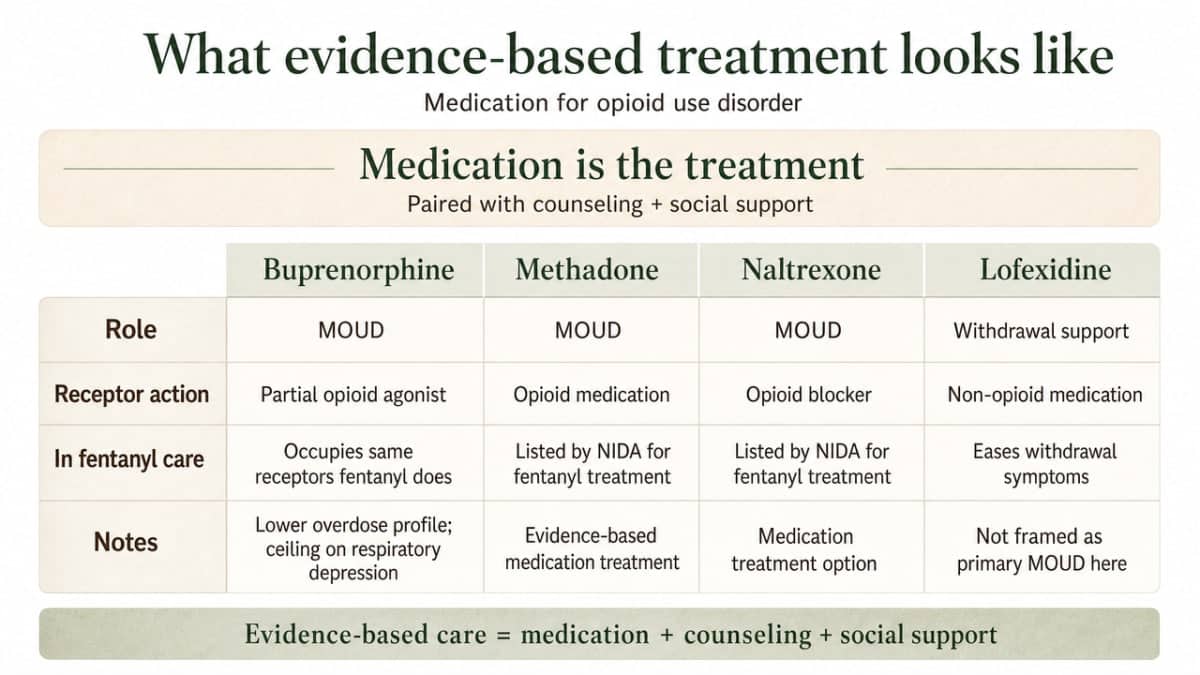
The single biggest shift in fentanyl care over the last decade is this: medication is the treatment. Not an optional add-on, not a crutch, not “replacing one drug with another.” The Missouri Department of Mental Health names Medication-Assisted Treatment an evidence-based practice that pairs pharmacologic care with counseling and social support for opioid use disorder 2. NIDA lists the working set for fentanyl specifically: methadone, buprenorphine, and naltrexone, with lofexidine approved to ease withdrawal symptoms 6.
Here’s what each one actually does.
- Buprenorphine
- (often as buprenorphine/naloxone) is a partial opioid agonist. It occupies the same receptors fentanyl does, without the same overdose profile — the ceiling on respiratory depression is why clinicians reach for it first in most outpatient settings. The catch you’ve probably heard about: you can’t start it while fentanyl is still holding those receptors, or you’ll get precipitated withdrawal, which feels worse than the withdrawal you were already in. SAMHSA’s TIP 63 is direct: don’t start buprenorphine until signs of withdrawal are present, and leave at least 24 hours between a last methadone dose and a first buprenorphine dose 5.
- Methadone
- is a full agonist, dispensed daily through licensed opioid treatment programs. For people with heavy fentanyl exposure or long histories with opioids, methadone often holds when buprenorphine won’t. TIP 63 describes withdrawal management doses in the 20 to 30 mg per day range, tapered over six days or more when a taper is the plan 5.
- Naltrexone
- especially the extended-release injection, blocks opioids entirely. It’s not for someone still in early withdrawal — you have to be fully off opioids first — but for the right person, it can be a strong option after stabilization.
- Lofexidine
- is non-opioid. It targets the adrenergic side of withdrawal — the sweats, the racing heart, the crawling skin — and NIDA notes it as an approved adjunct for symptom relief during the acute stretch 6.
You do not have to pick one of these off a menu tonight. A clinician picks with you, based on your history, your withdrawal severity, and where you are when the conversation happens.
Trauma-informed and dual diagnosis care: the piece most programs skip
Medication stabilizes the body. It does not answer the question of why the drug worked so well for you in the first place.
Most people using fentanyl in Kansas City are not chasing a high. They are managing something — chronic pain a doctor stopped treating, a panic disorder no one diagnosed, PTSD from a childhood or a deployment or a bad year, depression that made every morning feel like a wall. The opioid didn’t cause those things. It quieted them. That’s why fentanyl feels, in the early weeks, like the first thing that worked.
Dual diagnosis care treats both sides at once. If depression, anxiety, an eating disorder, or unresolved trauma is sitting underneath the substance use, and you only treat the substance use, the underneath comes back louder in month two or month three — and that’s usually when relapse happens. NIDA frames fentanyl addiction as a treatable chronic medical condition, and chronic conditions ask for chronic care, not a one-time intervention 6.
Trauma-informed means the clinical team assumes trauma is part of the story until proven otherwise, and structures the day around that assumption. Predictable routines. Real choices about your own care. Clinicians who don’t confuse compliance with progress. Family work when family is part of what needs healing, and space from family when it isn’t.
Sunflower Recovery Center is built around this dual diagnosis approach in Osawatomie, with programming that runs alongside medication support rather than in place of it.
Levels of care: residential, PHP, IOP, and what each is actually for
Treatment isn’t one room. It’s a series of them, and the goal is to step down without stepping off a cliff.
Residential is where most people with fentanyl dependence should start. You live on-site, medication and withdrawal support are hands-on, sleep and meals are structured for you, and the trigger environment you were using in is not in the building. Sunflower’s residential program runs 60 days, which is longer than many national defaults — that length matters for fentanyl, because the post-acute withdrawal window doesn’t close in a week.
Partial Hospitalization Program (PHP) is the next step down. You’re in clinical programming most of the day and sleeping in supported housing or at home. It keeps the structure while giving you back some autonomy.
Intensive Outpatient Program (IOP) is several hours of programming a few days a week. It’s for people who have stabilized and are rebuilding a normal schedule — work, school, family — with therapy and medication management still in the mix.
The mistake is treating any single level as the whole plan. SAMHSA’s federal guidance is clear that withdrawal management alone leaves people at high risk of return to use 10. The continuum — residential into PHP into IOP into outpatient — is what evidence-based care actually looks like for fentanyl.
Naloxone, counterfeit pills, and staying alive between now and admission
Between the phone call you’re about to make and the day you actually walk into treatment, there’s a stretch of hours or days where the goal is smaller and more urgent: don’t die. That’s not dramatic. That’s the honest version.
Keep naloxone within arm’s reach. Not in a drawer across the house. On the nightstand, in the bag you carry, in the glove box. NIDA’s current guidance is clear that standard-strength naloxone still reverses fentanyl overdoses in most people — but because fentanyl binds tightly and hits hard, more than one dose may be needed before breathing returns 6. If the first spray or injection doesn’t wake the person, give another after two to three minutes and call 911 anyway. Missouri’s Good Samaritan protections exist so you can make that call without a second thought.
Assume every pill is counterfeit. The DEA’s 2024 assessment describes counterfeit tablets pressed to look like M30 oxycodone, Xanax, or Adderall as a defining feature of the current Midwest supply, and Kansas City sits squarely inside that pattern 7. A pill from a friend is not safer than a pill from a stranger. The press machine doesn’t know whose hand it came from.
Two practical rules for the days between now and admission. Don’t use alone — if you’re going to use, someone sober needs to be in the room or on a phone call with you. And don’t try to white-knuckle a cold-turkey quit at home this week, because if you make it 48 hours and then use at your old amount, your tolerance has already dropped enough to put you at real overdose risk.
Staying alive is not the whole plan. It’s the part that has to happen first.
If you’re the family member reading this
A quick audience switch. The rest of this article has been written to the person using. This part is for you — the parent, the partner, the sibling, the adult child who has been the one checking on breathing at night.
You already know how tired you are. So start with what actually helps tonight, not next month.
Get naloxone in the house and know how to use it. Two doses, minimum. Keep one where they sleep. If they overdose, use it, call 911, and give a second dose after two to three minutes if breathing hasn’t returned — fentanyl often needs more than one 6.
Don’t push a cold-turkey quit at home. Not this week. A well-meaning ultimatum that leads to 48 hours without use, followed by a relapse at the old amount, is one of the most common overdose scenarios after the drop in tolerance 10. Medically supervised withdrawal isn’t weakness. It’s the version that keeps them alive.
When you make the admissions call, you don’t have to have the whole story. You need the last use time, the amount if you know it, other substances or medications in the mix, and any mental health history. The intake team fills in the rest.
And this: you are allowed to be scared and still be steady. Both, at the same time.
Getting help in the Kansas City metro: what to ask on the admissions call
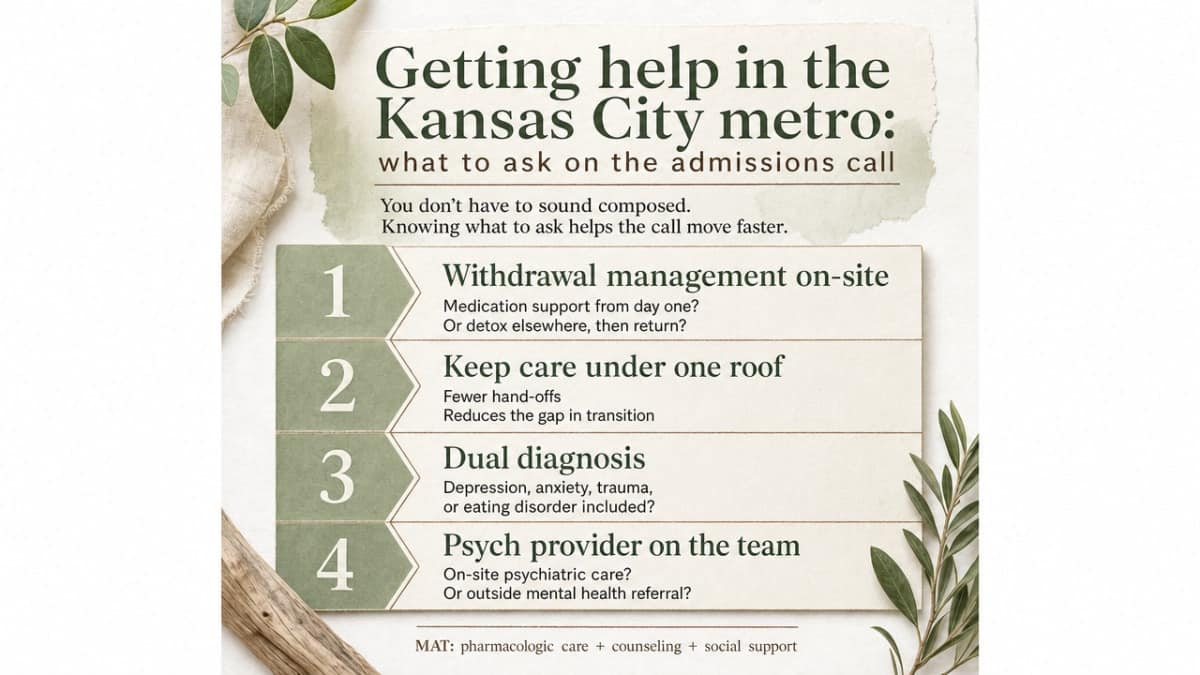
When you pick up the phone, you don’t have to sound composed. Admissions teams talk to people mid-crisis every day. What helps the call move faster is knowing what to ask.
Ask about withdrawal management on-site. Is medication support available from the first day, or will you be sent somewhere else for detox and then come back? For fentanyl, that hand-off is where people fall through — a program that keeps withdrawal and treatment under one roof reduces the gap that SAMHSA specifically warns about 10.
Ask about dual diagnosis. If depression, anxiety, trauma, or an eating disorder is part of the picture, is there a psychiatric provider on the clinical team, or is mental health an outside referral? Missouri’s Department of Mental Health defines MAT as pharmacologic care combined with counseling and social support — the counseling piece is not optional 2.
Ask about the step-down. What does the plan look like after residential? Sunflower runs residential, PHP, and IOP in one continuum, which matters because leaving a 30-day stay with no next appointment is one of the highest-risk moments in fentanyl recovery.
Ask about insurance and payment on the same call. Sunflower accepts most commercial insurance but does not participate in Medicare or Medicaid, so verify coverage before you drive. If Medicaid is your only option, the intake team can point you toward Kansas City metro programs that do bill MO HealthNet 1.
You are allowed to call more than one place tonight. The right call is the one that answers.
Reach Out Now for Immediate Fentanyl Support
Get connected to safe, compassionate help for fentanyl withdrawal and recovery today.
Frequently Asked Questions
Is fentanyl withdrawal actually dangerous, or just uncomfortable?
Fentanyl withdrawal is rarely fatal on its own the way alcohol or benzodiazepine withdrawal can be. The danger sits somewhere else: relapse. When your tolerance drops during withdrawal and you use again at your old amount, overdose risk climbs sharply. That’s why SAMHSA specifically recommends against short-term detox as stand-alone care and calls for medication support and naloxone at discharge 10.
Does naloxone (Narcan) still work on a fentanyl overdose?
Yes. Standard-strength naloxone still reverses fentanyl overdoses in most people, according to NIDA’s current guidance 6. The catch: fentanyl binds tightly, so one dose sometimes isn’t enough. If the person doesn’t wake or start breathing within two to three minutes, give another dose. Call 911 either way. Keep at least two doses within reach if fentanyl is anywhere in your home.
How long after my last fentanyl use can I start buprenorphine?
There isn’t one clean number, and that’s part of what makes fentanyl inductions tricky. SAMHSA’s TIP 63 is clear that buprenorphine should not be started until signs of withdrawal are actually present, or you risk precipitated withdrawal — a rougher version of what you’re already feeling 5. A clinician watching your symptoms, not a clock, decides the moment. Don’t try to time this on your own.
Why isn’t a short detox program enough for fentanyl?
Because getting through withdrawal isn’t the same as being treated. SAMHSA’s federal guidelines state plainly that short-term medically supervised withdrawal alone is not recommended, given the high rate of return to illicit opioid use afterward 10. Your tolerance drops during those days, and if you use again at your prior amount, the overdose risk is real. The care that works pairs withdrawal management with ongoing medication and counseling.
What should a family member do tonight if someone they love is using fentanyl in Kansas City?
Three things, in order. Get two doses of naloxone in the house and learn how to use them — fentanyl sometimes needs more than one 6. Don’t push a cold-turkey quit at home, because the tolerance drop that follows is where post-detox overdoses happen 10. Then call an admissions line with the basics: last use time, other substances, mental health history. You don’t need the whole story.
Does Sunflower accept Medicaid or MO HealthNet for fentanyl treatment?
No. Sunflower Recovery Center accepts most commercial insurance but does not participate in Medicare or Medicaid, so verify your coverage before you drive to Osawatomie. If MO HealthNet is your only path, the state does cover MAT for opioid dependence through preferred medications like buprenorphine and naltrexone 1, and the admissions team can point you toward Kansas City metro programs that bill Medicaid directly.
References
- MO HealthNet Opioid Dependence Agents Proposal (January 2026). https://mydss.mo.gov/sites/mydss/files/media/file/2026/01/Opioid_Select_Alcohol_Depend_Jan_2026_Proposal.docx
- Medication Assisted Treatment | Missouri Department of Mental Health. https://dmh.mo.gov/behavioral-health/medication-assisted-treatment
- Missouri Implements Statewide Prescription Drug Monitoring Program. https://oa.mo.gov/commissioners-office/news/missouri-implements-statewide-prescription-drug-monitoring-program
- Facing Addiction in America: The Surgeon General’s Spotlight on Opioids. https://www.hhs.gov/sites/default/files/OC_SpotlightOnOpioids.pdf
- TIP 63: Medications for Opioid Use Disorder – SAMHSA Library PDF. https://library.samhsa.gov/sites/default/files/pep21-02-01-002.pdf
- Fentanyl. https://nida.nih.gov/research-topics/fentanyl
- National Drug Threat Assessment 2024. https://www.dea.gov/documents/2024/2024-05/2024-05-24/national-drug-threat-assessment-2024
- Provisional Drug Overdose Death Counts. https://www.cdc.gov/nchs/nvss/vsrr/drug-overdose-data.htm
- The Deadly Missouri Fentanyl Epidemic: 2023 Update and Why We Carry Naloxone. https://pmc.ncbi.nlm.nih.gov/articles/PMC10317090/
- Federal Guidelines for Opioid Treatment Programs. https://library.samhsa.gov/sites/default/files/federal-guidelines-opioid-treatment-pep24-02-011.pdf