
Key Takeaways
- Lee’s Summit professionals weighing treatment face real reputational math, but federal law 42 CFR Part 2, reinforced by a 2024 Final Rule, blocks disclosure of substance use records without written consent 6, 10.
- A residential campus forty miles away in Osawatomie, Kansas puts treatment outside daily social orbits while keeping family visits and eventual step-down care geographically workable via US-69.
- Missouri requires trauma-informed, evidence-based interventions, and SAMHSA identifies integrated dual-diagnosis care as the preferred model for treating co-occurring depression, anxiety, PTSD, or trauma alongside substance use 1, 3.
- Compare levels of care — residential, PHP, and IOP — since peer-reviewed evidence shows appropriately matched outpatient care produces outcomes comparable to residential at follow-up 5.
The Quiet Calculation Behind Getting Help in Lee’s Summit
You already know what you’re weighing. It isn’t whether you need help. It’s what happens if the wrong person finds out you asked for it.
Maybe you’re the one who leaves the house in a pressed shirt every morning, drives west on I-470, and gets through another day at a downtown Kansas City firm on willpower and whatever’s in the console. Maybe you’re a spouse reading this on a phone in a locked bathroom because you don’t know how much longer you can hold the story together. Either way, the math running in the back of your head is the same. Reputation. Licensing board. Kids’ school pickup line. The neighbor who works in HR. The partner track. The badge.
That calculation is exhausting, and it’s also reasonable. Lee’s Summit is small enough that people notice absence and large enough that professional lives here often depend on quiet competence. Admitting to a substance problem can feel like handing someone a lever.
Here’s what most people in your position don’t realize until they make the first call: discretion in addiction treatment isn’t a favor a facility does for you. It’s federal law, recently reinforced, and it was written with your exact situation in mind 6, 10. The right kind of care is closer than you think, quieter than you expect, and structured so you don’t have to detonate your career to get better.
You’re not making a rash decision. You’re doing the calculation. Let’s walk through what it actually looks like.
Why Privacy Is a Legal Standard, Not a Marketing Promise
What 42 CFR Part 2 Actually Blocks
You’ve probably read a treatment center’s website promise “complete confidentiality” and wondered what that actually means when a subpoena lands or an HR investigator starts asking questions. Here’s the answer, and it’s better than the marketing copy suggests.
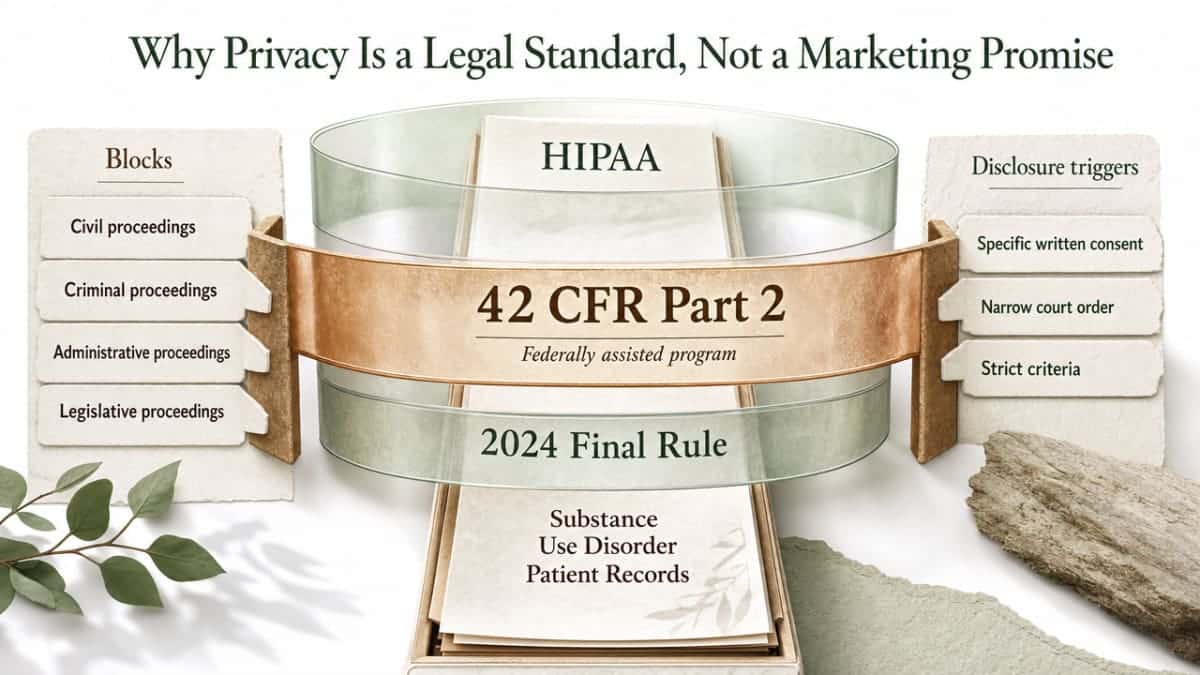
Federal regulation 42 CFR Part 2 governs the confidentiality of substance use disorder patient records at any program that receives federal funding or assistance, which covers essentially every licensed addiction treatment facility in the country. The rule states that your records“may not otherwise be used or disclosed in any civil, criminal, administrative, or legislative proceedings”without your specific written consent or a narrow court order that meets strict criteria 6. Read that sentence twice. It means:
- an opposing attorney in a custody dispute cannot pull your treatment records with a routine subpoena.
- an employer conducting an internal investigation cannot obtain them by asking.
- a state licensing board cannot access them through standard administrative discovery.
Part 2 is stricter than HIPAA. HIPAA generally permits disclosure of protected health information for treatment, payment, and healthcare operations without your consent 8. Part 2 does not. For substance use records specifically, the default is silence, and disclosure requires you to actively authorize it in writing, one purpose at a time.
Your co-occurring mental health records, treated concurrently under the same program, carry HIPAA’s additional confidentiality protections layered on top 8. So the architecture stacks: HIPAA covers your depression or PTSD treatment, and Part 2 wraps a second, tighter perimeter around anything that identifies you as someone who sought help for a substance problem.
The 2024 Final Rule and What Changed for Working Professionals
If someone told you years ago that Part 2 was outdated and would eventually erode, they weren’t wrong to worry. That prediction just turned out backward.
In February 2024, the federal government issued a Final Rule updating 42 CFR Part 2. The rule aligned certain provisions with HIPAA and implemented changes required by the CARES Act, but it preserved the core confidentiality protections that matter most to you 10. The stated intent was to“better align the requirements of 42 CFR part 2 with HIPAA regulations”while keeping patient privacy intact 10.
Practically, this means a few things for a Lee’s Summit professional. Your single written consent can now cover treatment, payment, and healthcare operations, which reduces the paperwork friction that used to complicate care coordination. Penalties for improper disclosure were strengthened. And critically, the rule maintained the prohibition on using your SUD records against you in legal or administrative proceedings without your specific consent 10.
The takeaway isn’t that the law got looser. It’s that the law got sharper. The 2024 update was drafted in an era where regulators know professionals are avoiding treatment because they fear disclosure, and the rule reflects that. Your privacy protections were reinforced within the last two years, not chipped away.
Consent, Health Information Exchanges, and Background Checks
The question that keeps most professionals awake at 2 a.m. is some version of this: will this show up somewhere I can’t see?
Health information exchanges — the digital networks that let hospitals and clinics share records — are the most common worry, and they are also the most tightly constrained. Under Part 2, records identifying you as a substance use patient generally cannot be disclosed through an HIE without your written consent, unlike HIPAA-covered information which can flow more freely 7. Emergencies and program audits carry narrow exceptions, but routine data sharing does not 7.
Background checks work differently than most people assume. A standard employment background check pulls criminal records, credit history, and verified employment. It does not pull medical records. Treatment at a Part 2 program is a medical event, not a public record, and there is no database a background check company can query to learn you were there 6.
If you’re required to disclose to a licensing board or a monitoring program, that disclosure comes from you, on your terms, with your written authorization. The choice stays in your hands.
The 40-Mile Drive: Distance as a Form of Discretion
Sunflower’s residential campus sits in Osawatomie, Kansas, about forty miles from your driveway. On a weekday morning, you can be there in under an hour. That distance is not a logistical footnote. It is part of the treatment plan.
Think about what a treatment facility located inside the Kansas City metro would mean for you. Someone from your firm’s satellite office could see your car in the lot. A client could recognize you at a stoplight. The waiting room could hold a parent from your kid’s soccer team. None of that is paranoia. Lee’s Summit and the surrounding suburbs run on overlapping social circles, and the closer treatment sits to your daily orbit, the more energy you spend managing exposure instead of getting better.
Osawatomie is far enough that the odds of running into someone you know drop close to zero, and close enough that your family can visit, that a family programming weekend does not require a flight, and that stepping down to outpatient care later remains geographically realistic. You cross the state line, take US-69 south, and the noise thins out.
You are not being shipped away. You are being given room. That is what forty miles buys you: a place where the person walking into the assessment room is just a person, not a title, and the drive home later is yours to explain however you choose.
What Discreet Residential Care Looks Like Day to Day
Trauma-Informed, Dual Diagnosis Care as the State Standard
You may have heard “trauma-informed” used as a soft-focus phrase in wellness marketing. In Missouri, it is neither a slogan nor an optional flavor of programming. It is written into the state’s regulatory code.
Under 9 CSR 30-3, providers delivering substance use disorder services are required to use evidence-based interventions“including, but not limited to, motivational interviewing, cognitive behavioral therapy, and trauma-informed care”when clinically appropriate 1. Trauma-focused individual counseling carries its own credentialing requirements. This matters because most professionals who develop a substance problem are not treating a chemical craving in isolation. They are managing something underneath it, and the state has recognized that treating the addiction without addressing what feeds it produces short-lived results.
The clinical consensus reaches further. SAMHSA identifies integrated care — treating substance use and co-occurring mental health conditions concurrently, within one coordinated team — as the preferred model for adults with dual diagnosis needs 3. That is not an upsell. It is the standard. Depression, anxiety, PTSD, and eating disorders travel with addiction more often than not, and treating them in sequence rather than together tends to leave the second condition free to reactivate the first.
Day to day, this shows up in ordinary ways. Your morning may include a cognitive behavioral therapy group. Your afternoon may include an individual session with a trauma-trained clinician. A psychiatrist reviews your medications alongside the therapy team, not on a separate track. Missouri’s provider guidance explicitly lists integrated treatment for co-occurring disorders and trauma-informed care among its core initiatives 2, and residential programs serving Lee’s Summit professionals from across the state line are structured accordingly.
The Substances That Keep Professionals Under the Radar
The substances that end careers quietly are not usually the ones that make headlines.
Alcohol is first, and it hides in plain sight. A high-functioning drinker in Lee’s Summit can keep the machinery running for years — client dinners, wine on the counter by 6, a second bottle no one sees — until the tremor in the morning becomes something a colleague notices. Benzodiazepines follow a similar pattern. Prescribed for anxiety, sleep, or panic, they build a physical dependence that produces withdrawal dangerous enough to require medical supervision. You cannot safely quit either one on a Saturday and be at your desk on Monday.
Stimulants are the professional-class secret that rarely gets named out loud. Adderall or cocaine used to get through a case, a deal cycle, or a hospital shift becomes a daily requirement, and the crash lands somewhere between depression and panic. Then there are the substances your primary care doctor may not ask about: kratom and 7-OH products, sold in gas stations and smoke shops, marketed as herbal supplements, and capable of producing opioid-like dependence and withdrawal that catches people completely off guard.
Trauma-informed dual diagnosis care matters here because the reason you started using any of these usually predates the substance itself 3. Treatment that only addresses the chemical leaves the driver intact. A residential team that can medically manage alcohol or benzodiazepine withdrawal, treat co-occurring depression or anxiety, and work on the underlying trauma is doing the whole job, not a piece of it.
The Level-of-Care Ladder: Residential, PHP, and IOP as a Re-Entry Plan
You have a job to return to. That fact does not disqualify you from serious care. It shapes the sequence.
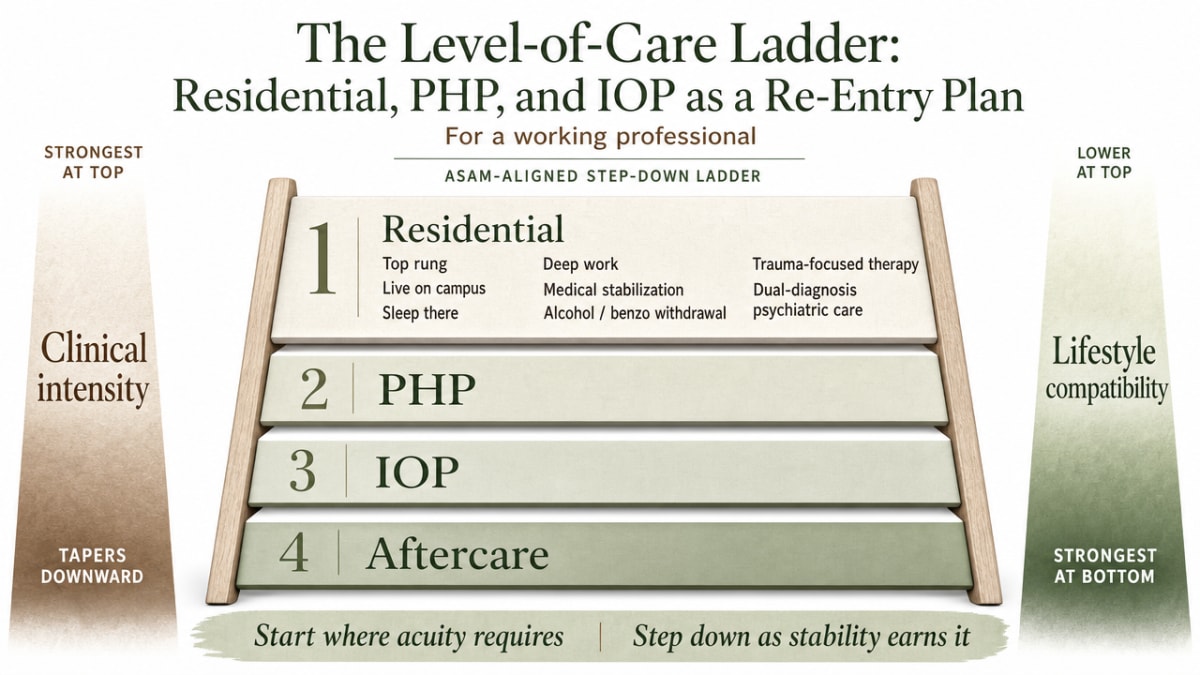
Addiction treatment is not one setting. It is a ladder, and Missouri’s Division of Behavioral Health promotes ASAM-aligned levels of care that include residential, partial hospitalization, and intensive outpatient programs so that clinical intensity can adjust to where you actually are 2. For a Lee’s Summit professional, that ladder is the re-entry plan. You start where the acuity requires, and you step down as your stability earns it.
Residential care is the top rung. Sixty days in Osawatomie means you are living on campus, sleeping there, and doing the deep work: medical stabilization if you are withdrawing from alcohol or benzodiazepines, trauma-focused individual therapy, dual-diagnosis psychiatric care, and the slow rebuilding of a nervous system that has been running on chemicals. Overnight stay is required. Weekly clinical hours are essentially all of them. Discretion is high because you are physically absent from your daily orbit and covered by a single explanation.
Partial hospitalization is the middle rung. You attend structured programming most of the day, most days of the week, but you sleep off campus. It is the bridge between full immersion and returning to work.
Intensive outpatient sits below that. Roughly nine to twelve hours of clinical programming per week, often scheduled in evening or morning blocks that fit around employment. You live at home. You keep working.
What this means for you is that the ladder can be climbed downward as well as upward. Sixty days residential, then PHP, then IOP, then aftercare — and each rung is quieter, more compatible with your calendar, and clinically appropriate to where you are by then. You are not choosing between disappearing for two months or getting no real help. You are choosing a sequence that starts intensive and gets you back into your life on a schedule your clinical team helps you set.
Handling the Calendar Block, the LinkedIn Silence, and the Parking Lot Question
The logistics that keep people from making the call are almost always small. A recurring calendar meeting. A LinkedIn profile that will go quiet. A neighbor who waves in the driveway every morning and will notice the empty spot. These aren’t shallow concerns. They’re the seams where exposure could happen, and thinking them through in advance is part of the work.
Start with the calendar. A sixty-day absence covered as a medical leave is not unusual and does not require a diagnosis. Under HIPAA, your employer is entitled to certification that you have a serious health condition requiring treatment; they are not entitled to know what the condition is 8. Your clinician provides what the law requires and nothing more. “Medical leave” is a complete sentence.
The LinkedIn silence handles itself. Most professionals post infrequently anyway, and sixty days of quiet reads as a busy quarter, not a crisis. If someone asks later, “I took some time off for a health matter” closes the conversation without inviting a second question.
The parking lot question — the colleague who sees you on a Tuesday morning when you should be at the office — is why the forty-mile drive matters. You are not walking into a facility three exits from your building. You are somewhere else, on a highway your coworkers have no reason to travel.
For the neighbor, a family member picking up mail and turning on a lamp in the evening is enough. You are allowed to travel for medical care without narrating it.
None of these covers are dishonest. They are simply accurate at the level of detail the situation calls for. The private facts stay private because the law says they can, and because you get to decide who needs to know what.
Continuing Care After You Return to Lee’s Summit
Discharge day is not the finish line. It is the point where the work moves from a controlled environment back into your actual life, and the plan built during residential care is designed to hold up under that shift.
A step-down through partial hospitalization and then intensive outpatient keeps the clinical structure intact while the geographic tether loosens. You start driving back to Lee’s Summit at the end of the day. You reopen your calendar. The trauma-focused individual counseling and integrated dual-diagnosis work that started in Osawatomie continue on a lighter schedule, because the state’s evidence-based framework requires that trauma-informed and co-occurring care follow you through each level, not just the top one 1, 3. The clinicians handing you off to the next rung are looking at the same treatment plan, not starting over.
Telebehavioral aftercare is where most Lee’s Summit professionals eventually land. A weekly individual session and a group can be done from a home office with the door closed, which removes the last logistical exposure — the recurring appointment on the calendar that someone might ask about. HHS best-practice guidance for telebehavioral health requires providers to use secure, HIPAA-compliant platforms and to coach patients on maintaining privacy during sessions, including a private room and headphones 9. That guidance exists because the risk it addresses is real: your recovery is only as private as the space you conduct it in.
Aftercare is also where the underlying work — the depression, the anxiety, the trauma that started this — gets the sustained attention it needs 3. Sixty days stabilizes. The next twelve months rebuild. You are not being released back into your old life to manage alone. You are being handed a lighter version of the same team, on a schedule that fits the life you are returning to.
How to Make the First Call Without Leaving a Trail
The first call is the smallest and heaviest thing you will do this week. Here is how to make it without leaving marks anywhere you don’t want them.
Use your personal cell, not a work phone. Work devices route through IT, and even the fact of a call to a treatment facility can sit in a log someone else can pull. Step out to the car, or take a walk. The conversation takes fifteen to twenty minutes.
When you call Sunflower, you can ask specifically what admission from Lee’s Summit looks like this week. You control what you share. A name and a callback number are enough to start. You can ask about assessment, insurance verification, the drive down US-69, and what a sixty-day stay or a step-down through PHP and IOP would look like on your calendar. Nothing you say on that call is documented in a way that can be pulled by an employer, a licensing board, or an opposing attorney without your written consent 6.
If you’d rather someone else make the call first, a spouse or adult family member can. You are still in charge of what happens next.
You have already done the hardest part, which is deciding the calculation is no longer worth running. The call is just the next small thing. Make it today.
Start your confidential recovery journey today
Connect instantly with a discreet admissions specialist for Lee’s Summit professionals seeking support.
Frequently Asked Questions
Can my employer find out I’m in addiction treatment?
Not without your written consent. Under 42 CFR Part 2, records identifying you as a substance use patient cannot be disclosed for civil, criminal, administrative, or legislative proceedings without your specific authorization or a narrow qualifying court order 6. If you take medical leave, your employer is entitled to certification of a serious health condition — not the diagnosis behind it 8.
Will addiction treatment show up on a background check or professional licensing review?
A standard background check pulls criminal, credit, and employment records. Treatment is a medical event, not a public record, and there is no database a screening company can query to learn you attended a Part 2 program 6. If a licensing board or monitoring program requires disclosure, it comes from you, in writing, on your terms — not from the treatment center pushing records outward.
How far is Sunflower from Lee’s Summit, and why does the distance matter?
Sunflower’s residential campus in Osawatomie, Kansas is roughly forty miles from Lee’s Summit — under an hour on US-69. That distance is deliberate. A facility inside the Kansas City metro raises the odds of running into a colleague, a client, or a neighbor. Forty miles puts you outside your daily orbit while keeping family visits and step-down care geographically realistic.
Do I have to do 60 days of residential care, or can I step down to outpatient?
The level of care matches your clinical picture, not a fixed script. Missouri’s Division of Behavioral Health promotes ASAM-aligned levels including residential, partial hospitalization, and intensive outpatient 2. For adults appropriately matched to level of care, peer-reviewed evidence shows IOP and day treatment produce reductions in problem severity and increases in days abstinent comparable to residential care at follow-up 5. Acute withdrawal or unstable co-occurring conditions still warrant residential first.
What if I’m using more than one substance, like alcohol and benzodiazepines?
Polysubstance use is common, and alcohol and benzodiazepine withdrawal can be medically dangerous — not something to attempt alone or on a weekend. Residential care handles medically supervised stabilization first, then the underlying work. Integrated dual-diagnosis treatment addresses co-occurring depression, anxiety, or trauma alongside the substances, which SAMHSA identifies as the preferred model for adults with co-occurring conditions 3. Kratom and 7-OH dependence are treated in the same integrated framework.
How do I make the first call without leaving a record my family or employer could find?
Use your personal cell, not a work phone — work devices route through IT logs you don’t control. Step outside or into your car; the call takes fifteen to twenty minutes. Share only a name and callback number to start. Nothing you say can be pulled by an employer, licensing board, or opposing attorney without your written consent 6. Call Sunflower and ask what admission from Lee’s Summit looks like this week.
References
- Missouri Secretary of State: Code of State Regulations (9 CSR 30-3). https://s1.sos.mo.gov/cmsimages/adrules/csr/current/9csr/9c30-3.pdf
- Information for Providers | dmh.mo.gov. https://dmh.mo.gov/behavioral-health/info-for-providers
- Substance Use Disorder Treatment for People with Co-Occurring Disorders. https://library.samhsa.gov/sites/default/files/pep20-06-04-006.pdf
- Integrated Treatment for Co-Occurring Disorders: The Evidence. https://library.samhsa.gov/sites/default/files/ebp-kit-the-evidence-10242019.pdf
- Substance Abuse Intensive Outpatient Programs: Assessing the Evidence. https://pmc.ncbi.nlm.nih.gov/articles/PMC4152944/
- 42 CFR Part 2 — Confidentiality of Substance Use Disorder Patient Records. https://www.ecfr.gov/current/title-42/chapter-I/subchapter-A/part-2
- Frequently Asked Questions: Applying the Substance Abuse Confidentiality Regulations to Health Information Exchanges. https://www.samhsa.gov/sites/default/files/faqs-applying-confidentiality-regulations-to-hie.pdf
- Information Related to Mental and Behavioral Health under HIPAA. https://www.hhs.gov/hipaa/for-professionals/special-topics/mental-health/index.html
- Protecting Patients’ Privacy (Telebehavioral Health). https://telehealth.hhs.gov/providers/best-practice-guides/telehealth-for-behavioral-health/preparing-patients-for-telebehavioral-health/protecting-patients-privacy
- Federal Register Vol. 89, No. 33 (2024 Part 2 Final Rule). https://www.govinfo.gov/content/pkg/FR-2024-02-16/html/2024-02544.htm