
Key Takeaways
- Shawnee County recorded 287 overdose deaths from 2020 to 2024, ranking 6th of 105 Kansas counties, so struggling in Topeka is common, not isolating 3.
- Treatment near Topeka spans residential, PHP, IOP, and standard outpatient, and the level is meant to shift as withdrawal risk, home stability, and work life change.
- State employee, commercial, and Medicaid coverage all handle SUD care differently, so verify medical necessity, pre-certification, in-network status, and deductibles before choosing a program.
- The hour south to Osawatomie creates distance from daily cues while keeping family close enough for weekend sessions, discharge planning, and trauma-informed dual diagnosis work.
You’re Not Late, and You’re Not Alone
If you’re reading this at your kitchen table in College Hill, on a break at the Statehouse, or at 2 a.m. after another rough night, take a breath. The fact that you searched at all is a real step. It doesn’t feel like one yet, but it is.
You already suspect what’s going on. The drinking or the pills or the kratom stopped being a coping tool a while back and started running the show. Maybe your spouse has stopped asking. Maybe your kid has started noticing. Maybe you’re the family member reading this for someone else, trying to figure out what to actually do on a Tuesday morning in Topeka.
Here’s what this guide is for: giving you a clear picture of what real treatment looks like within driving distance of the capital, how your insurance likely handles it, and what the next few days can actually contain. No sales pitch. No lectures. Just the practical map you came here for.
What Shawnee County’s Overdose Numbers Actually Say
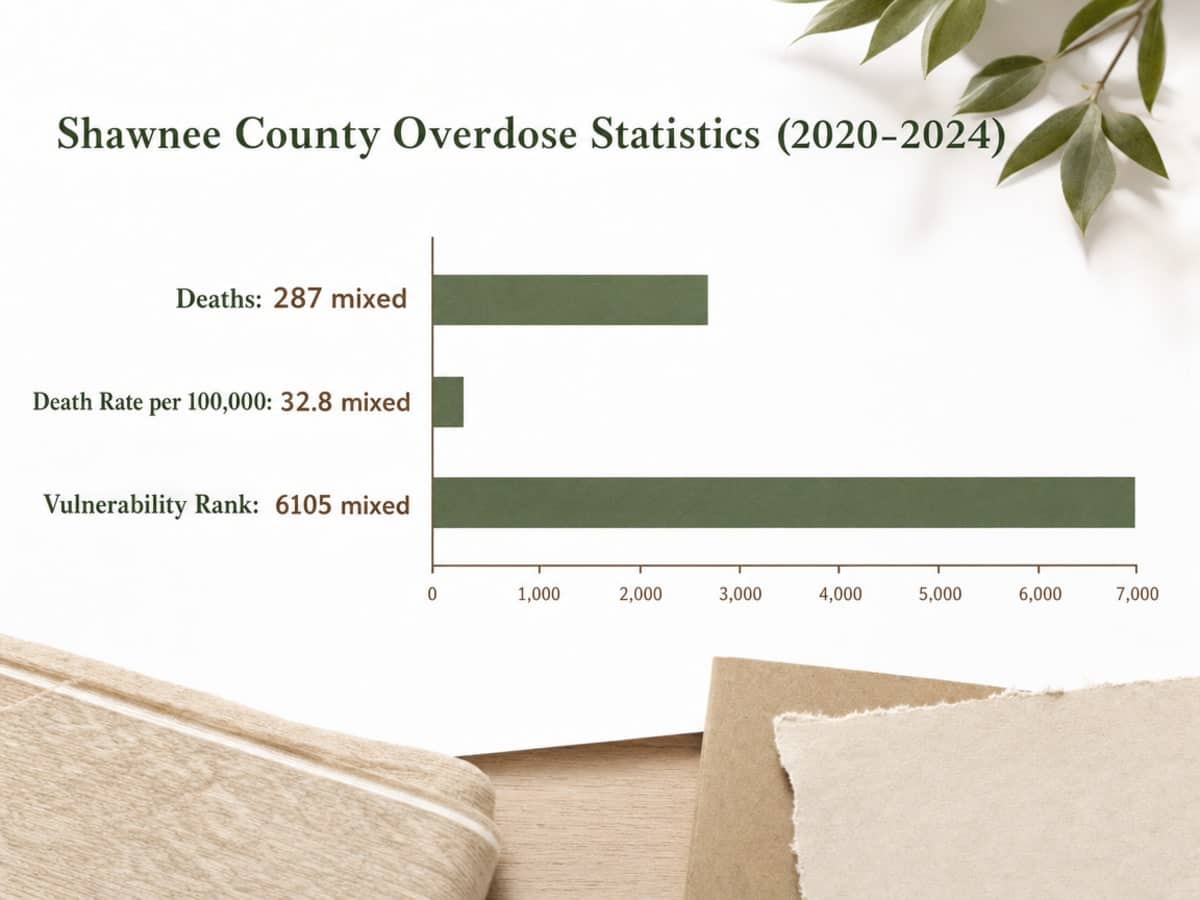
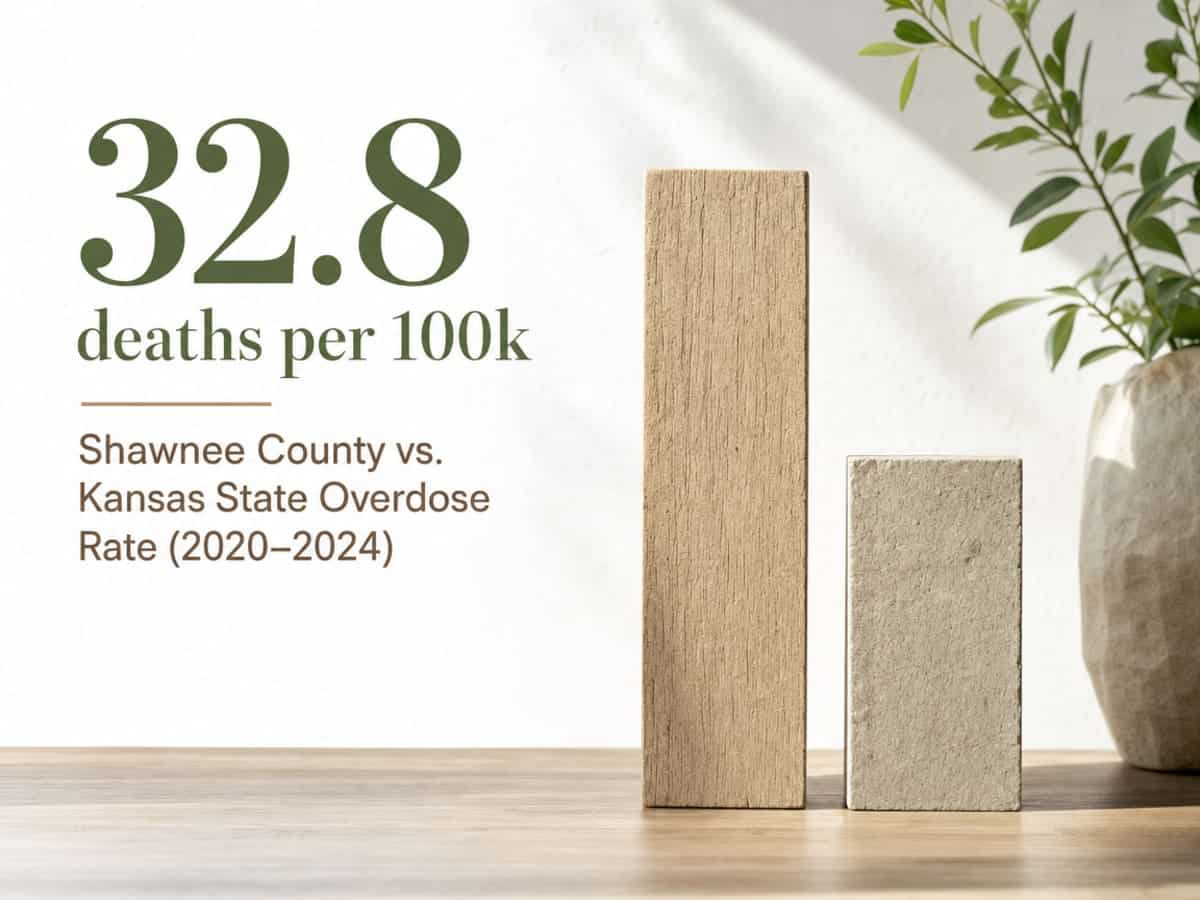
Here’s the honest picture where you live. Between 2020 and 2024, Shawnee County recorded 287 overdose deaths, a rate of 32.8 per 100,000 residents, and ranked 6th out of 105 Kansas counties on the state’s fatal overdose vulnerability assessment 3. That’s not a scare stat. It’s a signal that if you’re struggling here, you are not some outlier the system forgot about. You are part of a much larger group of Topekans who have been quietly holding on.
What those numbers don’t say is just as important. They don’t say how many people were state employees who kept showing up to work through it. They don’t count the people who almost died and didn’t. They don’t count the spouses sleeping with one eye open, listening for breathing.
They also don’t say anything about you specifically. Being in a high-burden county doesn’t mean your story ends the same way. It means the roads to treatment near Topeka are worn, familiar, and well-traveled. People from your zip code have walked them before.
One thing worth noticing: Kansas has historically had a higher opioid prescribing rate than the national average, even in years when the state’s overall overdose rate looked lower than the country’s 13. A lot of Topeka addictions didn’t start in a back alley. They started at a pharmacy counter after a surgery, a back injury, a bad year. If that’s your story, you are not weak and you did not fail. You got caught in something that caught a lot of people.
What the data does justify is urgency without shame. The stakes here are real, and so is the fact that treatment exists roughly an hour south of your front door. Knowing the ground you’re standing on is the first honest step. The rest of this guide is about what to do next.
Levels of Care, Translated
Residential, PHP, IOP, and Outpatient in Plain English
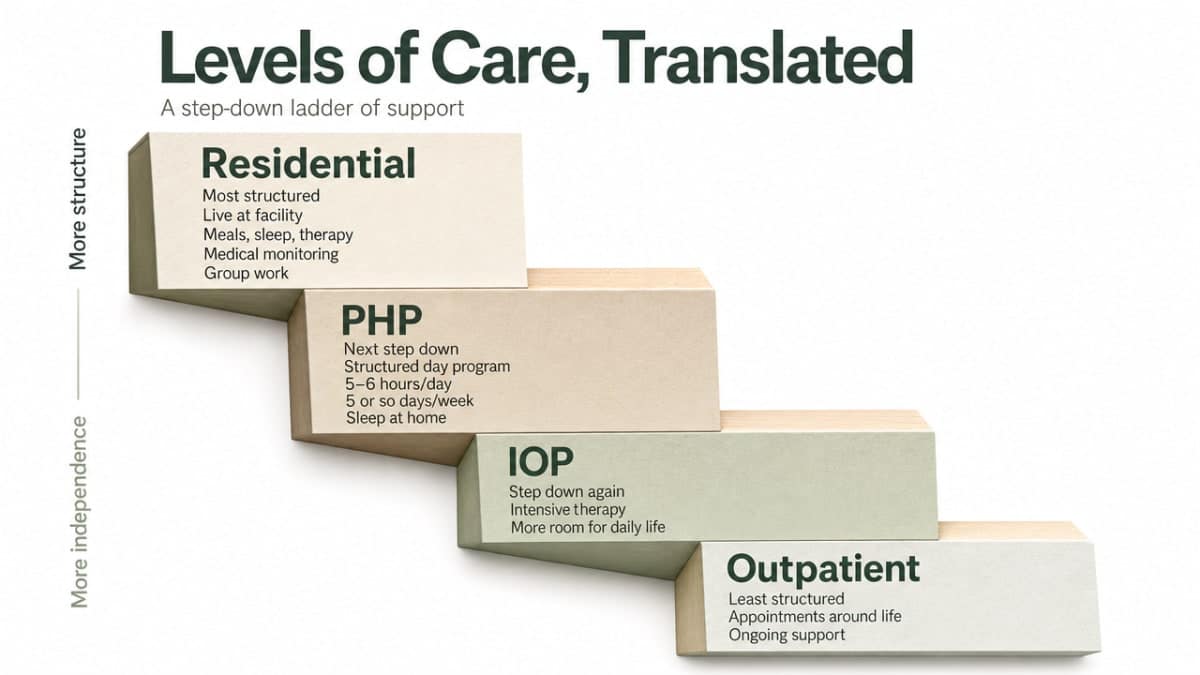
Treatment isn’t one thing. It’s a ladder, and where you step on depends on what your body and your life can safely handle right now.
- Residential
- The most structured rung. You live at the facility. Meals, sleep, therapy, medical monitoring, and group work all happen under one roof. This is where most people go when withdrawal is medically risky, when home isn’t safe, or when the daily environment keeps pulling them back into use. Sunflower’s 60-day residential program sits here.
- Partial Hospitalization (PHP)
- The next step down. Kansas defines PHP as an ambulatory, structured, therapeutic program that runs most of the day for people with substance use disorder, mental health diagnoses, or both 8. You get intensive clinical hours — think five to six hours a day, five or so days a week — but you sleep somewhere else. It’s often the bridge between residential and going home.
- Intensive Outpatient (IOP)
- Lighter still. Usually three days a week, three hours at a time. You keep working, or you slowly re-enter work. Kansas Medicaid covers PHP and IOP for SUD and co-occurring conditions at per diem rates, and commercial and state-employee plans generally treat PHP and IOP as covered outpatient services subject to medical necessity and pre-certification 8, 9.
- Standard outpatient
- Once a week or so. Individual therapy, medication management, maybe a support group. It’s the maintenance rung — where a lot of people live for a long time after the intensive work is done.
Community mental health centers in Kansas are authorized to deliver across this whole range, from outpatient to inpatient to PHP to home-based care 7. Private residential programs like Sunflower fit into the same regulated continuum under Kansas Behavioral Health Licensing 1. The labels are boring; the point is that real care exists at each level, and none of them are failure states.
How the Level Gets Chosen (and Why It Can Change)
You don’t pick the level off a menu. A clinician does an assessment — usually 45 to 90 minutes on the phone or in person — and matches you to the rung that fits your withdrawal risk, medical history, mental health picture, home environment, and past treatment attempts. Kansas Medicaid and state-employee coverage both build medical necessity criteria into this decision, which means an insurer will want documentation supporting whatever level is recommended 8, 9.
Here’s what a lot of people don’t realize: the level is supposed to change. That’s the design, not a setback.
A common path looks like this:
- You start in residential because withdrawal is real and home is loud.
- After a few weeks, you step down to PHP while you’re still stable and supported.
- Then IOP as your job and family life come back into the frame.
- Then weekly outpatient for months, sometimes years.
If you slip somewhere along the way, you can also step back up. That’s not restarting — that’s the ladder working. What you don’t want is a program that only offers one rung and calls it treatment. Ask any center you talk to, including Sunflower, how they handle the whole continuum and what discharge planning looks like when it’s time to go home to Topeka.
Insurance Without the Sales Pitch
If You’re a State or Municipal Employee
Topeka has one of the highest concentrations of state workers in Kansas, so odds are decent you (or your spouse) carry State Employee Health Plan coverage. Here’s the short version: SUD treatment is covered on the same terms as other medical services, which means inpatient, residential, partial hospitalization, and intensive outpatient care all sit inside your benefits — not off to the side as some optional add-on 9.
What that looks like in practice: residential and inpatient SUD stays are treated as inpatient benefits, and PHP and IOP for substance use are billed under your outpatient benefits 9. Deductibles, copays, and coinsurance follow the same structure as any other hospitalization or outpatient visit under your plan year.
Two things always apply, though. First, medical necessity — a clinician has to document why the recommended level of care fits your situation. Second, pre-certification — the plan generally needs to approve residential and PHP before you start 9. This sounds bureaucratic, and it is, but you don’t have to run this yourself. The admissions team at any licensed Kansas facility, Sunflower included, handles the paperwork with your insurer. That’s part of what they do.
A few questions worth asking your HR benefits contact or the number on your card:
- What’s my remaining deductible and out-of-pocket max for the plan year?
- Is residential SUD treatment in-network at the facility I’m considering?
- Who submits the pre-certification, and how long does it typically take?
- Does my plan require I try a lower level of care first, or can I enter at residential based on clinical assessment?
If you’re a City of Topeka, Shawnee County, or USD 501 employee, your plan may not be the state plan, but the mechanics are similar. Commercial and public-sector employer plans in Kansas generally cover the full SUD continuum with medical necessity review.
Commercial Plans, Medical Necessity, and Precertification
If you have private insurance through a non-state employer — a hospital system, a bank, an engineering firm, your spouse’s employer — the framework looks a lot like what state workers see. Federal parity law requires most commercial plans to cover behavioral health and SUD services no more restrictively than they cover medical and surgical care. In real terms, that means residential, PHP, and IOP for addiction are on the table.
The two words that will come up over and over are medical necessity and precertification. Medical necessity is the clinical case for the level of care you’re entering. Precertification is the plan saying, in writing, that they’ll cover it before you walk in the door. Both are standard, and both are what an admissions team spends its mornings on.
Before you call anyone, pull your insurance card out and find these: the member ID, the group number, and the behavioral health phone number on the back (sometimes it’s a separate line from medical). When you call a treatment center, they’ll ask for those, run a verification of benefits, and come back to you with an estimate of what your plan covers and what you’d owe. Ask for that estimate in writing.
If You’re on Kansas Medicaid
The good news is that Kansas has built real Medicaid pathways for SUD care. Coverage now includes partial hospitalization and intensive outpatient services for substance use disorder and co-occurring mental health conditions, paid at per diem rates that apply equally to public and private providers 8. That means there are in-network programs designed to treat exactly what you’re dealing with.
The fastest way in is the state’s centralized triage line. KDADS directs Kansans to Carelon Behavioral Health of Kansas at 1-866-645-8216 for assessments and referrals to in-network providers, including those serving the Topeka area 2. Ask for a full assessment, not just a facility name. A good assessment gets you routed to the right level of care instead of the closest open bed.
Why the Drive South Is a Feature, Not a Flaw
About an hour south of downtown Topeka, past Lawrence and off I-35, sits Osawatomie. That’s where Sunflower Recovery Center is. On paper, that hour looks like a hassle. In practice, it’s doing quiet clinical work before you ever walk in the door.
The neighborhoods, gas stations, bars, and pharmacies wired into your use are all in Shawnee County. So are the people who text you at 9 p.m. The drive puts distance between you and every automatic cue that has been running your day. That gap is part of the treatment, not a tax on it.
An hour is also short enough to keep your family in the room. Sunflower’s family programming, discharge planning, and step-down conversations depend on people who love you being able to actually show up. A drive you can do before lunch and be back by dinner is a different kind of ask than a flight to Arizona or Florida. Your spouse can attend a family session on a Saturday. Your adult kid can come to a discharge meeting after work.
Distance is also a shield for your job. Topeka is a small enough professional world that running into a coworker in the waiting room of a downtown clinic is a real fear. Osawatomie is not. For state employees, hospital staff, teachers, and anyone else whose face is known around the capital, an hour south buys real privacy without exiling you from your life.
When you call, ask about the drive from Topeka, who typically brings people down, and whether transport help is available on admission day. It’s a fair question, and the answer tells you something about how the program thinks.
What Trauma-Informed Dual Diagnosis Actually Means
The phrase gets thrown around a lot. Here’s what it looks like when it’s real.
Dual diagnosis means the program treats your addiction and your mental health at the same time, in the same building, by the same team. Not detox now and depression later. Not sober up and figure out the panic attacks on your own. If you’re drinking to quiet PTSD from a deployment, a car wreck, or a childhood you don’t talk about — the drinking and the trauma get worked on together. If you’re using pills to blunt depression that started long before the first prescription, the same rule applies. Trauma-informed care is defined in the clinical literature as “service delivery that is grounded in an understanding of how trauma affects peoples’ lives, service needs, and service usage” 11.
Trauma-informed means the whole environment gets built around a basic assumption: a lot of people who develop addictions have survived something. So the clinical model includes staff training, universal trauma screening, a supportive physical environment, and trauma-focused therapy woven into the treatment plan — not bolted on as an optional workshop 11. Practically, it changes how you’re greeted at admission, how groups are run, how staff respond when you have a bad night.
The evidence base is honest but real. A 2024 systematic review of trauma-informed care in substance use treatment settings found that TIC models can improve mental health symptoms and treatment retention in some studies, while noting meaningful heterogeneity in how programs implement TIC and how outcomes are measured 10. Broader clinical guidance keeps pushing addiction treatment toward trauma-informed, culturally responsive, interdisciplinary care, especially for people whose use is tangled up with structural stress and violence exposure 12.
What this means for you: when you call any program, including Sunflower, ask specifically how they screen for trauma, how PTSD or depression care runs alongside SUD treatment, and who on the team is trained to deliver trauma-focused therapy. If the answer is vague, keep asking. A real trauma-informed dual diagnosis program can walk you through it in plain language.
The Next 24–72 Hours: A Walkthrough
The First Call and the Screening
The first call is the hardest one. It’s also usually shorter than you think — 15 to 20 minutes on the front end, then a longer clinical screening once you’re routed to the right person.
When you dial, an admissions coordinator picks up. They’ll ask your name, your general situation, what you’re using and how much, whether you’re currently in withdrawal, and whether you have thoughts of hurting yourself. This isn’t an interrogation. It’s the intake team making sure you don’t need an emergency room before anything else. If you’re shaking, seeing things, or haven’t slept in three days, say that. It changes the plan.
From there, a clinician schedules the actual screening — often the same day. That conversation runs 45 to 90 minutes and covers your medical history, mental health picture, past treatment, home environment, and substances involved. This is the assessment that drives the level-of-care recommendation, and it’s what your insurer will look at when they review medical necessity 9.
Two things to know: you can be honest, and you can call from your car on a lunch break. Nobody is going to judge the number of drinks or the pills you didn’t tell your doctor about. The screening only works if it’s real.
Benefits Verification and What to Ask HR
While clinical is running the screening, the billing side runs a verification of benefits. You give them your insurance card details — member ID, group number, the behavioral health phone number on the back — and they call your plan directly. That call comes back with a written estimate of what’s covered and what you’d owe.
If you’re a state employee, your SUD benefits sit inside your regular medical coverage, with residential and inpatient billed as inpatient and PHP and IOP billed as outpatient, subject to medical necessity and pre-certification 9. Your HR benefits contact can confirm your remaining deductible and out-of-pocket max for the plan year, whether the facility is in-network, and how FMLA and short-term disability paperwork gets started.
Ask HR one more thing: what your leave options actually look like. Sixty days of residential is a real absence. Knowing whether you’re using PTO, FMLA, or a combination lets you walk in the door without one eye on your inbox.
Transport Day and What to Pack
Admission day usually lands within 24 to 72 hours of that first call, depending on how fast pre-certification clears and whether you need a medical detox bed. Someone from admissions will tell you when to arrive and what to bring. If getting yourself to Osawatomie from Topeka feels impossible — because you’re using, because you don’t have a car, because you don’t trust yourself for an hour on I-35 — ask about transport options when you call. It’s a normal question.
Pack light and practical:
- Two weeks of comfortable clothes
- Closed-toe shoes
- Toiletries in original containers
- Any current prescription medications in their pharmacy bottles
- Your insurance card and ID
- A notebook
- Phone numbers written down on paper in case your phone gets stored during intake
Skip anything with alcohol in the ingredients (mouthwash, hand sanitizer), anything sharp, and anything valuable you’d hate to lose.
Tell one person you trust where you’re going and when. Then get in the car. The hardest part of the drive south is the first mile.
How Family Fits In From an Hour Away
Sixty days feels like a long time when you’re the one going, and a long time when you’re the one staying home. Both are true. The good news is that an hour of highway between Topeka and Osawatomie is close enough to keep the people who love you inside the treatment, not outside of it.
Family programming isn’t a visitor’s day tacked on at the end. In a real trauma-informed dual diagnosis model, family sessions are part of the clinical work — education about how addiction and co-occurring conditions actually behave, guided conversations with a therapist in the room, and skill-building for the people who will be there when you come home 11. Your spouse learns what to say when you have a hard night in month four. Your adult kid learns why boundaries aren’t punishment.
When you call to ask about admission, ask about the family piece too. How often are sessions offered. Whether they run on weekends. Whether phone or video works when someone can’t make the drive. The answers tell you whether the program treats your household as part of the recovery, or as an afterthought.
Start your path to recovery today
Get guidance on travel, insurance, and admissions for Topeka area addiction treatment in one supportive call.
Frequently Asked Questions
How far is Sunflower Recovery Center from Topeka?
Sunflower is in Osawatomie, roughly an hour south of downtown Topeka via I-35. Close enough for your family to drive down for a Saturday session and be home by dinner. Far enough to break the daily cues driving your use. Call admissions to ask about transport help on the day you come in.
Will my State Employee Health Plan cover residential addiction treatment?
Generally, yes. Kansas state-employee coverage treats substance use disorder services on the same terms as other medical care, with residential and inpatient billed as inpatient benefits and PHP and IOP billed as outpatient, subject to medical necessity and pre-certification 9. Your admissions team runs the verification and pre-cert paperwork. Ask HR for your remaining deductible and out-of-pocket max for the plan year.
What if I’m on Kansas Medicaid?
Sunflower does not participate in Medicare or Medicaid, so KanCare won’t cover admission there. Kansas does cover PHP, IOP, and other SUD services for Medicaid enrollees at per diem rates 8. The fastest way to find an in-network program near Topeka is to call Carelon Behavioral Health of Kansas at 1-866-645-8216 and request a full assessment 2.
How long does the admissions process take once I call?
Most people move from first call to admission within 24 to 72 hours. The opening call runs 15 to 20 minutes. A clinical screening of 45 to 90 minutes usually happens the same day, and it drives the level-of-care recommendation your insurer reviews for medical necessity 9. Pre-certification and a detox bed, if needed, set the exact arrival time.
What does ‘trauma-informed dual diagnosis’ actually mean for my care?
Dual diagnosis means your addiction and your mental health conditions get treated together, by one team, in one program. Trauma-informed means the whole model is built around how trauma shapes behavior and treatment needs, with universal screening, staff training, a supportive environment, and trauma-focused therapy built into the plan 11. Systematic review evidence links these models to improved retention and mental health symptoms, with variation across programs 10.
Can my family visit or participate in treatment from Topeka?
Yes, and they should. Family sessions are part of the clinical work in a trauma-informed dual diagnosis model, not a visitor add-on 11. An hour of highway keeps your spouse, adult kids, or parents inside the treatment. When you call, ask how often family programming runs, whether weekend sessions are available, and how phone or video works when someone can’t drive down.
References
- Behavioral Health Licensing | Department for Aging and Disability Services. https://www.kdads.ks.gov/licensing-policy/behavioral-health-licensing
- Substance Use Disorder Treatment Services – KDADS. https://www.kdads.ks.gov/services-programs/behavioral-health/services-and-programs/substance-use-disorder-treatment-services
- Kansas Fatal Drug Overdose Vulnerability Assessment. https://www.kdhe.ks.gov/DocumentCenter/View/59744/Kansas-Fatal-Drug-Overdose-Vulnerability-Assessment-PDF
- Drug Overdose Deaths in Kansas by County 2020–2024. https://www.kdhe.ks.gov/DocumentCenter/View/55469/2020-2024-Map-of-Kansas-Overdose-Deaths-by-County-PDF
- Overdose Data and Prevention – Shawnee County Health Department. https://www.snco.gov/hd/substance_misuse.php
- Kansas Administrative Regulations – Behavioral Health (Book 3). https://www.sos.ks.gov/publications/KAR/2022/2022_KAR_Volumes_Book_3.pdf
- Kan. Admin. Regs. § 30-5-86 – Scope of services by community mental health centers. https://www.law.cornell.edu/regulations/kansas/K-A-R-30-5-86
- Kansas State Plan Amendment (SPA) – KS-25-0005 (Behavioral Health PHP/IOP). https://www.medicaid.gov/medicaid/spa/downloads/KS-25-0005.pdf
- State Employee Health Plan – 2026 Aetna Plan C. https://sehp.healthbenefitsprogram.ks.gov/media/cms/2026_Plan_C__AETNA_final_8aeca1e263e78.pdf
- A Systematic Review of Trauma Informed Care in Substance Use Treatment Settings. https://pubmed.ncbi.nlm.nih.gov/39641885/
- Study protocol: implementing and evaluating a trauma-informed model of care in a multi-site substance use treatment service. https://pmc.ncbi.nlm.nih.gov/articles/PMC10572352/
- Toward Trauma-Informed and Equitable Approaches to Substance Use Treatment. https://pubmed.ncbi.nlm.nih.gov/41562228/
- Kansas Opioid Summary – National Institute on Drug Abuse. https://nida.nih.gov/sites/default/files/21960-kansas-opioid-summary.pdf
- Overdose Reports & Resources – Kansas Department of Health and Environment. https://www.coronavirus.kdheks.gov/1308/Reports-Resources