
Key Takeaways
- Sunflower Recovery sits about 20 minutes north of Paola on US-169 in Osawatomie, making same-day intake a short local drive rather than a long-distance trip.
- Same-day access shortens the wait from first contact to first clinical appointment from 7.6 days to under one day, and rapid-access patients had lower 30- and 90-day ER, hospitalization, and mortality rates 12, 10.
- Calling Sunflower directly skips the state referral queue through Carelon’s 24/7 line, though the KDADS pathway remains a valid option if you don’t have a specific program in mind 1.
- Before deciding, weigh drive time from Paola, ride arrangements, what to pack, whether dual-diagnosis screening is included on day one, and what the step-down continuum looks like after residential care.
The 20-minute drive up US-169 when today is the day
If you’re reading this from a kitchen table in Paola, or from a parked car outside the Casey’s on Baptiste, and today is the day something has to change — you’re in the right place. Sunflower Recovery is about 20 minutes north up US-169, in Osawatomie. That’s it. Not a plane ride. Not a three-hour haul across the state. A short drive on a road you already know.
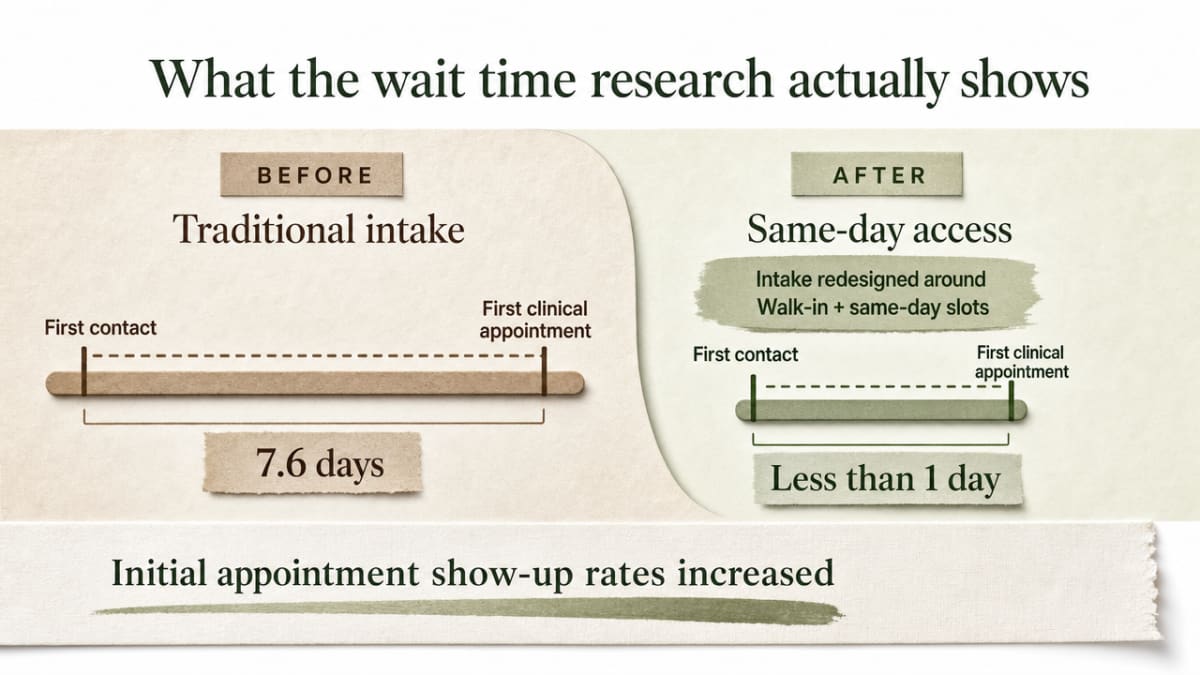
Same-day intake is real here, and it isn’t a marketing line. Peer-reviewed work on same-day access models shows average wait times dropping from 7.6 days to under one day when programs are built around it 12. That gap — a week of white-knuckling versus walking in this afternoon — is the difference this piece is about.
You don’t have to have everything figured out before you call. You don’t need a packed bag, a perfect explanation, or a plan for who tells your boss. You need a phone and roughly 20 minutes of highway. The rest of this walks through what the call sounds like, what to bring, who can drive if you can’t, and what the first hours at Sunflower actually look like. One step. Then the next.
Why same-day access is a clinical decision, not a convenience
What the wait time research actually shows
Here’s the part most people don’t know when they’re standing in their kitchen at 8 a.m. trying to decide whether to call: the delay between reaching out and actually sitting down with a clinician is where a lot of people lose the thread. Not because they don’t want help. Because a week is a long time when your hands are shaking.
A peer-reviewed analysis of same-day access models in substance use disorder programs measured this directly. When programs restructured their intake so patients could be seen the day they called, the average wait time from first contact to first clinical appointment dropped from 7.6 days to less than one day 12. That study looked at outpatient SUD programs that redesigned scheduling around walk-in and same-day slots, and it tracked show rates alongside wait times. Show-up rates for initial appointments went up too 12. The scope matters: this is intake-to-first-visit, not a promise of long-term outcomes. But that first door is the door most people never walk through.
Think about what a seven-day wait actually asks of you. Seven mornings of trying not to drink before noon. Seven evenings of wondering if today was the last chance you had. Seven chances for something to go wrong that you can’t take back. Under one day is a completely different ask. It’s one drive, one afternoon, one decision that you don’t have to keep re-making.
That’s why Sunflower’s same-day intake from Paola isn’t a scheduling flourish. It’s the mechanism the research points to. You called. You’re here. The clinical work starts now. The authors of that same study noted real operational trade-offs — same-day access asks more of staff and requires rethinking how a schedule is built 12. Those are problems for the program to solve, not for you. Your job today is much smaller. Your job is the phone.
Rapid access and what happens 30 and 90 days later
Getting in the door faster is one thing. What happens after — whether it actually changes the shape of the next three months — is the question that matters most to the person you love who’s still not sure this will work.
A 2023 cohort study of 876 people with prescription opioid use and other substance use disorders answered a version of that question directly. Researchers compared 440 patients who attended a Rapid Access Addiction Medicine (RAAM) clinic with 436 who did not, tracking a composite outcome that combined emergency department visits, hospitalizations, and mortality at both 30 and 90 days 10. The RAAM group hit that composite outcome at 22.7% (100 of 440). The comparison group hit it at 30.3% (132 of 436). The odds ratio came in at 0.68, with a 95% confidence interval of 0.50 to 0.92 10.
Read that again in plain terms. People who got into a rapid-access clinic were meaningfully less likely to end up in an ER, in a hospital bed, or dead within three months than people who didn’t. The authors are careful — they note that this was observational, so patients who chose RAAM may have differed in motivation or other factors from those who didn’t 10. It’s not a randomized trial. But the direction and size of the effect line up with what clinicians who run these programs describe: getting someone into structured care quickly reduces the acute crises that pile up during a week of waiting.
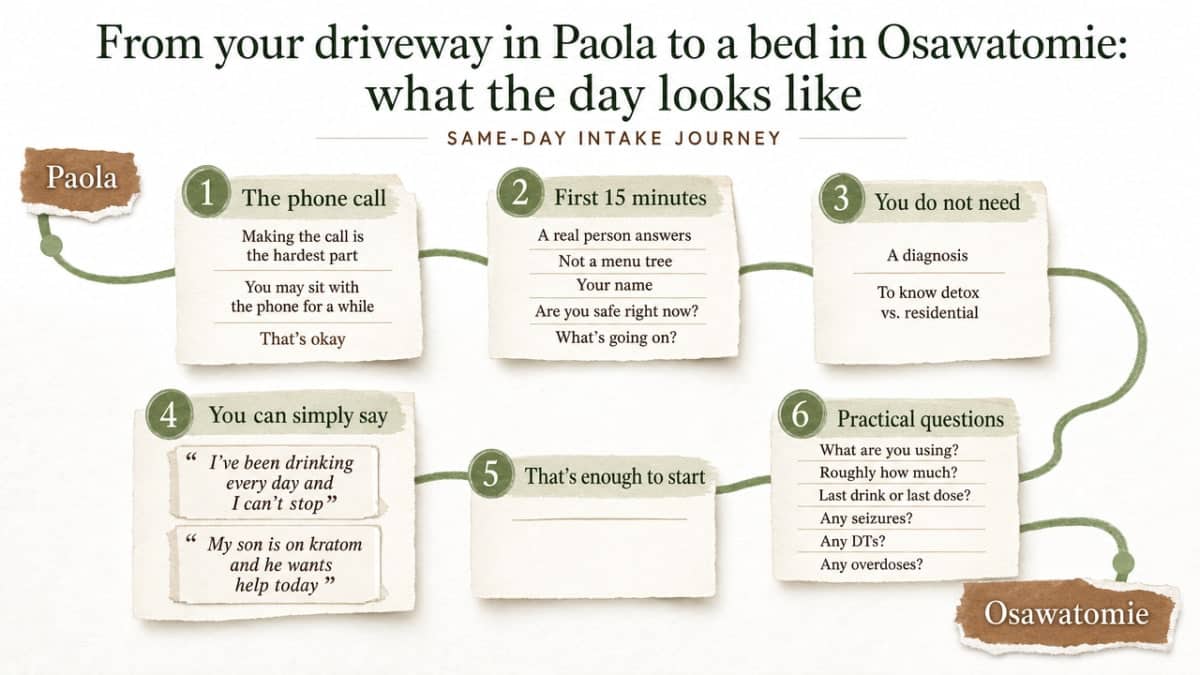
From your driveway in Paola to a bed in Osawatomie: what the day looks like
The phone call and the first 15 minutes
Making the call is the hardest part. You may sit with the phone in your hand for a while before you dial. That’s okay. A lot of people do. Once you’re ready, here’s what the next 15 minutes actually sound like.
Someone picks up. A real person, not a menu tree. They’ll ask your name, whether you’re safe right now, and what’s going on. You don’t need a diagnosis. You don’t need to know the difference between detox and residential. You can say something as simple as, “I’ve been drinking every day and I can’t stop,” or, “My son is on kratom and he says he wants help today.” That’s enough to start.
The intake coordinator will ask a handful of practical questions. What are you using, and roughly how much. When was your last drink or last dose. Any seizures, any DTs, any overdoses in your history. Prescription medications you take. Whether you have insurance, and which one. If you don’t know the answers, you don’t know the answers. They’ll work with what you’ve got.
By the end of the call, you’ll have three things: confirmation that a same-day bed is available, a rough arrival window, and a short list of what to bring. You’ll also have a direct number to call back if something changes in the next hour. That’s the whole first step. You picked up the phone. You said the words out loud. That already counts.
Packing a bag, arranging the ride, and leaving Paola
You have maybe 45 minutes between hanging up and pulling out of the driveway. That’s enough. It doesn’t need to be a perfect bag.
- Seven days of clothes. Comfortable stuff — sweatpants, T-shirts, a hoodie for cold rooms. Slip-on shoes.
- Toiletries in a clear bag.
- Your ID, insurance card, and any prescription bottles exactly as the pharmacy labeled them. Bring the bottles even if they’re almost empty.
- If you take medication for blood pressure, diabetes, seizures, or a mental health condition, that’s not optional — bring it.
- Leave the mouthwash, the aerosols, and anything with alcohol on the label. Leave the pocketknife. Leave the vape if you’re not sure.
If you can drive yourself and you’re not intoxicated, drive. If you’ve been drinking or using today, do not. Ask a spouse, a parent, an adult child, or a friend who’s known you long enough that the shame isn’t the point anymore. If nobody’s around, the intake coordinator can talk through options with you before you leave.
From Paola, you’ll take US-169 north. It’s a straight shot, about 20 minutes on a clear morning. Prairie on both sides, a couple of rises, and then the exits for Osawatomie. The people who study these pathways found that when systems offer same-day or next-day appointments and hold slots open for them, roughly 92% of scheduled patients actually complete the visit 11. That’s a striking number. Most people who say they’ll come, come. You will too.
One bag. One car. One road you already know.
Walking through the door: the first clinical conversation
You’ll pull into Osawatomie sometime around mid-morning if you left Paola after the call. The building isn’t a hospital. It doesn’t feel institutional. Someone from intake will meet you at the door — often the same voice from the phone — and take you to a private room. Not a waiting area. Not a clipboard on a lobby chair. A door that closes.
The first conversation is medical and it’s clinical, but it’s also human. A nurse will take your vitals — blood pressure, pulse, temperature, oxygen. They’ll ask when you last used and what. If alcohol or benzodiazepines are in the picture, they’ll pay close attention, because those two withdrawal syndromes can turn dangerous and they want to catch that early. They’ll ask about pain, sleep, appetite, past detoxes, any suicidal thoughts. Answer honestly. Nobody in this room is trying to catch you in something.
A clinician joins next. This is where the assessment gets broader — your history, what you’ve tried before, what your home life looks like, what you’re afraid of about being here. If you don’t feel like talking, you can say that. If you want to cry through half of it, you can do that too. Both are things they’ve seen.
By the end of this first sit-down, roughly the first hour, you’ll know your level of care — whether you’re starting in medical detox, moving into residential, or a combination. You’ll know what medications, if any, they’ll offer to make withdrawal safer. You’ll have a room assignment. You made it from a driveway in Paola to sitting across from a clinician who’s now on your team. That’s a real thing. Let yourself feel it for a second.
Dual-diagnosis and trauma screening on day one
Substance use rarely walks in alone. Somewhere in the afternoon of intake day, a different clinician will sit down with you for a longer conversation about mental health. Depression. Anxiety. Panic attacks. PTSD. Eating patterns. Sleep. Old trauma you may or may not want to talk about yet.
This isn’t extra. It’s the point. Research on integrated assessment is direct about it: screening for mental health and substance use together, on the same day, is essential because co-occurring disorders are common and they change what treatment needs to look like 14. If someone treats only the drinking and ignores the panic attacks that drive the drinking, the drinking usually comes back. Sunflower’s model is built around this — trauma-informed dual diagnosis care isn’t a marketing phrase on the wall, it’s what the assessment on day one is designed to find.
You don’t have to disclose everything this afternoon. You won’t. Trauma work doesn’t happen in an intake interview and no good clinician would push it there. What happens is a screen — standardized questions, gentle follow-ups, notes for the team. What surfaces here shapes the treatment plan the multidisciplinary team builds for you in the next 48 hours. Depression medication considerations. Trauma-focused therapy on the schedule. Whether an eating disorder specialist joins the team.
If you’ve been carrying something for a long time that you’ve never said out loud, this is a room where saying part of it is safe. Just part. Whatever you’re ready for.
The first night on the unit
By evening you’ll have a room. A bed with clean sheets. A window. A roommate, probably, unless the census is light. Dinner will happen whether you’re hungry or not — most people aren’t, on the first night, and that’s expected. Eat what you can.
If you’re in medical detox, a nurse will check on you through the night. Vitals, comfort medications if you need them, water. Alcohol and benzodiazepine withdrawal get watched closely for the first 72 hours because that’s when things can shift. Opioid withdrawal is miserable but rarely dangerous, and there are medications that make it a lot less miserable. Ask for what you need. That’s what the call button is for.
Sleep will be strange. It usually is. New bed, new noises, a body that’s suddenly not getting what it’s used to. Some people sleep four hours in fragments. Some sleep twelve. Either is normal.
Before you turn out the light, take a beat. This morning you were in Paola with a phone in your hand, wondering if today was really the day. Tonight you’re 20 minutes up the road, in a bed, in a program, with a team who knows your name. You did the hard part already. Tomorrow is just the next day.
The Kansas state pathway, and when to skip it
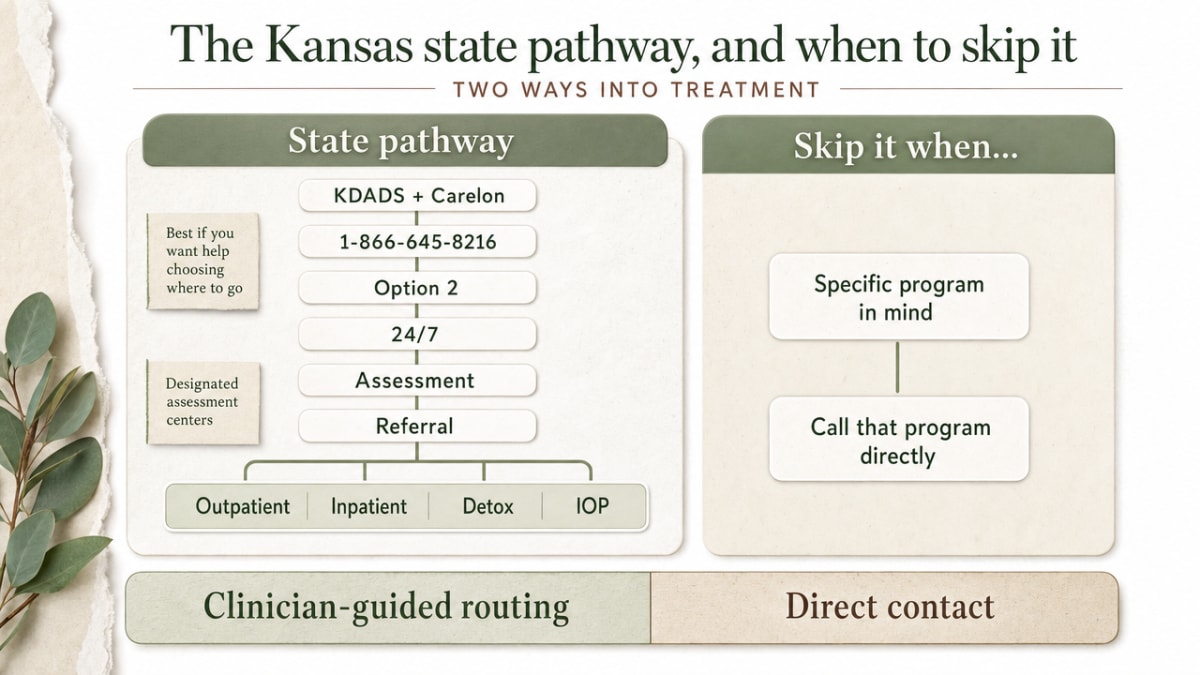
Kansas has a state-run way to get into substance use treatment, and you should know about it before you decide who to call. The Kansas Department for Aging and Disability Services (KDADS) contracts with Carelon Behavioral Health to run a statewide referral line at 1-866-645-8216, option 2 1. It’s answered 24/7. That number can connect you with an assessment and a referral into outpatient, inpatient, detox, or intensive outpatient care somewhere in the state 1, 6.
That pathway is real and it works for a lot of people, especially anyone who doesn’t have a specific program in mind and wants a clinician on the phone to help sort out where to go. Kansas law formally recognizes designated assessment centers — treatment facilities the state has approved to conduct those evaluations and route people into care 15. If you have no idea where to start, the Carelon line is a legitimate first door.
Here’s the honest tradeoff. When you call the state line, you’re entering a referral queue. The assessor has to talk with you, figure out what level of care fits, and then match you to a facility that has a bed today. That can take time. It may route you somewhere farther from Paola than Osawatomie. It may hand you a phone number and ask you to call the program yourself.
Calling Sunflower directly skips the middle step. You’re already talking to the program that has the bed. The clinical assessment happens when you arrive, not before you’re allowed to arrive. From Paola, that’s a 20-minute drive up US-169 instead of a series of transferred calls. Both paths are valid. If today is the day, the shorter path usually wins.
If you cannot drive yourself from Paola
Not being able to drive today doesn’t close the door. It just changes who turns the key.
Start with the people closest to you. A spouse, a parent, a grown kid, a friend who’s already asked how they can help — this is the ask. “Can you drive me to Osawatomie this afternoon?” Twenty minutes up, twenty minutes back. Most people say yes faster than you’d think. Shame tells you not to ask. Ask anyway.
If nobody’s available, Miami County has options. The county’s own transportation page confirms local bus service and private on-demand rides operating within the county 3. Call the intake coordinator at Sunflower before you book anything — they can help you figure out which service fits the timing, and whether a rideshare from Paola makes more sense for a same-day arrival.
What happens after intake day
Same-day intake gets you through the door. What keeps you moving forward is what comes after, and that part matters just as much. Research on walk-in and rapid-intake models is clear-eyed about this: getting people in the door boosts initial engagement, but sustained recovery depends on structured follow-up and case management 13. A great first day without a plan for day 30 isn’t enough. Sunflower is built around that reality.
Here’s what the continuum looks like from where you’ll be sitting. Residential treatment is typically the first stretch — usually up to 60 days, depending on what the clinical team recommends for you. Days have structure. Therapy sessions, group work, medical check-ins, meals, fitness, sleep. Your treatment plan gets refined as the team learns more about what’s actually going on underneath the substance use.
When you step down from residential, you don’t step off a cliff. Partial hospitalization comes next for many people — full clinical days, but you’re not sleeping on the unit. Then intensive outpatient, which is fewer hours a week and lets you start rebuilding the parts of your life outside treatment. Family programming runs alongside all of it, because the people driving you to Osawatomie today are going to need their own support too.
RAAM retention data offers some reassurance about what’s realistic: 74% of patients with alcohol use disorder and 68% with opioid use disorder stayed engaged in care over a 26-week period in one rapid-access clinic study 9. Not everyone. But most. The people who walk in also tend to stay.
Today’s job is just today. The rest gets built one step at a time, with a team.
Ready for a Change? Start Intake Today
Connect with admissions and begin your same-day rehab intake, just minutes from Paola.
Frequently Asked Questions
How far is Sunflower Recovery from Paola, KS?
About 20 minutes north on US-169. It’s a straight-shot drive up the same highway you already use to get to Olathe or Kansas City. No transfers, no back roads, no complicated route. From most addresses in Paola, you’re looking at roughly 15 to 20 miles up to the Osawatomie exits. If you left right after your call, you’d be walking in the door before lunch.
Can I really get into rehab the same day I call?
Yes. Same-day intake at Sunflower is a real, structured pathway — not a lucky exception. When rapid-access programs offer same-day or next-day appointments, roughly 92% of patients who schedule actually complete the visit 11. Beds fill and staffing shifts, so it’s not automatic every single hour of every day. But when you call, the intake coordinator will tell you plainly whether today works, and if not, they’ll tell you when it does.
What should I pack before leaving Paola?
Keep it simple. A week of comfortable clothes, slip-on shoes, toiletries in a clear bag, and your ID and insurance card. Bring every prescription bottle exactly as the pharmacy labeled it. Leave anything containing alcohol — mouthwash, hand sanitizer, cologne — at home. No pocketknives, no vapes unless intake approves them. If you forget something, someone can drop it off later. Don’t let a missing phone charger become the reason you didn’t go.
What if I can’t drive myself to Osawatomie?
Ask someone first. A spouse, a parent, an adult kid, a friend — 20 minutes up and 20 minutes back is a smaller ask than shame tells you it is. If no one is available, Miami County has local bus service and private on-demand ride options within the county 3. Call Sunflower’s intake coordinator before you book anything — they’ll help you match the timing. If you’re in a medical emergency, call 911 first.
Should I call the Kansas state referral line or Sunflower directly?
Both are legitimate. Kansas runs a 24/7 referral line through Carelon Behavioral Health at 1-866-645-8216, option 2 1, 6. It’s a good option if you don’t know where to start. Calling Sunflower directly skips the referral step — you’re already talking to the program with the bed, and the clinical assessment happens when you arrive rather than over the phone with an assessor who then routes you elsewhere. If today is the day, direct is usually faster.
What happens if I also have a mental health condition?
That’s expected, not a complication. Mental health and substance use conditions overlap often, and integrated assessment of both on the same day is essential to good treatment planning 14. On intake day at Sunflower, a clinician will screen for depression, anxiety, PTSD, eating patterns, and trauma alongside the substance use assessment. That screen shapes your treatment plan — medication considerations, trauma-informed therapy, specialist involvement. You don’t have to disclose everything at once. Just what you’re ready to say.
References
- Substance Use Disorder Treatment Services. https://www.kdads.ks.gov/services-programs/behavioral-health/services-and-programs/substance-use-disorder-treatment-services
- Overdose Data Dashboard. https://www.kdhe.ks.gov/1309/Data-Dashboard
- Transportation | Miami County, KS – Official Website. http://www.miamicountyks.gov/197/Transportation
- Drug Overdose Deaths in Kansas by County. https://www.kdhe.ks.gov/DocumentCenter/View/55469/2020-2024-Map-of-Kansas-Overdose-Deaths-by-County-PDF?bidId=
- Substance Use Disorder & Overdose Prevention Toolkit. https://www.kdhe.ks.gov/DocumentCenter/View/43233/2024-Overdose-Spike-Alert-Community-Response-Toolkit-PDF
- Contact Behavioral Health. https://www.kdads.ks.gov/services-programs/behavioral-health/contact-behavioral-health
- Kansas Fatal Drug Overdose Vulnerability Assessment. https://www.kdhe.ks.gov/DocumentCenter/View/59744/Kansas-Fatal-Drug-Overdose-Vulnerability-Assessment-PDF?bidId=
- Substance Use Disorder & Overdose Prevention. https://www.coronavirus.kdheks.gov/1298/Substance-Use-Disorder-Overdose-Preventi
- A rapid access to addiction medicine clinic facilitates treatment of substance use disorders. https://pmc.ncbi.nlm.nih.gov/articles/PMC6958640/
- Rapid Access Addiction Medicine Clinics for People With Prescription Opioid Use and Other Substance Use Disorders. https://pmc.ncbi.nlm.nih.gov/articles/PMC10665968/
- Implementing a Patient-Centered, Rapid-Access Substance Use Disorder Treatment Pathway in Primary Care. https://pmc.ncbi.nlm.nih.gov/articles/PMC12520321/
- Reducing Wait Time for Addiction Treatment: Impact of Same-Day Access Models. https://www.ncbi.nlm.nih.gov/pmc/articles/PMC6359090/
- Impact of Rapid Intake and Walk-In Clinics on Substance Use Treatment Outcomes. https://www.ncbi.nlm.nih.gov/pmc/articles/PMC6498877/
- Co-occurring Mental Health and Substance Use Disorders: Importance of Integrated Assessment. https://www.ncbi.nlm.nih.gov/pmc/articles/PMC8023946/
- 2026 Kansas Statutes – Section 65-4024a (designated assessment centers). https://www.kslegislature.gov/b2025_26/laws/065_000_0000_chapter/065_040_0000_article/065_040_0024a_section/065_040_0024a_k/
- Drug Overdose Deaths – State Data | CDC. https://www.cdc.gov/drugoverdose/data/statedata.html