
Key Takeaways
- Shawnee sits inside Johnson and Wyandotte counties, not Shawnee County near Topeka, so statewide overdose figures don’t map directly to your neighborhood’s rate or resources.
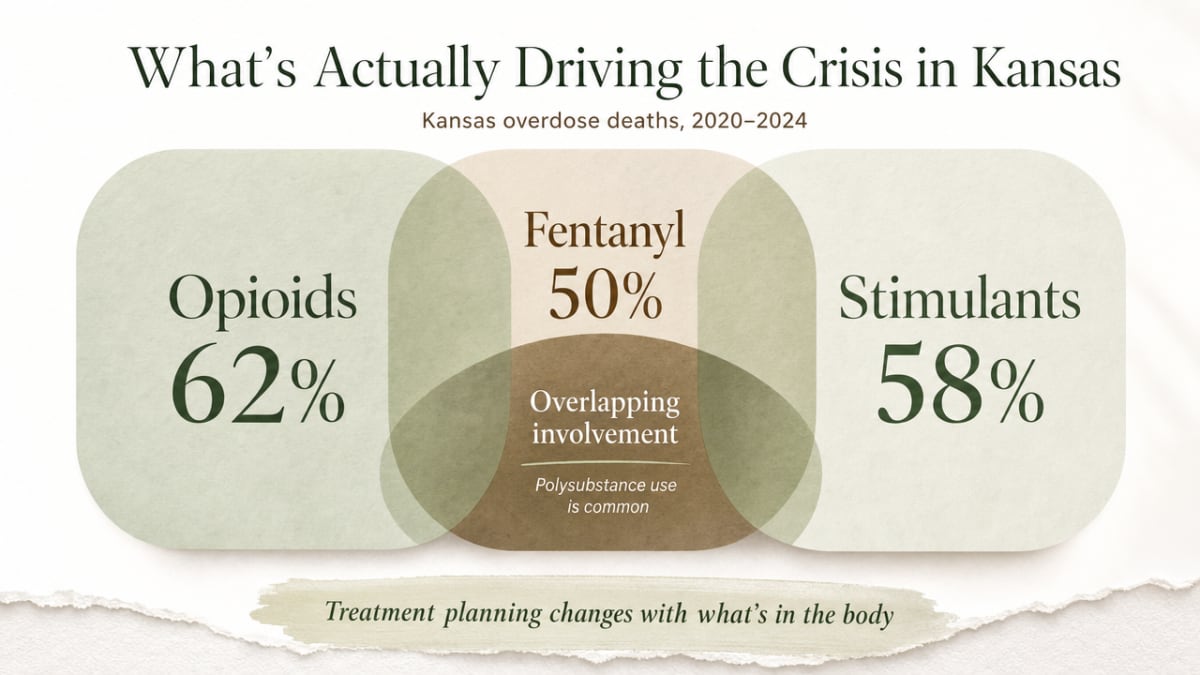
- Polysubstance use is now typical in Kansas, with opioids, fentanyl, and stimulants overlapping in most overdose deaths 8, which shapes what safe intake and withdrawal care must cover.
- Look for programs that treat mental health and substance use as one connected story from the first call, since integrated dual diagnosis care improves outcomes over sequential treatment 5.
- Before choosing a level of care, compare how residential, PHP, and IOP fit your household’s week, what commercial insurance covers, and whether the 45-minute drive to Osawatomie preserves family involvement.
When the Crisis Reaches Your Driveway in Shawnee
You probably didn’t picture this happening on your street. Maybe it’s the empty bottles you keep finding in the garage. Maybe it’s your adult son sleeping through another Monday, or your wife pouring wine before the school bus pulls away. Maybe it’s you, reading this at the kitchen table after everyone else went to bed, wondering how the shape of your life got this narrow.
Shawnee is a suburb built around ordinary things — driveways, backyards, kids’ practices at Erfurt Park, the Tuesday-Wednesday-Thursday grind of getting everyone fed and to bed. When addiction moves into a house like that, it doesn’t announce itself. It hides inside the routines that used to feel safe.
This guide is for you whether you’re the person struggling or the person watching someone you love struggle. Both of you are welcome here. Both of you deserve a plan that fits a working household in Monticello, Shawnee Mission, or western Shawnee — not a one-size flowchart pulled from a national brochure.
What follows is honest about the Kansas landscape, plain-spoken about what trauma-informed dual diagnosis care actually means, and specific about what the next call could look like. No urgency stacking. No promises. Just the local ground under your feet, and a realistic path forward from it.
What Kansas Overdose Data Actually Says About Your Neighborhood
The Statewide Picture Behind Your Front Door
You don’t need a statistic to know something is wrong in your house. You already know. But if you’re the family member sitting up at midnight trying to decide whether this is really as bad as it feels, it can help to see the scale of what Kansas is actually living through right now.
Between 2020 and 2024, Kansas recorded 3,013 overdose deaths statewide — roughly 21 deaths per 100,000 people each year, or about five deaths every three days 8. That’s a five-year window covering the whole state, not a single-year Shawnee number. But it’s the water your neighborhood is swimming in. When you drive down Shawnee Mission Parkway past the pharmacies, the sports bars, the urgent care clinics, this is the backdrop.
Here’s what that number actually means for a family in Monticello or western Shawnee: overdose is no longer a story that happens somewhere else, to someone else’s kid, in some other zip code. It is happening to accountants, to nurses, to youth soccer coaches, to grandmothers who started on prescription pain medication after a knee replacement. The people dying are not strangers in a report. They are the demographic profile of your cul-de-sac.
None of this is meant to frighten you into moving faster than you can. It’s meant to give you permission to trust what you’re already seeing. If the pattern in your home matches the pattern in the state, you are not exaggerating. You are paying attention.
Shawnee County vs. the City of Shawnee: A Confusion Worth Clearing Up
This one trips up almost everyone who starts googling.
Shawnee County is a different place. It’s the Topeka area, about an hour west on I-70. The city of Shawnee — your Shawnee, the one with Erfurt Park and the Aquatic Center and the Old Shawnee Days parade — sits inside Johnson and Wyandotte counties, not Shawnee County. When state reports list Shawnee County’s overdose numbers, they are not talking about your neighborhood.
The distinction matters, because Shawnee County’s overdose figures are heavy. KDHE recorded 287 overdose deaths there from 2020 to 2024, at a rate of 32.8 per 100,000 — noted as a higher rate than the state average 10. If you saw that number and assumed it described your street, take a breath. It doesn’t.
Johnson County, where most of Shawnee actually sits, generally shows a lower overdose rate than the counties around Topeka and Wichita, though the crisis is real here too. What this means practically: your family is making a treatment decision in a suburb that has resources, insurance coverage, and access — not one that’s been abandoned. That’s a genuine advantage. It also means you don’t have to accept the first program that answers the phone. You have room to choose care that fits.
What’s Actually Driving the Crisis in Kansas
If you’re trying to understand what your spouse or adult child is actually up against, the substance matters. It shapes withdrawal, it shapes risk, it shapes what treatment has to be ready for on day one.
Between 2020 and 2024, opioids were involved in 62% of Kansas overdose deaths, fentanyl specifically in 50%, and stimulants — mostly methamphetamine — in 58% 8. Those percentages overlap, because polysubstance use is now the norm rather than the exception. Someone using what they think is a Percocet from a friend at work may be swallowing fentanyl. Someone using meth to stay awake through a double shift may be using pills to come down at night.
This matters for you specifically because the treatment planning conversation changes depending on what’s in the body. Fentanyl withdrawal is medically serious. Methamphetamine leaves people exhausted, paranoid, and sometimes profoundly depressed for weeks after use stops — which can look like a mental health crisis on top of a substance one. Alcohol, still Kansas’s most familiar substance, carries its own withdrawal risks that can be dangerous without medical supervision.
When you call a program and start describing what you’ve seen at home — the pills you found, the foil, the empty bottles, the weight loss, the way they sleep — you are giving the intake clinician the information they need to build a safe first 72 hours. You don’t need to know the pharmacology. You just need to say what you’ve seen.
Why Dual Diagnosis Is the Rule, Not the Exception
Kansas Is Catching Up to What Families Already Knew
You may have watched this for years before anyone put a name to it. The drinking started after the panic attacks got worse. The pills started after the back surgery, but they kept going long after the anxiety about work took over. The meth showed up during a depression that nobody wanted to say out loud. You already knew the two things were tangled. What you may not have known is that the state’s own tracking has been slow to say so.
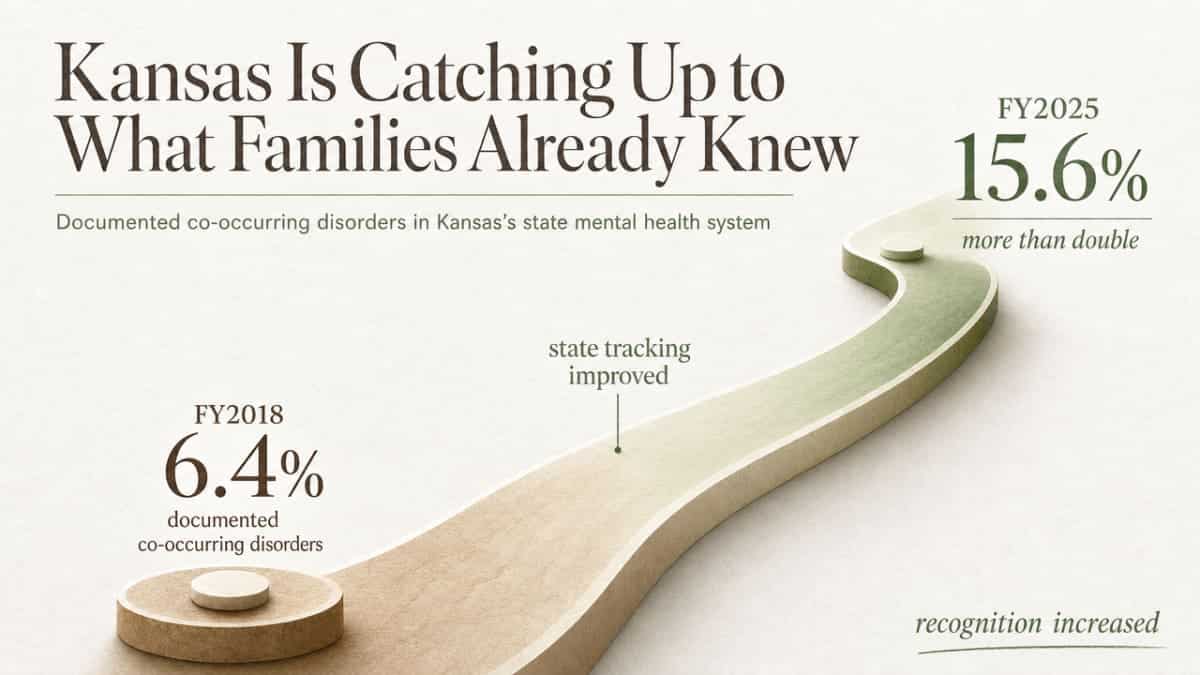
Here’s the shift. In fiscal year 2018, only 6.4% of adults served through Kansas’s state mental health authority had a documented co-occurring mental health and substance use disorder. By fiscal year 2025, that number had climbed to 15.6% — more than double 6, 7. That doesn’t mean the problem more than doubled in seven years. It means Kansas got measurably better at recognizing what was already sitting in front of clinicians all along.
For a family in Shawnee, that shift matters in a practical way. Ten years ago, a spouse could go into a treatment program and have the depression treated separately, later, elsewhere — or not at all. Today, the expectation is different. When you call an intake line and describe both the drinking and the anxiety, both the meth and the trauma history, both the pills and the postpartum depression that never really lifted, you should hear a clinician treat those things as one story. Not two problems on two floors of two buildings.
What Integrated Care Looks Like in the Room
Integrated care is one of those phrases that sounds like a filing cabinet. In practice, it’s much more ordinary than that.
It means the person running your loved one’s group therapy on Tuesday afternoon knows what the psychiatrist prescribed on Monday morning, and knows why. It means when your daughter says the cravings hit hardest right before she has to call her mother, the therapist doesn’t wave that off as unrelated to the substance work — she treats it as central. It means the treatment plan has one author, not three departments passing a chart back and forth.
The National Institute of Mental Health has been clear on this for a while: people with substance use disorders often have co-occurring mental health disorders, and treating both together improves outcomes compared with treating them in sequence or in parallel 5. The old model — get sober first, then we’ll look at the depression — often failed people, because the depression was part of why they were using in the first place.
What you’re looking for, when you call, is a program that asks about mental health in the same breath as substance use. Not as a checkbox on page four of the intake form, but as part of the first conversation. If the person on the phone treats your spouse’s PTSD and their drinking as one connected thing rather than two competing appointments, you’re in the right place.
Trauma-Informed Treatment, Translated Out of Jargon
Why Trauma Screening Belongs in Intake, Not an Afterthought
You may have noticed that certain phrases make your loved one shut down. A raised voice. A closed door. The specific hallway smell of a hospital. Trauma is not a diagnosis you have to earn through combat or catastrophe. It’s a nervous system that learned, at some point, that the world was not safe — and never fully unlearned it.
Here’s the piece that changes how you should evaluate a treatment program. SAMHSA’s TIP 57 reports that more than half of individuals who seek substance use treatment report one or more lifetime traumas, and that people with trauma histories have worse outcomes when that trauma goes unaddressed 12. That is not a small subgroup. That is most of the people walking through the intake door.
Trauma screening in the first conversation matters because it changes the plan. If your husband has an assault history he has never told anyone about, that shapes which group he can tolerate, whether a male or female therapist is a better starting point, what medications interact badly with dissociation, and how staff should respond the first time he panics in a hallway at 2 a.m. A program that waits until week three to ask is a program building a treatment plan on a foundation it hasn’t inspected. Integrating trauma-informed approaches into substance use treatment improves engagement and adherence 13— meaning people actually stay long enough for the work to hold.
What Changes for You, Your Spouse, and Your Kids
Trauma-informed care is often described in domains and principles 4. That language does not help you at your kitchen table. So here is what actually changes when a program takes it seriously.
Doors don’t slam. Staff knock before entering rooms. Nobody is grabbed by the arm to be redirected. When your wife says she doesn’t want to talk about her mother yet, the clinician doesn’t push — she notes it and comes back to it three sessions later, with warning. Physical exams are explained in advance. Restraints are a last resort discussed openly, not a first response.
The changes reach you, too. In family sessions, no one ambushes you with a list of everything you did wrong. The clinician frames the conversation as one where everyone in the household has been carrying something, and everyone gets a turn to set it down. If you have your own history — and many spouses and adult children of people with addiction do — a trauma-informed program will notice, and will point you toward your own support rather than treating you as staff.
For your kids, it means the language used in family programming assumes children are also affected, without pathologizing them. Their questions get real answers at their level. Nobody promises them things that can’t be promised. Trauma and its symptoms are treated as a central concern of the whole treatment picture, not a footnote 3. That’s the difference you’re listening for on the phone.
The Shawnee Family Calendar Around Treatment
Levels of Care and How They Fit a Working Household
Treatment is not one thing. It’s a set of intensities, and the right one for your household depends less on how bad the addiction looks from the outside and more on what your week actually contains.
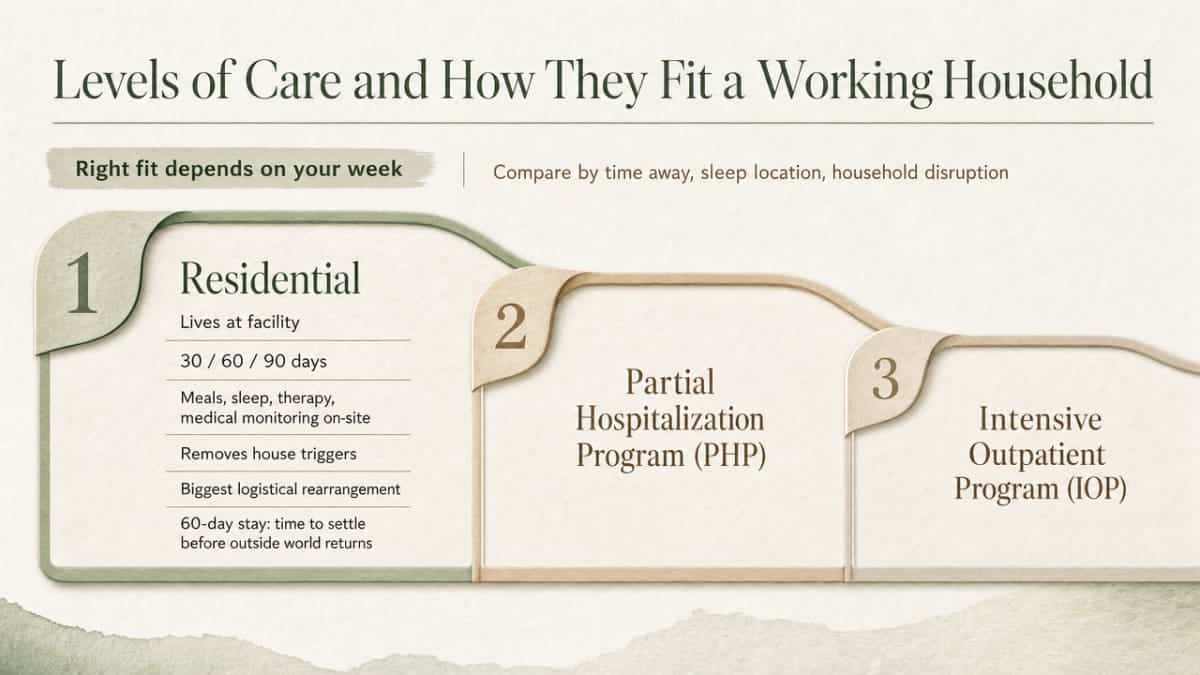
Residential care means your loved one lives at the facility, usually for 30, 60, or 90 days. Meals, sleep, therapy, medical monitoring — all of it happens on-site. For a Shawnee family, this is the option that removes someone entirely from the triggers of the house, the neighbors, the liquor cabinet, the coworker who supplies. It’s also the option that requires the biggest logistical rearrangement: who picks up the kids from Mill Creek, who covers the mortgage payment, who tells the employer what. A 60-day residential stay gives the nervous system real time to settle before the outside world comes back online.
A partial hospitalization program, or PHP, is the step between residential and outpatient. Your loved one spends most of the day at the facility — typically five to six hours, five days a week — and sleeps at home or in a sober-living setting. Intensive outpatient, or IOP, drops that to about nine hours a week, usually three evenings, which lets someone hold a job while still doing serious clinical work.
You don’t have to pick the level yourself. An intake clinician does that with you. Your job is to describe what a normal Tuesday looks like in your house right now.
Insurance, Cost, and the Questions Worth Asking First
Money is often the reason people don’t call. Please call anyway. You will get a clearer answer in ten minutes on the phone than in three hours on a website.
Sunflower Recovery accepts most commercial insurance plans — the kind you carry through your employer or the marketplace. It does not participate in Medicare or Medicaid, so if that’s your coverage, the intake team can point you toward Kansas resources that do, including the state referral line for substance use treatment.
Before you call, gather a few things: the name on the insurance card, the member ID, and a rough sense of what you’ve already tried — outpatient counseling, a previous rehab, medications. Then ask three questions:
- What will my plan cover for residential, PHP, and IOP?
- What is my out-of-pocket exposure once the deductible is met?
- What happens if we need to step down or step up between levels?
Real answers are possible in one conversation.
Osawatomie as ‘Close to Home’: The 45-Minute Drive South
Forty-five minutes south of Shawnee, past the edge of the metro, the road opens up. K-7 runs down through Olathe and into Miami County, and Osawatomie sits at the end of that drive — quiet, small, surrounded by farmland. That is where Sunflower Recovery Center is. And for a lot of Shawnee families, the distance is the point.
Here is the honest tradeoff. Treatment inside Shawnee itself, or ten minutes away in Overland Park, keeps someone close to the exact environment that has been hard on them. The same bar off Shawnee Mission Parkway. The same coworker who texts on Fridays. The same route home that passes the same liquor store. Forty-five minutes of highway puts real space between your loved one and those cues, without putting them across the country from you.
That distance is also short enough to keep family in the picture. A Saturday visit is a morning drive, not a plane ticket. Family programming — the sessions where you and your kids learn how to live alongside recovery rather than around it — is reachable on a weeknight if it needs to be. Discharge planning back into Shawnee life, the return to your kitchen and their bedroom and the school pickup line, happens with a team that has been thinking about that transition the whole time.
When you call, ask what family visits look like in the first 30 days, and how the team plans the step-down back into a Shawnee week. Those answers tell you whether the drive south is buying real distance, or just distance.
What to Do This Week
You don’t have to solve this by Sunday. You just have to move one inch that you weren’t willing to move last week.
Pick a quiet twenty minutes — after the kids are down, before the morning starts — and call Sunflower Recovery to ask about care options close to home. Have the insurance card in front of you. Have a short, honest sentence ready about what you’ve been seeing. The intake team can walk you through whether residential, PHP, or IOP fits your household, and what the drive down to Osawatomie actually looks like for a Shawnee family.
If your loved one isn’t ready to make that call themselves, you can still make it as a family member. You are allowed to ask questions on behalf of someone you love. That is not going behind their back — that is doing the research a person in crisis often cannot do for themselves.
One call this week. That’s the whole ask.
Take the First Step Toward Local Recovery
Connect with experts who understand Shawnee’s unique needs and start building your recovery plan today.
Frequently Asked Questions
Is there addiction treatment in Shawnee, KS itself, or do we have to leave town?
You don’t have to leave town to start. There are outpatient counselors and prescribers inside Shawnee and just over the line in Overland Park and Lenexa. What Shawnee itself does not have is a residential program with beds. If your household needs that level of care, the closest trauma-informed dual diagnosis option is Sunflower Recovery in Osawatomie, about 45 minutes south. A phone call helps you sort which level fits.
How far is Sunflower Recovery from Shawnee, and is that drive realistic for a working family?
It’s roughly 45 minutes south, down K-7 into Miami County. For a Shawnee family, that’s a Saturday-morning drive for a visit, not a weekend trip. Family programming and discharge planning back into your Shawnee week stay reachable. The distance is far enough to break daily triggers — the same bar, the same coworker, the same route home — and close enough that you’re still in each other’s lives.
What does dual diagnosis treatment actually mean for someone dealing with both anxiety and drinking?
It means one team treats both, at the same time, as one connected story — not the old sequence of get sober first and we’ll look at the anxiety later. NIMH is clear that people with substance use disorders often have co-occurring mental health disorders, and integrated care improves outcomes 5. In practice, the therapist running group knows what the psychiatrist prescribed and why. Same plan. Same author.
What does trauma-informed care look like in practice, not just on a website?
Doors don’t slam. Staff knock. Nobody is grabbed by the arm. Intake asks about trauma history in the first conversation, not week three. If your spouse says they aren’t ready to talk about something, the clinician notes it and returns to it later with warning. SAMHSA reports that integrating this approach improves engagement and adherence 13— meaning people stay long enough for the work to hold.
Does Sunflower Recovery take our insurance, and what about Medicare or Medicaid?
Sunflower accepts most commercial insurance — the plan you carry through an employer or the marketplace. It does not participate in Medicare or Medicaid. If that’s your coverage, the intake team can point you toward Kansas resources that do, including the state substance use treatment referral line. Have your member ID in hand when you call, and you’ll get a real coverage answer in one conversation.
How do we bring up treatment with a spouse or adult child who is not ready to hear it?
Pick a quiet moment — not after a fight, not after a drink. Say one specific thing you’ve seen, not a list of everything. “I found the bottles in the garage. I’m scared.” Then stop talking. You are allowed to call Sunflower yourself first, as a family member, and ask what options exist. Having a real plan in your pocket makes the second conversation easier than the first.
References
- Overdose Data Dashboard | KDHE, KS. https://www.kdhe.ks.gov/1309/Data-Dashboard
- TIP 57: Trauma-Informed Care in Behavioral Health Services. https://www.samhsa.gov/resource/dbhis/tip-57-trauma-informed-care-behavioral-health-services
- Trauma-Informed Care in Behavioral Health Services (SAMHSA). https://library.samhsa.gov/product/trauma-informed-care-behavioral-health-services/sma15-4420
- SAMHSA Spotlight – Kansas City: Trauma-Informed Approaches. https://library.samhsa.gov/sites/default/files/sma17-5016.pdf
- Substance Use and Mental Health. https://www.nimh.nih.gov/health/topics/substance-use-and-mental-health
- Kansas 2025 Uniform Reporting System Mental Health Data Results. https://www.samhsa.gov/data/sites/default/files/reports/rpt57206/Kansas.pdf
- Kansas 2018 Uniform Reporting System Mental Health Data Results. https://www.samhsa.gov/data/sites/default/files/cbhsq-reports/Kansas-2018.pdf
- Drug Overdose Deaths in Kansas 2020–2024. https://www.kdhe.ks.gov/DocumentCenter/View/55471/2020-2024-Kansas-Overdose-Deaths-PDF
- Kansas Fatal Drug Overdose Vulnerability Assessment. https://www.kdhe.ks.gov/DocumentCenter/View/59744/Kansas-Fatal-Drug-Overdose-Vulnerability-Assessment-PDF
- Drug Overdose Deaths in Kansas by County 2020–2024. https://www.kdhe.ks.gov/DocumentCenter/View/55469/2020-2024-Map-of-Kansas-Overdose-Deaths-by-County-PDF
- Kansas Health Statistics Report – December 2024 (Section on Drug Poisoning Mortality). https://www.kdhe.ks.gov/DocumentCenter/View/44065/Kansas-Health-Statistics-Report—December-2024-PDF
- Trauma-Informed Care in Behavioral Health Services (TIP 57 full PDF). https://library.samhsa.gov/sites/default/files/sma15-4912.pdf
- Integrating a Trauma-informed Approach Into Substance Use Disorder Treatment. https://www.samhsa.gov/resource/dbhis/integrating-trauma-informed-approach-substance-use-disorder-treatment