
Key Takeaways
- Growing up with parental substance use rewires the nervous system early, so effective treatment has to address both the current drinking and the childhood learning underneath it at the same time 1.
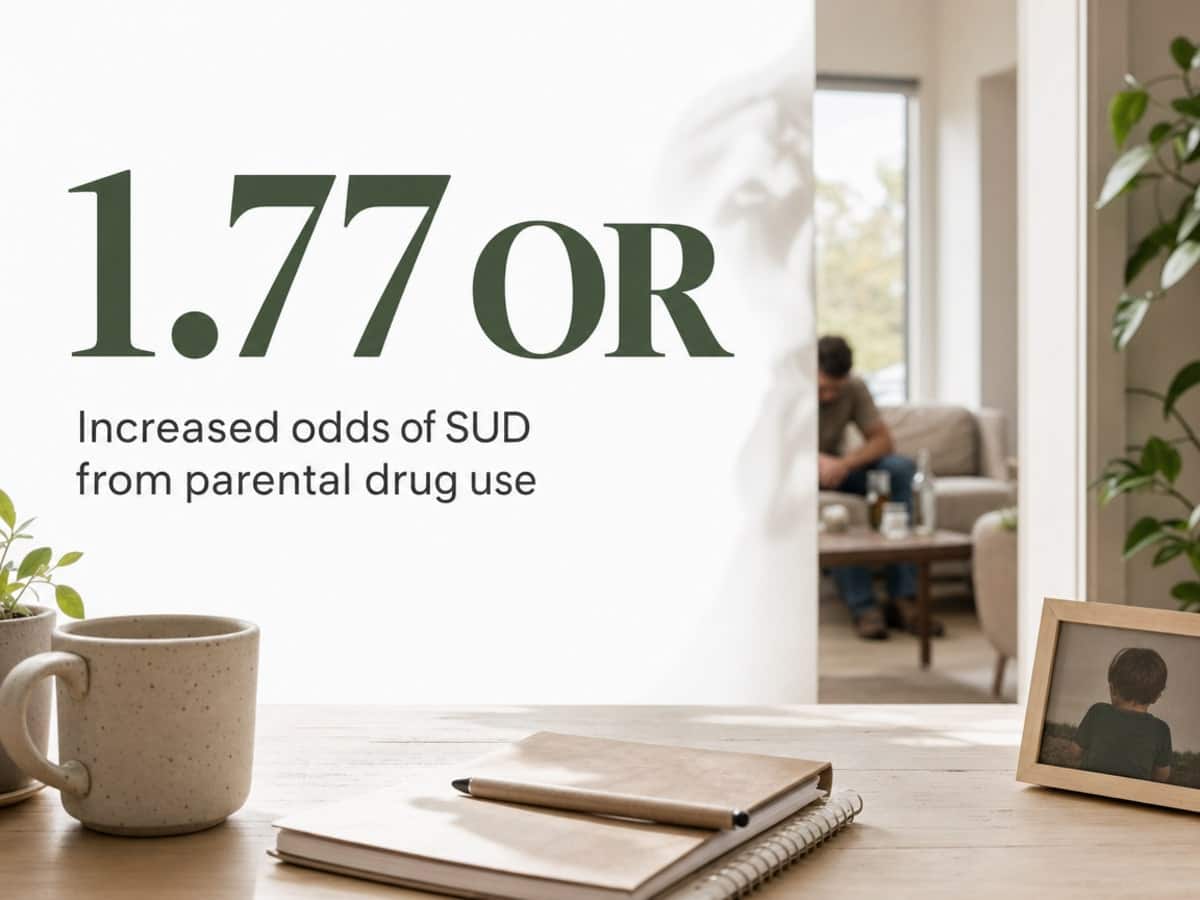
- Parental drug use carries an odds ratio of 1.77 for adult substance use disorders, and childhood coping roles — hero, scapegoat, lost child, mascot — often shape outcomes more than diagnostic labels 6, 7.
- Trauma-informed dual diagnosis care rests on safety, trustworthiness, empowerment, and integration, meaning trauma therapy runs alongside addiction work rather than being deferred until after detox and relapse prevention 2.
- When choosing a program, focus on how trauma-specific therapy is integrated day-to-day, whether family work requires your parent’s participation, and whether intake assesses coping roles and attachment patterns.
When your drinking starts to sound like the one you grew up around
You noticed it on a Tuesday, maybe. The way you poured the second one before you’d finished the first. The way you hid the empty. The way you told yourself you’d earned it, in a voice that wasn’t quite yours.
Or maybe it was the phone call from someone who loves you, and the flash of defensiveness you felt was too familiar. You’ve heard that tone before, from the other side of the door, when you were the kid who couldn’t sleep.
Whatever brought you here, you already know. Your drinking, or your using, has started to rhyme with the one you grew up around. The exact thing you promised yourself you would never do is the thing you are doing. That is a hard sentence to sit with. It is also, quietly, the first honest one.
This article is for you as the person with the problem, not for a family member trying to help someone else. It’s for the adult who is putting together, sometimes for the first time, that the childhood and the current drinking are not two separate stories. They’re one story with a long root system.
What follows is a look at what actually changes when family history is part of the picture, and what treatment can address instead of just interrupt. You did not start recovery from a blank page. That matters, and it changes what kind of care will reach you.
Why family history changes the treatment equation
You didn’t start from neutral
Most treatment programs work off a hidden assumption: that the person walking in is a blank slate, and the addiction is the main thing to subtract. If that were true for you, you probably would have gotten better the first time you tried.
Here is what the research says instead. Adults who lived through adverse childhood experiences are, on average, about 1.8 times more likely to develop a substance use disorder in adulthood than adults who didn’t 5. That figure is pooled across many kinds of ACEs — physical abuse, emotional neglect, household mental illness, parental substance use — and it comes from a scoping review of the ACE-SUD literature, not a single study. It is an average of risk elevation, not a prediction about you specifically.
But the direction of the arrow matters. You did not walk into your first drink with a neutral nervous system. You walked in with a threat-response system that had been calibrated by living with someone whose moods you had to track. You walked in with a set of unspoken rules about how much of yourself was safe to show. When you found something that quieted all of that — a drink, a pill, a line — of course it worked. It worked because it was doing a job your body had been looking for a solution to since you were small.
What childhood exposure actually installed
When people talk about “generational addiction,” they often mean genes. Genes are part of it. But they are not the whole story, and they are not the part treatment can do the most with. What treatment can do the most with is the learning.
Children in homes with parental alcoholism absorb specific things, whether anyone teaches them or not. They pick up expectancies about what alcohol does — that it is how adults relax, how conflict ends, how sadness gets managed. They pick up coping schemas — beliefs about whether feelings are safe to feel, whether other people can be counted on, whether you are allowed to need anything. A cognitive model of intergenerational alcohol problems describes this as a set of learned patterns that get installed early and then quietly run the show in adulthood, shaping which situations feel unbearable without a drink and which feelings you don’t have any other tools for 8.
Think about what you actually learned as a kid. You learned to read a room before you learned to read. You learned that certain footsteps meant one thing and other footsteps meant another. You learned when to disappear and when to become useful. Nobody wrote these lessons down. You just knew them.
Those lessons did not evaporate when you turned eighteen and moved out. They came with you. They showed up in your relationships, in your work, in the way your shoulders sit when the phone rings at a strange hour. And when the pressure of holding all of it got heavy enough, the same solution your parent used was already right there, familiar and effective and terrible.
This is what needs to be on the table in treatment — not as background information, but as part of the actual clinical work. Because if you only treat the drinking, the wiring underneath is still there, still asking to be soothed, still writing checks the sobriety can’t cash. That is the equation family history changes 2.

The inherited patterns standard rehab tends to miss
Parental substance use and the odds you’re carrying
Not all adverse childhood experiences carry the same weight when it comes to later addiction. That matters for you, because the specific thing you grew up with — a parent whose drinking or using shaped the household — is one of the strongest single predictors researchers have measured.
In a multi-site safety-net healthcare study, parental drug use was associated with an odds ratio of 1.77 for developing any substance use disorder as an adult. Physical abuse was the second strongest predictor of any SUD in that same sample, and sexual abuse emerged as the second strongest predictor for most specific SUDs 6. These are odds ratios from one population — people receiving care in safety-net settings — so the exact numbers don’t map perfectly onto every reader. But the pattern is consistent with the broader literature: growing up with a parent who used is not a soft risk factor. It sits near the top of the list.
What that means practically is this. Standard rehab often takes a symptom-first approach — detox, group work, relapse prevention skills, discharge. The assumption is that if the drinking stops, the person underneath will be able to build a life. For people whose family history is a major driver, that assumption skips the middle. The odds you’re carrying were not built in the last year of heavy use. They were built across a childhood, and the treatment plan has to know that going in 1. Otherwise you get sober against the current of everything your nervous system learned first.
The four roles you learned before you had words for them
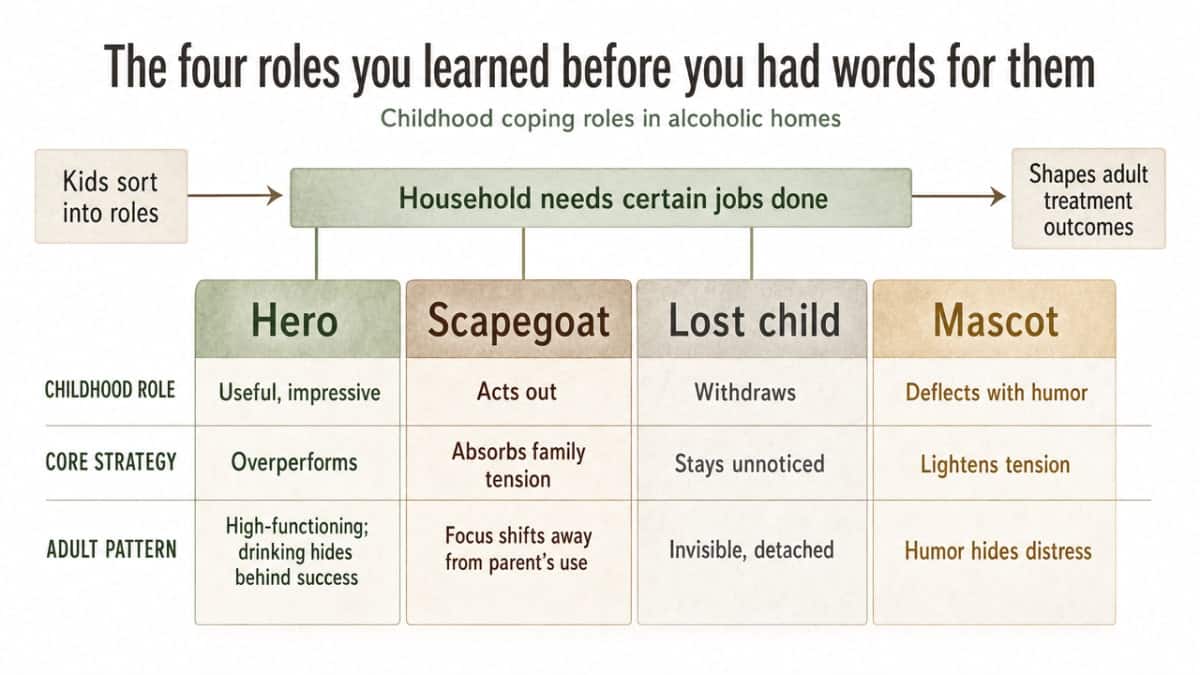
Kids in alcoholic homes tend to sort themselves into roles. Not because anyone assigns them, but because the household needs certain jobs done and the children figure out which one keeps them safest. Four of these roles come up again and again in the clinical literature and in family systems work: the hero, the scapegoat, the lost child, and the mascot.
The hero is the one who overperforms. Good grades, clean room, straight face at parent-teacher night. The hero learns that being useful and impressive is how you earn the right to exist in the room. In adulthood, the hero often looks high-functioning — the person whose drinking hides behind a promotion and a mortgage until it doesn’t.
The scapegoat is the one who acts out. This role absorbs the family’s tension by giving everyone something to focus on besides the parent’s use. Scapegoats often find substances early and get labeled the problem long before they have any say in the matter.
The lost child gets small. They stop asking for things. They spend a lot of time alone in their room, reading or drawing or just being invisible. In adulthood, the lost child can carry a deep isolation and an inability to name what they need — which makes drinking a private, quiet, extremely portable solution.
The mascot cracks jokes. They defuse the room. They learn that a laugh at the right moment can lower the temperature. As adults, mascots often use substances socially, in ways that look fine to everyone else, until the humor stops working and only the drinking is left.
Here’s why this matters for treatment. In a study of 124 adult children of alcoholics, overall treatment goal attainment did not differ based on whether participants met criteria for borderline personality disorder — but coping behaviors and the roles people had assumed did differentiate outcomes 7. Translation: the diagnostic label mattered less than the actual pattern of how you learned to cope. A program that reads your role and works with it will reach you in a way that a symptom checklist alone will not.
What trauma-informed dual diagnosis care actually treats
The framework: safety, trust, empowerment, integration
Trauma-informed care is a phrase that has been diluted by overuse. Any program can print it on a brochure. What it actually means, in the framework SAMHSA lays out in TIP 57, is a specific set of operating principles that shape how a program is built, not just what therapies get offered on Tuesday afternoon.
The first principle is safety. Physical safety, yes, but also emotional safety — the sense that you can say something true without being pathologized, punished, or handed a worksheet. For someone who grew up scanning a parent’s face for the temperature of the room, this is not a soft feature. It is the whole foundation. If you don’t feel safe in the space, the deeper work cannot happen, and you will do what you have always done: perform, disappear, or leave 1.
The second is trustworthiness, which shows up in small operational things — staff who do what they say they will do, schedules that don’t change without notice, consequences that are explained instead of imposed. If your childhood ran on unpredictable rules, predictable rules are medicine.
The third is empowerment. You get a say in your treatment plan. You are not managed; you are collaborated with. This matters for adult children of alcoholics because so many of you learned early that your preferences did not count.
The fourth, and the one standard rehab most often skips, is integration. Trauma-specific therapy is not a separate track you might get referred to after you finish the addiction program. It runs alongside the substance use work, because SAMHSA’s own guidance is clear that people with SUDs and untreated trauma histories have worse outcomes than those without trauma histories 2. Treating one and hoping the other resolves on its own is not the plan. Treating both, at the same time, is.
The therapies that reach the childhood layer
Inside a trauma-informed dual diagnosis program, the therapies you’ll encounter are not mysterious. They have names, evidence bases, and specific things they do well. What’s different is that they are aimed at the layer underneath the drinking, not just the drinking itself.
Eye Movement Desensitization and Reprocessing, or EMDR, is one you’ll hear about. It’s a structured, eight-phase therapy originally developed for PTSD, and it has been studied as an add-on to standard addiction treatment. The honest picture from the research is this: when EMDR is added to usual care for people with substance use disorders, patients show significant improvement in PTSD symptoms, dissociation, and general anxiety compared with usual care alone 12. A pilot study in addicted patients found EMDR led to significant reductions in PTSD and depressive symptoms — but not in the addiction symptoms themselves 13. So what does that mean for you? It means EMDR is not a magic wand that will stop your drinking. It is a tool that can quiet the parts of your history that keep making the drinking feel necessary. That is worth a lot, but it is not the same thing 11.
Cognitive behavioral therapy shows up too, but in a specific way for this population. Instead of only tracking triggers and building relapse-prevention skills, it works on the expectancies and coping schemas you inherited — the beliefs about what alcohol does, what feelings are safe, and what other people can be trusted with 8. These beliefs got installed young. You didn’t consent to them. Naming them out loud, with someone who knows what they’re listening for, starts to loosen their grip.
Group work in a trauma-informed program looks different from a standard rehab group too. The focus is not only on relapse stories and slogans. It includes work on the coping roles you brought in — the hero who cannot ask for help, the lost child who has never told anyone what it was actually like at home, the mascot who is exhausted from making everyone else comfortable. The dissertation research on ACOA treatment outcomes suggests that the specific coping patterns people arrived with mattered more for what happened next than whether they carried a particular diagnosis 7. Group is where those patterns get seen and, slowly, rewritten.
Repairing the attachment wound without waiting for your parent to change
There is a wound at the center of growing up with an alcoholic parent that no amount of sobriety alone will close. It is the attachment wound — the early learning that the person who was supposed to be steady was not, and that closeness came with a cost.
Attachment-based family work in adolescent substance use treatment has shown that repairing the parent-child bond can meaningfully support recovery 10. The research is in adolescents, and the mechanism is what matters here: relational repair, not just symptom reduction. For adult children, the repair usually does not happen with the parent who drank. Sometimes that parent is gone, still drinking, or unwilling to do the work. Sometimes the repair has to happen inside you — with the child you were, with the parts of yourself that never got to be small and safe.
Good family programming in an adult treatment setting does not require your parent to change for you to heal. It gives you the language, the boundaries, and the grief work to stop waiting. Waiting for the apology, waiting for the acknowledgment, waiting for the version of them who could have loved you the way you needed. That waiting has been part of what the drinking was for. When you stop waiting, something loosens.
What a treatment day looks like when the childhood story is on the table
A day in a trauma-informed dual diagnosis program does not feel like a boot camp, and it does not feel like a spa. It feels like a schedule that takes both of you seriously — the person who is trying to stop drinking and the kid who is still inside you, wondering if it’s safe here.
Mornings usually start with something that regulates the body before the mind gets asked to do anything hard. That might be breath work, a walk, or a check-in that includes how you slept. In programs that use biometric monitoring, sleep quality and heart rate variability from the night before become part of the conversation — not as surveillance, but as data that tells your clinician whether your nervous system is ready for deeper trauma work today or needs a lighter touch. If you slept two hours and your resting heart rate is elevated, this is not the morning to open a childhood memory.
Mid-morning is often individual therapy. This is where the childhood story gets specific. Not the sanitized version you’ve told at parties. The actual one — the Thanksgiving that ended early, the smell of the garage, the babysitter who noticed. In a trauma-informed setting, your therapist is trained to titrate. You go toward the memory, then back to the present, then toward it again, so nothing overwhelms the system that is already working hard 9.
Afternoons tend to hold group work and psychoeducation. Group is where you meet other people whose stories rhyme with yours. Psychoeducation is where someone finally explains why you flinch when a door closes too hard, and why the drink used to work so well. Two or three afternoons a week, you might do EMDR or another trauma-specific protocol 11. Family programming happens on its own track, usually once a week, and it does not require your parent to be in the room. Sometimes the most important family work is what you say to the empty chair.
Evenings are quieter. A meal, a reflection group, a phone call home if you have one to make. The day ends earlier than you might expect, because sleep is not optional when you are asking a nervous system to rewire itself. This rhythm is what integration actually looks like — the substance use work and the childhood work in the same schedule, on the same day, under the same roof 2.
Choosing a program that treats both problems as one
Questions to ask before you commit to a program
When you call an intake line, the person on the other end is trained to reassure you. That’s their job, and most of them mean it. Your job is different. Your job is to find out whether this program will actually treat the story you’re bringing, or whether it will treat the drinking and hope the rest sorts itself out.
A few questions cut through the marketing quickly.
Ask how trauma-specific therapy is integrated with the addiction work. Not whether it’s offered — whether it runs alongside, on the same schedule, with clinicians who talk to each other. TIP 57 makes the case that integrated care outperforms sequential care for people with trauma histories, and the difference shows up in the daily calendar, not the brochure 1.
Ask what happens when a session brings up something big. Is there a plan for the rest of that day, or do you go straight from an EMDR reprocessing session to a relapse-prevention group with no bridge in between?
Ask whether family programming requires your parent to participate. It shouldn’t. Good family work in an adult setting can happen with or without the family of origin in the room 10.
Ask about the clinical team’s experience with adult children of alcoholics specifically. Not “trauma” as a general category — the specific pattern of growing up in an alcoholic home. If the answer is vague, keep calling.
Ask what the assessment covers on day one. Coping roles, family history, and attachment patterns should be part of it, not just a substance-use inventory 7.
Starting somewhere different than where you started
You did not choose the house you grew up in. You did not choose the drinking that shaped it, or the roles you took on to stay safe inside it. Those were assigned to you before you had any say.
What you can choose now is where the next part starts. Not from the kitchen table you remember. Not from the version of yourself who learned to read a room before you learned to read. From a place that knows what you’re carrying and has been built to help you set some of it down.
That is what a call to Sunflower is for. Not a sales pitch. A conversation about what treatment might look like when the childhood story is on the table alongside the drinking — when both problems get treated as one, because that is what they always were.
You can call to talk about starting somewhere different than where you started. That is the interruption. That is the sentence that ends one story and opens the next.
Start Breaking the Cycle—Reach Out Today
Connect with someone who understands generational patterns and will help you take your first step forward.
Frequently Asked Questions
Is addiction treatment for adult children of alcoholics different from standard rehab?
Yes, in the parts that matter most for you. Standard rehab focuses on stopping the substance use. Trauma-informed dual diagnosis care treats the substance use and the childhood story on the same schedule, with clinicians who talk to each other. SAMHSA’s own guidance notes that people with SUDs and untreated trauma histories have worse outcomes without integrated care 2.
Do I need a formal PTSD diagnosis to qualify for trauma-informed dual diagnosis care?
No. Trauma-informed care is a framework, not a diagnosis-gated service. SAMHSA’s TIP 57 describes it as a way of organizing the whole program around safety, trust, and integration, whether or not you meet PTSD criteria 1. Many adult children of alcoholics carry complex, subclinical trauma that never gets a formal label. You still qualify. You still need it.
I’ve tried AA and standard rehab before and it didn’t stick. Does that mean I’ll fail again?
No. It usually means the treatment did not reach the layer that was actually driving the drinking. If your family history was never on the table, you were working against a nervous system nobody helped you understand. Research on ACOA outcomes suggests the specific coping patterns you bring in matter more than diagnostic labels for what happens next 7. Different approach, different chance.
Will I have to talk to or confront my alcoholic parent as part of treatment?
No. Good family programming in an adult setting does not require your parent’s participation. The relational repair can happen inside you, with the child you were, without waiting for an apology that may never come. Attachment-based work supports recovery through relational healing, and while much of that research is in adolescents, the mechanism translates: the repair does not depend on the other person changing 10.
Does EMDR actually help with drinking or drug use, or just the trauma symptoms?
Honestly, mostly the trauma symptoms. Studies of EMDR added to standard SUD treatment show significant improvements in PTSD, dissociation, depression, and anxiety, but pilot data has not shown direct reductions in addiction symptoms themselves 13, 12. That is still valuable. Quieting the trauma often removes the pressure that made drinking feel necessary, even if EMDR is not the piece doing the substance-use work.
How do I know if a program is really trauma-informed or just uses the label?
Look at the daily schedule, not the brochure. Ask whether trauma-specific therapy runs alongside the addiction work or gets bolted on later. Ask how the team handles a session that surfaces something big. Ask what assessment covers on day one — coping roles and family history should be in it, not just a substance-use inventory. TIP 57 principles show up in operations, not marketing 1.
References
- TIP 57: Trauma-Informed Care in Behavioral Health Services. https://www.samhsa.gov/resource/dbhis/tip-57-trauma-informed-care-behavioral-health-services
- Trauma-Informed Care in Behavioral Health Services (Full TIP 57 PDF). https://library.samhsa.gov/sites/default/files/sma15-4912.pdf
- Trauma-Informed Approaches and Programs. https://www.samhsa.gov/mental-health/trauma-violence/trauma-informed-approaches-programs
- Associations between adverse childhood experiences and substance use: A meta-analysis. https://pubmed.ncbi.nlm.nih.gov/37689565/
- Adverse childhood experiences (ACEs) and substance use disorder (SUD): A scoping review. https://pubmed.ncbi.nlm.nih.gov/33561668/
- Association of adverse childhood experiences (ACEs) and substance use disorders (SUDs) in a multi-site safety net healthcare setting. https://pmc.ncbi.nlm.nih.gov/articles/PMC7752652/
- Adult Children of Alcoholics: Treatment outcomes as related to borderline personality disorder diagnosis. https://digitalcommons.unl.edu/dissertations/AAI9004677/
- A cognitive model for the intergenerational transference of alcohol problems. https://pubmed.ncbi.nlm.nih.gov/19783372/
- TIP 57 Trauma-Informed Care in Behavioral Health Services (Alternate PDF). https://library.samhsa.gov/sites/default/files/sma14-4816.pdf
- Attachment-Based Family Therapy for Adolescent Substance Use. https://pmc.ncbi.nlm.nih.gov/articles/PMC7025563/
- Eye Movement Desensitization and Reprocessing (EMDR) Therapy: An Overview. https://pmc.ncbi.nlm.nih.gov/articles/PMC7839656/
- EMDR as Add-On Treatment for Psychiatric and Traumatic Symptoms in Patients with Substance Use Disorder. https://pmc.ncbi.nlm.nih.gov/articles/PMC5768622/
- Treating Trauma in Addiction with EMDR: A Pilot Study. https://pubmed.ncbi.nlm.nih.gov/25188700/