
Key Takeaways
- Kansas caregivers most often lean on wine, kratom, gray-market cannabis, and prescription pain medications — patterns tied to caregiving load, not personal weakness 9, 10.
- Adult and elder caregivers form a distinct clinical group, averaging 23.7 hours of care weekly, with 27% reporting trouble finding affordable local services 6.
- Kansas offers layered respite coverage — KDADS Family Caregivers, K-RAD for dementia, and county scholarships like Butler County’s — so treatment doesn’t require abandoning the person you care for 3, 4, 5.
- Start by calling Carelon Behavioral Health of Kansas at 1-866-645-8216, option 2, for a substance use assessment that matches residential, PHP, or IOP to your caregiving schedule 2.
The Second Glass After They Fall Asleep
You already know the shape of your evenings. Dinner cleared. Meds counted out for morning. Baby monitor angled just right so you can hear if she gets up. And then, somewhere between 9 and 10 p.m., the second glass. Or the kratom. Or the leftover hydrocodone from her last hip flare-up that you told yourself you’d throw out.
You are not a bad person. You are a person carrying something enormous, mostly alone, and you found a thing that takes the edge off for forty-five minutes before bed. That’s not a character flaw. That’s a pattern researchers can measure, and one they’ve been measuring more carefully in the last few years as caregiving loads have gotten heavier and quieter 7.
This article is written for you specifically — a Kansan caring for an aging parent, a spouse after a stroke, a disabled adult child, a sibling with a progressive illness. Not the parent of a toddler. The substances are different. The guilt is different. The way out is different, too.
Here’s what you need to hear first: you can get help without abandoning the person who depends on you. Kansas has a specific set of programs — some state, some county — designed to cover care while you step away. Most caregivers have never been told they exist. That’s what the next few sections are going to walk you through.
You’re not the only one pouring the second glass. And you’re not stuck with it. Both of those things are true at the same time.
What Caregiver-Driven Substance Use Actually Looks Like
The Substances Kansas Caregivers Actually Reach For
Let’s name them, because vague language protects shame and keeps you stuck.
The most common one is wine — usually after the person you care for is finally asleep, usually between two and four glasses, usually poured a little heavier each month. It’s the socially acceptable coping tool, which is exactly why it’s the hardest to see clearly. Research on U.S. women caregivers found that more frequent alcohol misuse strengthens the link between financial hardship and psychological distress — meaning the drinking doesn’t just take the edge off, it deepens the mental health hit when money is tight 10. If you’ve been drinking more since your mom moved in, or since your husband’s disability paperwork started, that’s not a coincidence.
Then there’s kratom, often from a gas station or a smoke shop off K-7 or I-70. It gets marketed as a natural energy or pain aid, and it slots neatly into the exhausted-but-can’t-stop routine of caregiving. It’s also physically addictive in ways most people who start using it don’t expect.
Cannabis is the third — usually edibles or a vape pen, usually for sleep. In states like Kansas where recreational cannabis isn’t legal, this often means gray-market product from a friend or a trip across the Missouri line.
And then there are the prescription pain medications — sometimes your own, sometimes the ones prescribed to the person you care for. Researchers have specifically flagged family caregivers as a group at high risk of prescription pain medication misuse, because physical pain is a huge and under-treated part of the caregiving experience 9. Your back hurts. Your knees hurt. There are pills in the house. The math writes itself.
Why Adult and Elder Caregivers Are a Different Clinical Population
A lot of articles about caregiver stress lump you in with the parent of a colicky newborn or the mom of three kids under ten. That’s a mistake, and it’s part of why the advice you’ve been reading hasn’t fit your life.
Caring for an adult — a parent with Parkinson’s, a spouse after a stroke, a sibling with early-onset dementia, an adult child with a developmental disability — is a different job with a different shape. The care recipient often used to take care of you. There’s grief woven through every task. The end point is rarely graduation or independence; more often it’s a nursing home decision or a funeral. The shame you carry about your own coping is shaped by that grief, not by exhaustion alone.
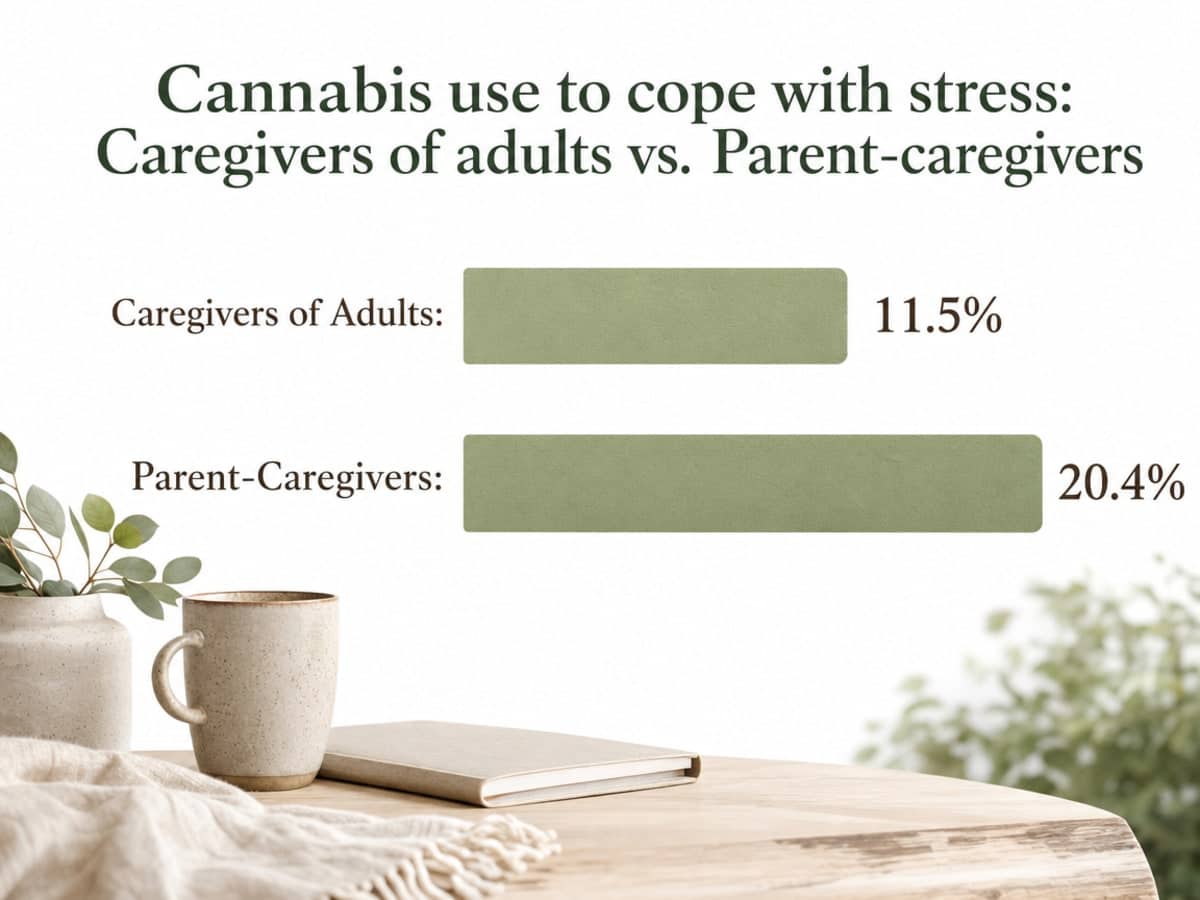
The substances line up differently, too. In a 2026 study of caregiver coping, 11.5% of caregivers of adults reported using cannabis in the past 30 days to manage stress, compared with 20.4% of parent-caregivers 8. That’s a self-reported behavior measure from a specific study window, not a Kansas prevalence rate — but the direction matters. Adult and elder caregivers, on average, reach for cannabis less often than parents do. What they reach for more, based on the broader research, is alcohol after hours 10and prescription pain medications tied to their own aging bodies and the medicine cabinets already in the house 9.
The integrative review on caregiver burden in substance-use contexts found that anxiety, depression, stigma, and the physical and emotional toll on the caregiver show up as moderate to severe in most measured populations 7. This isn’t stress. It’s a documented clinical pattern with a name.
That matters for treatment. A program built around a 30-year-old parent of toddlers won’t map to your life. A program that understands you are 52, that your mother lives in your guest room, that you haven’t slept eight hours in two years — that’s a different conversation.
What the Load Actually Looks Like in Kansas Homes
You probably don’t count the hours. Most caregivers don’t. But if you did, the number would land somewhere close to the national average for caregivers of adults: 23.7 hours a week 6. That’s a part-time job you never applied for, on top of whatever else you do — a shift at the hospital, a bookkeeping gig, watching grandkids on Saturdays, holding a marriage together.
And 23.7 is just the average. About 21% of caregivers of adults are giving more than 40 hours a week 6. That’s a full-time job with no clock-out, no weekends, no PTO. If that’s you — if you can’t remember the last uninterrupted night of sleep, if you eat standing up, if you’ve stopped answering texts from friends because you don’t have the bandwidth to explain — you’re in that top tier. That’s not weakness. That’s math.
Here’s the other number that matters: 27% of caregivers say it’s hard to get affordable services in the area where the person they care for lives 6. In rural Kansas, that percentage almost certainly runs higher. If you live in Miami County or out toward Chanute or up near Marysville, you already know. The adult day program is 45 minutes away. The one home health aide who was reliable retired. The waiting list for the county respite slot is longer than the county newsletter.
So when someone says “you just need to ask for help,” what they mean is: ask a system that’s already stretched thin, in a state where a quarter of caregivers can’t find affordable services even when they know exactly what they need. That’s not a solution. That’s a shrug.
The load you’re carrying is real, it’s measurable, and it’s heavier than most of the people around you understand. The drinking, the kratom, the pills — those aren’t signs that you’re weak. They’re the predictable result of asking one person to do the work of three, in a rural state, with a shrinking safety net, for years at a time.
Naming that out loud is not self-pity. It’s the first honest sentence in a conversation you’ve been avoiding.
The Guilt of Stepping Away Is a Clinical Problem, Not a Character Flaw
Here is the sentence you’ve probably said to yourself, some version of it, more than once: I can’t leave. She needs me. Nobody else knows how she takes her pills, how she gets in and out of the shower, which sounds mean she’s about to fall.
That sentence feels like love. It also functions, right now, as the wall between you and treatment.
The guilt is not a personal quirk. In the research on caregiver burden in substance-use contexts, stigma and self-blame show up as measured attributes, not soft ones — right alongside anxiety, depression, and the physical and emotional toll on the caregiver’s own body 7. In other words, the shame you feel about your drinking, and the shame you feel about even considering stepping away, are documented parts of the same clinical picture. They aren’t evidence that you’re weak. They’re symptoms of the load.
Getting help is not the opposite of caregiving. It is caregiving, aimed at the one person in the house nobody’s been watching.
Say that again, slowly, before you keep reading. The next section is about what actually happens to her while you go.
What Happens to the Person You Care For While You Get Help
The Kansas Respite Infrastructure Most Caregivers Have Never Been Told About
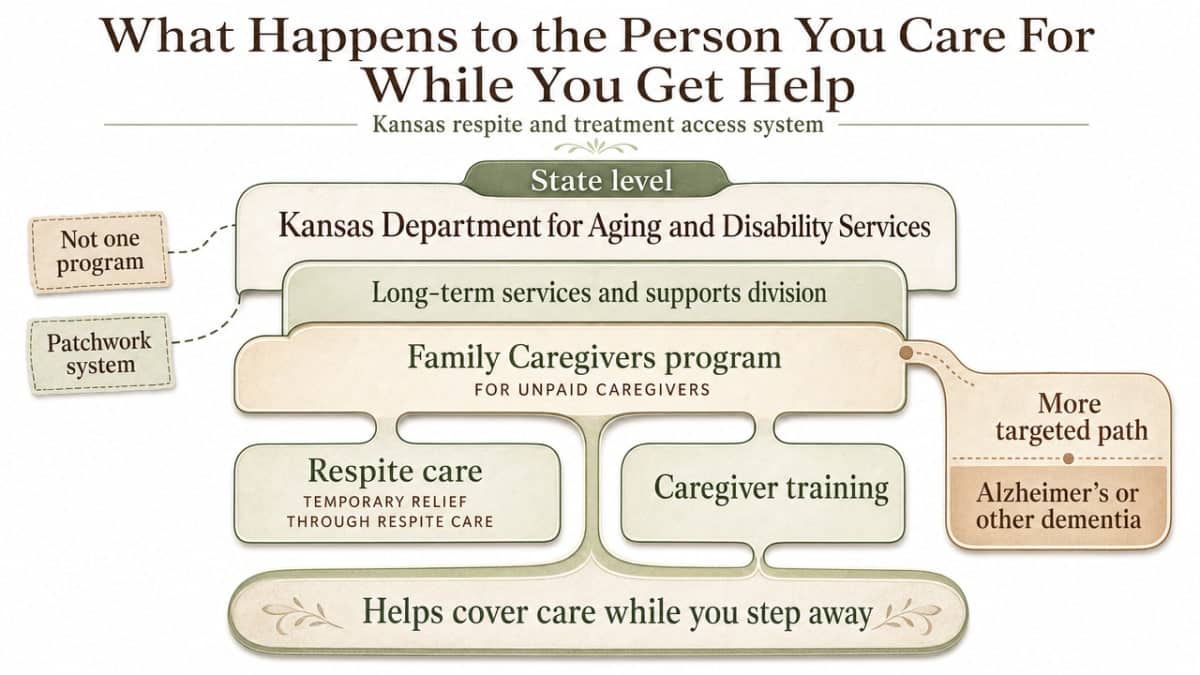
Here is the part nobody explained to you: Kansas has an actual system for covering the person you care for while you step away. It’s not one program. It’s a patchwork, which is why it’s easy to miss. But once you can see the pieces, you can put them together.
Start with the state level. The Kansas Department for Aging and Disability Services runs a Family Caregivers program under its long-term services and supports division, aimed specifically at giving unpaid caregivers temporary relief through respite care and caregiver training 3. That’s the umbrella. It exists because the state already knows what you know: unpaid caregivers can’t do this forever without help.
If the person you care for has Alzheimer’s or another dementia, there’s a more targeted option. The Kansas Respite for Alzheimer’s & Dementia Program, called K-RAD, is designed for family caregivers who have limited access to other supports. Its stated purpose is to provide relief to unpaid caregivers of someone with a probable diagnosis of Alzheimer’s or a related dementia 4. If your mother has been forgetting the stove, if your husband no longer recognizes the grandkids some afternoons, this is written for you.
Then there’s the county layer. Butler County, for example, runs a caregiver support program that offers respite scholarships to caregivers of adults 60 and older, and those scholarships can pay for in-home respite, overnight care in a facility, or adult day care 5. Not every county has something this developed, but many have some version — an aging council, a scholarship pool, a volunteer network. The pieces are uneven, but they exist.
And for the treatment side, Kansas centralizes access through Carelon Behavioral Health of Kansas. To schedule a substance use assessment or find providers in your area, you call 1-866-645-8216 and select option 2 2. One phone call opens the door.
None of this replaces you. It buys you the time to get well enough to keep being there. That’s the trade — not abandonment, coverage.
Matching Level of Care to Caregiving Hours You Need to Backfill
Treatment in Kansas isn’t one door. It’s three, and each one asks a different amount of you to be away.
A 60-day residential program is the most intensive option. You live on-site. Someone else cooks, someone else keeps the schedule, someone else sits with you at 2 a.m. when the withdrawal makes your skin crawl. For those 60 days, your caregiving hours — whether you were giving 23 a week or 40-plus — need to be covered by someone or something else 6. That’s where K-RAD, KDADS respite, and county scholarships do their heaviest work. Combined with a sibling stepping up, a paid aide, or a short-term placement in an assisted living facility, 60 days is doable. Hard, but doable.
A Partial Hospitalization Program, or PHP, is the middle door. You’re in structured treatment most of the day, most weekdays, and home in the evenings and on weekends. This maps well to a caregiver who has some help during business hours — a day program, an aide, a sibling who works nights — but who is still the primary person overnight.
An Intensive Outpatient Program, or IOP, is the lightest lift on your calendar. Typically three sessions a week, three hours each, often in the evenings. If a family member can cover three evenings a week, or if the person you care for is stable enough to be alone for a few hours, IOP fits.
Here’s the part most people get backwards: picking IOP because it fits your caregiving load is not settling for less treatment. It’s making a clinical decision based on your actual life. The assessment through Carelon or directly with a provider will tell you what level of care matches your substance use pattern 2. Your job is to bring the caregiving math into that conversation honestly — hours per week, who else is available, which respite programs the person you care for qualifies for — so the plan you build is one you can actually keep.
Treating the Depression, Anxiety, and Pain Underneath
The wine, the kratom, the pills — none of them are the actual problem. They’re the thing you found to manage the actual problem. Which is why programs that only address the substance, and donon’t touch what’s underneath it, tend not to hold for caregivers.
What’s underneath, for most people in your spot, is some combination of three things. There’s depression — the flat, gray kind that comes from watching someone you love lose ground, month after month, with no version of the story that ends well. There’s anxiety — the kind that keeps you scanning for the next fall, the next infection, the next phone call from the day program. And there’s physical pain — your back from the lifting, your neck from sleeping half-upright in a chair, the migraines that started sometime around year two.
The research names all three. The integrative review on caregiver burden in substance-use contexts found that anxiety, depression, and the effect on the caregiver’s own physical and emotional health show up as measured, moderate-to-severe attributes — not soft complaints 7. The pain piece has its own literature: family caregivers of older adults show high prevalence of physical pain, and that pain is a major contributor to caregiving difficulty and to prescription pain medication misuse 9.
This is what dual diagnosis means, in plain terms. It means treating the drinking and the depression at the same table, with the same clinical team, instead of sending you to one place for one and a different place for the other. It means somebody asking about your back before they ask about the wine, because they know the two are related. It means trauma-informed care that understands the grief of watching a parent disappear is not a side issue — it’s the engine.
If you get treatment that only pulls the substance out and leaves the depression and the pain in place, you already know what happens. You go home to the same house, the same monitor on the nightstand, the same 2 a.m. wake-ups. The reason you started drinking is still sitting there in the guest room. Recovery that lasts has to include what to do with that reason — not just the coping tool you built on top of it.
How to Actually Start: The Kansas Access Map
If you’ve read this far, you already know something has to change. Here is what starting actually looks like, in order, so you don’t have to figure it out at 11 p.m. after another glass.
- First call: Carelon Behavioral Health of Kansas at 1-866-645-8216, option 2. That’s the state’s centralized line for scheduling a substance use assessment and finding providers in your area 2. The assessment is the thing that tells you which level of care — residential, PHP, or IOP — actually matches what you’re using and how much. You don’t need to have decided anything before you call. You just need to answer honestly.
- Second call, either before or after the first, depending on your situation: the respite program that fits the person you care for. If they have dementia, ask about K-RAD through KDADS 4. If they don’t, ask about the KDADS Family Caregivers respite program 3. If you’re in a county with its own caregiver support office — Butler County is one example, but not the only one — ask about local respite scholarships that can pay for in-home coverage, adult day care, or overnight facility care 5.
- Third: if you want a private treatment provider that accepts commercial insurance and can build a plan around your caregiving schedule, Sunflower Recovery Center in Osawatomie is a direct option. Call and ask specifically how treatment can work around caregiving. That’s the sentence. Not “do you have openings.” Ask them to walk you through what residential, PHP, and IOP would each require of you week by week, and bring the respite programs you’ve already contacted into the conversation.
If you’re not ready for a Kansas-specific call yet, SAMHSA’s national helpline — 1-800-662-HELP — is free, confidential, and open around the clock 11. Some people need one warm-up call to a stranger before they can make the local one. That counts as starting.
You don’t have to do all of this today. You have to do one thing today.
Talk With Someone Who Understands Caregiver Stress
Get support planning treatment that fits your caregiving responsibilities and daily life.
Frequently Asked Questions
Can I get addiction treatment in Kansas without putting my parent in a nursing home?
Yes. That’s the assumption most caregivers walk in with, and it’s usually wrong. Kansas has respite programs — including KDADS Family Caregivers respite and county-level scholarships like Butler County’s — designed to cover in-home care, adult day care, or short-term facility stays while you’re in treatment 3, 5. A permanent nursing home placement is one option, not the default. Ask about respite before you assume the worst.
What happens to the person I care for if I go to residential treatment for 60 days?
Coverage gets built in layers. A sibling or adult child takes some hours. A paid aide or an adult day program takes others. Kansas respite programs — K-RAD for dementia caregivers, KDADS Family Caregivers respite otherwise — help pay for the gap 3, 4. Short-term stays in an assisted living facility exist for exactly this purpose. It takes planning, and it takes a phone call or two. It’s not one person replacing you. It’s a temporary schedule replacing you.
How do I get a substance use assessment in Kansas if I’ve never done this before?
Call Carelon Behavioral Health of Kansas at 1-866-645-8216 and select option 2. That’s the state’s centralized number for scheduling an assessment and getting matched with providers in your area 2. You don’t need to know your diagnosis, your insurance details, or your treatment preference before you call. The assessment is what tells you which level of care fits. You just need to answer honestly.
Is kratom or nightly wine really a problem if it’s the only way I’m getting through the day?
The fact that it’s the only way you’re getting through is the problem, not the answer to it. Research on caregivers found that more frequent alcohol misuse strengthens the link between financial hardship and psychological distress — meaning the drink that helps tonight deepens the depression tomorrow 10. Kratom is physically addictive, and it doesn’t stay at the same dose. If you’ve been hiding it, or increasing it, that’s your answer.
What if my caregiving includes dementia care — are there respite programs specifically for that?
Yes. The Kansas Respite for Alzheimer’s & Dementia Program, called K-RAD, exists specifically for family caregivers of someone with a probable diagnosis of Alzheimer’s or a related dementia 4. It’s designed for unpaid caregivers with limited access to other supports, which describes most people in your position. Ask KDADS about K-RAD by name when you call. It’s the most direct match for what you’re carrying.
How do I talk to my family about needing treatment when I’m the one everyone leans on?
Start with the facts, not the feelings. Tell them what you’re using, how often, and for how long — the honest version, not the softened one. SAMHSA publishes a family handbook that gives you language for this conversation, and their helpline at 1-800-662-HELP is a free, confidential warm-up call before you dial family 11. Expect some of them to react badly at first. Most come around once they see the coverage plan.
References
- Behavioral Health Licensing | Department for Aging and Disability Services. https://www.kdads.ks.gov/licensing-policy/behavioral-health-licensing
- Substance Use Disorder Treatment Services – KDADS. https://www.kdads.ks.gov/services-programs/behavioral-health/services-and-programs/substance-use-disorder-treatment-services
- Family Caregivers | Department for Aging and Disability Services – Respite for Caregivers. https://www.kdads.ks.gov/services-programs/long-term-services-supports/ltss-training-resources/respite-for-caregivers/family-caregivers
- Respite for Alzheimer’s & Dementia Program | Department for Aging and Disability Services. https://www.kdads.ks.gov/services-programs/aging/alzheimer-s-disease-and-dementia/respite-for-alzheimer-s-dementia-program
- Caregiver Support | Butler County, KS – Official Website. https://www.bucoks.gov/143/Caregiver-Support
- Caregiving in the U.S. 2020 (HRSA-hosted report PDF). https://www.hrsa.gov/sites/default/files/hrsa/advisory-committees/nursing/reports/report-caregiving-us-2020.pdf
- An Integrative Review of Measuring Caregiver Burden in Substance Use Disorder. https://pubmed.ncbi.nlm.nih.gov/32496400/
- Table 2 (caregiver substance use outcomes in recent caregiving research). https://pmc.ncbi.nlm.nih.gov/articles/PMC12936370/table/table2-30495334261426511/
- Prescription Pain Medication Misuse Among Family Caregivers: A Call to Action. https://pubmed.ncbi.nlm.nih.gov/40129349/
- The price of care: alcohol misuse as a moderator of financial hardship and mental health outcomes of U.S. women caregivers. https://pubmed.ncbi.nlm.nih.gov/41593387/
- Helping a Loved One Dealing with Mental and/or Substance Use Disorders: A Handbook for Families. https://www.samhsa.gov/sites/default/files/samhsa_families_family_support_guide_final508.pdf