
Key Takeaways
- Remote work in Kansas City removes the everyday friction — commutes, coworkers, shared spaces — that once interrupted problem drinking or pill use before it escalated.
- Local overdose data shows 80% of Kansas-side overdose deaths from 2020-2023 happened at a residence, making the home office the room where help most often arrives too late 13.
- Intensive outpatient and telehealth care layer onto a remote workday through evening groups, individual therapy, and medication visits, with engagement outcomes comparable to in-person treatment 2, 7.
- Before calling, compare levels of care (IOP, PHP, residential), whether medication for opioid or kratom dependence is offered via telehealth, and how commercial insurance coverage applies.
Camera Off, Glass Full: What Remote Work Actually Hides
If you’re reading this at your desk with the camera off, a drink or a pill within arm’s reach and a meeting starting in eleven minutes, you already know something is off. That awareness is worth listening to. It doesn’t mean you’re weak, dramatic, or beyond help. It means the quiet, private version of your workday has started to include something you wouldn’t do if a coworker could see you.
Remote work didn’t invent addiction. What it did was remove the small, boring frictions that used to catch problem use early. No commute means no forced sober window between the last pour and the first email. No shared kitchen means no one notices you’re on your third refill by 2 p.m. No hallway means no one smells anything on your breath. The camera-off, mute-on rhythm of a Kansas City home office — whether that’s a bungalow in Waldo, a downtown loft near the Crossroads, or a spare bedroom in Overland Park — lets a serious problem look, from the outside, like a normal Tuesday.
Here’s what this page is for. You don’t have to decide today whether you have a disorder, whether you need residential care, or whether you can tell your spouse. You just need honest information about what remote work is doing to your risk, what treatment actually looks like when you don’t have a physical office to disappear from, and how to make one phone call without your calendar giving you away.
Why Your Home Office Became the Riskiest Room
The Erosion of Everyday Friction
Think about what an old-school office day forced on you. A drive home before you could pour anything. A shared bathroom, a shared break room, coworkers close enough to notice glassy eyes or a slur at 3 p.m. A boss who walked by your desk. None of that was designed to catch problem drinking or pill use, but it did. It slowed you down. It added witnesses.
Your home office removes all of it. The bottle is in the kitchen, twelve steps from your chair. The kratom is in the drawer under the monitor. A delivery app can put a fresh handle at your door before your 4 p.m. meeting ends. Muting a call takes one click. Turning the camera off takes another. If you have a door, you have a private room. If you live alone, the whole house is one.
None of that means you’re doing something wrong by working from home. It means the small, boring checks that used to interrupt use aren’t there anymore. When people say remote work is isolating, this is part of what they mean — not just loneliness, but the absence of anyone standing between you and the next drink or dose.
What the Research Says About Remote Work and Substance Use
You deserve the honest version of this, not a scare pitch. Two studies matter most for what you’re going through.
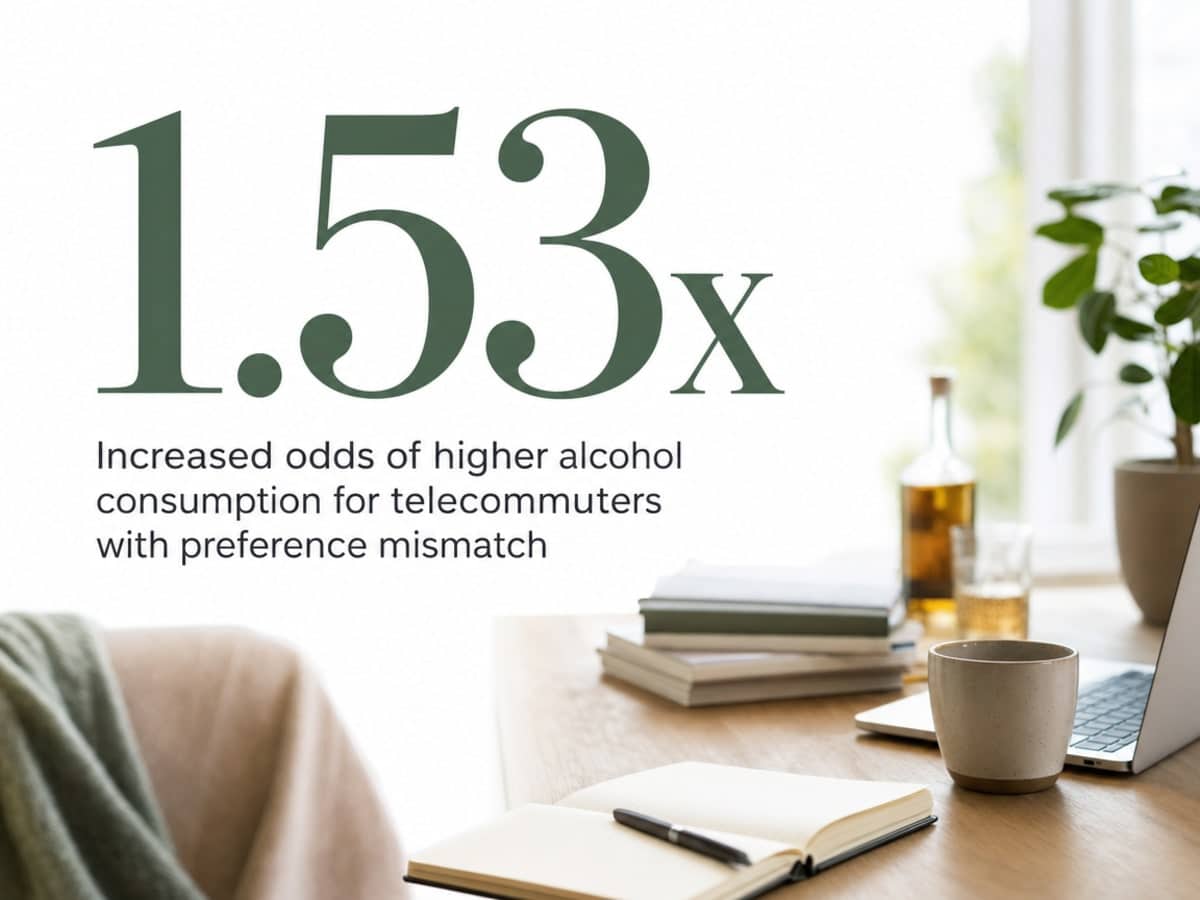
The first is a Japanese occupational health survey of more than 20,000 employees during the COVID-19 pandemic. Workers who telecommuted at least once a week had 29% higher odds of increased drinking (OR 1.29). For employees who were telecommuting even though they didn’t want to be — forced remote, preference mismatched to practice — the odds jumped to 53% higher (OR 1.53) 1. Two limits worth naming in the same breath: it’s Japan, and it’s the pandemic. You are not a data point in that study. But the pattern — that involuntary isolation drives coping more than voluntary flexibility does — is one you may recognize in yourself.
The second is a 2025 longitudinal study that pushed back on the simple story. Employees working from home did report 28% more drinking episodes and 26% more heavy episodic drinking than other workers. But when researchers followed the same people over time, changing their remote days didn’t change their drinking 11. Translation: the setting isn’t the villain. It’s the cover. People who are already vulnerable — to trauma, anxiety, pain, boredom, a family history — find that a home office lets the use grow without a chaperone.
That’s a more useful truth than “remote work is bad.” If the arrangement isn’t causing the problem, changing the arrangement won’t solve it. Treatment addresses the vulnerability underneath. The home office just stops hiding it.
Kansas City, Home, and the Overdose Map
Here’s the part of the picture that changes the stakes locally. On the Kansas side of the Kansas City Metro, health officials recorded 724 overdose deaths between 2020 and 2023. Sixty-eight percent involved an opioid. Eighty percent happened at a residence 13. Missouri-side patterns look similar.
The privacy of working from home is real, and for a lot of people it’s a genuine relief. Fewer eyes, less commute, more control over your day. That same privacy is what makes the room dangerous when use escalates. There’s no one to notice a longer pause between messages. No one to find you if a pill was stronger than the last one. Especially if what you’re using contains fentanyl and you don’t know it — and increasingly, in this metro, it does.
This isn’t meant to frighten you into a decision tonight. It’s meant to name what the map already shows: home is now the room where help most often arrives too late.

The Specific Behaviors You Already Recognize
You probably don’t need a screening quiz. You need someone to say the quiet parts out loud so you can stop wondering if you’re overreacting. Here are the patterns remote workers in Kansas City describe when they finally call.
- The 11 a.m. pour. Not a lunch drink, not a happy hour — a first drink timed to a lull between meetings, in a coffee mug so the color doesn’t show on camera. The mid-afternoon kratom or 7-OH dose to reset before a 3 p.m. standup, because the morning dose is wearing off and the withdrawal edge is starting to show in your voice. A benzo before a hard 4 p.m. conversation with your manager, framed in your head as “taking the edge off” instead of what it is.
- The delivery app that knows your address better than your parents do. Refills that arrive between meetings so no one at home sees the bag. A second phone or a second account for the dispensary, the smoke shop, the liquor store that delivers past 9 p.m. A drawer, a cabinet above the fridge, a bag in the garage — a small geography of hiding places inside your own house.
- The camera-off default. The mute button used to take a sip, a bump, a hit. The Slack status set to “in a meeting” when you’re actually lying down. The calendar block labeled “focus time” that is really recovery time from last night. Sunglasses on a video call because your eyes give you away.
- The social math. You have stopped seeing the friends who would notice. You decline the in-office days when you can. You’ve started drinking alone because drinking with people has become logistically inconvenient. If you live with a partner, you’ve gotten good at timing use around their schedule — the walk to the mailbox, the school pickup, the shower.
None of this makes you a bad person. It makes you someone whose coping has outgrown its container. If you recognized yourself in more than two of these, that’s not a diagnosis — it’s information. And it’s enough to make one call.
What Treatment Looks Like When You Work From Home
A Treatment Week Layered Onto a Remote Workday
You don’t have to blow up your job to get help. That’s the first thing worth knowing. An intensive outpatient program is designed for exactly the life you’re living — work during the day, treatment in the evening or in structured blocks around your calendar.
A typical week might look like this. Monday, Wednesday, and Thursday evenings you log in to a group session from 6 to 9 p.m. — three hours of clinical group work with people who are dealing with the same things you are. During the workday, nothing on your calendar changes. You take your meetings. You ship your work. You eat lunch.
One weekday afternoon, you have an individual therapy session — usually an hour, often bookable at 4 or 5 p.m. so it lands after your last meeting. Once a week or every other week, you meet with a psychiatric provider to check on medications, sleep, and mood. If you need medication for opioid or alcohol use disorder, that visit is where it’s managed.
Add a Saturday morning group or a family session for the people who live with you, and you have a full clinical week. Your work calendar sees a few blocks labeled “appointment” or “personal.” No one needs a diagnosis. You are not asking for time off. You are using the flexibility you already have — the same flexibility that let the problem grow — to build the structure that reverses it.
Does Virtual and Hybrid IOP Actually Hold Up Around a Job?
The honest answer is yes, and the numbers are stronger than most people expect.
A recent review of telehealth outpatient programs for substance use and co-occurring mental health conditions found roughly 80% engagement at 30 days, with 91% of participants attaining 30 consecutive days of abstinence 2. Those outcomes are comparable to traditional in-person programs. In other words: getting your care through a screen — or a mix of screen and in-person visits — does not water down the clinical result.
Engagement is often better with telehealth, not worse. One large analysis of substance use treatment during the telehealth expansion found that having an early video visit was associated with a lower risk of dropping out (OR 0.64) and much higher odds of staying engaged (OR 5.40) compared with in-person-only care. Even audio-only visits improved engagement (OR 2.12) 7. If your bar for calling was “I have to be able to actually go to the appointments,” the data says telehealth makes that easier, not harder.
There’s a reason this matters for you specifically. The most common reason people quit outpatient treatment isn’t willpower — it’s logistics. A commute across the metro after a full workday. A no-show fee after a meeting ran long. A group that starts at 5:30 when your team is on the East Coast. Remove those frictions and people stay. The flexibility that let the drinking hide is the same flexibility that lets treatment stick.
When IOP Isn’t Enough: Residential, PHP, and Stepping Up
Sometimes an evening group and a weekly therapist can’t hold what’s happening. That’s not a failure — it’s information. If you’re drinking through withdrawal at your desk, using opioids or benzos daily, or the home environment itself is what keeps triggering use, IOP alone is not the right starting point.
Sunflower offers a continuum for exactly this reason. Residential care is a 60-day program in Osawatomie where you step out of the home office entirely and into a structured environment — medically supervised, trauma-informed, and set up to address the mental health conditions underneath the use. A Partial Hospitalization Program sits in the middle: full clinical days without an overnight stay. IOP is the least disruptive tier, the one that layers onto a remote job most cleanly.
Most people don’t stay in one tier the whole way. You might start residential, step down to PHP for a few weeks, and finish in IOP while you return to work. Or begin in IOP and step up if the first month tells the clinical team you need more support. The point is that the level of care can move with you. Your job doesn’t have to know which tier you’re in — only that you’re taking care of a medical need on your own time.
Opioids, Kratom, and the Medication Question
If what you’re using is opioids, kratom, or 7-OH, the treatment conversation is different from the alcohol one — and honestly, better than it used to be. There is medication that can stop the withdrawal, quiet the craving, and let you sit through a workday without counting minutes to your next dose. Buprenorphine is the most common one for opioid use disorder, and it now works for kratom and 7-OH dependence too, because the underlying receptor story is similar enough that the medication does its job.
The part that matters for your situation: you can start it through telehealth. Federal telemedicine flexibilities have allowed qualifying practitioners to prescribe buprenorphine for opioid use disorder via telehealth, including in some cases by phone evaluation 14. That means the first visit doesn’t have to be an in-person appointment you have to explain on your calendar.
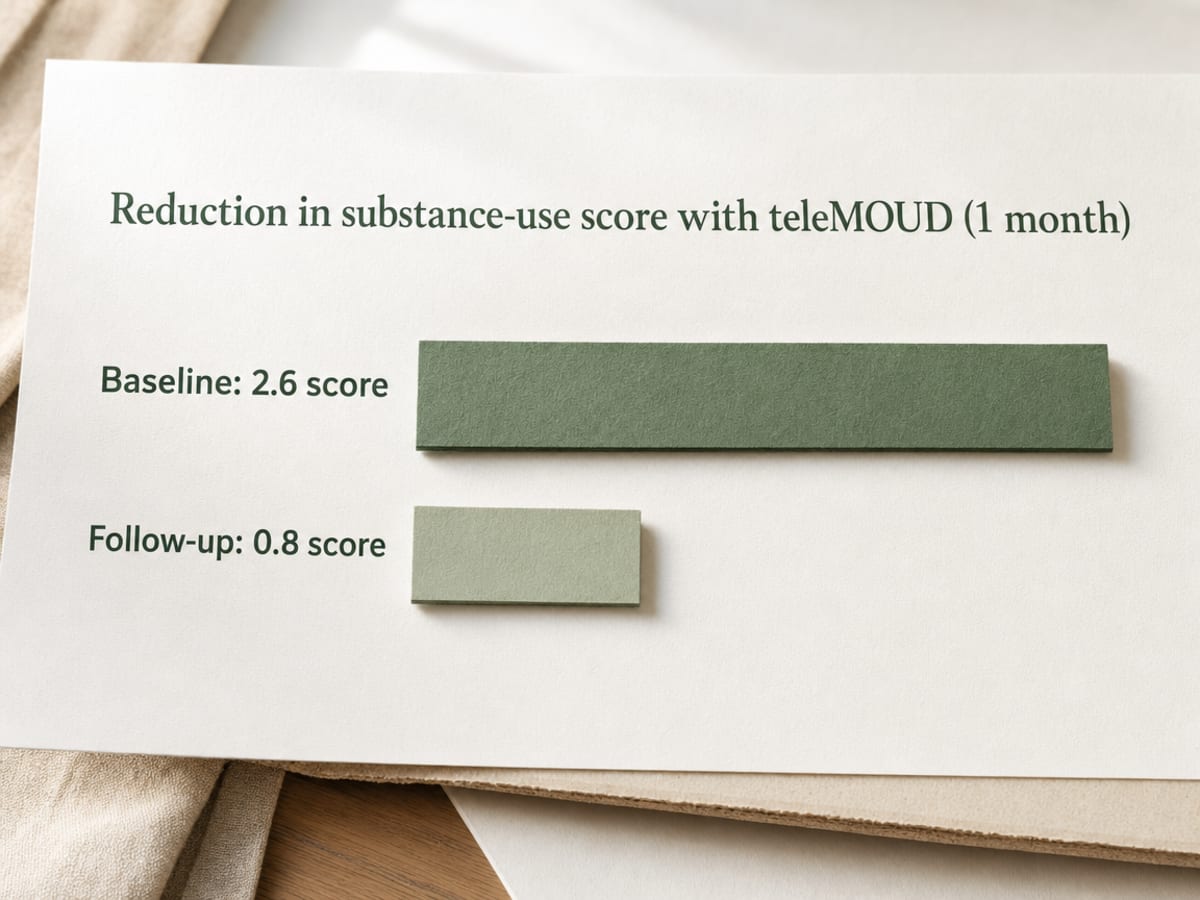
The results move fast. In a 2024 study of more than 2,500 patients in a telehealth medication for opioid use disorder program, the share of patients reporting any opioid misuse fell from 49.8% at baseline to 10.5% after roughly one month of treatment 3. One month. That is not “eventually.” That is the difference between the version of you reading this and the version of you at your next quarterly review.
You don’t have to decide today which medication, which dose, or whether you’re ready. You only have to be willing to have the conversation with a prescriber who won’t lecture you.
Calling Without Your Calendar Exposing You
The first call is smaller than you think. It’s fifteen minutes with someone at intake asking about what you’re using, how often, what your work schedule looks like, and what kind of care might fit. You don’t have to have language for any of it yet. “I’m drinking more than I want to and I work from home” is a full sentence and a full reason to call.
Here’s the operational part no one else will tell you. Put the call on your calendar as “dentist,” “PT,” “annual physical,” or nothing at all — a plain block with no title. If your calendar is visible to your team, use a private appointment. Call from your cell, not the company softphone. Step outside, sit in your car, or take a walk in your neighborhood — the fifteen-minute block that used to hide the problem can hide the first conversation about fixing it.
You are not required to disclose a diagnosis to your employer to start treatment, and nothing about intake pings HR. If you later need protected time for a higher level of care, that’s a separate decision with its own paperwork. For now, the only person who needs to know you called is you.
The Underlying Story: Trauma, Anxiety, and Dual Diagnosis
Here’s the part most people don’t want to look at, and it’s the part that changes everything about whether treatment actually works. The drinking or the pills or the kratom is rarely the whole story. It’s usually the loudest symptom of something quieter underneath — unprocessed trauma, an anxiety disorder that never got named, depression that’s been running in the background since your twenties, grief that never got room to land.
Remote work made the mask easier to wear. You didn’t have to perform “fine” in a hallway anymore. You could shut your laptop, close the door, and self-medicate whatever was making the day feel like too much. That works for a while. Then it stops working, and the thing you were using to cope becomes its own problem sitting on top of the first one.
Sunflower’s model is built for this. The center specializes in trauma-informed dual diagnosis care — meaning the clinical team treats the addiction and the mental health condition together, in the same plan, with the same providers. Depression, anxiety, PTSD, eating disorders, unresolved trauma from childhood or from something more recent: these get addressed alongside the substance use, not after it. Because if only the substance gets treated, the reason you reached for it is still there when you finish.
You don’t have to have a diagnosis in mind before you call. Most people don’t. You just have to be open to the possibility that what you’ve been white-knuckling by yourself is treatable, and that the isolation of your home office has been amplifying something that deserved care a long time ago.
What Untreated Use Is Already Costing You at Work
You already suspect this, so it’s worth saying plainly. Untreated substance use disorder cost the U.S. economy an estimated $92.65 billion in productivity losses in 2023 — absenteeism, presenteeism, and people leaving the workforce entirely 12. That number is not a scold. It’s a mirror.
Presenteeism is the part that lands for remote workers. You’re logged in. You’re answering messages. But the version of you at the keyboard by 3 p.m. is not the person who got hired. The email that should have taken twenty minutes takes ninety. The deck you used to build in a morning stretches across two days. You’re missing the thread on calls you used to lead. Your manager hasn’t said anything yet, and that silence is doing its own damage — you’re spending energy managing the fear of being found out on top of the use itself.
Treatment costs time. Not treating costs more, and you’re already paying it.
A Direct Next Step
You don’t have to be ready for treatment to make one phone call. You only have to be ready for information.
Call Sunflower Recovery Center and ask what care could look like around your work schedule. Say you work from home in the Kansas City area. Say what you’re using, roughly how often, and what times of day are hardest. Ask about IOP hours, telehealth options, and whether medication is part of the plan for what you’re dealing with. Ask what your commercial insurance is likely to cover — Sunflower works with most commercial plans, though not Medicare or Medicaid.
You are not signing up for anything on that call. You are gathering the information you need to decide what happens next. That’s enough for today.
Start your confidential recovery journey today
Connect with a supportive team ready to help you build a safer, healthier routine while working remotely.
Frequently Asked Questions
Can I keep working from home while I’m in treatment?
Yes, for most people in IOP. Sessions are scheduled in evening blocks or around your workday, and telehealth options mean you don’t have to commute across the metro after a long day at the keyboard. If your clinical team recommends PHP or residential care, you’d step away from work for that period — but IOP is designed to layer onto a full-time remote job.
Will my employer find out if I start an IOP?
Not automatically. Intake is confidential and doesn’t ping HR. You are not required to disclose a diagnosis to your employer to begin outpatient treatment. If you later use insurance, your explanation of benefits shows a provider name, not a diagnosis to your manager. Protected leave under FMLA is a separate decision if you ever need higher-level care.
Does virtual or hybrid IOP actually work as well as in-person treatment?
The evidence says yes. A recent review of telehealth outpatient programs for substance use and co-occurring conditions found roughly 80% engagement at 30 days and 91% attaining 30 consecutive days of abstinence, comparable to in-person care 2. Early video telehealth was also associated with lower dropout and higher engagement versus in-person-only visits 7. The screen doesn’t dilute the clinical work.
Can I get medication for opioid or kratom use disorder through telehealth in Kansas City?
In many cases, yes. Federal telemedicine flexibilities have allowed qualifying practitioners to prescribe buprenorphine for opioid use disorder via telehealth, including phone evaluation for some patients 14. Kratom and 7-OH dependence often respond to the same medication because the receptor story overlaps. Your first visit can happen from your home office — ask about it on the intake call.
What if IOP isn’t enough and I need a higher level of care?
That’s what the continuum is for. Sunflower offers residential care (a 60-day program in Osawatomie), a Partial Hospitalization Program, and IOP. You can start at the level that fits and step up or down as the clinical picture changes. Many people begin residential, transition to PHP, then finish in IOP while easing back into remote work. The level moves with you.
Does Sunflower accept my insurance?
Sunflower works with most commercial insurance plans, which is typically what remote workers have through their employer. The center does not participate in Medicare or Medicaid. The clearest next step is a quick call — share your insurance card details and the intake team can verify benefits and give you a realistic picture of coverage before you commit to anything.
References
- Relationship between alcohol consumption and telecommuting preference-practice mismatch during the COVID-19 pandemic. https://pubmed.ncbi.nlm.nih.gov/35507292/
- Examining the state of telehealth for mental health and substance use disorders. https://pmc.ncbi.nlm.nih.gov/articles/PMC13328975/
- An Assessment of the One-Month Effectiveness of Telehealth Treatment for Opioid Use Disorder Using the Brief Addiction Monitor. https://pubmed.ncbi.nlm.nih.gov/38258856/
- Telehealth supports retention in treatment for opioid use disorder. https://nida.nih.gov/news-events/news-releases/2023/10/telehealth-supports-retention-in-treatment-for-opioid-use-disorder
- Addiction Treatment and Telehealth: Review of Efficacy. https://pubmed.ncbi.nlm.nih.gov/34644125/
- CORoNaWork: Occupational Health Study on Telecommuting and Alcohol Consumption (full text as in PubMed link above). https://pmc.ncbi.nlm.nih.gov/articles/PMC9262312/
- Did Telehealth Expansion in the US During the COVID-19 Pandemic Improve Access to Substance Use Treatment and Outcomes?. https://www.bu.edu/aodhealth/2024/02/27/did-telehealth-expansion-in-the-us-during-the-covid-19-pandemic-improve-access-to-substance-use-treatment-and-outcomes/
- 2023 NSDUH Annual National Report. https://www.samhsa.gov/data/report/2023-nsduh-annual-national-report
- Changes in Alcohol Use During the COVID-19 Pandemic: Impact of the Lockdown Conditions and Mental Health Factors. https://pmc.ncbi.nlm.nih.gov/articles/PMC7781407/
- Working at home and alcohol use. https://pmc.ncbi.nlm.nih.gov/articles/PMC8444538/
- Is the association between working from home and higher alcohol consumption a matter of workplace or worker characteristics?. https://pmc.ncbi.nlm.nih.gov/articles/PMC12074692/
- Productivity Losses From Substance Use Disorder in the U.S. in 2023. https://pmc.ncbi.nlm.nih.gov/articles/PMC12793919/
- Drug Overdose Deaths in Kansas 2020-2023: Quick Facts (Kansas City Metro Region). https://www.kdhe.ks.gov/DocumentCenter/View/43963/SUDORS-Data-By-PHEP-Regions
- Prescribing Controlled Medications via Telehealth – Rural Spotlight. https://ruralhealthinfocenter.health.mo.gov/prescribing-controlled-medications-via-telehealth/