
Key Takeaways
- A failed DOT test or refusal places a Kansas CDL holder in FMCSA Clearinghouse prohibited status, which blocks safety-sensitive work but leaves a defined return-to-duty path open 1.
- The federal route back runs through five fixed steps anchored by a face-to-face Substance Abuse Professional evaluation, completed treatment, a negative return-to-duty test, and unannounced follow-up testing 3.
- Kansas drivers face patterns the data already reflects — amphetamines were the primary substance in 41.9% of 10,867 treatment admissions in 2023 — so honest disclosure about stimulant and alcohol use shapes the right level of care 10.
- Line up a SAP-coordinated treatment provider, a discharge and aftercare plan, follow-up testing, and Kansas medical self-certification on one calendar before making the first confidential intake call 4.
What happens to your CDL when you ask for help
The fear you are feeling right now is real, and it is not unreasonable. You have heard the shop-talk version of what happens when a driver fails a test or admits to a problem: your name goes into the Clearinghouse, your commercial privileges get frozen, and your paycheck stops. Some of that is true. But the piece nobody tells you at the truck stop is that the same federal system that flags you also spells out, in plain steps, how you get back to driving.
Here is the honest version. If you have a violation, a refusal, or a positive DOT test, you are placed in prohibited status in the FMCSA Clearinghouse, and Kansas will check that status before your CDL or CLP is issued or renewed 1. Prohibited means you cannot perform safety-sensitive functions until you complete the return-to-duty process. It does not mean your CDL is gone forever. It means the door is locked, and there is a key.
That key has a name: the Substance Abuse Professional, or SAP. A SAP evaluates you, recommends education or treatment, verifies you completed it, and clears you for a return-to-duty test 2. Walking into treatment on your own, before an employer or a test forces the issue, often gives you more room to plan, more privacy, and more say in how the next twelve months look.
You are not the only Kansas driver looking at this on a phone tonight
Maybe you are parked at a Flying J off I-70. Maybe you are in a sleeper berth outside a warehouse in Edwardsville, waiting on a 4 a.m. dock time. You typed something into your phone that you would never say out loud to your dispatcher. That took something. Whatever brought you here tonight, the fact that you are reading this instead of pretending everything is fine is already a real step.
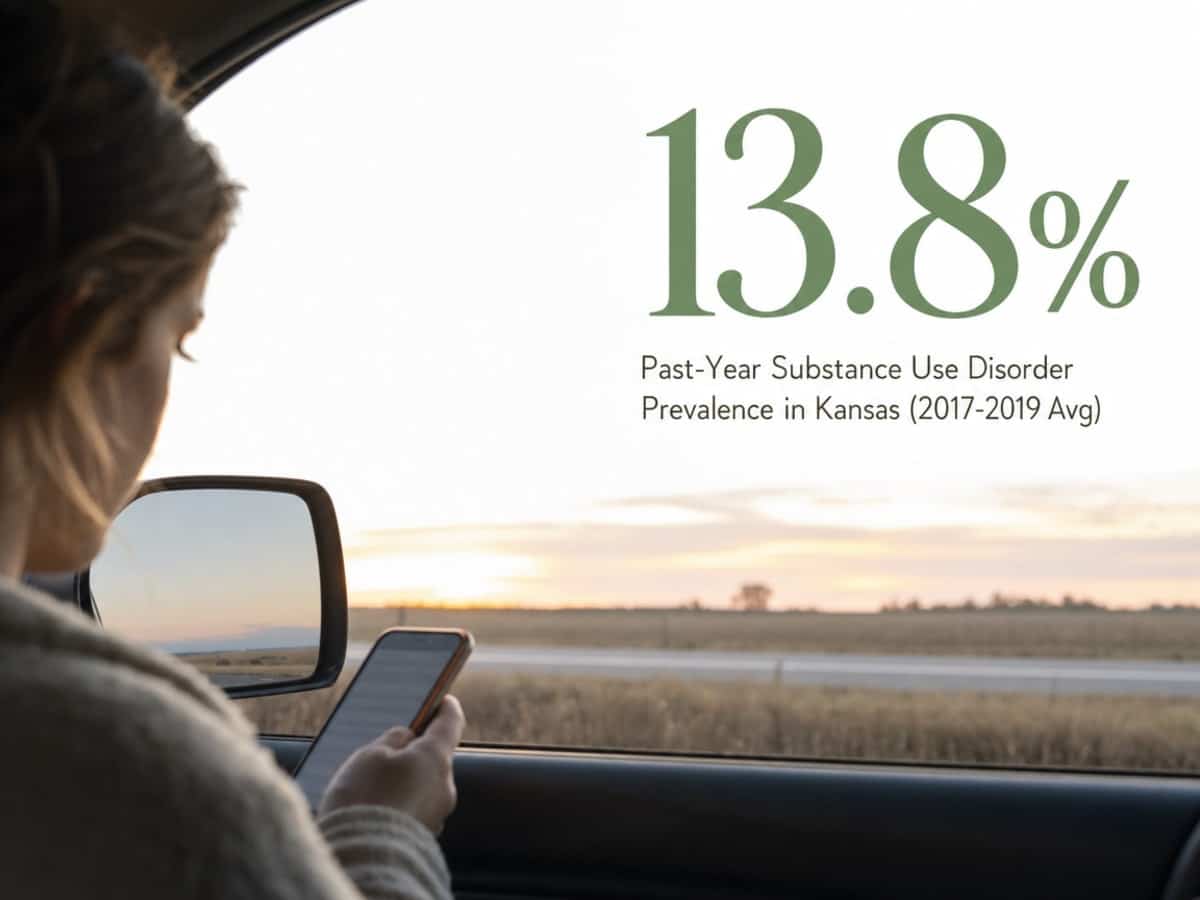
Here is what the numbers in your state actually say. SAMHSA’s Kansas Behavioral Health Barometer found a 13.8% past-year substance use disorder prevalence among Kansans age 12 and older, based on an annual average from 2017 through 2019 — roughly 44,000 people in a given year 9. That figure is not just teenagers or people on the news. It includes working adults with mortgages, kids in school, and jobs they cannot afford to lose. It includes drivers.
So no, you did not stumble into some rare, shameful corner of the state. You are in the middle of a very common Kansas story. The difference is that most of those 44,000 people are not carrying a CDL, and you are — which is exactly why the next few sections walk through the DOT return-to-duty path in plain language, before you have to make a single call.
The DOT return-to-duty process, walked step by step
Prohibited status, the Clearinghouse, and what it actually blocks
Prohibited status is a specific label, not a personal verdict. Once a violation, refusal, or positive test hits the FMCSA Clearinghouse, your record shows “prohibited,” and Kansas checks that status before issuing or renewing a CDL or CLP 1. What that blocks is narrow but serious: you cannot legally perform safety-sensitive functions. Driving the truck. Fueling it. Sitting behind the wheel while in ready-line status. Any task the DOT counts as safety-sensitive is off the table until you complete the return-to-duty process.
What it does not block matters just as much. It does not delete your CDL from the system. It does not put your name on a public list your neighbors can search. It does not automatically tell your family. Your prior driving history stays intact, and your license itself is not shredded — it is disqualified from commercial use until the process closes out 1.
You should also know that the clock does not start ticking against you until an employer or the state acts on that status. That is why drivers who reach out to a SAP and start treatment before a chaotic incident often keep more control over timing, employer conversations, and how the record reads on the other side.
The five steps from violation back to driving
The path back is not a maze. It is five steps, in order, and every SAP in the country works from the same federal playbook 3. Reading them once, on your own, before anyone else is in the room, changes how the first phone call feels.
Step one: the trigger. Either a violation lands on your Clearinghouse record — a positive test, a refusal, an alcohol confirmation at 0.04 or higher — or you self-identify to an employer under a qualifying voluntary program. Either way, you enter prohibited status and the return-to-duty pathway opens.
Step two: the face-to-face SAP evaluation. A qualified Substance Abuse Professional meets with you, in person or by real-time video that meets DOT audio-visual standards, and assesses what is going on. This is not a formality. It is the door to everything else 3.
Step three: complete the recommended education, treatment, or both. The SAP prescribes what you need — outpatient, residential, structured education — and you finish it. The SAP verifies completion.
Step four: the return-to-duty test. After the SAP signs off, an employer directs an observed RTD test. A negative result clears you to perform safety-sensitive functions again.
Step five: the follow-up testing plan. The SAP sets a schedule of unannounced follow-up tests — at least six in the first twelve months back, and possibly extending up to five years 3. That plan travels with you between employers.
Five steps. Not one of them is easy. All of them are known.
What a SAP evaluation is, and what it is not
A SAP evaluation is a clinical assessment, not a courtroom. The SAP’s job is to figure out what happened, what level of care you need, and what will actually reduce the chance you land in the same spot again. It is a face-to-face conversation, and under current DOT guidance it can be conducted by real-time audio-visual technology when in-person is not practical — but not by phone alone 3.
What it is not: your SAP is not your therapist, and your SAP is not your employer’s investigator. The SAP is a neutral gatekeeper for the return-to-duty process. They will ask about your substance use, your medical history, your work patterns, and your support system. They will recommend a specific level of care — outpatient counseling, an intensive outpatient program, partial hospitalization, or residential treatment — and later verify that you completed what they prescribed 3.
What it is not, also: a trap. Being honest with the SAP is how you get an accurate recommendation and a shorter path. Understating the problem usually leads to under-prescribed care, a shaky recovery, and a follow-up test failure a year in. Walk in ready to say the actual truth about the sleeper cab, the energy drinks, the pills, the beers, the kratom, and whatever else is really in the mix.
Why the road itself keeps you using
Stimulants to stay awake, alcohol to come down
You already know the cycle. The load has to be in Denver by morning. You have been up since a 3 a.m. dispatch call in Salina, and there is one bump, one line, one pill that keeps your eyes on the reflectors past midnight. Then, once the trailer is dropped and the truck is parked behind a Casey’s, something has to bring the nervous system back down so you can sleep four hours before the next run. A tallboy. A pint. Two.
This is not a personal weakness. It is a work-shift pattern that the occupational medicine literature has documented for years. A systematic review of psychoactive substance use among truck drivers linked higher use of alcohol, amphetamines, marijuana, and cocaine to long trips, night work, and fewer hours of rest 12. The truck did not choose that combination for you, but the schedule made it the path of least resistance.
Kansas data confirms the pattern is not niche. Kansas recorded 10,867 substance abuse treatment admissions in 2023, and amphetamines were the primary substance in 41.9% of them — the largest single category by a wide margin 10. Stimulants are not a side story in this state. They are the front door to treatment for thousands of Kansans, and a meaningful share of them are people who work jobs that punish sleep.
If your use looks like this — uppers to run, downers to stop — a SAP evaluation and treatment plan need to see both sides of it. Treating only the alcohol misses half the problem. Treating only the stimulants leaves the crash unmanaged.

Isolation as a clinical risk factor, not a personality trait
You have probably been told, more than once, that you are just a loner. That you like your own company. That the cab suits you. Some of that might even be true. But there is a difference between preferring quiet and going eleven days without a real conversation, and the medical literature takes that difference seriously.
A systematic review and meta-analysis of truck-driver health found that the isolated nature of the work is associated with low social support, loneliness, and depression 11. That is not a slogan on a wellness poster. That is a peer-reviewed finding across multiple studies. Loneliness and depression are not moods to shake off between runs; they are clinical conditions that reliably drive substance use and reliably make it harder to stop.
Think about the shape of your last month. Truck stop showers. A microwave burrito at 1 a.m. A text thread with your kids that goes quiet for days at a time. A dispatcher who only calls when something is wrong. The people who understand what your day looks like are on the CB or the app, not across the table from you.
When you walk into treatment, this is one of the first things a good clinical team looks at — not as a character flaw, but as a driver of the substance use itself. Structure, group work, and honest connection are part of the medicine. That is not soft talk. That is what the evidence supports.
The overdose picture Kansas drivers pass through
You run through counties every week that look nothing like each other on a map but share the same problem. KDHE’s 2022 Opioid Vulnerability Analysis flagged a long list of Kansas counties in its highest-vulnerability group, including Sedgwick, Shawnee, Douglas, Leavenworth, Reno, Saline, Crawford, Montgomery, Labette, and more than a dozen others across the state 13. Some of them hold your home terminal. Some of them are just the exit where you fuel up.
The nonfatal picture is just as loud as the fatal one. KDHE estimated 7,578 Kansas emergency department visits in 2024 that were suspected to involve overdose 7. That is not a distant headline. That is a number that includes drivers who made it to a hospital and drivers who nearly did not, some of them people whose CDL is still active in the system.
You are not being asked to feel afraid of a map. You are being asked to notice that the places you drive through are already dealing with this, out loud, and that reaching out for help in Kansas is not stepping into an empty room. The infrastructure and the language exist. So does the door.
Treatment that runs on two tracks at once
The DOT compliance track: SAP hours, testing, documentation
One track is paperwork. That is not an insult — it is a description. The DOT compliance track is a stack of specific, verifiable actions: the face-to-face SAP evaluation, the education or treatment hours the SAP prescribes, the SAP’s follow-up report confirming you completed what was recommended, the observed return-to-duty test ordered by an employer, and the follow-up testing schedule of at least six unannounced tests in your first twelve months back 3. Every one of those pieces generates a document. Every document has to land in the right place.
The Clearinghouse is where a lot of it actually shows up. SAPs report certain return-to-duty information directly into the FMCSA Clearinghouse 2, and Kansas checks that record before a CDL or CLP is issued or renewed 1. That is why a good treatment provider does not just hand you a discharge summary. They coordinate with your SAP so the reporting matches the clinical reality, in the format DOT expects. Sloppy documentation is how drivers who did the hard work still get stuck.
The clinical track: trauma, sleep, dual diagnosis
The other track is the one that actually keeps you sober. Compliance paperwork does not treat the reason you started using in the first place. That is what the clinical track is for, and it looks different for every driver who walks through the door.
For a lot of CDL holders, the story underneath the substance use includes trauma that predates the truck — a childhood, a deployment, a loss, an assault — layered on top of years of broken sleep, missed meals, and long stretches without anyone to talk to. The peer-reviewed literature on driver health backs that up, linking the isolated shape of the work to loneliness and depression 11. Those are not moods. They are clinical targets.
Trauma-informed dual diagnosis care treats the substance use disorder and the co-occurring mental health condition in the same plan, at the same time, with clinicians who talk to each other. Depression, anxiety, PTSD, disordered eating, chronic sleep disruption — these are the things a driver-focused clinical team should be assessing on day one, not saving for month three.
Residential, PHP, and IOP — which level fits which driver
Your SAP recommends the level of care, and honest clinical assessment does the rest. Three levels come up most often for CDL holders, and they are not interchangeable.
Residential is where you live on-site while you get treatment. Sunflower’s 60-day residential program is built for drivers who need real distance from the truck, the route, and the people who supply the substances that ride along with the job. If your use pattern is daily, if you are running stimulants to stay awake and alcohol to come down, if withdrawal is medically serious, or if you have tried outpatient before and it did not hold — this is usually the honest answer. Prohibited status is already keeping you out of the cab. Use that window.
Partial hospitalization is the middle gear. You live off-site but attend structured clinical programming most of the day, most days of the week. It works for drivers who have stabilized past acute risk but need more contact and structure than a weekly appointment can provide.
Intensive outpatient is lighter contact — several sessions a week, in the evening or on a schedule that leaves room for other responsibilities. IOP fits drivers stepping down from a higher level of care, or drivers whose SAP evaluation and clinical assessment agree that outpatient intensity is enough to address what is actually going on.
The level that fits you is the one an honest evaluation lands on. Not the shortest one. Not the one that looks best on paper.
Planning the return to the cab
Discharge, follow-up testing, and medical self-certification as one project
Treat the last week of treatment and the first year back behind the wheel as one continuous project, not two separate chapters. Discharge planning is where that project gets built. A good clinical team hands you off with a written aftercare plan, a therapist or counselor scheduled in your home area, and a clear line of communication with your SAP so the follow-up report and the return-to-duty documentation actually match what you did in the program.
Then the testing calendar starts. Your SAP directs a follow-up plan of at least six unannounced tests in your first twelve months back to safety-sensitive work, and that schedule can extend as long as five years depending on what the SAP recommends 3. Those tests travel with you between employers. If you switch carriers eight months in, the follow-up plan does not reset — the new employer inherits the schedule.
Talking to your employer, your dispatcher, and your family
These are three different conversations, and you do not owe them the same information. Your employer needs what the DOT requires — the SAP evaluation, the completed treatment, the negative return-to-duty test, and the follow-up testing plan 2. That is a compliance conversation, not a confession. Keep it in that lane.
Your dispatcher usually needs even less. They need to know when you are available for loads again. They do not need your clinical history. If your carrier’s HR structure separates safety compliance from day-to-day dispatch, use that separation.
Your family is the harder conversation, and the more important one. The spouse who has been holding the house together during your runs, the kids who noticed you were different at Thanksgiving — they have been carrying this too. Sunflower’s family program exists because recovery that ignores the people at home tends not to hold. Tell them what you can. Let them ask questions. That is not weakness. That is what home time is supposed to be for.
Making the call: confidentiality, insurance, and what to ask
The first phone call is the hardest one. It is also shorter than you think. A confidential intake conversation is not a commitment to check in tomorrow. It is a chance to ask your questions before anyone knows your name — what levels of care are offered, whether the clinical team has worked with CDL holders and SAPs before, how they coordinate documentation with your SAP, and what the timeline could look like from evaluation to a negative return-to-duty test 3.
On insurance, be direct. Sunflower accepts most commercial insurance and does not participate in Medicare or Medicaid. If your carrier’s plan is commercial, a benefits check happens on that same first call, and you find out what is covered before you decide anything.
Bring a short list to the call: your general use pattern, any prior violations or tests, whether you have already been placed in prohibited status, and your home terminal. You do not have to have it all figured out. You just have to pick up the phone. Call Sunflower confidentially to ask about treatment options that protect your path back to your CDL.
Confidential Help Is One Call Away Now
Connect with someone who understands DOT testing fears and can guide you through safe, CDL-protected recovery.

Frequently Asked Questions
Will I automatically lose my CDL if I go to treatment for addiction?
No. Seeking treatment on your own does not trigger prohibited status or a Clearinghouse entry. What triggers that is a violation, refusal, or positive DOT test 1. Reaching out for help before a chaotic incident often gives you more control over timing, employer conversations, and how your record reads afterward.
Can my employer or dispatcher find out if I seek treatment on my own?
Not from the treatment side. Clinical records are protected, and voluntary treatment does not go into the Clearinghouse. Your employer only sees SAP-reported information after a qualifying violation or self-report under a company program 2. Your dispatcher usually only needs to know when you are available for loads again.
What exactly does a SAP evaluation involve, and can it be done remotely?
A SAP evaluation is a face-to-face clinical assessment that reviews your substance use, history, work patterns, and support system, and lands on a specific level of care. Under DOT guidance, it can be conducted by real-time audio-visual technology when in-person is not practical, but not by phone alone 3.
How long does the DOT return-to-duty process take from first call to first negative test?
Timing depends on the level of care your SAP recommends. Outpatient plans can move in weeks. A 60-day residential stay is longer by design. What is fixed is the sequence: SAP evaluation, completed treatment, SAP verification, then an observed return-to-duty test ordered by an employer 3. Do not rush the middle step.
Does Sunflower accept commercial insurance, and what about Medicare or Medicaid?
Sunflower accepts most commercial insurance. It does not participate in Medicare or Medicaid. If your carrier’s health plan is commercial, a benefits check happens on the same first phone call, so you find out what is covered before you commit to anything. Ask about coverage for residential, PHP, and IOP levels.
What happens with follow-up testing once I am back behind the wheel?
Your SAP sets an unannounced follow-up testing schedule of at least six tests in your first twelve months back to safety-sensitive work, and it can extend up to five years 3. That schedule travels with you between employers. Switch carriers eight months in, and the new employer inherits the plan.
References
- Drug & Alcohol Clearinghouse Information. https://www.ksrevenue.gov/dovclearinghouse.html
- Learning Center | SAP. https://clearinghouse.fmcsa.dot.gov/Learn/SAP
- Substance Abuse Professional (SAP) Guidelines. https://www.transportation.gov/sites/dot.gov/files/2022-05/ODAPC_SAP_Guide_May_2022.pdf
- Kansas Commercial Driver’s License Holder Medical Self Certification. https://www.kdor.ks.gov/Apps/MotorVehicles/MotorVehicle/KCDLCertificate
- Substance Use Disorder & Overdose Prevention. https://www.kdhe.ks.gov/1298/Substance-Use-Disorder-Overdose-Preventi
- Kansas Fatal Drug Overdose Vulnerability Assessment. https://www.kdhe.ks.gov/DocumentCenter/View/59744/Kansas-Fatal-Drug-Overdose-Vulnerability-Assessment-PDF?bidId=
- 2026 KDHE Overdose ED Visit Fact Sheet. https://www.kdhe.ks.gov/DocumentCenter/View/56984/2026-KDHE-Overdose-ED-Visit-Fact-Sheet-PDF?bidId=
- Overdose Data Dashboard. https://www.kdhe.ks.gov/1309/Data-Dashboard
- Behavioral Health Barometer: Kansas, Volume 6. https://www.samhsa.gov/data/sites/default/files/reports/rpt32833/Kansas-BH-Barometer_Volume6.pdf
- 2023 TEDS-A Kansas | CBHSQ Data. https://www.samhsa.gov/data/node/51056
- Cardiometabolic risk factors and mental health status of truck drivers: a systematic review and meta-analysis. https://pmc.ncbi.nlm.nih.gov/articles/PMC7590350/
- Psychoactive substance use by truck drivers: a systematic review. https://oem.bmj.com/content/71/1/71
- 2022 Opioid Vulnerability Analysis. https://www.kdhe.ks.gov/DocumentCenter/View/41078/2022-Opioid-Vulnerability-Analysis-PDF