
Key Takeaways
- Olathe families sit close enough to Sunflower Recovery Center in Osawatomie via US-169 to build family sessions, visit days, and discharge planning into a normal working week.
- Family involvement functions as a clinical input, not a courtesy — research links it to better treatment entry, retention, reduced substance use, and improved family functioning 1, 12.
- Before choosing a program, compare what family programming actually includes: disease education, communication and boundary work, behavioral couples therapy where appropriate, and structured discharge planning 9.
- Know which local number fits which moment — 911 for medical emergencies, Olathe’s Mental Health Co-Responder and Johnson County’s 24/7 crisis line for mental health crises, and 1-866-645-8216 for treatment placement 14, 15.
When Someone You Love Needs More Help Than You Can Give
You’ve probably already tried more than anyone knows. The hidden bottles. The car keys you moved. The calls at 2 a.m. The apology texts, the promises, the relapses. Somewhere between last month and tonight, you crossed a line most families don’t talk about: you realized love isn’t enough anymore.
That’s not a failure. That’s information.
If you’re reading this from a kitchen in Olathe with your phone tilted away from someone who’s asleep on the couch, or from your car in a Price Chopper parking lot because it’s the only place you can think, you already know the shape of the problem. What you may not know yet is that you don’t have to hand your loved one off and hope for the best. Family involvement isn’t a nice add-on to adult addiction treatment. It’s one of the strongest levers we have. Research reviewing 15 randomized controlled trials found that family engagement in substance use treatment leads to reductions in substance use and improvements in how families actually function together 1.
This page is written for you specifically — the spouse, parent, adult child, or sibling in Olathe trying to figure out what happens next. Not just what happens to your person, but what happens with you in the room. The drive to Sunflower Recovery Center in Osawatomie is short enough to matter. Staying involved from Olathe is realistic. And your role, once treatment starts, is bigger than you think.
Why Your Involvement Actually Moves the Needle
Here’s the thing most families in crisis don’t hear until they’re already exhausted: the research is not neutral on whether you should be involved. It’s directional.
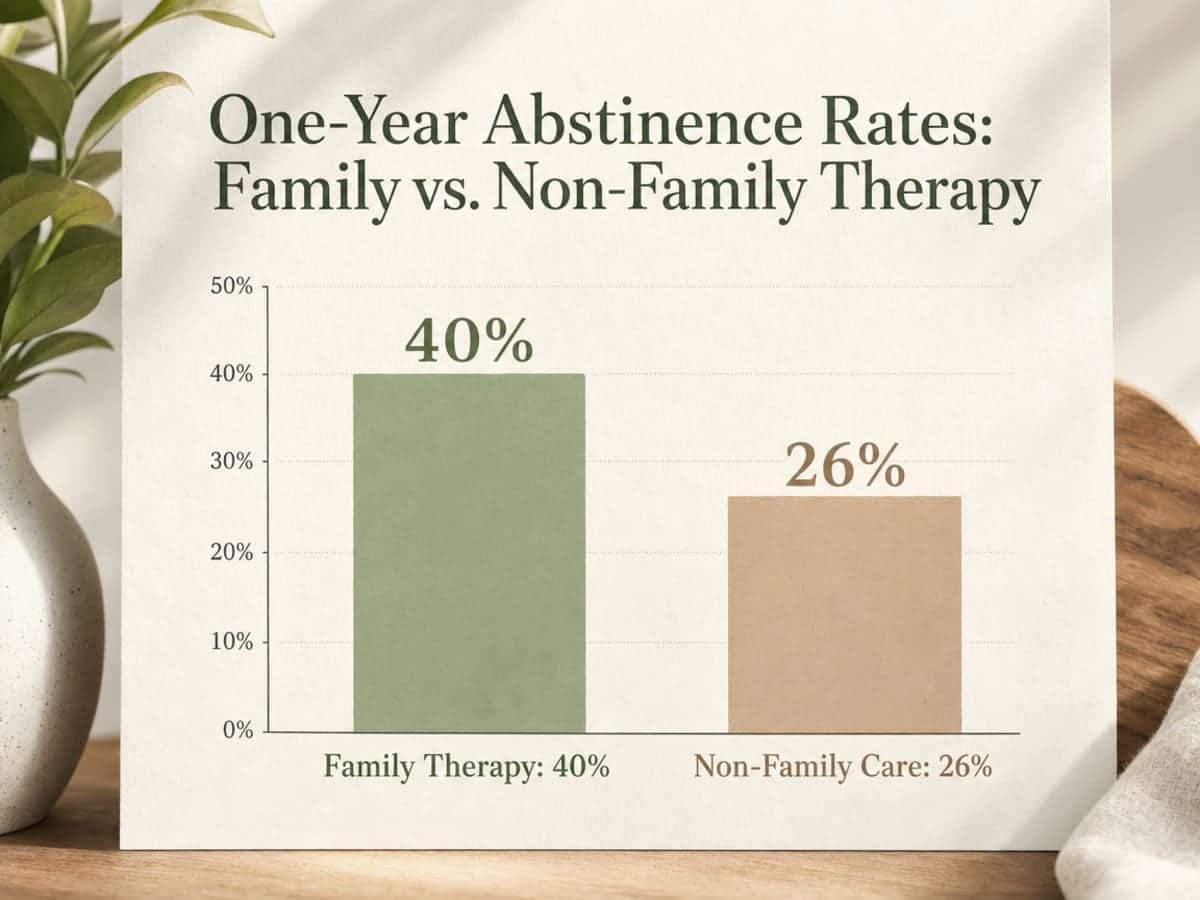
A community-clinic randomized trial comparing usual-care family therapy to non-family treatment for substance-using youth found that one-year abstinence rates climbed to 40% in the family therapy group, compared to 26% in non-family care 3. That’s an adolescent sample, and Sunflower treats adults, so please don’t read those numbers as a promise about your husband, your daughter, your brother. Read them as a signal about the mechanism: when families sit in the room, outcomes shift. The study authors noted that treatment attendance didn’t differ between the two groups. What differed was what happened inside the sessions when family was part of it.
The adult-side evidence points the same direction. A peer-reviewed review of family involvement in substance use disorder treatment and recovery concluded that involving families is associated with better treatment entry, better retention, less substance use, and improved psychosocial outcomes for the person in care 12. Meta-analytic work across the addictions has also found that specific behavioral techniques used in family and couple work improve outcomes for both the person with the addiction and the concerned family members sitting across from them 2. That two-way benefit matters. You are not just fuel for someone else’s recovery. Your own sleep, your own resentment, your own hyper-vigilance — those get treated too.
And yet, family-focused work remains underused compared to how well it performs. A review of family interventions for drug and alcohol misuse argued directly that these approaches either match or improve on individual-only care, and that the gap between the evidence and routine practice is a real one 8. A scoping review from 2018 said essentially the same thing: family involvement can reduce harm to relatives and improve treatment outcomes, but it’s still inconsistently offered 7.
So when you ask yourself whether showing up to the sessions, making the drive, learning the language — whether any of that actually matters — the honest answer is yes. Not as a nice gesture. As a clinical input.
What a Family Session Actually Covers
Family Disease Education: Getting Everyone on the Same Page
The first family session is usually not the confrontation you’re bracing for. It’s a classroom.
SAMHSA’s clinical advisory on family therapy in substance use disorder treatment describes family disease education as a foundational model — one where clinicians walk everyone through what addiction actually is, how it changes the brain, how it interacts with trauma and other mental health conditions, and why willpower alone has never been the missing ingredient 9. That last part matters. If you’ve been carrying a quiet theory that your loved one just needs to try harder, or that you should have caught this sooner, this session is where a clinician gently takes that weight off the table.
You’ll learn the vocabulary the treatment team is already using — tolerance, withdrawal, co-occurring disorders, relapse warning signs. You’ll also hear how addiction rearranges family roles: who over-functions, who disappears, who becomes the peacekeeper. None of that is a diagnosis of your family. It’s a map of where you’ve been living.
Coming out of this session, most Olathe families report the same thing: the fights at home start to make more sense, and the shame gets quieter. That alone is worth the drive.
Communication Skills and Boundary Work
Once everyone shares a vocabulary, the work shifts to how you actually talk to each other.
This is the session where you’ll practice things that sound simple and turn out to be hard. Saying what you need without launching into the ten years of receipts. Listening without immediately problem-solving. Naming a limit — around money, around lying, around driving the kids — without it turning into an ultimatum you can’t hold.
A 2023 meta-analysis across the addictions found that specific behavior change techniques used inside family and couple sessions improved outcomes for both the person in treatment and the family members sitting with them, including relationship functioning 2. That two-way effect is the point. The communication tools aren’t only there to help your loved one stay in recovery. They’re there because you have been running on adrenaline for a long time, and adrenaline is not a communication strategy.
You may leave this one tired. That’s normal. You’re using muscles that have been on standby for years.
Behavioral Couples Therapy When a Partner Is Involved
If your loved one is your spouse or long-term partner, there’s a specific track that may enter the picture: behavioral couples therapy.
SAMHSA’s Advisory 39 identifies behavioral couples therapy as one of the family-oriented models with the strongest evidence in adult substance use disorder treatment, linked with increased abstinence, better treatment adherence, and reductions in the legal and family problems that tend to trail addiction into a marriage 9. In practice, it looks less like traditional couples counseling and more like a structured partnership. You and your partner meet with a clinician, agree on a daily recovery contract, and work through the specific relationship patterns that have been feeding the addiction — the fights before drinking, the silence after, the cycles of trust and betrayal.
It’s not a rehash of every wound. It’s forward-facing. What are we doing differently this week? What’s the plan for the moment when he wants to use? What do you do when the resentment surges at 9 p.m. on a Tuesday?
This track isn’t right for every couple, and it’s not appropriate where there’s active intimate partner violence or safety concerns. A clinician at Sunflower can tell you whether behavioral couples therapy fits your situation after an initial assessment. If it does, the sessions become one of the more reliable levers you have.
Discharge Planning as a Family Meeting
The session families most often underestimate is the last one — or the series of last ones.
Discharge planning is where the treatment team, your loved one, and you sit down and figure out what the first thirty days back in Olathe actually look like. Not in the abstract. Concretely. Who’s picking up prescriptions. Which support meetings your person is committing to. What the plan is if they walk into the kitchen at midnight and the craving is loud. Whether they’re going back to the same job, the same friend group, the same apartment where the last relapse happened.
A scoping review of family-focused practices in addictions found that involving families in treatment planning is associated with better treatment completion and outcomes, in part because families carry information about the home environment that clinicians can’t see from inside a facility 7. You know which family gathering is coming up. You know which coworker still texts at all hours. You know what the drive home from work passes.
Bring that information. Ask the questions you’ve been afraid to ask. Discharge is not the end of your involvement — it’s the handoff, and how well it’s built determines a lot of what happens next.
![Process infographic mapping the four sequential family session components explicitly described in this section's four subsections, aligned with SAMHSA Advisory 39 [ref_9]](https://www.sunflowerrecovery.com/wp-content/uploads/2026/08/addiction-treatment-Olathe-KS-content-v2-2.jpg)
The Drive from Olathe and What Visit Days Look Like
One of the first questions Olathe families ask on the phone is the most practical one: how are we supposed to stay involved if our person is an hour away?
The honest answer is that the corridor from Olathe down to Osawatomie is short enough to build a real rhythm around. Most families take US-169 south and end up at Sunflower in roughly the same time it takes to get across the metro in rush hour. That matters. Family involvement stops being a good intention and starts being something you can actually put on the calendar — a Saturday, a mid-week evening for a session, a discharge planning meeting you don’t have to take PTO to attend.
SAMHSA’s advisory on family therapy in substance use disorder treatment describes family programming as a set of concrete, scheduled components, not open-ended visitation: family education blocks, structured therapy sessions with a clinician, and joint planning meetings tied to specific points in the treatment arc 9. That structure is why the visit is worth the drive. You’re not sitting in a waiting room hoping for fifteen minutes. You’re arriving for something that has a purpose on the schedule.
A typical visit day for a family coming down from Olathe usually blends several pieces. There’s the family session itself, where a clinician sits with you and your loved one and works through whatever the week has surfaced — a hard phone call, a relapse fear, a boundary that needs sharpening. There’s often a shared meal, which sounds small until you remember how many meals you’ve spent worried, distracted, or eating in shifts. There’s individual time with your person that isn’t rushed. And when discharge starts coming into view, there’s a planning touchpoint where you, the treatment team, and your loved one map out the first weeks back in Olathe together.
Call Sunflower to ask what visiting days and family programming actually look like on the current schedule. Times shift, groups reconfigure, and the intake team can tell you exactly what a Wednesday or a Saturday would involve for your specific situation — including whether kids can come, what to bring, and how to fold the drive into a work week without burning out in month one.
Local Crisis Resources Before, During, and After Treatment
Treatment isn’t a single door you walk through. It’s a chain of moments, and some of them will happen at 11 p.m. on a Tuesday in Olathe, weeks before your loved one is admitted anywhere — or months after they come home. Knowing which number to dial for which moment is one of the more useful things you can do tonight.
Start with the stakes, once, so you can put them down. KDHE recorded 3,013 unintentional or undetermined-intent overdose deaths in Kansas between 2020 and 2024 11. That’s the backdrop your family is living inside. It’s not meant to frighten you — you’re already frightened. It’s meant to make the case that acting tonight, imperfectly, beats waiting for a cleaner moment that isn’t coming.
- If your loved one is in immediate danger, call 911.
- If the situation is a mental health crisis that hasn’t tipped into medical emergency — someone won’t come out of a bedroom, someone is threatening self-harm, someone is disoriented in a way that scares you — Olathe has a Mental Health Co-Responder program where licensed mental health professionals respond alongside police officers, help de-escalate, assess what’s actually needed in that moment, and hand your family information about community resources you can use next 14. It’s not the same as a standard police call. It’s built for exactly the situation you’re in.
- The Johnson County Mental Health 24/7 crisis line is the next rung. You can call it from your driveway. You don’t have to be sure it’s a crisis to use it — that’s what the clinicians on the other end are trained to sort out with you 14.
- For treatment placement itself, the Kansas Substance Use Disorder Treatment Referral Line at 1-866-645-8216 can walk you through options across the state, including publicly funded programs if insurance is a wall 15. Keep that number in your phone even after your loved one is in care. Recovery is not linear, and the number that helped you find a bed once may help you find one again.
After treatment, these same lines stay useful. A rough weekend, a slip, a moment where you’re not sure whether to call the therapist or the crisis line — that’s what they’re for.
The Roles Inside a Family: Spouse, Parent, Adult Child, Sibling
Every family in an Olathe living room right now is dividing the labor of a crisis without meaning to. Someone’s tracking the bank account. Someone’s tracking the mood. Someone hasn’t slept in a week. Once treatment starts, those roles don’t disappear — they get renegotiated. Naming them helps.
If you’re the spouse or partner, you’re carrying the daily weather. You know which mornings are bad before your feet hit the floor. Your job inside treatment is not to become a second clinician. It’s to show up to the sessions you’re invited to, tell the truth in them, and start separating the marriage from the addiction. SAMHSA’s advisory identifies behavioral couples therapy as one of the family-oriented models with the strongest evidence base in adult substance use disorder treatment — linked with more abstinence, better adherence, and fewer family and legal problems trailing behind 9. If that track is offered, take it seriously.
If you’re a parent of an adult child, your role is harder than it looks. The instinct is to go back to being the fixer you were when they were nine. Treatment will ask you to hold something more complicated: presence without rescue. Attend family education. Learn what enabling actually looks like in your specific household — the car insurance, the guest room, the rent you keep floating. A clinician can help you sort what’s support from what’s keeping the addiction fed.
If you’re the adult child of a parent in treatment, you may be doing this while raising your own kids in Olathe, working full time, and grieving a version of your mom or dad you’re not sure you’ll get back. Your role is not to parent your parent. It’s to show up to the sessions you can, ask the questions the treatment team won’t know to ask, and let yourself be honest about what the last several years cost you.
If you’re the sibling, you may feel like the least official person in the room. You’re not. Siblings often carry the longest institutional memory of the addiction — what it looked like at fifteen, at twenty-five, at last Thanksgiving. That context is clinical information. Bring it.
A 2023 meta-analysis across the addictions found that structured family and couple interventions produced measurable improvements for both the person in treatment and the family members alongside them, including relationship functioning 2. Every role in the room gets something back. You don’t have to be the strongest one. You just have to be the one who came.
What Progress Looks Like from Where You’re Sitting
Progress in the first weeks won’t look like the movie version. Nobody comes home fixed. What you’ll notice instead is smaller and stranger.
A phone call that ends on time. A hard conversation your loved one doesn’t walk out of. A Sunday where the argument you’d normally have doesn’t happen because one of you used the language you learned in a session. Your own shoulders sitting a half-inch lower by Wednesday night. These are the wins. Count them.
A peer-reviewed review of family involvement in substance use disorder care describes the mechanism plainly: when families are involved, communication improves, support becomes more useful, and psychosocial outcomes get better for the person in recovery 12. That’s not a promise about a specific day. It’s a description of what tends to shift when you keep showing up. The improvements stack quietly. You often notice them only in retrospect — a month in, when you realize you slept through Tuesday without checking your phone.
You’ll also notice something the research doesn’t measure well but every family feels. The house sounds different. The dread that used to live in the hallway starts to loosen its grip. You catch yourself making a plan for a weekend three months out. That’s progress too — not just for your person, but for you. You were allowed to want your life back. You still are.
Keep the drive on the calendar. Keep the sessions on the calendar. Tell the truth in them. That’s the whole assignment this month.
Making the First Call
The hardest part of the call is dialing. Once someone picks up, you don’t have to have your speech ready. You don’t have to know your insurance policy number. You don’t have to have convinced your loved one yet.
You can say: I live in Olathe. Someone I love is in trouble. I want to understand what family involvement looks like from here. That’s enough to start.
Ask what a typical week of family programming includes. Ask which sessions you’d be invited into, and when. Ask what the drive down looks like on visit days, and whether there’s a mid-week option if weekends are impossible. Ask about behavioral couples therapy if that fits your situation, or family disease education if you’re a parent trying to understand what you’re actually up against 9. Ask what the intake team needs from your loved one to say yes, and what they need from you.
If Sunflower isn’t the right fit, the intake team can help you think through what is. If you’re not ready to commit tonight, that’s fine — the call itself is the first thing you’ll do differently. That counts.
Talk with someone about Olathe family involvement
Get real answers about family support and visiting from Olathe.
Frequently Asked Questions
How far is Sunflower Recovery Center from Olathe, and can we realistically visit during treatment?
Sunflower is located in Osawatomie, a straight shot south from Olathe via US-169. Most families build visit days into their week without taking a full day off. The intake team can confirm current visit schedules, mid-week session options, and what family programming looks like for your specific situation — call and ask what a typical Saturday or weekday visit involves before you plan around it.
What actually happens in a family therapy session?
Sessions usually cover four things across the arc of treatment: family disease education, communication skills, boundary work, and discharge planning 9. Early sessions lean educational — how addiction actually works, why willpower isn’t the missing piece. Later sessions get more practical: how you talk to each other, what limits you can hold, and what the first thirty days back in Olathe will look like.
My loved one is in crisis tonight. What do we do before we can get them into treatment?
If it’s a medical emergency, call 911. If it’s a mental health crisis that hasn’t tipped medical, Olathe’s Mental Health Co-Responder program sends a licensed clinician alongside police to de-escalate and connect your family to resources 14. The Johnson County Mental Health 24/7 crisis line is another option you can call from your driveway 14. For treatment placement, the Kansas Substance Use Disorder Treatment Referral Line is 1-866-645-8216 15.
Does family involvement really change whether my loved one stays sober?
Yes. A peer-reviewed review of family involvement in substance use disorder care found that involving families is associated with better treatment entry, retention, less substance use, and improved psychosocial outcomes 12. It’s one of the reasons SAMHSA treats family therapy as a core clinical model rather than an optional add-on 9. Your presence in the sessions is a clinical input, not a gesture.
What if our family relationships are already strained or unsafe?
Tell the intake team. Clinicians assess family dynamics before pulling everyone into a room, and some tracks — including behavioral couples therapy — aren’t appropriate where there’s active intimate partner violence or safety concerns 9. Family programming can be adapted. You might start with individual family education, or with sessions that include some relatives and not others. Honesty on the first call protects everyone.
How do we start the conversation with Sunflower without committing to anything?
Call and say you’re in Olathe, someone you love is in trouble, and you want to understand what family involvement looks like from here. You don’t need insurance details, a diagnosis, or your loved one’s agreement to make that first call. Ask what visit days include, which sessions you’d sit in on, and what the drive corridor means for a working week.
References
- Efficacy of Family-based Interventions in Addressing Substance Use Disorders: A Systematic Review on Randomized Controlled Trials. https://pubmed.ncbi.nlm.nih.gov/41970367/
- A systematic review and meta-analysis across the addictions (family and couple-focused interventions). https://pubmed.ncbi.nlm.nih.gov/36716584/
- Randomized Trial of Family Therapy versus Non-Family Treatment for Adolescent Conduct and Substance Use Disorders. https://pmc.ncbi.nlm.nih.gov/articles/PMC4465884/
- A Randomized Clinical Trial of Family Therapy in Juvenile Drug Court. https://pmc.ncbi.nlm.nih.gov/articles/PMC4917204/
- Multidimensional family therapy for young adolescent substance abuse: Twelve-month outcomes of a randomized controlled trial. https://pubmed.ncbi.nlm.nih.gov/19170450/
- Brief strategic family therapy versus treatment as usual: Results of a multisite randomized trial. https://pubmed.ncbi.nlm.nih.gov/21967492/
- Family-focused practices in addictions: A scoping review. https://pmc.ncbi.nlm.nih.gov/articles/PMC5781095/
- Family interventions for drug and alcohol misuse: is there a case for greater use?. https://pubmed.ncbi.nlm.nih.gov/16612212/
- The Importance of Family Therapy in Substance Use Disorder Treatment (Advisory 39). https://library.samhsa.gov/sites/default/files/pep20-02-02-016.pdf
- Overdose Data Dashboard. https://www.kdhe.ks.gov/1309/Data-Dashboard
- Kansas Fatal Drug Overdose Vulnerability Assessment. https://www.kdhe.ks.gov/DocumentCenter/View/59744/Kansas-Fatal-Drug-Overdose-Vulnerability-Assessment-PDF?bidId=
- Family Involvement in Treatment and Recovery for Substance Use Disorders. https://pmc.ncbi.nlm.nih.gov/articles/PMC8380649/
- Family-based treatment for adolescent substance abuse: controlled trials and new horizons in services research. https://pubmed.ncbi.nlm.nih.gov/21113237/
- Mental Health Co-Responder | City of Olathe. https://www.olatheks.gov/government/police/patrol/mental-health-co-responder
- Treatment and Recovery. https://www.kdhe.ks.gov/DocumentCenter/View/12044/Treatment-and-Recovery-PDF